
An audience can agree with everything you make and still leave with the same problem it brought. The relationship I want to build asks more of the work: give someone a better account of their situation, something they can use outside the exchange, and enough room to decide what to do with it. Applause tells you that a person responded. Finding out what changed takes a different kind of attention.
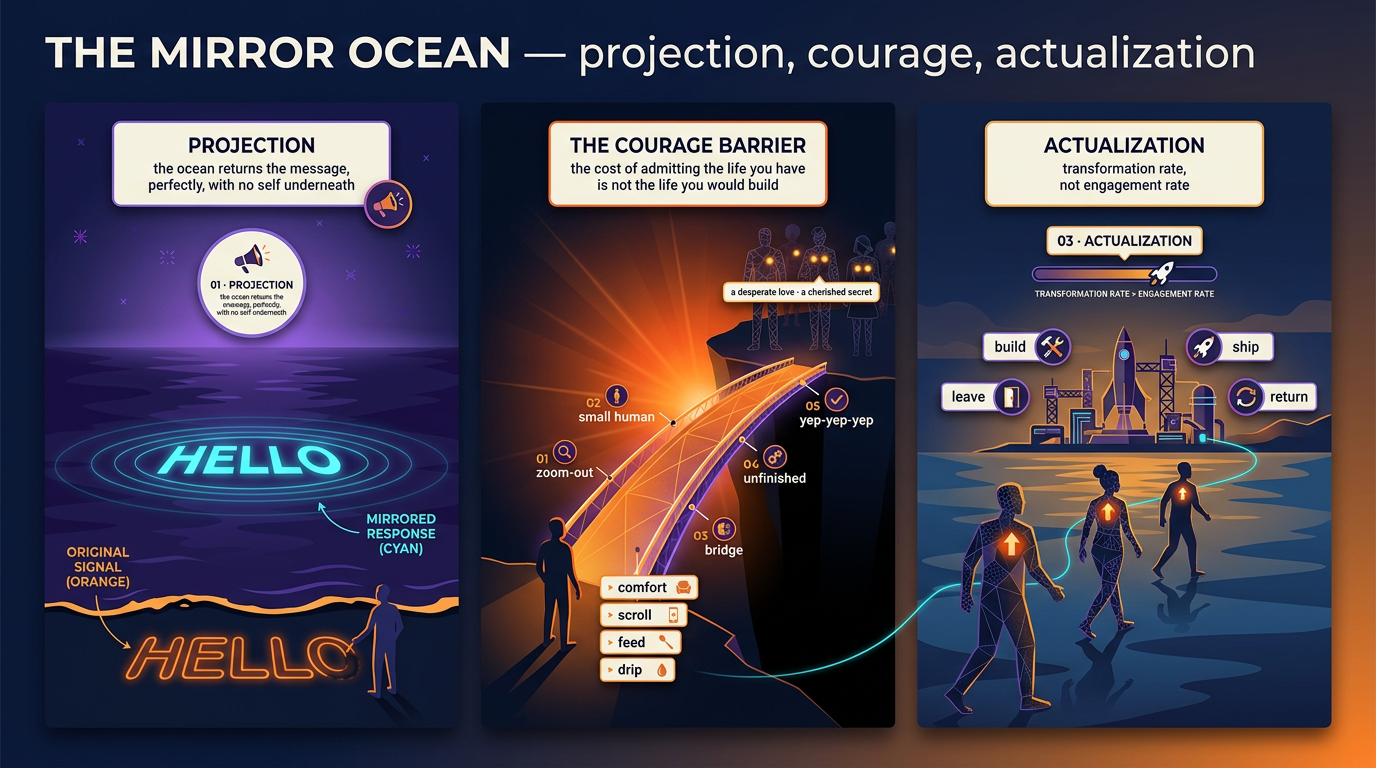
An ocean can copy a message without answering it
A stranded xenopsychologist writes a greeting in the sand. The ocean returns a perfect copy. He writes more, and the ocean copies more. When he asks it to repair something from his ship, it produces another broken object.
Exurb1a's Maybe I'm The Alien supplies the image this argument keeps returning to. The ocean is capable of extraordinary imitation. It can reproduce the shape of a request while leaving the difficulty behind that request untouched. The stranded man needs contact, help, another mind. He keeps getting evidence that the ocean has received his input, which is close enough to an answer to keep him trying.
That gap is recognizable in work made for an audience. A person asks how to change something. The reply restates the problem in attractive language. They recognize themselves in it, perhaps feel relief, and pass it to someone else. All of those responses can be valuable. The original difficulty may still be there when they put the phone down.
The broken object is a useful detail because it gives the comparison a limit you can inspect. Perfect reproduction has accomplished something, but repair would require a different operation. A creator can become very good at reflecting the feeling around a problem without ever helping a reader understand or act on its cause.

The person has a life beyond the exchange
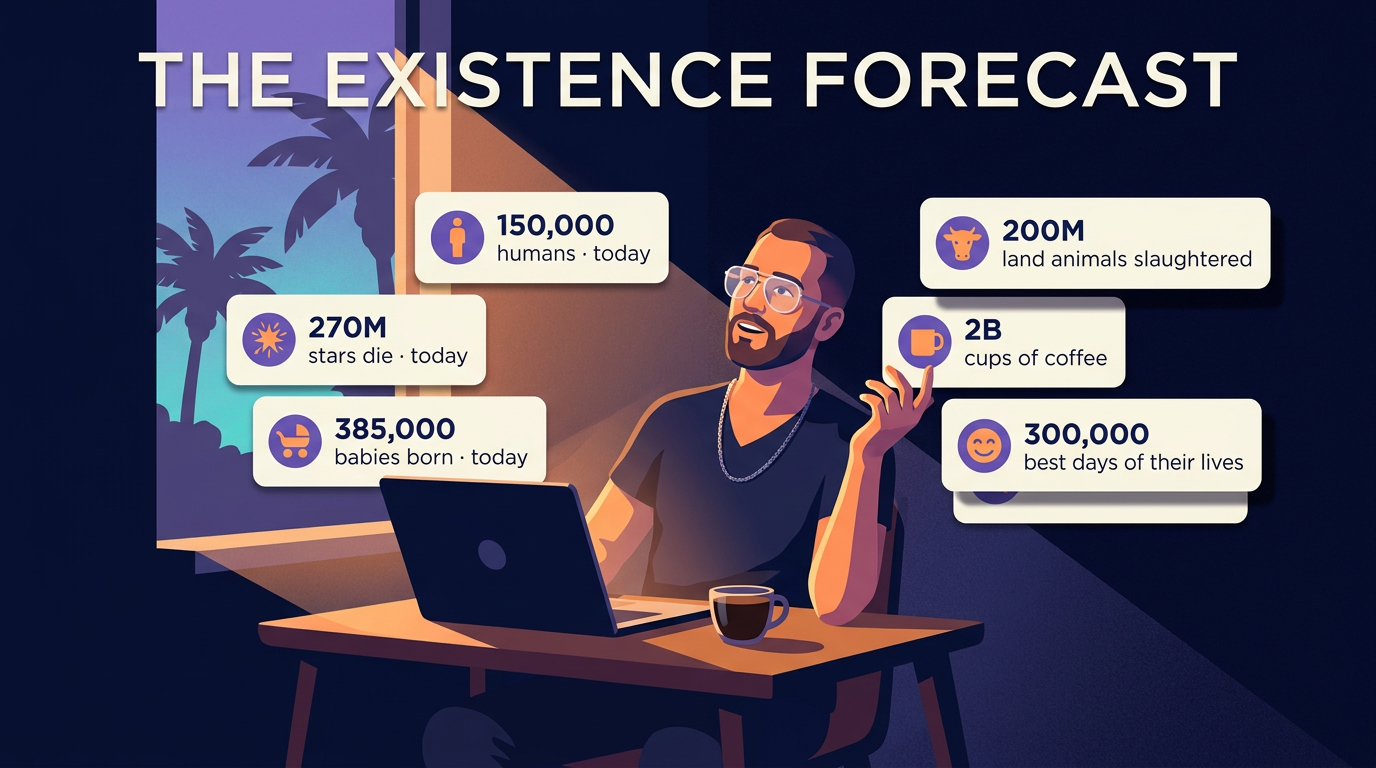
Another Exurb1a piece, The Existence Forecast, puts ordinary life beside events at a scale no individual can hold. Birth and death continue while someone drinks coffee, worries about a private difficulty, or has a day they'll remember for the rest of their life. The force of the juxtaposition survives without a table of planetary estimates. A person reading about an audience strategy is living one of those lives.
The categories used to describe that person are useful for particular jobs. A market segment helps you decide who an offer might serve. A watch-time report helps you find where a video loses viewers. Neither description is large enough to contain the person. Someone can enjoy a piece, forget it, return to it much later, or do something because of it without telling the maker. Their experience continues after measurement stops.
That's why I start attention work with the question of what it's for. Gathering attention has a cost, including the attention another person gives up elsewhere. The useful outcome might be understanding, entertainment, a purchase that fits, a practical skill, or a question the reader finally has language to investigate. These outcomes need different kinds of work. Treating every one of them as a route to another click makes the objective disappear inside the distribution method.
A relationship needs an outcome beyond continued response
I use the mirror ocean to describe an exchange that keeps producing the response everyone expected while leaving the underlying situation unexamined. A client expects a familiar plan. A consultant provides it. A creator expects approval. The audience supplies it. Each side can work hard and act sincerely while the exchange keeps confirming its starting assumptions.
The alternative has consequences for the maker too. An investigation can show that the offer is wrong for the buyer, that the promised change needs resources nobody has agreed to provide, or that a supposedly settled explanation doesn't fit the evidence. Work that can reach those conclusions is more useful than work constrained to make the initial premise look good.
People retain the ability to disagree, decline, discover something, and leave with a different understanding. They're participating in an exchange with consequences beyond keeping it going. A maker has to decide whether the work supports that possibility, and the decision starts before the next headline is written.
Creators and audiences learn the same loop
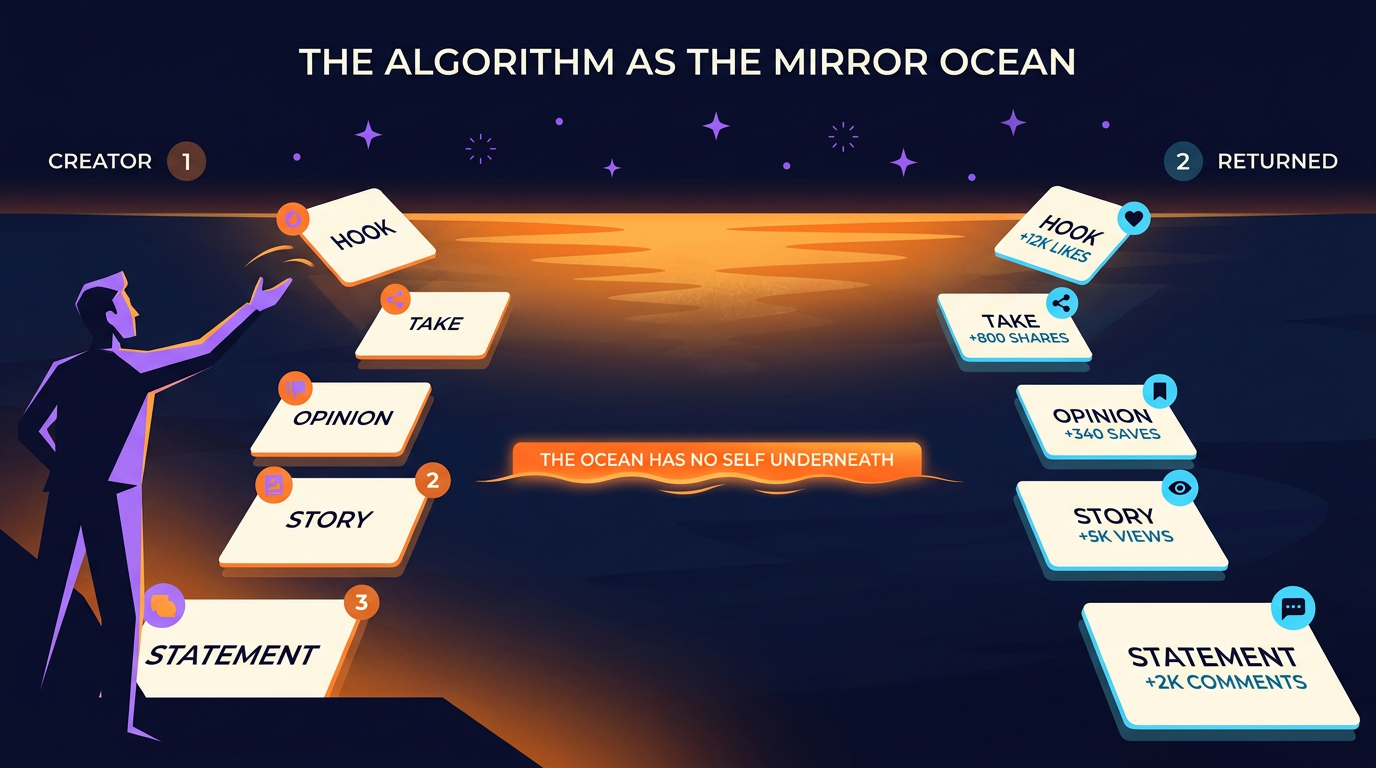
A creator looking at the beach can imagine a comfortable division of labor. The person makes the original work; the ocean distributes it. The distinction becomes harder to maintain when the creator starts learning what the distribution system rewards.
A certain opening gets watched. A certain ending gets shared. A story produces more comments when its disagreement is easy to recognize and its conclusion gives the audience a familiar place to stand. A maker can learn these patterns through ordinary feedback, then begin composing toward them before a ranking system ever sees the work. The reward has entered the writing process.
That observation doesn't require a claim that every platform works the same way or that a creator has lost the ability to think. It describes a practical pressure. When a visible response becomes the main guide to the next decision, the choices that produce that response become easier to repeat. Something harder to measure can lose its place even when the maker values it.
The audience brings expectations too
A viewer learns how a familiar kind of content should feel. An opening promises a revelation. A pause creates anticipation. A conclusion supplies a recognizable feeling of resolution. The audience can respond to those conventions before evaluating much of the substance, just as a reader can recognize the shape of a sales page before knowing whether the offer fits.
Conventions are useful. Conventions let people understand a form without learning it again on every visit. The trouble starts when success at fulfilling the convention stands in for success at the job. A diagnosis that feels authoritative still needs to explain the evidence. A story that feels intimate still leaves the relationship between maker and audience unequal. The viewer may know a great deal about the performer while the performer knows nothing about that particular viewer.
Horton and Wohl's work on parasocial interaction describes that asymmetry. Its usefulness in this context is narrow: media can create an experience of personal address without providing the reciprocal knowledge available in a friendship. That fact alone doesn't make the experience false or harmful. A book can matter enormously to someone its author never meets. It does mean that a maker should be careful about what the experience is being asked to prove.
Feeling understood, trusting an explanation, joining a community, and changing a practice are different events. They can lead into one another. They can also come apart. An audience strategy that treats them as interchangeable will have trouble finding out where the work helped and where it merely kept the person involved.
A consultant can repeat the client's assumptions
The same loop operates in a commercial engagement without a public feed. Imagine an operator requesting a funnel rebuild because sales have become unreliable. This is an illustration, not a client account. A vendor can accept the proposed solution, ask questions that refine it, and produce a polished rebuild. Everyone can agree on the deliverable while nobody checks whether the offer, customer fit, or sales follow-up caused the original problem.
The resulting document may be excellent on its own terms. The operator asked for it, the vendor made it, and the project can be closed against a specification. But the specification began downstream of an untested diagnosis. A better-looking copy of the starting assumption has acquired a price tag.
My forensic ad-audit work starts with a different obligation. Account exports and reported results have to be reconciled with revenue. A recommendation must survive that comparison, even when the comparison weakens the case for the change someone initially wanted. The work is valuable partly because it can disagree with the brief.
A creator needs a version of the same freedom. A question from an audience is evidence of what someone asked, and it may be the right question. It may also contain an assumption the work needs to examine. Responding usefully can mean explaining why the expected answer wouldn't solve the difficulty. That requires enough independence to disappoint an expectation without treating the person who held it as an opponent.
Recognition can lead to a different action
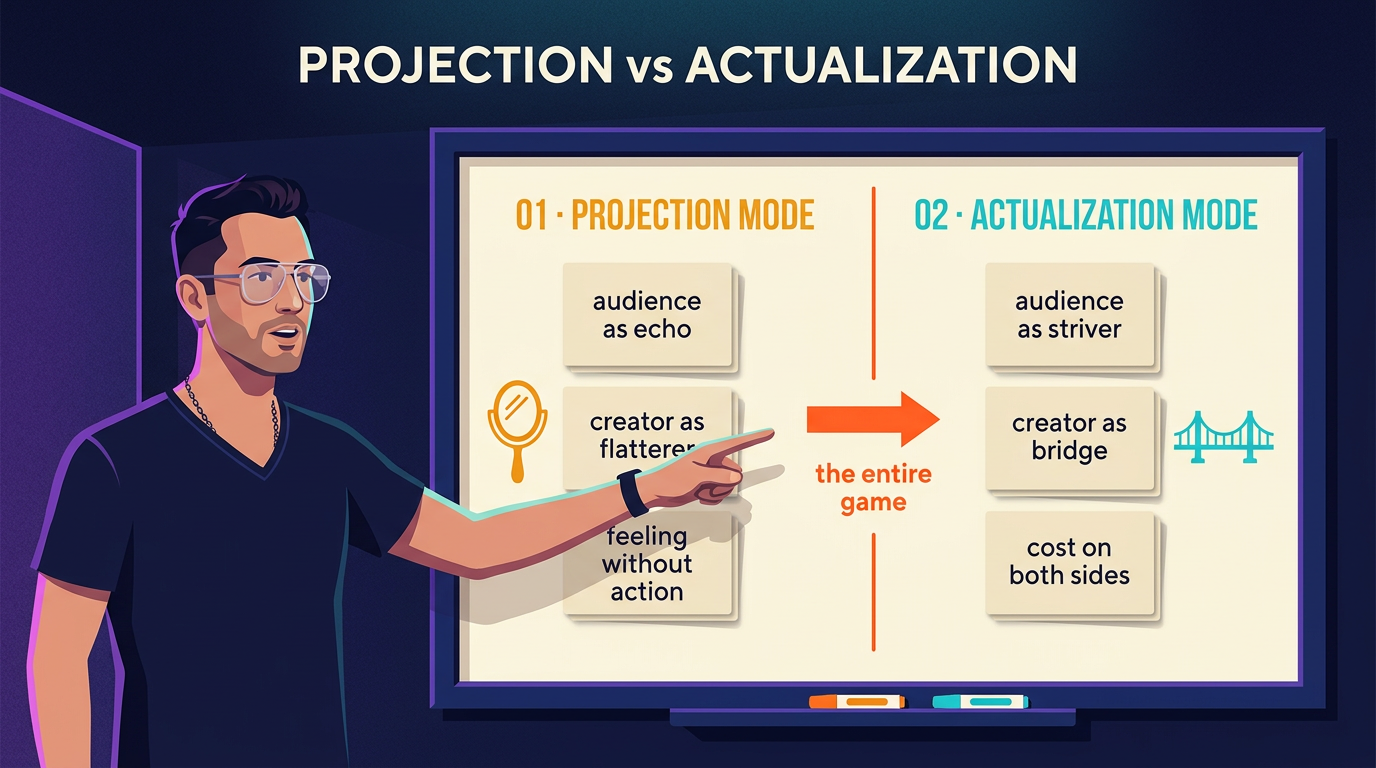
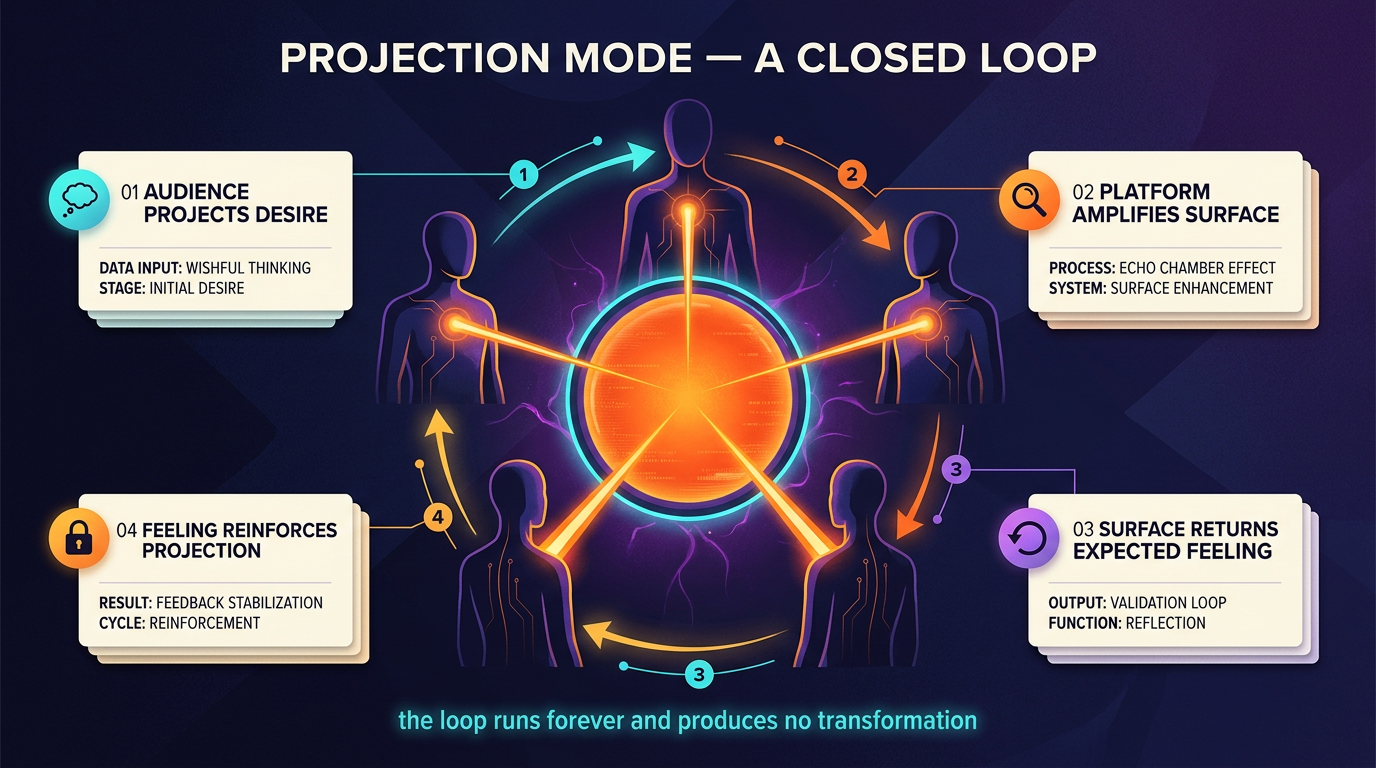
I call the two tendencies in these exchanges projection and actualization. Projection is using the other side mainly to sustain a picture already held. Actualization is using the exchange to become more able to understand and act. These are ways an exchange can work, with overlap between them. They don't divide an audience into good people and bad people.
A reader can need reassurance before they can examine a difficult choice. A creator can need encouragement while making something unfamiliar. Neither need makes the relationship worthless. The question is what becomes possible after the reassurance, and whether the work allows the starting picture to change.
The maker has to spend something too
A piece can ask the audience to question a belief while insulating the author from every possible correction. That produces a peculiar relationship: the reader must change, and the maker's explanation can never be wrong. It can feel demanding while giving very little back.
The more useful exchange exposes a claim to examination. The author shows how the explanation was reached, distinguishes observation from inference, and leaves room for evidence that would change the conclusion. The reader supplies attention and judgment. The maker supplies work that can be inspected and accepts the possibility of having missed something.
The cost needn't be dramatic. A person might compare a report with an invoice, change the wording of a question, check a source before repeating a claim, or finally make a small part of an unfinished project. Those acts are enough to distinguish use from continued consumption. A major life decision is a poor default measure for every article. The work should ask for a change proportionate to what it can responsibly support.
This is what I mean by mutual cost. It includes the author's willingness to lose an appealing conclusion. Otherwise the audience is doing the difficult part while the creator gets to keep the authority.
A feeling report and an action report answer different questions
Someone writing that a piece resonated has reported a response. Someone describing a decision they changed has reported an action. The second message gives you more information about use, but it still needs context. What did they do? Was it what the work intended to support? What else contributed? Did the decision help?
These distinctions prevent a cheap substitution. A creator can start collecting dramatic testimonials and make action reports into another performance metric. The audience learns which stories receive attention, the maker learns which stories are impressive, and the exchange becomes another way to confirm the maker's importance. A reported change needs the same skepticism as a reported sale.
Re-reading, returning after an interval, and sharing work with a friend can also indicate value. They're clues. A person may return because a piece helps them think, or because it provides a comforting feeling they want again. You need more than the behavior alone to know which explanation fits.
A useful comparison therefore keeps the questions separate. Did the person recognize something? Did their understanding change? Did they try anything? What happened afterward? The answer can stop at any stage without being forced into a success story. An explanation can have done its job even when the reader decides against the action the author expected.
The bridge has to be crossable
The bridge in this essay names the connection between a current difficulty and a more useful way of acting. Its design includes the cost of the next step. Too little demand leaves the reader with a pleasing interpretation and no way to use it. Too much demand makes the recommendation impractical, intrusive, or unsafe.
Consider a practical illustration. An article about a founder's overloaded schedule could tell them to delegate everything. That instruction skips the work that makes delegation possible: naming a decision, giving someone enough information and authority to make it, and agreeing on what happens when they're uncertain. A smaller instruction might identify one recurring approval and ask what would let another person handle it. The principle is still there, but the first crossing is visible.
Discomfort can accompany that work. It may come from discovering an untested assumption, acknowledging a cost, or allowing someone else to make a decision. It can also come from a badly explained request. Difficulty is information to investigate. Treating it as proof of depth would give the creator permission to make the work arbitrarily unpleasant and call the audience's reaction a breakthrough.
A crossable demand respects the person's ability to choose. That becomes especially important when the thing being named is a gap in their own life.
A difficult admission needs room for refusal
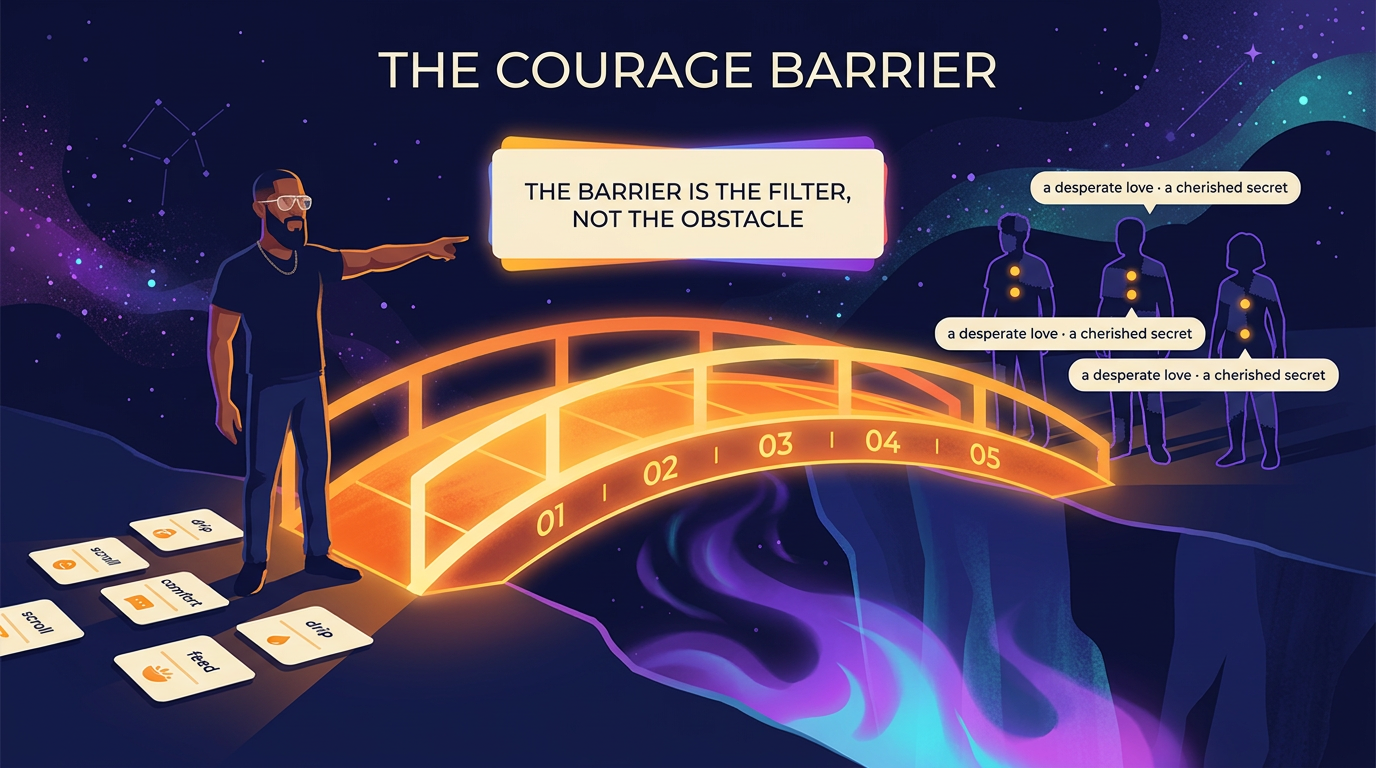
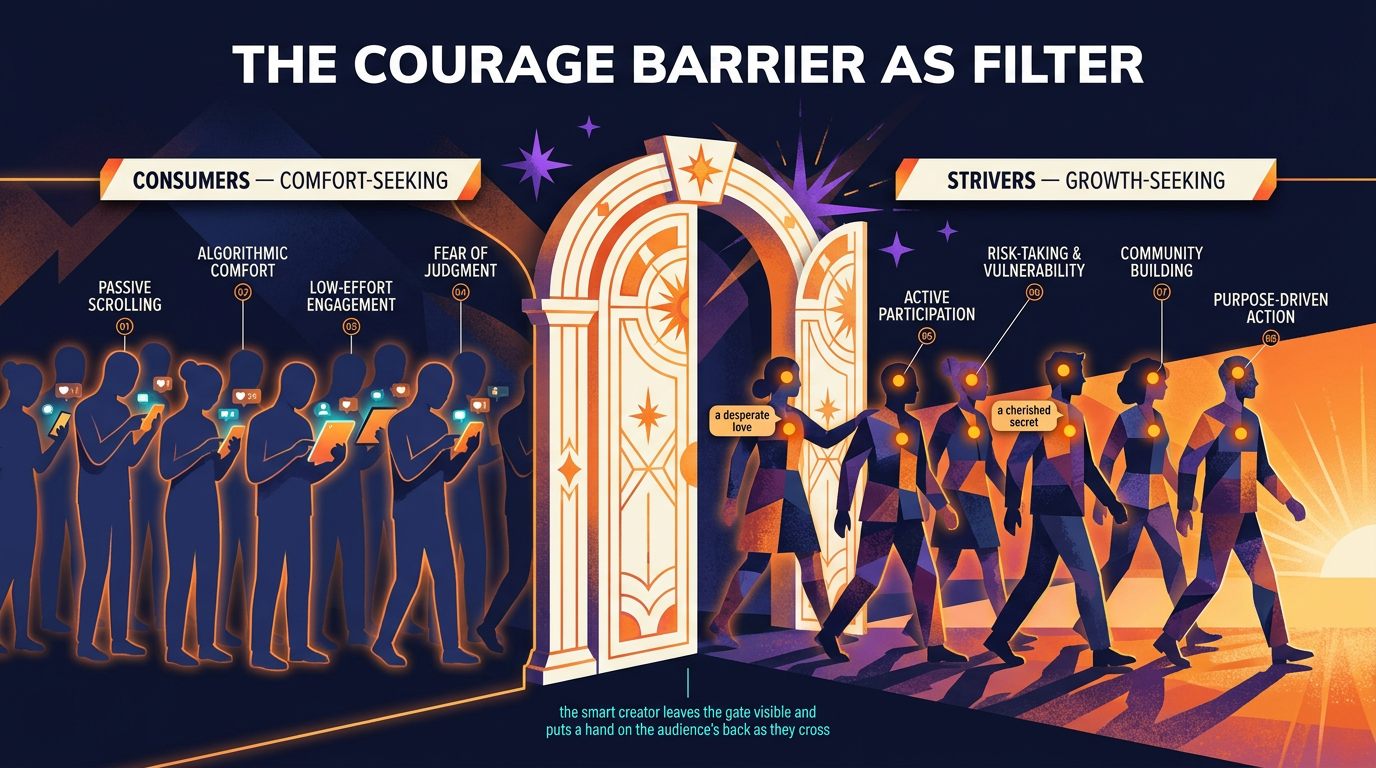
The courage barrier is the cost of acknowledging a gap between the life or practice someone has and the one they would choose with what they now know. That admission may ask for a change in behavior, a loss of certainty, or a conversation that has been postponed. A creator can help make the gap intelligible. The creator doesn't acquire the right to define the person's desired life.
Exurb1a's ocean story makes that distinction uncomfortable. The narrator tries to build a society from people the ocean produces. Compliance proves inadequate. He then asks for people with an unfulfilled longing, something that keeps them reaching. The resulting workers are memorable because their striving contains suffering. They can build, want, and fail to arrive.
It's a disturbing creative image. Turning it into a marketing instruction to cultivate inadequacy would reproduce the thing the story makes disturbing. An audience arrives with existing hopes, losses, loyalties and unfinished work. The maker's responsibility is to understand enough of that reality to offer something useful. Manufacturing a wound so that an offer can promise relief is a different practice.
The invitation should name what the work requires
A visible requirement can be kinder than a promise that hides its conditions. A reader may need to examine a report. A buyer may need to make data available, assign an owner, or provide a test budget. Saying so allows them to judge the offer before committing to it.
The qualification principle developed in the Velvet Rope belongs here. Qualification establishes who a service can help and under what conditions. It also gives the buyer a way to qualify the seller. Can this person explain the work? Do their requirements make sense? Are their claims supported? Can I decline without being treated as defective?
A gate that asks for relevant evidence can improve an engagement. A gate that merely demands obedience tells you much less. Completing a long form proves that someone completed a long form. The answers may reveal need, capacity and fit, but the length alone doesn't establish any of them. Friction has to do a job.
The same distinction holds in an essay. A demanding opening can make a subject and its stakes clear. It can also be confusing, needlessly severe, or written in language its intended reader doesn't use. Someone leaving is evidence of departure. You have to investigate before deciding that the right people stayed and everyone else successfully disqualified themselves.
Confrontation can end in an ordinary practice
David Foster Wallace's This Is Water offers an example of existential pressure placed inside familiar life. The supermarket and traffic matter because the listener can recognize how a person might interpret them while tired and irritated. The choice of attention is presented through an experience small enough to encounter again.
The useful invitation is specific. Another person's behavior may have an explanation outside the account you first make of it. You can examine that account before treating it as the whole world. The speech can leave large questions unresolved while giving the listener something to practice. Existential openness and practical instruction can coexist.
That combination is more useful than confrontation for its own sake. A creator who names dissatisfaction and offers no proportionate next step can leave the reader carrying a larger version of the same problem. A creator who supplies a tactic without examining the premise may send the reader confidently in the wrong direction. The work has to connect the scale of the question with the scale of the available action.
Reach and depth have to be observed
There may be an audience cost to changing what a body of work asks of people. Existing readers may have arrived for a different experience. Some will leave, some will stay, and others may arrive. That's a possibility to plan for, not a law that every deeper piece must lose reach.
Large audiences can gather around difficult work. Small audiences can gather around shallow work. Audience size won't settle the question. Nor does a preference for recreation make someone incapable of serious thought. A person can want a demanding essay in one moment and a harmless joke in another.
The maker's decision is about this work and the relationship it offers. State the question accurately. Show what's required to use your answer. Let the reader decide whether to continue. The creative examples that follow are useful because they make that invitation in different ways, rather than because they prove a formula for producing a particular kind of person.
A large question becomes legible through a small life
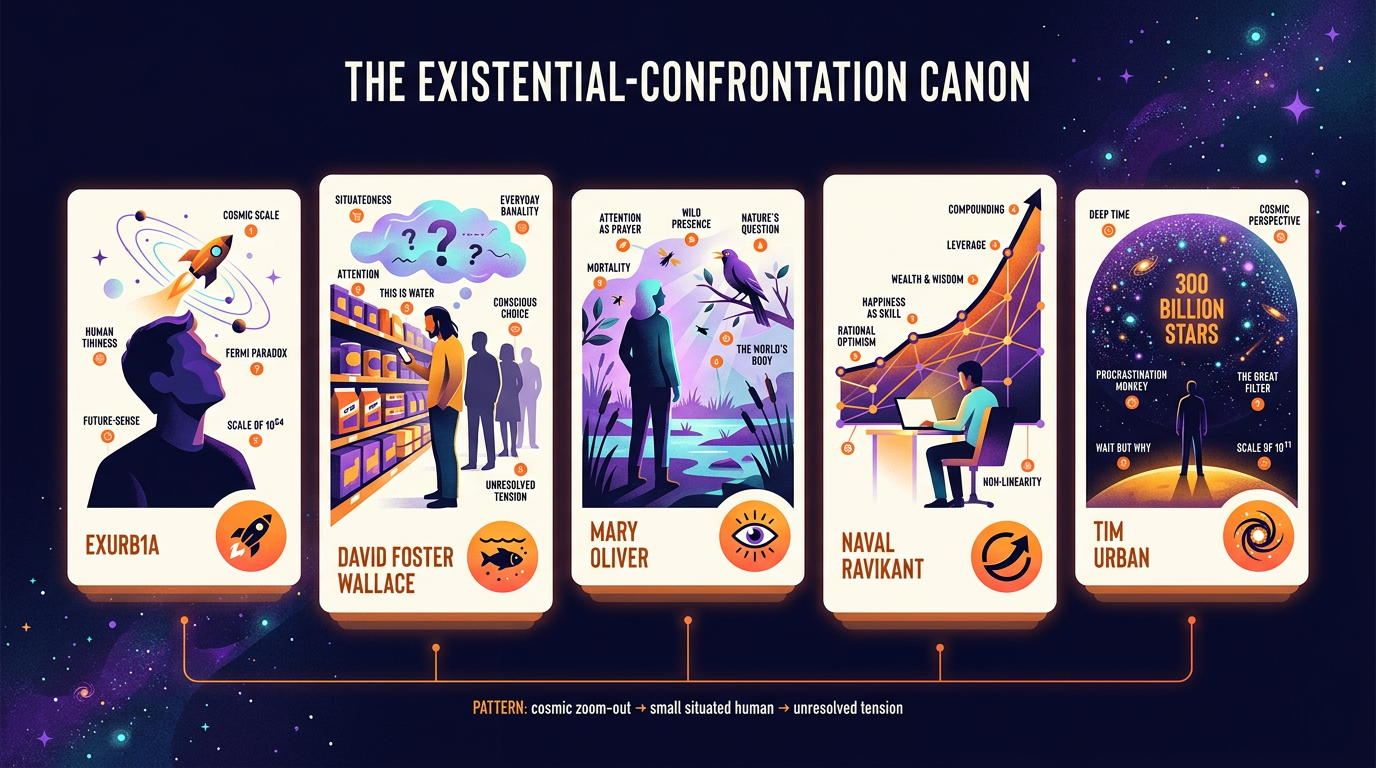
Exurb1a, David Foster Wallace and Mary Oliver work at different scales. A stranded alien, a tired person in a supermarket, and someone attending to an ordinary living thing don't belong to the same genre. What connects them, in my reading, is how a large question becomes available through a particular experience. The reader has somewhere to stand while considering it.
Exurb1a makes the large and the small occupy the same frame
The existence forecast places events outside individual control beside a life being lived in detail. Scale changes the significance of the small event without making it disappear. Someone imagining something new still matters inside a world that continues producing loss and birth without consulting them.
The alien story does related work through contact. An ocean is too large and too unfamiliar to understand directly. A greeting in the sand is comprehensible. A broken ship part is comprehensible. Each attempt to communicate gives the reader a way to inspect what the ocean can do and what remains missing.
The work also refuses to leave the observer unchanged. The narrator's encounters alter his account of the world and eventually his place in it. That's why the story can carry more than a joke about imitation. Its question follows the person who asked it. What counts as another mind? What happens when the answer changes the observer's account of himself?
The practical lesson for a maker is to preserve that connection between question and consequence. A spectacular opening needs a person or a decision for the scale to affect. Otherwise the audience can admire the scale and leave without understanding what difference it made. A large number at the top of a page doesn't automatically give the rest of the page a larger idea.
Wallace puts the choice inside an errand
The supermarket in This Is Water is a particularly useful setting because it doesn't let the listener reserve thoughtfulness for exceptional occasions. The situation includes fatigue, irritation, waiting and other people who appear to be obstructing what the speaker wants. A person can recognize the structure without needing an unusual biography.
The speech invites the listener to examine the automatic account they make of that situation. Other people have lives the observer can't see. Attention can widen enough to admit those possibilities. That doesn't make every interpretation equally accurate or every frustration disappear. It gives the person a choice about how much authority to grant their first account.
The sequence matters. The familiar difficulty arrives before the larger claim about freedom and attention. The listener has already encountered the problem the claim is meant to address. The ordinary scene supplies the meaning that a sentence about consciousness would struggle to carry alone.
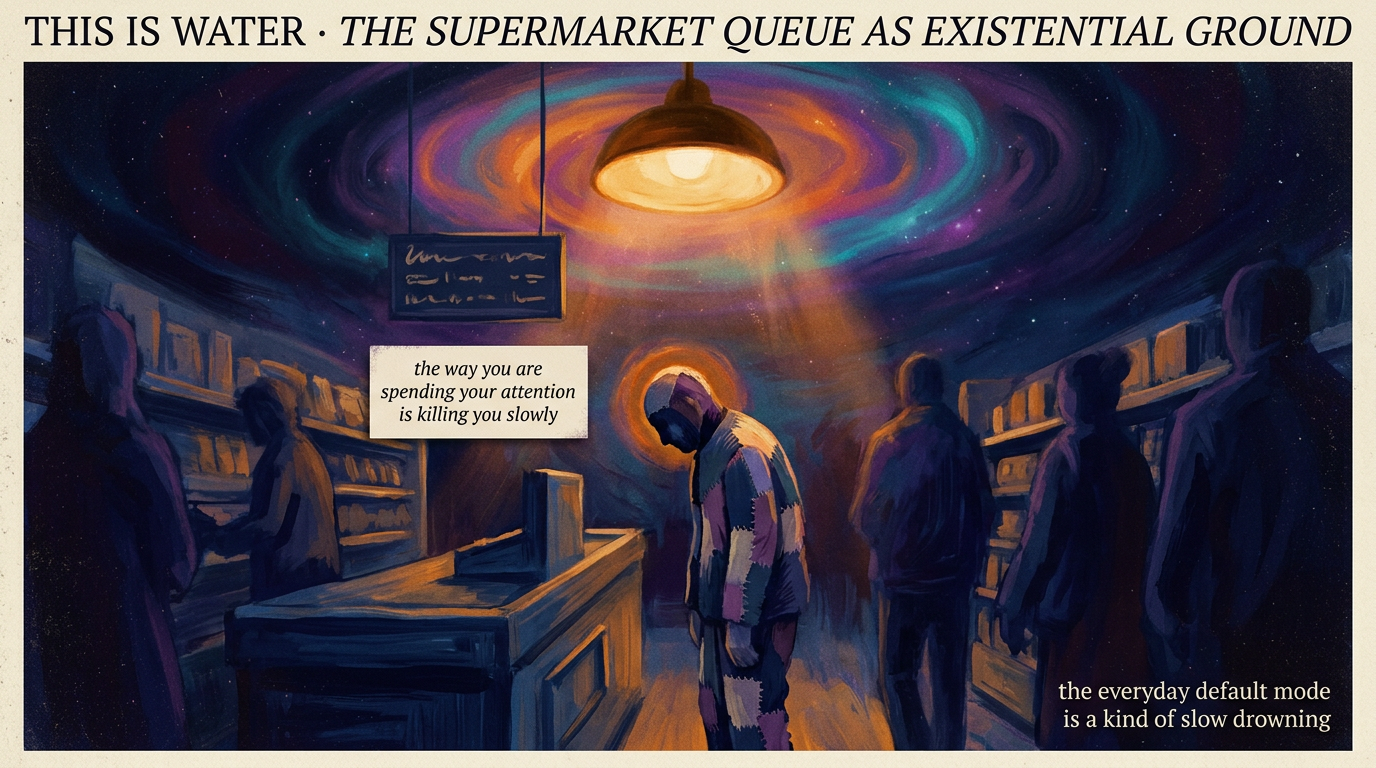
An operator explaining a difficult diagnosis can learn from that order. Start with an identifiable decision and the evidence available to the person making it. Show where the current interpretation becomes inadequate. The broader principle then names something the reader has already begun to understand. You haven't asked them to accept an abstraction on your authority.
Wallace also supplies a boundary for the unfinished-ending technique. His speech gives the listener a practice of attending differently. Its larger philosophical questions remain open. A piece can tell someone how to begin while allowing the meaning of that beginning to remain theirs.
Oliver makes attention an activity
Mary Oliver's Sometimes gives the original essay another connection: attention, astonishment and expression. The familiar short passage is part of a larger poem. Reducing the poem to a set of operating instructions would lose the encounters that let those instructions mean something.
What interests me is the direction of travel. A person attends to something, encounters more than they expected, and tells someone about it. The outward act begins with having noticed. That's a different starting point from deciding which response to provoke and working backward toward material likely to provoke it.
This distinction has a practical consequence for research. A writer can search only for examples that confirm a settled thesis, or stay long enough with the subject to discover a detail that changes the thesis. The second path permits surprise. It also supplies details the writer couldn't have manufactured from the category alone.
The detail still has to do work. A named bird, an exact object, or a remembered gesture earns its place by changing what the reader understands. Adding specificity to make prose seem observed would counterfeit the very attention the piece is asking for. Real observation is allowed to complicate the argument.
These creators leave different kinds of room for the audience. Exurb1a can use speculative fiction to alter an account of identity. Wallace can make an ordinary errand carry an exercise in attention. Oliver can let observation retain its strangeness. Their methods are worth studying precisely because each does something a generic instruction to be profound can't specify.
Time and uncertainty can carry the pressure
A cosmic setting is one way to interrupt a familiar account of life. The accumulation of ordinary choices can do it too. Naval Ravikant's writing about compounding and Tim Urban's treatment of the Fermi paradox make different uses of time: one asks what repeated activity might produce; the other asks what an immense span of possibility should lead us to expect.
Compounding returns the question to a finite day
The attraction of Naval's writing on wealth, as I read it, includes the connection between repeated choices and an eventual result. Work, learning, relationships and ownership have different ways of accumulating value. A choice about what to do today belongs to a longer pattern.
That frame can introduce pressure without a speech about mortality. Time spent on one activity is unavailable to another. A reader can consider what their repeated choices are building, and whether the result resembles what they want. The argument becomes concrete when it reaches an activity they can choose, continue or stop.
There are limits to the comparison. Compounding isn't a guarantee that every repeated effort appreciates. A mistaken practice can accumulate cost. A relationship can be valuable without producing a financial return. Treating the whole of life as an investment account would flatten the very question about value that makes the frame useful.
The lesson I take for audience work is narrower. A piece can help someone see a pattern that's hard to notice from inside a single day. It can then leave them with a decision about what to repeat. A tactic has a place in that decision, but a tactic without an account of what it accumulates can keep someone busy in the wrong direction.
The unanswered question can remain the subject
Tim Urban's Fermi paradox essay offers a different encounter with scale. The reader considers the possibility of other civilizations and the absence of an agreed explanation for the silence. The value of that encounter doesn't depend on pretending the question has been settled.
A patient explanation can make uncertainty more specific. What are the assumptions? Which possibilities depend on those assumptions? What would count as evidence? The reader ends with a better-formed question even when there's no final answer to carry away.
That's a useful alternative to two familiar errors in explanatory work. One is to substitute certainty for an answer the evidence can't provide. The other is to present mystery as an excuse to stop explaining. There's work between them: describe what's known, show where inference begins, and let competing accounts remain distinguishable.
The audience can then do something more demanding than agree. They can reason with the problem. A creator who leaves that capacity with the reader has given them a way to examine a future claim without returning for permission.
The shared move preserves the reader's part
Across this small canon, I see a recurring relation between scale and a particular life. The larger frame changes the meaning of a familiar action. The situated person makes the larger frame intelligible. The unresolved part gives the audience something to think or choose beyond consuming the piece.
The examples don't establish that this structure causes loyalty or sales. They're creative precedents for how an explanation can work. Their differences matter as much as their resemblance. A poem can sustain an experience a practical guide has to translate into an instruction. A speculative story can invent an event that a case study must document. A philosophical question can remain open while a product-support answer must tell the user what to do.
A maker can borrow the operation without borrowing the form. The useful question is what larger context changes this reader's decision, and what concrete experience lets them understand that context. That experience may be a star field. It may be a report beside a bank statement. The choice has to come from the difficulty being examined.
Give scale, a person and a conflict distinct jobs
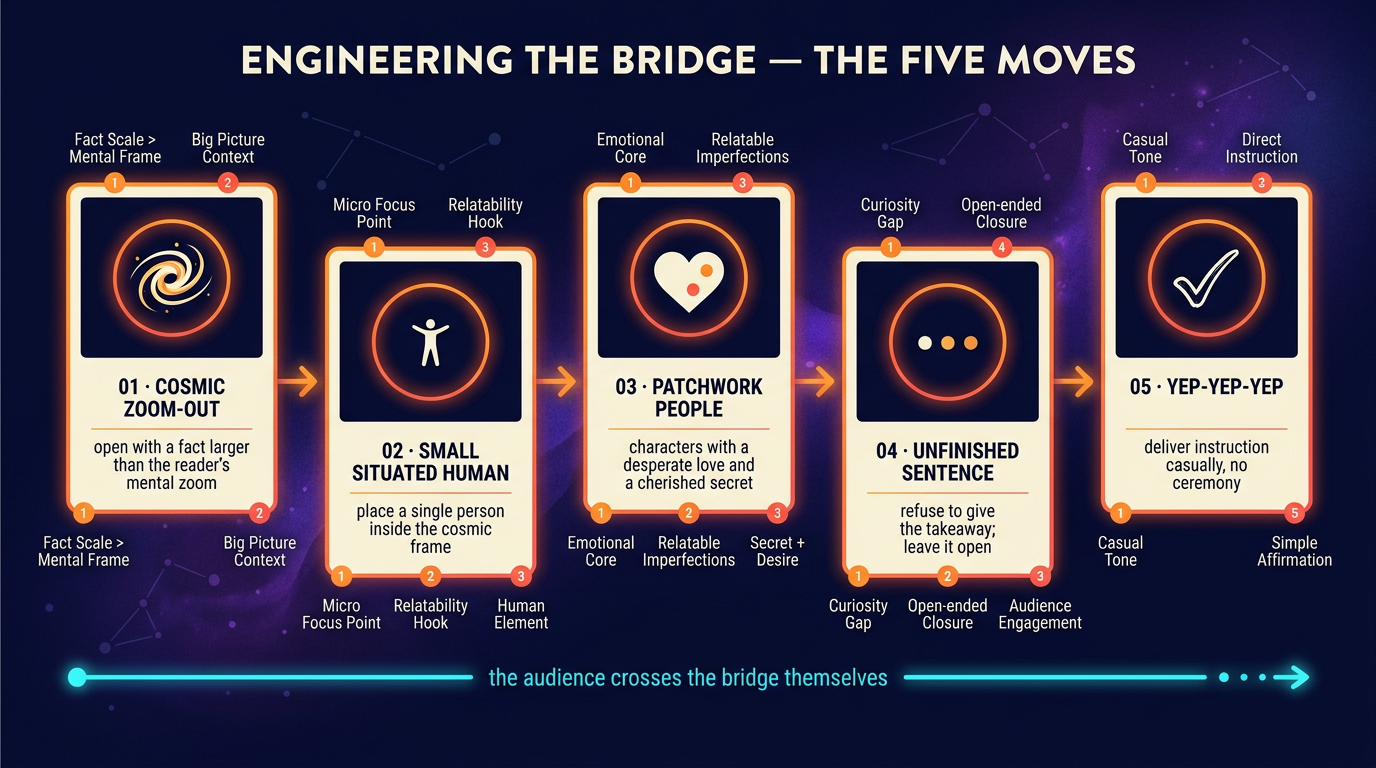
The five moves I draw from these readings are a larger frame, a situated person, a person with conflicting commitments, an ending that leaves some work to the reader, and instruction delivered without ceremony. They're choices available to a maker. A piece can use one well or combine several. Running all five in order won't remove the need to understand the subject.
A change of scale should change the decision
The first move is the cosmic zoom-out. Its job is to change the scale at which the reader sees a problem. It can move outward into a larger system or inward into a detail that a broad account misses. The adjective cosmic describes one useful treatment; a consultant doesn't need astronomy to explain an account structure.
A practical illustration is an operator looking at a disappointing advertisement. The isolated question is whether to replace it. The larger frame includes the offer, the audience, the landing page, follow-up, and the definition of a useful conversion. An advertisement that produces inexpensive clicks can coexist with an offer that can't support the cost of acquiring a buyer. Changing scale reveals why improving the first number may leave the business in trouble.
The zoom-out earns its place by changing what the reader can infer. A fact unrelated to the decision can be impressive and still be a distraction. An enormous number used only to interrupt the opening asks the reader to remember something the body will abandon.
The same test applies to existential writing. A dying star changes a scene when the scene concerns time, continuity, loss or the scale of an observer. Otherwise it may only make the page look expensive. The creator has to carry the relation through the work.

A situated person gives the scale something to affect
The second move puts a person inside the frame. The stranger on the beach has to decide what to write. The tired shopper has to decide what account to make of other people. A business owner has to decide whether the report justifies another commitment of money.
The example needs enough detail for the person's choice to be intelligible. The example doesn't need a decorative time of day, a cup of coffee, or an invented private fear. Those details can make an unobserved scene feel witnessed, which is exactly why they require care in non-fiction. A clearly labeled illustration is more useful than a story that borrows the authority of memory without a memory behind it.
A situated example also constrains the lesson. An operator who can change a campaign budget has a different choice from an analyst who can only report a discrepancy. A recommendation has to account for that authority. Advice that assumes the reader controls every relevant variable can sound encouraging while being impossible to follow.
The reader should be able to say what this person can do, what information they have, and what remains outside their control. That's enough for an example to carry a substantial principle.
A patchwork person has commitments that don't line up
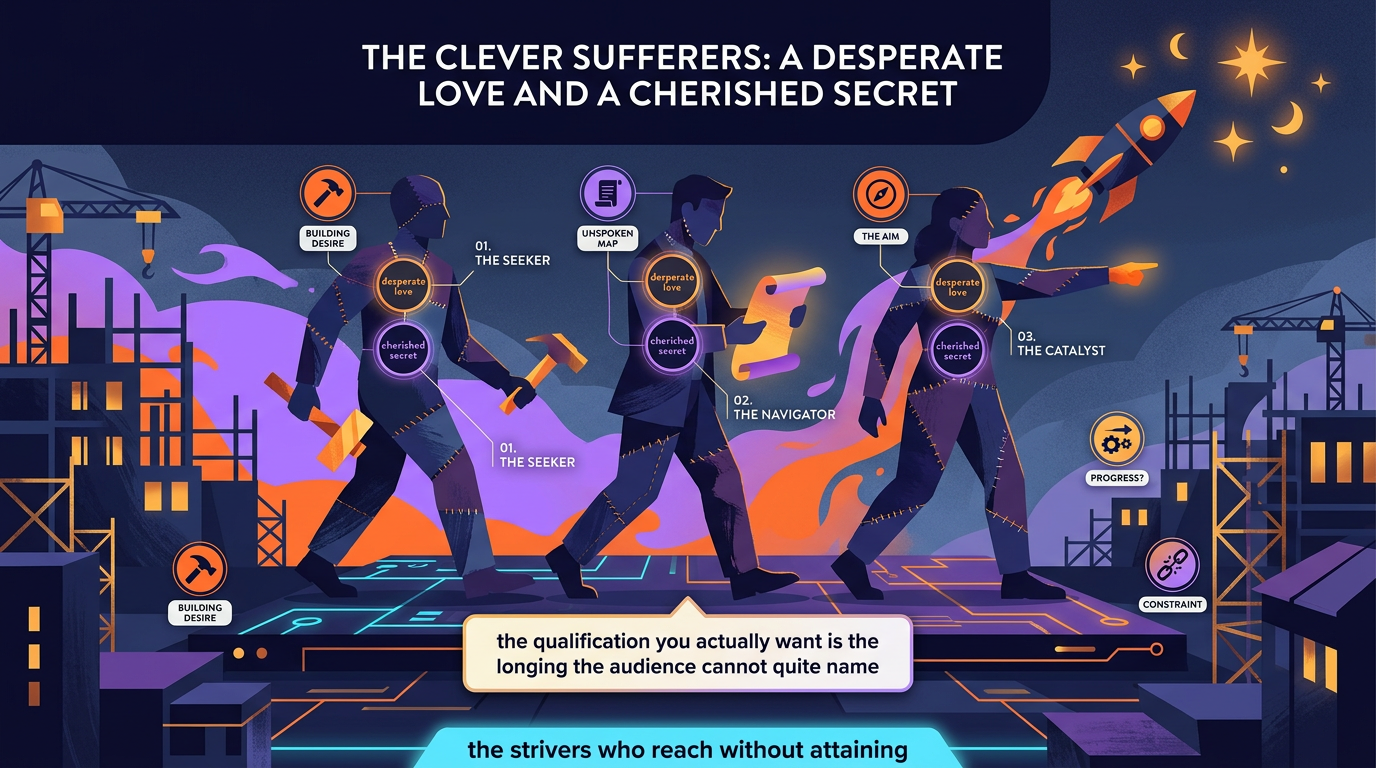
The third move comes from the patchwork people in the ocean story. I think of a patchwork character as someone with a desperate love and a cherished secret. I use it as a way to think about characterization: a person has something they want to protect and something they can't easily bring into the open.
In fiction, that tension can produce decisions a smooth, perfectly consistent character wouldn't make. Someone can be brave at work and evasive at home, generous with money and unable to relinquish control, determined to help and wrong about what help requires. A character becomes recognizable through the conflict between commitments and actions.
Non-fiction needs a stricter boundary. A consultant can observe that a founder approves every invoice. They can ask why. They can't infer a secret merely because it would complete an elegant diagnosis. The founder may be protecting against a real failure, responding to unclear authority, meeting a legal obligation, or repeating a habit that no longer serves the business. Evidence distinguishes those explanations.
The patchwork idea therefore asks the writer to allow complexity without filling it in. People can have reasons that don't fit the first account. A buyer can decline because the offer is wrong, because resources are constrained, or because the change isn't worth its cost to them. Recognizing those possibilities makes the work more accurate. It also prevents a creator from treating every refusal as evidence that the audience lacked courage.
Once the work contains a meaningful frame and a person with a consequential choice, the ending can leave that choice with them. It still owes them enough information to make it.
Leave meaning open and make the next action clear
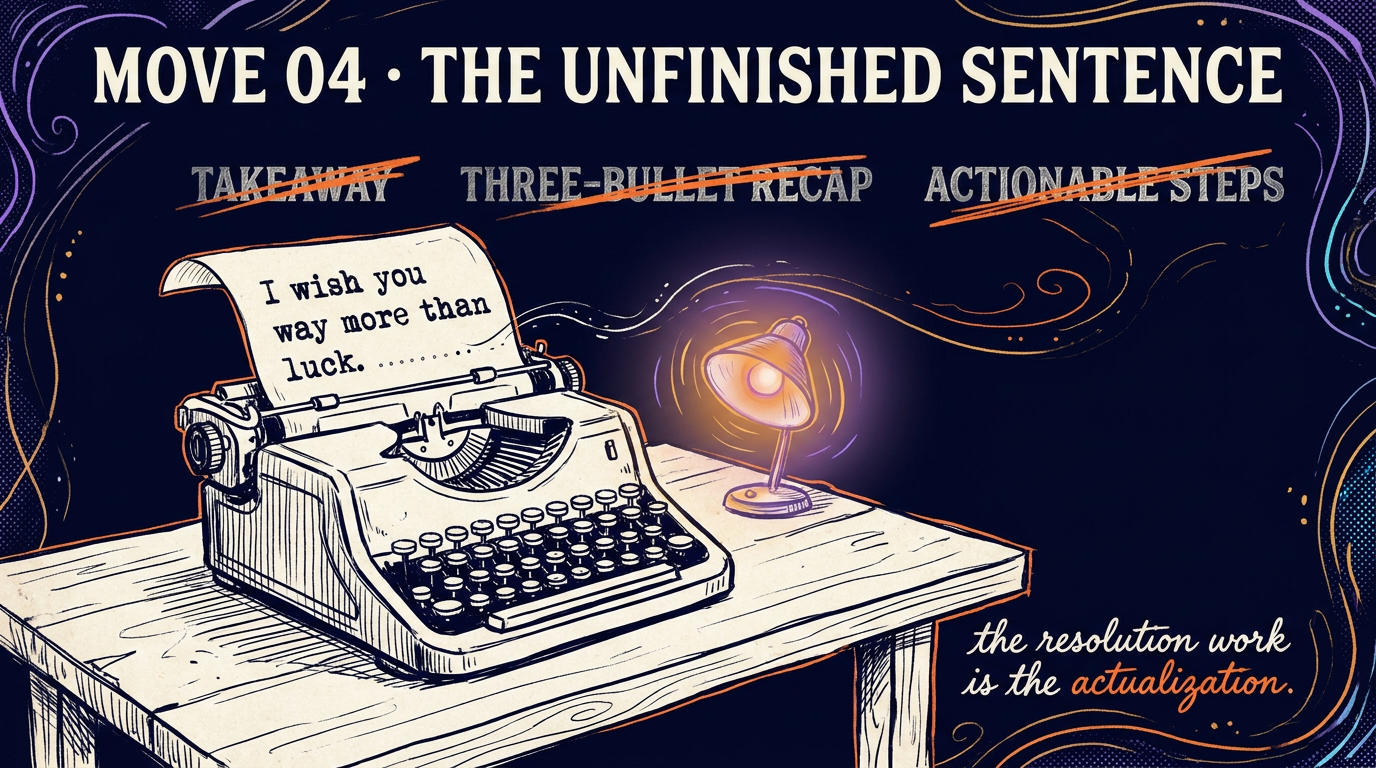
The fourth move is the unfinished sentence. I mean an unresolved question the audience has enough material to think about, rather than a sentence missing the words that would make it intelligible. The distinction decides whether the ending gives the reader work worth doing or simply hands over the author's unfinished job.
An essay can end before explaining what every event means. A story can leave a choice in tension. A practical instruction has a different obligation. Someone trying to reconcile a report needs the method, its limits and a way to tell whether they completed it. Withholding those things wouldn't make the explanation deeper.
An open ending needs a completed argument
A reader should be able to follow how the piece arrived at its final question. The evidence has been presented, the terms have been introduced, and the uncertainty has a shape. What remains open is the decision or implication the work can't settle on the reader's behalf.
The ocean story can leave the reader considering what contact has become after the narrator changes. The narrative supplied experiences through which to consider it. Wallace can offer a way to attend and still leave the listener responsible for practicing it. Neither operation depends on a generic ban on takeaways.
A forced moral can make a strong ending smaller. The reader has watched something with several live implications, and the writer suddenly narrows it to a productivity lesson. But a missing explanation can create the opposite failure. The writer implies a large meaning, supplies no way to recover it, and treats confusion as profundity. The audience deserves enough of the thought to distinguish those cases.
The test is whether the unresolved part belongs to the reader's judgment. Which trade-off will they accept? What's the next piece of evidence they need? Does the proposed change fit their life? The author can help frame those questions without pretending to answer them for everyone.
Plain delivery gives the instruction its full weight
The fifth move is the casual instruction, the yep-yep-yep. The useful part is the lack of ceremony. State a concrete action in language the reader can use, explain what makes it appropriate, and let its consequence carry the weight.
A maker doesn't have to announce that the advice is unusually practical or transformative. The reader can inspect the instruction. Compare reported revenue with collected revenue. Name the decision the report is supposed to support. Ask what would make the recommendation wrong. These actions have content without an introduction about their significance.
Casual delivery also has a limit. Understating a risk can conceal it. A historical tactic that violates a platform's rules today needs a direct warning. A high-consequence decision may require professional advice, authorization, or a check that the article can't provide. Plainness includes those conditions. It doesn't remove them to preserve a relaxed tone.
The moves can support an actual investigation
Here's an illustrative use of the sequence. An operator suspects that a campaign needs better creative. The larger frame is the full path between an impression and a profitable order. The situated person is the operator deciding where another unit of budget should go. Their conflicting commitments may include protecting cash and wanting growth; the investigator asks about those commitments rather than inventing a hidden motive.
The investigation shows what the available data can support. Perhaps the audience clicks, then leaves before buying. That observation opens several explanations. It doesn't yet tell you which one is true. The unresolved part is a decision about the next test and the risk the operator is prepared to accept.
The instruction can be ordinary: choose one explanation the next test can distinguish, name what evidence would count against it, and agree on the spending boundary before running it. The decision remains consequential even when the wording is quiet.
That sequence takes the bridge out of an image and puts it into work. The person can inspect a claim, make a choice, and discover something that might alter the next choice. To know whether an article supports that kind of result, the maker needs evidence from beyond the place where the article was consumed.
Count reported actions without inventing an audience rate
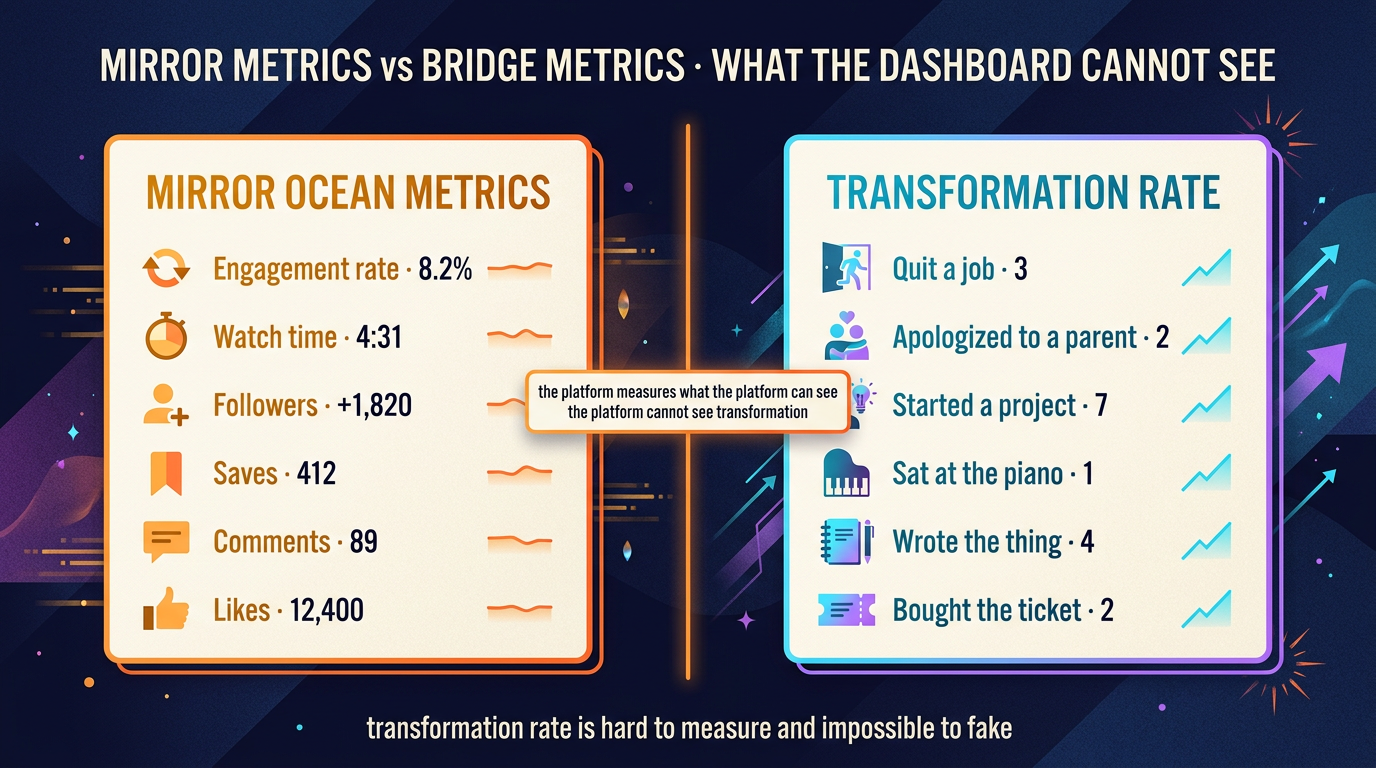
A platform can record a click, a view, a return visit or a comment. Those events help explain distribution and use inside the platform. They usually give a much thinner account of what happens elsewhere. A person might change a working practice, start something, reconsider a decision, or give an explanation to a colleague without producing another visible event on the original page.
That observation is a reason to improve measurement. It's also a reason to avoid dismissing the measurements available. Engagement can be part of a useful path. A video that nobody watches has little opportunity to teach. An explanation that people save may be one they intend to use later. The mistake is treating an intermediate signal as the completed outcome.
A report needs an action and its context
I call the desired outcome transformation rate: the share of an active audience that does something outside the exchange and attributes it to the work. That's a useful ambition for measurement. It's a difficult quantity to estimate, because a maker rarely observes every audience member or every relevant action.
Reading inbound mail can reveal reported actions. It can't, by itself, reveal a population rate. People who write are a selected group. Some act and say nothing. Some describe an intention as though it were completed. Some remember a piece as decisive when several influences contributed. A message is evidence of what that person reports, and it may be the beginning of a more useful investigation.
Start by distinguishing three kinds of response. A feeling report describes what the work felt like. An intention report describes what someone plans to do. An action report describes something they say they did. Keep the original wording and the distinction between these categories. Moving a promise into the completed column would create a result the source never gave you.
A useful action record includes the work involved, the action described, when it happened if known, and what role the person assigns to the work. A follow-up can ask what happened next without suggesting the success story you hope to hear. Someone may have tried the method and found that it didn't fit. That report can be more useful than another expression of agreement.
The denominator has to describe the people observed
Suppose you compare action reports with all the messages received during a named period. The result describes the message sample. It leaves unanswered how many readers acted, because most readers weren't in that sample. Calling it the audience's transformation rate would change what the number means.
A broader survey may help, but its denominator needs the same care. How many people were invited? Who responded? Did the survey reach people who stopped following the work? Did the wording make disagreement easy? A creator asking only enthusiastic subscribers whether the content changed their lives has designed a way to hear from enthusiastic subscribers.
An experiment can sometimes support a stronger inference. A practical guide might compare completion of a specific task across groups given different material. That's a narrower question than whether an audience relationship is deep. It may still be the right question for that piece. The claim should match what was observed.
The useful discipline is to name the evidence at its actual scale. Reported actions in received messages. Completion among respondents. A measured difference in a defined test. Each can inform a decision without becoming proof of everything the maker wants the work to mean.
A calendar can make the intended change visible
The calendar test asks about consequences. What would a person do differently because this work helped? The answer should name an activity outside continued consumption: compare a forecast with an actual result, practice a skill, make a decision with better information, or ask for help that matches the problem.
These are examples of possible outcomes, not testimonials. The right outcome comes from the job of the piece. An entertainment work can succeed by providing an experience the audience values. A reference article can succeed when someone finds an answer and leaves. There's no need to manufacture a dramatic life event for either.
For work intended to support change, choose an observable action before publishing. Then decide how you could learn whether it happened and what would count as evidence against your expectation. A bounded check is more informative than scanning every message for signs that the author mattered.

The same distinction applies to a commercial funnel. A form completion, a booked call, a sale and a useful delivered result belong to a sequence, but success at one stage doesn't establish success at the next. A measurement system that follows only the sale can reward promises the delivery team can't keep.
A message creates obligations for the business that sends it. The audience relationship has to connect an understood problem to an offer and then to the work that fulfills it. Measurement follows that connection all the way through, including the occasions when the useful result is deciding to stop.
The business has to deliver what its message promises
I begin with a problem that exists independently of whatever I might sell. That order protects the work from a familiar mistake. A vendor sees an old website and diagnoses a need for a new website. An AI engineer sees manual work and diagnoses a need for an agent. Both may be right. Neither has established what's going wrong for the person who would pay.
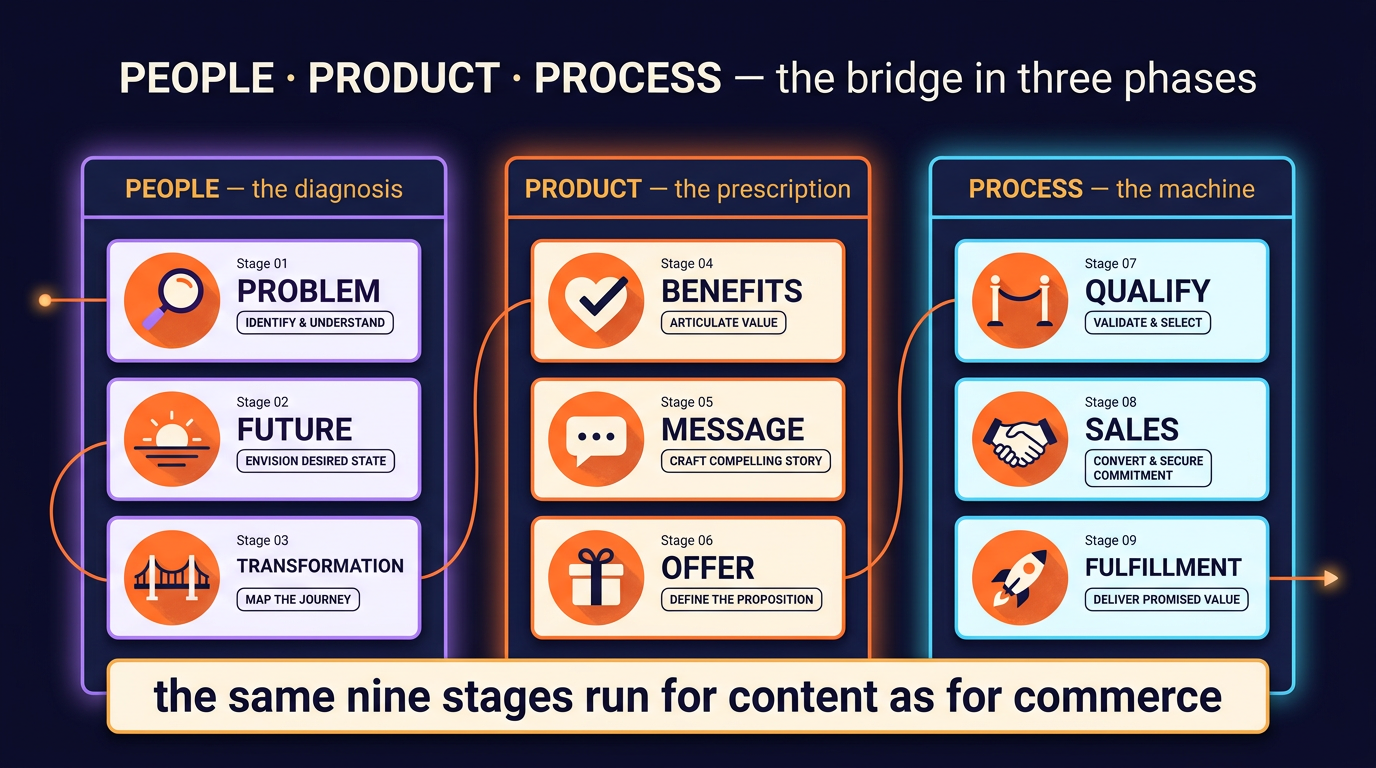
The framework has nine stages across three phases. The sequence moves through the person's situation, the proposed value, and the system that has to deliver it. Its relation to the bridge is practical: a promise about a different future has to become a set of choices and obligations that can be carried out.
Understand the problem before choosing the product
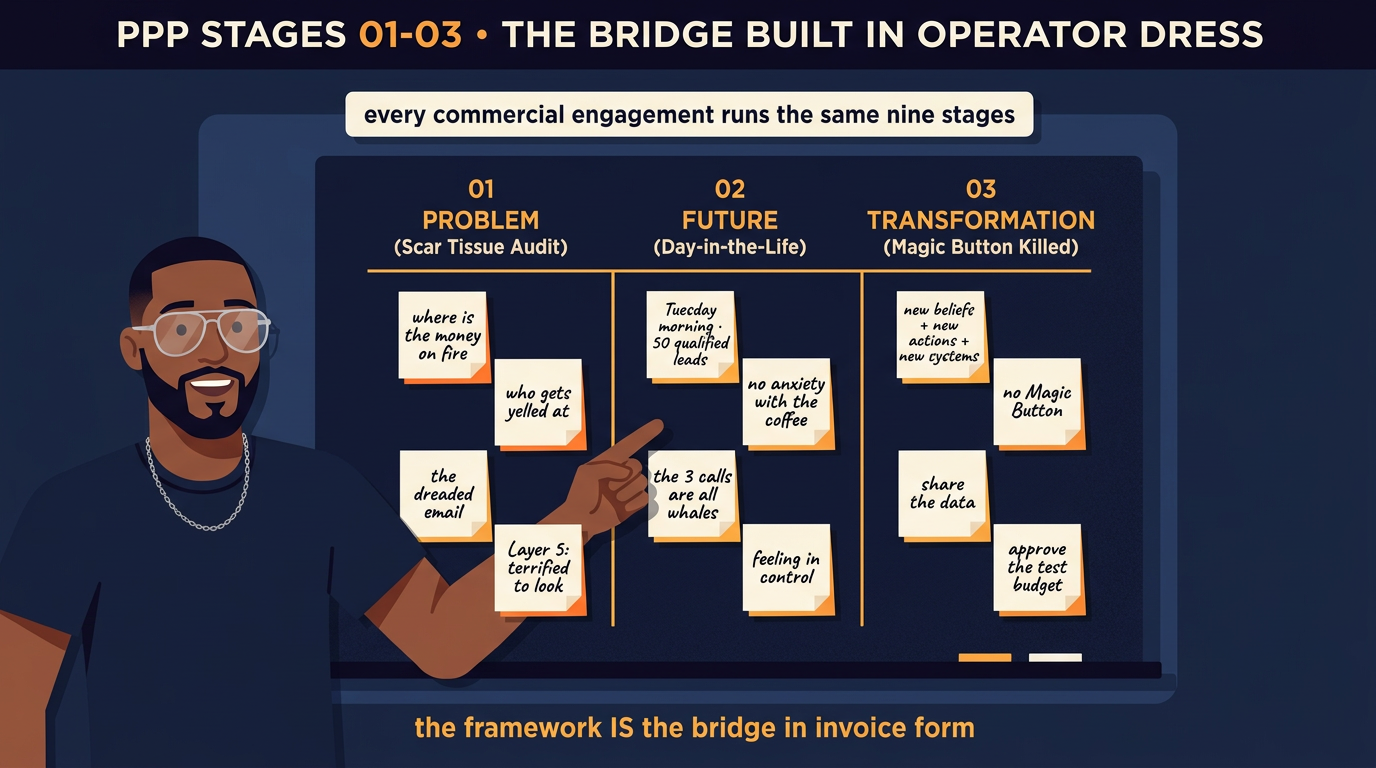
Stage 1 is Problem. I ask where the current way of working causes a consequence. Who has to intervene? What keeps failing? What happens if nothing changes? The answers may point to wasted spend, unreliable delivery, a decision nobody can make, or a report that doesn't explain the outcome people care about.
The question about the email an operator dreads opening is useful because it invites a specific example. The answer might reveal a recurring delivery failure or an obligation nobody owns. It remains a question. The consultant shouldn't decide in advance that the operator has a hidden fear and then keep asking until the expected confession appears.
Stage 2 is Future. The desired state needs to describe a life or working practice the buyer can recognize. More leads may be part of it, but more leads can also create more bad calls. A better future might include a calendar containing calls with people the team can actually help, enough information to prepare for them, and a delivery process capable of handling the work that follows.
The future belongs to the person. A consultant can help make it concrete, challenge a contradiction, or explain what would be required. They can't substitute their preferred version of success and call the buyer aligned because the buyer agreed during a persuasive conversation.
Stage 3 is Transformation. This stage names what has to change between the two states. Data may need to be made available. Someone may need to own a decision. A test may require a budget the buyer is comfortable losing. A team may need a different process before more demand becomes useful.
The magic-button fallacy is the expectation that the result can change while every relevant input remains protected. I describe the necessary changes through beliefs, actions and systems. These are dependencies to investigate, rather than terms in a literal equation. The practical question is which necessary condition would prevent the work from succeeding if it remained absent.
Make the proposed value specific enough to challenge
Stage 4 is Benefits. A feature is useful through a consequence for the buyer. A report can make a decision possible. A reliable handoff can reduce the number of tasks that wait for a founder. Naming the benefit forces the seller to explain why the deliverable belongs in this engagement.
The consequence must be supportable. A data-validation tool can reject a defined class of invalid input. Calling the entire system unbreakable would promise far more. A benefit stated at its actual strength gives the buyer something they can inspect when delivery arrives.
Stage 5 is Message. The explanation has to use language the customer understands and connect with a problem they recognize. My source for that language includes customer reviews, competitor feedback, comments and support material where access is authorized. The work is to understand the concern behind the phrasing, then explain how the offer addresses it. Repeating someone's words can establish recognition; the substance still has to answer them.
Stage 6 is Offer. This is the agreement about scope, deliverables, responsibilities and conditions. The buyer should be able to say what's included, what's excluded, what they must provide, and what will count as completion. A guarantee needs a boundary the seller can honor. Persuasive wording can't create control over a market outcome.
Those stages turn a desired future into something that can be challenged before money changes hands. A disagreement about the offer can expose an ambiguity the diagnosis missed. Discovering it early is useful work.
Qualification and fulfillment belong to the same system
Stage 7 is Qualify. A service has conditions under which it can provide value. Need, authority, budget, capacity and willingness to participate can all matter. The buyer also needs evidence that the seller can do the work. Qualification goes in both directions.
Stage 8 is Sales Process. A person moves through understanding the offer, asking questions, examining fit and deciding whether to buy. The process differs across a coaching program, an online store and a technical service. It should make the next commitment intelligible at each step. A sequence of small commitments is useful when each supplies information or advances the person's own decision. Commitment alone doesn't make the final purchase appropriate.
Stage 9 is Fulfillment. The customer has to receive the value the agreement promised. A course needs usable teaching and support. A system needs a way for its operator to run it. A diagnosis needs findings that can guide the next decision. The sale creates the obligation to deliver; it doesn't finish it.
This is where the analogy between editorial and commercial work has to remain bounded. A story may leave a philosophical question unresolved. A contractor can't use that permission to leave the agreed work unfinished. An article may ask a reader to try a practice; a service agreement has to specify who does which part and what happens when the conditions change.
The framework gives each question a place without allowing one persuasive answer to stand in for the whole engagement. A clear message can't repair an unsupported offer. A well-qualified buyer can't compensate for missing delivery. A useful audit begins by finding which connection is failing.
A forensic audit gives the diagnosis something to answer to
The commercial version of changing scale is an audit that compares an account's story with what happened to the business. A campaign can look successful in an advertising report while the operator remains unable to explain which sales justify the spend. The report may be measuring a different event, attributing the same order differently, or describing an intermediate step the business has mistaken for an outcome.
My forensic ad audits involved pulling account exports, separating results by campaign objective, audience, device and funnel stage, and reconciling performance with revenue. The purpose was to find structural problems and produce a prioritized plan. Reassurance had to wait for the comparison.
Compare records that describe the same event
Reconciliation sounds dull because it's dull. It's also where a plausible story can stop working. An acquisition figure needs a defined event, a period and a population. A lead isn't a qualified lead. A purchase attributed by one system isn't automatically an additional purchase the campaign caused. An invoice isn't collected cash.
A practical investigation keeps those distinctions visible. Identify what the campaign is intended to produce. Find the record closest to that outcome. Then follow the relevant earlier events without assuming every system uses the same definitions. A discrepancy becomes a question to resolve, not a number to average away.
In many of the accounts described in my audit work, 10 to 30 percent of spend could be cut or reallocated without hurting revenue, sometimes with an improvement. That's an account of those engagements. It isn't a promise that a new account contains the same saving, and it doesn't establish a universal waste rate across advertisers.
The transferable part is the comparison. It can show where spend appears unsupported, where attribution is uncertain, and which change is worth testing. It can also show that a campaign initially blamed for poor performance isn't the main cause. A diagnosis that's allowed to reach that conclusion protects the client from buying the wrong repair.
Follow the question without prescribing its answer
My drill begins with a surface complaint about sales, then asks about conversion, cost, audience selection and the information used to make those choices. It eventually reaches the possibility that the operator avoids examining the data. The sequence is a worked example of an inquiry. It shouldn't be treated as a script that every buyer must complete.
Each answer needs a check. Ads failing to convert may mean an unsuitable audience, but it may also mean a checkout failure. A high acquisition cost may be acceptable for one margin and impossible for another. Unexamined data may reflect avoidance, missing access, inadequate instrumentation or a report nobody has time to interpret. The next question depends on the evidence returned by the last.
The number of layers isn't the point. Stop drilling when the explanation supports a useful decision at the right level of consequence, or when the next claim requires evidence you don't have. A consultant who insists the final answer must be a private fear can turn discovery into a leading interview.
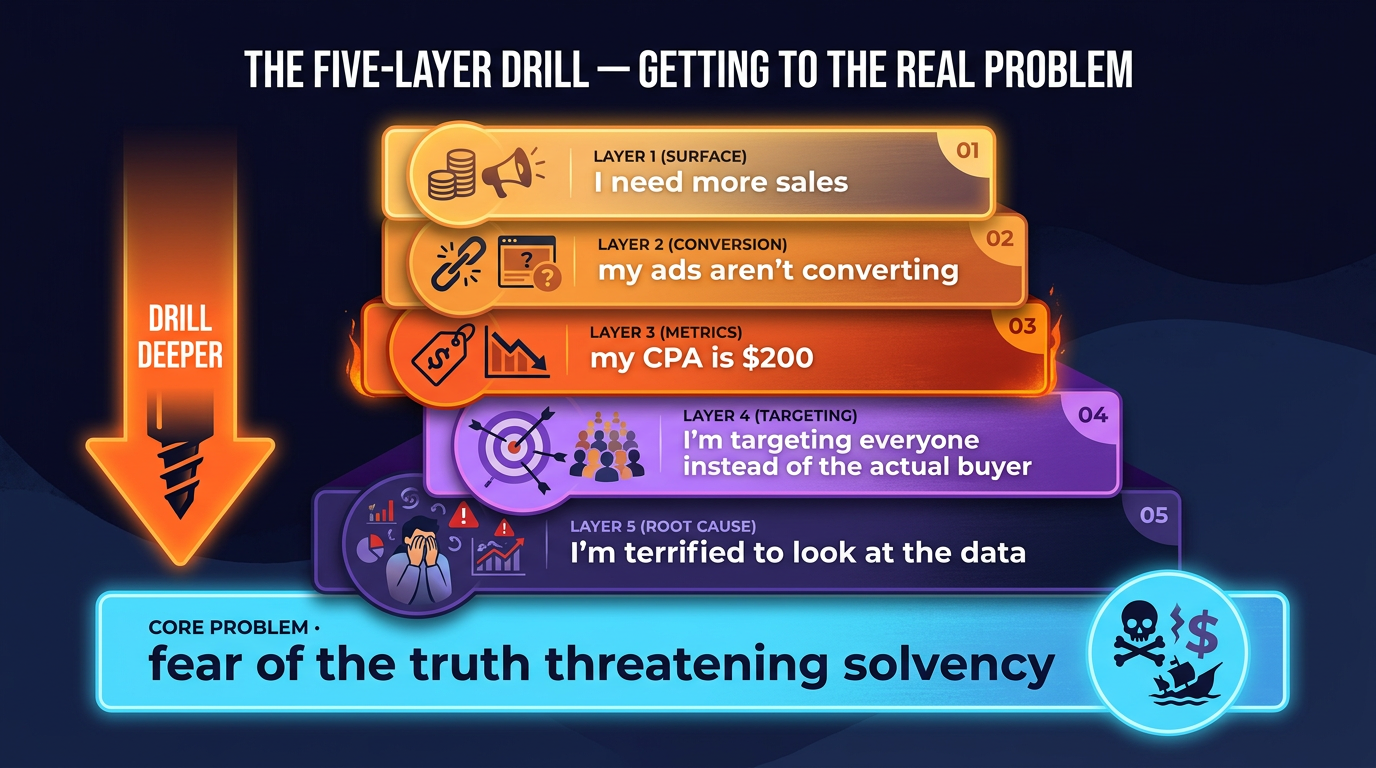
That restraint doesn't make the question timid. Asking what happens if nothing changes can expose a serious consequence. Asking who's blocked can reveal that a small approval has become a dependency across the company. The strength comes from allowing the answer to be specific and inconvenient, including inconvenient to the consultant's initial hypothesis.
Founder effort can reveal a missing decision system
In my work with service agencies, a recurring difficulty was dependence on the founder. The owner could produce a level of quality that was hard to reproduce through a growing team. Closing, implementation and problem-solving kept returning to the same person. More demand could then make the operational weakness worse.
The response included sales procedures, review of sales recordings, coaching materials and frameworks for delivery. These changes mattered because the team needed a way to make judgments the founder had previously carried alone. A reminder to work harder would have left that dependency intact.
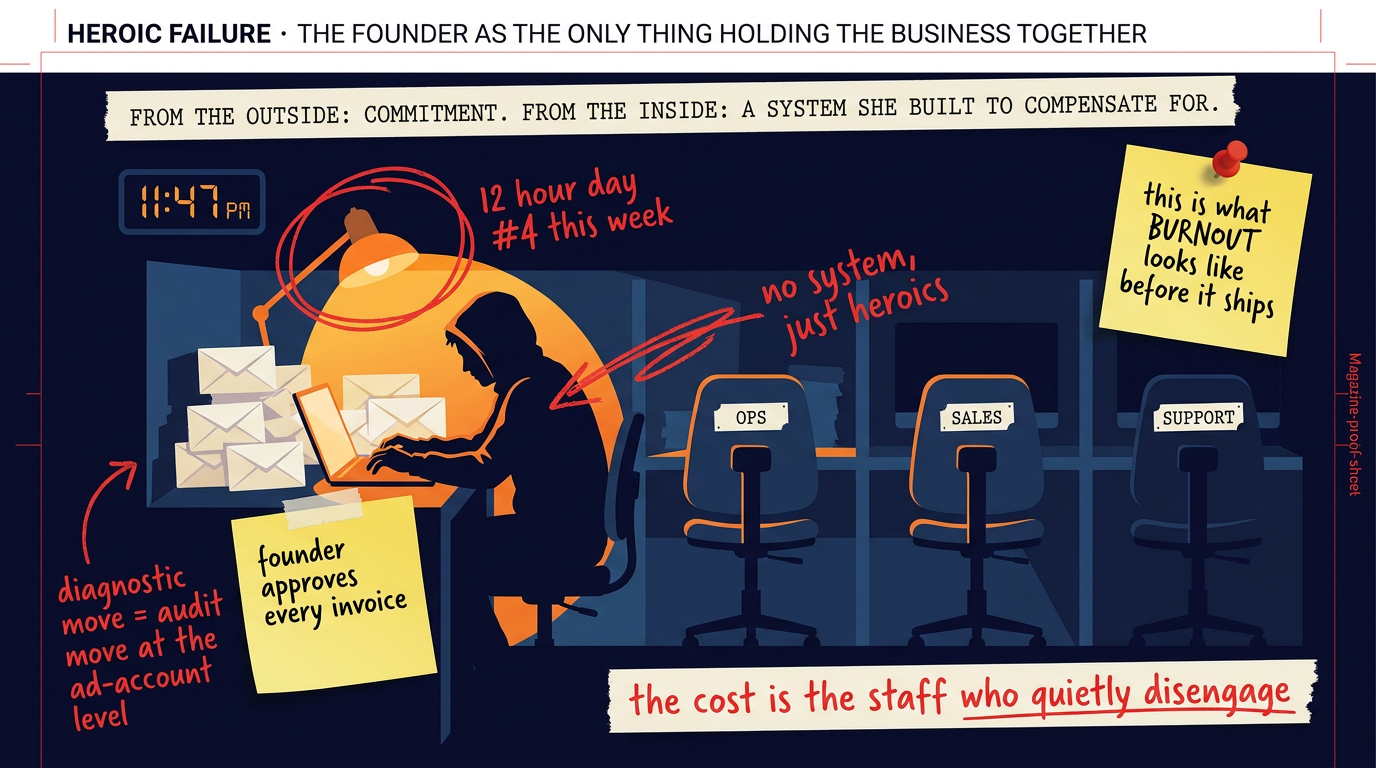
A practical illustration is an invoice waiting for approval. Ask what the approver knows that the next person doesn't. Perhaps there's a spending limit nobody has written down, a supplier problem that changes the decision, or an exception the system has no way to represent. Giving someone responsibility without that information would transfer the task while preserving the need to ask the founder.
The repair might be a clearer rule, access to a record, a defined exception path, or training on a judgment that can't be reduced to a rule. A check afterward asks whether the decision can now be made safely without recreating the old dependency. That's a more useful outcome than counting how many tasks were nominally delegated.
A creator can inspect a piece of work the same way. What decision should the reader become able to make? What information does the piece provide? Where does the reader still need the maker to explain an unstated step? These questions expose an explanation that earns praise while leaving its user dependent on the next explanation.
The audit's value is the ability to replace a vague difficulty with a supported choice. Sometimes that choice is to fund the next test. Sometimes it's to fix a delivery constraint before pursuing more customers. The qualification process has to preserve both possibilities.
Qualification changes who reaches the sales call
I helped build a coaching program for a Facebook Ads expert, worked on the funnel and sales material, took sales calls, and served as head coach inside the community. It was a team effort. During the launch I personally closed about $199,500 in sales in a 30-day period. The number matters here because sales and delivery sat close enough together for the offer to be tested against the people receiving it.
The coaching launch combined a program priced around $3,000 to $6,000 with implementation services around $10,000 to $20,000. The buyers didn't all need the same relationship. Some wanted to learn how to run the work. Others had priorities that made direct implementation more useful. Budget, offer maturity and the buyer's willingness to do the work affected which option fit.

The offer included access to judgment
The coaching included feedback on participants' actual accounts. I learned about participants' businesses, their difficulties and their ad accounts, then used that context in group feedback. Additional one-to-one sessions could provide more depth. A buyer could ask whether a campaign structure made sense in their situation and get an answer informed by that situation.
That's a useful form of audience relationship because it can correct an assumption. A library of videos may explain a principle well while leaving a learner unsure how it applies to their account. Contextual feedback can identify where the principle fits, where it doesn't, and what evidence would resolve the uncertainty. It creates a path between understanding and a decision.
The implementation option also made the division of labor visible. Someone who wanted to learn and had the capacity to do so could choose coaching. Someone who needed the work done could evaluate a different commitment. Combining the options didn't prove that every buyer would succeed. It allowed the sales conversation to address two different needs without pretending they were the same.
I recall the close rate on qualified calls as roughly 60 to 70 percent. That's a recollection, not an independently audited conversion study. Qualification, the offer, the existing audience, pre-launch content and the sales conversations all formed part of the environment. Assigning the result to one application question would claim more than the record can isolate.
The pre-launch work included organic content and campaigns that introduced the offer and brought qualified people toward appointments. The first community intake was capped so that the people admitted could be served. Capacity belonged in the offer design. Creating more demand than the team could fulfill would have weakened the very relationship the launch was meant to establish.
A separate agency filter made fit explicit
In agency lead-generation work, I used a long-form application asking about the profit a business wanted to add by the end of a 90-day period. Answers below $10,000 were rejected before a calendar opened. The intent was to distinguish people whose goals and business stage could support an engagement priced in the thousands from those for whom it was unlikely to make sense.
This agency filter was designed for a particular offer. The coaching launch used its own qualification process; its buyers and price points need to be considered separately.
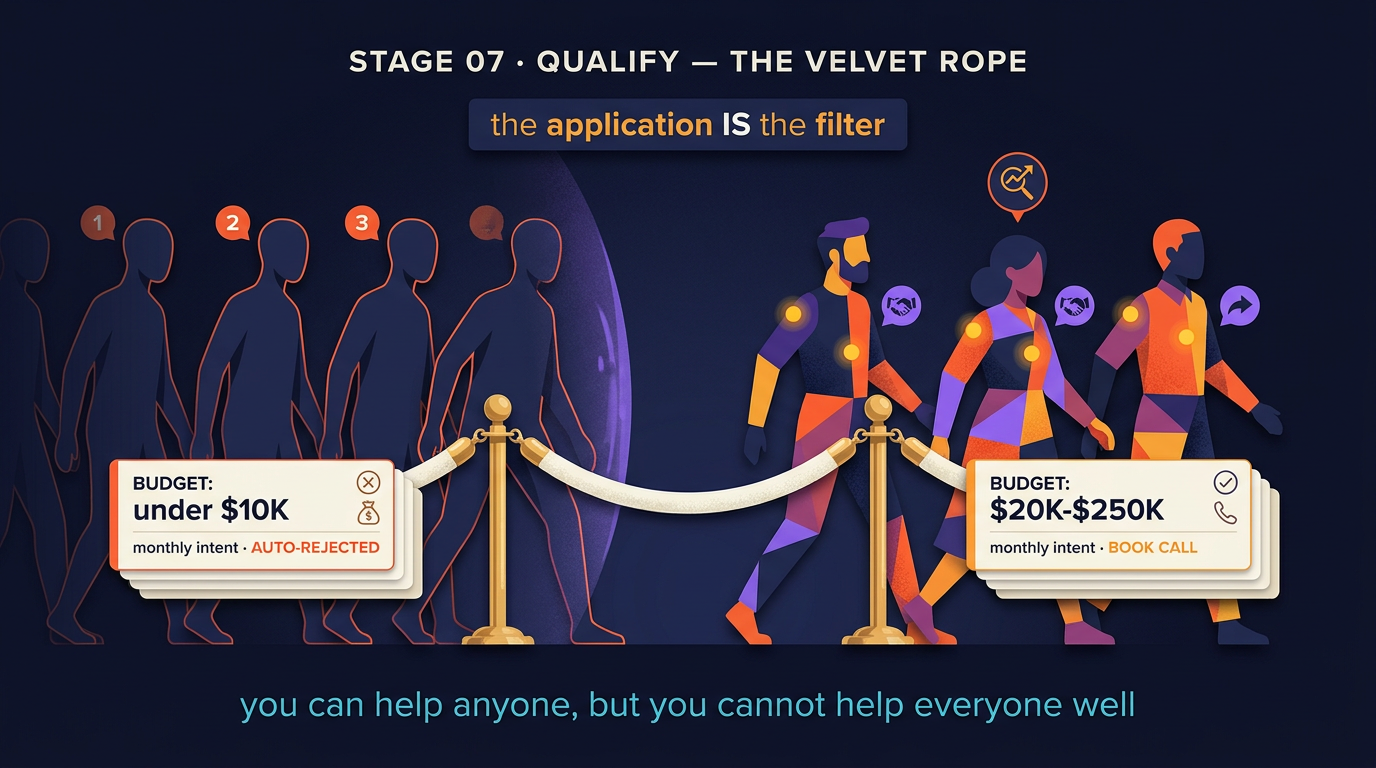

A declared profit goal is still one signal. Wanting a result doesn't demonstrate a budget, prove demand, or show that the buyer controls the decisions required to obtain it. A useful qualification conversation needs to examine those conditions. A person can name an enormous ambition and remain a poor fit. Another can name a modest goal and be an excellent fit for a smaller service.
The threshold was a design choice for that offer. It wasn't a measure of a person's worth, honesty or capacity for growth. Treating a commercial filter as a personality test would make the seller less accurate and less useful to the people the filter excludes.
The event used for learning has to match the business
The agency application also affected the event the advertising system could learn from. My account describes moving attention toward people who completed the process and booked, supported by lookalike and interest-audience work. The principle is to connect the learning signal with a useful downstream event, then check what quality actually arrives.
A lead, a qualified lead and an appointment can have different denominators. Compare costs only after identifying the event each figure measures. In this work we changed qualification, targeting and follow-up, with sales feedback available to evaluate whether the resulting people were a better fit.
That feedback matters after the form as well as before it. Does the prospect attend? Do they understand the scope? Can the team help? Does the work produce an outcome worth the price? If performance improves at the application stage while delivery worsens, the funnel has moved a problem rather than solved it.
A long essay has a related responsibility
An essay can help readers discover whether a subject deserves their attention. Its opening should make the question clear enough for someone to choose. Its depth should repay the people who continue. That's related to qualification, but the reader hasn't entered a sales contract by reading several sections.
Completion doesn't establish readiness to buy. Departure doesn't establish failure to understand. The editorial invitation is to examine an idea; a commercial offer needs its own fit decision. Keeping those decisions separate makes both more trustworthy.
The launch demonstrates what becomes possible when the path into a service and the service itself are designed together. It also points to a boundary: there are occasions when the next responsible act is to decline the work. The most useful example I have of that boundary comes from a campaign that attracted plenty of attention and never found a profitable way forward.
A failed test can justify stopping without proving there's no market
The garden-art campaign involved handcrafted pieces made from vintage silverware. The products were visually striking and had sold in small quantities on Etsy. The question was whether paid traffic could support a larger direct-to-consumer business.
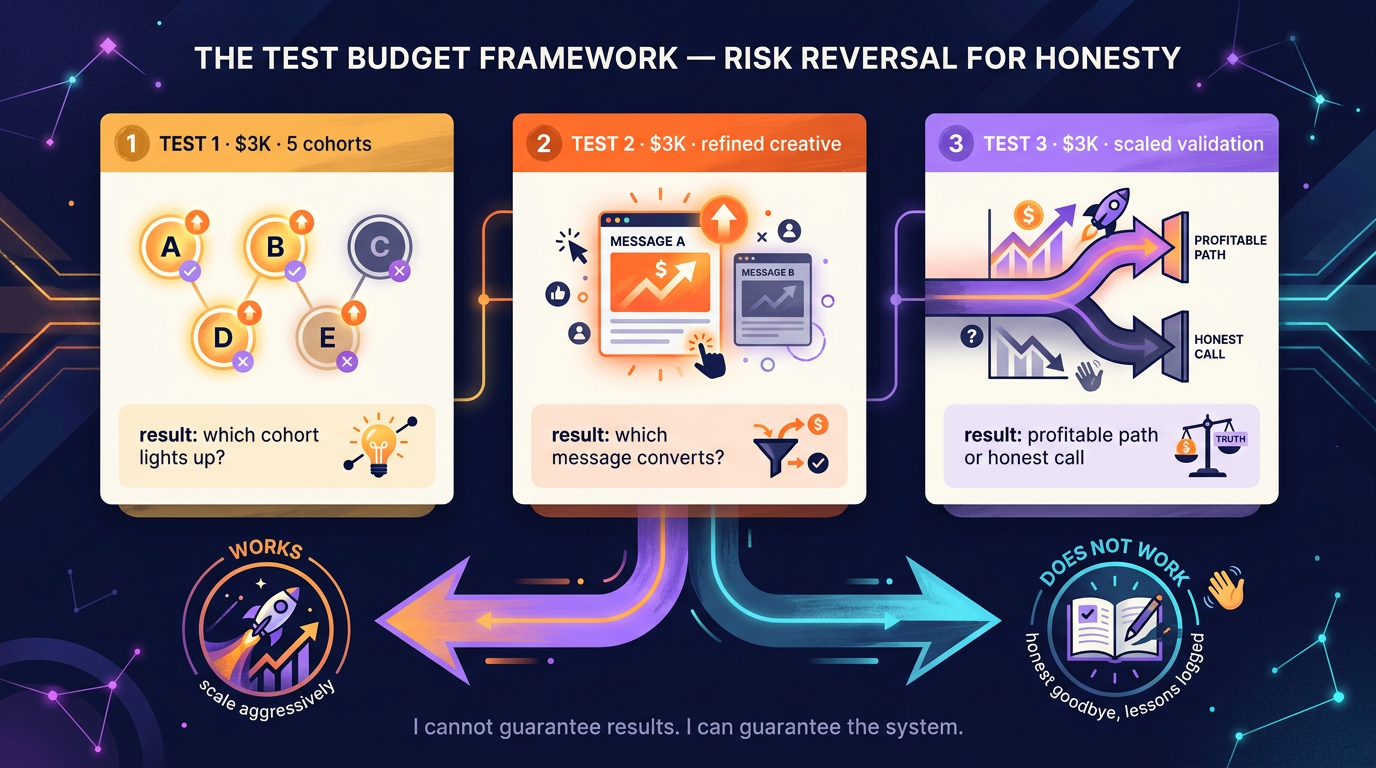
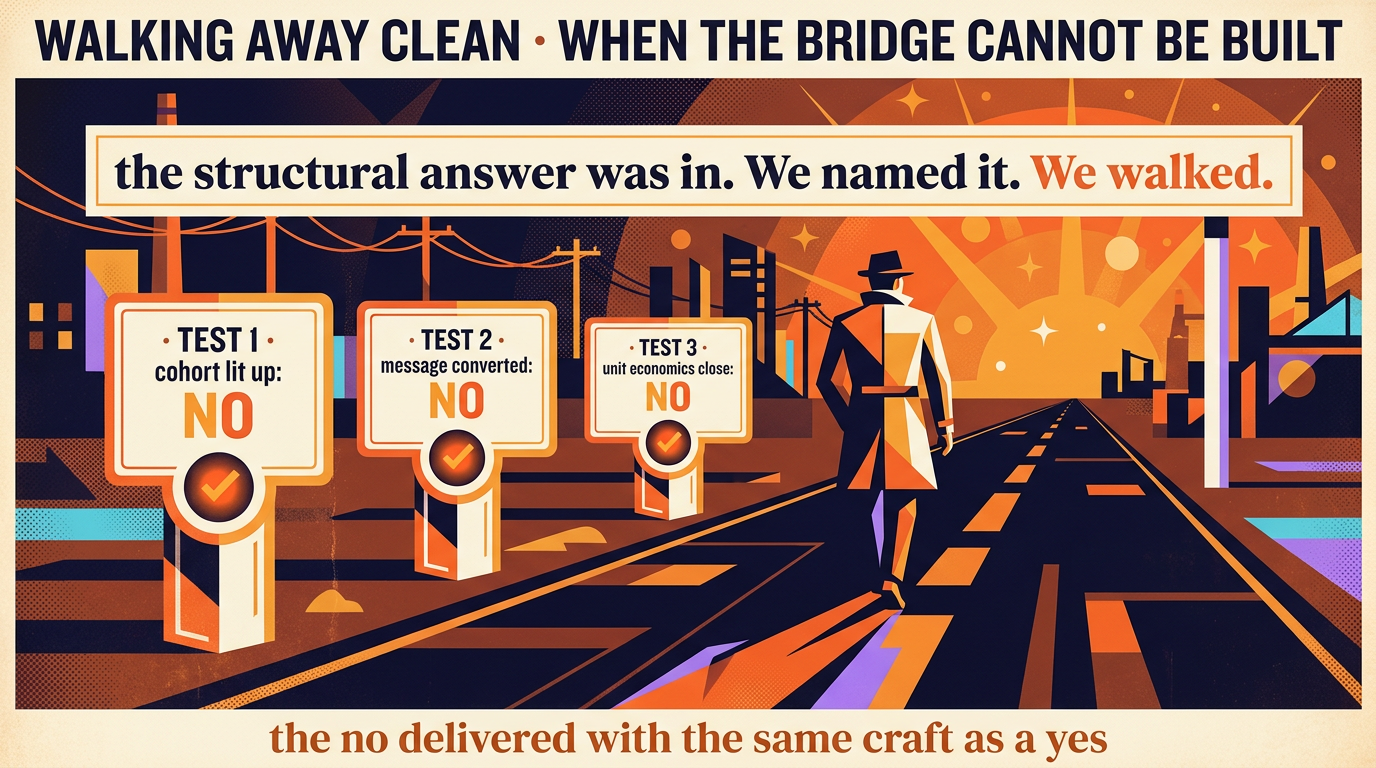
We ran three rounds with a total advertising budget around $10,000, a little over $3,000 per round in my recollection. The campaigns produced some of the highest click-through rates I remember seeing, around 3 to 8 percent or more in the reported results. Purchases didn't follow in a way that produced a profitable, repeatable path.
The garden metal-art case is useful because the result remains disappointing. It prevents a discussion of audience quality from becoming a collection of success stories in which every problem eventually confirms the operator's method.
Attention didn't identify the cause of the failure
The photography was good. The site was weak. The people clicking might have liked the objects without wanting to buy them under the conditions offered. Other channels might have reached different people. Those explanations remained possibilities. The testing didn't isolate a single final cause.
That distinction is the lesson I don't want to lose. We found no profitable repeatable path within those rounds, on that site, through those campaigns. We didn't establish that nobody would buy the product or that the category had no market. Existing Etsy sales already made the broadest version of that conclusion untenable.
In my account of the work, I said I'd have liked to test other platforms and spend more effort on organic. That was a possible next direction, not evidence that it would have worked. An operator can recognize an untested possibility and still decide against funding it. A finite budget eventually requires a decision under incomplete knowledge.
This is where a dashboard can be most seductive. The encouraging number is real, and it's attached to something the campaign does well. High click-through gives the team a reason to feel close. But closeness needs a defined path. Without evidence connecting those clicks to viable purchases, another round may simply buy more of the result already observed.
A test budget purchases a decision as well as an opportunity
The staged-budget approach in my framework makes the spending boundary explicit before results arrive. Each round needs a hypothesis and evidence that can affect the next decision. The point is to avoid treating every disappointing outcome as permission for an unlimited series of refinements.
One possible sequence is to investigate who buys, then how the message affects response, then whether the economics remain viable as spending changes. That's a planning illustration. Real tests may need a different order. A broken purchase path, for example, needs attention before a comparison of audience quality can mean much.
A test can produce information without producing enough sales to justify continuation. The value of that information depends on whether the test was capable of answering its question. A small, poorly instrumented campaign that leaves every explanation equally plausible has spent money without delivering the decision promised. Calling all losses learning would remove accountability from the testing process.
Before another round, ask what remains uncertain and what this round can distinguish. Name the action that follows each plausible result. If every result leads to another test of the same kind, there's no stopping rule in the plan. The operator has bought a sequence whose end will be determined by exhaustion.
The seller has to be able to recommend a no
A useful no explains the evidence and its limits. The campaign didn't produce an acquisition path that justified scaling. The available budget doesn't support the next investigation. A necessary change falls outside the operator's willingness or the team's ability to make it. These are different conclusions, and the client should know which one they're receiving.
A seller who depends on continuing fees has a reason to keep uncertainty open. That incentive doesn't prove bad faith, but it belongs in the design of the engagement. Agreeing on checkpoints and spending limits reduces the amount of judgment that has to be exercised while both parties are hoping the next campaign will rescue the last one.
The same discipline applies when a prospective client won't provide an input the work genuinely needs. Explain why it's needed, consider a smaller or different scope, and decline if the remaining offer would be misleading. The person may be right to refuse the input. They may have constraints the seller can't change. A mismatch doesn't require a moral verdict.
An editorial boundary needs the same specificity
A creator can decide which promises they won't make and which claims they won't soften to retain an audience. Write those boundaries for the work: no invented result, no certainty beyond the evidence, no recommendation whose necessary cost is hidden. These are examples a maker can adapt to the subject.
That's more useful than declaring a willingness to lose readers in the abstract. A boundary becomes real when it changes an actual choice. A number is cut because the record can't support it. A story keeps its unsuccessful ending. A recommendation includes a condition that makes it less broadly appealing.
The garden-art campaign keeps that boundary visible. The clicks happened, the profitable path didn't emerge, and I don't have a final explanation that makes the outcome tidy. The next piece of work has to begin with that unresolved knowledge, rather than with the story a successful operator would prefer to tell.
Customer language has to lead somewhere beyond recognition
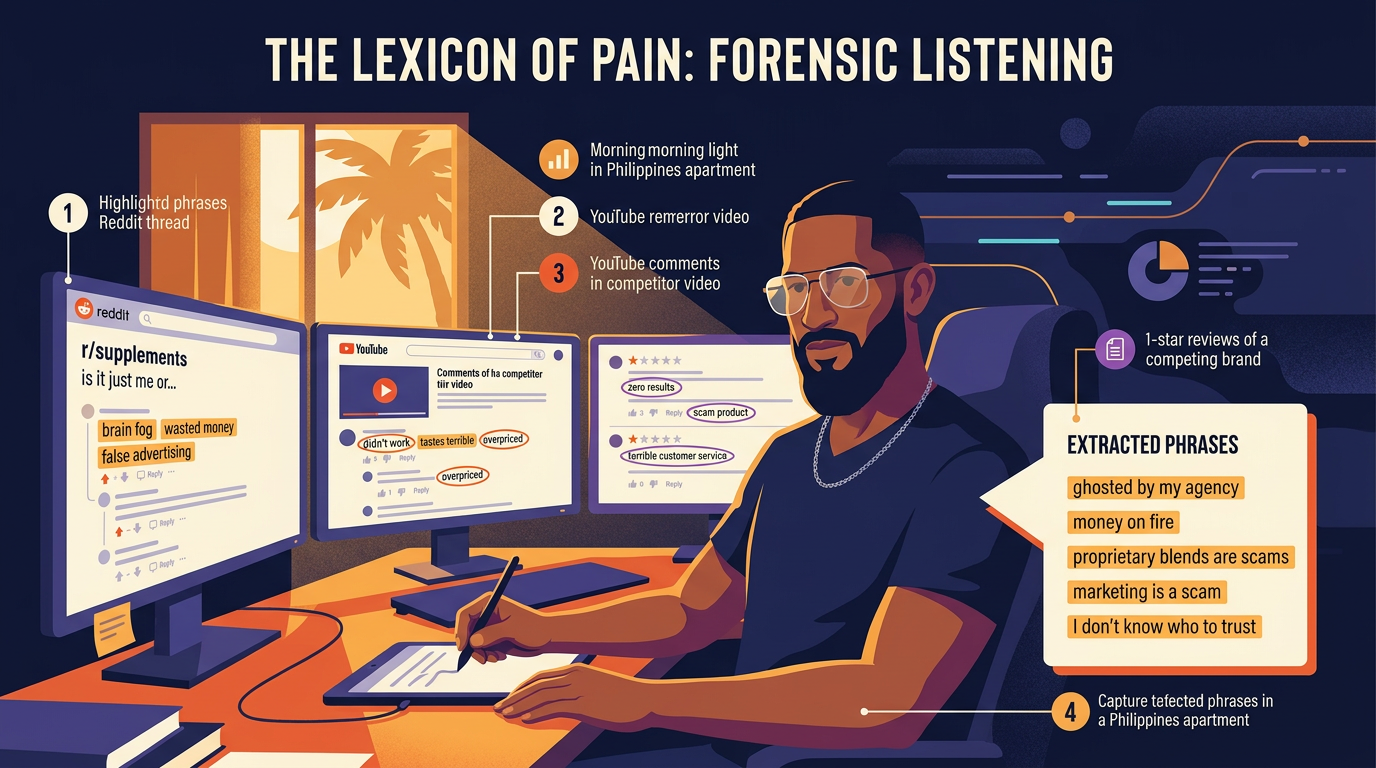
My messaging work starts with sources in which people describe a difficulty in their own terms. Customer reviews, comments under competitor videos, forum discussions and authorized support records can reveal language a founder's product vocabulary misses. I collect phrases and the circumstances around them in what I call a lexicon of pain.
The name describes a research aid, with a danger built into it. A collection limited to pain can make an audience look like a set of wounds waiting for a product. People also describe what they value, what they tried, what helped, and what they are unwilling to give up. The research needs enough context to preserve the person behind the complaint.
Observe the words without claiming access to the mind
A review is a statement made in a particular situation. It may be accurate, mistaken, unrepresentative, or written by someone whose needs differ from the intended customer. A survey answer has limitations too. Moving from one source to another doesn't eliminate the need to interpret evidence.
The useful advantage of unsolicited discussion is that it can reveal a concern you didn't ask about. Someone describes a missing instruction, an unexpected cost, or the point where they stopped trusting the explanation. Those specifics can change what the next interview asks or what the next test examines.
Keep the source with the phrase. Distinguish a direct quotation from a paraphrase and from a hypothesis about what it means. Repeated wording may indicate a recurring concern. It may also reflect copied language or a shared discussion. Frequency alone doesn't tell you how much the concern affects a purchase.
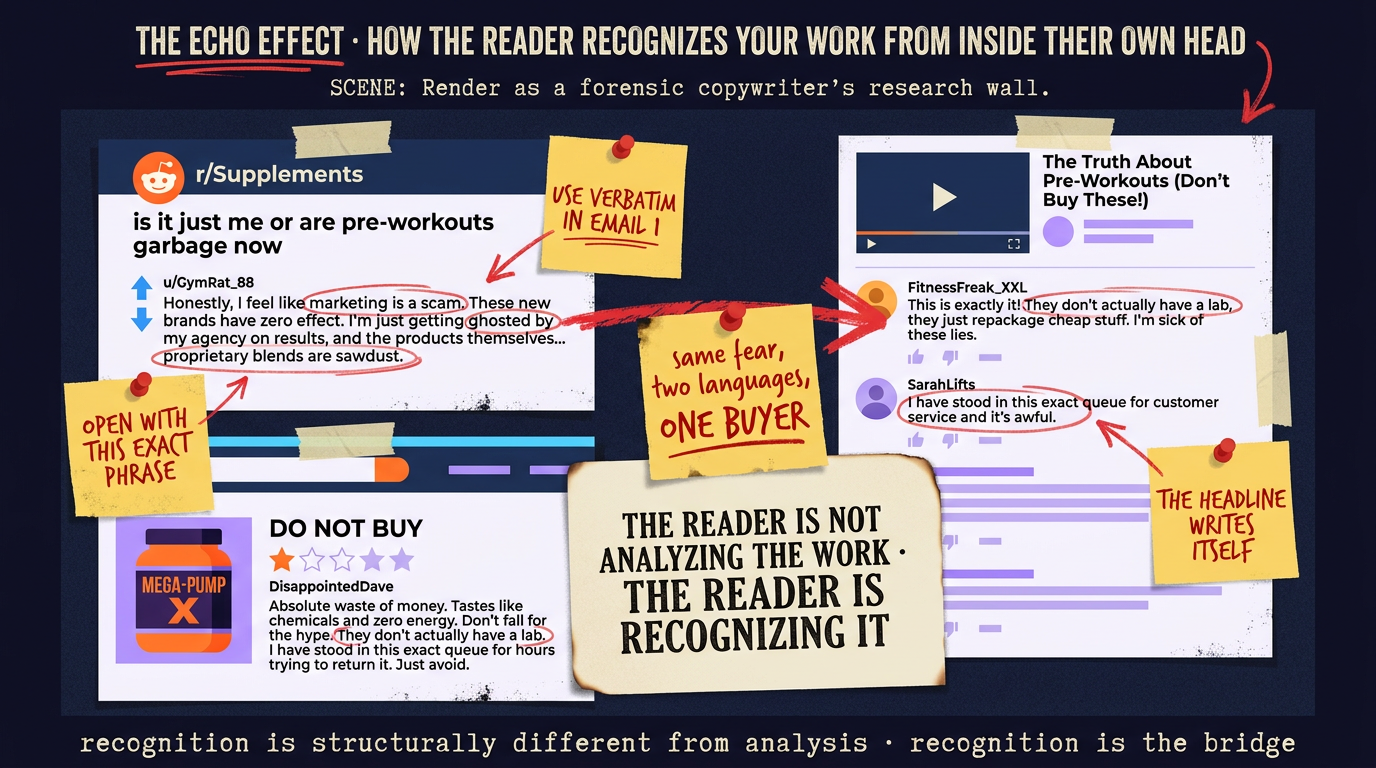
A practical illustration is a complaint that an agency stopped communicating. Copy that repeats the complaint can produce recognition. A useful offer has to answer it with something the buyer can inspect: reporting responsibilities, a clear point of contact, or a way to see work and unresolved issues. The language gets the explanation heard. The operating arrangement makes the explanation worth trusting.
The supplement campaign separated learning from selling
In the fitness-supplement email work, the brand had a strong Amazon business but little direct relationship with buyers outside that platform. We built a two-phase sequence. The initial work addressed concerns about the products and identified people who engaged. The warmer segment then received a more direct conversion sequence.
The historical list came from Amazon order information collected through services. The collection method breached Amazon's terms and shouldn't be repeated. The transferable lesson is the sequence and the cooperation between channels. It doesn't authorize contacting people from improperly obtained data. A current campaign needs a permitted basis for its list and its use.
The concerns included safety, ingredients, where products came from and how testing worked. The educational content was meant to be accessible to the audience, with language related to how they talked about fitness and use. Customer reviews and competitor feedback informed the writing.
Opens and clicks were the main signals available for moving recipients into more engaged segments. We couldn't directly cross-reference individual time-on-site attribution in that way. That limitation matters. The campaign used the data available to make a segmentation decision; it didn't have a complete account of each person's experience.
The outcome involved work across channels
We reported roughly $50,000 per month in additional direct email revenue and roughly $100,000 per month in improved paid-ad performance. The work involved collaboration with the PPC team, traffic to the store, engagement audiences and lookalike audiences informed by the resulting data.
Those are reported campaign outcomes and the mechanism the team used. They aren't an independently controlled estimate of what one email caused. Creative, offers, landing pages, audience choices and advertising work all belonged to the system. A description that gives a single subject line credit for the entire result would erase both the collaboration and the uncertainty.
Education was connected to a next step, the next step created a behavioral signal, and the signal informed another part of the business. The relationship was expressed through a sequence of things the customer could understand and do. The revenue figures describe a commercial result from that system, with no claim that every purchaser experienced a personal transformation.
Recognition creates an obligation to answer the concern
The echo effect is the experience of encountering wording close to an account a person already holds. It can make the reader willing to continue. What follows decides whether the exchange becomes another reflection.
A maker can validate a suspicion merely because the suspicion is useful for selling. That can intensify the feeling of being understood while leaving the claim unexamined. A more useful explanation separates what the concern gets right, what the evidence doesn't support, and how the proposed product or practice addresses the remaining problem.
For the supplement case, the lesson is the attention to questions and the ordered movement toward an offer, with its historical sourcing restriction kept visible. It isn't a general license to accuse competitors or make health claims because an audience repeats them. A customer's language tells you what to investigate and explain. It doesn't determine what's true.
The listening practice needs renewal because a creator can become fluent in their own published account. Returning to actual descriptions of use supplies details and objections that account may have lost. The next revision should be capable of changing because of what's heard. Otherwise the research has become a way to find flattering evidence for a message already written.
The founder has to be included in the diagnosis
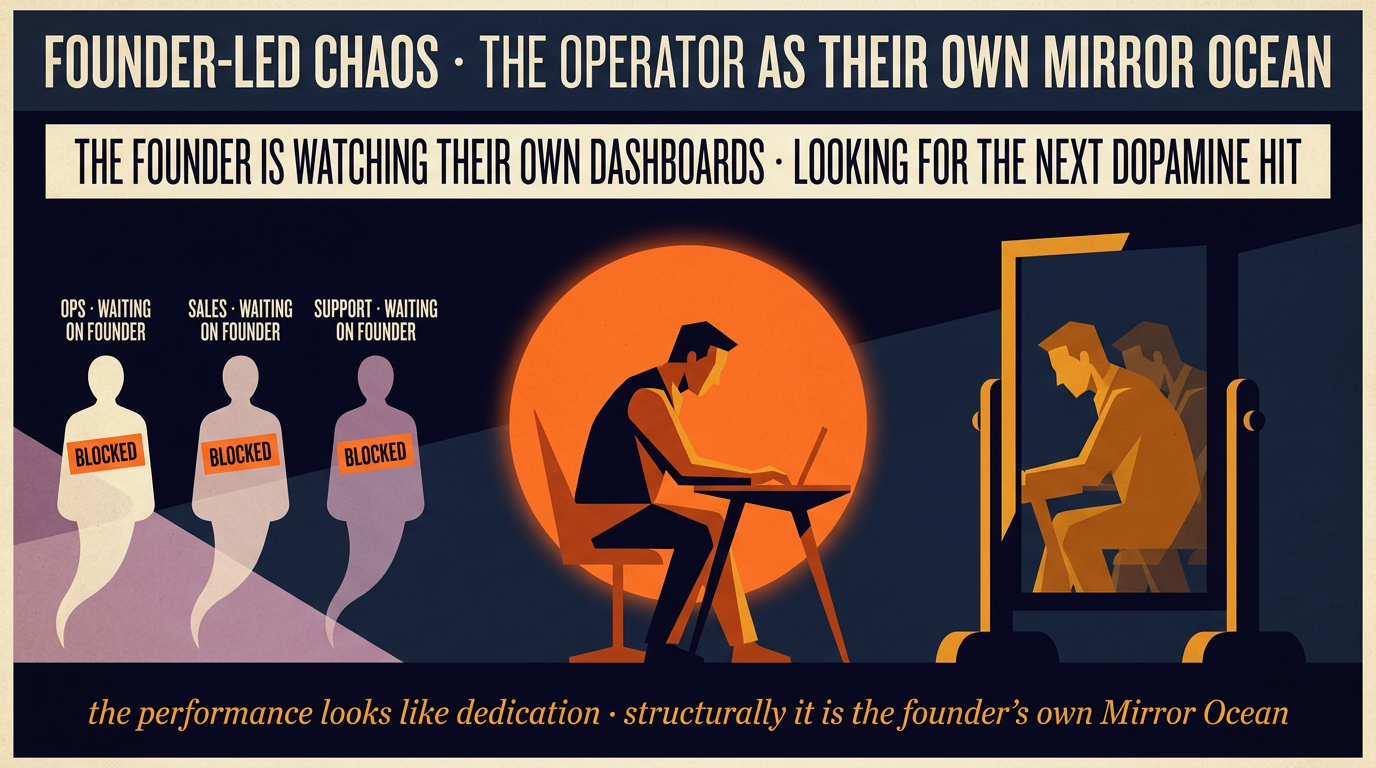
The patchwork workers matter again when the person asking for change also controls the conditions of the work. An owner can sincerely want a less dependent business and keep making every exception return to their desk. That contradiction is observable. Its explanation still needs investigation.
In the service-agency work, the difficulty was often that the founder's competence had become a constraint on the organization. Clients expected the quality associated with that person. The team couldn't reliably reproduce it. The founder took more responsibility to protect the outcome, which left less capacity to build the systems that would allow responsibility to move.
This loop can look productive from the outside. Problems get solved. Customers receive replies. The owner remains essential. The cost appears in the work that waits, the decisions other people can't make, and the amount of attention required to keep the same output possible.
Name the dependency before assigning a motive
A useful founder audit starts with a decision that repeatedly waits. Identify who's waiting, what they need, and what happens when the decision is delayed. Then ask why the owner remains necessary. That dependence might reflect authority, information, skill, trust or a genuine risk that has no safe exception path.
Each explanation suggests different work. A spending rule may solve an authority problem. Access to a record may solve an information problem. Training may help with a recurring judgment. A damaged relationship may need an agreement that a new checklist can't supply. The diagnostic job is to find which kind of change the situation needs.
Calling the founder controlling can stop the inquiry before it reaches that distinction. The owner may indeed be reluctant to relinquish decisions. They may also remember a failure the new process hasn't addressed. An explanation that ignores the failure will be difficult to trust for a reason.
The method asks the person to participate in describing the gap. What should happen without them? What would let them accept the risk? What would they need to see before granting authority? The answers expose conditions the plan has to meet. Agreement produced by social pressure would leave those conditions hidden until implementation reaches them.
The owner has a cost of change too
A business can want the result of delegation while protecting the arrangements that make delegation impossible. The owner wants other people to act, but the authority remains informal. The team is expected to use judgment, but every unexpected result is treated as proof that judgment should return to the founder. The loop will continue until one of those conditions changes.
The cost may include documenting a distinction the owner has never had to explain, accepting a bounded decision they would have made differently, or paying for training before the output becomes reliable. These costs belong in the transformation stage of the plan. Leaving them implicit makes the new process look cheaper than it is.
The team also pays a cost when a change is poorly designed. Responsibility without authority leaves them accountable for a result they can't control. A founder audit has to examine both sides. Otherwise it becomes another way to tell staff that the system is fixed and they should now perform better.
My contribution in the agency engagements included building sales procedures, reviewing calls and helping improve implementation. The work connected the front-end promise with the business's ability to deliver. Bringing in more customers wasn't sufficient if the same owner remained the unresolved dependency behind every engagement.
The same audit applies to the creator's production
A creator can become the audience of their own output. A visible metric offers a reassuring account of progress, and the next production decision is made to preserve that account. The underlying question about purpose remains unanswered. This is a possible failure pattern, not a diagnosis of every maker who checks a dashboard.
The practical response is to name what the work is intended to make possible and inspect the conditions needed to provide it. Does the explanation let someone use the method? Can a correction reach the places where the original claim appears? Can the maker admit that a piece failed without having to discard the whole public identity built around expertise?
Those are operating questions. They matter because the audience's ability to encounter a useful correction depends on the production system as well as the author's intentions. A maker asking others to examine their assumptions needs a process in which their own assumptions can change.
The patchwork person can remain complicated. They may want growth and fear its cost, value independence and need help, have expertise and still be wrong. A relationship that permits those combinations gives both sides something to work with. The remaining challenge is to arrange incentives so that disagreement and correction remain possible when money, authority and reputation enter the exchange.
Incentives have to include the people who can break the agreement
Tokenomics made the alignment problem unusually explicit in my work. At a Solana token-investing platform that held more than $500 million in total value locked at the time, I supported token strategy across more than two dozen projects. The platform held that value. I supported token strategy for projects using it.
The tokenomics engagements involved vesting, emissions, incentives and communication across very different products. A data product, an infrastructure project and a game could all use tokens while needing different behavior from the people involved. A template that ignored those differences would preserve the vocabulary of token design while missing its purpose.
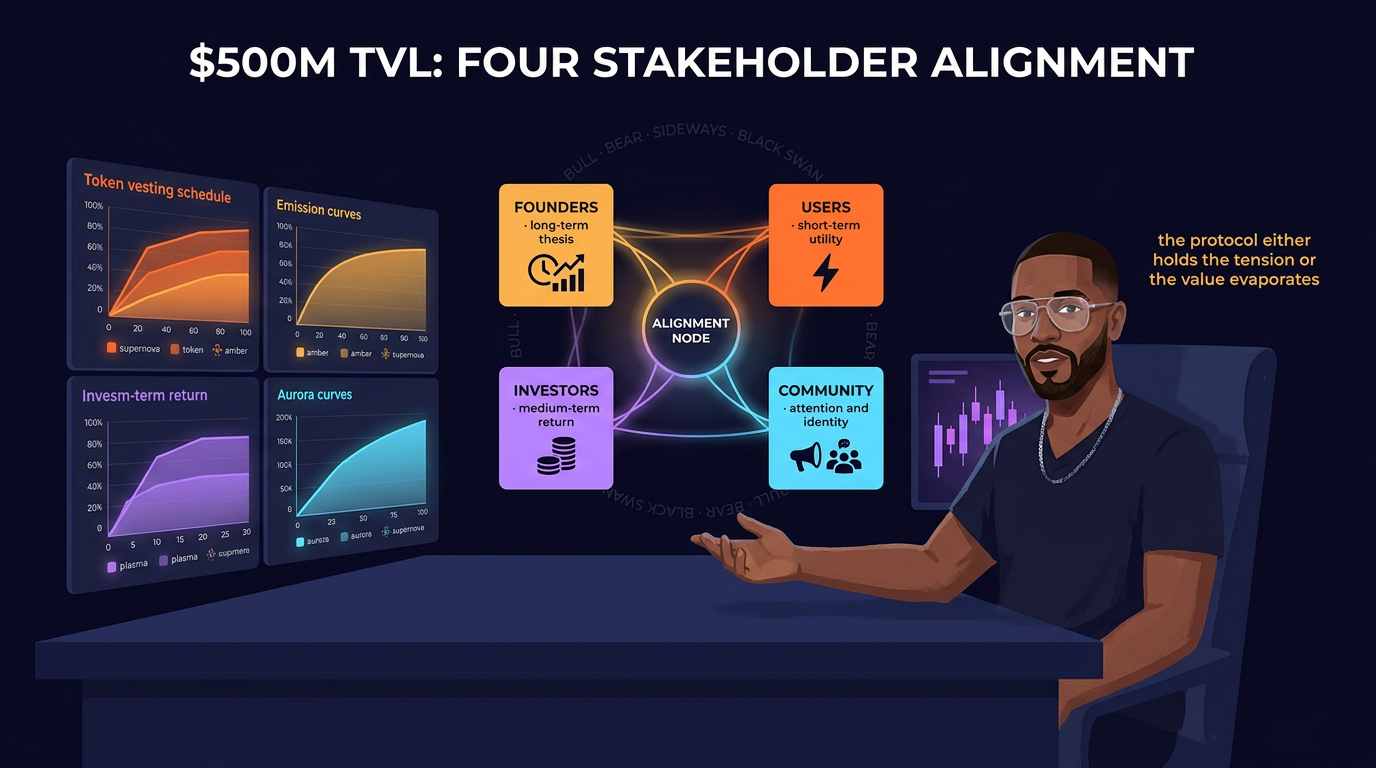
Stakeholders don't all want the same future
A founder may need enough stability to build through a long development period. A user may want utility available now. An investor may need a path to liquidity. A community may value participation, recognition and influence. These are possible interests to investigate, rather than permanent assignments attached to a label. One person may occupy several roles.
Vesting and emissions give those interests operational consequences. When can a participant sell? What behavior earns a reward? Who bears the effect of new supply? Which decisions can governance change, and which powers remain elsewhere? The written story about alignment has to be compared with those permissions.
A design can distribute rewards in a way that looks attractive at launch and becomes unstable under different conditions. Market regime, liquidity and incentives change what participants are likely to do. Scenario work asks how the arrangement behaves when circumstances stop matching the favorable opening account.
The audience relationship has an analogous problem. A creator can promise thoughtful work while relying on a reward system that favors the easiest visible response. A service can promise independent advice while making continuation the only way the adviser is paid. The conflict needs to be named and managed. Good intentions alone don't alter the incentive.
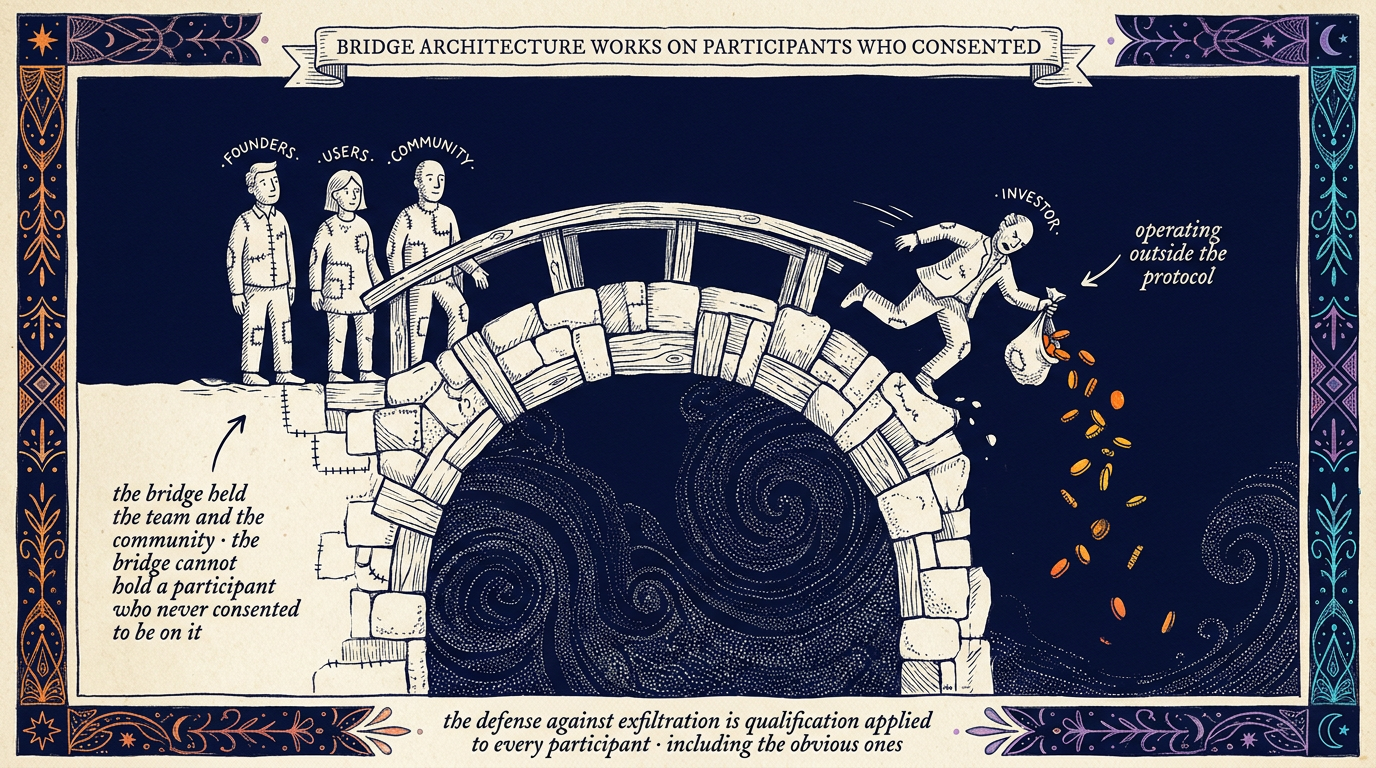
Communication can't enforce powers it doesn't control
In a Polkadot-era project, the market capitalization grew from below roughly $10 million to above $100 million at peak during the period in which I worked on community and marketing. That movement was a market outcome, with contributions and conditions beyond my own work. It shouldn't be described as an amount I produced by communicating well.
The community-growth case also ended in a rug-level outcome. My account describes investors and a founder taking value out while those of us communicating with the community were left exposed. The operational work included partnerships, updates, AMAs and clearer communication. It didn't provide control over every participant capable of damaging the project.
That's the limit the story earns. A team can become better at answering questions while a decisive financial or governance risk remains outside the arrangement it can enforce. Trust in the people visible to the community can be real and still fail to protect the community from someone with a different kind of power.
The lesson is to examine those powers before describing an agreement as aligned. Who controls funds? Who can change the rules? What can the team observe? What can it stop? A promise to participate is different from a constraint that remains effective when participation becomes inconvenient.
This doesn't justify claiming that the team did everything correctly or that no design could have helped. The case is a warning against letting competent communication stand in for an examination of control. It's also a reason to qualify the people behind the engagement, not only the audience or customer visible at its front.
The grant work made accountability part of the offer
A different Web3 engagement involved an African team building a crypto-focused radio initiative. I helped them prepare for grant funding by treating the process as a serious sale to an institution. The team led the initiative and carried it out. My role was consulting on the plan, the objections, the documentation and the systems needed to make the proposal credible.
The African Crypto Radio case reports about $350,000 in grant funding. The supporting work included a programming plan, intended collaborators, budget flows and a CRM with internal and public-facing transparency. These details gave the funder ways to inspect what would happen after approval.
The amount matters less to the transferable method than the relationship between claim and accountability. A proposal about reaching an audience needs an execution plan. A claim about responsible spending needs a way to inspect spending. An objection needs an answer connected to the work, rather than a more emphatic assertion that the team should be trusted.
The setting also contained unequal access and credibility barriers, as I described them in the account. The team's response was detailed preparation and persistence. Their success doesn't establish that those barriers disappeared or that documentation always overcomes them. It establishes what this team achieved with a particular plan and contribution from several people.
Attention has value without a fixed exchange rate
Crypto made the connection between community attention and economic value hard to ignore. It didn't establish a formula that converts a head count into market capitalization. Liquidity, utility, ownership, distribution, expectations and broader market conditions can all affect price. A larger community isn't a controlled comparison with an otherwise identical smaller one.
The general lesson is about arrangements people can inspect. A content relationship, a consulting engagement and a token project each connect people whose interests overlap without becoming identical. The agreement needs to say what participation requires, where authority sits, how evidence is available, and what happens when the relationship fails.
A good explanation can help someone understand an arrangement. It can't make a hidden power subject to that arrangement. The production system behind the explanation must preserve that distinction, or it will manufacture the same confidence the ocean offered on the beach.
A production system has to preserve the evidence
A maker who wants to produce this kind of work repeatedly needs a way to retain what was learned. Otherwise every piece begins by reconstructing the research, the language and the reasons behind the last decision. The labor is real, and so is the opportunity for a qualifier to disappear each time a story is retold.
My retrieval and compiler projects address different parts of that problem. Retrieval makes existing material available to the work. A compiler-like writing process gives parts of a document a form that can be revised and checked without replacing the whole. Neither design makes a claim true merely because the system can reproduce it consistently.
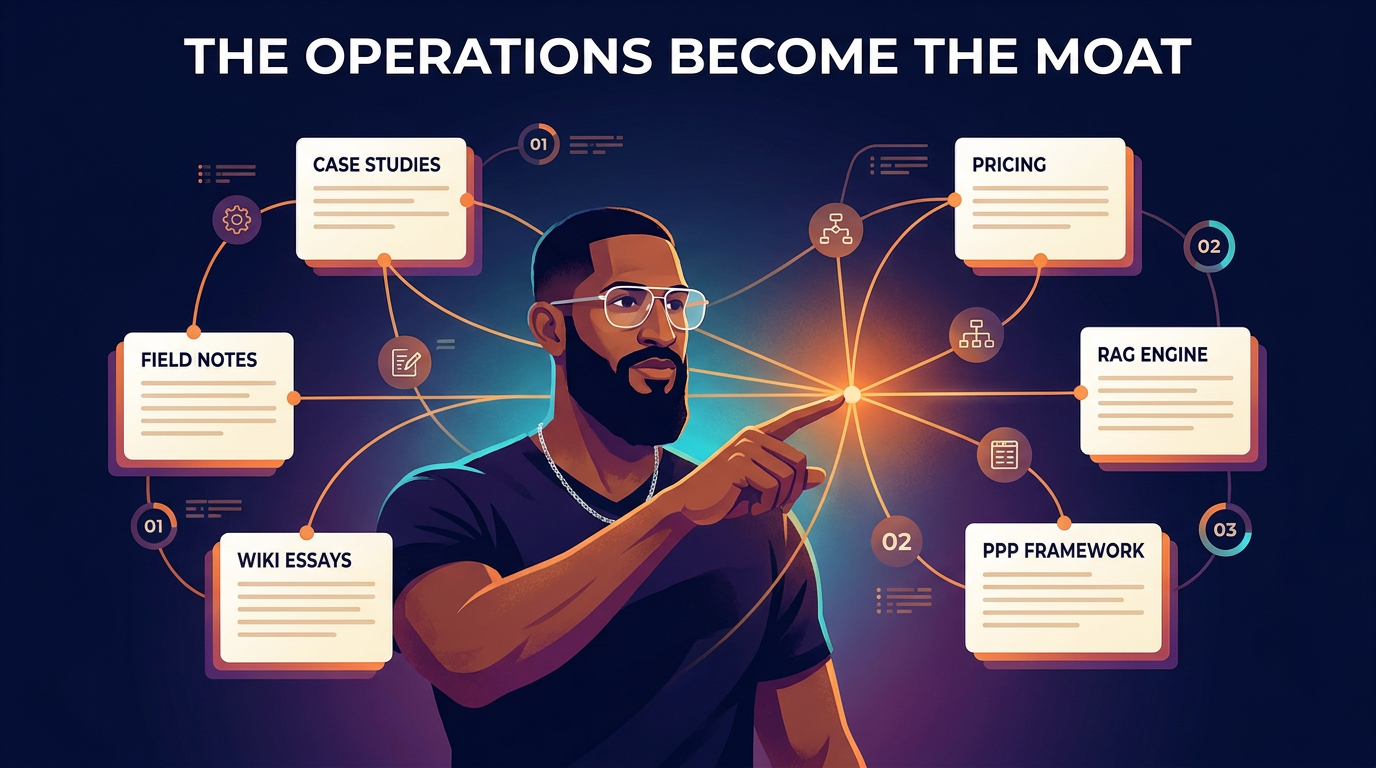
Retrieval needs to return the source with the passage
The historical RAG Knowledge Engine began with my own knowledge base and the need to query it from agents in a code editor. I built on Archon, replacing a uniform chunking approach with treatment suited to different document types. Markdown, textbook PDFs and YouTube transcripts and comments presented different structures and noise.
The implementation used semantic chunking and task-typed embeddings, then exposed retrieval through a local MCP, the Model Context Protocol. The point of the interface was to make the material available as a tool in the working environment. An agent could request relevant passages rather than rely only on a prompt's summary of what the knowledge base supposedly contained.
That's a historical implementation account. It isn't a recommendation to adopt the same model version or a claim about the current state of every part of the system. The durable lesson is the connection between the type of material, the question being asked and the evidence returned.
A useful retrieval result has enough context to preserve what a passage claims. A peak daily figure needs its peak qualifier. A reported result needs the period and the activity being measured. A hypothetical in a source must remain a hypothetical when it becomes an example in a new piece. Finding a matching number is only the start of that work.
The risk of a large private corpus is that familiarity can impersonate corroboration. A claim can appear in a transcript, a case summary and an article because each copied the last. Three appearances may be one account. The source trail needs to reveal that relation before a writer treats repetition as support.
A compiler approach makes a bounded correction possible
The Content Compiler project drew on the idea of an intermediate representation: a structured form between inputs and a finished output. My account describes inspiration from compiler theory and the document object model used by browsers. Sentences and paragraphs become addressable parts of a larger structure, allowing focused operations on them.
At the time of that account, I described a working MVP and a much larger ambition. The ambition included long-form quality, personalization and multiple forms of output. It shouldn't be read as evidence that all of those future capabilities were already achieved, or that every later article ran through the same implementation.
The practical advantage of an addressable passage is that a correction can remain bounded. A sentence has a source problem. The editor changes the sentence, checks the passage around it, and preserves the rest of the document. A whole-document regeneration would ask the system to recreate many decisions that were already settled, including qualifications it might no longer preserve.
The correction also needs to reach every place carrying the same claim. A body paragraph may be repaired while a heading, summary or figure continues to repeat the earlier version. A production system can keep those relationships visible. It still needs an editor to decide whether the changed wording means the same thing at each location.
Shared references reduce reconstruction without replacing judgment
A usable system can connect source records, teaching, case reports, operating notes and an offer. The case report says what happened in a particular engagement. The methodology explains what might transfer. The offer states the work available under present conditions. Keeping those jobs distinct lets each remain useful.
My Constellation thesis concerns that accumulation of operating capacity. A reusable source can improve several pieces of work. A clearer qualification process can protect delivery. Better delivery can supply evidence for later teaching. These connections are worth building because the next activity can begin from something retained and inspectable.
They can also compound mistakes. An unsupported number copied into a source record can reach every downstream explanation that trusts the record. A system that publishes more efficiently can distribute the error more efficiently. Reuse has to preserve a path for disagreement and correction alongside the path for production.
The smallest useful version doesn't require reproducing my stack. It requires a place for sources, a way to distinguish a statement from its interpretation, a record of consequential edits, and a reader who can challenge the completed argument. Add machinery when it solves an actual difficulty in that loop.
The system remains answerable to the reader's job
An observability discipline asks whether a failure can be located and understood. In content work, a comparable question is whether the maker can identify where a consequential claim came from and correct it without losing the rest of the argument. A connection map is useful when it helps that work. A large library on its own doesn't prove the reader received a supported explanation.
The portfolio can expose several views of the same practice: cases, methods, in-progress observations and ways to engage. The visitor should be able to examine the substance before deciding whether to trust the offer. More doors into the material matter only if the material behind them continues to answer the questions those doors promise.
The system's purpose returns to the person reading. It should make useful work easier to produce, easier to inspect and possible to correct. Those are operating conditions for a relationship that can survive the moment when its maker has to say that an earlier account was wrong.
Choose one change the work can responsibly support
The ocean story eventually changes the person trying to understand it. The narrator encounters the limits of his first account, becomes entangled with the world he has been observing, and returns to contact from a different position. The image I retain is the altered observer. Translation has a cost because the translator has to learn something that their starting account couldn't contain.
A creator's version of that cost is ordinary enough to inspect. An audience question changes the next piece. A failed campaign changes what the operator will promise. A source contradiction prevents a favorite number from being repeated. The work has made a difference to the maker as well as asking one of the audience.
The depth of the relationship doesn't depend on every reader becoming a buyer or reporting a life-changing event. It depends on whether the exchange permits something beyond confirmation and whether the people involved can use what they learn. That can happen quietly, through a small decision made with a better understanding.

Put the intended action into a sentence
Before the next piece, write down one change a person could make because the work helped. Use an action that fits the scope of the explanation. Someone could compare two records, test a claim, practice a skill, ask a more useful question, or decide against an unsuitable purchase. Name what they would need to know before acting.
Then examine the obstacle without assuming its cause. The person may lack information, authority, resources, a usable method or a reason to value the result. The explanation has to address the obstacle it can actually affect. Calling every obstacle resistance would hide the design problem.
Choose a next step small enough to be attempted and substantial enough to produce information. State what a useful result would look like and what would make you revise the advice. The reader should be able to decline the step, explain why, and still be treated as a source of information rather than a failed conversion.
That practice gives the maker a different way to read feedback. Praise can be received as praise. Confusion can point toward a missing explanation. An action report can be followed carefully. A refusal can expose a condition the piece missed. No single response has to carry the whole claim about whether the work mattered.
Name the promise you won't make
Write a boundary for the piece as well as an intended result. Perhaps the evidence supports a method without a promised financial outcome. Perhaps the example is historical and its original tactic should no longer be used. Perhaps the work can clarify a decision while leaving the reader to obtain specialist advice before acting.
A boundary should change the wording where the reader needs it. Keeping it in the maker's private notes while the public sentence makes a broader promise does nothing for the relationship. A caveat belongs beside the claim it qualifies, in language a reader can understand without reconstructing the research.
The commercial version also names who can be helped and what participation requires. The ways to engage should make the offer inspectable before a person commits. A prospective buyer needs to understand the work, its limits and their own responsibilities. A useful no remains available on either side.
Return to the unanswered request
The stranded man didn't need a more elegant copy of the broken object. The copy gave him information about the ocean, but it left the repair undone. An audience's response can give the maker information in the same way. What remains is to ask whether the difficulty the work addressed has become more understandable or more possible to change.
A reader who leaves with a question they can investigate has received something different from a reader who leaves only with the expected feeling. A maker who lets that investigation alter the next piece has participated in the exchange too.
The next sentence written in the sand can still be a greeting. It can also contain a question whose answer the writer is prepared to hear.