
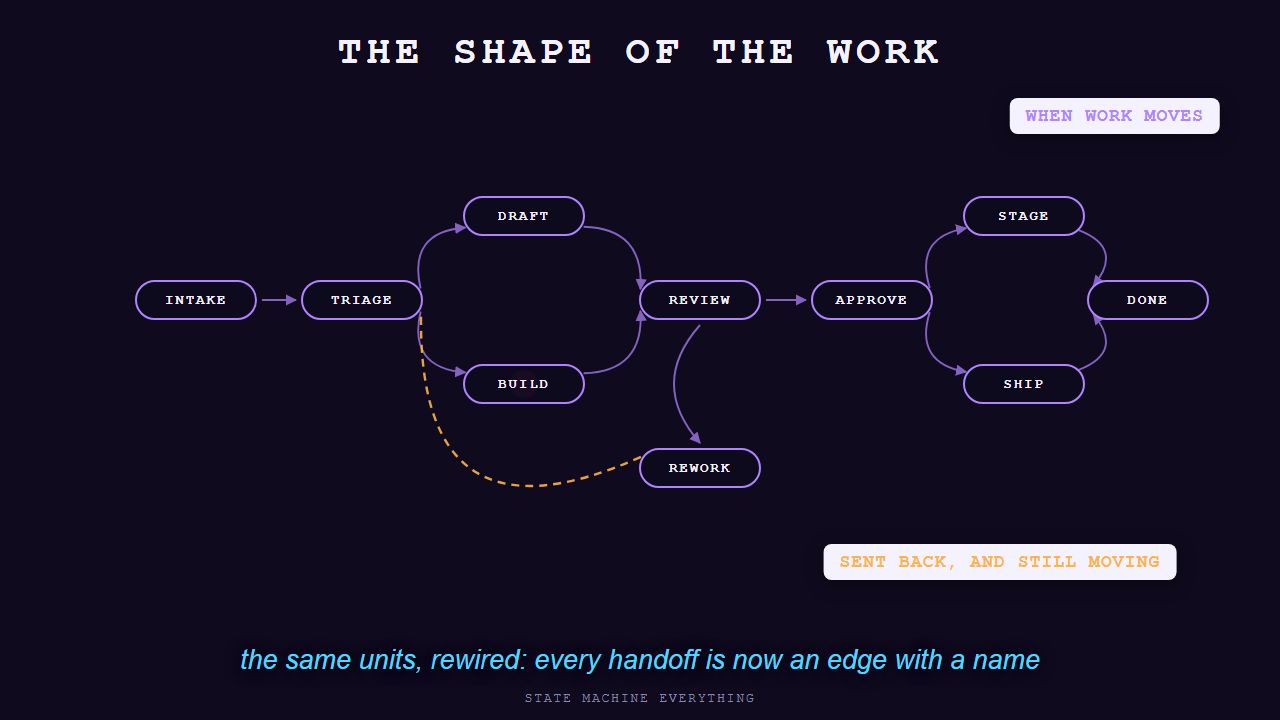
I model every operating system I run as a directed graph, with named nodes, edges that carry conditions, and one state object with a declared owner for every key. An article gets written by a graph. A feature ships through a graph. An enterprise proposal that takes three weeks to assemble gets decomposed the way an expert would decompose it, and what comes out is a graph.
The vocabulary came from LangGraph, a Python library for building agent workflows as state machines. I picked it up to wire agents together, and inside a month I was drawing the same shapes on paper for work that had no agents in it at all: hiring, client onboarding, a launch. A library for orchestrating language models had handed me a precise vocabulary for something I'd been doing badly for years without one.
This entry is that vocabulary and the four moves it buys you: conditional gates that carry a quality requirement, fan-out and fan-in for exploration that doesn't collapse into an average, parallelism that falls out of the structure instead of out of somebody's attention, and cycles, because real work gets sent back. Everything here comes from systems I run, including one production LangGraph whose verification node I'll walk through line by line.
Where the org chart stops answering
Every handoff passed and the work shipped broken anyway
An agent finishes a piece of work and reports back: work committed, lint clean, ready for review. I read the report, review the diff, merge it, move on. Days later a page on the live site is wrong in a way a single look would have caught, and I go back through the history trying to find who dropped it.
Nobody dropped it. That's what makes this failure worth writing about instead of just complaining about. The implementer did the work they were briefed on. The reviewer read the diff they were handed. I merged a branch that built and passed every check that ran against it. Every party in that chain satisfied their own definition of done, and the thing still came out broken, because the defect lived in the transition and nobody owned transitions.
Play it back and the gap is specific. The implementer's definition of done was "the code compiles and the tests pass." The reviewer's was "the diff does what the brief says." Mine was "the branch is green." None of those three sentences contains the one that mattered, which is that a rendered page is done when somebody has loaded the deployed URL and looked at it. That sentence lived in my head, and my head isn't a system.
The fix people reach for first is to write it down harder. Add it to the checklist. Say it in the brief. Repeat it at standup. That is workflow design by accumulation, and it works for about two weeks, which is roughly how long it takes a busy team to start reading the checklist as decoration. The decay is structural rather than cultural. A checklist item is an instruction addressed to a person, and instructions addressed to people compete with everything else addressed to those people that week.
The version that survives contact is different in kind. You stop writing the requirement as an instruction and start writing it as a condition on the transition itself. Work doesn't move from review to merge because somebody believes it's ready. It moves because a named condition evaluated true, and when the condition evaluates false the work goes somewhere else, which is usually backward.
Three questions, and most structures answer one
Any piece of work in motion raises three questions. Most operating structures are built to answer one of them well, and the one they skip is the expensive one.
Who is responsible. An org chart answers this and answers it well. That's what an org chart is for, and dismissing it would be silly. When something breaks and you need to know who has the authority to fix it, a hierarchy gives you a fast answer and a short escalation path. I have never worked with a company that got value from deleting its org chart.
What happens next. A checklist or a linear process document answers this, and also genuinely works. A sequence is the cheapest possible model of work and it's correct far more often than graph enthusiasts admit. Onboarding a laptop is a checklist. Closing the books is a checklist. Anything where the steps are fixed, the order is fixed, and nothing gets sent back is a checklist, and converting it to a graph is an act of self-harm.
Under what condition may the work move. This is the question neither structure answers, and it's where the money goes. An org chart has no place to write it, because a box on an org chart holds a person and a condition isn't a property of a person. A checklist has no place either, because the arrow between step four and step five is implicit. It's the whitespace between two lines of text, and you can't attach a requirement to whitespace.

Model the work as a graph and that third question finally gets a home. The condition lives on the edge. It has a name, an owner, an evaluation rule, and a defined behavior when it comes back false. It becomes a thing you can point at in a review, argue about on purpose, test before you rely on it, and change deliberately when it turns out to be wrong.
That's the whole move. Everything else here is consequences of it.
Node, edge, state · the entire vocabulary
Three words carry the whole method. Learning them takes about ten minutes. Applying them to a business you already run takes about a day and tends to be uncomfortable, because the exercise surfaces every place where two people believe they own the same thing.
A node is a contract, not a person
A node is one unit of work with a declared contract. The contract has three parts and all three are mandatory: what it takes in, what it produces, and what counts as failure. A node with no declared failure condition isn't a node yet. It's a wish.
A node is a contract rather than a person, a job title, or a team. "Produce the campaign brief from the intake form and the buyer research, and fail if either input is missing" is a node, and "Marketing" isn't. The same human can occupy six nodes across three graphs in the same week, and a node can be occupied by a different person, a script, or an agent on Tuesday than it was on Monday, without the graph changing at all.

That separation is the first thing the model buys you. Once work is described by contracts rather than by people, you can reason about the work while the staffing changes underneath it. A contractor leaving stops being a crisis about knowledge in someone's head and becomes a question about which node needs a new occupant.
The rule I use to test whether a node is real: hand its contract to a competent stranger and see whether they could execute it without asking you a question. If they'd have to ask, the contract has a hole, and the hole is exactly where the work will fail when you're on a plane.
An edge is a condition, not an arrow
An edge connects two nodes and carries the condition under which work travels along it. The arrow is the cheap part. Anyone can draw arrows. The condition is the expensive part and the part that gets skipped.
There are exactly two kinds of edge and it's worth being pedantic about the difference, because mixing them up is the most common modeling error I see.
- An unconditional edge means the work always goes here next. It carries no decision. Most edges in a healthy graph are this kind, and that's fine; a graph where every edge is a decision is a graph nobody can follow.
- A conditional edge means a named function looks at the current state and returns the name of the next node. One input, several possible destinations, and the choice is made from data rather than from memory or mood.
In LangGraph the second kind is add_conditional_edges, and it takes the source node, a routing function, and the set of destinations that function is allowed to return. The routing function receives the state and returns a node name. That signature is worth sitting with, because it enforces something an org chart can't: the decision is a function of the state, and the set of possible outcomes is declared in advance. A router that could return anything is a router nobody can reason about.
Translate that into a business and you get a discipline most approval processes lack. "The manager decides whether it goes out" is an org-chart sentence. "It goes out when the claim check passes and the legal flag is clear, and otherwise it goes back to the author with the failing check named" is an edge. The second version can be audited after the fact. The first can only be re-litigated.
State is owned, and the owner is named
State is the object that flows through the graph. In a writing system it holds the brief, the research, the outline, the draft, and the review findings. In a sales system it holds the account, the qualification answers, the proposal, and the objection log. Nodes read from it and return updates to it.
One detail changed how I run teams, and most people who use these libraries never look at it.
When you declare a state key in LangGraph without saying how updates to it should be merged, the library backs that key with a channel called LastValue. Read its implementation and the docstring says it "stores the last value received, can receive at most one value per step." Send it two updates in one step and it doesn't take the newer one, and it doesn't take the older one. It raises an error, and the error text is this:
At key '{key}': Can receive only one value per step. Use an Annotated key to handle multiple values.
The framework refuses to guess. Two nodes writing the same key in the same step produces a crash rather than a silently resolved race. The error carries a code named INVALID_CONCURRENT_GRAPH_UPDATE, and the only way to make it stop is to declare a merge rule for that key: append the values, add them, take a maximum, run your own function. The declaration is called a reducer, and it's the author saying out loud what should happen when two writers collide.
Sit with what that means outside the library. Every operation I've audited has at least one field that two functions both believe they own. The lead status that sales updates and marketing automation also updates. The launch date that the PM keeps in the project tool and the founder keeps in their head. The price that lives in the proposal, the CRM, and the invoice template. In an operation, a collision on those fields doesn't raise an error. It produces a number, quietly, and the number is whoever wrote last.
Undeclared shared ownership is a defect a correct system refuses to run, rather than a soft problem better communication fixes. The library made me see it because the library crashed. The business version doesn't crash; it just gets a wrong answer and keeps going, which is worse, because a crash tells you where to look.
So the state rule I now apply to every operation: every field has exactly one writer, and if a field genuinely has two, the merge rule gets written down before anyone touches it. Not "we'll coordinate." A rule. Sales owns stage; marketing writes score; when both fire in the same hour, score loses. That sentence takes thirty seconds to write and removes an entire category of argument permanently.
Each of those three parts fails in its own way when it's left implicit.
Everything from here builds on those three, and the structures most companies use instead can't express them.
Where flat structures break, and the research that got there first
What the flat structures genuinely earn
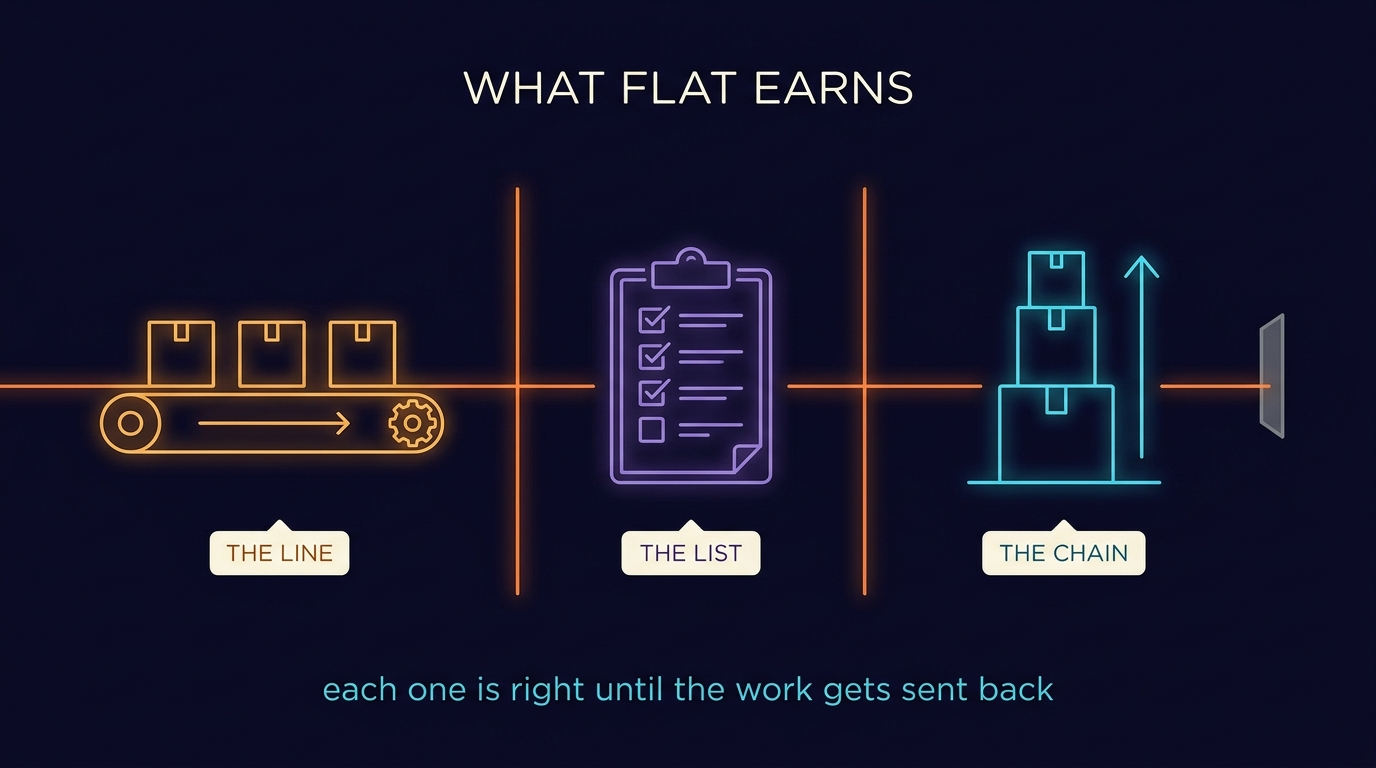
Three flat structures run most companies, and each of them is good at something specific. Being precise about what they earn is the only way to be credible about where they fail.
The assembly line earns throughput on repeated identical work. Break a job into fixed stations, staff each station, and per-unit cost drops. When the work really is identical every time, this is unbeatable and no amount of modeling improves on it.
The checklist earns reliability on sequences where omission is the main risk. Atul Gawande's surgical work made this famous for good reason. A pilot's pre-flight and an accountant's close both benefit enormously from a list, because the failure mode being defended against is forgetting a step, and a list is the correct instrument for forgetting.
The role hierarchy earns fast escalation and clear authority. Somebody is accountable, somebody above them can override, and the chain terminates. Coordination costs drop because you don't have to negotiate who decides every time something is ambiguous.
All three share one property, and it's the property that eventually bites. Each of them encodes the structure of the work implicitly, in a form that has no slot for a condition. The assembly line assumes the piece always moves forward. The checklist assumes you never go back to step two. The hierarchy assumes the escalation path is the coordination path. Those assumptions hold until the work has to be revised, explored, or done four ways at once, and then all three degrade into the same thing: people talking to each other and hoping.
Flash organizations, and the part Stanford got right
The most serious research attempt at this problem came out of Stanford's HCI group, and it deserves to be represented accurately rather than used as a foil.
At UIST in 2014, Retelny, Valentine, Bernstein and colleagues published flash teams, a framework for assembling paid experts from the crowd. Their teams, in the paper's words, "consist of sequences of linked modular tasks and handoffs that can be computationally managed." The representation is worth reading carefully, because it undercuts the lazy version of this argument. A flash team is a graph. Blocks hold role-specific tasks with declared inputs, outputs, and durations. Directed dependencies connect them. Their platform, Foundry, reads that graph to recruit the experts, schedule them, and route artifacts between blocks. It hires elastically as task needs change, and it pipelines intermediate output, starting a downstream block as soon as the upstream one has produced enough to be useful.
That is a task dependency graph with roles attached, built and shipped in 2014. It worked. The paper reports crowdsourcing design prototyping, course development, and film animation "in half the work time of traditional self-managed teams."
Then at CHI in 2017, Valentine, Retelny and the same group published flash organizations. Flash teams fixed their tasks, roles, and dependencies at authoring time, and open-ended projects refuse to hold still, so the group changed the primitive. Their abstract names the move:
This paper introduces flash organizations: crowds structured like organizations to achieve complex and open-ended goals. Microtask workflows, the dominant crowdsourcing structures today, only enable goals that are so simple and modular that their path can be entirely pre-defined.
The paper claims two technical contributions, which I'll give in its terms. The division of labor gets encoded into "de-individualized roles," the way a film crew or a disaster response team assigns roles to people who have never worked together before. Those structures then get reconfigured "through a model inspired by version control," which allows the work and the division of labor to keep adapting after the project starts.
The group's conference talk makes that second mechanism literal. Any member can "branch, edit, and issue pull requests against any organizational structure: roles, teams, hierarchy, tasks," and those pull requests are "reviewed up the hierarchy and merged through a three-way diff." A member proposes a new role, a split team, or a changed reporting line, and it gets approved into the live structure by the levels above. Hiring runs continuously rather than up front, because the role structure keeps changing.
They were right about the diagnosis. A fixed graph can't carry open-ended work, and that finding is solid. Anyone who has watched a Gantt chart survive first contact with a real project knows it in their body.
Two roads lead out of that finding. They took one of them.
A tree is a graph with the interesting edges deleted
A role hierarchy is already a graph. It's a specific, restricted one: a tree. A tree has properties that follow from its definition rather than from anyone's design choices, and those properties took me years to notice because the org chart is such familiar furniture that nobody reads it as a data structure.
A tree has exactly one path between any two nodes. No cycles, by definition, because a cycle is what a tree is defined by not having. Every node has one parent. Information moving between two siblings has to route up through their common ancestor and back down.
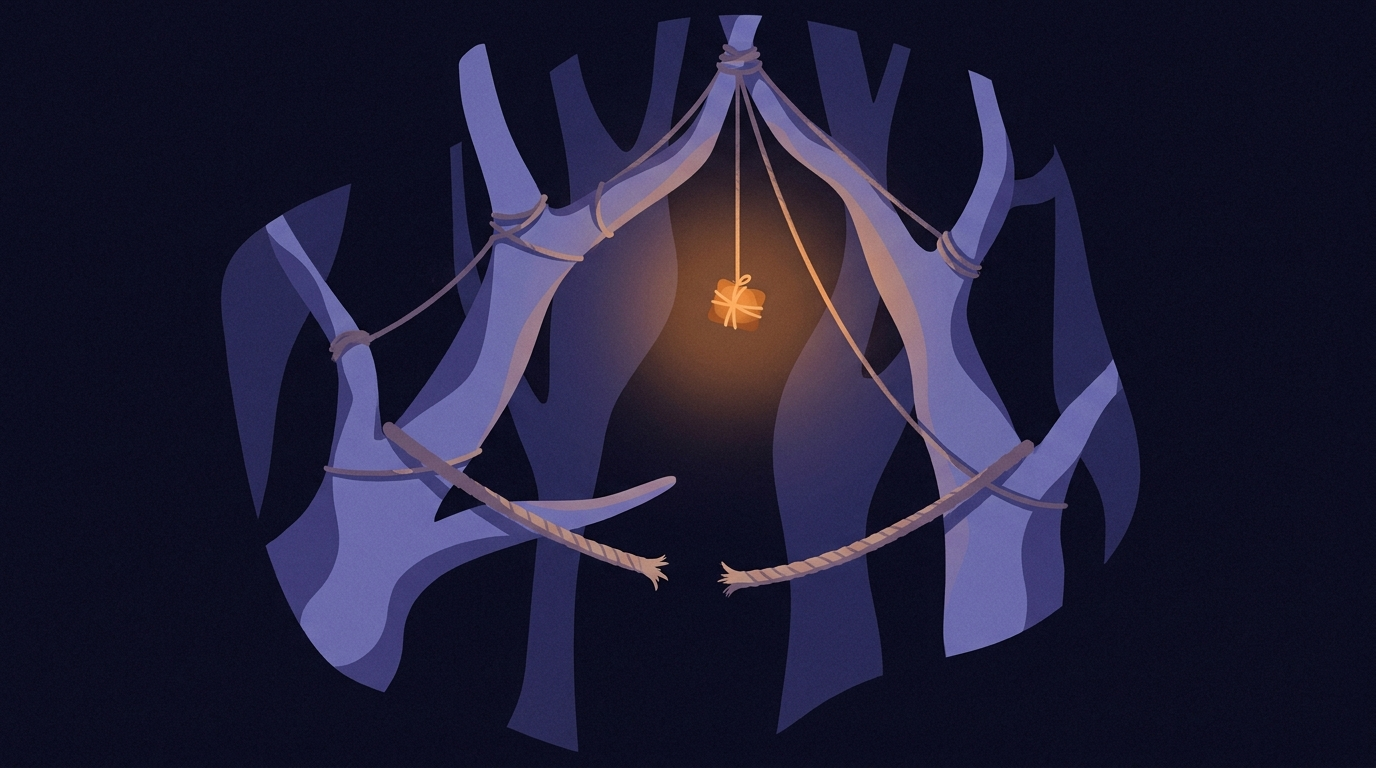
Those properties have hard operational consequences, and they're the reason coordination in a hierarchy always feels like it costs more than it should:
- A tree can't express a rework loop. The send-back from review to author is a cycle, and a cycle is precisely the thing a tree excludes. In a hierarchy the send-back happens, obviously, but it happens off the structure, in a Slack message. It's real work with no representation, which is why it never appears in any estimate.
- A tree can't express a fan-in. Three specialists producing three inputs that one decision has to combine is a node with three parents, and a tree gives every node one parent. So the merge happens in a meeting, and the meeting is load-bearing infrastructure that nobody documented.
- A tree can't express a lateral dependency. Engineering needs a thing from legal. The tree's only path runs up to whoever manages both, which is usually a VP with no context, so the actual path is a back channel and the org chart is now fiction.
So the flash organizations pull request mechanism starts to look like something specific. It's how you recover expressiveness that the tree structurally lacks. When your primitive can't represent a needed relationship, you add a runtime process for editing the primitive. That works, and their deployments show it works. It also means every structural adaptation costs a proposal, a review, and an approval, which is a lot of ceremony to pay for the fact that you can't draw an arrow backward.
Harel took the other road in 1987
The other road was mapped thirty years before the flash organizations paper, in a different field, against the same problem.
David Harel's Statecharts: A Visual Formalism for Complex Systems, published in Science of Computer Programming in 1987, starts from the observation that plain finite state machines become unusable on real systems. His target was the class he called reactive systems: avionics, embedded controllers, communication switches, anything that has to keep responding to its environment rather than compute an answer and halt. Flat state diagrams blow up on them. Model a few independent modes and the state count is their Cartesian product, so the diagram grows past readability long before the system grows past ordinary. The name for that is state explosion, and it's the same complaint the Stanford group had about fixed workflows, arriving from the reactive-systems side instead of the crowdsourcing side.
Harel's answer was to keep the graph and give it more expressive power. He added three things:
- Depth. A state can contain substates, so you describe a mode once and refine it, instead of enumerating every combination.
- Orthogonality. A state can hold concurrent regions that are active at the same time, so three independent behaviors are three small diagrams rather than one diagram with their product of states.
- Broadcast communication. One event reaches every region at once, so coordination doesn't require wiring every pair of components together by hand.
Notice that hierarchy appears in Harel's answer too. He didn't reject it. He put hierarchy inside the graph as one of several structuring tools, alongside concurrency and event broadcast, and kept the explicit transitions with their conditions. The graph stayed the representation; hierarchy became a feature of it.
That's the fork. Both roads recognize that flat structures fail on complex work. One trades the explicit representation for a hierarchy plus a process for editing the hierarchy. The other keeps the explicit representation and makes it expressive enough that runtime change is a normal thing it does rather than an exception it needs a committee for.
The workflow research community spent years cataloguing exactly which capabilities separate the two roads. Wil van der Aalst and Arthur ter Hofstede's Workflow Patterns Initiative enumerated the recurring control-flow constructs real processes need, then tested actual commercial workflow systems against the list. The systems handled sequences, exclusive choices, and simple parallel splits well. They struggled or failed on arbitrary cycles, complex synchronization, and multi-instance patterns where the number of parallel branches is decided at runtime.
That failure list is a precise description of what a tree and a fixed pipeline both can't do. It comes down to loops, real merges, and dynamic parallelism, which is the same list as the four moves from the top of this entry, arrived at independently by people with formal methods instead of client work.
The four moves a graph makes available
Four moves separate a graph from a list. Each one has a name in the workflow literature, an implementation in any state-machine library, and a form it already takes in a business whose operating systems are designed rather than inherited. Each also has a characteristic way of being drawn wrong.
Conditional gates, and what a gate with teeth costs
A gate is a conditional edge whose condition is a quality requirement. Work arrives, the condition evaluates, and the work goes forward or somewhere else. Three properties separate a gate that holds from a gate that's theater, and all three are required.
The condition evaluates something observable. "The reviewer is satisfied" isn't observable. "Every claim in the draft resolves to a source in the corpus" is observable, because you can run it and get an answer that doesn't depend on who ran it. The moment a gate's condition is a state of mind, the gate has become a person, and people under load approve things.
The false branch is defined and it goes somewhere real. This is where most gates die. Somebody draws the approval step, writes down the criterion, and then never writes down what happens when the criterion fails. So when it fails, the failure is a conversation, and conversations under deadline resolve toward shipping. A gate without a declared false branch isn't a gate; it's a speed bump with a sign.

The party that evaluates isn't the party that did the work. An implementer's self-report is evidence about the implementer's confidence rather than about the work. I run this as a hard rule now because I broke it repeatedly and paid for it every time: the agent doing the building never produces the artifact that proves the building is correct.
Ask when a gate last failed something. If the answer is "it hasn't," what you have is a ritual. Real gates fail work regularly, that's the entire point of building them, and a team that experiences a gate as an occasional annoyance is a team whose gate is doing its job.
A gate isn't free. Every gate adds a stop. Every stop adds latency, and if the false branch fires the work travels backward and the latency compounds. That cost is exactly what you're buying: you're paying in cycle time to stop paying in defects that reach a customer. Where a defect is cheap to fix downstream, the trade is bad and you shouldn't build the gate. Where a defect reaches a client's inbox, the trade is obvious.
Fan-out and fan-in, for exploration that doesn't average
Fan-out is one node producing several parallel branches. Fan-in is the node that collects them. In LangGraph the dynamic form is the Send primitive: a node returns a list of Send(target, payload) objects, and the runtime dispatches each one as its own invocation. The count is decided at runtime from the state, so a plan with three tasks fans into three workers and a plan with nine fans into nine, with no change to the graph.
The business version is the thing good creative directors have always done and rarely written down. You brief three people separately, on purpose, rather than asking one person for one campaign concept, and you keep them apart while they work.
Isolation is what makes fan-out worth paying for. Three people in a room produce one idea with three sets of fingerprints, because the first idea spoken anchors the other two. Three people working separately produce three genuinely different starting points. The separation is the mechanism, and a fan-out where the branches can see each other has quietly become a single branch with extra headcount.
The fan-in is where the value usually gets destroyed. The merge rule has to be declared before the branches run. It's the same reducer question from earlier, arriving now in creative work: when three writers hand you three answers, what combines them?
There are only a few answers that survive contact, and picking one in advance is the whole discipline.
- Select. One branch wins whole, on a criterion named before anyone started. The losing branches are discarded intact rather than harvested for parts.
- Concatenate. All branches survive as separate artifacts, because the downstream consumer wants coverage rather than a single answer. Research fan-outs usually want this.
- Score and rank. A named rubric runs against each branch and the output is an ordering, which is useful when a human makes the final call and wants their reasoning constrained.
- Synthesize under a stated constraint. A new artifact gets built from the branches by a node that has its own contract, which is legitimate exactly when the synthesis is itself skilled work with a declared bar.
The failure mode is the one that isn't on that list: taking the safe middle of three directions. That's an average, and the average of three creative directions is reliably worse than any of the three, because each one was coherent and the blend is coherent with nothing. It happens because nobody decided the merge rule, and in the absence of a rule the group reaches for the option that offends no one. Naming the merge rule before the fan-out is how you stop it, and it takes one sentence in the brief.

Parallelism is a property of the graph, not of the manager
Most teams run serially without deciding to. The work goes one thing at a time because that's how it got written down, and it got written down as a list because a list is what people reach for. Nobody ever asked which steps actually depend on which.

Draw the same work as a graph and the answer stops being a matter of opinion. Two nodes can run at the same time when neither is reachable from the other. That's a structural property you read off the drawing, not a judgment call somebody makes on a Monday.
Every time I've drawn a real process for the first time, the same thing happened: a third to a half of the sequence turned out to be false dependencies. Step four came after step three in the document because somebody typed it there, and step four needed nothing from step three at all. On the list it looked like an ordering. On the graph it was two disconnected nodes sitting next to each other, and the pointlessness of running them one after another became visually obvious.
The operating consequence matters more than the diagram. In a serial shop, when one thing blocks, everything behind it waits, and the wait is invisible because the queue is implicit. In a graph, a block on one node is a block on that node's descendants and on nothing else. Every other branch keeps running, and it keeps running by default rather than because a manager noticed and reassigned people.
That's the discipline I keep having to re-learn when I'm running several lanes, meaning parallel streams of work, at once. The instinct when something blocks is to work the block, because the block is the loudest thing in the room. The correct move is to audit which lanes the block doesn't touch and start every one of them, then work the block in its own thread. A blocked node blocks its descendants, and treating it as though it blocks the whole graph is how a five-lane team produces one lane's output.
Cycles, because real work gets sent back
The fourth move is the one that separates this from every project-management tool on the market, and it's the reason I stopped trying to make DAG tools fit.
Airflow and Dagster model work as directed acyclic graphs. Acyclic is in the name and in the constraint: you can't draw an edge backward. That restriction is correct for what those tools were built for, which is data pipelines, where a stage runs, produces output, and never gets asked to run again on the same input.
Real work with humans and judgment in it isn't shaped like that. A draft comes back. A design gets rejected. A proposal gets a question that sends discovery back open. The send-back is a cycle, and a cycle is exactly what an acyclic graph excludes by definition.
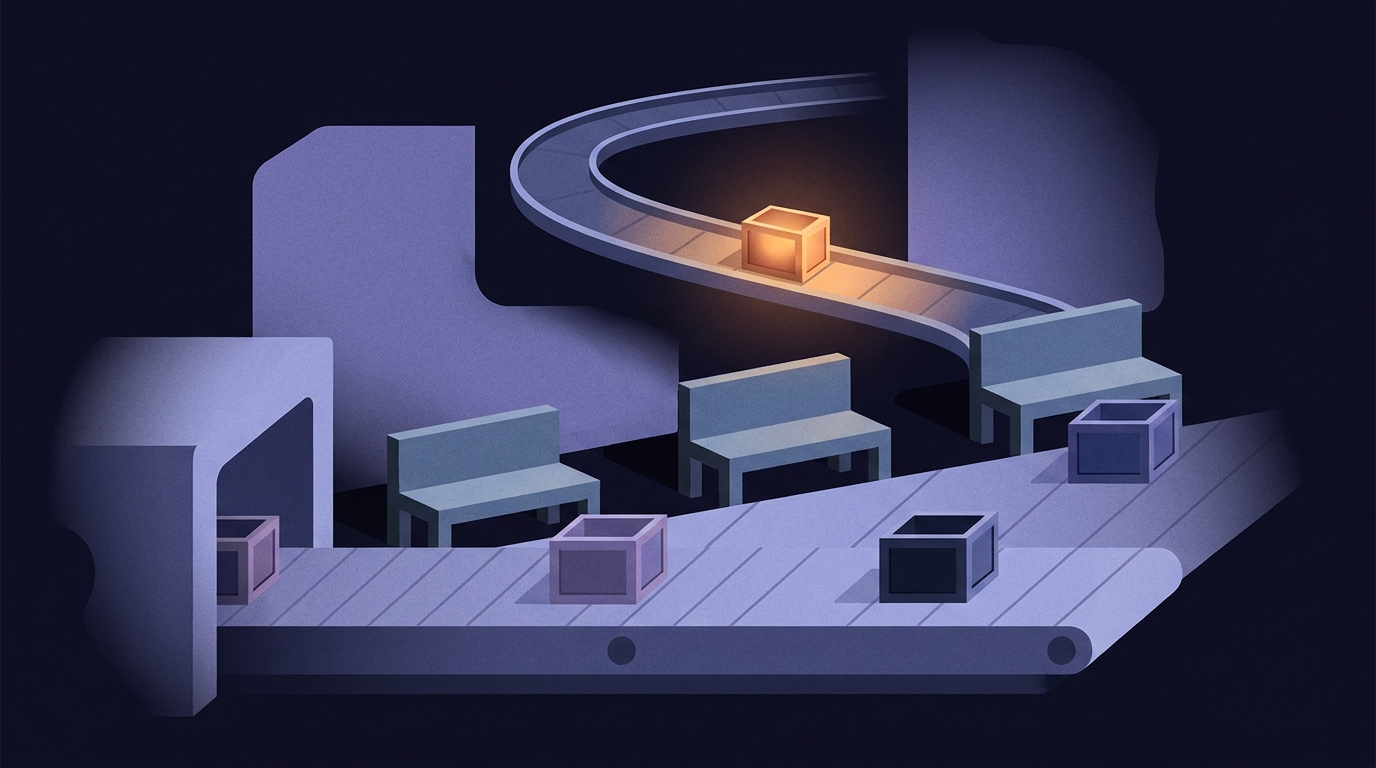
Force that work into a DAG and you get one of two outcomes, both bad. Either you unroll the loop into "draft one, review one, draft two, review two, draft three" and the graph inflates with copies of the same node while still capping the rework at whatever number you guessed, or you hide the loop inside a node's implementation and the graph shows a single box labeled "writing" that internally contains three weeks of revision nobody can see. The first is combinatorial mess. The second is the loop leaving the map, which is where it was before you started drawing.
Systems built for this let you draw the edge backward. LangGraph permits cycles directly, and guards against the obvious failure with a step limit: exhaust it and you get GraphRecursionError, whose docstring says plainly that it exists to prevent infinite loops and that you raise the ceiling deliberately by passing a higher recursion_limit in the run config. Temporal takes the same position from the durability side, running workflow code with ordinary loops and recursion, recording every step to an event log so a crashed workflow replays its history and resumes.
That replay mechanism is the same idea as a checkpointer, and it has a business analogue. Temporal reconstructs state by replaying the event log, which requires the workflow code to be deterministic with respect to that history. An operation that can reconstruct how a decision was reached from a durable record has the same property, and an operation that can't has a state machine running in people's memories.
The one rule cycles need is a bound. An unbounded loop in a business is a project that never ships, and it looks exactly like a design going through its ninth round with everyone too invested to stop. Bounding it is one line: after N passes the work leaves the loop and goes somewhere else, usually to a human with authority to accept it, cut its scope, or kill it. The system I run caps attempts and routes an exhausted task to a terminal state named ABANDONED, which is deliberately an ugly word, because a task that quietly retried forever would be worse than one that stopped and said so.
Worked example one · the team is the graph
This entry was written by the graph in this section. The nodes named here are the nodes that ran, and the send-back edge fired twice.
The instinct when you need a long piece written is to find a good writer and give them the topic. That works when the writer already holds the domain. When they don't, what comes back is fluent and hollow, and the failure surfaces two weeks later when somebody who knows the subject reads it. The graph exists to put the failure earlier and cheaper.
The nodes, with their contracts
The graph has nine nodes, each with declared inputs, outputs, and a failure condition, and I call them by the names they carry in the repo, because a node name that matches nothing in the repo is a node nobody executes.
The research fan-out is three because the piece needed three unrelated kinds of correctness, and each one contaminates the others if the same reader chases all three. One branch got the library primitives right, working from installed source rather than documentation. One got the lineage right, reading what the prior art actually claimed. One got the operator's real practice right, reading the systems that already run. A single researcher chasing all three produces a blend where the weakest branch quietly sets the standard for the other two, because attention is finite and the interesting thread wins.
The fan-in rule for research is concatenate rather than synthesize, and picking that in advance mattered. Synthesis at the research stage is where a nuance dies: the prior-art branch came back saying flash teams were a dependency graph and flash organizations deliberately moved away from one, which is a distinction a synthesizing node would have flattened into "Stanford did crowdsourcing research." The whole third section of this entry lives inside that distinction.
The three gates, and what each one refuses
Three conditional edges carry the quality of the whole thing. Each one names what it checks and where the work goes when the check fails.
- The outline gate. Condition: every value point in the brief has a section that lands it, and every planned cut is named with its reason. The false branch goes back to outline. This gate is cheap to pass and it prevents the expensive failure, which is discovering after ten thousand words that the piece answers a different question than the one commissioned.
- The QC gate. Condition: an independent reader working from the complete artifact finds no voice-floor violation, no unsourced claim, and no dead stretch. The false branch goes back to prose with the specific defect named, never to a general instruction to improve. This one fired twice on this entry.
- The live gate. Condition: the deployed production URL has been fetched and the change is visibly present on it. The false branch goes back to build. Nothing else satisfies this gate. A green pipeline doesn't, a merged branch doesn't, and a screenshot of a local server doesn't.
The live gate is the one I had to learn expensively, and it's the one most teams are missing. A week of approved copy once sat in a spec while everyone involved described the work as done, because every intermediate signal said done. Committed is a claim about a repository. Live is a claim about what a stranger sees. Only the second one is the thing anyone was paying for, so only the second one belongs on the gate.
The state, and who writes each key
A state table is the artifact that stops the arguments, and it's the one most teams never write: one row per key, one writer per row, and where a key genuinely has two writers, the merge rule sits in the row. Naming the writer is the same discipline as tracking provenance in a data system, applied to work instead of records.
In this graph's state table, the key that does the most work is body. It has one writer, and every other node reads it. That single constraint kills the failure where a reviewer edits the draft directly, the writer keeps writing from their own copy, and the two versions diverge until somebody spends an afternoon reconciling them. In a graph, the reviewer's output goes into findings, and the writer applies findings to body. Review produces findings; only the author produces text. That's a one-sentence policy, and it's a reducer.
Worked example two · rolling out a feature
A feature rollout is the example where the graph earns its keep fastest, because rollouts already have the two things flat structures handle worst: genuinely independent work that shops run serially, and a reverse transition everyone talks about and nobody specifies.
Four branches that were never actually sequential
The spec node produces one artifact: what the feature does, what changes underneath it, and what has to be true for it to be considered working. Four branches fan out from it, and on most teams these four run one after another for no reason anyone can defend.
- build writes the feature. It reads the spec and writes code.
- migration makes the data shape ready. It reads the spec's schema section and writes a migration that is safe to run before the feature exists.
- instrumentation makes the feature measurable. It reads the spec's success criteria and writes the events and dashboards that will report on them.
- docs makes the feature explicable. It reads the spec and writes the customer-facing and internal copy.
All four read the spec. None of them reads any of the others. That's the definition of parallel, and it's a structural fact rather than a scheduling preference, which is exactly why the graph settles the argument that the project plan can't.
Instrumentation is the branch that gets cut when a deadline tightens, and cutting it is the specific mistake the graph exposes. The metric gate downstream reads state that instrumentation writes. Drop instrumentation and the gate has nothing to evaluate, so it degrades into somebody watching a dashboard and forming an impression. On a checklist, instrumentation looks like an optional step near the end. On the graph, it's a node the gate depends on, and cutting it visibly disconnects the gate from its input.
The fan-in at integration has a merge rule, and it's the strict one: all four branches present, or the node doesn't run. No partial integration. That rule is the reason a rollout stops shipping with the docs half written and the events landing in a table nobody queries. In workflow-pattern vocabulary this is a synchronizing join rather than a simple merge, and the difference between those two is the difference between waiting for everything and continuing on whatever showed up.
A router with three declared destinations
After integration and a staging gate, the feature reaches a canary: a small slice of real traffic, chosen so a defect is survivable. Then comes the interesting edge.
The metric gate is a routing function that reads the state instrumentation wrote and returns one of three node names. All three are declared in advance, and that constraint is the whole value.
Most rollouts have two of those three and improvise the third, the flat-metric case, which is the common reality, and without a declared hold destination it gets resolved by whoever is most senior in the channel at the time, which produces different answers on different days for identical data. Naming hold as a real destination with its own repeat bound converts a recurring argument into a rule somebody wrote once.
The rollback edge, and why a rollback plan is not one
Every team has a rollback plan. Almost no team has a rollback edge, and the difference isn't semantic.
A rollback plan is a document describing what would be done. It has no trigger, no owner at the moment of firing, and no rehearsal. It's read during the incident, which is the worst possible time to read anything.
A rollback edge is a transition in the graph with three properties: a condition that fires it, a party that owns firing it, and a destination state the system is known to reach. It gets designed with the same care as the forward path, and it gets exercised, because an edge nobody has traversed is an edge nobody knows works.
The test takes one question. Ask what number fires the rollback and who fires it. A team with an edge answers immediately and the two halves of the answer agree. A team with a plan says something like "we'd look at the errors and make a call," which is an accurate description of having no edge at all.
There's a second-order consequence worth having. Once rollback is an edge rather than a judgment, firing it stops being an admission of failure and becomes an ordinary traversal. That changes behavior under pressure more than any amount of blameless-postmortem language does, because the engineer who fires it is following the graph rather than making a career decision at two in the morning. A reverse transition that is drawn is a reverse transition people are willing to take.
The ramp loop is the cycle in this graph, and it's bounded by construction: traffic steps at one percent, five, twenty-five, and a hundred, with the metric gate evaluated at each step. Four passes, then the loop is over because there's no larger step. That's the cleanest kind of bound, where the loop terminates because it ran out of work rather than because a counter stopped it, and it's worth looking for that shape before reaching for a counter.
Worked example three · the intensive enterprise proposal
Ask a novice to decompose a large proposal and you get a list of document sections. Ask somebody who has won and lost a lot of them and you get something structurally different, and the difference isn't the number of steps.
An expert's decomposition puts most of its design effort into where the gates go, and a novice's puts all of it into the document. That single distinction predicts the outcome better than writing skill does, because the expensive proposal failures are almost never bad prose. They're a beautiful document answering a problem the buyer doesn't have, or arriving at a buyer who was never going to sign anything.
The gate that runs before anything gets written
The first gate sits before the first paragraph, and it's the highest-leverage edge in the whole graph. Its condition has five parts, and a genuine no on any one of them routes the work to a terminal node named decline.
- A budget band exists and somebody said it out loud. It's a range they confirmed, not a number I guessed from their headcount.
- The person in the room can sign, or can name the person who signs. Anything vaguer than that is a research project wearing a sales conversation's clothes.
- There is a named problem with a cost attached. "We want to explore AI" has no cost. "Our support team reads the same forty tickets every week and we're hiring a third person to keep up" has one.
- Doing nothing has a consequence. If the business survives ninety days of inaction comfortably, the work isn't urgent and the proposal will sit in a drawer regardless of quality.
- They can describe what success looks like at ninety days. Vagueness here is the reliable predictor of scope creep later, because a buyer who can't say what winning looks like will keep revising the definition.
Decline is a real node with a real output rather than a polite silence. It produces a short reply naming what would have to be true for this to be a fit, plus a pointer to something useful. That artifact matters commercially: a clean decline generates referrals at a rate that surprised me the first year I started doing it deliberately, and it costs a fraction of what a doomed proposal costs. The reasoning behind that gate, and the sales system built around it, is The Velvet Rope.
The reason this gate has to be a gate rather than a guideline is that its false branch is the one nobody wants to take. Every incentive at the moment of decision points toward writing the proposal anyway. Pipeline pressure is real, the work looks interesting, and declining feels like leaving money on the table. A gate is a decision made in advance by a calmer version of you, which is precisely what it's for.
Three discovery branches, and the one everybody skips
Discovery fans out into three isolated branches, and each one is a distinct piece of research with its own question. They stay isolated for the same reason the research branches did: whichever thread is most interesting captures a single investigator's attention and the other two get done badly.
The political branch is the one people skip, and skipping it is why technically excellent proposals die without explanation. Every meaningful change reassigns something: budget, headcount, authority, or the story about why last year went the way it did. Somebody is worse off, and that person rarely objects in the meeting. They object afterward, in a hallway, to the person who signs. A proposal that hasn't named them is a proposal with an unmodeled failure path.
Naming it is the same discipline as instrumentation in the rollout graph: you're making an existing force visible so a gate downstream can read it, and the usual outcome is that you write one paragraph addressing their concern directly and the objection never gets made.
The gate only the buyer can satisfy
The three branches fan in to a problem statement, and the merge rule is synthesis under a constraint: the statement has to be expressible in the buyer's own words. Then comes the edge that carries more weight than everything downstream of it.
You read the problem statement back to the buyer and watch what happens. Recognition is the pass condition. If they say some version of "yes, that's exactly it," the gate opens. If they correct you, or hedge, or add a qualifier that changes the shape, the gate fails and the work routes back to discovery, which is a cycle, and it's a cheap one to traverse compared to what happens if you skip it.
What makes this gate different from every other gate in this entry is who evaluates it. The condition is evaluated by a party outside the graph. Every other gate here is internal, and internal gates share a weakness: a sufficiently confident team can satisfy all of them and still be wrong about the thing that matters. The read-back gate can't be satisfied by conviction, because the buyer either recognizes their problem or doesn't.
Every system worth trusting has at least one gate like this. In the article graph it's the live gate, where a fetched production URL is the only evidence that counts, which is the same standard evaluation work has to meet. In a product it's a user completing a task without help. An operating system with no external gate is a closed loop that can be internally consistent and externally wrong indefinitely, which is the shape of most companies that are confidently going out of business.
The red team, and the objection loop
Before submission the document meets an internal red team: somebody who didn't write it, arguing against it on purpose. The condition has three parts. Every claim traces to something real, every number carries the qualifier of its source rather than a version cleaned up by arithmetic, and the strongest objection the buyer could raise has an answer inside the document.
That last part is the one that changes outcomes. A proposal that survives its own red team arrives having already answered the question the buyer was going to ask in week two, and answering it in writing before it's asked reads as competence rather than defensiveness.
After submission the objection loop runs, and it has two return edges rather than one. Most teams draw only the first.
- The objection is answered in the document already. The return edge goes to a short response node that points at the section, which is cheap.
- The objection reveals something discovery missed. The return edge goes all the way back to discovery, because the problem statement was wrong and every downstream artifact inherited the error. It's expensive, and the edge exists so that expense gets paid instead of papered over with a clever reply.
Drawing that second edge is what stops a losing proposal from being defended into the ground. When the graph says an objection of this class routes back to discovery, going back is following the process rather than admitting you wasted three weeks, and the emotional difference between those two framings decides what actually happens.
Designing agents, skills, and workflows as graphs
Everything so far applies to work done by people. It applies harder to work delegated to agents, because an agent has no judgment about the parts of the contract you left out. A person handed a vague brief asks a question or fills the gap from experience. An agent handed a vague brief fills the gap from its training and reports success.
An agent profile is a node contract
Most agent profiles I see are written as personalities. "You are a meticulous senior engineer who values clean code." That text does something, and what it does is bias the output distribution slightly. What it doesn't do is tell the agent what it receives, what it must produce, or what counts as having failed.
Write the profile as a node contract and the same three slots from earlier come back, unchanged:
- Inputs. The exact files, the exact state keys, and the reading list. Not "relevant context." An agent evaluates only what it was handed, so an unlisted input is an input that doesn't exist.
- Outputs. The artifact, its path, and its shape. An agent that reports in prose has produced a claim. An agent that writes a file has produced evidence, and only the second kind can be graded by something that isn't a conversation.
- Failure condition. What the agent must refuse to do, and what it does instead. This is the slot that's almost always empty, and its emptiness is why agents complete tasks they should have halted on.
The failure slot deserves its own sentence because the cost of leaving it blank is specific. An agent with no declared failure condition will always produce something, since producing something is what the training rewards. It will fill a missing input with a plausible guess and hand you a finished-looking artifact built on it. The failure condition is what converts that into a halt, and a halt is cheap while a confidently wrong artifact costs whatever it costs to find out.
Verification belongs on the edge, and here is one that runs
The graph I use to run spot fixes across repositories is a LangGraph, and its shape is the four moves with nothing exotic added. The wiring, close to verbatim:
builder = StateGraph(SpotFixState)

builder.add_node(RECON, recon_node)
builder.add_node(PLAN, plan_node)
builder.add_node(EXECUTE, lambda state: {})   # routing hub
builder.add_node(EXECUTE_TASK, execute_task_node)
builder.add_node(VERIFY, verify_node)
builder.add_node(MERGE_GATE, merge_gate_node)

builder.add_edge(START, RECON)
builder.add_edge(RECON, PLAN)
builder.add_conditional_edges(PLAN, route_after_plan,
                              {EXECUTE: EXECUTE, GATE: MERGE_GATE})
builder.add_conditional_edges(EXECUTE, fan_out_execute, [EXECUTE_TASK])
builder.add_edge(EXECUTE_TASK, VERIFY)
builder.add_conditional_edges(VERIFY, route_after_verify,
                              {EXECUTE: EXECUTE, GATE: MERGE_GATE})
Read it against the four moves and every one is visible. fan_out_execute dispatches one worker per task, so a plan with three tasks fans into three and a plan with nine fans into nine. EXECUTE_TASK flows into VERIFY, which is the fan-in. route_after_verify can return EXECUTE, which is an edge pointing backward: the retry loop, drawn on the graph rather than living in someone's follow-up message.
The compile step attaches a checkpointer backed by SQLite, which is what makes a run resumable across process restarts. Same idea as Temporal's event log, at a much smaller scale: the state lives in a durable store rather than in the memory of whatever was running when the laptop closed.
The node that matters most is verify_node, and its behavior is the whole argument of this section. For each task that reported itself executed, it runs that task's declared verification command and routes on the result. A pass marks the task verified. A failure appends the failure to the task's history and sends it back around the retry loop. When the attempt cap is exhausted the task becomes ABANDONED and goes to a human, rather than looping forever.
Two clauses in that node carry more weight than their line count suggests, and both exist because of failures that already happened. The first covers a task that declares no verification command at all. It doesn't pass. Its docstring: such a task "is left for the human gate (it cannot be machine-verified)." The second covers a check that fails to run. The runner's docstring: a non-zero exit or a timeout is a fail with the captured detail, "never a silent pass on error."
Those two clauses close the gap that swallows most verification systems. A missing check and a broken check both look like the absence of a failure, and absence of a failure reads as success to anything that isn't paying attention. Here neither one can reach the merge gate wearing a passing grade it didn't earn.
The same rule applies one level up, in what a verification command is allowed to be. A task that produces something a human will look at can declare a command that exits zero while proving nothing, because it checked a local build instead of the deployed page. A green check on the wrong artifact is worse than no check, since it converts an open question into a settled one. So the operating rule is that a rendered deliverable is graded against the live URL by an opened screenshot rather than by an exit code standing in for one.
Failing closed means the ambiguous case is treated as a failure rather than as a pass. The task doesn't get marked verified and it doesn't get left in a middle state that the next gate mistakes for verified. It's abandoned to a human with the reason attached. That's more expensive per task and it's the only version that's trustworthy, because a verification system whose unclear cases resolve toward pass will, over enough runs, converge on passing everything.
Note where the check sits: in a separate node on the path out of execute_task_node, which is the node that did the work, rather than inside it. An agent that grades its own output is a gate whose evaluator and subject are the same party, and that arrangement fails the same way self-reported code review fails, for the same reason.
A node is not an agent, and the boring ones carry the load
The most useful thing this model did to my agent designs was to separate the two ideas. Every node in the spot-fix graph is a node. Only some of them contain a language model.
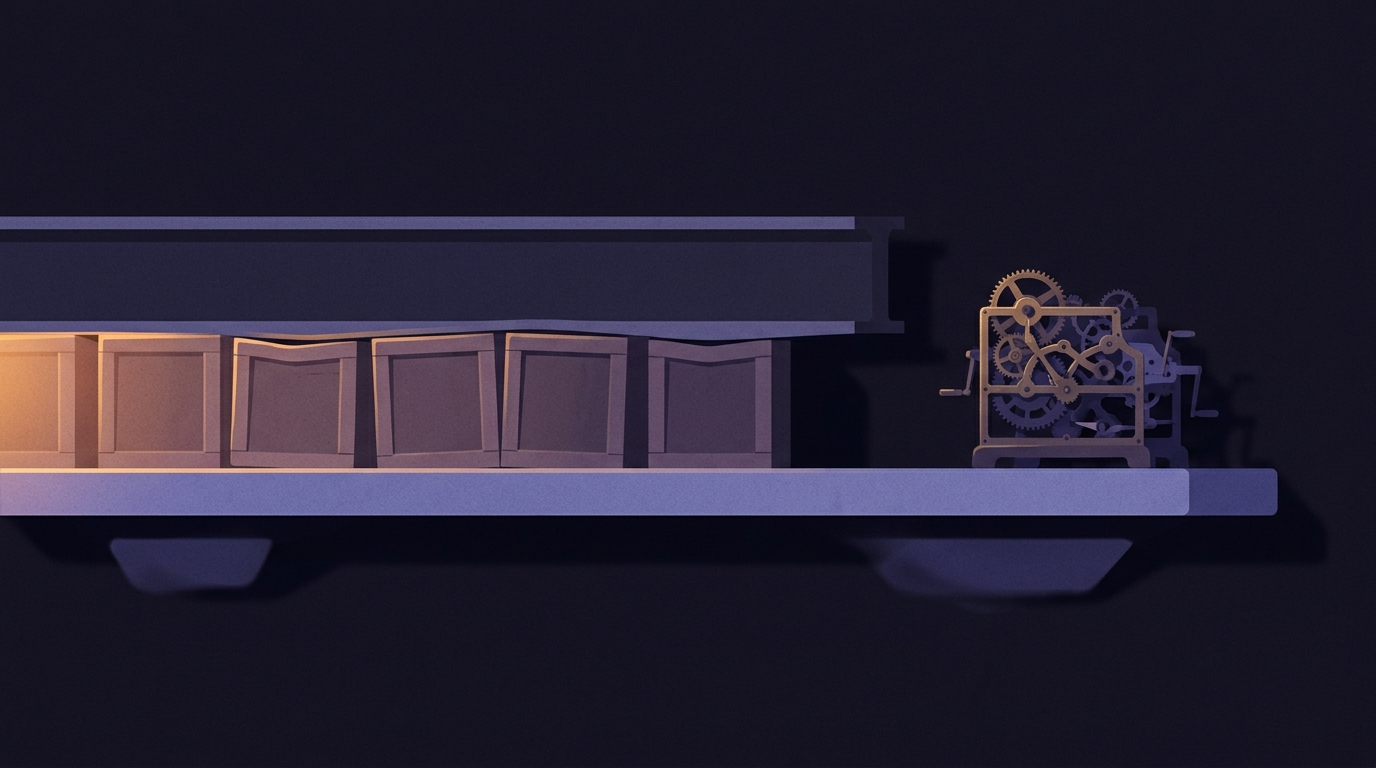
verify_node runs a subprocess and reads an exit code. There's no model in it, no prompt, and no judgment. Its docstring makes the point directly: this node "runs arbitrary Python (the subprocess), which is the chairman's Node definition exactly: a node processes a task without being an agent." The routing functions are the same, plain deterministic Python reading state and returning a name.
That distribution is deliberate and I'd defend it as the main design lesson. Put the model where judgment is genuinely required, and put deterministic code everywhere else, especially on the gates. A gate implemented as a model call is a gate that can be talked into passing, which the model will do politely and at scale. A gate implemented as an exit code can't be persuaded of anything.
The same reasoning bounds the fan-out. The planner is a model, so its output could in principle be an arbitrarily long task list, and a graph that fans out over an unbounded list is a graph that can be talked into launching a hundred workers. A static limit sits in front of it, and the error text explains the reasoning rather than just enforcing it: a plan that decomposes past the limit "is a designed failure, not an unbounded list the graph fans out over." Where a model's output determines how much work happens, a deterministic bound belongs between the model and the work.
Why worktrees are a state-ownership rule
Every implementation agent I run works inside its own git worktree, and I used to explain that as merge-conflict avoidance. That explanation is true and it's the smaller half.
The actor model, from Hewitt and later Erlang, says an actor may modify its own private state and can affect other actors only by sending messages. No shared memory, so no locks and no data races, by construction rather than by discipline. A worktree is that rule applied to a filesystem: the agent owns its tree, mutates it freely, and communicates results by producing a commit that somebody else reads.
That's the same single-writer rule as the state table in the article graph, one layer down. Two agents editing one working tree is two nodes writing one state key with no declared reducer, and unlike the library, the filesystem won't raise an error. It'll interleave the writes and hand you a plausible file. The worktree is the reducer, and its rule is that merges happen at a named point, reviewed, rather than continuously and invisibly.
The graph is the ground floor of the spec
Specs go stale because they're written as prose, and prose has no structure a reader can check. Two competent people read the same paragraph and build different things, then argue about which reading was correct, and the paragraph supports both. This is the standing complaint about the product requirements document, and it survives every attempt to fix it with a better template, because the template governs the headings while the ambiguity lives in the sentences.
Spec-driven development asks the spec to carry more weight than that. If the document is the artifact everyone builds from, and increasingly the artifact a coding agent builds from, then it has to be checkable before anyone writes a line. Prose can't be checked. A graph can.
Draw the graph first and the spec writes itself out of it, because every element of the graph corresponds to a section of the document that has to exist.
From graph to written brief
The translation is mechanical, which is the point. Nothing here requires taste.
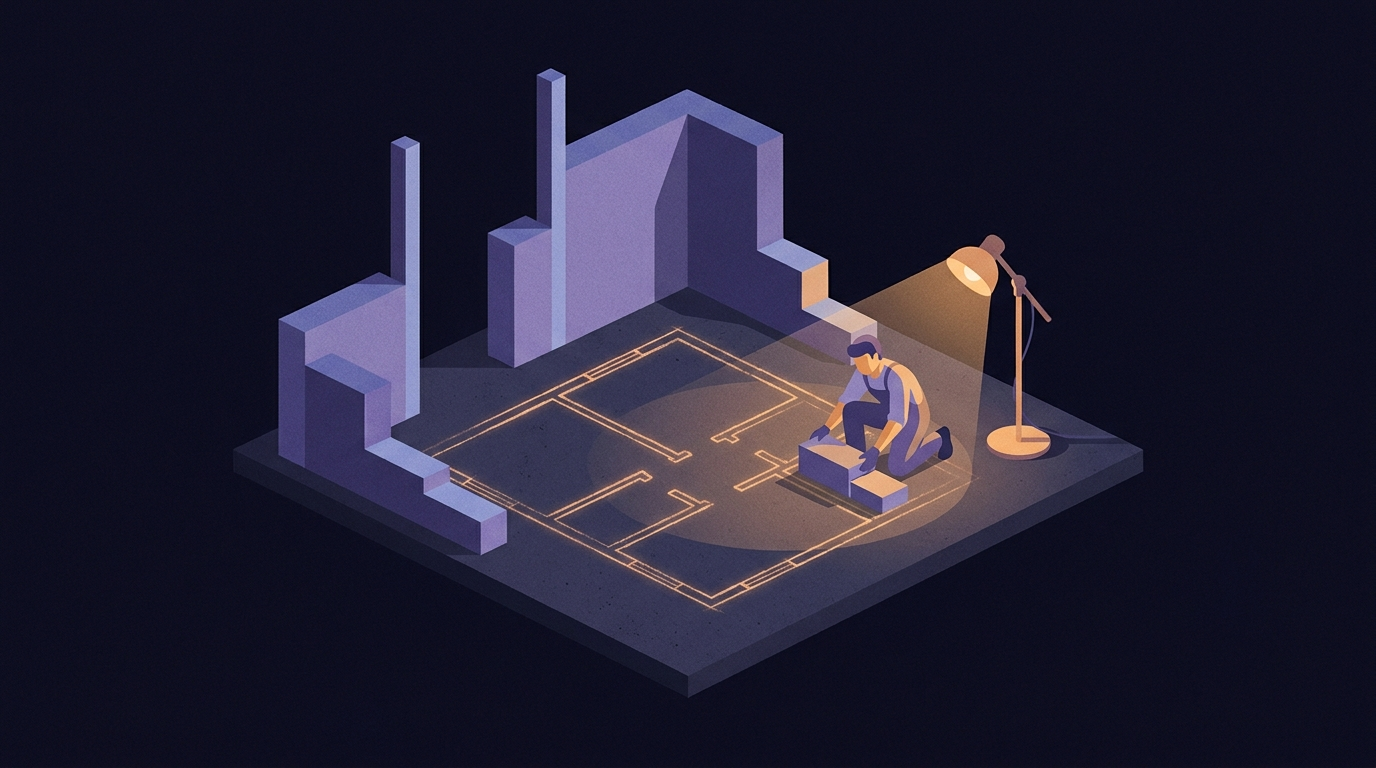
Each node becomes a section. Its heading is the node name, and its body is the contract: what it receives, what it produces, and what counts as failure. A node whose section can't be written is a node whose contract was never real, and finding that out while writing is much cheaper than finding it out while building.
Each edge becomes an acceptance criterion. An unconditional edge becomes a sequencing statement. A conditional edge becomes a testable criterion with its false branch named, which is exactly the shape acceptance criteria are supposed to have and rarely do. "The work is accepted when X" is half a criterion. "The work is accepted when X, and when X is false it returns to node Y with the failing check named" is a whole one.
Each state key becomes a data contract. Its four columns are name, shape, writer, and merge rule, and the fourth one prevents the argument that would otherwise happen in month three.
What falls out of this is a spec with a property most specs lack: you can diff it. When scope changes, the change is a node added, an edge rerouted, or a key given a new writer. Compare that to a prose spec, where a scope change is a paragraph rewritten and nobody can tell from the diff whether the meaning moved.
Where the nine rungs attach
The operational hierarchy I brief work against runs from the mission at the top down to the events that happen in the world, with the purpose held over all of it as a constraint rather than as a step. Every brief I write carries every rung of it. The graph gives four of those rungs a physical home, and the mapping is tight enough that it works as a completeness check on the drawing.
Two of those rungs repay attention. Decision carries an authority as well as a heuristic, which is the part that goes missing when people write routing logic. A rule with no named authority produces the same paralysis as no rule, because when the rule is ambiguous nobody knows who resolves it. On an edge, the authority is a field: this router decides within its scope, that one escalates.
Event is the rung most graphs are missing entirely. A graph whose nodes only read state written by other nodes is a closed system with no contact with reality. Somewhere there has to be a node whose input is a thing that happened outside: a form submitted, a payment cleared, a page fetched. Those are the leaves of the whole hierarchy, and a graph without them is a simulation.
What makes a spec checkable before anyone builds
Van der Aalst's workflow research formalized process models as Petri nets and defined what it means for one to be sound. A workflow net is sound when three things hold: every execution that terminates ends cleanly at the end state with nothing left dangling, there are no dead tasks that can never run, and there's no deadlock or livelock preventing the end from being reached.
That's a property of a drawing. You can check it before a line of code exists, before anyone is hired, before the first meeting about the meeting. A prose spec has no equivalent, because there's nothing in a paragraph to check.
The formal version needs tooling. The informal version takes ten minutes with a whiteboard and catches most of what the formal version would, and I run these three on every graph before it goes anywhere:
- Is every node reachable from the start? Trace forward from the entry point and mark what you reach. An unreachable node is work somebody planned that no path leads to, and it's usually a step that mattered in a previous version of the process and got orphaned when something upstream changed.
- Can every node reach a terminal state? Trace backward from each ending. A node that can't reach one is where work goes to sit. In a business this is the queue somebody owns in principle and nobody empties, and it's always discovered by a customer rather than by a review.
- Does every cycle have an exit condition? Find each backward edge and name the condition under which the loop stops. A cycle with no exit is the revision round that never converges, and drawing it makes the absence of a bound visible in a way that describing the process never does.
Those three checks have found something in every process I've drawn for a client. It's usually nothing exotic: an orphaned approval step nobody performs, a queue with no drain, and a review loop with no stated end, sitting in a process document that reads perfectly well as prose.
That's the argument for drawing it in the first place. Prose hides structural defects because prose has no structure to violate. A graph makes the same defects visible as shapes: a node with no incoming edge, a node with no outgoing edge, a loop with no exit. You spot them from across the room, before they cost anything.
Five places this is the wrong tool
Modeling has a cost and the cost isn't small. Drawing takes time, keeping the drawing current takes more, and a stale graph is worse than no graph because people trust it. Here are five situations where I don't do this, stated plainly so nobody has to discover them the expensive way.
The work is a fixed sequence and nothing gets sent back. Use a checklist. Payroll, month-end close, laptop provisioning, the pre-flight. When the steps are fixed, the order is fixed, and the failure mode is omission rather than judgment, a list is the correct instrument and a graph adds machinery that buys nothing. Converting a working checklist into a graph is the most common form of this mistake and it usually happens right after somebody reads an article like this one.
One person doing one thing in one sitting. The value of the model comes from coordination: multiple parties, handoffs, and state that outlives a session. Strip those out and what's left is a person who knows what they're doing. A graph for solo work in a single sitting is a diary written in advance.
The shape of the work is genuinely unknown. This one is the trap for people who like this stuff, and I've fallen in it. Drawing a graph for something you've never done produces a fiction with a professional appearance, and the appearance is the problem: people follow it. Do the thing once, badly, paying attention. Then draw what actually happened. A model is a compression of experience, so with no experience there's nothing to compress and the drawing is just your assumptions with boxes around them.
The work runs once and never again. Modeling repays itself through repetition. The second run is cheaper because the shape is known, the tenth is cheaper still, and the gates have had nine chances to catch something. A genuine one-off has no second run to amortize against. Do it, write down what you learned, and skip the drawing.
An incident is in progress. This one needs care, because it credits the structure this entry has spent nine sections complicating. During an incident you want the org chart. You want a named incident commander with authority to direct, an escalation path, and one voice deciding. A routing function assumes the state is readable and the condition is evaluable, and during an incident neither is true: that's what an incident is. Graphs are for designed work. Hierarchies are for undesigned situations. A shop that has both, and knows which one it's in, is running better than a shop committed to either.

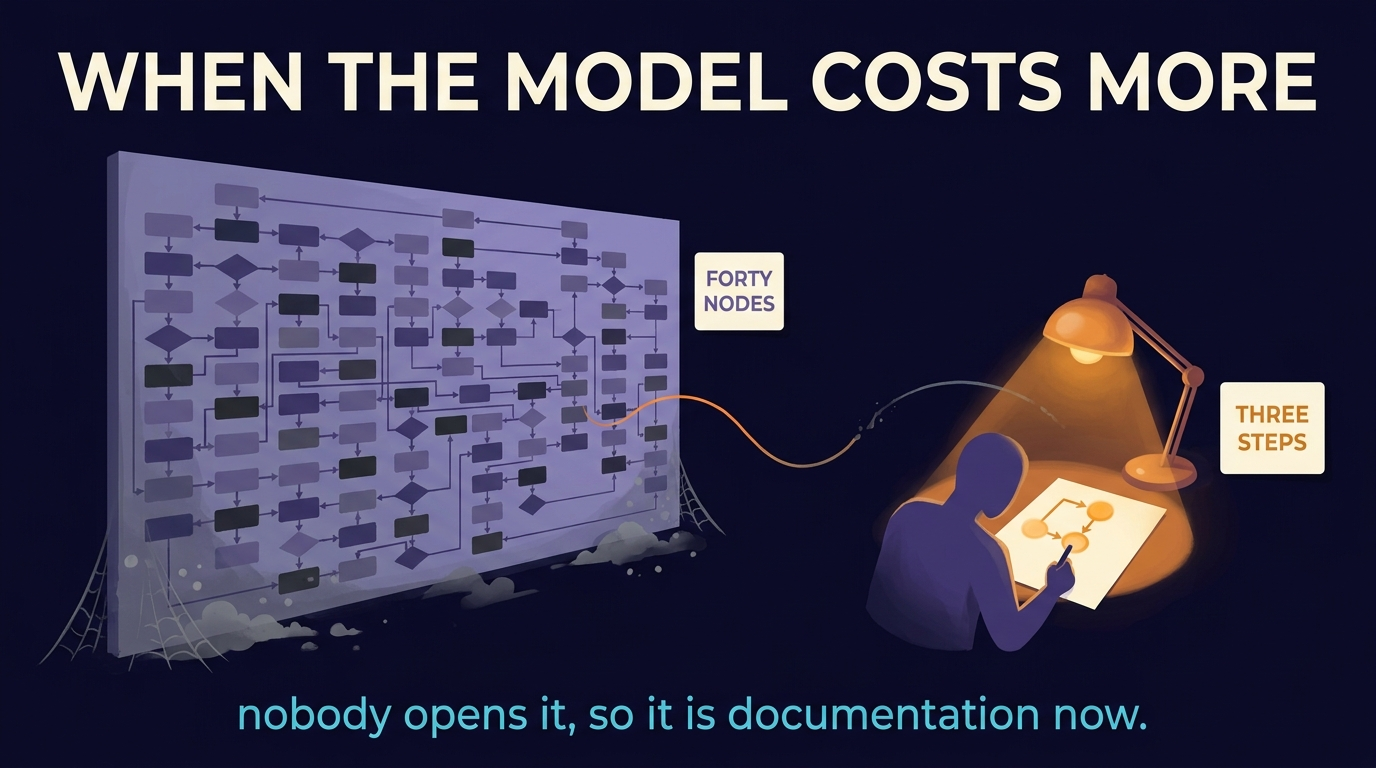
Underneath all five is one test, and it's the one to apply when a case doesn't obviously fit any of them. Does the model cost less than the failures it prevents? A gate that catches a defect before a client sees it pays for itself on the first catch. A gate on work where a mistake costs an apology and a re-send is ceremony, and ceremony has a way of accumulating until the process is mostly ritual with a little work embedded in it.
The tell that you've over-modeled is behavioral rather than structural. Nobody looks at it. When people execute from memory and the diagram is something they'd only open if asked, the model has stopped being an operating system and become documentation of one. That's the moment to cut it back to the two or three edges that were carrying the weight, and to notice that those edges were doing all the work the whole time.
How to start, and the four ways it goes wrong
The smallest version that pays for itself
The instinct after reading this is to draw the whole company. That produces a large diagram, a warm feeling, and no change in behavior, because a model nobody executes is a picture.
Start with one process that already hurts. Something with a recurring failure you can name, where you've had the same conversation more than twice. Four steps, in order:
- Draw the nodes you actually run. That means the real ones, including the informal step where somebody checks something before letting it through, rather than the ones in the process document or the ones you'd like to run. That informal step is usually the most important node on the page and it's never written down anywhere.
- Draw the edges, and mark which ones carry a decision. Most won't. The ones that do are where your attention goes for the rest of this exercise.
- Find the transition where work most often dies. You already know which one it is. It's the handoff you follow up on, the one you check personally, the place where things sit for three days and nobody can say why.
- Put one real condition on that one edge, with a real false branch. Name what has to be true, name who evaluates it, and name where the work goes when it isn't true. Then run it for two weeks.
That's the whole first pass: one edge. If it holds, the second one is obvious, and it usually turns out to be the one immediately downstream, because a gate that starts catching things reveals where the work it caught was going to end up.
The four ways it goes wrong
There are four failure modes, each with a one-question diagnostic, and I've shipped all four.
Over-modeling. It looks like forty nodes for a job with three real decisions in it. It happens because drawing is pleasant and precise, and precision feels like progress. The graph becomes a second job: it needs maintaining, it goes stale, and the staleness is invisible until somebody follows it into a wall. Diagnostic: when did somebody last open this without being asked to?

Gates with no teeth. The condition is written and the false branch isn't, so failing the gate produces a conversation and conversations under deadline resolve toward shipping. The gate appears on the diagram, gets counted as quality control, and has never once stopped anything. Diagnostic: when did this gate last fail something, and what happened to that work?
Fan-out with no fan-in. Three people explore three directions and then the work reconvenes with no declared merge rule. What happens next is that the loudest branch wins, or the three get averaged into something that satisfies nobody. The exploration cost was paid in full and the value was thrown away at the last step. Diagnostic: before the branches start, can you say in one sentence what will combine them?
State everyone can mutate. Two functions both write the lead status. Two people both maintain the price. The system doesn't crash, it just produces a wrong number quietly and keeps going, which is the worst available behavior because it never announces itself. Diagnostic: pick your three most argued-about fields and name their single writer. If any of them has two, write the merge rule today.
What this actually buys you
Back to the work that finished clean and shipped broken. In graph terms the diagnosis is a single sentence: there was an edge from build to merge with no condition on it, and the requirement that should have been the condition lived in my head instead.
The fix was one gate, not more diligence or a longer checklist. Its condition can only be satisfied by fetching the deployed URL, its false branch routes back to the implementer with the failing check named, and it's evaluated by something that isn't the implementer. That gate has failed work many times since, which is how I know it's a gate.

None of this requires the library. LangGraph gave me the vocabulary and a place to see the ideas run with the sharp edges intact, and the vocabulary is the transferable part. You can draw the whole thing on paper and get most of the value in an afternoon. Nodes with contracts. Edges with conditions. State with one writer per key. Gates that have failed something. Loops with an exit.
The compounding is the part that took me longest to see. Every process you draw makes the next one faster, because the shapes repeat: a qualification gate looks the same in sales and in hiring, a fan-out with an isolation requirement looks the same in research and in creative work, and a bounded revision loop looks the same in writing and in engineering. After a dozen of these you stop drawing from scratch and start recognizing which shape you're in, which is most of what people mean when they say somebody is good at operations.
And the part that has nothing to do with efficiency: work stops being personal. A defect stops being evidence about a person and becomes a missing condition on an edge, which is a thing you can fix on a Tuesday. That's a better place to work, and it's the reason I keep drawing these long after the throughput argument stopped being the interesting one.
An org chart says who is responsible. A checklist says what happens next. Only a graph says under what condition the work is allowed to move, and that condition is where the failures live. Put it on the edge, name its false branch, give it an evaluator who didn't do the work, and bound every loop.