
The default video advice tells small operators to ship short-form: hooks under three seconds, payoff under sixty, post seven a day, ride the algorithm. That advice describes a real mechanic and produces a real outcome: a feed of disposable clips that scale follower counts and decline immediately. The follower count is the metric; the trust isn't. Most short-form-only operators discover six months in that the audience doesn't buy from them, doesn't refer them, and doesn't remember what they actually do.
Long-form video runs the opposite play: one forty-minute or three-hour piece per cycle, dense, structured, and visibly the output of real reasoning. The format is slower, harder to make, and impossible to fake, and that's the point. The piece compresses hours of thinking into one watch, and the watcher who sits through it ends up in a different relationship with the operator than any short-form sequence can produce. The piece is proof-of-work in the cryptographic sense: the artifact's existence is itself the evidence the operator did the work.
Why long-form does what short-form cannot
Long-form video earns three outcomes short-form structurally can't, and each one compounds in a different direction.
The first is depth. A forty-minute piece has room to show how the operator thinks: the reasoning chain shows up, the places where the model breaks down show up, and the operator handles them on camera. The viewer has watched the brain operate, not a polished version of it. Short-form by its nature compresses out the reasoning and presents only the conclusion, and a conclusion without its reasoning reads as opinion. The reasoning is what makes it knowledge, and knowledge is what buyers pay for.
The second is trust. Sustained attention is the relationship: a viewer who watches forty minutes has, by the end, given you forty minutes of their life, and they feel that even if they never put it into words. They'll reference your work in conversations, defend your positions to skeptics, and buy from you when the moment comes. The trust that comes from sustained attention has no substitute, and you can't stack thirty minutes of three-second clips into one forty-minute relationship.
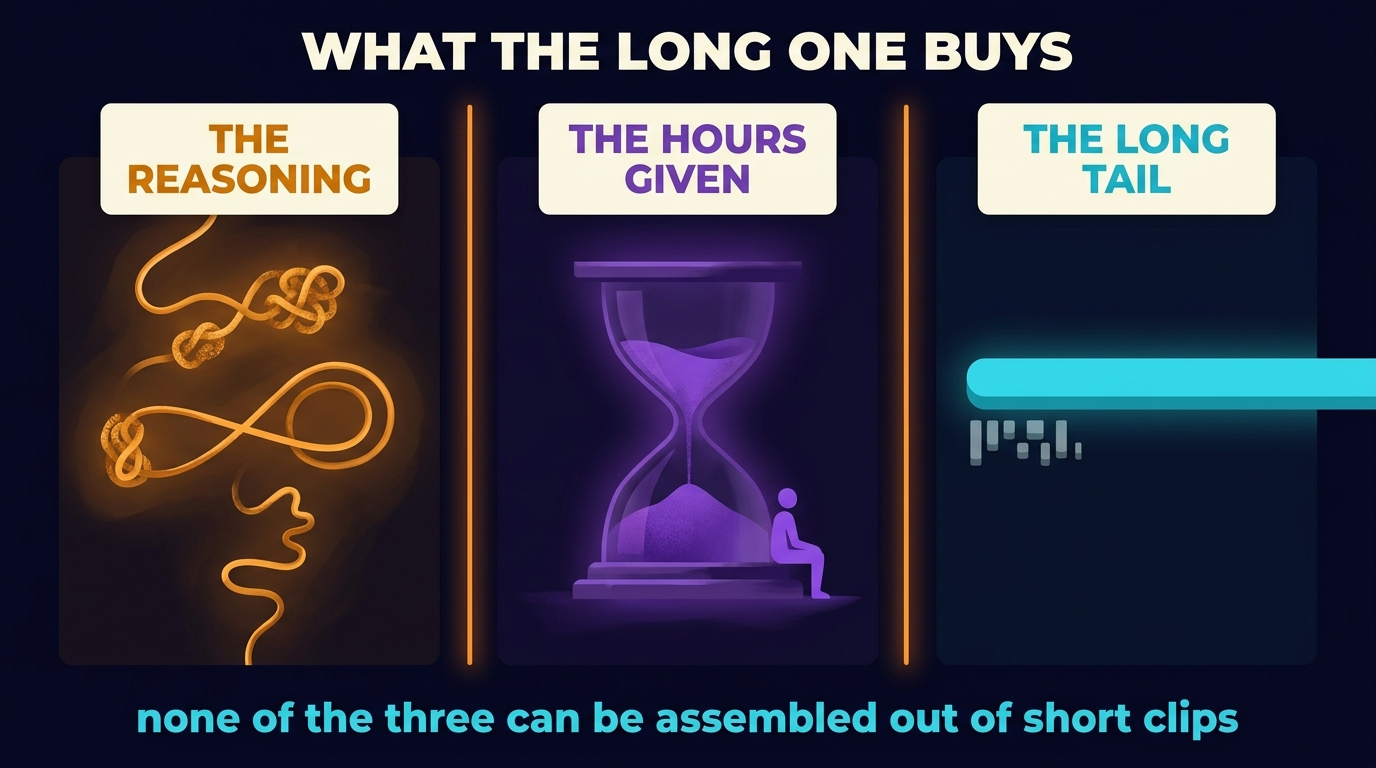
The third is search position. The platform's recommendation engine reads watch time as the strongest signal of value. A piece with high retention through a forty-minute runtime ranks against the piece-per-piece average and outperforms it. Long-form pieces become the long-tail traffic generators that keep pulling viewers in for years after they ship. A short-form piece has a half-life of days; a long-form piece has a half-life of months and sometimes years.
Andy's YouTube channel went from eight thousand to two hundred and twenty thousand subscribers in fourteen months on a long-form schedule with no paid promotion. The mechanic was watch time on dense pieces, not virality: the algorithm read them as serious-viewer content and routed them to other serious viewers. The growth compounded on the depth axis.
Proof-of-work · the artifact as the evidence
Proof-of-work is a concept borrowed from cryptography, where an artifact's existence is mathematically expensive enough that producing it is itself the evidence the producer did the work. The same logic applies to long-form video, more loosely but for real. A coherent forty-minute piece on a topic is hard enough to fake that its existence is reasonable evidence the operator thought the topic through. A short clip can be performed by anyone with the right script, while a long-form piece falls apart on camera if the underlying model isn't there.
That difficulty matters for credibility because the audience for a results-oriented service market is suspicious of polish. Polish marks marketing and reasoning marks practice, and the viewer learns to tell which one they're watching within a few minutes. Long-form gives the operator room to stay in reasoning mode long enough for the viewer's pattern-matching to settle, and the proof-of-work effect lands when the piece keeps making sense forty minutes in. The viewer concludes, correctly, that the operator has shipped the work the piece describes.
The dishonest version of long-form is a forty-minute piece padded with filler to hit the runtime. The audience reads padding instantly, and ten minutes of dense content stretched to forty is worse than ten minutes shipped at ten. Long-form is permission to let the topic find its natural length, not a runtime target. Sometimes that length is twenty minutes and sometimes it's three hours. The discipline is to stop when the topic stops, whatever number the runtime has reached.
Production economics · what the format actually costs
The default assumption is that long-form costs more than short-form because it's longer. The math runs the other way once production discipline is right. Long-form is cheaper per useful minute than short-form because most of the cost in short-form is the polish of the first three seconds and the rapid editing required to hold attention through a small runtime.
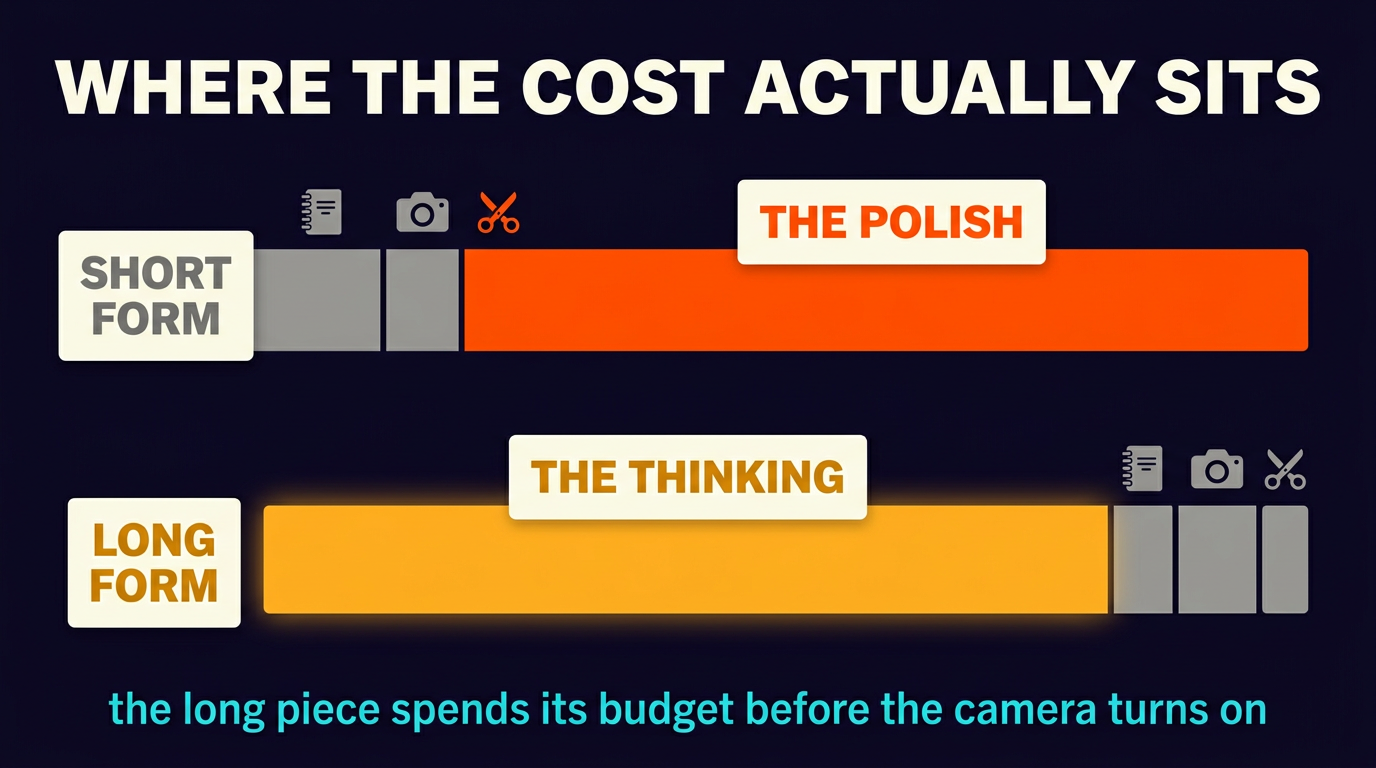
The production economics that work for solo operators look like this: two cameras in fixed positions with no camera operator, prepared notes structured by section instead of a word-for-word script, a single take with breaks, and editing limited to cuts, basic color, and chapter markers. There are no motion graphics on every line and no B-roll cutaways every six seconds. The viewer who came for long-form is paying attention to the reasoning, and the production exists to stay out of its way.
That setup is the podcast-with-a-camera pattern, where the cost sits in the preparation, not the post-production. A two-hour piece takes about two hours of preparation (the notes and the topical structure), an hour and a half of recording, and ninety minutes of editing, which comes to five hours of total production for a piece that holds traffic for months. The same five hours spent on short-form produces about ten clips, each of which decays inside a week. The unit economics favor long-form by a multiple, not a margin.
Operators who try to film long-form like a TV production burn out within three months. The discipline is to budget less polish, not more. Reasoning is the asset; cinematography is the overhead.
Format discipline · what the piece actually contains
A long-form piece has the shape of a long-form essay, played out on camera, and it runs in five parts. The structure travels across topics and survives the inevitable run-time pressure to drift into rambling.
Open with the question in the form a real operator asks it, stated the way the audience would actually ask, instead of today we are going to talk about X. The first ninety seconds establish that the piece is about a problem the viewer recognizes.
Name the model, meaning the frame the piece will use: the structural lens rather than the conclusion. Walking the viewer through the lens before the application is what makes the application stick. Short-form skips this step because it doesn't have time, and long-form's time advantage is the room to build the model before applying it.
Walk through the reasoning. The middle of the piece applies the model to the question, and it's where the reasoning becomes visible. Each step gets named. Each step gets justified. Each step gets a small example. The viewer watches the operator think through the problem instead of announcing a conclusion.
Surface the failure modes. A long-form piece earns credibility by showing where the model breaks and naming its limits: This works for X, here is what happens at Y, here is the case Z where you need a different lens. Operators who never name the limits get read as marketers, and operators who do get read as practitioners.
Land on what changes if the model is right. The closing names the viewer's takeaway explicitly instead of signing off with thanks for watching. That takeaway is the specific cognitive shift the viewer should now have and the specific operational change available to them on Monday. The viewer leaves with an action, not a feeling.
Where to start
There are three places to start, ordered by difficulty and impact.
Easiest, do today. Ship one twenty-minute piece on a topic where you've shipped real work. Make it the specific case where you faced the problem, what you did, and what you learned, rather than a survey of the field. Talk into the camera, prepare notes, edit lightly, and ship it. The piece has to exist on your site, not compete with established channels.
Medium, this month. Build the two-camera setup and lock the production economics: two cameras in fixed positions, prepared notes, light editing. Run it once and time the actual production cost end to end, and the number will come in lower than the default assumption. Once the economics are real, the format becomes sustainable, and sustainability is the bottleneck most operators hit.
Hardest, this year. Commit to one long-form piece per month for twelve cycles and let the audience compound. Most channels die in months three through six because the operator doesn't see the curve yet. The compounding shows up around month seven; the asymmetric returns show up around month ten. The discipline that gets you there is producing the piece on schedule even when the audience numbers are still small. The audience that compounded for Andy was the audience the first six pieces filtered into existence, not the audience that watched them.
Long-form video is proof-of-work. The piece's existence is the evidence the operator did the thinking, and the depth of the format is the relationship the audience can't get from short-form. For the broader theory of how attention, trust, narrative, register, and distribution compose, see Standard Model of Effective Media.