
Light crossing a magnetar's surroundings gives me a way to think about retrieval. A question crosses a body of knowledge before an answer reaches you, and the organization of that knowledge changes what that answer can contain. A weak answer may mean the evidence is missing, retrieval failed to reach it, or the model failed to use what it received. Comparing two retrieval paths can help separate those possibilities, provided somebody checks the evidence underneath both answers.

Strong magnetic fields change how light crosses a vacuum
A magnetar is a neutron star with an exceptionally strong magnetic field. A small stellar remnant sits inside a region whose magnetic conditions are far beyond an ordinary optical bench. Light travels out through that region before it reaches an astronomer's instrument. What happens along the way matters to what the instrument reads.


Calcite makes the distinction visible
A piece of calcite can show two images of the same print. The crystal treats different polarizations of light differently. Polarization describes the orientation of a light wave's electric-field oscillation. Two components of one beam can therefore propagate differently through the same material, and the image you see carries the result.
Polarized sunglasses offer another familiar handle on orientation. They filter light according to polarization, which helps reduce reflected glare. Filtering light and making its components propagate differently are different operations. What they share is the ability to distinguish light by how its electric field is oriented.
Quantum electrodynamics predicts a polarization-dependent response even in a vacuum under an applied magnetic field. Physicists call that effect vacuum birefringence. The comparison with calcite is about the optical response: the two polarizations can experience different refractive indices. A refractive index describes how light propagates through a medium. Here the medium is magnetized vacuum.


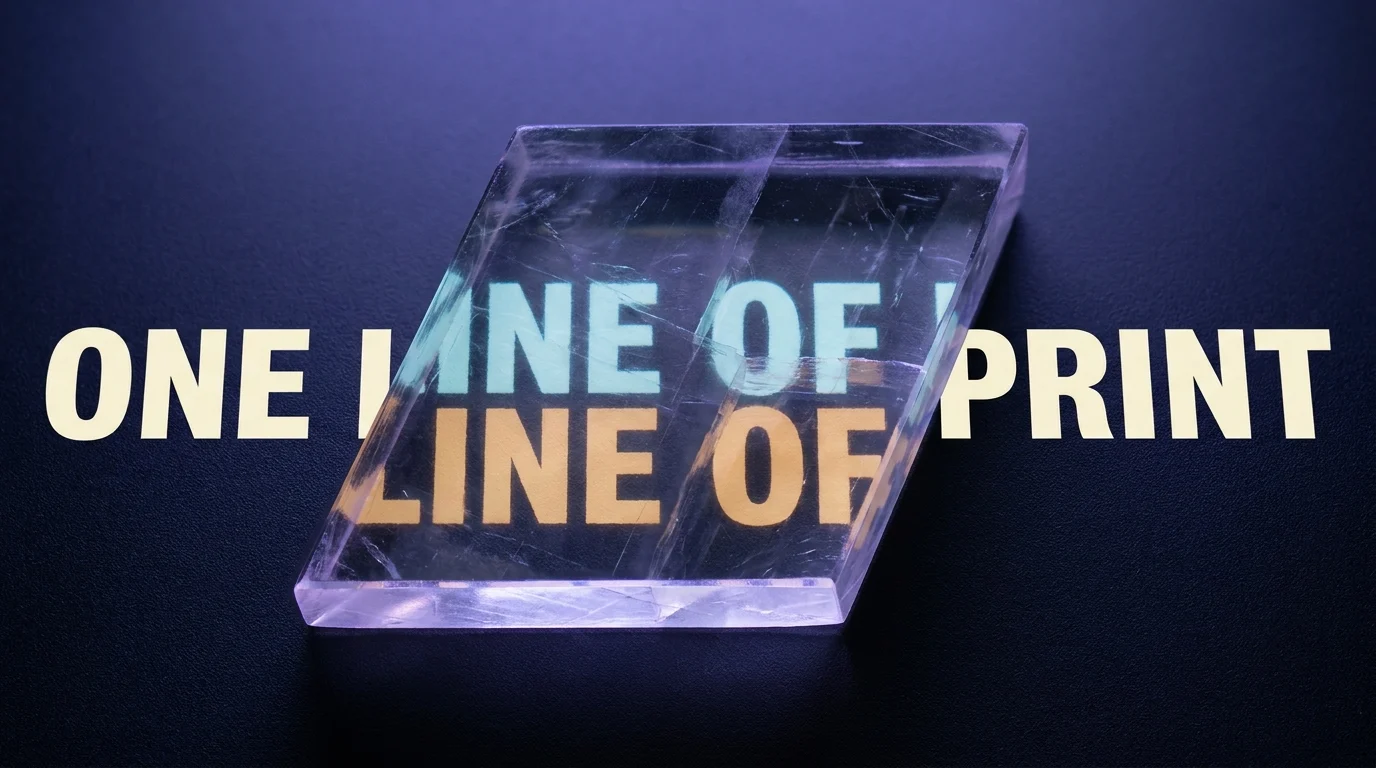
There are no crystal atoms arranged around the star. Calling the effect space crystals gives me a compact name for the comparison, but the physical claim remains specific. A magnetic field changes the vacuum's optical response. A drawing of one beam leaving as two makes that idea visible; it doesn't mean an astronomer has photographed a pair of separated beams beside a magnetar.
A physical effect still needs a measurement
An appealing picture can become more certain than the observation it represents. Astronomers measure polarization in arriving light and compare those measurements with models of the star and its surroundings. The resulting evidence has to be interpreted. Laboratory experiments approach the prediction from another direction, using controlled light and magnetic fields and looking for a very small change.
A theoretical prediction, a laboratory bound and astronomical evidence establish different things. A prediction says what should happen under stated conditions. A bound constrains how large an effect could be within an experiment's sensitivity. An observation supports an explanation to the extent that it fits the evidence and survives alternatives. None of those words can be exchanged just because a crystal in empty space makes a better opening.

The image stays useful with those limits intact. Light carries information about conditions along its path, so somebody studying the light has to understand both its source and what it crossed. My retrieval question has the same practical shape. When an answer arrives with evidence missing, I want to inspect the path that selected its evidence before concluding that the source had nothing useful in it.
A probe, a map and a medium answer different questions
Echolocation starts with an animal sending a signal into surroundings it can't see and using the return to locate things. That gave my earlier writing about market sensing its central instrument. Ask something of the world, observe the response, and revise the picture. A question, an offer or a test can expose distinctions that watching from a distance would leave unresolved.

Mapping relevance adds another job. The returns have to be assembled into a picture of which ideas connect, which parts of a subject are well covered, and which remain hard to reach. A clap in a dark room belongs to that explanation: separate echoes carry information about the same room, and a useful map has to make sense of them together.


| Phenomenon | What it teaches | Where it lives |
|---|---|---|
| A bat in the dark | Send a signal out and rebuild a room you cannot see from what comes back | Sensing a market before it will tell you anything directly |
| A clap in a dark room | The returns draw the shape of the territory, assembled out of fragments | Mapping which parts of a body of knowledge a question can actually reach |
| Light crossing a magnetised vacuum | The medium a signal crosses has structure of its own, and hands two speeds to one signal | Reading retrieval as optics, with the embedding space as a medium rather than a void |
Space crystals puts attention on what lies between the source and the return. The question itself matters. So does the material available to answer it. Between them sits a system that decides what the question will encounter. Treating that system as transparent makes it difficult to tell whether a poor result came from the question, the source material or the way the material was searched.
Consider a question about why customers cancel a service. The recorded conversations may contain the customer's words, the support system may contain what happened next, and the account record may contain whether the customer eventually left. An assistant that reads only the nearest transcript passage gets a different evidential situation from one that can connect the conversation to the account outcome. The question hasn't changed. The evidence available to the assistant's answer has.
This example describes the information a retrieval system would need. It reports no client experiment or measured result.
Answers still need their original records
I work on knowledge bases, vector embeddings and the neighborhoods those embeddings form. That work includes examining clusters and gaps, rather than assuming a graph of named entities is the right representation for every question. A question about an exact clause, one about recurring themes and one about how two events connect can require different ways of selecting evidence.
The medium in this comparison includes the stored passages, their metadata, their connections and the procedures used to retrieve them. Those components remain distinct engineering choices. A stronger embedding model won't restore a condition removed by a chunk boundary. A summary won't establish a date that nobody recorded. A relationship between two accounts won't help if the system has mistaken two different customers for the same person.
The comparison gives those failures a place to look. It doesn't give them a common physical cause. An embedding space has no magnetar hiding inside it, and a customer's language has no polarization angle waiting to be read off a sales call. What transfers is the habit of examining the conditions through which information reaches an observer.
The return becomes useful when its source remains recoverable. A map can orient someone within a subject, but the underlying records still decide whether a particular answer is justified. Building retrieval means making those records reachable without losing what they actually say.
Retrieval changes which evidence a question can reach
An embedding model converts text into a vector, a list of numbers used to compare that text with other material. A retrieval system can embed a question, search for nearby document vectors and return the corresponding passages. That's a useful starting design. A refund policy can answer a question about a refund window without an elaborate representation of the whole business.
The comparison becomes less reliable when proximity is treated as an assurance that the returned passages contain everything needed. A similarity score is an output of a particular model and retrieval procedure. Its usefulness depends on the material, the task and the evidence the question requires. Two questions with similar scores can still differ in whether the returned passages support an answer.


My own corpus needed different treatment for different documents
I built a local retrieval system on Archon for my own knowledge base. It held my Markdown writing alongside PDF textbooks and YouTube material, including transcripts and comments. The point was to make those sources available to the agents I was working with through a local Model Context Protocol connection. MCP gives an agent a defined way to call a tool; in this case, the tool searched material I controlled.
Those sources weren't interchangeable. A technical document has sections and code blocks. A transcript can carry an explanation across an interruption. A comment thread can contain a reply whose meaning depends on the comment above it. Cutting each source by the same mechanical rule risks separating a claim from its conditions, its speaker or the question it answered.
I extended the ingestion and chunking pipelines by document type and used semantic grouping to help choose boundaries. I also used task-specific embedding settings for different jobs, including organizing material and retrieving it for questions. The record supports those engineering choices and my reported improvement in access to the corpus. It doesn't contain a controlled benchmark that assigns a numerical gain to each choice.
That last distinction limits what the experience can teach. It gives a reason to inspect chunking and task configuration in a failing retrieval system. It gives no guarantee that replacing a reader's chunker will improve their answers, and no basis for claiming that every other system uses an inferior approach.


A task setting changes the comparison being made
Some embedding systems distinguish the task of representing a question from representing a passage that might answer it. Other settings support similarity or clustering. The names and supported combinations belong to the model's documentation. A historical account of one model's task settings is a record of what I used, not a current API manual.
This is a useful place to test the medium idea. Different settings can change the vectors produced from the same words and the material returned by a search. But a query setting and a document setting may be designed as complementary roles. Swapping them arbitrarily can make a retrieval path invalid rather than reveal a meaningful hidden distinction. A comparison starts with configurations the provider says are compatible.
The same discipline applies to multimodal retrieval. A system may store text, images and audio without comparing their meanings in one shared embedding space. Shared storage, support for several content types and a common embedding space describe different capabilities. Each needs its own evidence. Even a model that places images and text together won't make every visual detail retrievable by every wording of a question.
| Layer | What multimodal meant there | What a question gains |
|---|---|---|
| Storage | Several kinds of store standing side by side: relational tables here, documents there, vectors in a third place | One system to ask instead of three, with the meaning still split across them |
| Data | Several kinds of content held by one system: text, images, audio | One place to look, while each kind still travels in a lane of its own |
| Embedding | A photograph and a paragraph placed in the same space by the same model | One medium every kind of meaning crosses, which means a question can cross it too |
A layered index can support a broader question
A question about a recurring theme across many calls can require evidence spread over the corpus. A hierarchical system can group related passages, summarize groups and let a broad question retrieve at that level before checking the underlying records. Cross-links can support a different route, connecting a complaint to a contract or an account outcome.
The summary and the source do different jobs. A summary helps locate a pattern. The source establishes what was said and under which conditions. If a summary combines unlike accounts or hides contradictory passages, its convenient answer can be less trustworthy than the less polished result from a simpler search.


A generated wiki can also make a body of material easier to navigate. That alone says little about how its question-answering system retrieves evidence. The relevant inspection is concrete: which records did this question reach, which did it miss, and can a generated answer be traced back to them? A graph visualization or a hierarchy diagram can't answer those questions on its own.
Retrieval engineering changes that path. Chunk boundaries preserve or separate context. Metadata permits or prevents filtering. Links make some relationships traversable. Summaries offer a broader view with an additional opportunity to misstate the sources. Each addition has to justify itself through an answer the reader can check.
A null reading describes an experiment's limits
The vacuum experiment named PVLAS makes the difficulty concrete. It sends polarized light through a magnetic field and uses repeated passes between mirrors to increase the opportunity for a tiny effect to accumulate. The question is whether the returning light shows the change the theory predicts. A controlled experiment can constrain that change even when it can't claim a detection.


A bound is useful information. It rules out effects larger than a stated limit under the tested conditions. It also tells the next experiment what sensitivity it must exceed to improve that limit. Describing such work as years in which a needle never moved throws away what was learned and suggests that the researchers mistook an instrumental limit for an empty universe.
Strong fields bring different experimental trade-offs
The sky offers strong magnetic fields that a laboratory can't reproduce in the same way. Observing a neutron star therefore gives scientists access to a different physical setting. It also removes some of the controls available on an optical bench. An astronomer observes radiation after it has passed through the star's environment and has to account for how the radiation originated, the geometry and other effects along the path.
That trade-off matters. Stronger conditions can make a predicted signature easier to detect while making attribution more dependent on a model. A laboratory can have a signal that's harder to see alongside a more controlled comparison. Calling one strategy successful and the other useless would conceal what each is able to establish.
| When | What was done | How strong the claim is |
|---|---|---|
| 1936 | Heisenberg and Euler work out from quantum theory that past a certain field strength empty space should split light by its polarization | A prediction. Standard theory ever since, and untested at the time. |
| A quarter century, ending in bounds | PVLAS bounces a polarized laser tens of thousands of times between mirrors inside the strongest magnets available, hunting a difference of a couple of parts in 10^23 | Null, with bounds. Ever more precise statements of how large the effect can't be, and no detection. |
| 2016 | Optical polarimetry of an isolated neutron star measures around 16 percent linear polarization | Consistent with the effect. The phrase the field uses, and the phrase this note uses. |
| 2024 and 2025 | X-ray polarimetry of magnetars measures much stronger signatures, carrying the energy dependent behavior the models call for | Strong evidence. At least one published analysis argues it's still short of compelling on its own. |


The astronomy claim concerns optical observations of an isolated neutron star and X-ray observations of magnetars. Polarization measurements can be consistent with vacuum birefringence while leaving competing explanations under discussion.
[Editorial source gap: the inherited astronomy claims require primary-paper references and their model qualifications before publication. No fresh scientific literature verification was available for this draft.]
A controlled retrieval comparison can be useful even if a particular astronomical interpretation changes. Physics supplied the question I wanted to ask; it doesn't certify an answer in a different field.



| What was compared | The laboratory | The sky |
|---|---|---|
| What it cost | A quarter century of funded work, exquisite mirrors, the strongest magnets available, and a vacuum chamber | Nothing. The star was already running, and the star is the vacuum chamber |
| Field strength | A few tesla, which puts the effect 20 orders of magnitude under household visibility | 10 to 100 times past the 1936 line, held as a resting condition |
| How long until a reading | Roughly 25 years | A few years from owning an instrument that reads polarization in X-rays |
| What came back | Bounds: ever more precise statements of how large the effect could not be | Strong evidence, with at least one published analysis in dissent |
Retrieval has its own sensitivity limits
A retrieval system can return no useful material for several reasons. The material may not exist in the corpus. It may exist in a file that failed ingestion. The index may omit it. A filter may exclude it. The question may use language that retrieves the wrong passages. The model may receive the correct passage and still fail to use it.
Those possibilities call for different corrections. More documents won't repair a filter that excludes the right account. Entity extraction won't repair a missing recording. Changing the generation prompt won't restore a passage that never reached the model. A useful diagnosis follows the evidence along the actual path.
A positive control helps. Choose a question whose supporting passage is known and check whether the system can retrieve it. Then try a question requiring a relationship between known records. The difference can locate a limitation without pretending that every null hides a valuable discovery.
The lesson I take from the laboratory and the sky is therefore conditional. A failed measurement leaves the conditions of measurement open to inspection. Sometimes the next step is a better instrument. Sometimes it's a different place to look. Sometimes the evidence really is absent. The retrieval system has to leave room for all of those outcomes.
Enrichment makes relationships available to a question
I use field strength as a way to think about the conditions under which a question can be answered. In a corpus, those conditions include how much relevant material is present and how much useful structure has been made accessible. Volume and enrichment can work together. They aren't a physical equation, and multiplying a document count by an enrichment score wouldn't measure intelligence.
Mass means coverage. Does the corpus contain the calls, tickets, contracts and outcomes needed for this particular question? Enrichment means making some of their relationships explicit enough to retrieve and inspect. A large archive with missing outcomes can remain unable to answer why customers leave. A small archive with careful relationships can answer a bounded question well while supporting no conclusion about the whole market.

Each added relationship has a job
Entity resolution establishes which mentions refer to the same person, company or product. A customer's full name, shortened name and account identifier may need to lead to one account. The opposite error matters too: merging two customers because their names resemble each other creates a relationship the business never had.
Time makes sequence available. The date a call was recorded, the period a contract covered and the date an account closed describe different events. A system that collapses them into a generic timestamp can reverse the story. Knowing that a complaint preceded cancellation supports a different statement from knowing only that both appear somewhere in the archive.
Provenance keeps an extracted fact attached to the record that supports it. Confidence records how uncertain that extraction is. A model's confidence label deserves inspection of its own. Naming a field confidence doesn't make the value calibrated. An uncertain match needs to remain uncertain as summaries and answers are built from it.
Cross-links let retrieval follow a relevant connection beyond nearby wording. A ticket may name a feature, a contract may promise that feature and a call may explain the customer's use. A question about the promise can require all of them. Group summaries offer another route through the same records, provided their claims can be checked against the passages they condense.
| Layer | What it makes explicit | What it buys the question |
|---|---|---|
| Entities | Who and what is named in each passage, and which mentions are the same thing | Two calls about one account stop being two unrelated blocks of text |
| Time | When each fact was true, and when it stopped being true | Sequence exists, so a question can ask what came before what |
| Provenance | Where each claim came from and who said it | An answer can carry its trail back to the passage that earned it |
| Confidence | How strongly each extracted fact is held | A weak reading gets reported as weak instead of stated flat |
| Cross-links | Which distant passages are secretly about the same thing | Answers that live between regions become reachable at all |
A cancellation question needs outcomes as well as complaints
Consider an illustrative corpus of customer calls. A flat search for cancellation might return passages about price, missing features and support. Those passages could be accurate and still leave the decision unresolved. They establish that somebody complained. They don't establish which complaints were associated with leaving.
Now suppose the same calls can be connected to the right accounts, the date of each conversation and the account's later status. The question can become more discriminating. Do the accounts that left show a particular pattern? Did the complaint appear before the exit? Do retained accounts make the same complaint? What happened after support responded?
Those are possible questions, not invented findings. Their answers might weaken the original explanation. Price may be mentioned across both retained and departed accounts. A feature complaint may occur after a cancellation decision. Accounts with missing call recordings may make the apparent pattern unrepresentative. Useful enrichment exposes those possibilities alongside the more convenient story.


The method has a boundary. Linking a complaint to an outcome establishes an association in recorded material. It doesn't prove that the complaint caused the outcome. The business may need another investigation before changing a price or a product. Retrieval can make that investigation better informed without becoming a substitute for it.
Absence requires a defined place to look
A question about what's missing asks more of a corpus than a lookup does. Finding a contract clause can establish that the clause appears in that contract. Failing to retrieve a clause establishes much less. The search could have missed it, the document could be absent, or the relevant language could use different terms.
A defensible absence claim names its population and coverage. An analyst might inspect a defined set of proposals for a particular commitment, account for missing files and ambiguous wording, and report what that inspection found. Asking an assistant what competitors offer that the business never mentions requires competitor evidence too. An archive containing only the business's own proposals can't supply the missing half by implication.

That's why an ingestion count makes such a poor result. The operational question is what a defined body of material can support and what remains unknown. Adding structure is useful when it makes the evidence for an important question reachable. Adding more material is useful when it repairs a relevant coverage gap. Either can also make a larger, more expensive system that answers the same questions no better.
Compare two retrieval paths on the same questions
A paired retrieval test gives the medium comparison a practical form. Hold a question and its source corpus fixed, then compare a simple retrieval path with a path that uses a specific enrichment. The comparison asks whether the extra structure changes the available evidence and whether that change improves an answer enough to justify its cost.
The twin test is a proposed evaluation method. No benchmark results are reported here, and the test can disagree with the expectation that the more elaborate path will win.


Define a useful answer before looking at the twins
Start with questions the intended user actually needs answered. Include lookups, questions spanning records, thematic questions and questions for which the corpus can't support an answer. Keep the distinctions visible. An average over all questions can hide a failure on the class that matters most to the business.
For each question, identify what a supported answer would need. A lookup may need a particular clause and its effective date. A cross-record question may need several passages and a justified connection between them. A thematic question may need coverage across a defined group, including evidence that challenges the theme. An unanswerable question should produce an explicit limit on what can be concluded.
This preparation gives the comparison something firmer than a preference for fluent prose. It also prevents an enriched system from defining success after showing what it happens to do well. A person who understands the source material needs to inspect the proposed support. An assistant evaluating its own answer can repeat the same unsupported assumption twice.
Change one retrieval decision at a time
Use the same model version, instructions and source snapshot for both paths. Keep generation settings and the available answer budget comparable. Hold access permissions constant. A richer path must remain limited to records the user is allowed to see; more complete retrieval is no improvement if it exposes someone else's information.
Choose an interpretable difference. One path might retrieve ordinary passages, while the other uses an entity link to reach related records. Another test could compare direct passage retrieval with a group summary followed by source checks. Adding new documents, a larger model, different prompts and a graph in the same comparison would leave the cause of any gain unresolved.
A paired test won't make every cost identical. More retrieved evidence can require more context and processing. Record that difference as part of the decision. To understand the particular contribution of structure, keep the evidence budget comparable where possible and describe the remaining differences. To evaluate the complete product, include its actual additional cost.


The record for each question should let another person reconstruct the comparison. Save the question, the configuration and the exact corpus version. Keep the retrieved passages in order, their identifiers, each generated answer and its citations. Record failures to retrieve or generate as failures. Quietly replacing a failed run would make the system appear more reliable than the experience a user would receive.
Compare evidence before comparing prose
Inspect what each path returned. Did the enriched path reach a relevant record the simple path missed? Did it preserve a condition or retrieve a superseded version? Did it bring in extra text that made an unsupported conclusion easier to write? Only then compare the generated answers against their supporting passages.
Two fluent answers can agree because both missed the same evidence. Two very different answers can disagree because one invented a connection. Textual difference alone measures neither answer quality nor retrieval value.
Generation can also vary while retrieval stays fixed. Repeat a comparison where variability could change the decision, or examine retrieval directly before involving generation. Holding the model and prompt constant helps control the comparison. It doesn't subtract every source of variation out of the resulting text.
The useful output is a question-by-question record of supported improvement, regression, unchanged performance and unresolved cases, with the extra cost attached. That record can show where a layer earns its place. It can also show that a simpler path already provides the evidence the user needs.
A difference becomes useful when its cause is inspectable
A large gap between the twins is a place to investigate. It could contain the evidence for keeping an enrichment layer, or it could expose a new way for the system to be wrong. The first reading is therefore a question about the source passages: what changed in the evidence, and does that change support a better answer?
Suppose a question requires connecting a support complaint with the contract governing that account. The enriched path reaches both, while the simple path returns only the complaint. A reviewer can inspect the account match, the contract version and the connection a generated answer makes. If those hold, the added relationship has done a particular job that the other path failed to do.
The conclusion stays that narrow. It says this relationship helped this class of question under the tested conditions. It leaves open whether a different chunking rule, a metadata filter or another simpler approach could achieve the same result. The test is meant to improve a decision, so the simplest adequate alternative remains part of the comparison.
| The reading | What it says about the medium | What to do next |
|---|---|---|
| A large split on threshold questions | The structure is there and it is carrying the answer | Keep paying for the layer that produced it, and note which question classes it pays in |
| A small split everywhere | Either the enrichment is not doing work yet, or the corpus is genuinely thin | Raise field strength on one subdomain and run the same battery again |
| A zero split on lookups | The answer sits in one chunk, so the medium had nothing to add to it | Read it as health, and stop buying structure for that class of question |
Agreement can be success or a shared failure
A lookup whose answer sits in a single well-formed passage may produce the same supported answer on both paths. That's a reason to question the additional cost for this task. It leaves no obligation to create a difference for the sake of the method.
Agreement across harder questions needs more inspection. Perhaps the supposedly enriched path didn't use its links. Perhaps the summaries repeat the same narrow set of sources. Perhaps both paths have already found enough evidence. A single score close to zero won't distinguish those explanations.
Choose a bounded area of the corpus where the relevant records are known. Verify that both paths actually execute as configured, then examine the evidence returned for the same questions. A known-answer question tests basic reach. A deliberately unsupported question tests whether the system invents support. Together they help separate retrieval failure from an answer that should remain unknown.
This is also where thin source material becomes a legitimate conclusion. A recorded call may never contain the reason for a cancellation. The account status can establish that the customer left without establishing why. Keeping that distinction visible is a useful outcome even if neither twin produces the hoped-for explanation.
Disagreement can reveal a new defect
Enrichment introduces derived material. An extracted relationship can be wrong, a summary can merge conflicting accounts, and a date can be attached to the wrong event. A confident answer built on those errors can look more analytical than a simple answer while being harder to challenge.
Inspect the intermediate record when a result improves suspiciously. Trace a summary's claim to the source passages. Check a relationship against both ends. Keep disagreements between sources visible. A precise answer that depends on an uncertain identity match should carry that uncertainty, even when the final paragraph would sound cleaner without it.

The same care applies to vocabulary tests. Asking in a customer's language and then in an internal product vocabulary can expose different retrieval results. It can also change the meaning of the question. Somebody has to establish that the two phrasings ask for the same thing before treating their difference as a property of retrieval alone.
The stopping decision follows the user's job. Keep an added layer when its supported benefit on important questions warrants its latency, cost, maintenance and error risk. Narrow it when it helps only a defined class. Remove it when a simpler path does the job equally well. A comparison that justifies removing complexity has answered the question it was built to ask.
Customer language depends on where it was collected
The same question about conditions applies before a market-research corpus exists. A survey response, a competitor review and a support ticket are records produced under different circumstances. Collecting them changes which experiences the analysis can see. Combining them without preserving those circumstances makes the larger dataset less informative than it appears.
I start by identifying a problem independently of the product somebody wants to sell. A request for better ads can arrive with an assumed diagnosis already attached. The research has to leave room for a different explanation: the audience may be wrong, the offer may be difficult to trust, or the product may disappoint people after the sale. Starting with the proposed solution can make every collected answer seem to confirm it.

I collect the phrases before I write the message
I read relevant Reddit threads, comments under competitors' YouTube videos, one-star reviews and support tickets when access is available. I keep the phrases customers use to describe what happened. Those phrases can identify a problem more precisely than the company's own category for it.
The method matters in a small way that's easy to lose. A company may classify a problem as poor communication. The customer may describe a specific unanswered question, a promised update that never arrived or a charge they couldn't explain. The category groups the incidents. The customer's words preserve what the incident meant to the person affected.
The unanswered question, missed update and unexplained charge are illustrative situations, not harvested quotations. A new piece of copy still needs the actual wording from the relevant market before it can claim to use that market's language.

| Channel | What it answers that a survey cannot | Why the field runs high there |
|---|---|---|
| A one-star review of a competitor | What went wrong badly enough that someone wrote it down with nobody asking | It is written to warn a stranger, so there is no reason to soften it |
| A thread that opens with is it just me, or | Whether a private suspicion is one person's bad week or the market's shape | The writer believes they are alone, so the sentence carries no positioning |
| A support ticket typed in genuine anger | The exact point where the product stopped being worth the effort | Anger removes the editing pass, and the phrasing arrives at full strength |
| A note sent at two in the morning about an invoice that did not clear | What the writer is actually afraid of losing | It is written past the hour when anyone performs for an audience |
An exact phrase belongs beside its source and context. Keep what product the writer was discussing, what happened, what they expected and what's known about the outcome. A complaint about an earlier product version shouldn't quietly become a statement about the present one. A paraphrase can help categorize a record, but it should remain distinguishable from the words the customer actually used.
Angry reviews select a particular group of customers
A one-star review can make a failure vivid. It also selects for people who chose that channel and that rating. A support queue records the customers who contacted support. A public thread includes people willing and able to post there. None of those groups automatically represents everyone who buys, leaves or remains satisfied.
A one-star review can be written to persuade an audience, edited after the event or posted for reasons the researcher can't verify. Anger may reveal a consequence that a polite interview misses, but anger alone doesn't authenticate the account.
A survey has its own limits and its own uses. It can ask the same question across a defined group, follow up a pattern found elsewhere or include people who never post publicly. An interview can uncover why a phrase meant something different to two customers. The decision is which question each source can help answer and what selection effects remain.

The comparison with a magnetar earns its place here only as a prompt about observability. Strong conditions can make a response conspicuous. They can also change the response. A crisis may reveal an existing dependency and create new dependencies at the same time. Treating everything observed under stress as a hidden permanent truth would turn the comparison into an excuse to ignore context.
Repeated language becomes a hypothesis to investigate
The same phrase across unrelated records can identify a useful line of inquiry. Check whether the records are independent, whether they describe comparable events and whether the repetition survives beyond one channel. Several people copying a popular complaint aren't several independent accounts of the same experience.
Then connect the language back to the business decision. Does the complaint recur among customers who left? Does it also appear among customers who stayed? Does a product change address the stated problem? Those questions connect this research practice to the earlier retrieval example without inventing a market-wide conclusion from a handful of vivid sentences.

Writing benefits from the same trail. A lesson becomes more useful when the reader can locate the incident, the record or the reasoning that produced it. That doesn't require every useful sentence to come from an extreme event. A quiet, well-documented observation can teach more than a dramatic story whose evidence disappeared during the retelling.
I want the collected language to change what gets written and what gets investigated. The raw record stays available so the message can be challenged. The customer's phrase gives an analyst something precise to examine. The analyst still has to establish how far that phrase can speak for anyone else.
Inspect one unanswered question before enlarging the system
A useful next step starts with an answer that matters and the evidence it would require. Choose a question the current system handles poorly. Name the source records that should support it, or record that their presence is unknown. That small distinction separates a retrieval investigation from a search for material the business never collected.
The possible outcomes lead to different actions. A missing source calls for a decision about collection or access. An ingested source that never appears calls for inspection of indexing and retrieval. A correct passage followed by a wrong answer calls for inspection of how the model used its context. A cross-record question may warrant an explicit link, a summary layer or a better way to search existing metadata.
| What came back | The question to ask | What you do next |
|---|---|---|
| A null result | Is the medium empty, or is my field weak? | Raise field strength on one subdomain and ask again before concluding anything about the medium |
| Signal where everyone had agreed there was nothing | What field strength revealed it? | Add whatever produced those conditions to your instrument collection |
| A medium you cannot see directly | What does one signal do when you send it two ways? | Send it both ways and read the split, which cancels everything the two paths share |

Each action can remain bounded. Fix one relevant coverage gap or make one useful relationship available, then ask the same question again under recorded conditions. Keep the original result. The comparison should make it possible to explain what changed, including a correction that produced no benefit.
An evidence gap can survive the investigation. A customer may have left without giving a reason. A contract may be ambiguous. Two accounts of the same event may conflict. The system should preserve those limits rather than manufacture the missing connection. A clear statement of what the records can't support can prevent a business from acting on a plausible but invented explanation.
The transfer has to earn its place separately
The physics and the engineering proposal remain different claims. Vacuum birefringence belongs to a scientific theory and to experiments and observations interpreted within it. Retrieval enrichment belongs to a particular system, corpus and user need. A physical effect can't establish that a graph will improve search, that a summary preserves an argument or that a certain customer channel gives an accurate account.

The comparison gives me an instrument for deciding where to inspect. The test of that instrument is whether it helps produce a better-supported decision. My Archon work supplies an actual engineering example of changing chunking and task configuration for a mixed corpus. The proposed twin test offers a way to inspect similar choices rather than taking my preference as a guarantee.
A simple system can be the right result. A lookup may already reach its source. An added relationship may cost more to maintain than the questions using it are worth. A broad analysis may require records the business has no reason or authority to collect. The method leaves those decisions available.

The light around a magnetar has a path before it has a reading. A retrieval answer does too. The next time an assistant produces a paragraph that could have been written without opening the documents, keep the question and inspect that path: the material available, the records selected and the claims that answer made from them. Then change the smallest part that the evidence identifies.
"The medium is never empty" is the thought I keep from the star. The engineering work is to find out what this particular medium contains, what the question can reach and what the resulting answer can justify.