Email is the only direct-to-cashflow channel where you fully own the customer journey. No platform down-ranks your sends because it had a board meeting, and no algorithm buries your launch because the format changed last week. The list is yours, the cadence is yours, the relationship is yours. That leverage is real, and most operators waste it because they treat the channel as a broadcast tower instead of a structured conversation.
This essay is the practitioner playbook for the four sequence archetypes that do most of the work: welcome, nurture, post-purchase and win-back. Its companion piece is Conversion Funnel Design, which covers the architectural decisions that determine which sequences need to exist in the first place.
Email is not a newsletter. It is a structured conversation.
The most common way operators fail at email is broadcast: they send the same thing to the whole list, hope a few people care, and repeat. Broadcast looks like the Mailchimp-shaped weekly newsletter, the occasional product drop, or the announcement-shaped email about something that happened to your team. The buyer ignores most of it, the list erodes quietly, and the team blames open rates instead of looking at what was sent.
Andy says it directly in the portfolio copy: email is the only channel where you control the entire customer journey. The key is treating email as a structured conversation, as opposed to a broadcast network. Each sequence guides the buyer deeper into the funnel based on where they are. A buyer who's cold and skeptical gets a different sequence from one who's warm but uncertain, and the warm but uncertain buyer gets a different one again from a buyer who's ready but hesitant. The architecture changes based on the buyer's state, not on the calendar.
Three conditions in 2026 tighten the case for structured conversation further. Apple Mail Privacy Protection (MPP) pre-fetches images on most sends, which means open rates are inflated and partly fictional. The Yahoo and Gmail sender-reputation rules that landed in February 2024 penalize bulk senders whose engagement looks weak; broadcasts that nobody clicks degrade the reputation of every other email you send to the same list. And the flood of AI-generated content means the inbox is full of plausibly written emails that nobody asked for, where signal density is the only thing that cuts through. Taken together, broadcast email costs you reputation and earns you nothing, while sequenced email pays for itself on all three counts at once.
The next-email-earned test
The architectural principle behind every sequence in this playbook is the next-email-earned test. Before a sequenced email sends, it has to pass one question: did the prior email in this sequence earn the right to send this one? If the prior email got opened, clicked, replied to, or otherwise engaged, the next email is earned. If the prior email got nothing, the sequence pauses or branches into a re-engagement track. The default is "prove the right to keep talking," not "send the next thing."
The signal that tells you whether the right was earned is clicks, not opens. Open rates were already a fuzzy metric before MPP. Now they're partly fictional, especially across iOS-heavy lists. Click-through rate (CTR) and click-to-open rate (CTOR) survive the privacy changes because they require an explicit human action that the MPP proxy can't fake. Sequenced flows hit CTR around 332% higher than broadcasts, and the top behavioral-trigger flows hit CTOR around 152% higher than the average. The benchmark for a healthy 2026 list is 2-6%+ CTR per send, with the top of the band reserved for sequences built off voice-of-customer (VoC) research.
Even good operators make the inverse mistake in 2026 and optimize for the open. They run AI-driven subject-line tests, watch open rates climb 26-42%, and congratulate themselves. Then the CTR drops because the subject line cashed a check the body couldn't honor, and the unsubscribe rate ticks up because clickbait without payoff feels like a small betrayal. The list quietly deteriorates while the dashboard shows lift. Move the tests from the subject lines to the buttons and the CTAs, and optimize for the click that produces revenue. The open only produces a vanity metric.
The four archetypes
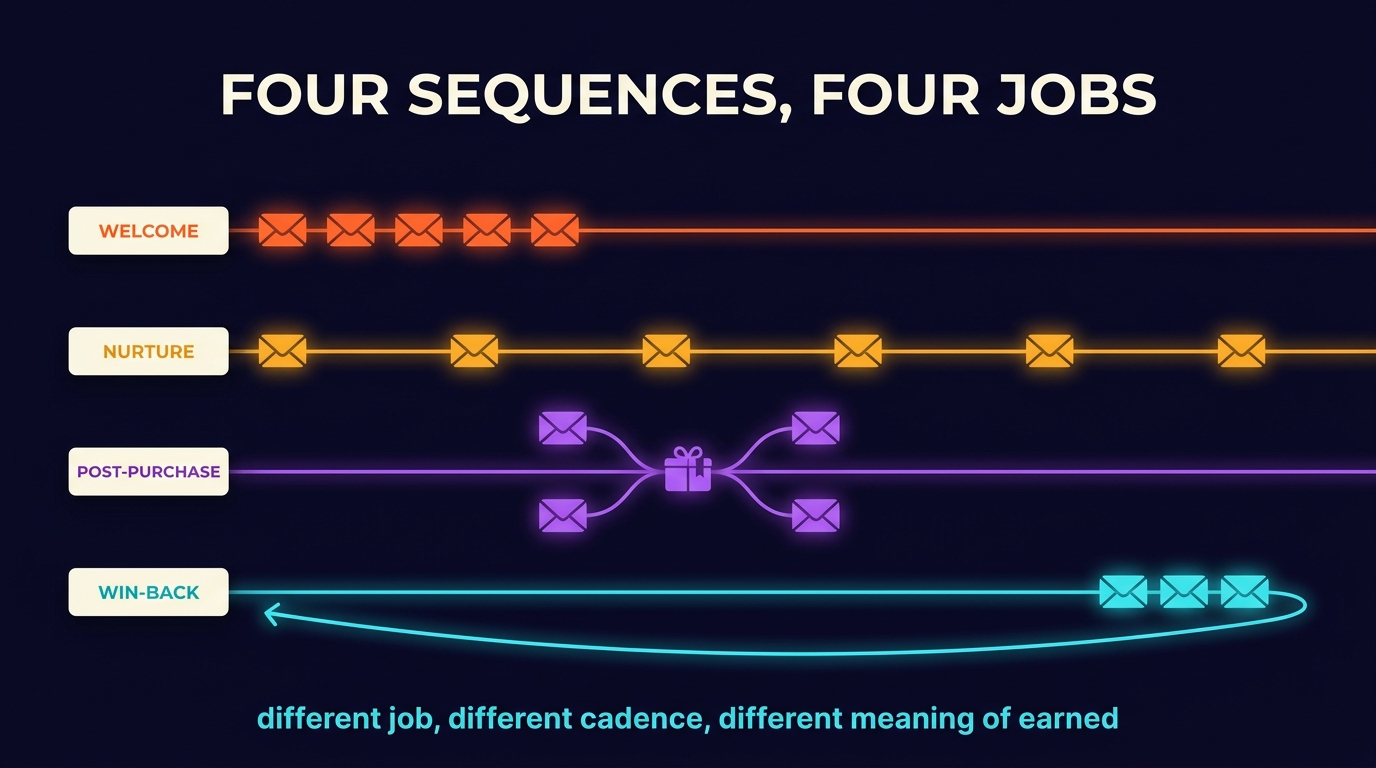
Welcome. The welcome sequence runs five to seven emails over the first two weeks. The job is to introduce the relationship and establish the rhythm: who you are, what to expect, what the buyer should do next. The first email lands within five minutes of subscribing because that's when the buyer's attention is highest. Every subsequent email references something specific from the prior one to signal continuity. The metric that matters is the click-through rate by the third email. If a subscriber hasn't clicked once by email three, the welcome sequence hasn't earned the right to keep going, and the system either branches them into a lower-cadence track or pauses entirely. The discipline comes from my Fitness Supplements case study, where phase one was relationship-building with no hard pitches, just valuable content addressing common buyer concerns mined from reviews and competitor feedback.
Nurture. This one runs eight to twelve weeks, at one or two emails per week. The job is to compound belief. Each email handles one specific objection or surfaces one specific proof point. The buyer isn't ready to buy yet, and the sequence makes them ready by addressing the friction one email at a time. Segmentation matters here in a way it doesn't in welcome: RFM data (recency, frequency, monetary), browse behavior and prior engagement signals all feed which nurture branch the subscriber lands in. Behavioral triggers (cart abandoned, page visited multiple times, product viewed but not bought) interrupt the default cadence and route the buyer into a higher-intent track. The Fitness Supplements work used this structure: phase two targeted the warm segment (the subscribers who clicked in phase one) with conversion-shaped messaging, benefit framing, and direct CTAs to the e-commerce site.
Post-purchase. This sequence runs four to six emails over the first ninety days after purchase. The job is to convert the transaction into a relationship. The buyer has paid; now you teach them how to get the most out of what they bought. The emails cover onboarding content, usage tips, social proof from other customers, and an invitation to a referral or review. Done well, post-purchase produces a measurable jump in repeat purchase rate and Net Promoter Score. Done badly, it produces silence and a churned customer ninety days later who never knew what they were supposed to do next. Predictive churn signals (declining usage, missed milestones, support tickets that go cold) trigger branches into recovery tracks before the customer is gone.
Win-back. The last archetype runs three emails over two weeks and then comes to a hard stop. The job is to recover attention from a subscriber whose engagement has declined past a threshold (no click in 60 days, no open in 90, RFM score in the bottom decile). The first email asks a direct question: do you still want to hear from me? The second offers a specific reason to stay (a piece of unique content, a meaningful update, a one-time offer). The third announces removal from the list with a soft return option. Subscribers who don't engage by email three get pruned. Pruning a non-engaged subscriber improves deliverability across the rest of the list, which is the operational dividend that makes the win-back archetype worth the engineering.
Sequences inherit from voice-of-customer, same as funnels
Every sequence inherits its language from the same diagnostic discipline that produces the funnel itself. The output of that discipline is the Lexicon of Pain: the verbatim phrases extracted from one-star reviews, support tickets, sales-call transcripts, Reddit threads and competitor reviews, exhaustively, per the Conversion Funnel Design playbook. It feeds the subject lines, the bodies, and the CTA copy of every email. Templated sequences hit baseline numbers. VoC-driven sequences lift revenue 4-7x over templated, because the subscriber reads the email and feels like the writer is inside their head.
My anchor for this comes from the Fitness Supplements engagement. The buyers were skeptical-by-default supplement consumers worried about efficacy doubts, ingredient questions, and proper usage. The phase-one sequence addressed those concerns directly using language pulled from customer reviews and competitor feedback. The phase-two conversion sequence used benefit-focused messaging that mirrored the same objection-handling pattern, with risk reversal through guarantees and transparency. The result was an additional $50K per month in direct email revenue from a previously dormant channel, plus an additional $100K per month in PPC performance because the cleaner pixel data from email-driven traffic allowed the paid team to refine lookalike audiences.
The compound effect is the point everything else rests on. A well-designed email sequence feeds cleaner intent signals into your paid pixel, sharpens your retargeting, and improves the targeting model the ad platform uses to find more buyers like the ones you already converted. One investment lifts three channels. The math runs in your favor when the sequences inherit from real research instead of from a template.
The 2026 deliverability context
The same three 2026 changes that make broadcast expensive also shape what a sequence has to look like to perform.
The Mailchimp-era assumption that opens are the primary signal is gone. MPP pre-fetches images for a substantial share of recipients, which makes opens partly fictional. Sequencing decisions that depend on opens (branch on opened-vs-not-opened) are now branching on noise. The click is the replacement signal, so branch on clicked-vs-not-clicked and treat CTOR as the trust metric. Subscribers who click consistently are real; subscribers who only "open" without ever clicking are increasingly likely to be MPP proxies.
Gmail and Yahoo's sender-reputation rules raised the floor on what a sender has to do to maintain inbox placement. Authentication (SPF, DKIM, DMARC) and one-click unsubscribe are both mandatory, spam complaint rates above 0.3% trigger penalties, and bulk senders who maintain low engagement rates get throttled or junked. Those rules make pruning non-engaged subscribers through win-back sequences a deliverability investment now, not a list-shrinkage cost. A smaller list of engaged subscribers outperforms a larger list of partially-dead ones across every revenue metric that matters.
The AI content flood means the inbox is louder than it's ever been. Everyone has "AI-generated personalization at scale" now, so what sets an email apart is signal density per email, in the buyer's exact language, anchored to specific proof. Generic AI nurture sequences underperform because they sound like every other generic AI nurture sequence in the inbox. VoC-anchored sequences cut through because the subscriber recognizes their own language and reads to the end.
Where to start
Here are three starting points, in order of difficulty and impact.
Easiest, do today. Audit your current welcome sequence. For every email in the flow, ask: did the prior email earn this one? If the prior email had no click-through, the next email shouldn't have sent on autopilot. Pause any send that fails the test. The audit takes an hour. The deliverability and engagement lift shows up inside a week.
Medium, this week. Build the win-back sequence if you don't have one. It's three emails and a hard stop, with ruthless pruning of subscribers who don't engage by email three. The short-term effect is that your active list shrinks. The medium-term effect is that your inbox placement improves measurably because the engaged-rate of your list jumps. The Yahoo and Gmail sender rules reward that pruning with better deliverability on every other email you send.
Hardest, this month. Rebuild your nurture sequence from scratch using the Lexicon of Pain. Pull the verbatim phrases from one-star reviews, sales-call transcripts, support tickets, Reddit threads and competitor reviews. Map each phrase to an objection, each objection to a single email, each email to a click-through CTA that proves the objection got handled. That comes to eight to twelve emails, sequenced over eight to twelve weeks. The first version will be ugly. The second version, written from the first version's engagement data, will outperform anything you could template-write from scratch.
Email is a structured conversation, and every email earns the next by producing a click, not an open. The Lexicon of Pain that drives funnel architecture also drives sequence design. The 2026 deliverability conditions reward engagement and punish broadcast, and disciplined email feeds cleaner data into every other channel you run. For the architectural decisions that determine which sequences need to exist, see Conversion Funnel Design.