
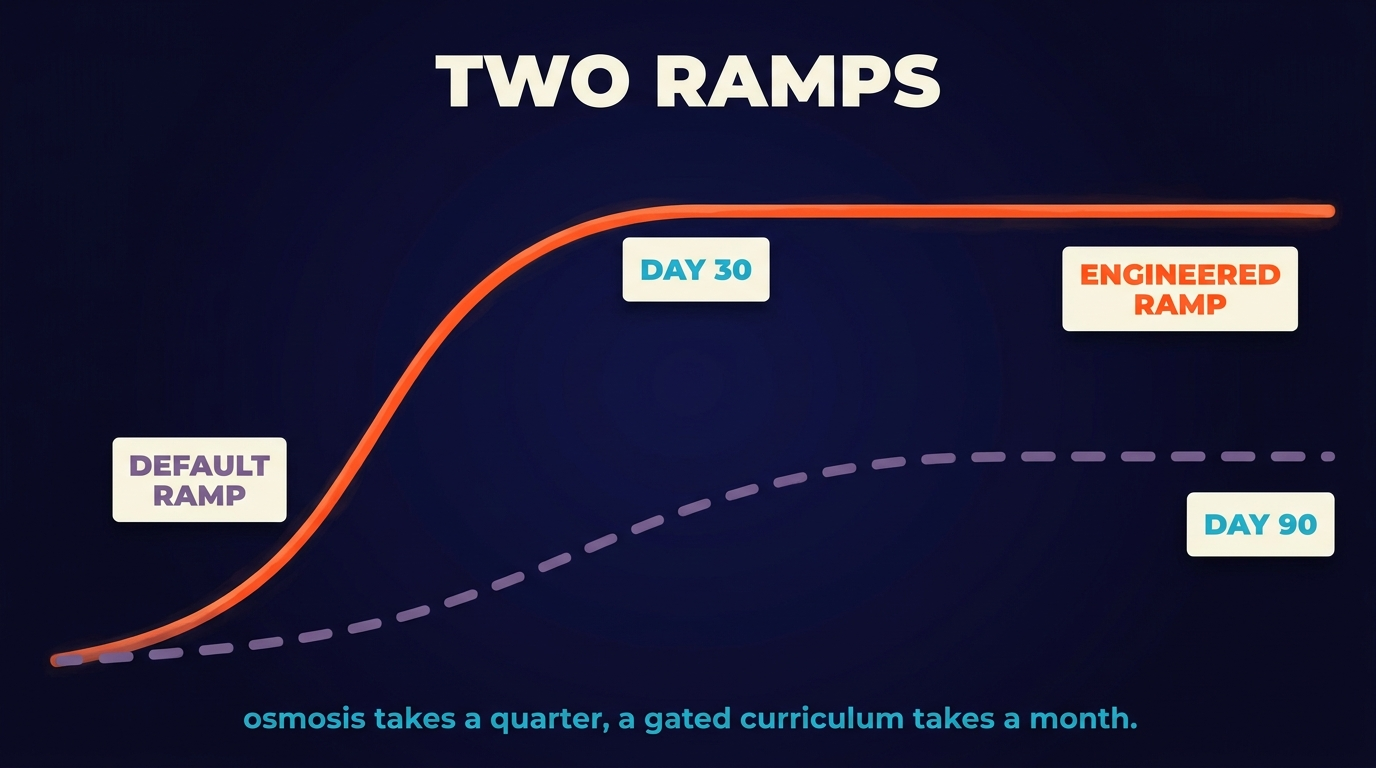
Most companies hire a sales rep, hand them a slide deck and a CRM login, throw them on a few calls to shadow, and then wait ninety days for the ramp metric to suggest the new hire has figured it out. Sometimes the rep figures it out by day ninety. More often the rep figures out a personal version of the job that's sixty percent of what the team actually does, hits a partial number, and the company never realizes it could have hit a full number with day-thirty performance instead of day-ninety. The lost revenue is invisible because there's nothing to compare it to.
This essay is the practitioner playbook for compressing the ramp. It corresponds to Stage 9 of the People · Product · Process framework (recalibration cadence and the playbooks that make process repeatable), and it borrows its formal lens from State Machine Everything, which treats enablement as a state machine: the rep is in a known state, the next state is reachable through a defined transition, and the transitions are gated on observable competencies, not vibes.
The osmosis tax
The default mode of sales onboarding is osmosis. The new rep shadows the senior rep on a few calls, reads whatever slide decks the marketing team produced last quarter, and gets a CRM login and a slack invite. They learn by absorbing whatever the team radiates, and different reps absorb different fractions of the actual operating model. The fastest learners reconstruct seventy percent of it in three months. The slowest learners reconstruct forty percent and never catch up.
The cost of osmosis-onboarding is a sixty-day ramp gap that nobody on the leadership team measures. The new hire's quota doesn't start counting for ninety days. The senior reps' time gets consumed by ad-hoc questions. The pipeline the new hire would have been working sits unworked because they aren't yet trusted on it. The compounding effect across a year of hires is meaningful: a five-rep team that ramps in ninety days produces less revenue than a five-rep team that ramps in thirty, holding everything else constant. The thirty-day team is made of better enablement, not better reps.
The portfolio framing on this is the source. From coaching program and course creation: most coaching programs and courses fail because the offer, curriculum, and delivery weren't designed as a system. Through a People-Product-Process lens, I help you turn expertise into something that reliably changes behavior. Sales enablement is the same problem in a different setting. It's a curriculum-design exercise, not a documentation exercise. The output is changed behavior in a constrained timeline. The constraint is that the rep is performant on day thirty, not day ninety. The osmosis-onboarding default fails the constraint because it was never designed against it.
The thirty-day curriculum · gated, not chronological
A thirty-day enablement curriculum is structured around competencies, not chronology. Each competency is one specific thing the rep must be able to do unsupervised. Each competency has an observable demonstration: a recorded mock call, a written deal-summary, a passed-with-feedback live coaching session. The rep advances to the next competency when they pass the demonstration, not when the calendar says so.
The competencies stack in dependency order. Foundational product knowledge sits underneath everything; you can't run a discovery call if you can't answer basic product questions. Discovery-call execution sits underneath proposal generation; you can't write a useful proposal without diagnosed pain. Negotiation sits at the top of the stack and is the last competency to gate. Because of the dependency order, the curriculum looks like a directed graph of competencies with prerequisite edges, not a list of topics.
Each competency has three artifacts: a short content module that explains the principle (15-25 minutes max, video or text), a practice exercise the rep completes (mock call, written deliverable, role-play), and a demonstration that gets reviewed by the manager or a senior rep (pass, fail with specific feedback, or repeat). The artifacts are deliberately compact. Long content modules signal that the curriculum is being padded for the appearance of rigor; short modules force the curriculum designer to identify the actual load-bearing principle.
The thirty-day target is intentional: by day thirty, a competency-gated curriculum produces a rep who has demonstrated every core capability under controlled conditions. The rep isn't at peak performance yet, which comes later as they accumulate live reps, but they're now performant enough to be trusted on real opportunities without senior babysitting. That's the operational threshold that matters. The senior reps recover their time. The pipeline starts working.
Playbooks · the operating model in one document
A playbook is the operational artifact that turns enablement from training into a system. It's a single document (or a small connected set) that answers: what does a rep on this team do, in what order, with what tools, against what definitions? It covers the discovery call structure, the qualification framework, the proposal template, the objection-handling library, the follow-up cadence, the escalation criteria and the renewal motion, and each section stays short, operational and maintained against reality.
From the source on this exact pattern: now the playbook is something where we had very specific actions required... the media buyer would take a look at the current day's performance, the previous three days, and the previous seven days. Then they would compare to see: is the ad getting better or is it getting worse? Anything that's getting worse got killed. Anything that's getting better, we would keep. That fragment is from the fifty-four solar account engagement and it captures the playbook ethos exactly. It names specific actions, specific cadences and specific decision criteria. The playbook is what the rep does on Monday at nine, not theory.
The playbook only works when it's ruthlessly maintained. The rule is simple: a playbook entry that disagrees with the current operating model is a bug. Either the entry gets updated to match reality, or the operating model gets corrected to match the playbook. Drift isn't allowed. Quarterly playbook reviews catch the drift; a designated playbook owner (usually the sales manager or operations lead) is responsible for keeping the document accurate. A playbook that isn't maintained turns into the same wallpaper a workflow diagram becomes when nobody enforces it.
The playbook also pulls double duty as the new-hire onboarding artifact. The thirty-day curriculum can reference the playbook directly for every operational definition. The rep doesn't have to learn the operating model and the curriculum separately, because the curriculum teaches the playbook. By day thirty, the rep has internalized the playbook because they've spent thirty days demonstrating capability against its definitions.
Call libraries · the asset that makes the senior rep portable
A call library is the highest-leverage enablement asset most teams already have the raw material for and never assemble. The raw material is the call recordings the team is already producing on Gong, Chorus, or whatever conversation-intelligence tool the company runs. The assembly is the curation. A senior rep or sales manager selects a small set of calls (twenty to thirty, not two hundred) organized by category: the best discovery call, the best objection handle, the best technical demo, the best save on a deal that almost died, and the best loss with a clean postmortem. Each clip is annotated with what to listen for.
The new rep watches the call library in week one. The pattern compression is enormous compared to ride-alongs. A ride-along delivers one call, randomly selected, with no curation. A curated library delivers twenty calls, deliberately selected, with the senior rep's commentary embedded. The new rep has now absorbed more pattern in five hours than two weeks of ride-alongs would have produced, and the senior reps didn't have to lose those two weeks of selling time.
The call library compounds when it's treated as a maintained asset. New exemplary calls get added quarterly. Stale calls (referencing pricing models that have changed, products that have shipped, competitors that have pivoted) get retired. The library has a curator (typically the sales manager) responsible for quality. Without curation the library bloats: two hundred calls is worse than thirty, because the new rep can't tell which calls are exemplary and ends up sampling at random. Curation is the work.
The library also serves the existing team. A rep going into a difficult deal can sample the relevant clips to refresh on the patterns. A rep struggling with a specific objection can watch the three best handles in the library before their next call. The asset serves the team's continuous calibration as well as its new hires. My framing on continuous calibration applies here directly: the library is one of the loops that prevents the operating model from drifting silently.
Three metrics that diagnose enablement
Three metrics tell you whether enablement is working.
The first is time to first deal, the number of days from start date to first closed-won. It's the bluntest measure and the hardest to dress up. A team trending the median time-to-first-deal down quarter over quarter is a team whose enablement is improving. A team where this number is flat or rising despite headcount growth has an enablement problem the leadership has probably been blaming on hiring or on the market.
The second is the day-thirty competency completion rate, the percentage of new hires who pass every gated competency by day thirty. It measures whether the curriculum is calibrated correctly. Below seventy percent, the curriculum is too aggressive or under-resourced. Above ninety-five percent, it's probably under-rigorous and isn't gating anything. The right zone is seventy-five to ninety percent: enough rigor to mean something, enough achievability that most hires actually pass.
The third is win-rate variance across reps, the standard deviation of close rate across the team, holding lead source constant. High variance means the playbook isn't being executed consistently and reps are running their own versions of the operating model. Low variance means the playbook is the operating model. Enablement that compresses variance is enablement that has graduated from training into systems. The compression is itself a leading indicator that the team can scale: a low-variance team can absorb new hires and predict their output, and a high-variance team can't.
Where to start
There are three places to start, in order of difficulty and impact.
Easiest, do today. Write down the five competencies a rep must have on day thirty: five, not nine or twelve. Write each in one sentence, with one observable demonstration. Compressing the list to five forces clarity; if you can't pick five, the operating model itself is unclear, and the enablement problem is downstream of a strategy problem.
Medium, this week. Pick five exemplary calls from your existing recording library and annotate them: one best discovery, one best objection handle, one best demo, one best save and one best loss postmortem. Give each call two to three minutes of written annotation. Drop the set into your team wiki. Tell the next new hire to watch all five in week one. Watch what happens to their week-two performance.
Hardest, this month. Write the day-thirty competency gate: the specific demonstration the rep must pass, its format, the reviewer, the pass criteria and the fail-and-repeat structure. Run the next hire through it. Don't let calendar time substitute for demonstration. The first hire through the gate will surface every gap in the curriculum. Refine the gate from what you learn. By the third hire, the gate is calibrated and the team has an enablement system instead of an enablement aspiration.
Sales enablement is curriculum design under a constraint: the rep is performant on day thirty, not day ninety. The output is changed behavior in compressed time. Three artifacts compound across hires: the gated competency curriculum, the maintained playbook, and the curated call library. Each one ages well only with active maintenance. For the underlying methodology see People · Product · Process; for the workflow context that determines what counts as competent see Workflow Design.