
Three agencies have rebuilt the funnel and the conversion rate didn't move. The headline got swapped, the hero shot got refreshed, and the CTA got A/B tested into oblivion, but the number stayed flat and the buyer kept bouncing. Everyone agreed something was wrong, and nobody could name what. That's the tell that the funnel was built off a template, not off a diagnosis. The wrong question was answered with the wrong tool, beautifully.
This essay is a practitioner playbook for end-to-end conversion funnel design, starting from what your buyer actually believes and working outward to architecture. It's the full explanation behind the service of the same name in the homepage's Sales & Growth section. The companion piece, The Velvet Rope, covers what happens at the qualification gate after the funnel has done its job, and this piece covers everything before that gate.
The template trap
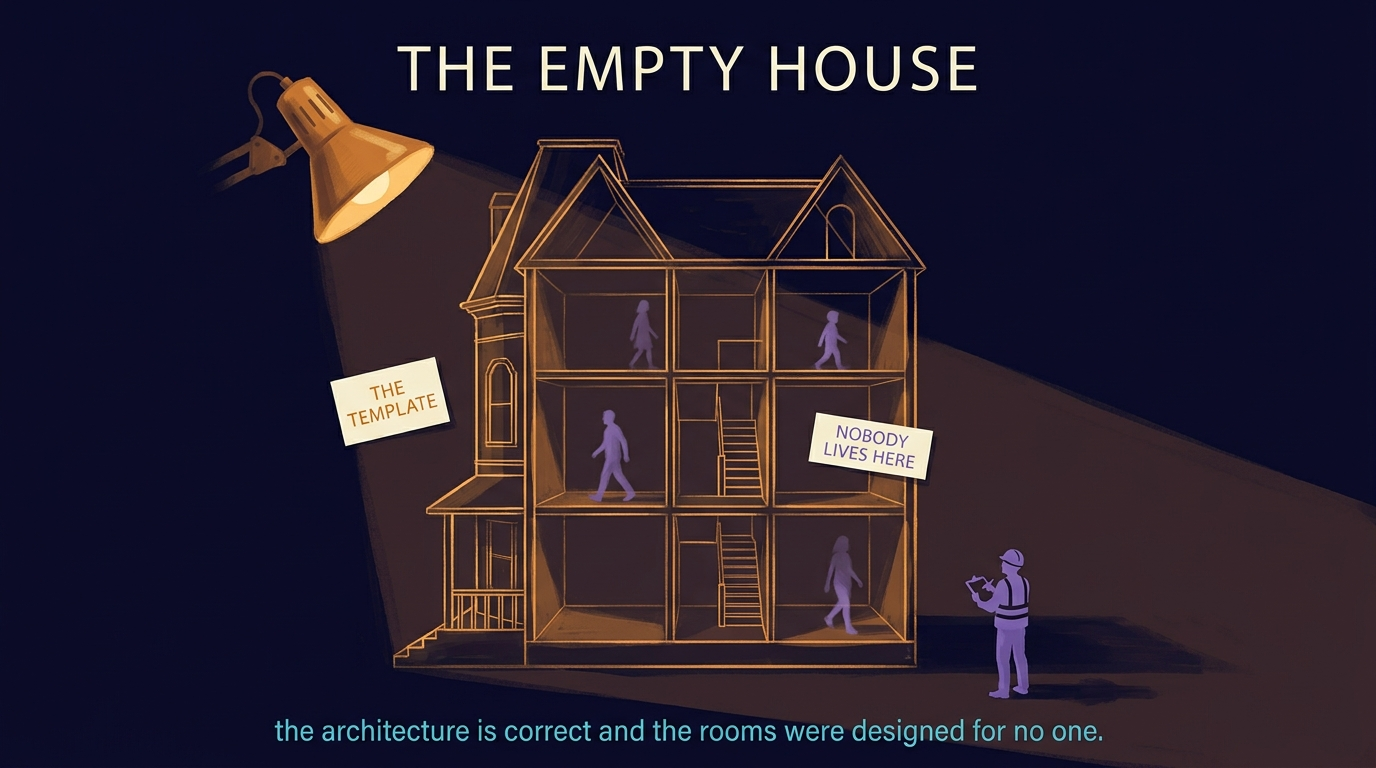
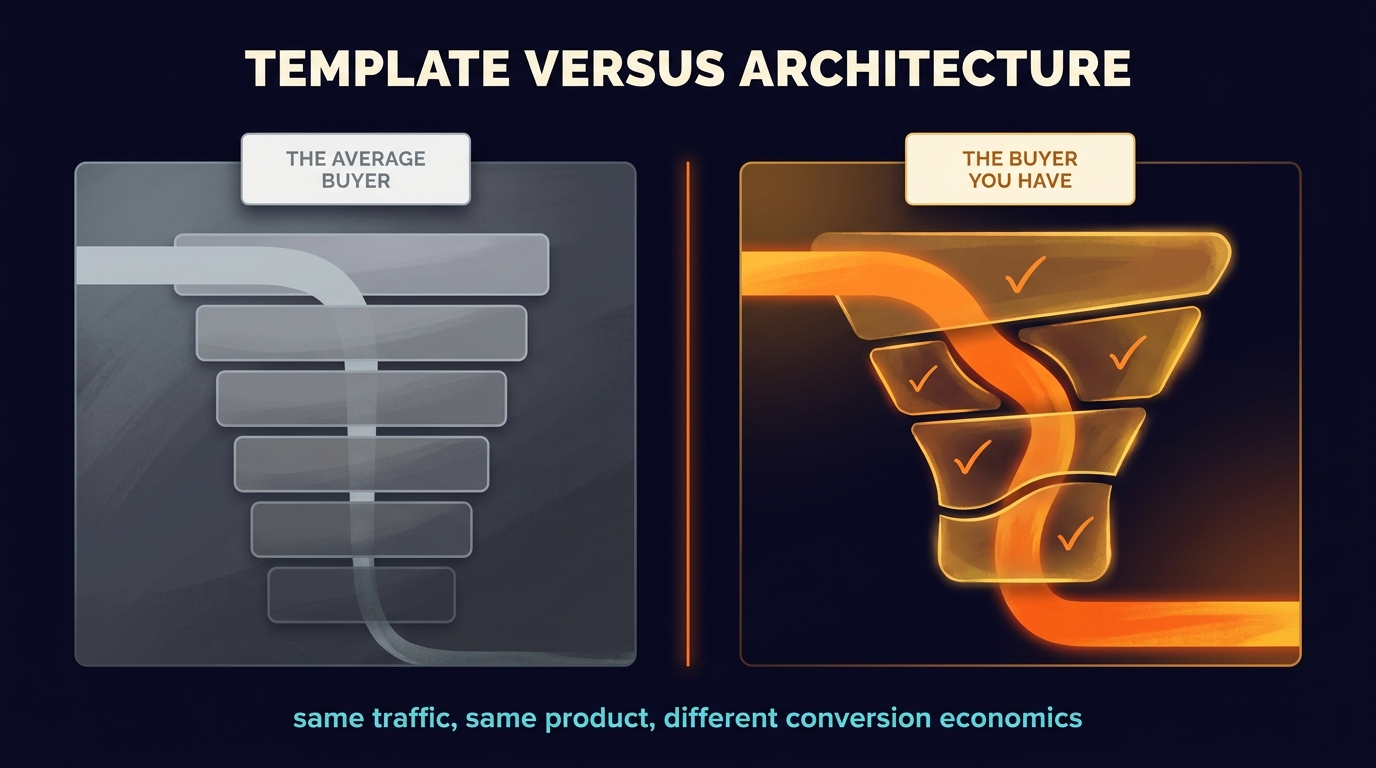
Most funnel work starts with a template: six steps (awareness, interest, desire, action, retention, referral), then the hero band, the features grid, the testimonial wall, the pricing table, and the CTA. You pick a stack from the popular tools, drop in your copy, and ship. The template encodes a specific buyer (a generic one) at a specific awareness level (somewhere in the middle) with a specific objection profile (vague). When your buyer is more specific than the template, which is always, the funnel underperforms in proportion to how specific they are.
The template trap is leverage that has expired. Templates work in the early days of a category, when buyers are roughly homogeneous and the template encodes the patterns that worked for the first cohort. Once the category matures and buyers segment into sophisticated cohorts, the template becomes a ceiling. Three months of template iteration buys you one round of incremental lift. Three weeks of voice-of-customer research buys you a structural rebuild that compounds for the next year.
The other failure mode is template plus tactics. The funnel is a template, and the CRO (conversion rate optimization) program is a series of micro-tests on top of it. Nobody has studied the buyer, and the hypothesis bank is empty. Every test is a button color or a headline word swap, and the lift is statistically real but commercially trivial. A 3% lift on a 1.4% conversion rate is twenty-eight basis points, which is invisible against the variance from running ads on Tuesday versus Saturday. This is the pattern Andy ran into across multiple engagements before the diagnostic discipline became the default. Verbatim from the transcripts: I mine your reviews, support tickets, analytics, and Reddit/YouTube comments to map what your best buyers are trying to solve. The diagnosis comes first. The rebuild follows.
What end-to-end actually means
End-to-end conversion funnel design is the full path from the moment a stranger first encounters your category to the moment they renew, refer, or churn. The middle of the funnel (your sales landing page, your sequence, your pricing page) is what most operators design. The edges (where attention starts, where retention compounds) usually go unmanaged, and they're where most of the revenue lives.
Sixty percent of buyers take six or more actions before they convert. Touchpoints fragment across paid channels, organic search, social platforms, peer recommendations, podcast mentions, and now LLM-mediated discovery where ChatGPT or Claude tells the buyer what to consider before the buyer ever lands on your site. Last-click attribution buries the work the early touchpoints did. The buyer remembers the third touchpoint as the trigger; the platform credits the seventh. The funnel you optimized in your analytics tool isn't the funnel the buyer actually walked.
End-to-end design starts from that messy reality. You map every channel, every touchpoint, every belief shift the buyer has to make to move from one stage to the next. The architecture follows the buyer's path, not the platform's reporting model. From the AndyDataGuy DTC metal-art case study: the breakthrough came from CSV-exporting Facebook ad data and building cohort analysis by creative, age, device, and headline. The pattern that popped (45+ women on iPhone buying as gifts) was invisible inside any default funnel report. The cohort had to be reconstructed from the raw export. Once it was, the entire funnel got rebuilt around that buyer's specific journey, and revenue went from $10K to $150K monthly inside ninety days.
Voice of customer is the diagnostic, not the decoration
Voice-of-customer (VoC) research is a forensic sweep to extract the exact phrases your buyer uses to describe the problem they came to solve, not a hunt for pretty quotes for the next pitch deck. Those phrases become the headline of every page, the subject line of every email, the first frame of every ad. When the buyer reads their own language back, the bounce rate drops. When they read someone else's language, they leave inside ten seconds.
The sweep covers five sources, in order of signal density.
- One-star reviews of your product and your three closest competitors. One-star reviews are pre-articulated objections. The buyer was unhappy enough to write four hundred words explaining exactly what broke. The phrases they use are the objections your funnel has to defuse before they even surface.
- Support tickets and refund requests. The pattern is the same: the buyer is annoyed enough to type, and they'll tell you the gap between what they thought they were buying and what they actually got. That gap is your messaging mismatch in plain English.
- Sales-call transcripts (Gong, Fathom, Granola, raw Loom). Listen for the moments the prospect pauses, restates a question in their own words, or asks the same thing twice. Those are belief friction points. They name the objections you have to handle before the call.
- Reddit threads, YouTube comments, niche Discord and Slack communities. Here the buyer writes an unfiltered internal monologue for peers, not for vendors. The Lead-Gen Funnel Overhaul case study drew heavily from this layer to rewrite the offer from scratch.
- Competitor reviews on G2, Capterra, Trustpilot, App Store, Google Maps. The pain language takes its clearest form here, because the buyer is comparing across vendors and naming what they wish they had.
The artifact you produce is a Lexicon of Pain: a flat document of fifty to two hundred verbatim phrases, sorted by belief-shift category. Entries look like "I tried two agencies and neither could explain what was actually broken", "the dashboard tells me something is wrong but never which lever moves the needle", and "I keep paying for tests that nobody runs". Each phrase is a piece of language you can drop into copy. The Lexicon is the diagnostic output, and the funnel is the prescription that uses it.
One caveat applies in 2026: don't run VoC on a single source. Reddit-only VoC produces funnels optimized for the loudest cohort. Sales-call-only VoC ignores the buyers who never made it to a call. The full sweep is mandatory. Multi-channel fragments hide true belief blocks; partial VoC produces funnels that look correct and underperform anyway. Andy's discipline is explicit: real behavior, language, and constraints pulled from real data, plural sources, triangulated.
Belief shifts as architecture
Once the Lexicon is in hand, the architecture follows. A funnel is a sequence of belief shifts. At each stage the buyer holds a specific belief about themselves, their problem, their options, and you. The job of that stage is to update one of those beliefs. If the page tries to update three beliefs at once, none of them update. If the page tries to update no belief, the buyer leaves with the same belief they arrived with.
Two frameworks carry most of the weight. The first is Eugene Schwartz's awareness levels, written in 1966 and still holding up. The levels run from unaware to problem-aware to solution-aware to product-aware to most-aware, and each one needs different language, different proof, and a different CTA. A solution-aware buyer who lands on a product-aware page bounces; the page presupposes a belief they haven't formed yet. The second is Jobs-to-be-Done, in particular the hire/unhire framing. The buyer hires your product to make functional and emotional progress on a job. The funnel architecture inherits its emphasis from the job, not the feature list.
The composite move is to map each Lexicon phrase to the awareness level it implies and the job it expresses, then build the funnel stage by stage so each stage hands the buyer the next belief in the language they already use. Andy's verbatim discipline: we engineer your message and offer to match that psychological reality grounded in your customer's lived experience. The work is mechanical: Lexicon in, awareness map out, stage-by-stage architecture next.
The third framework is the LTV-to-CAC ratio with a North Star metric. The funnel architecture only matters if it produces customers whose lifetime value covers their acquisition cost three times over. A funnel that produces lots of cheap conversions with brittle retention loses money on a longer time horizon. VoC-first design tends to widen LTV/CAC because the customers who come through resonate with the offer; they renew, they refer, they upgrade. The ratio is the truth-teller. If the ratio doesn't move, the funnel didn't work, no matter how many micro-conversions improved.
The four-stage workflow
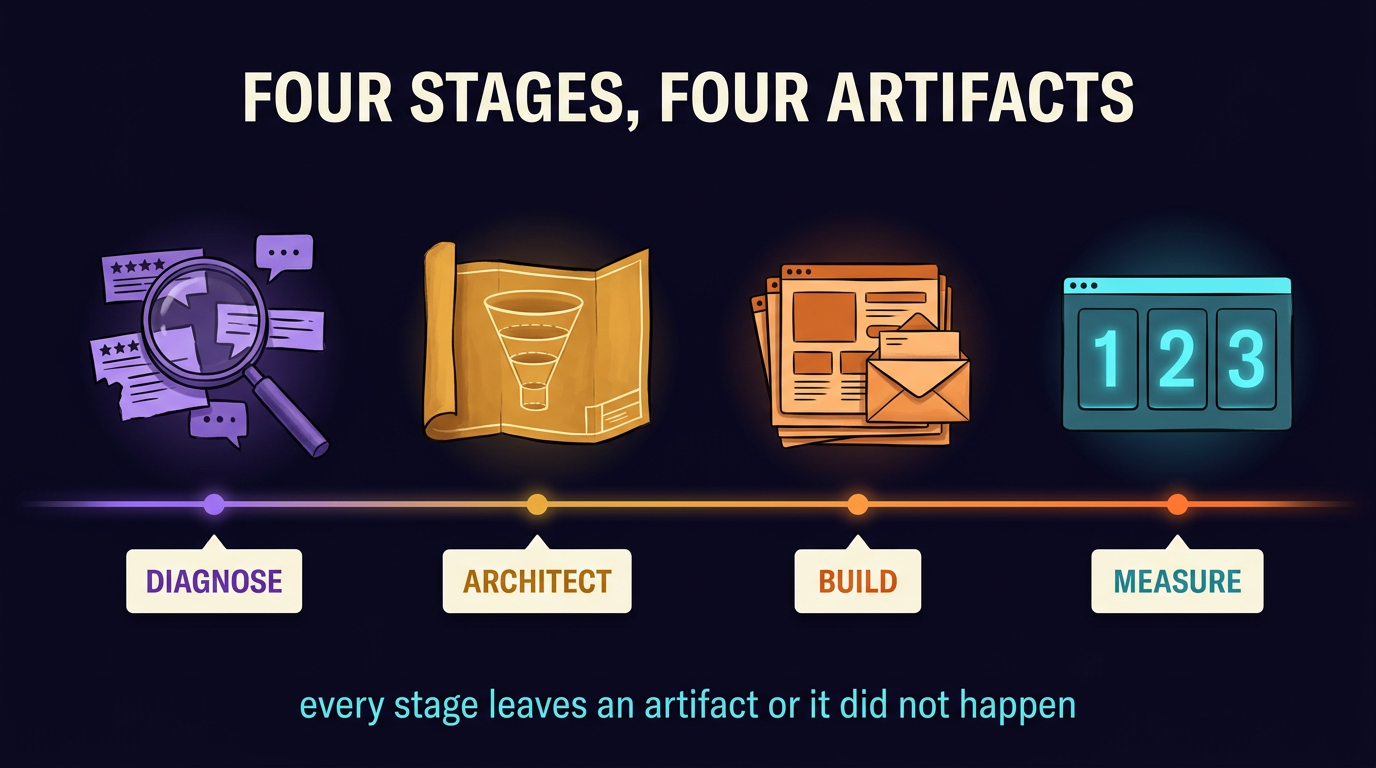
Stage 1: Diagnose. It takes two weeks. Run the five-source VoC sweep. The output is the Lexicon of Pain plus an awareness-level map plus a jobs-to-be-done summary. No copy gets written in this stage. The temptation to start drafting the headline before the Lexicon is complete is the failure mode that produces every template-shaped funnel you've seen. Hold the line.
Stage 2: Architect. It takes one week. Map each belief shift to a stage. Decide channel allocation: which traffic is problem-aware (long-form content, SEO, podcast mentions), which is solution-aware (paid search, comparison content), which is product-aware (retargeting, webinars, demos). Specify the artifact at each stage (page, email, ad, video, audit). Specify the metric at each stage (clicks, applications submitted, calls booked, proposals signed, revenue closed). The output is a one-page architecture map. If the map doesn't fit on one page, the architecture has too many beliefs to update, so collapse it.
Stage 3: Build. It takes three to six weeks, depending on scope. Write the copy from the Lexicon. Build the pages, sequences, ads, and videos. Wire the analytics so each metric on the architecture map has a corresponding number in the dashboard. The build inherits its specifications from Stage 2; it doesn't reinvent them. If you find yourself in build asking architecture-level questions, you skipped Stage 2 and the work will rot.
Stage 4: Measure. It's ongoing, with a hard checkpoint at thirty, sixty, and ninety days post-launch. The questions are "did the LTV/CAC ratio move," "did the awareness-stage distribution of qualified leads shift the way we predicted," and "did the sales-call objections we engineered for actually surface less often," rather than "did the conversion rate go up." Measure the structural shifts, not the cosmetic ones.
What changes when VoC leads
Three things move when the funnel inherits from VoC. Cost per qualified lead drops, often by half or more, because the targeting and offer match the buyer's actual language. The Lead-Gen Funnel Overhaul case study moved CPL from $50 down to under $10 over a sixty-day window using this discipline. The offer was rebuilt around the Lexicon, a new long-form qualifying application filtered the wrong fit before the call, and the platform pixel re-trained on the profile of buyers who actually completed the application.
Close rate goes up because the buyers who reach the calendar arrive with the right beliefs already in place. The Facebook Ads Coach case study hit sixty-to-seventy percent close rates on qualified calls during its $199.5K-in-30-days run because the funnel had pre-handled the common objections in the page copy and the application before the prospect ever spoke to a human.
LTV-to-CAC widens because resonant customers retain. The Fitness Supplements case study shows the compound effect: an email sequence built from VoC produced $50K/month from a previously dormant channel, and the cleaner pixel data the email traffic generated unlocked another $100K/month from refined PPC lookalike audiences. One investment lifted two channels, both because the underlying buyer model was correct.
The fourth thing that changes doesn't show up in a dashboard. The team stops arguing about which channel is broken. The argument used to be paid versus organic versus email versus product. Once the architecture map exists, the argument becomes "which belief shift is failing at which stage," which is a question with a falsifiable answer. The arguments get shorter and the experiments get sharper. That's the operational dividend of doing the work.
Where to start
There are three starting points, in order of difficulty and impact.
Easiest, do today. Open your last twenty one-star reviews and your three nearest competitors' one-star reviews. Copy every concrete pain phrase into a flat document. Don't analyze yet; just collect. Most operators have never read their own reviews end-to-end, and the language sitting there is doing nothing for them. One hour of collection produces enough Lexicon to rewrite the headline of the page that is bleeding the worst.
Medium, this week. Pull the last twenty sales-call transcripts (Gong, Fathom, raw Loom recordings). Listen at 1.5x for moments of friction: where the prospect pauses, restates the question, asks the same thing twice. Those moments are belief gaps. Map each gap to a funnel stage. The page upstream of that gap is the page you rewrite first.
Hardest, this month. Run the full five-source VoC sweep before the next funnel rebuild. Produce the Lexicon, the awareness-level map, the JTBD summary. Hold the rule that no copy gets written until the diagnostic artifact is signed off. The first funnel built from this discipline will outperform every iteration of the template you've been working on, often by margins that look unrealistic until they show up in the LTV/CAC report.
Funnel design is a sequence of belief shifts in the language your buyer already uses. The diagnostic comes first, the architecture follows, the build inherits its specifications from the architecture, and the measurement reads the structural shifts, not the cosmetic ones. Every shortcut around this discipline produces the same template-shaped funnel that was already underperforming before you touched it. The companion essay on the qualification gate that comes after the funnel does its job is The Velvet Rope.