
Customer service and tech support usually get treated as one team. Operationally they're two distinct workloads with different competencies, different SLA shapes, and different escalation paths. Customer service handles the questions that involve no debugging: how do I, where is, can you change, what is the policy on. Tech support handles the questions where the system is misbehaving: it's not working, the data is wrong, the integration broke, the metric I see doesn't match the metric you bill on. Treating the two as one produces operators trained well for neither workload, customers routed to the wrong queue, and an escalation path that's both ungated and unclear.
This essay is the deeper companion to Support Operations. Support Operations covered the operating-model fundamentals (triage, response-time engineering, the knowledge base as a deflection asset). This one digs into what matters once the support workload includes technical work: tier-three escalation discipline, technical-documentation systems, the trust-deposit framing, and the feedback loop back to product. The work corresponds to People · Product · Process Stage 9 (post-sale fulfillment) and inherits the formal lens from State Machine Everything.
Every interaction is a trust deposit or a withdrawal
The most useful frame for service operations is a trust ledger: every customer interaction is a deposit or a withdrawal against a balance. A clean resolution where the customer felt heard and the issue closed is a deposit. A bounce between two queues that ended in a partial answer is a withdrawal, and so is a first response that took six hours. A senior engineer dialing in to debug live with a frustrated customer and resolving in twenty minutes is a major deposit. At the company level, the retention curve is the integrated sum of that ledger across the customer base.
From the source: done right, each resolved ticket becomes a small trust deposit. Support turns from "complaint department" into one of your most effective revenue channels. The ledger is what justifies investments leadership otherwise treats as cost. A dollar that goes into cutting first-response time speeds up trust deposits, and a dollar that goes into the senior-engineer escalation rotation is the difference between a saved account and a churned one. Reframing that spend as ledger management changes which tradeoffs leadership is willing to make.
The ledger also disciplines operators. Each interaction is part of an ongoing relationship the company is keeping. A snippy response from an exhausted operator is a withdrawal that lingers, and a sincere acknowledgment of a mistake is a deposit that stacks. Operators who keep the ledger in mind tend to write differently from operators who treat each ticket as a one-off, and the team's tone shifts with them. The CSAT number moves because the operating model itself values the relationship over throughput, not because anyone trained for empathy.
Customer service is not tech support · train for the workload
The two workloads share infrastructure (the help-desk tool, the SLA system, the knowledge base) but diverge sharply in operator competency. The customer-service competency is reading policy correctly, navigating emotional escalation, asking clarifying questions that surface non-obvious context, and de-escalating without giving away the company's leverage. The tech-support competency is reading logs, isolating variables, reproducing the customer's environment, knowing the product's failure modes well enough to skip three obvious diagnoses, and writing a precise reproduction case for engineering when escalation is required.
One operator can hold both competencies, but most operations shouldn't assume that as the hiring default. A small team can run a generalist tier with senior backup, but as volume scales the generalist tier produces inconsistent quality on the technical side because most generalist hires don't have the engineering background to debug efficiently. The fix is to split the workloads at the triage layer. Tickets that involve account changes, billing, policy questions, and onboarding flow to the customer-service queue. Tickets that involve broken behavior, data discrepancies, integration errors, and performance complaints flow to the tech-support queue. The split happens automatically from tags the customer picks in the support form, with ML classification or operator triage handling the ambiguous cases.
The split also clarifies hiring and training. The customer-service queue trains on policy, tone, and de-escalation patterns, while the tech-support queue trains on the product's internals, the diagnostic toolchain, and the escalation criteria for engineering involvement. The career paths diverge too. Operators who excel at customer service often grow into customer-success roles, and operators who excel at tech support often grow into solutions engineering or product roles. Acknowledging that divergence early lets the company invest in the right development path for each operator instead of pretending they're the same job.
Escalation paths · tier three is engineering, not a heroic senior engineer
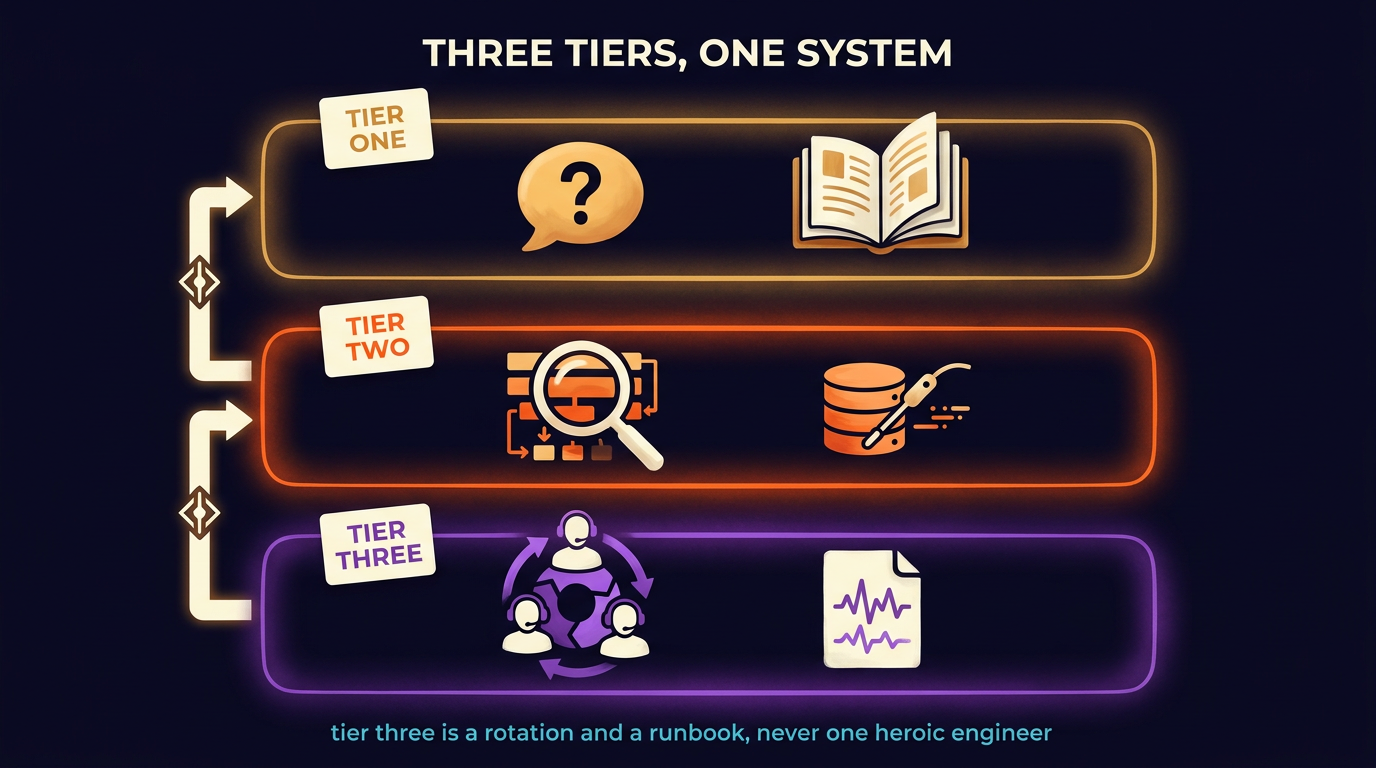
Tier-three escalation is the part of support that most often breaks under volume. In the usual pattern, tier one and tier two escalate to a senior engineer who has accumulated tribal product knowledge, and that engineer becomes the de facto escape valve for support. They handle each escalation through personal heroics, they don't document, and they have no peer cover. When they go on vacation, the escalation queue lengthens. When they leave the company, the escalation system effectively dies for six months while a new senior accumulates the same tribal knowledge.
The fix is to treat tier three as a system rather than a person, and the system has four parts. A named on-call rotation runs across multiple engineers (at least three for a small team, more as volume scales), so no single engineer carries the load permanently. Defined escalation criteria tell tier-two operators when to push up and tell tier-three engineers what to expect when they get paged. A required reproduction case comes with every escalation: the steps to reproduce, the affected account, the relevant log lines, and the expected versus actual behavior. And a postmortem after every tier-three resolution converts that resolution into a tier-two playbook entry, a knowledge-base article, or both.
The reproduction-case requirement is the cheapest leverage in the entire pattern. Most tier-three escalations historically arrive as panic with vague symptoms. The on-call engineer spends thirty minutes reconstructing the case before any debugging starts. Requiring a structured reproduction case at the escalation boundary makes the tier-two operator do that reconstruction, which they can typically manage with twenty minutes of effort. The tier-three engineer then arrives at a problem that's ready to debug and spends their time on the part that needs their expertise. Mean time to resolve comes down, tier-three engineers' satisfaction with the support team goes up, and the escalation rate stabilizes because tier-two operators learn from each escalation what it takes to surface an issue cleanly.
From the source on workflow runbooks, the same discipline applies here: deliverables typically include ticket analysis, improved workflows and SOPs, knowledge bases, macros, escalation paths, and simple metrics so you can see resolution time, backlog health, and where friction actually lives. The escalation path is itself a runbook, with the escalation criteria as its trigger, the reproduction case as its response, and the postmortem as its maintenance loop. Runbook discipline applies wherever there's a recurring failure mode the team shouldn't be reinventing the response to.
Technical documentation · the second brain that scales support without scaling headcount
Technical documentation is the load-bearing asset that decides whether tech support scales linearly with customers or sublinearly. From the source: every repeated "how do I…?" support ticket is a documentation failure. Most documentation problems stem from misalignment between product teams and users. The result? Docs that are outdated before launch, or systems that create more questions than they answer. The documentation problem looks like a content problem and is actually a system problem. Content that gets written once and never maintained rots faster than the product changes. Content organized around the engineering team's mental model fails when the user's mental model differs.
The documentation system has four layers. The first is information architecture organized around the user's intent (I want to do X) rather than the product's structure (here is the X module). The second is a single-keyed source of truth: every fact lives in exactly one place, and everything else that shows it (in-app help, support macros, the AI assistant's RAG corpus, meaning the documents it retrieves answers from) references that place. The third is an update process tied to product release cycles, so doc updates ship with the feature, not three weeks after. The fourth is a quarterly maintenance audit that retires stale entries and rewrites the ones product changes have invalidated.
The same documents serve multiple consumers. A well-written troubleshooting article deflects a support ticket from the customer who finds it through search, accelerates a tier-one operator's response when they drop the link in their reply, and trains the AI assistant that retrieves it to answer questions inline. From the KB section of the portfolio: knowledge base management turns that fragile, tribal knowledge into a durable asset that trains new hires, supports existing staff, and powers AI systems. One round of maintenance work compounds across all three consumers. The investment leverage is several times what most teams realize.
Andy's discipline on this in production: I design documentation as an operational system using People-Product-Process. Deliverables typically include a documentation audit, improved information architecture, rewritten or net-new guides, templates, and a simple maintenance process so content doesn't rot. The maintenance process turns the documentation set from a one-time deliverable into a living asset. Without it, the writeup of the system at launch becomes the gravestone of the system at month six. With it, the documentation outlives the product team that wrote it and trains every new operator who joins.
Two metrics that matter specifically for tech support
Beyond the four metrics from Support Operations, two more metrics diagnose the tech-support layer specifically.
The first is the tier-three escalation rate, the percentage of tickets handled in tier two that escalate to tier three. A rate trending down quarter over quarter signals that tier-two operators are leveling up, the playbooks are absorbing more of the diagnostic work, and the engineering rotation is being protected from interruption. A rate trending up means either the product has gotten harder, the playbooks have decayed, or tier-two operators are escalating defensively to avoid responsibility. The investigation when this metric rises is operational, not punitive.
The second is time to reproduction inside tier three: the minutes between an escalation arriving and the engineer reproducing the issue locally. It's the diagnostic for whether the escalation interface itself is working. A high time-to-reproduction means the reproduction-case requirement is being treated as optional and the engineer is doing reconstruction work that should have happened upstream. A low time-to-reproduction means the interface is clean and the escalation system is doing what it was designed to do. Engineers will often resist being measured this way, and the resistance is usually a signal that the metric is the right one. The metric doesn't blame the engineer for resolution time, which depends on how hard the bug is. It measures the upstream interface, the part operations can directly improve.
Where to start
There are three places to start, in order of difficulty and impact.
Easiest, do today. Pull the last thirty days of tickets and split them into customer-service and tech-support categories, then look at the volume ratio and at the resolution-time distribution in each category. The shape of those two distributions usually surprises leadership: one queue is dominating the operator's time and the other is dominating the customer's frustration, and they're rarely the same queue.
Medium, this week. Write the reproduction-case template: steps to reproduce, affected account, relevant log lines, expected behavior, actual behavior, and screenshots or recordings, somewhere between three and seven fields. Use it on the next tier-three escalation. The first time it gets enforced, the tier-two operator will push back because it's more work upfront. The second escalation will land cleaner. By the fifth, the template is internalized and tier-three engineers stop dreading the queue.
Hardest, this month. Stand up a real tier-three on-call rotation with three named engineers, paging coverage, and a postmortem cadence. The postmortem cadence is the hard part, not the rotation. After every tier-three resolution, someone spends fifteen minutes on a structured writeup that answers what the root cause was, which playbook entry or KB article should retire this class of escalation, and who owns the writeup. That cadence is what turns escalations into compounding deflection rather than recurring pain.
Customer service and tech support are two distinct workloads sharing infrastructure. Treat them as one and operator quality regresses on the technical side. Treat them as two and the escalation paths, the documentation, and the metrics can each be designed against the right operating model. Every interaction is a trust deposit or a withdrawal, and the cumulative ledger is the retention curve. For the operating-model fundamentals see Support Operations; for the workflow lens see Workflow Design.