
Most consulting frameworks are sales tools that ate their function. They start as a way to organize messy reality and end as a way to bill more hours. People, Product, Process runs the other direction. It is a diagnostic stethoscope rather than a billable framework, and the test of whether I have written it up properly is whether you can run it on yourself, in a parking lot, with no consultant present.
The whole thing is three words and nine stages. Three words name the layers a business problem can live on. Nine stages name the sequence that takes a customer from a problem they haven't yet articulated to a result they can point at. Every business problem sits on one of those three layers, and most of them get misdiagnosed because the founder is staring at the wrong layer with total conviction. The work of an operator is figuring out which layer the actual problem lives on before you spend a dollar fixing anything.
I have run this at every scale I have had access to. A metal wall art store that went from ten thousand dollars a month to a hundred and fifty thousand in ninety days. A solar portfolio with fifty-four separate ad accounts that got consolidated into one intelligence layer and raised capital on the back of it. A coaching launch that did a hundred and ninety-nine and a half thousand dollars in thirty days. Agency lead generation that moved cost per lead from two hundred dollars to eighteen. Those are one sequence applied nine different times, not nine different playbooks, and the winning move kept coming from a stage nobody wanted to run.
This is the full thing: every stage, what it produces, the diagnostic questions I actually ask, the worked examples, and the specific ways each stage fails when you skip it. It's long because the framework is nine stages deep and a summary of it is worth roughly nothing. A summary tells you the stages exist. It doesn't tell you what to say when a client refuses to give you a budget number, and that is the moment the framework earns its keep.
Why the order matters
People comes first because every product is downstream of who it serves and who builds it. Most of what looks like a product problem is a customer-misalignment problem wearing a product costume. Wireframes are fine. Features ship on schedule. Conversion sits flat because the whole thing was built for a person nobody in the building has actually met.
Product comes second because once you know the person, an offer either fits or it doesn't. Teams get this wrong by treating "product" as the codebase, the SaaS, the SKU. A product is the entire promise made to a customer: what is claimed, what it costs, what proves it, what happens if it fails. A startup with a beautiful codebase and no offer-market fit has a product problem, and no amount of engineering touches it.
Process comes last because it is the most expensive layer to fix and the easiest to fix wrong. Most operators reach for process first. They want better OKRs. They want a new CRM. They reach for process because process is the thing they have authority over, and having authority over something feels a great deal like that thing being the problem. The diagnosis was wrong. The prescription happened to be within arm's reach.

If you are working on process before you are sure about people and product, you are doing what is in front of you instead of what is required. That is the most common operator failure mode I see, and it is expensive precisely because it looks like work.
There is a second reason for the order, and it matters more in practice than the first. Each phase produces the raw material the next phase consumes. Stage 1 produces language, in the customer's own words, that Stage 5 turns into a message. Stage 2 produces a named future that Stage 6 puts a price on. Stage 3 produces a list of behaviors a customer has to change, which is exactly the list Stage 7 qualifies against. Skip a stage and the stage downstream of it has nothing to work with, so it improvises. Improvised inputs are how a campaign ends up sounding like a company talking about itself.
Watch what that looks like in a real failure. A team runs no voice-of-customer work, so Stage 5 has no vocabulary to draw on, so the copywriter writes from the brand deck. The copy sounds fine. It sounds like every competitor, because every competitor also wrote from a brand deck. Then someone decides the problem is creative fatigue and commissions more of the same copy at higher production value. Cost per acquisition climbs. The team concludes the channel is saturated. Nothing about the channel was ever the issue. Stage 1 never ran, and the whole chain downstream of it has been running on invented inputs for eight months.
The lineage, stated plainly
This framework isn't original to me, and pretending otherwise would fail the first test it sets for everyone else. Its parent doctrine is Sell Futures, Not Features by Michael Killen, a UK sales coach whose earlier book Five Figure Funnels taught me how to think about high-ticket conversion architecture before I had ever charged five figures for anything. The one-line thesis is his: people don't buy products, they buy a better future version of themselves. Everything in the People phase of this framework is downstream of that sentence.
Here are the specific borrowings, named so you can go read the source rather than take my word for the reasoning. The qualification acronym I use in Stage 7 is a modification of his: he runs Budget, Authority, Need, Timescale, Suppliers, and I run Budget, Authority, Need, Timeline, Engagement, because in my market a lead who goes quiet tells you more than a lead who happens to have an incumbent vendor. The assume-the-sale posture in Stage 8 is his. The idea that price complaints are a problem rather than an objection, and that the correct response is agreement followed immediately by the next step, is his and it changed my close rate more than any other single thing I have read. The benefit taxonomy in Stage 4 (Have, See, Feel, Eat, Do, Know, Meet, Status, and Moral Struggle sitting above all of them) is his taxonomy, and I use it unchanged because I haven't found a better one.
What I added came from running that architecture across a portfolio rather than a practice. Killen wrote for agencies selling funnels. I was operating e-commerce stores, a fifty-four-account solar portfolio, a supplements brand, a coaching launch, a grant-funded media project, and later a stack of AI and data engagements, which meant the diagnostic front end had to get much heavier before the sales machinery was worth switching on. The Scar Tissue Audit, the Heroic Failure indicator, Seven Layers Deep, the Lexicon of Pain, the Day in the Life test, the three-phase nine-stage architecture itself, and the recalibration cadence are mine. So is the insistence that Stage 1 produces a written artifact you could hand to a competitor.
Two reasons, and neither is modesty. First, a reader who knows the source can go get the source, and the source is better than my summary of it on the six or seven points where he goes deeper than I do. Second, a framework that claims virgin birth is a framework you can't trace, and an untraceable framework is indistinguishable from one somebody made up over a weekend. Naming the lineage is what makes the rest of this checkable.
A few other debts, since we are here. "Sales is a transference of enthusiasm" is Zig Ziglar. The five things a person needs to hear from you before they can comfortably buy, which run underneath Stage 5, are Blair Warren's: confirm their suspicions, quell their fears, justify their failures, believe in their dreams, and throw rocks at their enemies. The bottleneck logic in the Process phase is Goldratt's Theory of Constraints applied to a sales pipeline instead of a factory floor. The offer-construction levers in Stage 6 are recognizably Hormozi's Grand Slam anatomy. Loss aversion, which is why a stage-7 disqualification email converts better than a stage-7 invitation, is Kahneman and Tversky. None of that is original, and the framework rests on all of it.
One thing I changed on purpose and should flag. Killen writes for a reader who is uncomfortable selling and needs permission. Large stretches of his book are spent dismantling the belief that sales is beneath a serious person, which is exactly right for that reader and mostly wasted on mine. My readers are usually operators and engineers who aren't squeamish about sales so much as they are convinced it is somebody else's function. So this essay spends its philosophy budget elsewhere: on why diagnosis is engineering work, why a qualification gate is a system boundary, and why a fulfilment guarantee is a claim about your own process discipline rather than a claim about your talent.
People · the diagnostic phase
Nothing in this phase mentions what you sell. That constraint is the entire point, and it is harder to hold than it sounds, because a person who owns a solution sees every problem through the shape of it. A fence company believes the problem is a missing fence. A web developer believes the problem is an old website. An AI engineer believes the problem is an absent agentic workflow. Each of them is describing their own inventory and calling it a diagnosis.
The customer isn't walking around thinking about a missing fence. They are thinking about a dog getting out onto a road, or about what the neighbours make of a yard that has looked like that for two summers. The website problem is a founder who is embarrassed to send a URL to an investor, or a lead flow that stopped converting and now threatens payroll. The AI problem is a person who is still at the office at eight because the same four tasks eat every evening.
So the People phase runs three stages, and every one of them produces an artifact that would still be true if your company vanished tomorrow. Stage 1 produces a problem statement written independently of any solution. Stage 2 produces a future described in observable artifacts rather than adjectives. Stage 3 produces a list of the specific behaviours that have to change for the crossing to be possible, which is also the list you disqualify against. Together they define a gap, and the width of that gap plus the certainty you can bring to crossing it is what you are actually pricing later.
Stage 1 · The problem, independent of your solution
The governing line for this stage is that the problem exists whether you are there to solve it or not. Say it out loud before every diagnostic call, because the first hypothesis your brain produces will be shaped by whatever you happen to sell, and it will feel like insight.
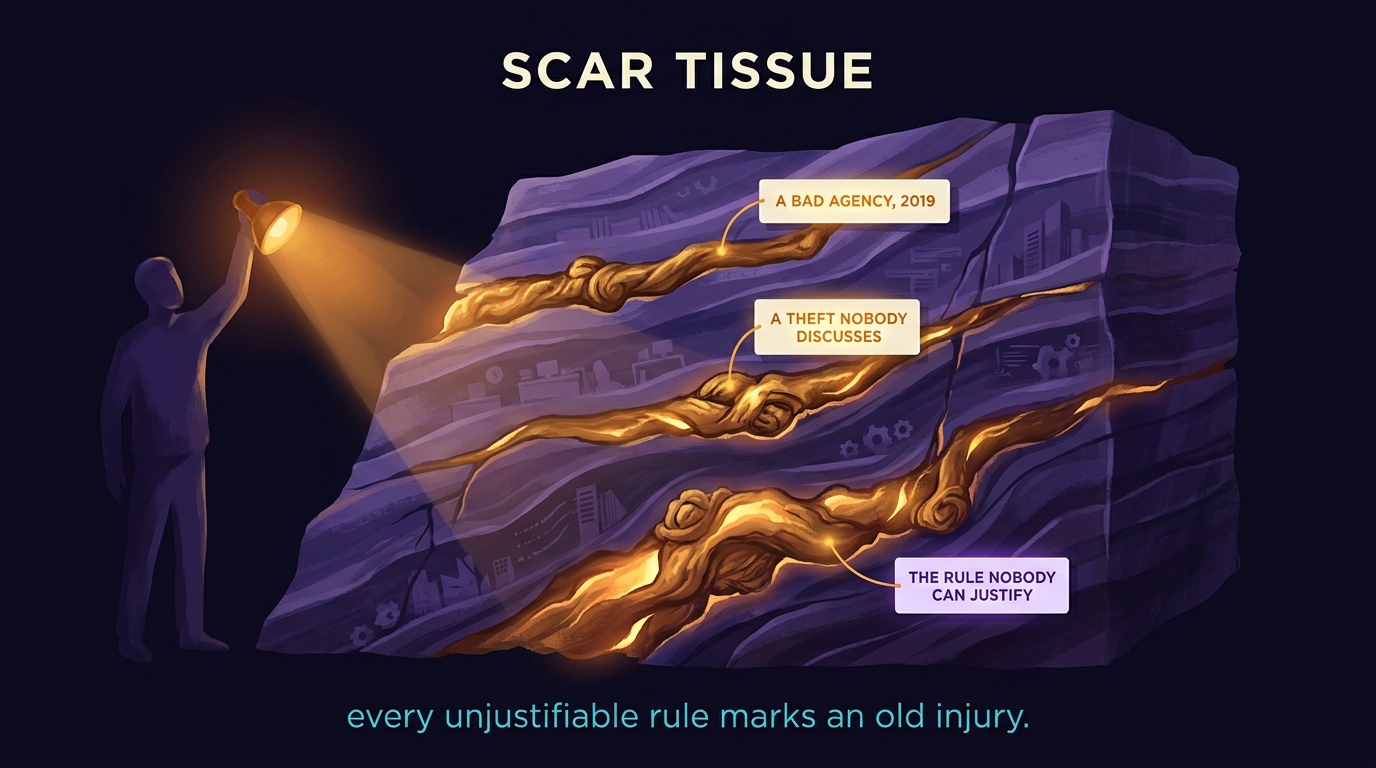
I don't open with a SWOT analysis or a discovery questionnaire. I open with the pain, and specifically with what I call the Scar Tissue Audit: the places where a business has been burned before, where it is bleeding right now, and where the founder is acting out of an old injury rather than a current strategy. Scar tissue is easy to find once you know it is what you are looking for, because it shows up as a rule nobody can justify: a company that won't run paid acquisition because of one bad agency in 2019, a founder who personally approves every invoice because a bookkeeper stole from them once, a team that refuses to touch a system because the last person who did got blamed for an outage.
Four questions do most of the work, and none of them are questions a polite consultant asks.
- Where is the money actually catching on fire right now? I'm asking where it's burning, today, in a way somebody in the building already knows about, not where spend is inefficient.
- Who gets yelled at when this breaks? The answer names a person, and the person names the process, and the process names the constraint. This question routes around the org chart faster than anything else I know.
- What is the one email you dread opening every morning? Dread is specific in a way that dissatisfaction isn't. Nobody dreads a generality.
- What happens if we do absolutely nothing for ninety days? If the answer is "we would be fine," you have found a preference rather than a problem, and preferences don't fund projects. If the answer changes the founder's face, you are close.
Sitting on top of those, I watch for Heroic Failure: somebody working extraordinarily hard to compensate for a broken system, and being praised for it. Heroic Failure is the single most reliable indicator that the real problem is upstream of where everyone is looking. If a CEO is personally handling support tickets because they don't trust the team, the problem sits upstream of support volume: no process exists which would let trust be anything other than personal. The business leans on the heroism, which is why nobody wants to name it. Removing it feels like an insult to the person doing it.
Seven Layers Deep
A client will tell you the problem is that they need more sales. That's never the problem. It's the surface-level complaint they feel safe sharing, and it's safe because it implies no fault. So you drill, one "because" at a time, until you hit something the founder hasn't said out loud to anyone.
That last point is the practical reason this stage exists rather than a philosophical one. If I solve Layer 1 and rebuild the campaign, and the campaign works, the dashboard now shows a number that confirms two years of waste. A founder who is terrified of that number will find a reason to pause the campaign within six weeks. I have watched it happen. So the actual deliverable in that engagement was a reporting layer, not better ads, and the layer made the data survivable: framed forward, framed as a decision rather than a verdict, with the historical baseline stated once and then never dwelt on again. Diagnose the core and the prescription changes shape.
Sources of truth, and the Lexicon of Pain
Most consultants ask a founder what their customers want. That is a mistake, and a structural one rather than a lazy one. The founder is the single most biased witness available. They have happy ears. They remember the customers who validated the roadmap and forget the ones who churned quietly. They have also spent years constructing an internal story where the product is good and the market is slow, because the alternative story is unbearable.
So I go to the places where customers are honest because they think nobody is watching.
- Reddit threads. Find the subreddits where the audience actually lives. Search for the phrasings that precede a confession: "is it just me or," "am I the only one," "I am so frustrated with." Those threads carry the unfiltered version.
- YouTube comments. I read the ones under competitors' videos, specifically. People disclose remarkably intimate detail in a comment section they assume is disposable.
- One-star reviews of the closest five competitors. I skip the five-star reviews entirely, because a meaningful share are incentivized. One-star reviews tell you exactly what enraged somebody: a timeline, a hidden fee, an unanswered ticket. That is a market gap with a receipt attached.
- Support tickets, going back eighteen months. If I can get access, I read the last fifty angry ones. This is where a product breaks somebody's heart in their own words.
- Sales call transcripts. They're rarer, and the richest source when they exist, because you get the objection and the pause before the objection.
Out of that corpus I build a Lexicon of Pain: a working database of the exact phrases customers use, kept verbatim, tagged by emotion and by which stage of their journey produced them. I don't write copy. I assemble it from that lexicon, which is why Stage 5 later has almost no blank-page problem.
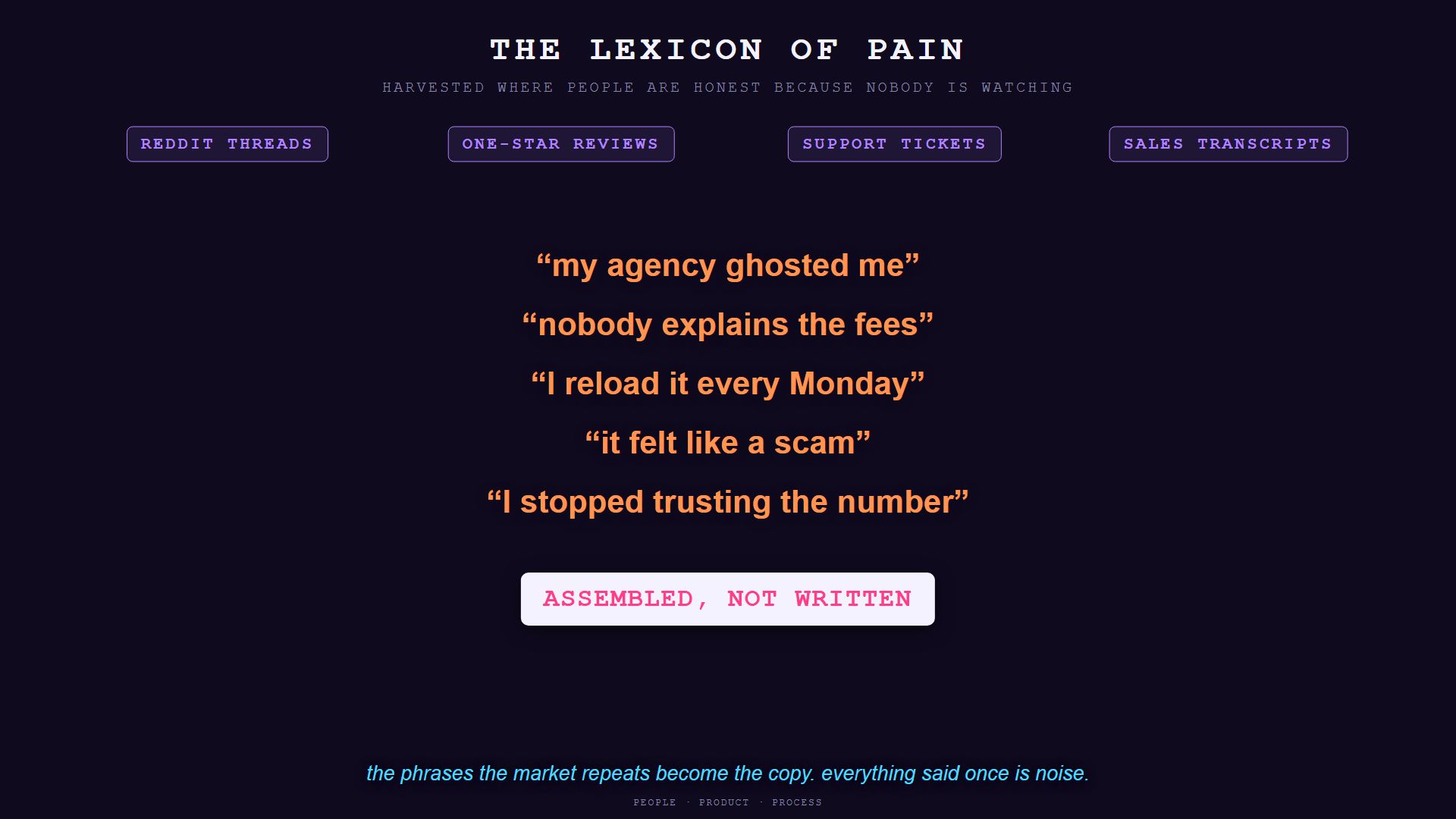
Two filters make the corpus useful. Generic complaints are worthless and specific complaints are gold. "The dashboard is slow" tells you nothing. "I have to reload twice every Monday morning when the export runs" is diagnostic, because it names a trigger, a frequency, and a workaround. And if a third of the corpus says a version of the same specific thing, it stops being a complaint and becomes a roadmap item. Frequency is what converts an anecdote into evidence.
Case in point: the metal art misdiagnosis
A client sold metal wall art. Their stated problem was that they needed better ad creative, because a competitor was running ads with a handsome male model and outperforming them. They were fixated on this competitor. Their diagnosis was that they weren't cool enough.
Had I taken that at face value, I would have hired a model, shot a video with better production value, and burned the budget on a hypothesis nobody tested. Instead I ignored the vibes and went to the data. I exported their Facebook ad results to CSV, built pivot tables, manually categorized the audience segments, and ran a cohort analysis. It was deeply unglamorous work, and it took two days.
The buyers weren't young, trend-conscious people impressed by a model. They were women aged forty-five and up, buying gifts for their families. The emotional truth underneath the purchase had nothing to do with being cool. These were women trying to be the thoughtful grandmother, the wife who got it right, the person who made a house feel like a home. The real problem was that every piece of messaging was reaching for sleek and modern when the buyer wanted warm and sentimental.
So we stopped trying to be cool. We leaned all the way into sentimentality, rewrote around a line that was already sitting in their own review corpus, "family is forever," and rebuilt the targeting around gift-giving psychology instead of aesthetic affinity. The store went from ten thousand dollars a month to a hundred and fifty thousand in ninety days. We solved the actual problem, which was helping a grandmother give a gift that landed, instead of the imagined problem, which was looking cool to a competitor.
The competitor fixation is its own diagnostic signal. When a founder can describe a rival's creative in detail but can't describe their own top-decile customer, the business is being run against a competitor's audience rather than its own, and the creative is almost never the problem.
The output
By the end of Stage 1 you have a problem statement written independently of anything you sell rather than notes or a brief, short enough to be read aloud, and durable enough to serve as the reference point every time the project gets lost in implementation detail. It takes this shape.
Two properties make that sentence work. It names a belief rather than a tactic, so the fix can't be reduced to a deliverable. And it carries a consequence with a clock on it, which is where the urgency in every later stage comes from. Urgency that you manufacture in Stage 8 reads as pressure. Urgency that was already true in Stage 1 and is simply being restated reads as diligence.
Stage 2 · The future, named as observable artifacts
Most businesses stop at goals. They ask a client what they want, the client says a new website or ten percent more leads, and everybody writes it down. Stop there and you are a commodity bidding against every other vendor on price and turnaround.
A future is a lived reality with an identity attached to it, not a metric.
The parent doctrine uses roadside assistance to make this concrete, and I have never found a better image for it. You are broken down at two in the morning on a motorway in heavy rain. Headlights appear. The van pulls up and the technician gets out, and instead of looking at your car he walks you back to his van, slides the door open, and starts explaining every wrench, socket, and diagnostic tool he carries. He is thorough. He clearly loves his job. And you don't care about a single word of it, because the future you are buying is being warm, dry, and moving again. The tools are his reality. The road is yours.
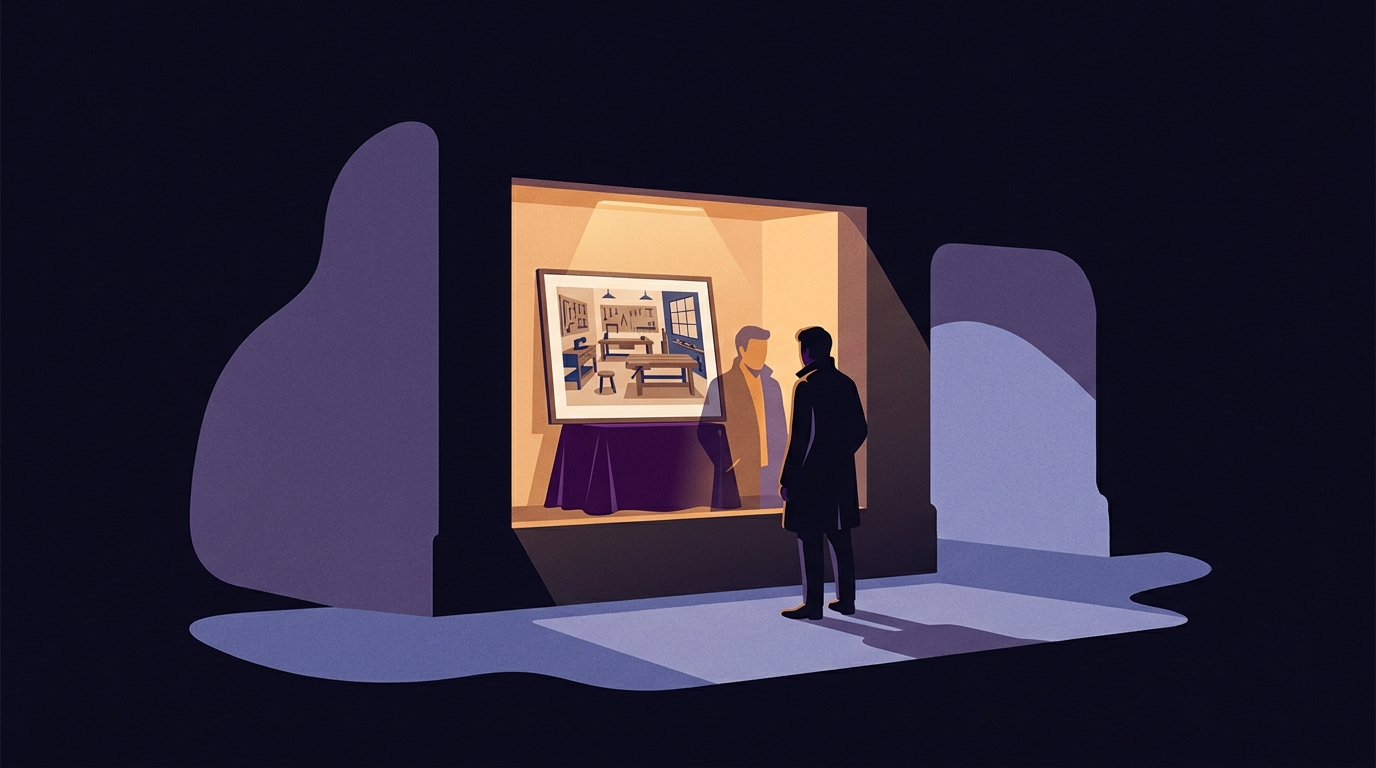
Every feature pitch is that technician with the van door open.
The Day in the Life test
To check whether a future is compelling enough to sell against, I ask a client to describe their average Tuesday after the problem is solved. Not a quarter. Not a milestone. A Tuesday. Then I listen for sensory detail, because sensory detail is the tell that somebody has actually imagined the state rather than restated the goal.
The strong answer is doing something specific that the other two aren't. It names artifacts a third party could verify: a dashboard with a number on it, a completed application form, a calendar with three entries. That is what "observable" means here. If the future you have written down can't be photographed, screenshotted, or counted by somebody who doesn't work at the company, it is still a feeling rather than a specification, and you won't be able to prove you delivered it.
Identity and status are the actual purchase
When I ran the launch for a Facebook ads coaching program that did a hundred and ninety-nine and a half thousand dollars in thirty days, I wasn't selling videos about ads. Nobody wants to watch videos about ads. That sounds like homework, and homework is a cost.
What was on sale was a promotion in social status. The current identity was an overworked freelancer who gets pushed around by clients, panics at every algorithm update, and chases invoices. The future identity was a strategic partner who commands respect, charges five figures on retainer, and has a system that runs without heroics. The copy never promised a better click-through rate. It promised the ability to fire a bad client and not sweat the rent, and to be able to tell a spouse that things were secure.
Same move on a completely different project. When I pitched a Web3 radio initiative for a three hundred and fifty thousand dollar grant, the proposal wasn't for a radio show. The current state was an underdog team ignored by the global crypto establishment. The future state was the primary cultural bridge for Web3 adoption across an entire continent. The committee funded the status of being the organization that opened a new market, not a media plan, and every line of the proposal was built to make that status legible to them.
This is why price stops being the conversation once a future is properly specified. A price is compared against other prices. A future is compared against the cost of not arriving, and that comparison is almost never close.
The boring future, which is the one technical buyers want
In AI and data engagements the future usually looks dull, and dullness is the product. Excitement in engineering means something is on fire.
For a team drowning in bugs, the future is reliability, not a flashy new capability. It's going home at five on a Friday because the pipeline caught the defect before it reached production. It's sleeping through the night instead of getting paged at three in the morning, because the ingestion layer validates its inputs with typed models and reports its own behaviour through structured tracing, so when a malformed record arrives the system rejects it gracefully instead of taking the database down with it.
Notice that I have described a future in engineering terms and it still isn't a feature list. "We use Pydantic and LogFire" is a feature. "A weird string enters the system at four in the morning and nothing happens to you" is a future. The technical specificity earns credibility with a technical buyer, and the consequence framing is what makes it purchasable by whoever signs.
The solar portfolio taught me the sharpest version of this. Fifty-four ad accounts across an agency, and the stated ask was better reporting. Better reporting was never the future. The owners wanted to raise capital. The future was walking into an investor meeting with a unified portfolio intelligence layer that demonstrated a real competitive moat across a market rather than anecdotes about individual accounts. They raised at a multi-eight-figure valuation. The delivery mechanism was SQL and dashboards. The thing purchased was wealth, and the gap between those two sentences is the entire stage.
Defining the gap
With Stage 1 and Stage 2 both written down, you have two coordinates and therefore a distance between them. Point A is chaos, waste, uncertainty, tribal knowledge locked in one person's head, and the quiet suspicion of being a fraud. Point B is systems, profit, clarity, documented process, and standing. My scope and my price are determined by exactly two things: how wide that gap is, and how much certainty I can supply about crossing it.
Both of those terms are things you control. Gap width is a function of how well Stage 1 was run: a shallow diagnosis produces a narrow gap and a commodity price, because "we need a website" is a two-thousand-dollar problem while "one bad quarter wipes us out and nobody in the building can see it coming" isn't. Certainty is a function of proof: case studies, an audit you already ran, a guarantee, a named mechanism, a live dashboard the client can watch. Vendors who compete on price are usually competing there because they have neither term.
One failure mode belongs here, and it's the one I fall into most often myself. Once you can articulate a future well, it is tempting to articulate it beyond what you can deliver. The check I run is whether every element of the future maps to something in the eventual scope. If the future includes an investor meeting and my scope doesn't include the artifact they will put in front of investors, then I have written marketing rather than a specification, and Stage 9 will make me pay for it.
When the future is right, the question a client asks changes shape. They stop asking what this costs and start asking how fast you can get there. That change is the signal that Stage 2 is finished and you are allowed to move on.
Stage 3 · The transformation, priced in behaviour
You can't cross a chasm in two small jumps. Stage 1 named the hell and Stage 2 named the heaven. Stage 3 builds the bridge and, more importantly, prices it in something other than money.
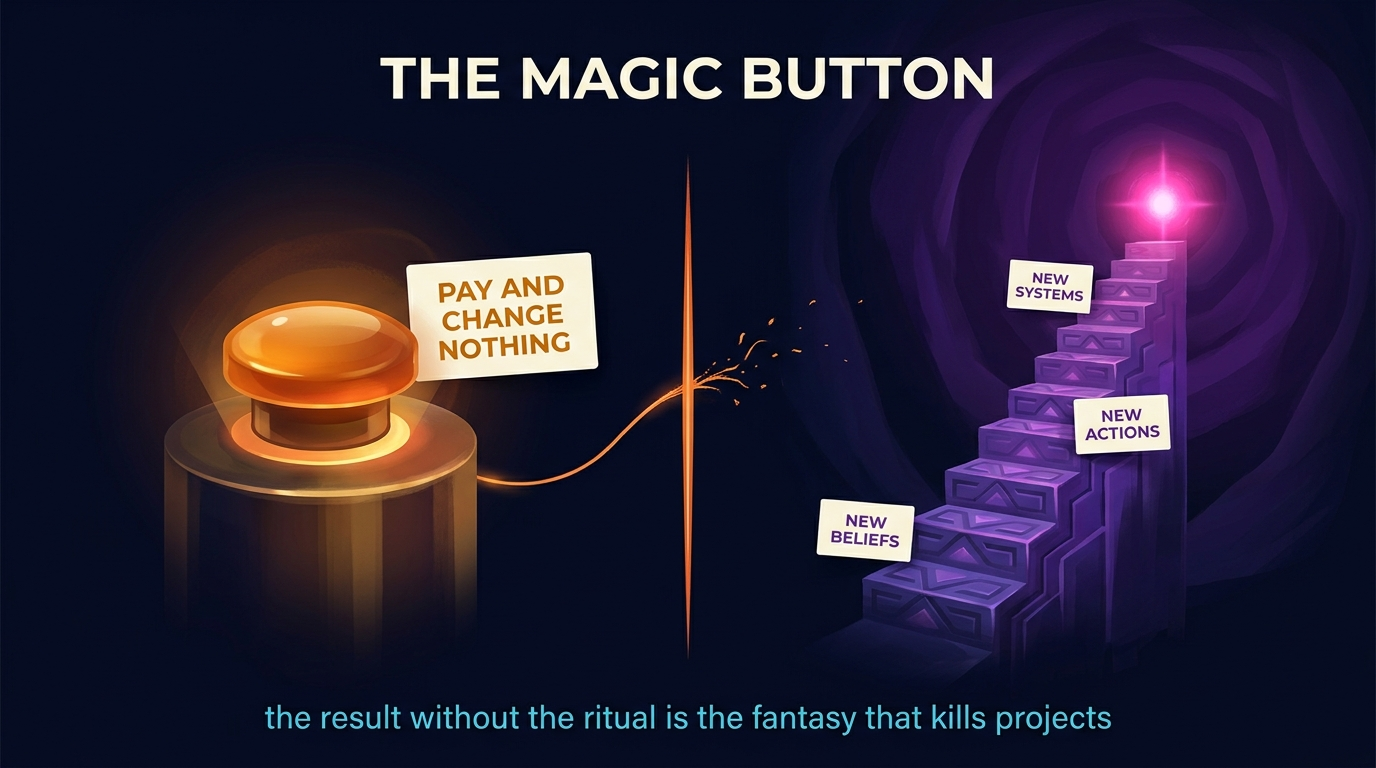
Most customers operate under a delusion that is comfortable enough to survive years of contact with reality: they believe they can reach a radically different future while keeping their current behaviour intact. They want the result without the ritual. They want to lose weight and keep the pizza. They want seven figures of revenue and refuse to spend on paid acquisition because ads are risky. They want reliable data and refuse to enforce schema validation because validation slows development down.
Transformation is the specific set of sacrifices, investments, behavioural shifts, and identity updates required to make the crossing possible. This is the stage where I have to be direct with a client and say that getting what they want requires changing what they do, and that if the input doesn't change I can't guarantee the output. It goes down better than people expect, because most founders already suspect it and have been waiting for somebody to say it without flinching.
The Magic Button fallacy
Most clients want a magic button. Pay a fee, have somebody disappear into a dark room and click a mouse, and money comes out of the printer while nothing about the operation changes. Stage 3 kills that quietly and early, by mapping the cost of change item by item.
Transformation in action: from order taker to chooser
When I worked with digital agencies moving from referral roulette to predictable revenue, cost per lead fell from two hundred dollars to eighteen. The transformation was operational psychology, not better ads or better copy.
The old identity was the beggar. I need clients. I will take anyone with a pulse. I will spend sixty minutes on a call with a pre-revenue startup on the chance that something comes of it. Every part of the operation was built around that identity, including the calendar link on the homepage.
What we installed was a velvet rope. A long-form application replaced the calendar link. One question on that application asked how much profit they wanted to add in the next ninety days, with three bands to choose from. Anyone selecting the lowest band was rejected automatically and never saw a booking page at all.
The owners were frightened by this. We are turning away business, they said. What if we miss a unicorn. The answer was that we weren't turning away business, we were changing what business meant, from order taking to strategic partnership. Two things happened as a result, and they're different kinds of win.
- Technical transformation. The ad platform's optimization was now being trained on application completions rather than link clicks. It went looking for people who complete long forms about profit targets, which is a materially different human being than one who clicks an ad. Lead volume fell. Lead quality rose enough that cost per qualified lead collapsed.
- Cultural transformation. The sales team stopped burning out on bad calls. Their close rate climbed because they were now speaking to peers rather than to people hoping to be rescued. Confidence in a sales conversation is largely a function of who was on the last five calls.
Neither of those results was available without the behaviour change, and the behaviour change was frightening at the moment of commitment. That is the shape of every real transformation: the moment it is agreed to is the moment it feels most like a mistake.
The process is the hero, and I am not
In this stage I introduce the mechanism of change, and I take care not to sell myself as the mechanism. Selling yourself as the saviour produces a client who is dependent, an engagement that can't be handed over, and a business that can't scale past your own calendar.
For the solar portfolio, the transformation was moving from fifty-four siloed accounts managed on intuition to one central intelligence layer. Getting there required the agency to accept something uncomfortable about itself: that its individual media buyers weren't geniuses, and that the data across the portfolio knew things no individual buyer could know. That is an identity update for a whole department, and it had to be agreed before any pipeline was built.
For AI engagements the equivalent shift is from prompting on vibes to specification-driven development. It requires a client to stop saying "make it better" and start answering a harder question about what the system is being rewarded for. Teams that can't make that shift produce demos indefinitely and never produce a product, and no amount of engineering talent on my side compensates.
This is where I disqualify
Stage 3 is the first place in the sequence where I actively remove people. If a client wants the future but won't undergo the transformation, we stop here. That looks like a client who won't share data, won't approve a testing budget, or won't follow the process they signed off on. Any one of those, surfaced plainly in Stage 3, ends the conversation before either of us has spent real money.
I am not here to drag people across the finish line. I am here to build the bridge. They have to walk across it.
That sounds harsh in print and it plays as relief in the room, because a client who is genuinely unwilling already knows it. Naming it lets them decline without inventing a budget excuse, and roughly a third of the ones who decline come back within a year having done the work.
The whole stage compresses into one expression, which I've written on more whiteboards than anything else in this framework: new results equal new beliefs plus new actions plus new systems.
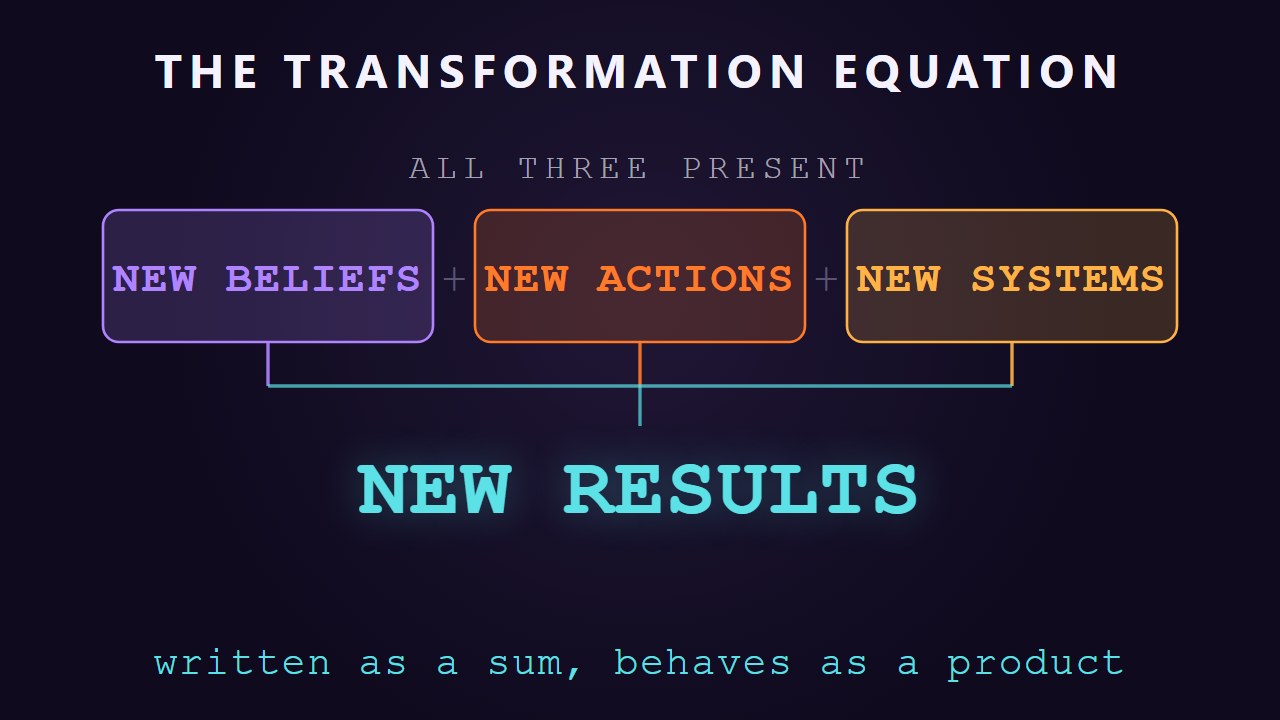
The multiplicative reading is the useful one. New systems installed on top of old beliefs get worked around within a quarter. New beliefs without new systems produce a burst of enthusiasm and then a return to baseline. New actions without either produce exhaustion. This is also why Stage 3 outputs feed Stage 7 directly: the behaviours you named here become the criteria you qualify against, so a person who fails the transformation test never reaches a sales call at all.
Product · the packaging phase
A product isn't the thing you hand over. The Xbox controller is a delivery method. The accounting engagement is a delivery method. The trained model behind an API is a delivery method. None of those are what somebody buys, and treating them as the product is why so many technically excellent companies can't sell.
A product decomposes into exactly three things: benefits, which is what value this creates in somebody's life; offer, which is what they give and what they receive and under what terms; and message, which is how any of that reaches them in language they already use. Nothing else is the product. A widget with no articulable benefit is an object rather than a product, and every episode of every investor pitch show is a person discovering that in public.
I run these three in the order benefits, message, offer, which is one step off from the way the phase is usually named. The reason is practical: benefits are raw material, message is the assembly of that material into language, and an offer is only structurable once you know which specific future you are pricing. Building the offer first is how a business ends up with a package that is internally coherent and describes nothing anybody wants.
Stage 4 · Benefits, and the "so what" drill
Start with a definition that survives contact with edge cases. A feature is anything that could be swapped for a competitor's version, another tool, or an entirely different method. A car is a feature: it can be replaced by a train, a bike, a bus, or by not travelling. A benefit is much harder to substitute, because a benefit is a better future version of the person. Nothing else makes you feel the way arriving on your own schedule with your own music does, and no other product replaces that.
The corollary opens up whole categories of copy: results don't equal delivery. The method you use to produce a result is never the only method available, so leading with the method invites a substitution comparison you didn't need to have.
The "so what" drill
I take every feature of a service or product and beat it with the same question until it hits a nerve. Here are two worked examples, one deeply technical and one commercial.
"We use typed validation models in the Python data layer."
Data types are enforced at runtime rather than assumed.
The application refuses bad input instead of crashing on it.
Your pipeline stops being a source of emergencies. You don't pay a senior engineer a hundred and fifty an hour to fix a three in the morning crash because a user typed a date in the wrong format. It buys quiet weekends and a lower maintenance line in the budget.
"We aggregated fifty-four ad accounts into one warehouse."
Trends are visible across an entire market rather than one city.
You know a creative is fatiguing two weeks before the local installer down the road does. Budget moves off dying ads and onto winners while they are still winning. That is an information advantage over every competitor in the region, and it compounds every month you hold it.
Two passes are usually not enough and five is usually too many. The stopping condition is a sentence a non-technical decision maker would repeat to somebody else without needing you in the room.
The nine categories, which are a checklist rather than a theory
Benefits are easier to find when you know where to look, and the parent doctrine supplies a taxonomy I haven't been able to improve on. It has eight visceral categories with a ninth sitting above all of them. Run every product through all nine and you will find hidden benefits, meaning the illogical, status-driven drivers people rarely admit to and always buy on.
what they believe they are entitled to, what they think they deserve, and what they won't do
A reliable supplier. Everyone promises it, almost nobody delivers it, and it can't be faked for longer than one engagement.
People handle a few of them badly. Feel is the substrate rather than one category among nine: every benefit on the list resolves into a change in how somebody feels, including the ones a buyer will insist are purely rational. People who describe themselves as logical decision makers are better at constructing justifications afterwards, not less emotional, and you can verify this in about four seconds by watching one of them get upset about a technology choice.
Know is really six things wearing one word: confidence, clarity, certainty, assuredness, predictability, and insight. Knowledge is a form of security, which is why "I will know exactly what next month looks like" outsells "you will have a comprehensive reporting suite" every time.
Status comes in two shapes. Role-model status sounds like wanting to be the recognizable figure of a category. Title status sounds like wanting to be described a particular way inside an industry. Don't assume everybody in your market wants either, because some people's desired status is to stay exactly where they are, and no amount of persuasion moves them for long.
Moral struggle is the hardest and the highest leverage. It has three parts that all have to line up: the type of moral concern, the way your buyer engages with it, and the circumstance in which they engage. Humans compartmentalize ruthlessly, which is why the same person buys eco-friendly dish soap and an unnecessary new fridge without noticing any tension. I watched a company with a genuine sustainability program decline a server contract that would have cut their carbon footprint substantially, because it cost more up front and the board held a stronger moral obligation to shareholder capital. Right moral aim, wrong moral method, no sale.
The benefit stack, and hard metrics over soft vibes
Every benefit I write gets stacked on three levels, and a pitch that misses a level loses the corresponding part of the decision.
- Functional: what it does. Automates follow-up. Catches malformed records at ingestion.
- Economic: what it saves or makes. Cost per lead down ninety percent. Twenty hours a week off manual entry.
- Emotional: how it feels. You stop feeling like a chaotic amateur and start feeling like somebody running a company.
Miss the emotional level and you lose the connection. Miss the economic level and you lose the budget, because the person who signs has to justify it to somebody who wasn't in the room. I am allergic to soft benefits like brand awareness, better engagement, and synergy, and I tie everything to one of three hard metrics: revenue, time, and risk. Every claim in every proposal I write lands on one of those three or it comes out.
Worked example: the supplement brand
A supplements brand on Amazon believed their benefit was their ingredient panel, which listed five grams of creatine. That's a commodity, and a supermarket down the road has five grams of creatine too.
So we went hunting for the moral struggle instead. Supplement buyers are frightened of putting something harmful into their body, and specifically frightened of proprietary blends that hide underdosed ingredients behind a total. The benefit we sold was safety and trust. The feature was third-party lab testing. The benefit was that you aren't poisoning yourself with cheap filler from a factory nobody has audited, and that you can take this and feel good rather than jittery and sick. The hidden benefit, the one nobody says out loud, is getting to be somebody who cares about quality rather than somebody buying sludge because it was on offer.
Commercially, that trust moved the customer from a transactional forty dollar purchase to a subscription relationship worth roughly four hundred over its life. The economics of the whole business changed on the back of a benefit that was already true and had never been said.
The benefit bucket
Everything from this stage goes into a bucket rather than a paragraph. It's a working list of every benefit a product delivers, written as before-and-after sentences, kept where the whole team can reach it. "Before working with me, my customers have no spare time with their family. After working with me, they take a morning off without checking anything." It holds dozens of them, not three.
The bucket is sales ammunition. Any email, landing page, video script, webinar, or proposal draws from it, which means nobody on the team starts from a blank page and nobody has to invent a claim under pressure. There is also a diagnostic buried in it: if you can't list more reasons somebody should buy than reasons they shouldn't, you have located why the product isn't selling, and it isn't the ad platform.
Above all of the categories sits one benefit that outranks the rest and can't be faked. Every customer, in every market I have worked in, is ultimately shopping for a reliable supplier who lives up to their expectations. That is the master benefit. It is also the one that Stage 9 either proves or destroys, which is why fulfilment is part of this framework rather than an operations concern that happens after the interesting work.
Stage 5 · Message, assembled from their words
Nobody has ever woken at three in the morning in a cold sweat because they urgently needed to hire a consultant. People are focused on their problems, and those problems exist whether or not your solution does. This is the hardest shift in the whole framework to hold, because you know your solution exists and you have to write as though it doesn't.
Daniel Priestley has a line I have never improved on: be a PhD in your customer's problems. Not a PhD in your own method. Almost every business gets this backwards and spends its entire marketing budget explaining how good, different, unique, and special its solution is, across websites, videos, decks, talks, and podcasts, all of it about them.
There are only two reasons a business doesn't flip that. Either they genuinely don't know their customer's problems, which is recoverable, or they have invested so much in existing marketing that scrapping it feels like admitting waste, which is a sunk cost fallacy wearing a strategy costume and is much harder to fix because it lives in somebody's ego rather than in a document.
Curse of knowledge, and the flumpkin problem
Console manufacturers spent a generation advertising teraflops. I have built gaming machines and worked inside technology companies and I couldn't tell you what a teraflop buys me. As a piece of communication it is equivalent to announcing that this bathroom has fifteen flumpkins while the competitor's has only twelve. The customer's actual internal response is to wonder what a flumpkin is.
What happens next is the actual failure. The company notices confusion and concludes the customer needs more education about flumpkins, so it produces more content explaining the unit. That is the same reflex as explaining a joke that didn't land. Explaining it doesn't make it funnier and doesn't make the audience laugh; it just makes everyone present aware of how long this is taking.
The fix is a translation rule. After naming any feature, the next word should be a version of "imagine." Loading a game the instant you press the button. Switching between two games without saving, quitting, or waiting. Graphics good enough that film productions render with them. Then, if a technical buyer wants the underlying number, it is available. Lead with the number and the experience never gets described at all.
Echo their words back
My rule for messaging is that I don't guess what a customer is thinking. I go back to the Lexicon of Pain built in Stage 1 and I use their phrasing, unedited, including the parts that make a brand manager uncomfortable.
If the corpus says marketing is a scam, that phrase goes in the copy. If it says my last agency ghosted me, that goes in. The instinct to sand those down into something more brand-appropriate is the instinct to sound like every competitor, since every competitor is sanding theirs down too. Specific, borrowed, slightly rough language is the fastest available proof that you have talked to somebody.
Here's what this looks like in practice, across three very different markets I've worked in:
The five things a person needs to hear before they can buy
Underneath every message that works are five relational needs, catalogued by the copywriter Blair Warren. They read like a list about persuasion and they are actually a list about being on somebody's side, which is why they hold up in technical markets where persuasion tactics usually die.
"You were right that this platform was never built for a company your size."
"Nothing goes live until you have watched it run against last quarter's data."
"It did not work last time because you were taught a method built for a different market."
"You want to be the reference brand in this category. How do we get you there?"
One literal enemy you can point at, plus three conceptual ones they already resent.
Here are some notes from using these in markets where the audience is technical and allergic to persuasion.
Confirming a suspicion works because everyone carries a theory about why their situation is the way it is, and being told they were right is a rare experience. The engineering version is usually structural: the tool genuinely was built for a different scale, the vendor genuinely does optimize for enterprise contracts, the previous consultant genuinely did leave before the hard part.
Justifying failures is the one that unlocks people who have already tried and failed at the thing you sell. That population is larger than the untried population and is written off by most vendors as burned. Removing blame is what makes them approachable, and it has the additional benefit of being usually true, since most people fail with a method because they were handed a method built for somebody else's constraints.
Naming an enemy comes in two forms and the strongest messaging combines them. A literal enemy has a name and an address: a specific incumbent, a category of vendor, a platform whose incentives run against your buyer. A conceptual enemy is an idea or condition: technical debt, tribal knowledge, gut-feel budgeting, the quarterly reporting cycle. One literal enemy plus three conceptual ones is the working recipe. Use it carelessly and you build an audience that is only unified by grievance, which is a customer base that will turn on you the moment you become large enough to qualify as an incumbent yourself.
The anti-newsletter approach
Most businesses treat email like a megaphone. They shout about a sale, or they send a newsletter full of company updates nobody asked for and nobody reads. I treat messaging as a conversion system with three rules.
- Segmentation, because one message doesn't fit all. Cold leads get a warm-up sequence built on education and trust. Warm leads get a conversion sequence built on offer and consequence. Past buyers get an ascension sequence built on upsell and referral. Sending the third to the first is the fastest route to a spam complaint.
- Skepticism first. If the industry is full of scams, and crypto and supplements both are, I say so in the first message. "You are probably thinking this is snake oil, and here is why you are right to be worried" outperforms every attempt to sound trustworthy, because a claim of trustworthiness is exactly what a scam also makes.
- One job per message. The job is a click, a reply, or a purchase, and passive reading doesn't count. A message that doesn't ask for a specific action is a cost with a delivery receipt.
Worked example: the supplement warm-up
A multi-million dollar Amazon supplements brand had no relationship with its own customers, because the marketplace owned the data. We ended up with a list of cold, skeptical buyers who didn't know they were on a list at all.
A discount blast to that list would have gone straight to spam, and would have burned the asset permanently. So the sequence was built as education and relationship rather than promotion.
The second-order effect was larger than the first. Engaged traffic from those emails fed the ad platform's optimization with high-quality signal, since the people clicking through to read about ingredient sourcing are a very specific population. That retraining lifted paid performance by around a hundred thousand a month. The messaging work paid for itself twice, once directly and once through a channel it was never aimed at, which is a pattern I have now seen often enough to plan for.
The eight-beat message structure
Every sales message I write runs the same beats in the same order, whether it is a three-minute pitch, a landing page, a forty-five minute webinar, or a written proposal. The medium changes how much room each beat gets. The order doesn't change.
Beat seven deserves one clarification, because it is where technical companies reliably go wrong. There is a difference between your process and your method. A process is what your team does internally: open the client, locate the address book, configure the read receipt. A method is what the customer would do, framed from their side: who are you sending this to, what are you telling them, when is it going out. Describing your internal process to a buyer is selling features in a different costume. Describing the method makes them feel capable, and a buyer who feels capable hires you to do it faster rather than deciding they no longer need you. The fear that explaining the method costs you the sale has never once been true in my experience, and the opposite has been true repeatedly.
One more caution, since this stage produces the most reusable assets in the framework. Everything you write here is downstream of the Lexicon of Pain, which means everything you write here goes stale on the same schedule the lexicon does. A phrase harvested eighteen months ago describes a market that has since had a recession, a platform change, or a new competitor. Refreshing the corpus is part of the recalibration cadence I run on every active engagement, and skipping it is how a brand ends up sounding like a very confident description of a market that no longer exists.
Stage 6 · Offer, a structured agreement
An offer is the vehicle that delivers the transformation from Stage 3. It contains deliverables, a timeline, a scope, whatever bonuses exist, and most importantly a position on risk. Most businesses have a weak offer and misdiagnose it as a pricing problem or a lead problem.
The goal of the stage is to arrange the deal so that saying no is the riskier option, and to align incentives so the customer understands you are on the same side of the table. That last part has a mechanism behind it: you can't reach an agreement if one of you disagrees, so an offer that requires the buyer to lose in order for you to win will never close cleanly, and if it does close it will poison Stage 9.
Four levers
I build offers with the same four levers, which are recognizably the Grand Slam anatomy Alex Hormozi catalogued.
- The mechanism. This is how you do it, given a name. A named mechanism is incomparable, because a buyer can't line it up against three competitors on a spreadsheet. Naming is a decision to be evaluated on your own terms, not a branding exercise.
- The price anchor. Contrast the price against the cost of inaction rather than against competitor pricing. This costs ten thousand and the problem is costing you a hundred thousand a year is a different sentence than this costs ten thousand and they charge eight.
- Risk reversal. A guarantee tied to the outcome moves risk from the buyer to you. This is the highest-leverage lever available and the one most people refuse to touch, usually for a reason that is really a Stage 7 problem in disguise.
- Bonuses. These are high-value, low-marginal-cost additions that each answer a specific objection. Templates that answer "we do not have the internal capacity." Access to a peer network that answers "will I be on my own afterwards."
The guarantee needs its own note, since it's the one that produces the most anxiety. A guarantee is a claim about your own process discipline rather than a claim about your talent. If you have run Stages 1 through 5 properly and you qualify properly in Stage 7, then the outcome is largely a function of inputs you control, and guaranteeing it is arithmetic. If you're unwilling to guarantee anything, ask which of those stages you're quietly skipping.
Worked example: the hybrid high-ticket offer
The Facebook ads coaching launch from Stage 2 wasn't sold as coaching, because coaching carried two objections in that market and both were fair. People distrust coaches on the grounds that coaches are failed practitioners. People distrust agencies on the grounds that agencies are expensive and slow.
So the offer was built as a hybrid that answered both at once. A done-with-you component taught the system, so nobody was dependent afterwards. A done-for-you component put me inside the ad account restructuring campaigns personally, so implementation wasn't left as an exercise. And access to a room full of seven-figure agency owners supplied status and network, which is a benefit you can't manufacture and can only convene.
It was priced in tiers from three thousand to twenty thousand, and the high price was a feature rather than a concession. It signalled that this was for serious operators, which is a Veblen effect and a qualification mechanism running in the same number. Close rate on qualified calls ran between sixty and seventy percent, and that number reflects the offer and the gate rather than closing skill: it's what happens when an offer answers the two objections the market actually holds and the qualification gate has already removed the people for whom neither answer matters.
Structuring for technical services
In AI and data engagements the objection is different and the structure has to answer it. What technical buyers fear is a science project: something that drags on for months, consumes budget, produces demos, and never ships.
The specification phase is what makes that structure safe rather than reckless. Defining done together in writing before building is the mechanism that lets a fixed price exist at all, and it doubles as a final qualification checkpoint, because a client who won't participate in defining done has told you something important at the cheapest possible moment.
The five questions
Before an offer leaves my hands it has to answer all five of these. An offer that can't is incomplete, and an incomplete offer is a leaky bucket that no amount of paid acquisition refills.
- What is the named outcome the customer is buying?
- What is the proof that the outcome is real?
- What is the guarantee that holds you accountable to it?
- What is the qualification that ensures only the right buyer gets in?
- What is the framing that makes the price look obvious in hindsight?
Notice that question four is a Stage 7 concern living inside a Stage 6 artifact. That is deliberate. Qualification is a property of the offer itself as well as a gate in front of a calendar. An offer with an application requirement, a price floor, and a stated constraint qualifies continuously without anybody having to say no to anyone.
By the time an offer is presented, you have diagnosed the pain, defined the future, built the bridge, clarified the benefits, and spoken their language. The offer is the final checkmate. It puts a price on a transformation both parties have already agreed is real, and it removes the risk of failure from the person who has less information.
Process · the conversion phase
Everything upstream of this phase is preparation. This is where preparation becomes revenue, and it is also where most of the framework's value gets destroyed by people who run the first six stages beautifully and then improvise the last three.
Treat each of these three as a state machine with explicit states and explicit gates, because that is what they are whether or not anybody has drawn them. A lead is in exactly one state. A transition happens for a stated reason. A gate either passes or it doesn't. The process you can see is the process you can fix; the process you can't see is the process that breaks quietly at whatever your busiest moment turns out to be. That claim gets its own treatment in State Machine Everything, which is the companion piece to this phase.
One framing to carry through all three. Selling is only two things: a transference of enthusiasm, and working out with a person what makes sense for them. That is the whole job. Everything else in this phase is machinery for doing those two things at a scale larger than your own calendar.
Stage 7 · Qualify, the velvet rope
Sales is conservation rather than hunting down every animal in the forest: identifying the specific animals you can actually help and putting real resources behind them. You can help anyone. You can't help everyone. Refusing to choose is the single clearest signal that somebody doesn't actually want more customers, because a person who wants customers will happily name which ones.
This stage is the velvet rope, and it is the most under-used tool in the entire framework. It costs nothing to install and it prevents the most expensive class of mistake available to a services business, which is serving the wrong customer extremely well.
What qualification is actually checking
Qualification checks five things, and only the first is about money.
- Can they afford to work with you? The obvious one, and the one most people stop at.
- Can they afford to act on your advice? That's a different question. Selling somebody a strategy they can't fund the execution of makes you the villain in six weeks. It is like selling a car to somebody who is then outraged that fuel costs money.
- Can you actually get them an outstanding result? An adequate one doesn't count. Some customers will benefit less from your particular strengths no matter how well you execute, and taking them is a decision to produce a mediocre case study.
- Do you want to work with them? This is allowed to be a criterion. I have declined engagements over how somebody spoke about their own team, and I have never once regretted it.
- Will they refer? A client who will introduce you to two peers is worth substantially more than the contract value, and you can usually tell in the first conversation by whether they talk about their network at all.
The go-away method
I practise negative marketing on purpose. I actively try to repel the wrong people, and I want roughly nine out of ten readers of a given page to conclude that it isn't for them.
In the agency lead generation campaigns from Stage 3, the mechanism was the poison-pill question on the application form: how much profit do you want to add in the next ninety days, with three bands to select, and anyone choosing the lowest band never saw a calendar. The logic is arithmetic rather than snobbery: a business without the ambition to add a certain amount of profit doesn't have the budget to pay for the work that would add it, and the sales team was spending hundreds of hours a quarter discovering that one call at a time.
That campaign's result, cost per lead falling from two hundred dollars to eighteen, came from the retraining described in Stage 3: the long form taught the ad platform to optimize for application completion rather than link click. Fewer leads arrived, and the sales team spent their whole week on the top decile instead of ten percent of it.
BANCE
Before a human speaks to a lead, five things get established. Killen runs Budget, Authority, Need, Timescale, Suppliers. I run Budget, Authority, Need, Timeline, Engagement, swapping the last letter, because in my markets an incumbent vendor is rarely decisive and responsiveness always is.
The budget question, and the silence after it
This is where most people fall down, and the failure is emotional rather than tactical. Asking for a budget feels like admitting you care about money, and people worry it makes them look greedy. That fear is no more grounded than a client worrying that wanting their business improved makes them look selfish.
Ask it plainly. "What budget have you allocated for this project?" No preamble, no softening clause afterwards. Then, and this is the part that takes practice, stay completely silent. The only acceptable answer is a currency and a number. Not "we were hoping you could tell us." Not "we have something in mind but would rather not say." Silence after an unsatisfactory answer is uncomfortable for about four seconds and feels like an hour, and in almost every case the other person fills it with the truth.
Three variants for when the direct question stalls:
- "What are you willing to invest to get these results?" It reframes budget as investment, which is a different question psychologically and a more accurate one factually.
- "What would achieving this actually mean for the business?" It opens up the future again, and the answer usually contains the number implicitly.
- Run the arithmetic live. If they want a hundred thousand in new revenue, a twenty-five thousand investment is a four-to-one return, which beats anything a bank will offer them. If they argue with that ratio, ask which fund they know that yields four to one, and offer to go work there instead.
Two answers are red flags rather than data. A flat refusal to disclose a budget usually means one of two things: they don't trust you to deliver, or they believe they aren't worth the investment themselves. Both are disqualifying at this stage. And "we do not know our budget" generally means the project hasn't been thought through, which is recoverable with the arithmetic above but tells you that Stage 1 needs another pass before anything gets quoted.
I am also cautious about a client whose budget is everything they have. Those engagements are harder to run, more heavily supervised, and carry an emotional weight that distorts every technical decision. I would rather be one line in a larger allocated budget than the entirety of somebody's last resort.
Paid discovery
The most profitable move available in this stage is to qualify somebody further and have them pay for the privilege. That means a deep dive, priced, scheduled, and structured, that produces an artifact they keep whether or not they hire you.
The framing that works is procedural rather than persuasive. Here is our discovery session. It runs a set length, it costs a set amount, it produces a written plan, that plan is yours to keep, and if you go ahead the fee comes off the total. Then book the slot rather than asking how they feel about it. A process that sounds standard gets treated as standard.
Four things happen at once. It filters out anyone unwilling to spend anything. It pays for time that was previously donated. It makes the eventual larger sale substantially more likely, because somebody who has already transacted once transacts again more easily. And it dramatically improves the quality of the proposal, because you now have real information instead of assumptions.
Inside the session, the method is go wide then go deep, twice. Ask for goals until the list is exhausted, using "what else" as the only prompt. Then ask which one is the real priority, and shut up. Then ask why that one, and go wide again on reasons. Then ask which of those reasons matters most, and ask why again. Two levels down, the answers stop being metrics and start being about security, standing, and fear. That is the layer the purchase is actually made on, and you now have it in the client's own words, which means Stage 5 has already been done for this account.
Then run the same wide-and-deep pass on problems rather than goals. Negative language is more specific than positive language, because most people learned to describe frustration long before they learned to describe satisfaction, so the problems list yields sharper phrasing than the goals list every time.
Automation as the bouncer
All of the above scales through tooling rather than headcount. A form captures the answers. A scoring layer evaluates them against a defined ideal-customer profile. High-fit responses trigger an immediate booking invitation and a notification. Low-fit responses get a courteous decline plus genuinely useful free resources, which is a better outcome for them than a wasted call and preserves the relationship for a year from now when their situation has changed.
One caution, because I have watched this go wrong. Automation can't replace a sales process that doesn't exist yet. Automating a broken qualification flow produces more of what you were already getting, faster and at higher cost. The manual, uncomfortable version has to work first, and then you install the escalator on a staircase you already carved.
Disqualifying out loud
Since this essay is itself a sales artifact, it would be inconsistent to run a stage on qualification without applying it here.
If you want more sales without changing anything about how you operate, this framework will frustrate you, because six of its nine stages happen before anybody gets pitched. If you are looking for a script, the scripts in here are the least valuable part and they will underperform without the diagnosis in front of them. And if you are unwilling to turn down revenue, Stage 7 will read as reckless rather than as arithmetic, in which case run the first six stages and leave this one alone until turning somebody away costs you less than it currently does.
Qualifying is about protecting capacity for the clients who will get the best of your work, not about being difficult, and every hour spent with somebody you can't help is an hour stolen from somebody you can.
For a standalone practitioner guide to this stage, see The Velvet Rope. It expands the go-away method, the application gate, and the in-call BANCE sequence into a full playbook with the scripts written out.

Stage 8 · Sell, the engineered path
The sales process is the entire engineered path from stranger to buyer, and the call is one node on it. In high-ticket services that leadership happens on a video call. In e-commerce it happens on a product page. In software it happens during onboarding. It's the same job on a different surface.
Real selling is leadership rather than persuasion. You are taking somebody through the fear of change, which they have every reason to feel, since change is where their previous three vendors let them down.
Stranger to superfan
Every step is a micro-commitment that builds momentum, and each one is a legitimate decision point rather than a trick.
- The hook. An ad or a piece of content stops the scroll by naming a specific pain. It's the moment somebody thinks "wait, that is me."
- The context. A landing page says you are in the right place, here is what happens here, and here is who it is for. Qualification is doing work already.
- The commitment. An application or an add-to-cart asks for a small investment of effort, which is what converts a browser into a participant.
- The diagnosis. A call, a quiz, or a trial gets framed as finding out whether this fits rather than as a pitch.
- The prescription. The proposal or the checkout says here is the plan and here is what it costs.
The silent salesperson
For businesses without a sales team, the copy is the salesperson, and scroll depth is the script. Sales copy scales conversations you have already had successfully: take the pitch that worked in a room, write it down, and it delivers itself identically to a thousand people at a cost close to zero, at whatever hour suits them, in their own home, having invited it in.
The structural rules follow from treating the page as a call. The hero section is the handshake, and it has to pass the test of whether somebody understands what you sell within about three seconds. The body copy is the pitch, and its job is answering objections before they are raised: is this cheap plastic, is this hard to integrate, how long until I see anything. The cart or the form is the close, where anxiety peaks, which is why the small print near the button matters more than the headline above it. Ships within twenty-four hours. Cancel anytime. Thirty-day refund.
When we scaled a kitchen gadgets store to six hundred thousand dollars in sixty days, the conversion didn't come from a sales call. It came from replacing a page. The pretty page failed because it was trying to be a brand and never asked for anything. The ugly page won because it behaved like a direct-response salesperson: large bold headlines, real scarcity, and relentless focus on the benefit of a perfect slice rather than the feature of a moulded handle. Aesthetics lost to structure, which is a result I have reproduced enough times to stop being surprised by it.
The demo as a validation event
In software sales, the demo is where most deals go to die, and engineers kill them with generosity. Treating a demo as a training session means clicking every button and showing every setting, which produces a prospect who is exhausted and no closer to a decision.
My rule is simple and strict: don't show a feature unless it solves a problem the prospect admitted to having in the first five minutes. The move that follows is to ask permission before demonstrating. "You mentioned your team spends four hours a week reconciling spreadsheets by hand. If I could show you that happening in one step, would that be useful?" Now the prospect asks to see it, which means they are pulling the sale toward themselves rather than being pushed toward it.
Two adjacent notes, since the shape of the process differs by motion. In product-led growth the sales process is the interface, so the empty state has to look like a to-do list rather than a void, and first value has to land inside the first session. In enterprise sales you are selling to a committee, so the work is arming the internal champion with the material they need to sell you to the economic buyer in a room you will never be in.
The build-versus-buy objection
In technical markets the real competitor is rarely another vendor. It is the client's own engineering team saying they could build this in a weekend. Arguing that they couldn't is both rude and usually false.
So I agree, and then reframe the question as an allocation decision. Your team is genuinely capable of building this. The question is whether you want them building internal tooling or shipping the thing your customers pay for. Maintaining this internally is a permanent claim on a fraction of an engineer's attention, every quarter, forever. Which allocation of your best people produces more? That conversation ends well far more often than any defence of my own capability would.
Metrics that matter
Every step of this gets instrumented, because a conversion problem is only diagnosable if you know which step is leaking.
The close comes before the objection
Most people believe a sale is made when objections run out. The opposite is true. You need objections in order to close, because an objection is the moment somebody puts something on the line, and until that happens nobody has committed to anything.
So the order of events is sell, close, hear objections, close again, not sell, hear objections, close. That inversion is the single most valuable adjustment available in this stage, and it is uncomfortable because it means deliberately inviting rejection earlier than feels safe.
Understanding what an objection actually is changes how you feel about hearing one. When somebody raises a reason they can't proceed right now, what they are saying underneath is that they want this and need help justifying it. They will never phrase it that way, because saying no is how a person retains control of a situation and saying yes feels like yielding. That is why "no" arrives so often from people who go on to buy.
Listen, agree, close
My entire objection-handling method is three words, listen, agree, close, and I've never needed a fourth. Listen to what they said. Find the part of it you genuinely agree with, and say so. Then state the next step again.
Agreement is the piece people skip, and skipping it is why most objection handling escalates. Agreeing doesn't mean conceding, and it doesn't mean the customer is right about everything. It means demonstrating you can see the situation from where they are standing, which is the prerequisite for them accepting anything you say next. You can't reach an agreement while one party is disagreeing, and that is a definitional constraint rather than a soft skill.
What it sounds like in practice: "I agree, that is a real amount of time to commit. You are right to want weekly checkpoints, and I think building those in is a good call. We can start today with a signature and a deposit."
Price is a problem, not an objection
The difference between a price complaint and an objection changed my close rate more than anything else I've learned, so it gets its own treatment.
When somebody says this is expensive, or we don't have that in the account right now, that isn't an objection. An objection is a reason to doubt that you will deliver. A statement about money is a description of their situation, and the correct response is agreement followed immediately by the next step.
"I agree. It is expensive. Everything is at the moment. Sign here and send the deposit and we will get started."
What most people do instead is return to selling. They hear the price comment and start re-explaining the value, the deliverables, the roadmap, the whole pitch again. That is the single most reliable deal-killer in this stage, and it has a name: return to selling. It is the entrepreneur on the investment show who gets asked a direct question about margins and responds with another speech about how good the product is. Watching it happen live is like watching a car accident in slow motion, and it is happening because the seller is anxious rather than because the buyer is unconvinced.
Selling and closing are different activities with different registers. Selling runs on enthusiasm. Closing runs on logic, and specifically on the customer's logic: what to sign, what to click, when it starts, what happens first. A supermarket cashier is the best closer in the world. They don't ask whether you are sure you want the items. The sale happened before the belt; their job is the exchange.
If somebody genuinely asks for a lower price, agree there too, and attach the arithmetic. Yes, we can bring it down. Which element would you like to remove? Almost nobody wants to remove anything. They wanted to be heard on the number, and being heard is the whole transaction.
Assume the sale, and stay quiet
The strongest buying signal in the world is that the customer is talking to you. Everything else people are trained to watch for is noise on top of that. So assume the sale: assume they want to buy regardless of their tone, their questions, their delays or their complaints, and let that assumption shape how you ask questions.
Then leave silence after you ask. When you deliver a close and the response is "I am just not sure," most sellers detonate into the gap with three more questions. Nothing in that sentence is a no. It is a person thinking out loud. Silence gives them room to locate the actual blocker and say it, which is the only version of the objection you can do anything with.
Silence has a second function that costs deals when it is missing: it gives the customer room to buy. I have lost more sales by not letting somebody agree than by any failure to persuade.
What has to be true before a close can work
A close needs five conditions. If one is missing, no technique closes the gap, and every clever objection turn is a way of avoiding whichever one you skipped.
- Buyer awareness. You are talking to somebody who can decide. If you hear "I need to run it past my manager," Stage 7 failed.
- Urgency. A stated consequence of not acting, which came from Stage 1 and is being restated rather than invented.
- A written offer. That means one page, not a forty-page contract: what is delivered, when, for how much, what each party supplies, two signatures, a payment link.
- Confidence in the product. Ask them outright whether they believe this will do the job. You are allowed to ask.
- Confidence in you. Also askable directly, and the answer is more useful than any signal you could infer.
Here's a handful of closes I use, all of which are versions of listen, agree, close. The pros-and-cons list, taken in turns, which works because the customer runs out of cons at four and their first pro tells you their real buying reason. Asking somebody who has raised a cheaper competitor why they are talking to you today, then staying silent while they close themselves. Offering the more expensive tier to somebody hesitating on the cheaper one, which anchors and converts more often than it has any right to. And ending every single sentence with the next step, until the customer can predict it, because the last person to state a next step is the one who gets the business.
Stage 9 · Fulfilment, and the real close
Plenty of marketers stop caring the moment a payment clears, which is short-sighted in a way that shows up in the numbers about eleven months later. Retention costs less than acquisition. Referrals are free leads. Reputation can't be bought, only earned, and it is earned in exactly one place.
Holding onto one framing through this stage changes how closing feels: the close benefits the customer rather than you. Closing is the first moment they feel anything improve. Think of the relief of finally booking the appointment, or committing to the date. That relief is itself a benefit, and it is unavailable to them until they sign. If your product is good, they are receiving more than they are handing over, which means every deal you fail to close is a benefit somebody didn't get.
So the stage matters. If you sell a future in Stage 2 and deliver a mess in Stage 9, you aren't a bad operator, you are a fraud, and the market finds out.

The first forty-eight hours
The moment a client pays, anxiety arrives. Did I just make a mistake. My job is to kill that anxiety with visible progress, fast, before it has time to become a story.
- Services: welcome message, a clear roadmap, and one quick win they can see inside two days, meaning something that visibly moved rather than a status update.
- Software: time to first value measured in minutes. If somebody buys an agent build, they should see a trivial workflow executing on day one rather than waiting two weeks for a demo.
- E-commerce: the thank-you page is where you tell them they made a good decision and exactly what happens next, not a receipt.
The metal art brand taught me a physical version of this. Shipping steel is difficult: it bends, it scratches, and the packaging cost is real. We over-engineered it anyway, because the future we had sold was gift-giving. If a grandmother opens the box and the piece is bent, the moment we sold is destroyed and no refund repairs it. If she opens it and finds it polished, wrapped properly, with a handwritten note, she feels like she got it right before the thing is even on a wall. Lifetime value was created in a packaging decision that a spreadsheet would have flagged as waste.
Fulfilment as a system rather than heroics
I don't run heroic fulfilment, where somebody burns a weekend fixing what a process should have caught. Heroic fulfilment is Stage 1's Heroic Failure indicator, pointed at your own company, and it fails the same way: it works until the person doing it takes a holiday.
On the technical side that means the reliability tooling is a fulfilment decision rather than an engineering preference. Typed validation at the boundary, property-based tests, structured tracing on every meaningful operation, and errors that surface rather than degrade silently. These catch defects in development instead of production, which means the client gets a system that simply works and I don't spend Saturdays debugging. Reliability is the ultimate feature. A dashboard that never breaks is a dashboard somebody trusts enough to make decisions on, and a dashboard nobody trusts is an expensive screensaver.
The empty state problem
Software arrives empty. A CRM with no contacts. A dashboard with no data. An agent with no knowledge base. The user opens it, sees a void, feels the weight of everything they now have to do, and quietly stops. That moment is where most churn is created, well before anybody cancels.
- Never ship a blank slate. Deliver starter packs. When I hand over an agent framework it comes with several working agents already built, so the first action available is pressing run rather than reading documentation.
- Pre-load with synthetic data. A dashboard should demonstrate its own value before it is connected to anybody's messy production database. Sell the completed state by showing it.
- Nudge on usage signals. Somebody logged in and didn't complete setup gets a short, specific message with a thirty-second video, not a newsletter.
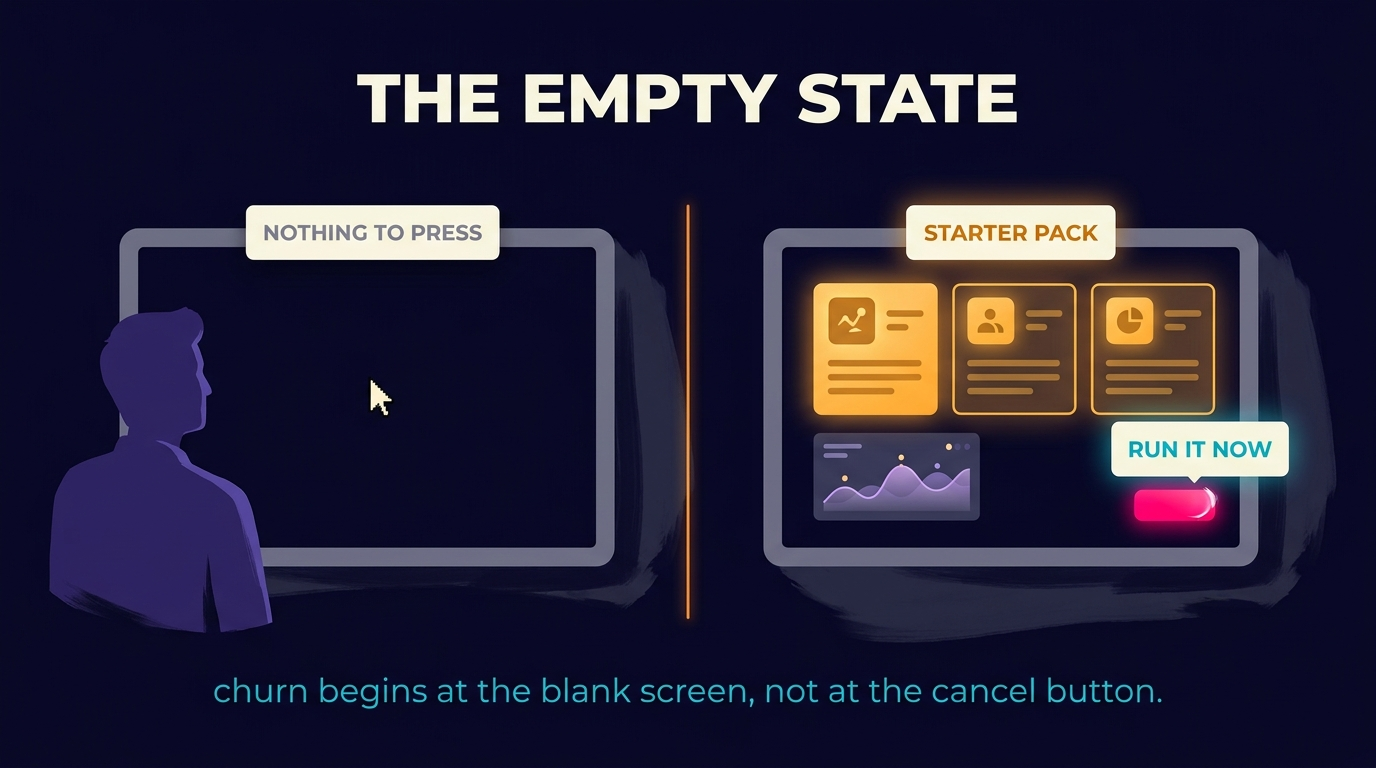
Documentation is a deliverable
In technical delivery, weak documentation is a fulfilment failure rather than a nice-to-have gap. If a client has to email me to ask how to run the thing I built, I didn't finish.
So documentation gets treated as a deliverable equal to the code. The readme is the instruction manual for the machine rather than an afterthought. Video walkthroughs are embedded directly where the reader is standing. Copy-and-paste snippets exist for every common task, tested. The effect is that the client feels capable rather than dependent, and, to most people's surprise, a client who feels capable hires you again for something harder. Dependency looks like retention and behaves like resentment.
Transparency as a trust multiplier
The solar portfolio client was anxious in the way every client with real money in a channel is anxious. Are the ads working. The conventional answer is a monthly PDF, which is slow enough to breed suspicion between editions and detailed enough to be unreadable.
What we built instead was a live dashboard on top of the warehouse: spend, leads, cost per acquisition, updating continuously, available to them without asking. The behavioural change was immediate and larger than the technical one. They stopped calling to ask how it was going and started calling to say spend more. Transparency eliminated the anxiety that had been generating those calls, and it did something else too: it converted the reporting layer from a cost centre into the artifact they later walked into investor meetings with.
Underneath is a general principle: anxiety in a client relationship is almost always an information deficit rather than a performance deficit, and information deficits are cheap to fix compared to the trust they cost.
Re-selling the work that is already working
Fulfilment means doing the work and also reminding a client that the work is working, because a system that runs quietly becomes invisible, and invisible work gets cut in the next budget review by somebody who wasn't paying attention.
Weekly reports follow one shape, and it takes three lines.
On longer retainers this scales into a quarterly review, which is a re-selling event rather than an administrative one. Here is what shipped. Here is the money or time it saved, stated as a number. Here is the roadmap for the next quarter. I don't send an invoice and hope the value is self-evident, because value is never self-evident to somebody who has moved on to their next problem.
The referral engine
Good fulfilment produces the next sale without a campaign. After we delivered the first grant-funded media project with rigorous documentation and open reporting, the next ask was substantially easier, because we had established a reputation for being the adults in the room in an industry that mostly isn't. That reputation was bought by delivering and then making the delivery legible, not with marketing.
Reputation can't be purchased, only exchanged for. Somebody has to give you something, you have to make a promise, and you have to deliver on it. That is the whole mechanism, and it is why free work builds so little of it. Without a real exchange, nothing was risked and nothing was proved.
Why I can guarantee anything at all
I offer guarantees because I trust the process rather than because I trust my own brilliance. Follow the People research. Engineer the product and the offer properly. Qualify ruthlessly. If all three are true then fulfilment is close to arithmetic, and guaranteeing an arithmetic outcome isn't brave.
A freelancer does tasks. A partner takes responsibility for the outcome. The distance between those two sentences is nine stages long, and every one of them is a place where responsibility could be quietly handed back.
That is also the direct answer to the question people ask about the guarantee in Stage 6. A guarantee is a bet on your own process discipline. If you are unwilling to make it, the useful move is to find which stage you don't trust, and then go fix that stage rather than adjusting your terms.
One last property of this stage connects it back to the top. Stage 9 is where the master benefit from Stage 4 is either proved or destroyed. Every customer is ultimately shopping for a reliable supplier who lives up to their expectations, and every element of fulfilment is a small test of that claim: whether the first forty-eight hours delivered anything, whether the documentation answered the question, whether the dashboard was up when they looked. Nobody grades those tests consciously. Everybody remembers the result.
Running it on a cadence
Every process drifts. Every dashboard goes stale. Every persona ages out. The final property of this framework is that it eats itself unless you re-run it on a rhythm, and admitting that is what separates a diagnostic from a deliverable.
I run it quarterly on every active engagement. The first pass takes weeks, because you are building artifacts from nothing: the problem statement, the Lexicon of Pain, the future specification, the benefit bucket, the qualification criteria. Each subsequent pass takes a couple of days, because the artifacts exist and the work becomes a diff rather than a build. The diff asks what changed in the corpus, which benefits stopped landing, which qualification criterion is now letting the wrong people through, and where the bottleneck moved.
The compounding lives in the rhythm rather than in the depth of any single pass. A shallow quarterly re-run outperforms a brilliant annual one, because market drift is continuous and a year of it is more than a single review can absorb.

What to re-run, and what to look at
Find the bottleneck, then move
Goldratt's constraint theory applies to a business as cleanly as it applies to a factory. Find the slowest gate. Move resources onto it. Then find the new slowest gate, because there always is one, and move again.
Most operators try to optimize the whole system at once, which feels thorough and produces almost nothing. A system runs exactly as fast as its bottleneck, so improving anything else is theatre with a project plan attached. The specific value of the metric routing in Stage 8 is that it tells you where the constraint currently sits, and the specific value of the cadence is that it catches the constraint after it has moved, which it does every time you fix one.

People, Product, Process is a stethoscope rather than a checklist. You don't complete it. You re-run it whenever the patient changes, and the patient is always changing.
When the framework breaks
One failure mode dominates everything else, and it is confusing the layer.
- A process problem treated as a people problem gets the wrong person fired. The replacement inherits the same broken workflow and fails in the same way roughly a quarter later, at which point the diagnosis is confirmed rather than questioned.
- A people problem treated as a product problem builds the wrong feature, beautifully, on schedule, and ships it to an audience that was never going to want it.
- A product problem treated as a process problem produces an immaculate CRM nobody uses, because the offer was the constraint and no amount of pipeline hygiene fixes an offer.
If you remember nothing else, remember the order. And if you can't tell which layer a problem sits on, don't start fixing anything. Sit with the diagnosis longer. Being wrong about the layer costs far more than being slow about the prescription, and slowness is visible while a wrong layer isn't.
Four stage-specific failures worth knowing by name
Diagnosing through your own inventory. It's the most common one, and the hardest to catch from the inside, because a diagnosis shaped by what you sell feels like expertise. The check is mechanical: read your problem statement and see whether it names your product category. If it does, you have written a proposal and called it a diagnosis. Rewrite it so a competitor could use it.
Selling a future you haven't scoped. Stage 2 gets seductive once you are good at it. Somebody who can articulate a compelling future can articulate one that nothing in the eventual contract delivers, and the bill arrives in Stage 9 with interest. The check is a line-by-line map from every element of the stated future to something in the scope. Anything unmapped comes out of the pitch or goes into the scope.
Skipping Stage 3 because the client seems keen. Enthusiasm at signature isn't the same as willingness to change behaviour, and enthusiastic clients are the ones most likely to agree to a transformation they haven't priced. This failure is invisible for about six weeks and then presents as a project that has stalled for reasons nobody can name.
Building the machine before the message. Automation applied to a process that doesn't work produces more of what you were already getting. I have watched teams spend a quarter building a fifteen-email nurture sequence rather than having ten conversations, and the sequence was excellent, and it converted nothing, because there was no working conversation for it to scale.
The limits of the framework itself
There are two situations where this is the wrong tool, and I'll say so rather than sell it anyway.
The first is a genuine distribution problem in a market where the product and the message are both already validated. If you are converting well and simply can't reach enough people, the constraint is media buying and channel economics, and running a nine-stage diagnostic will confirm what you already know at considerable expense. Go and buy attention.
The second is a business whose economics don't work at any conversion rate. If the unit economics are negative and the fix is pricing or cost structure, no amount of diagnosis, offer engineering, or qualification repairs that. This framework improves conversion and retention. It doesn't manufacture margin that the model never had.
There is also a failure mode in the framework's own rhetoric that I should name, since I have committed it. Nine stages is a satisfying number and a satisfying structure, and satisfying structures invite completeness for its own sake. Not every engagement needs all nine run at full depth. A small, well-understood project with a known buyer might justify a light pass on Stages 1 through 3 and a serious pass on 6 through 9. The discipline is knowing which stages you are running lightly and saying so out loud, rather than running all nine at a uniform shallowness and calling it thorough.
The framework as a whole
Nine stages, three phases, one outcome: a production system you have actually understood instead of one you hoped into existence. What makes the sequence hold together is that every stage produces a named artifact, and the stage below consumes it. Skipping one produces improvisation, which is a gap wearing better clothes.

What each stage owes the next one
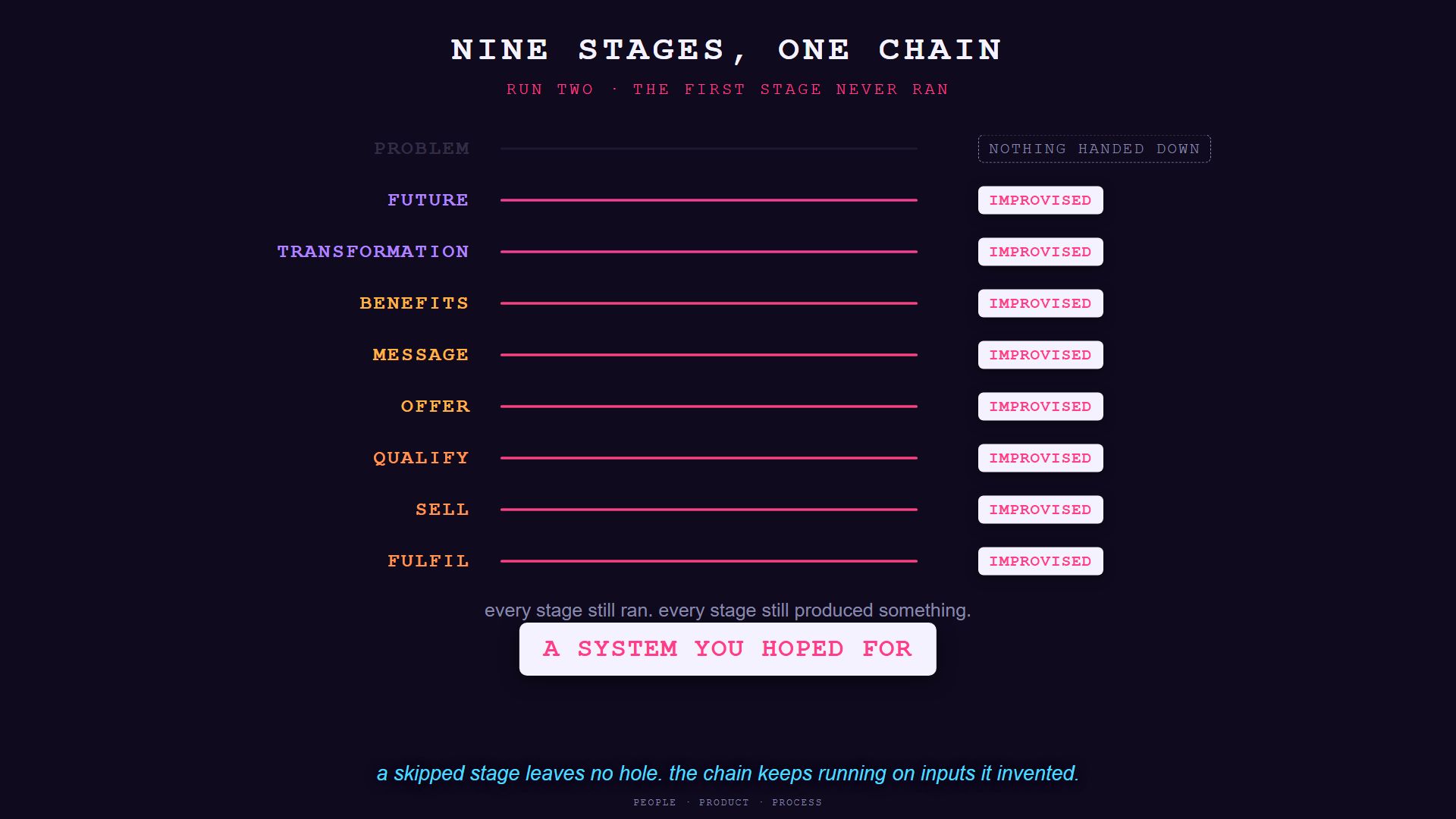
Running your first pass
If you are running this on your own business rather than a client's, here is the sequence I would use, and the order matters more than the polish of any individual output.
- Spend a day in the corpus before you write anything. One-star reviews of your five closest competitors, the subreddit where your buyers complain, the last fifty support tickets. Collect phrases verbatim into one document. Don't summarize, don't tidy, and resist the urge to categorize while you are still collecting.
- Write the problem statement in one sentence using the broken-belief, specific-pain, consequence shape. Then check that it doesn't name your product category anywhere. If it does, you diagnosed through your inventory and you go again.
- Run the Day in the Life test on three existing customers. Ask about a Tuesday. Push until the answer contains something a photograph could capture. Those three answers are your future specification, and they will be more concrete than anything you would have invented.
- List the behaviours that have to change for that Tuesday to be possible. Be specific enough that each item is checkable. That list is now both your delivery risk register and your qualification criteria.
- Beat every feature with "so what" until it lands on a payroll line, a calendar, or a fear. Write the results as before-and-after sentences and put them somewhere the whole team can reach. Aim for twenty, not three.
- Draft the message using the eight beats, pulling phrasing from step one rather than writing fresh. If a sentence didn't come from the corpus, ask what it is doing there.
- Rebuild the offer against the five questions. If you can't answer the guarantee question, work out which upstream stage you don't trust, and go fix that instead of weakening the offer.
- Install one gate this week. Not three. Replace the calendar link with an application, or add a single disqualifying question. Measure what happens to lead volume and to close rate separately, because one of them going down is the mechanism working.
- Write the close down and use it verbatim for a month, including the part where you stay silent afterwards. Scripting it is what stops you improvising your way back into selling.
- Instrument the first forty-eight hours after purchase, and put one visible win inside it. This is the cheapest retention work available and almost nobody does it.
Ten steps, and about half of them produce a document rather than a change. That ratio is correct. The documents are the framework; the changes are what the documents make obvious.
I'd want somebody to take the underlying commitment from all of this, not the nine stages, which are a scaffold and could reasonably have been eight or eleven. The commitment is to diagnose the situation independently of what you happen to sell, describe the destination in terms somebody could photograph, price the crossing in behaviour before pricing it in money, and then build machinery that carries the right people across and turns the wrong ones away early enough that nobody wasted a quarter finding out. Everything else here is implementation detail on top of that, and implementation detail is worth exactly as much as the diagnosis underneath it.