Distribution usually gets treated as an afterthought. The piece gets written, and only then does the question become where do we post it. The order is wrong. Distribution is the structural design, not the channel, and it decides whether a single piece earns a single read or six months of compounding attention. Get the structure right and a small operator outranks a content team. Get it wrong and a content team produces a feed nobody remembers.
Social engineering is the practice of designing distribution as a system. It trades the question which platforms should I be on for which channel earns me an asset that does not disappear when the platform changes the algorithm. Its model rests on the difference between owned and rented attention, and its operational discipline is the loop that turns rented attention into owned attention without leaving the rented channels behind.
Owned versus rented · the load-bearing distinction
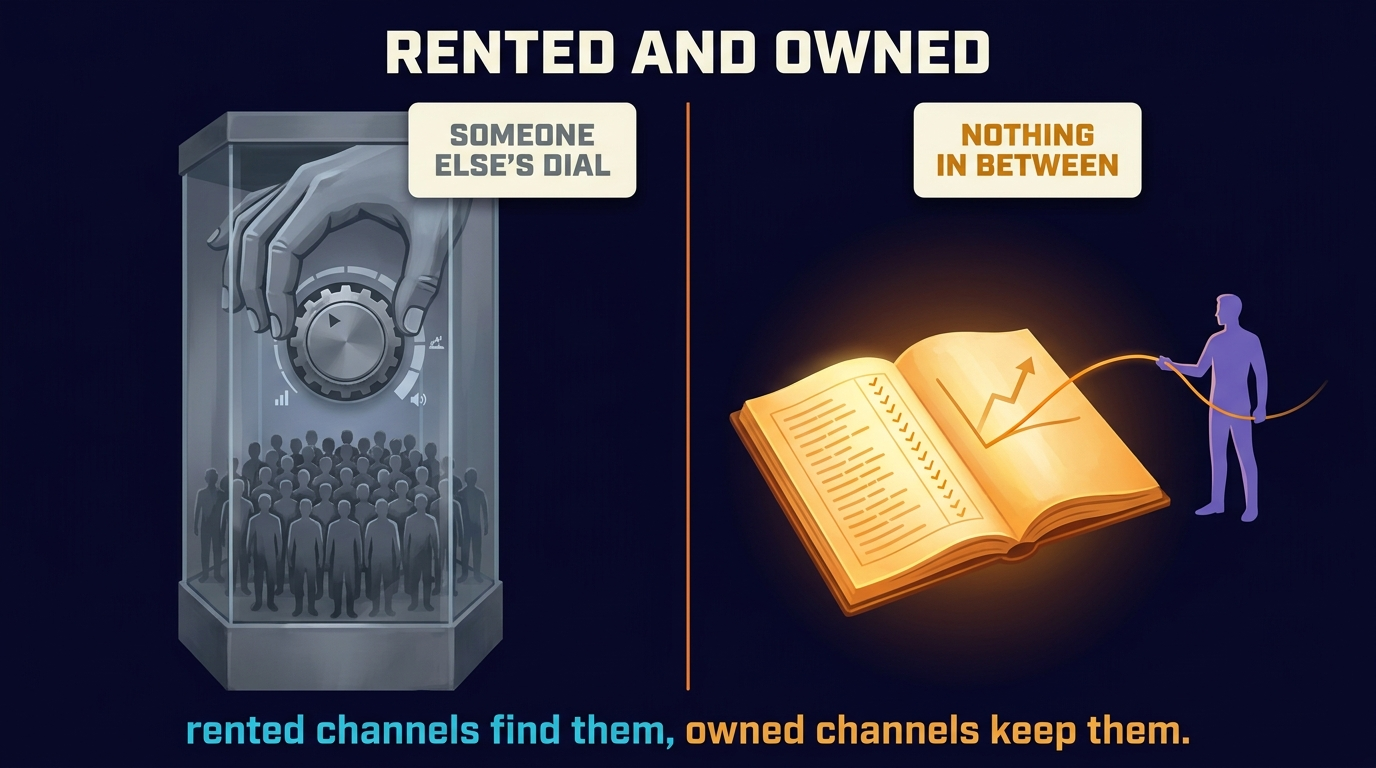
Every distribution channel sits on one of two sides of a line. On one side are rented channels, where the platform owns the audience and the access. You can have ten thousand followers on a rented channel and lose all of them in a single algorithm change, a single account suspension, or a single platform pivot. The audience isn't yours; you're paying rent in attention units to use it.
On the other side are owned channels, where the audience is on a list you control: email subscribers, RSS feeds, SMS lists where the platform is dumb pipes. Once a person is on your owned channel, no third party can sit between you and them. They might unsubscribe, but they won't be algorithm-throttled away.
The strategic move is to keep the rented channels, because they're where discovery happens; nobody hears about you on a list they aren't on yet. Use them as the top of a funnel that ends in an owned channel. Every piece of content shipped to a rented channel has a single secondary job: turn one casual viewer into one owned-channel subscriber. That handoff is the deliberate structural design of every post, video, and thread to point downstream at an asset that takes the relationship off the rented platform, not pop-up email harvesting.
Andy's own pattern is the working example. The YouTube channel went from eight thousand to two hundred and twenty thousand subscribers in fourteen months with zero paid promotion. The win is the email list those subscribers feed into, the wiki they read on, and the long-form video they watch end-to-end, not the subscriber count. The rented channel did the discovery, and the owned channels held the relationship.
The four distribution loops
Distribution that compounds runs four loops in parallel, each with a different time horizon and a different mechanic, and they reinforce each other. A site that runs only one loop has a structural ceiling no amount of effort breaks through.
Search. The search loop is evergreen retrieval. A piece earns its position through topical density (see Content Strategy) and the position holds for months to years, compounding through link equity and topical authority. It's the slowest loop and the highest-leverage one. A canonical entry that ranks for a head term pulls traffic for years without further effort.
Feed. The feed loop runs on the platform's recommendation engine, which decides where a piece surfaces, and its time horizon is days to weeks per piece. It compounds through audience-profile training: each piece that performs well teaches the algorithm what kind of viewer wants you, which makes the next piece easier to surface. It's the fastest loop and the most fragile one, and a platform pivot resets it.
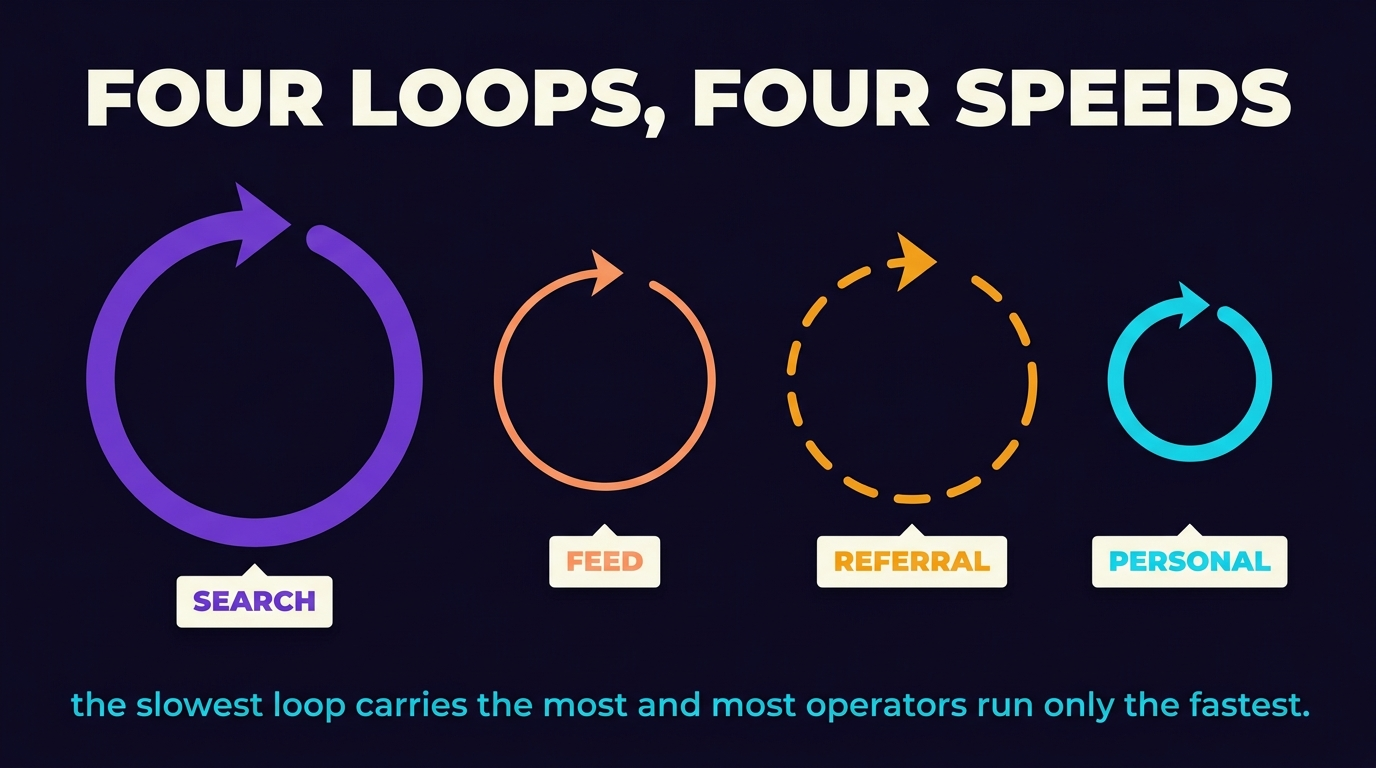
Referral. The referral loop is audience-to-audience pass-through: someone with a bigger or different audience cites your work, links your piece, or passes it along. Its time horizon varies, and it compounds through reputation density. The more you're cited by people whose judgment matters, the easier it gets for the next person of that kind to cite you. It's the loop that usually gets ignored because it can't be scheduled, yet it's the loop that moves you from known to respected.
Personal. The personal loop runs through direct messages, inbound emails, calls, and casual conversations. Its time horizon is immediate, and it compounds through personal reputation. Every direct interaction either confirms or contradicts the impression the public work created, and this loop is what turns a passive subscriber into an evangelist. Treat it like a channel, not like overhead.
Signal design · one post should do four jobs
For any distribution effort, the economical question is how much work each post does. Most posts do one job: they give value to the audience already paying attention, and that's it. The same post can be engineered to do four jobs at once with no additional production effort. All that changes is the structural awareness of the operator hitting publish.
The first job is hooking the casual scroller. The first line, frame, or visual has to earn the second line. The casual scroller hasn't consented to your post; you're interrupting their feed, and the hook is the price of admission. My pattern is to open with the most counterintuitive sentence in the post, not the most polite one.
The second job is giving value to the existing audience. The body has to be worth reading for someone who already follows you. The audience that already trusts you is the one most likely to refer you, so boring them costs more than missing the casual scroller.
The third job is signal-training the algorithm. The post has structural features the platform reads as this is the kind of content my serious users want: length, retention curves, comment density, save rate. You design the post to score on the metrics the platform actually weights, not the ones that look good on a dashboard. Those weights are platform-specific and they change, so treat them as ongoing research, not a fixed playbook.
The fourth job is routing one viewer to the owned channel. Every post carries a single soft handoff to an owned destination, such as a wiki entry, a long-form video, or an email list. The handoff is ungated and low-pressure, mentioned naturally in a way that rewards the curious viewer who wants more. The viewer who follows the link is the high-intent subscriber, and the viewer who doesn't is still served by the post, so both count as wins.
Cadence versus event · the two production modes
Production splits into two modes that look like the same activity from outside but are structurally different. Confusing them is why operators burn out producing one and resent producing the other.
Cadence work is the daily firehose of field notes, short posts, threads, comments, and replies. Production cost per unit is low and quality variance is high, which is fine because the volume averages it out. Its job is presence and personality. Cadence work shows up consistently enough that the audience knows you're alive, builds intimacy, and surfaces in the feed loop, where freshness matters.
Event work is the periodic flagship: the long-form video that took two weeks, the canonical wiki entry that took a month, the launch that compounds into a quarter of inbound. Production cost per unit is high and quality variance is low, since you don't ship until it clears the bar. Its job is depth and proof, and event work is what the referral loop cites and what the search loop ranks.
Operators who burn out usually picked one mode and tried to make it do the other's job. Cadence-only operators ship every day and never compound, because no individual piece earns the depth the search and referral loops reward. Event-only operators ship rarely and never build the feed-loop momentum, because the algorithm can't find a stable enough signal to lean into. The discipline is to run both, in proportion. My ratio is roughly a daily cadence (field notes) and a monthly event (a long-form video or canonical wiki entry), with the cadence stream cross-promoting the event piece for two weeks after release.
Where to start
There are three places to start, ordered by difficulty and impact.
Easiest, do today. Pick one owned channel and commit to it for the next three years. Email is the safest pick because the protocol is older than any platform and isn't going anywhere. A simple channel is fine as long as it exists. A list of one hundred subscribers you address by name is more valuable than a follower count of fifty thousand on a channel you don't own.
Medium, this month. Audit your last twenty rented-channel posts. Count how many of them include a soft handoff to your owned channel; the actual count is usually two or three. Get the next twenty to ten or more. The handoff can be light, a line, a link, or a reference, and the structural awareness compounds even when individual posts feel uneventful.
Hardest, this quarter. Ship one event piece per month, whether a long-form video, a canonical wiki entry, or an anchor essay. Build the cadence stream around it with short posts, field notes, and replies that reference, quote, or extend the event piece. After three months, the third event piece will inherit traffic from the first two, and that's the moment compounding becomes obvious in the analytics.
Distribution that compounds runs four loops at once and engineers every post to do four jobs. The loops feed each other; the jobs share the same production unit. For the broader theory of how attention, trust, narrative, and distribution compose, see Standard Model of Effective Media.