
A brand voice needs instructions another writer can use and reasons an editor can point to when a draft sounds wrong. The owner's ability to recognize the voice is a starting point. The handoff needs more than that.
A family-portrait studio rejected AI-written campaign copy in my Voice Fingerprint work. We measured the client's actual writing, including sentence rhythm, punctuation and vocabulary, and rebuilt the campaigns against that reference. The rebuilt campaigns were accepted. The client could compare the rejected copy with the revision instead of trying to settle the disagreement through adjectives about tone.
That work shows a way to make a voice dispute inspectable. It doesn't establish that a particular sentence pattern will sell more portraits, or that matching a numeric profile makes every sentence good.
The same distinction applies to a smaller writing team. A useful brand system gives the writer decisions to make, examples to learn from and checks that catch a departure. The owner still decides what the brand should sound like. Other people need enough of that decision written down to produce and revise a piece without asking the owner to supply every sentence.
Register, vocabulary and mythology answer different questions
Tone describes the impression a reader gets. Calling a brand confident or approachable leaves a writer with a lot of choices. A brand system makes those choices explicit enough to discuss.
I separate voice into register, vocabulary and mythology. A register is a mode of writing for a particular reader and job. Vocabulary controls the words and phrases used within that mode. Mythology is the collection of recurring stories and named ideas a reader can recognize across the body of work.
The distinctions help an editor locate a problem. A conversational email can use the approved words and still sound like a formal report. A familiar concept can disappear under a new name even though the sentence reads well. Each problem needs a different correction.
The three components give the editor different evidence to examine:
| Component | Decision for the writer | Evidence for the editor |
|---|---|---|
| Register | Which writing mode fits this reader and job? | Approved passages written for a comparable purpose |
| Vocabulary | Which words or constructions belong here? | A rule with its scope, reason and examples |
| Mythology | Which existing idea does this passage use? | Its canonical name, definition and connection to the argument |
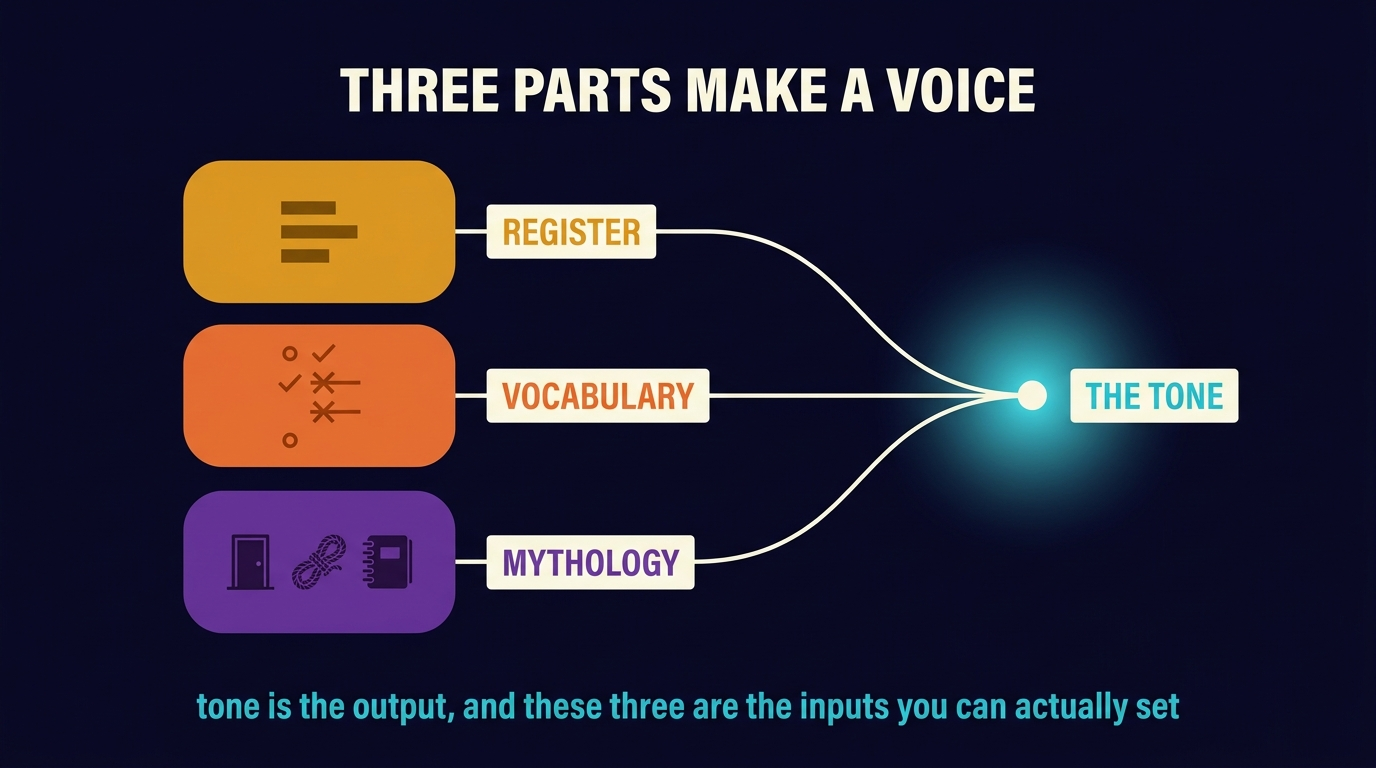
These components work together. A wiki explanation may introduce a named method, explain it patiently and keep the terminology stable. A short customer email may need everyday language and no named method at all. The brand can remain recognizable in both. Consistency means the choices fit the job and the established voice, with enough evidence for another person to see why.
A register specification starts with the reader's job
A mode label gives a writer a place to start. The specification has to explain what happens there. My site's DEFAULT, CASUAL and PUBLIC labels distinguish kinds of writing, but the reader and the purpose determine what a particular piece needs.
A reference entry owes its reader a developed explanation. A conversational email can get to its purpose without the background a reference entry needs. Press material needs enough context for someone who hasn't followed the work. The writer's choices about sentence length, technical terms, humour and personal detail follow from that relationship.
The supplement emails needed a familiar voice
My fitness-supplement work gives a concrete example. The campaign addressed buyers' questions about safety, ingredients and where the products came from. We used educational content before the conversion sequence. The writing used language fitness buyers already used, and the delivery was closer to advice from someone at the gym than a company announcement.
The register served that particular conversation. Familiar phrasing could make the explanation approachable, but the ingredient and testing claims still needed support. A friendly sentence doesn't make a product claim true.
The historical case also involved collecting customer data through methods I explicitly warned against repeating. The writing decision was to explain the product in language the audience recognized, with education appropriate to the relationship.
Approved passages make the specification usable
Write down who will read the piece, what they came to do and what they already know. Then describe the range of sentence lengths, the room for personal disclosure or humour, and the moves that would break the mode. Correct grammar stays available in every register.
Choose five examples per mode from writing you've already approved, with enough variety to show range: an opening, an explanation, a qualification, a transition and a close can reveal more than five similar punchlines. Keep the surrounding context available so a writer can see what each sentence was doing.
Examples need reasons. Point out what makes a passage fit its reader, and why a superficially similar sentence would go too far. The next writer needs to judge material the examples haven't covered.
Vocabulary rules need a reason and a scope
A vocabulary list makes a preference specific. An editor can identify a forbidden construction, point to the rule and ask for a correction. A writer can check the draft before handing it over.
My writing rules prohibit em dashes. They also reject a familiar construction that opens by denying one idea, then announces another as a revelation. The repair is to state the supported point directly. Corporate filler gets the same attention. A sentence about using a product rarely gains anything when the writer replaces "use" with a fancier synonym.
Those rules operate at different levels. A punctuation character is a literal match. A sentence construction needs enough context to establish its shape. A vocabulary match may need interpretation. A word can be an empty sales adjective in one sentence and part of a technical definition in another.
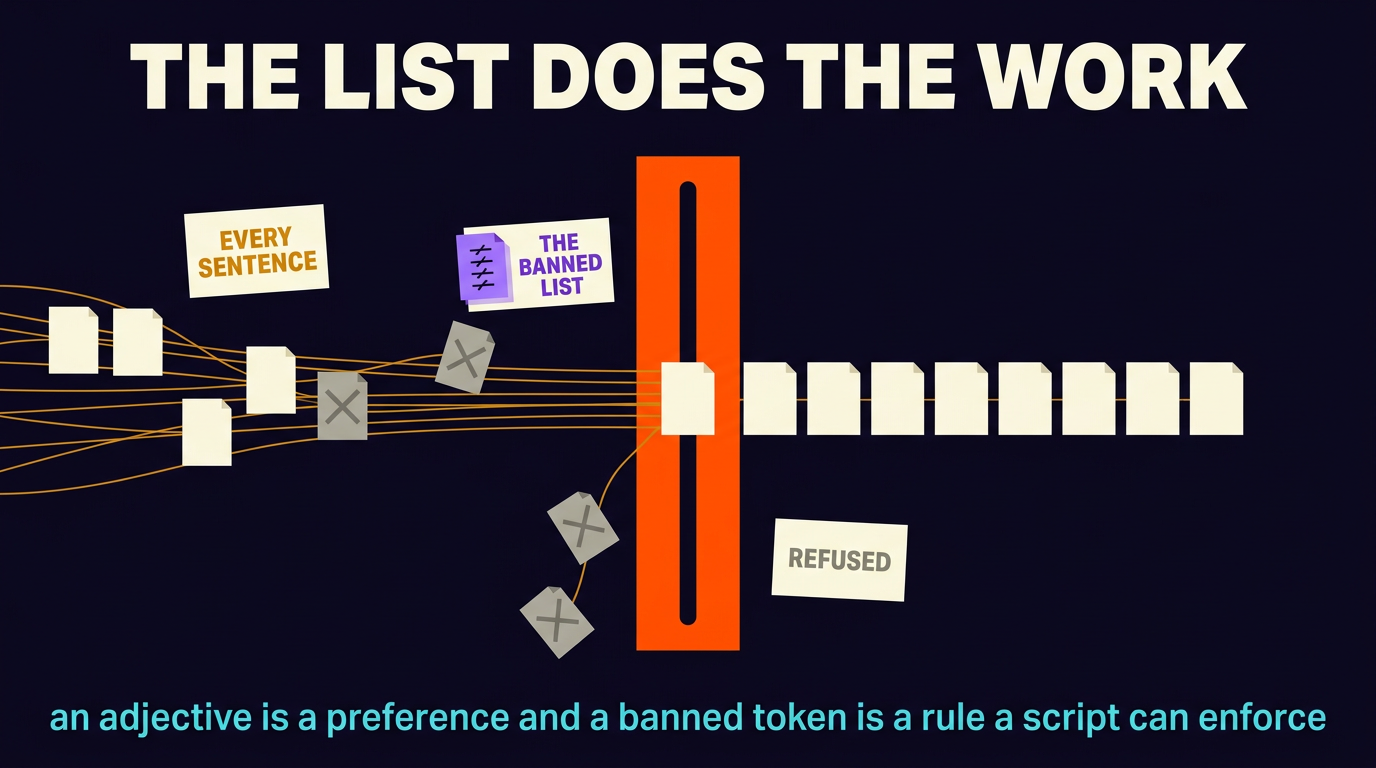
A useful rule records the problem the writer is trying to avoid. Keep the disallowed wording, a supported replacement and an explanation together. A replacement should improve the sentence's meaning or ease, not merely exchange a flagged word for an unflagged synonym.
The required list protects concepts with established names. People · Product · Process should keep its name when the framework is introduced. The writer can explain the idea in ordinary language alongside the name. That explanation helps a newcomer understand the term without creating a second name for it.
Start with the violations that recur in actual drafts. A growing list needs an owner who can distinguish a standing rule from an editor's preference on one sentence. Record a justified exception with the passage it applies to, so another writer doesn't interpret it as permission everywhere.
A script can catch literal matches before publication. It can't decide whether the paragraph teaches anything, whether a quotation is accurate or whether a technically compliant sentence belongs in this voice. Those decisions remain part of reading the piece.
A recurring name has to point to a consistent idea
Vocabulary control keeps a name stable. Mythology gives that name something worth remembering. I use the term for recurring stories, characters and concepts across a body of work, including the methods a reader meets again in another article.
The Velvet Rope names qualification before a sales call. The Beggar and the Chooser describe contrasting ways of approaching that decision: taking almost any call, or protecting capacity for clients the business can help. These names belong to the same argument. Repeating them gives a returning reader a way to recognize the connection.
A name also needs enough explanation for someone arriving for the first time. My diagnostic questions examine past failures and current problems. The Lexicon of Pain collects the actual phrases customers use about their problems. A reader can follow either method without having read the rest of the site.
Keep a concept record with the canonical name, a plain definition and the entry that explains it. Add the alternative names that have appeared in earlier drafts, so an editor can distinguish a new idea from an accidental rename. Record where a term applies and where it would mislead.
A tactical post can stand alone. Forcing an established character into a product instruction gives the reader another thing to decode. Use a named idea when it carries reasoning the passage needs, and link to the fuller explanation where that helps.
The resulting body of work can accumulate connections without requiring every reader to start at the beginning. A recurring name remains useful only while the underlying idea stays recognizable. Repetition without that consistency produces a slogan.
An audit returns a passage and a reason to change it
An audit compares the whole piece with the writing mode, vocabulary rules and concept records. The editor needs the intended reader and job as well as the draft. A sentence can fit one use and fail another.
Separate a literal violation from an editorial finding
Run the mechanical checks on the complete text. A forbidden punctuation mark has a definite answer. A matched word produces a candidate to read in context, especially inside quotations or technical descriptions. Each confirmed violation should point to the applicable rule and its correction.
Then read from opening to close for register fidelity. Compare the draft with the approved examples. Check whether a reference entry sustains its explanation, whether a conversational piece begins speaking like a corporate announcement, and whether the amount of personal detail still fits the relationship with the reader. A long sentence can stay when its clauses carry a connected thought. Cutting every sentence to the same length would erase part of the voice the system is meant to preserve.
Check named concepts where the piece uses them. The canonical name and definition should agree, and a link should take the reader to the explanation it promises. A piece that introduces no existing concept may have no mythology problem to fix. Judge that choice against the job of the piece.
Give the writer enough evidence to revise
A useful finding identifies a particular passage. Saying the piece feels too corporate leaves the writer to guess again. Point to the change in mode, the wording that caused it and an approved passage that demonstrates the intended treatment.
The return note can stay small. It needs the exact span, the rule or reader problem, the proposed correction and any fact the editor couldn't verify. The writer should be able to accept the correction or explain the disagreement without reconstructing the entire review.
Use pass or fail for an explicit rule. Keep a reason beside the decision. A personal preference that the specification hasn't established needs a separate discussion before it becomes a standing prohibition.
Voice compliance is one part of approval. An article can keep its mode, avoid banned words and use every canonical name while still teaching nothing useful. Read it for what the reader can understand or do afterwards. Check factual claims against their sources. The writing system helps people inspect a draft; approval still requires those decisions.
Start with a piece another writer has to revise
Choose an existing piece and give it a specific job. Gather the passages that already sound right, identify the mode they share and write down the rules those passages support. Begin with the vocabulary problems found in actual drafts. Add the named concepts the chosen piece needs.
That produces a small working set: a register specification, vocabulary rules and concept records, all tied to real writing. Another writer can use the set to revise the piece. An editor can return findings against it. Both people have something concrete to disagree about.
The disagreement helps locate what the system is missing. A writer may follow a word rule and still miss the explanation's purpose. An editor may reject a sentence for a preference that appears nowhere in the examples. Record that distinction. Correct the draft where it violates an established rule, and clarify the specification where the instruction left a genuine choice unresolved.
Use the revision to improve the instructions. Add the approved passage and its reason, keep the relevant rejected wording beside it, and give the next writer the same decision without making them repeat the conversation. A changed preference should be visible as a changed rule. An old draft shouldn't silently become evidence for the new one.
Software can take over repeated literal checks once those checks are clear. A shared document is enough to begin. Building an elaborate checker before the team agrees on examples can automate a disagreement without resolving it.
The handoff has a practical stopping point. Another writer can produce a coherent revision, the editor can explain which choices fit, and any remaining question has a named passage attached. The owner is deciding the voice instead of supplying all the sentences. That's the part of a brand system worth testing on the next piece.
The broader account of attention and narrative is in Standard Model of Effective Media. The related entries on Content Strategy and Video Content Engine cover how a body of work is planned and produced.