
The CRM is the most expensive piece of software a small business owns and the most reliably broken one. Six-figure annual subscriptions sit underneath sales teams that bypass the system, build workarounds in spreadsheets, and rely on Slack threads to remember which deal is at which stage. Leadership opens a dashboard once a quarter, sees numbers that nobody trusts, and quietly stops looking. The CRM has become a graveyard. The pipeline runs in someone's head.
This essay is the practitioner playbook for fixing that pattern. It corresponds to People · Product · Process Stage 7, where the implicit operational state machine becomes explicit, and to State Machine Everything as the formal lens that says every workflow has states and transitions whether you draw them or not. The CRM is one of those state machines. Most of them are drawn poorly. The cost of the bad drawing shows up in revenue you don't earn and pipeline you can't forecast.
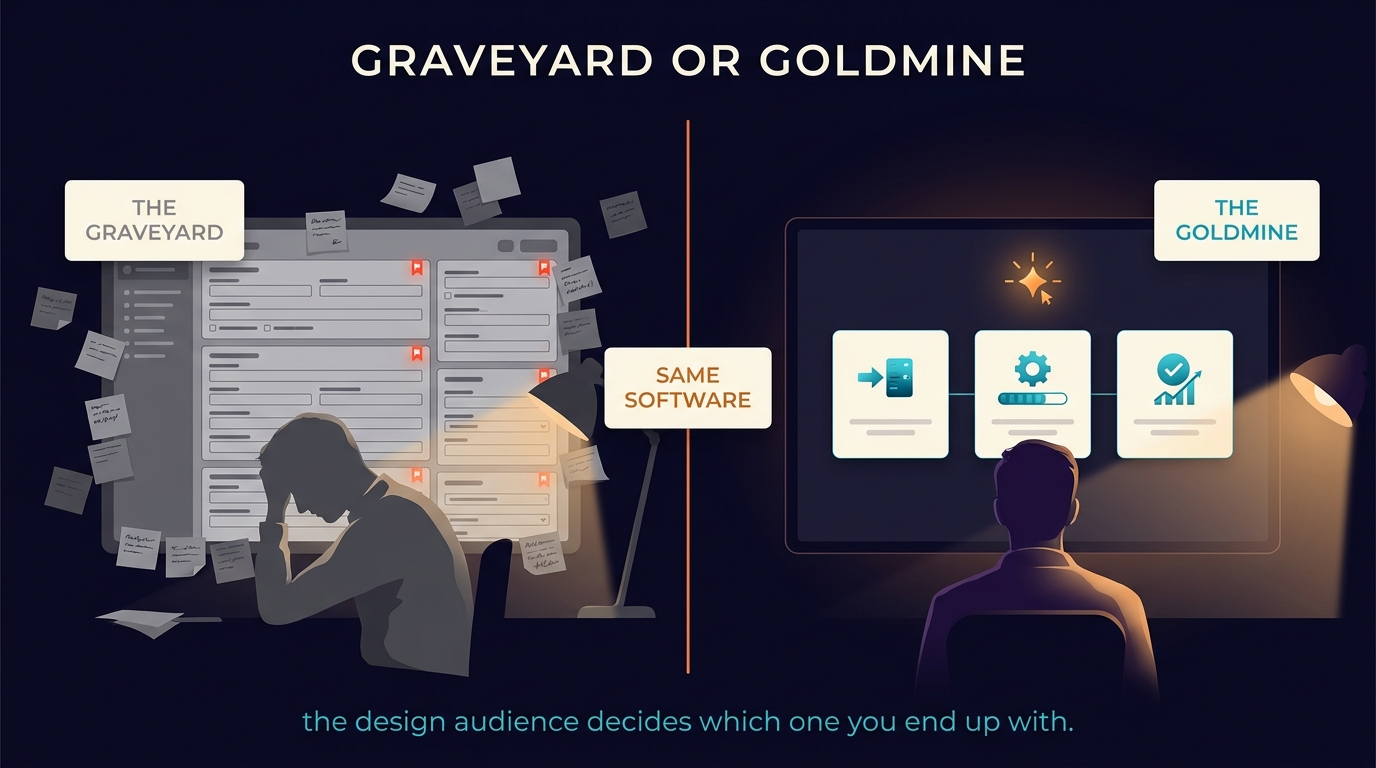
Goldmine or graveyard
The CRMs that work and the CRMs that fail come from the same software and cost roughly the same money. The variable that separates them is who the system was designed for. Most CRMs get designed around management's reporting wishlist: dozens of mandatory fields, brittle workflows, and no clear next action for the rep at any stage. The rep opens the system, scans for what they have to fill in to keep their manager off their back, fills exactly that, and closes the tab. Data quality collapses on impact. Leadership loses visibility into where revenue comes from. The CRM is now a tax on the team that pays nothing back.
The CRM that works gets designed for the rep first. The reporting falls out of the design as a secondary artifact. From the source: most systems get designed around management's reporting wishlist instead of how reps actually sell. The result? Dozens of mandatory fields, brittle workflows, and no clear next actions. Reps avoid systems that punish them for using the system. Every wasted minute inside the CRM is a minute not spent in front of a buyer. The fix is structural: you redesign the machine so working it is the path of least resistance, because training reps harder won't solve a graveyard CRM.
Every successful CRM rebuild runs on one principle: the CRM is a People Product Process system, a three-layer alignment exercise where the people who use it daily, the product definitions that determine what counts as a stage transition, and the process that maps how deals actually move all have to agree. When one layer disagrees with the other two, you get the graveyard. When all three align, you get the goldmine. Four levers make that alignment happen: the lifecycle stages, the automation rules, the sync layer and the rebuild itself.
Lifecycle stages · the names that decide everything
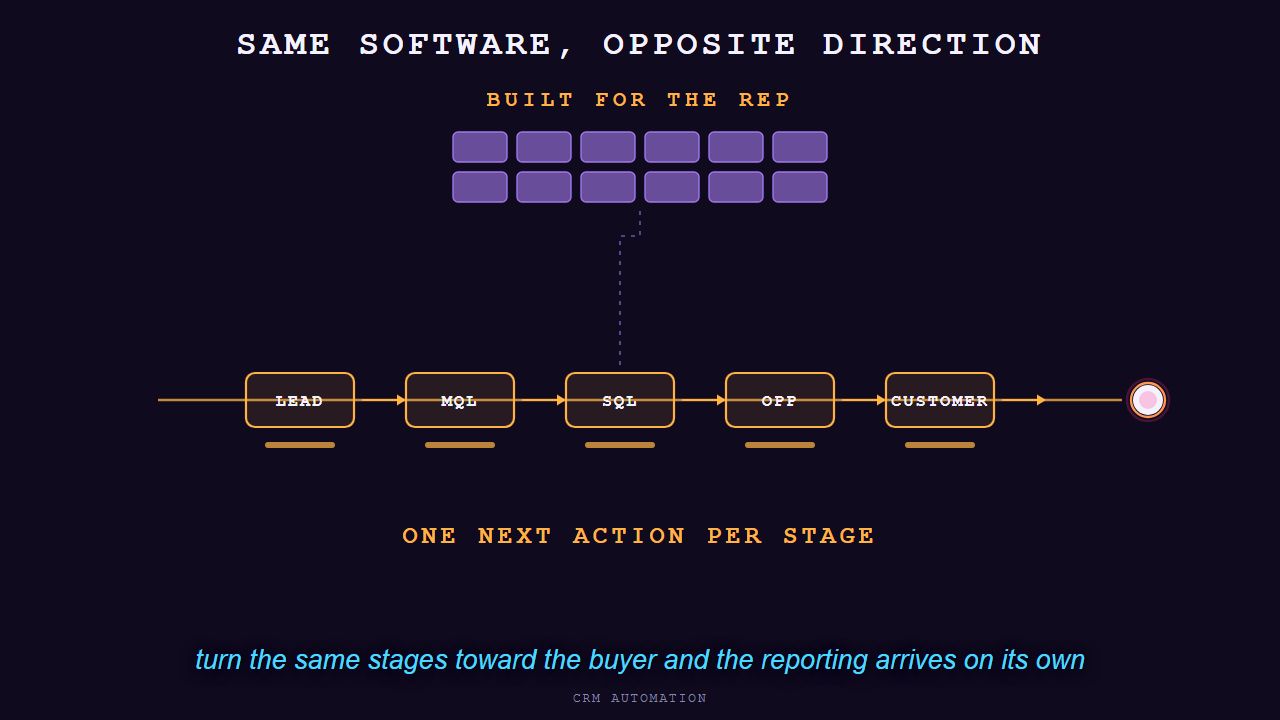
Lifecycle stages are the bones of the CRM: Lead, Marketing-Qualified Lead, Sales-Qualified Lead, Opportunity, Customer. Most teams use those words, and almost no team agrees on what they mean operationally. Ask three reps when a Lead becomes an MQL and you get three answers. Ask the marketing director and you get a fourth. Now ask what number leadership sees on the dashboard. That number is the sum of four different definitions running in parallel, so it's fiction wearing a number's clothing.
The fix is to define each stage by an observable trigger that any rep can verify in under thirty seconds without judgment. MQL is a record that has completed a specific form, hit a specific score threshold, or matched a specific firmographic filter, not a feeling. SQL is a record where a discovery call has occurred, BANCE (the in-call disqualification framework) has been logged, and the rep has confirmed budget and authority. Opportunity is when a proposal has been sent and acknowledged. Each definition is a switch the rep flips by completing a specific action, and because the action exists in the world, the stage transition follows from it.
Once the triggers are defined, the lifecycle becomes a state machine you can audit. Each stage has an entry condition, and each transition has a name and a default automation that fires when the trigger event is recorded. The dashboard now reflects reality because every state in it is the result of a verifiable operation. See State Machine Everything for the formal treatment of why this matters: the workflow you can't see is the workflow that breaks.
The number of stages matters less than the rigor of the definitions. A four-stage funnel with crisp triggers outperforms an eleven-stage funnel with vibes-based transitions every time. When in doubt, run fewer stages with sharper definitions. You can always split a stage later when the operational reality earns the split, and you can't retroactively earn rigor by adding more stages.
Automation rules · the rep's reflexes, externalized
Automation gets a bad reputation because most teams automate the wrong things. They automate notifications that nobody reads. They automate enrichment that fills fields nobody uses. They automate handoffs that produce tickets neither side knows what to do with. The Zapier flow count goes up, the rep's job gets harder, and the system that was supposed to remove friction adds it.
Think of CRM automation as the rep's reflexes, externalized. The rep used to remember to log a follow-up after every call. Now the system remembers it for them. The rep used to manually enrich a record after a form submission. Now the enrichment happens before the rep opens the record. The rep used to forward an email to the account executive (AE) when a deal needed escalation. Now the routing rule fires on the score threshold and the AE sees the deal in their queue. Each automation removes a step the rep used to do consciously and replaces it with a system action that produces the same outcome.
Three filters decide whether an automation belongs in the system. Does it fire on a real event that already exists in the data, or does it require manual tagging that the rep will skip? Does it produce a clear next action that a specific person owns, or does it produce a notification that adds to the noise floor? Does it fail safely when an upstream step is missed, or does it cascade silent breakage downstream? An automation that passes all three is worth building. An automation that fails any of the three is worse than no automation, because it produces the appearance of process where there is none.
The automation rules that earn their keep most reliably are the boring ones: SLA timers that nag the rep when a lead has been untouched for twenty-four hours, round-robin assignment that distributes inbound across the team without anyone having to think about it, stage-change triggers that auto-create the next task when a deal moves forward, and deal-rot alerts that surface opportunities idle for thirty days so the manager has a coaching conversation before the deal dies quietly. None of them are clever, and all of them save five to ten minutes per rep per day, which compounds across a team into hours per week, which compounds across a quarter into capacity for actual selling.
Andy ran this exact pattern at an eight-figure agency managing fifty-plus solar accounts. From the source: I used this same philosophy at an 8-figure agency managing 50+ solar accounts, building an automated round-robin system that systematically delivers tasks to media buyers. The secret? Define tightly scoped automations around clearly defined processes that produce the most value. Not "let's automate everything" chaos. The round-robin was tightly scoped: it removed one specific decision (who gets this task) from the manager's plate, and that single removal compounded.
Sync layers · the CRM as the spine, not the silo
The CRM never lives alone. Stripe knows what the customer paid. Segment knows what they did inside the product. The support tool knows whether they are happy. The marketing platform knows what they opened. The accounting system knows whether they paid on time. A CRM that doesn't absorb signal from those systems is a silo pretending to be a spine: reps lose context, leadership loses a coherent picture, and the data the company already owns sits in five tools that don't talk to each other.
The sync layer is the engineering that makes the CRM the spine. Three design decisions decide whether the sync layer works or generates a quiet disaster. The first decision is record identity. Every external system has a primary key of its own: Stripe has a customer ID, the marketing platform a contact ID, the product a user ID, and the CRM a contact record. None of them are the same. The sync layer needs an opinion about which one is the source of truth and an explicit mapping table that resolves the others to it. The opinion is usually email-plus-domain or a custom external-ID field. The mapping has to be enforced or the sync produces duplicates and orphans.
The second decision is directionality. For every field that exists in two systems, one of them owns the truth. Customer lifetime value is owned by the billing system, not the CRM. Last activity timestamp is owned by the product, not the CRM. Deal stage is owned by the CRM, not the marketing platform. The sync layer encodes those opinions and pushes data in one direction per field. Bidirectional sync without per-field directionality is how teams accidentally overwrite their own pipeline reports with stale data from a system that was never meant to own that field.
The third decision is what happens on conflict. Real systems disagree. The billing system says the customer is active. The CRM says the deal is closed-lost. The product says the user hasn't logged in for ninety days. These conflicts are signals about a real-world misalignment that someone needs to act on, not data errors. The sync layer should surface each conflict as an alert routed to a specific human instead of silently resolving it by overwriting one value with the other. The conflict log is itself a leading indicator of where the operational machine is breaking.
Tools matter less than the design. Andy has shipped this pattern across Clickup, HubSpot, Salesforce, and many other tools. The principles of CRM design stay consistent across all platforms. The platform you pick changes only the syntax.
The rebuild · how a graveyard becomes a goldmine
A CRM rebuild that works runs on a sixty-day clock and follows a specific sequence: the cheapest version of the work that doesn't skip a load-bearing step.
Week one is the audit. You sit with three reps and watch them work the existing system without coaching. You log every workaround: every spreadsheet they keep on the side, every Slack thread they use as memory, every field they ignore, and every field they fill with garbage to clear the validation gate. The audit is field observation. Surveys give you the rep's theory of their behavior; observation gives you what they actually do.
Weeks two and three are the redesign. You map the current state machine. You name the stages. You define the triggers. You decide which automation rules survive the rebuild, which get cut and which get added. You pick the sync layer scope: which external systems get connected, which fields go which direction, what happens on conflict. The reps are in the room. Not consulted by survey. In the room. The redesign is a co-authored document. They sign it before week four starts because adoption depends on ownership.
Weeks four and five are the rebuild. You configure the new system in parallel with the old one and don't migrate yet. You run a parallel cohort of new deals through the new system while the old system continues to run the existing book. The parallel run catches the gaps the redesign missed before the cutover, and there are always gaps, because the redesign is a model and the system is reality.
Weeks six through eight are enablement. You migrate the live data. You retire the old system. You run the team through the new workflow with hands-on training, not a slide deck. You measure adoption daily. Adoption is the only metric that matters in this window. A new system at twenty-percent adoption is worse than the old graveyard at sixty percent, because at least the graveyard's data was consistently bad. Mixed adoption produces noise that nobody can interpret.
A new hire turns performant by day 30 instead of day 90, and reps trust the system instead of routing around it. The gain is the design work. The original CRM stayed the same. What changed was the design audience, the trigger definitions, the automation scope, and the parallel-run rebuild discipline. The principle generalizes: the rebuild is an alignment exercise the team didn't previously have permission to run.
Where to start
There are three starting points, in order of difficulty and impact.
Easiest, do today. Shadow one rep for sixty uninterrupted minutes while they work the CRM. Log every workaround you see: every spreadsheet, every Slack thread, every field they skip, every field they fill with junk. Don't coach, don't interrupt, just log. At the end of the hour, you have a more accurate map of your CRM than any audit deck has ever produced.
Medium, this week. Write the operational definition of every lifecycle stage on a single page. Each stage gets one sentence that describes the observable trigger that causes the transition. Use MQL: contact has submitted the long-form intake form and matches the firmographic filter. Avoid MQL: lead has expressed marketing-qualified interest. The first is a switch. The second is a feeling. Reps can flip switches consistently, and feelings drift across reps and across days.
Hardest, this month. Pick one automation that is currently live and retire it cleanly. Yes, retire. Most CRMs have accreted automation rules that nobody remembers writing, that fire on conditions nobody can articulate, and that produce notifications nobody reads. Cutting one of these is harder than adding one because the team is conditioned to believe more automation is better, and that instinct is wrong. The first move that gets the system back into shape is the cut, not the add.
The CRM is a People Product Process system. Design for the rep who sells, define stages by observable triggers, scope automation around real events with clear next actions, and treat the sync layer as the spine that makes external systems coherent. The reporting falls out of the design and is never the input. For the full nine-stage diagnostic context see People · Product · Process.