
The thirty-day disaster that taught me what intelligence is
A working algorithm, in production, on real money, by Friday afternoon
In 2018 I shipped what I thought was a brilliant automated bidding system for a programmatic display client. The brand was an e-commerce operation spending roughly $50,000 per day across multiple ad exchanges. The legacy system was a glorified rule engine: if conversion rate is above X and cost per acquisition is below Y, increase bid by Z percent. It worked, and it also left enormous money on the table because it couldn't adapt quickly to changing inventory, audience fatigue, or competitive responses. I convinced the client to let me replace it with a Monte Carlo Tree Search system that would treat each bid decision as a node in a search tree, using Upper Confidence Bound selection to balance exploration of new bidding strategies against exploitation of known profitable ones. On paper it was beautiful. In theory it should have outperformed the rule engine within a week.
The system went live on a Friday afternoon, which was the first mistake. By Monday morning we'd burned through the whole weekend's media budget with almost nothing to show for it. The tree search had walked itself into a runaway exploration corridor, where the UCB formula somehow convinced it that more and more expensive disasters were promising paths worth investigating further. The math was correct, and the algorithm did exactly what the equation said it should do. The problem lived one rung above the math, in the design of the reward function and in the assumption that the market holds still, which the textbook analysis of UCT (the tree-search version of UCB) depends on. Sitting in the Monday-morning emergency meeting, watching the CMO's face cycle through three shades of red, I understood for the first time the difference between a working algorithm and a working system.
The math worked. The system did not.
UCT and MCTS are extraordinary tools, and AlphaGo beat Lee Sedol in 2016 using essentially the same selection rule I was using to bid on display inventory. The failure was that I'd implemented an algorithm without engineering the system around it that it needed to work. The reward function I gave it was conversion volume in a 24-hour window, which was easy to measure and almost completely wrong. Conversion volume rewards the system for spending more, because more spend produces more raw conversions even when those conversions cost twice what they earn. The algorithm was optimizing exactly what I told it to optimize, and what I told it to optimize was a mirror of the metric I happened to be tracking. The system handed me back a beautiful copy of the question I'd asked it, and the question was wrong.
That failure burned real money and cost me about six months of trust I had to rebuild slowly. It also taught me the most important distinction of my operator career, and this essay is built on it. Intelligence is information that has been engineered, end to end, into a system that produces good decisions in the operator's real world. Most companies that invest in "data" or "AI" or "analytics" are stockpiling information and calling it intelligence. They're wrong in the same specific way I was wrong on that Friday afternoon. The information layer is necessary, and on its own it's worthless. Intelligence engineering is the discipline that turns the necessary into the sufficient.
This essay is the operator's manual for that discipline, written from the inside by someone who has shipped both the failure and the recovery. The discipline rests on three commitments:
- Diagnose pain forensically before designing any system, because systems built on the operator's stated problem instead of the actual problem will optimize toward the wrong outcome reliably and at scale
- Engineer the reward function as carefully as the algorithm, because the reward function is the loaded statement the system will mirror back to you for as long as you let it run (see the Mirror Ocean essay)
- Verify in production with calendar-changing evidence, not dashboard-changing evidence, because dashboards lie indefinitely while calendars only lie for so long
Intelligence is not information
Why the data warehouse never paid for itself
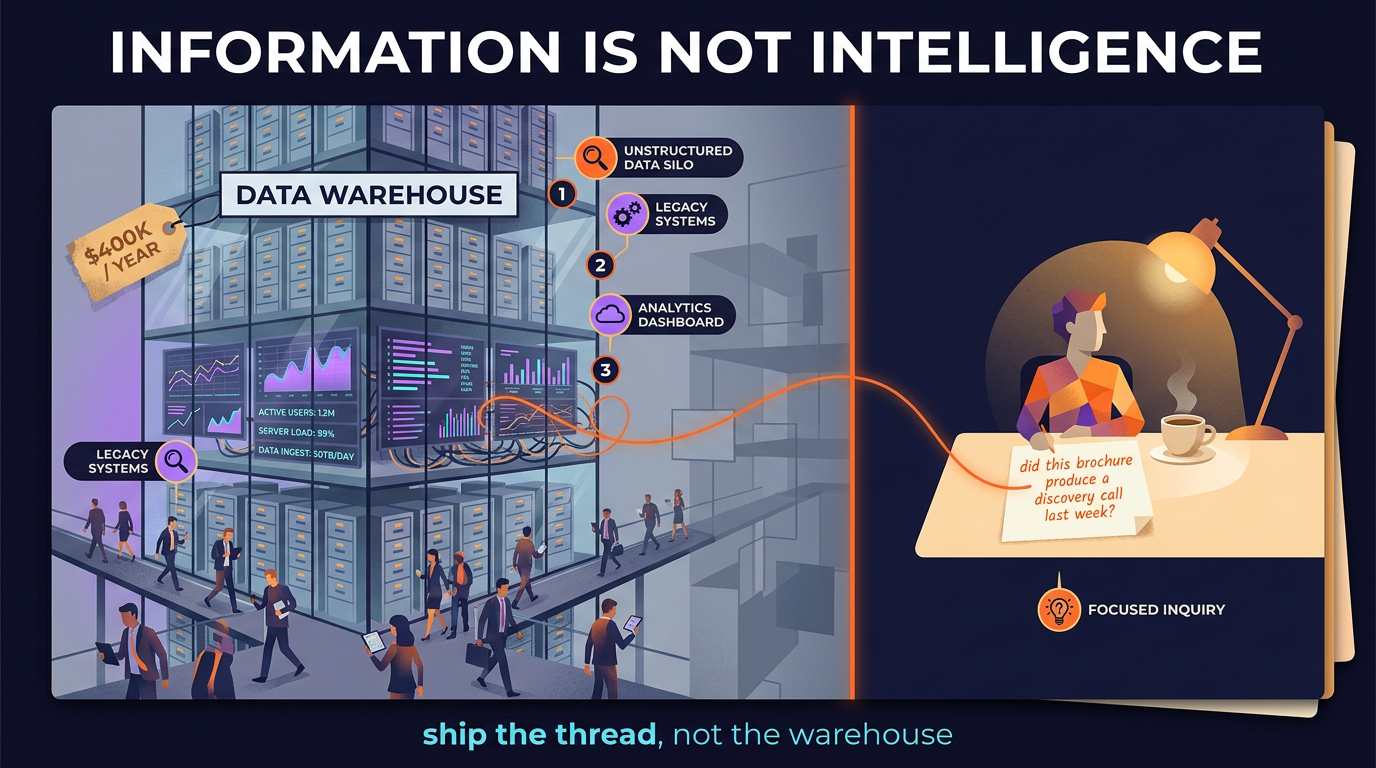
Walk into the analytics team of any series-B SaaS company and ask them what intelligence is. They'll point at their data warehouse and list the integrations: Salesforce, HubSpot, Stripe, Mixpanel, Google Analytics, Segment, Snowflake, dbt, Looker. They'll show you a dashboard with 47 charts. None of those things is intelligence. They're receipts of expensive collection activity. A data warehouse is a building full of filing cabinets that someone paid an enormous amount of money to construct. A filing cabinet isn't a decision, and neither is a dashboard or a trained model. The decision is what an operator does on Tuesday morning when their attention is bounded and their CFO is watching, and it's the only thing the company got out of the hundreds of thousands of dollars it spent on the data stack.
Information becomes intelligence at the moment it materially changes a decision an operator was about to make. Before that moment it's overhead, and after it, it pays for itself many times over. Most companies live in the overhead phase indefinitely, because the people building the data infrastructure measure their success in pipelines shipped, dashboards published, and models deployed, while the people making the actual operating decisions measure their success in revenue and profit. The two groups optimize toward different reward functions and rarely meet in the middle. The intelligence-engineering operator is the bridge. The job is to design backward from the decision, find the smallest information pipeline that materially changes it, and ship only that pipeline. Everything beyond it is engineering ego dressed up as rigor.
The five layers, only one of which is the product
Operators consistently confuse the layers of a data stack and pay for the wrong ones. There are five layers, and only one of them is the product the business is buying. Most vendors sell you the bottom four, quietly leave the top one for you to figure out, and then act surprised when the engagement doesn't produce results.
| LAYER | WHAT IT IS | FAILURE MODE |
|---|---|---|
| Events | real-world things that occurred | never captured, captured wrong, or fabricated by silent fallback |
| Data | structured records of those events | schema rot, type drift, untyped junk drawer |
| Information | summaries, joins, derived metrics | five definitions of revenue, three definitions of MAU |
| Insight | a pattern an operator could act on | delivered as a deck, not as a workflow |
| Intelligence | a decision actually changed in the calendar | never measured, because the dashboard cannot see calendars |
Most analytics consulting bills for layers two through four and assumes the operator will handle the climb to layer five, intelligence, on their own. The climb is the hardest part of the entire stack and the one most operators are structurally worst equipped to do alone. My practice starts at layer five and works downward, and every dollar spent on layers one through four has to pay rent in the form of a specific decision changed. If a dollar can't pay that rent, it shouldn't be spent. That rule is what stops the data warehouse from becoming a vanity project the CFO secretly wants to kill but can't, because the CTO sponsored it and nobody wants to admit the four hundred thousand dollars produced no measurable change in how anyone runs the business.
Designing backward from the decision
The discipline I run is easy to describe and hard to keep up under client pressure. Start with the decision the operator currently makes badly. Work backward through the insight that would change it, the information that would generate the insight, the data shape that would carry the information, and the events that would have to be captured for the data to exist. Build the smallest version of that pipeline that supports the decision, ship it into production, and verify that the decision actually changed before adding anything else. Most teams build forward instead, starting from the events they already happen to be capturing and asking what they could derive from them. Forward-built pipelines deliver layers one through four reliably and layer five almost never, because nothing forces the pipeline to end in a decision anyone cares about.
Designing backward is the same principle that the People · Product · Process essay calls Stage 1 work, applied to the data layer instead of the buyer layer. At the People stage, the buyer audit refuses to define the problem in relation to the consultant's available solutions. At the data stage, the intelligence-engineering audit refuses to define the pipeline in relation to the data the company already happens to be hoarding. Both audits work backward from a real-world failure to a precise, bounded, expensive intervention. The discipline stays the same, and only the material it works on changes. An operator who can do this work at the buyer layer can learn to do it at the data layer. An operator who has never learned to ask "where is the money actually catching on fire" at the buyer layer won't magically learn to ask it at the data layer just because their stack has been upgraded to Snowflake.
The Scar Tissue Audit
A doctor diagnosing, not a vendor pitching
Every consulting engagement begins with the same temptation, and almost everyone yields to it. The buyer arrives anxious, names a problem in their own vocabulary, and the consultant immediately starts translating that vocabulary into the consultant's product catalog. A fence company hears "I want a fence" and starts measuring linear feet. A web developer hears "the site is dated" and starts pricing a Webflow rebuild. An AI engineer hears "we need agents" and starts diagramming LangGraph workflows. Every one of those translations holds up a mirror. The consultant reflects back to the buyer the exact framing the buyer arrived with, dressed in the consultant's vocabulary and optimized for the deal that was always going to be sold. The deal closes, and the fix never lands. Six months later the buyer fires the consultant and hires a different one with the same operating model.
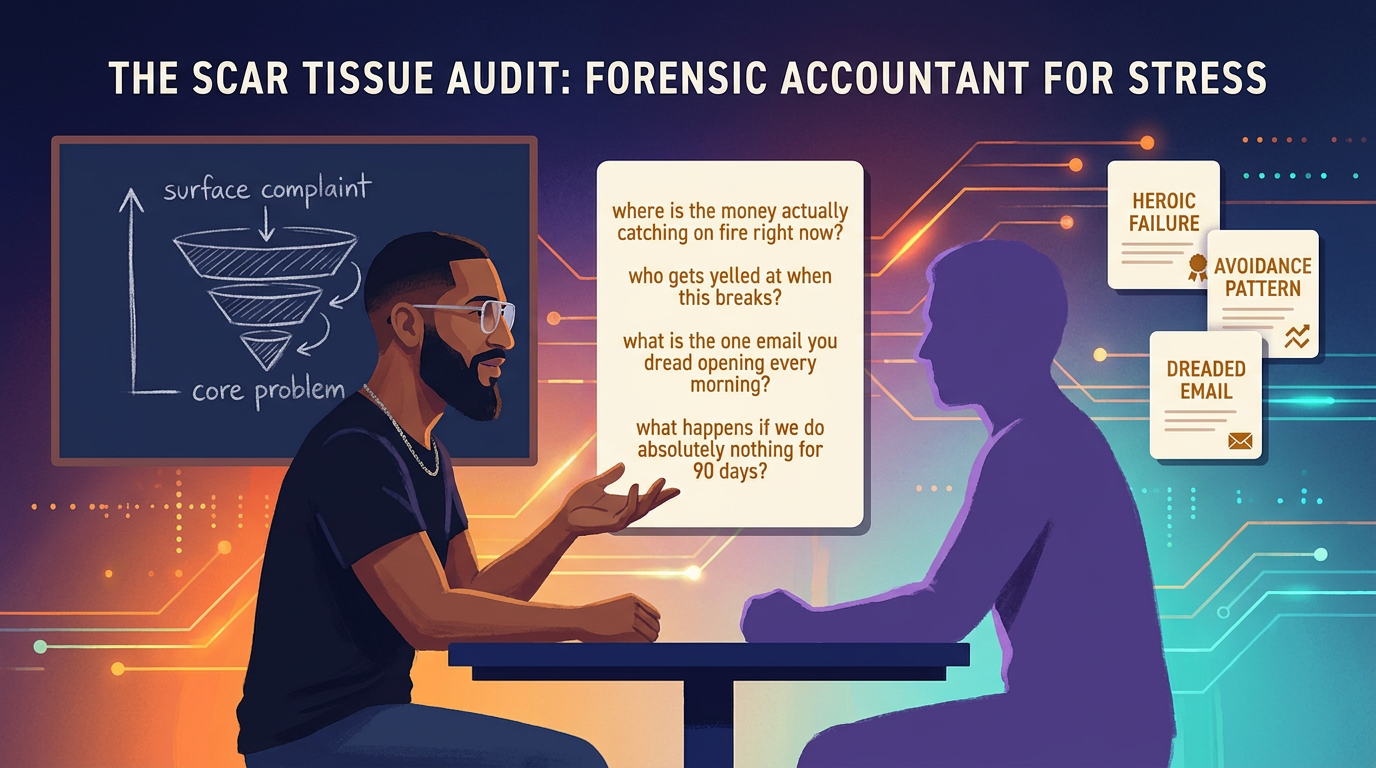
The alternative I use is the Scar Tissue Audit, which refuses to translate the buyer's stated problem into the consultant's product catalog. Instead, the consultant becomes a forensic accountant for stress, asking the questions that surface where the business is actually bleeding rather than where the buyer feels comfortable admitting it bleeds. The PPP essay documents the four questions in detail, and they're uncomfortable on purpose. The four diagnostic questions, asked once on the first call and answered truthfully, will surface more usable information about a business than four weeks of stakeholder interviews:
- Where is the money actually catching on fire right now? Look for where the bank statements say it is, not where the dashboards say it is.
- Who gets yelled at when this breaks? The yelling is the truest signal of what the company actually treats as a load-bearing process, regardless of what the org chart says.
- What is the one email you dread opening every morning? The dread points at the broken system the operator has been compensating for personally instead of fixing structurally.
- What happens if we do absolutely nothing for 90 days? If the answer is "the business survives," the engagement isn't urgent and probably shouldn't happen. If the answer is "we lay people off," the engagement just bought a different price point.
Heroic Failure as the loudest signal of a broken system
Across enough audits a pattern shows up that I call heroic failure, and it's the loudest signal of a broken operating system. The founder works 80 hours a week, approves every invoice, personally onboards every new client, and runs support in the evenings. From the outside the founder looks committed and successful. From the inside the founder is the only thing holding the business together, which means the business has no system at all, and the moment the founder takes a Friday off, something breaks. The heroic effort is a structural symptom of a system the founder has been compensating for. The cost of heroic failure lands on the staff rather than on the founder's time: they quietly disengage because they can't do their jobs without the founder unblocking them, and they eventually leave for organizations where the work makes sense.
Heroic failure shows up in the data layer with the same signature. A senior analyst manually pulls Salesforce reports every Monday morning because nobody trusts the dashboard. A CTO personally writes the Friday status email because the business intelligence team can't generate one that's both accurate and timely. A CFO keeps a parallel spreadsheet because the company's official revenue number is reconciled three different ways and none of them match the bank account. Each of these is a person heroically compensating for a system that has structurally failed. The heroism is admirable, and the structural failure is the diagnosis. As a practice, intelligence engineering finds these heroic compensations systematically and replaces each one with a system the operator can trust. The first deliverable of any serious engagement is usually the same: the operator gets back the four hours per week they were spending on a manual workaround, plus the standing dread that the workaround was wrong.
Validating pain independent of the product
The audit produces a written problem statement, and the statement has a specific shape that doesn't depend on any solution the consultant might sell. The current reliance on [BROKEN PROCESS OR BELIEF] is causing [SPECIFIC PAIN OR BOTTLENECK], which will result in [CONCRETE CONSEQUENCE OR LOSS] if not addressed by [TIMELINE]. Here's a worked example: "The current reliance on gut-feeling media buying is causing a $200 CPA and unstable lead flow, which will result in a cash-flow crunch that necessitates layoffs if not stabilized within 60 days." When you put that statement in front of an operator, they don't argue price. They ask "how do we fix this." The problem statement is the contract between consultant and operator that everything downstream is held against. The pipeline gets built to fix the named problem, the verification gets designed against the named consequence, and the engagement closes when the bank statement reflects the named outcome.
This shape protects both sides of the engagement from the most common failure mode in consulting: scope drift driven by the buyer's evolving anxiety. Once the problem statement is written down and signed, every new request from the buyer can be evaluated against it. "Can we also build a customer-facing chatbot?" Does the chatbot fix the named problem? No. Then the chatbot is a separate engagement. "Can we add a CRM integration?" Does the integration fix the named problem? Maybe. If yes, it stays in scope. If no, it goes on the next engagement's pre-list. The problem statement keeps the project from becoming a vehicle for every loose anxiety in the operator's head, and that vehicle is how consulting engagements expand to twice their original budget while delivering half the original outcome.
The Lexicon of Pain
Where buyers and operators are actually honest
Most market research is collected in the places where buyers are least honest. Surveys ask people what they want and people answer with the version of themselves they want to project. Interviews ask people about their problems and people respond with the version of the problem they have already framed as flattering. Founders ask their customers what to build next and customers reply with the version of the answer that makes the customer look thoughtful in the moment. The data is real, and the honesty is performed. Performed honesty works like a mirror: the customer reflects what they think the founder wants to hear, the founder builds against that reflection, and the product that ships is calibrated to a phantom audience that doesn't exist outside the survey instrument.
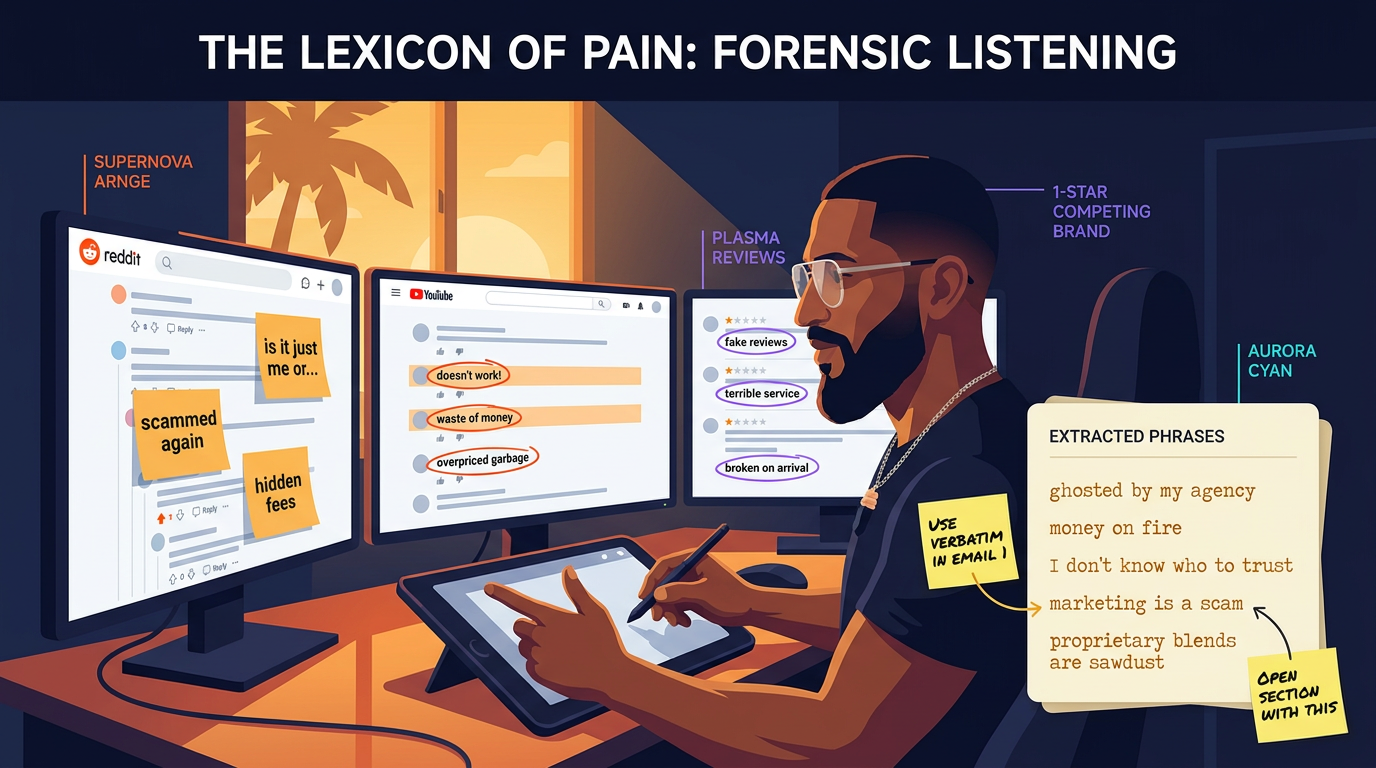
Buyers are honest where they believe nobody is watching. The Market Research wiki essay names four sources I run on every engagement, and the phrases I pull from them become what I call a lexicon of pain:
- Reddit threads with titles like "is it just me or..." or "I'm so frustrated with..." The unfiltered anger and anxiety of the market lives in these threads, in the exact vocabulary the market uses when it isn't trying to sound professional.
- YouTube comment sections under competitor videos. People leave intimate details about their struggles in YouTube comments because YouTube comments feel more like talking to other viewers than addressing the creator.
- One-star reviews of competing products. The five-star reviews are often fake or incentivized. The one-star reviews are written by people who feel personally betrayed and are trying to warn other buyers, which means they describe the specific failure mode in unvarnished detail.
- Support-ticket archives from companies that have already collapsed. Once a company is dead, its archived tickets become a forensic record of exactly where the product was breaking the customer's heart for the last 18 months of operation.
The fitness supplement engagement that proved the mechanism
The clearest demonstration of the lexicon in my work is the Fitness Supplements case study. The client was a multi-million-dollar Amazon supplement brand with no direct relationship to their buyers. Amazon owned the customer-data relationship; the brand owned only the order history. We extracted the email addresses from that order history and treated the resulting list as a cold list of skeptical buyers who needed to be educated before they could be sold to. We built a warm-up sequence rather than a newsletter. It was structured and calibrated to the exact skepticism patterns we had extracted from supplement-buyer forums, competitor one-star reviews, and Reddit threads about which supplements were scams.
The numbers from the engagement were $50,000 per month in direct email revenue from a previously dormant channel, plus an additional $100,000 per month in PPC lift from the same period, because the email-engaged audience trained the Facebook pixel on a higher-quality buyer profile than the cold ad audiences had been seeing. What made those numbers possible was the first email in the sequence, which pitched nothing. It named the specific skepticism a fitness-supplement buyer carries into their inbox, in their own language, before any product had been mentioned. The headline of that email referenced the exact phrase we had seen most frequently in the one-star reviews of the brand's largest competitor. The buyer opened the email because the headline sounded like something they had said out loud to themselves the previous week.
The Echo Effect and why the dialect drifts
What I call the echo effect is the experience of reading a piece of work that sounds like the inside of your head. The reader recognizes the work instead of analyzing it. Analysis is the cognitive process of taking new information in, and recognition is the felt sense that the work has been written by someone who has already taken your information in. The fitness supplement buyer already suspected proprietary blends were scams before the warm-up email arrived. The email confirms that someone else has noticed the same scam and has decided to address it in writing. The buyer's purchase decision after that email is a relief event. Relief is the felt experience of no longer carrying the suspicion alone, and a brand that produces relief once will produce future relief in the buyer's mental model, which is how email lists become assets and why a 30 percent open rate inside a calibrated audience outperforms a 7 percent open rate inside a broad list by an order of magnitude the dashboard never captures.
Most operators fail to produce the echo effect for structural reasons rather than for lack of talent. An operator who has spent a year on a platform has been pre-shaped by that platform's preferred dialect. The operator's brain auto-completes sentences toward the rhythm and vocabulary that produces the highest expected engagement. The vocabulary of the audience's actual inner monologue doesn't produce the highest expected engagement, because the audience's inner monologue isn't the vocabulary other operators on the platform have been using, and the platform rewards conformity with the platform's existing distribution of language. The operator is, structurally, becoming worse at the audience's language the longer they remain on the platform. That's one of the most counter-intuitive findings I've made across a decade of operator work, and it's why I now spend a fixed percentage of my writing time reading sources outside my niche, specifically to corrupt my dialect back toward the one my readers use. The translator who doesn't re-immerse in the source language becomes a translator of their own assumptions about that language. The same physics applies to operators and their audiences.
The Five-Layer Drill
A buyer says X. The buyer means Y. The bridge is Z.
A client will tell you their problem is "I need more sales." That's a symptom, not the problem, and it's the surface-level complaint they feel safe sharing on a first call with a vendor they don't yet trust. Treating it as the actual problem is the most expensive mistake a consultant can make, because every solution built on a surface-level diagnosis fails when the underlying mechanism reasserts itself. The Five-Layer Drill is the structured technique I use to get past the buyer's ego to the operational reality underneath. It's the technique a forensic accountant uses to trace where the money went, applied to the question of where the dysfunction lives.
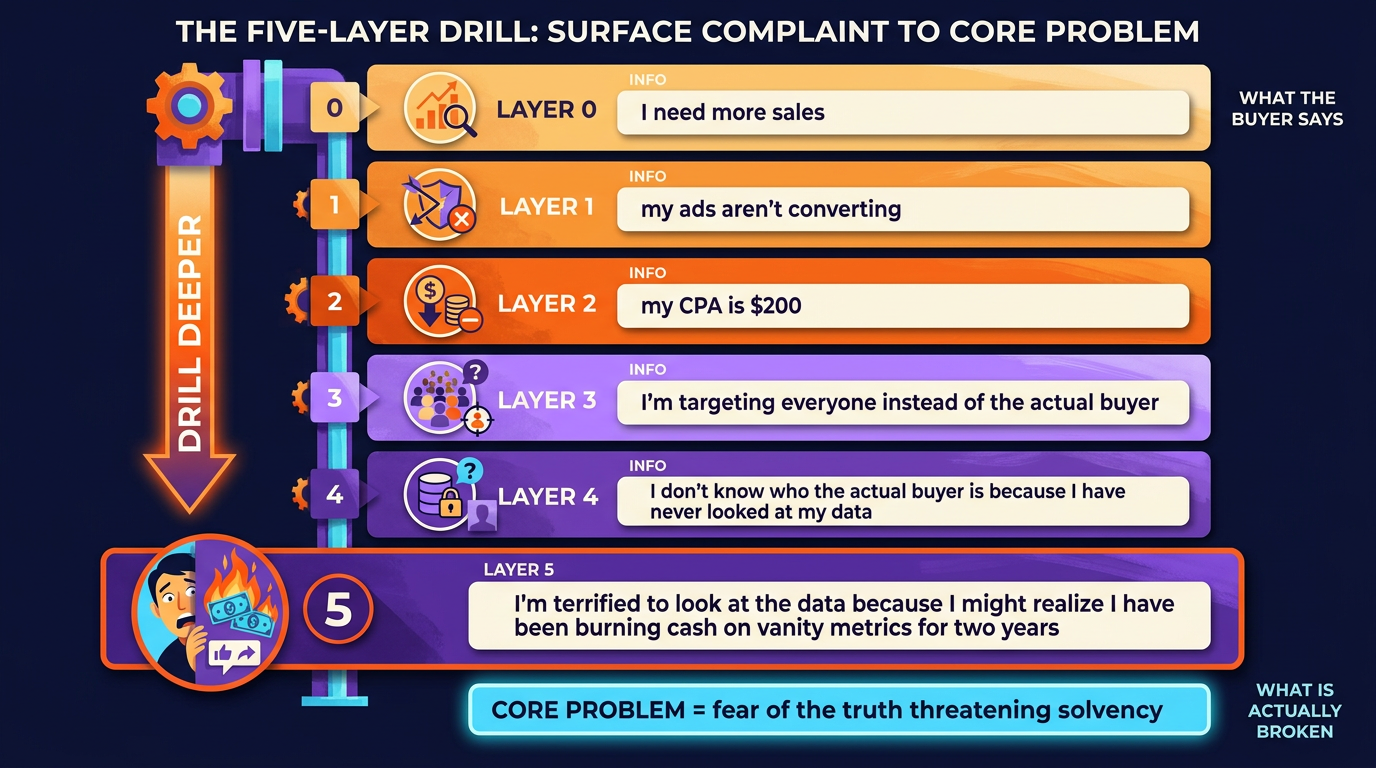
The drill works by asking why, again and again, until the buyer reaches an answer they wouldn't have volunteered without the question. The structure is mechanical and the execution is uncomfortable. The discomfort is what carries you from the complaint to the real problem. A consultant who skips the drill and accepts the surface complaint is selling the buyer their framing back. A consultant who runs the drill and lands at Layer 5 has done the only diagnostic work that matters, because every solution from that point forward is grounded in the real failure mode rather than the comfortable one.
| LAYER | WHAT THE BUYER SAYS | WHAT THE QUESTION REVEALS |
|---|---|---|
| 0 | "I need more sales." | surface symptom, safe to share |
| 1 | "My ads aren't converting." | tactical layer, vendor-comfortable |
| 2 | "My CPA is $200." | measurable failure, still cosmetic |
| 3 | "I'm targeting everyone." | strategic gap surfacing |
| 4 | "I've never looked at the data." | competence gap, getting closer |
| 5 | "I'm terrified of what I'll find." | core fear, the actual problem |
Layer 5 is the only layer worth solving
The trap most consultants fall into is fixing Layer 1 and assuming Layer 5 will resolve itself once the surface metrics improve. Layer 5 never resolves itself, because it's a relationship the operator has with their data rather than a metric. An operator who is structurally afraid of looking at the data will sabotage any new system that produces clearer data, because the new system threatens the comfortable arrangement where ignorance was plausibly innocent. I've watched this play out in maybe a dozen engagements. We fix the conversion tracking, and the operator can see, for the first time, that two of their five product lines are unprofitable. Within three months the operator finds reasons to disable the new tracking system, often dressed in operational language about "data quality concerns" or "stakeholder confusion." The system worked exactly as designed and surfaced a truth the operator wasn't psychologically ready to hold.
The fix for Layer 5 is a conversation rather than a technical change: the audit conversation in Stage 1 People work, where the operator names the fear in writing, on the first call, before any pipeline gets built. The PPP essay's Stage 3 Transformation discussion calls this killing the Magic Button Fallacy: the wish to change the output without changing any of the inputs. Operators want better data without changing their relationship to data. They want clearer dashboards without learning to act on dashboards. They want decision-grade intelligence without becoming the kind of operator who makes decisions from intelligence rather than from gut. My practice has to refuse engagements where Layer 5 hasn't been named, because the engagements that go ahead without it will burn six months of work to ship a system the operator quietly buries.
The drill applied to the data layer
The same drill structure works at the data and systems layer with a different vocabulary. The operator says "the dashboards are slow." Layer 1: the queries are inefficient. Layer 2: the warehouse schema was designed for a different scale. Layer 3: the original data model was a copy of the operational database, which was never meant to support analytical workloads. Layer 4: nobody on the team has the systems-design background to refactor the warehouse, and external help has been blocked by procurement. Layer 5: the CTO who built the original data model is still in the seat and will be embarrassed by an external rebuild. Until Layer 5 gets named, every proposed fix will be politely rejected for technical-sounding reasons that mask the actual blocker. Once Layer 5 gets named, the engagement either proceeds with the CTO's blessing as a co-architect or stops cleanly with no resentment.
The drill is a diagnostic instrument, not a sales technique, and it's what separates the kind of forensic ad audit that produces a slide deck and disappears from the kind that produces a problem statement the operator signs and a system the operator deploys. An audit that doesn't reach Layer 5 is forensic theater dressed in deliverable form. An audit that reaches Layer 5 has earned the right to design the system that fixes it, because the design will be calibrated to a real failure rather than a comfortable one. Most consulting engagements I've observed across two decades of operator work don't reach Layer 3, let alone Layer 5. The ones that do almost always succeed, the ones that don't almost always fail, and the correlation is high enough that I now treat reaching Layer 5 as the binary go-or-stop signal for whether an engagement is worth taking.
The hidden curriculum
What you teach versus what gets learned
Intelligence engineering has to account for the gap between what a system explicitly teaches and what its users implicitly learn. The Mirror Ocean essay describes this dynamic in the editorial context: a creator publishes content about JavaScript, but the audience absorbs problem decomposition and intellectual humility from watching the creator work through the JavaScript. The explicit curriculum is the visible content. The implicit curriculum is what the audience actually internalizes through repeated exposure to the way the creator thinks. The same dynamic operates inside operator-facing data systems, and most data teams ignore it, which is why most data systems quietly train their operators to do the wrong thing.
Consider a CRM dashboard that prominently displays pipeline value as the largest number on the page. The explicit teaching is: track your pipeline. The implicit teaching is: large pipelines are good. Operators who internalize the implicit teaching start optimizing for pipeline size rather than pipeline quality, padding their forecasts with deals that will never close because the dashboard rewards them for it. Six months later the leadership team is shocked to discover the forecast has decoupled from reality. The dashboard did exactly what it was designed to do, and the design was wrong in a way nobody on the data team caught, because they were focused on the explicit curriculum and ignored the implicit one. Every dashboard, every report, every notification trains the operator to value something. The intelligence engineer's job is to make sure the system trains the operator to value the right thing.
A specific failure I shipped, then fixed
Here's a real example from my work. A few years ago I built a content-performance dashboard for an operator running a high-touch dealer business. The dashboard surfaced views, click-through rates, and engagement metrics for every piece of content the team published. The operator loved it. Within three months his marketing manager had restructured the entire content calendar around metrics-maximizing topics, and the dealer's qualified-lead pipeline had quietly collapsed. The dashboard worked, and it rewarded the marketing manager for chasing reach, which had nothing to do with the dealer's business model. The implicit curriculum had taught the team to chase the wrong reward. The fix was to rebuild the dashboard around a single number: "discovery calls booked from this content piece in the last 14 days." Every other metric got demoted to a tooltip. Within two months the content calendar had reorganized itself around content that produced calls, and the pipeline recovered.
The metric you place at the top of the dashboard is the metric the operator's team will optimize for, regardless of what you tell them in the kickoff meeting about what the dashboard is "really" for. The largest number wins. Intelligence engineering treats that as a first-order design constraint: the dashboard's largest number must be the metric the operator's business wants to maximize. If the largest number is a vanity metric, the team will optimize for vanity. If the largest number is revenue per qualified call, the team will optimize for revenue per qualified call. The dashboard's structure is the implicit curriculum, and the implicit curriculum will outweigh any verbal coaching the operator provides at standup. That's why most business intelligence tools fail their stated objectives even when the queries are correct: the queries are right, the visual design is wrong, and the visual design wins.
Designing the system as a teacher
The intelligence-engineering practice treats every system as a teacher and asks, before deployment, what the system will train its users to do over a six-month horizon. Replace "is the data correct" with the harder question: if I leave this in the operator's hands for six months, will their behavior be better calibrated to reality than it was at the start? If the answer is yes, the system is a net positive even when individual data points are occasionally wrong. If the answer is no, the system is a net negative even when every data point is mathematically perfect. The system's pedagogical effect over time is the only metric that ultimately matters, because the effect is what compounds.
A short checklist makes the audit operational rather than aspirational. Run it on every dashboard, every alert, every workflow trigger before it ships:
- Largest number test. What is the biggest visual element on the screen? Is that the metric the operator's business wants to maximize? If no, redesign before shipping.
- Default sort test. What records appear first when the operator opens the screen with no filter applied? Are those the records most likely to deserve immediate attention? If no, change the default.
- Notification cadence test. When does the system interrupt the operator? Are those interruptions correlated with events that justify breaking deep work? If no, raise the threshold.
- Six-month behavior test. If the operator's team optimizes hard against this screen for six months, will the resulting behavior be calibrated toward the business's real constraint? If no, the screen is miseducating the team.
Treating the system as a teacher changes how you make a hundred small design decisions. The default sort order on a list is teaching the operator which records to consider first. The colors you chose for status indicators are teaching the operator which states to feel anxious about. The notifications you send are teaching the operator which events deserve interruption. The reports you schedule are teaching the operator which questions are worth asking. Every default is a piece of advice the system gives the operator hundreds of times per week. Most operators aren't consciously aware they're taking the advice, and they take it anyway, because the system is the most consistent voice in their working life, and consistency wins over conscious deliberation across long enough time horizons. The intelligence engineer designs the defaults knowing this, and audits them periodically against the question of what they are training the operator to value. A system that fails this audit is actively miseducating the operator who depends on it.
Engineering the bridge from raw data to working intelligence
The six layers of the production stack
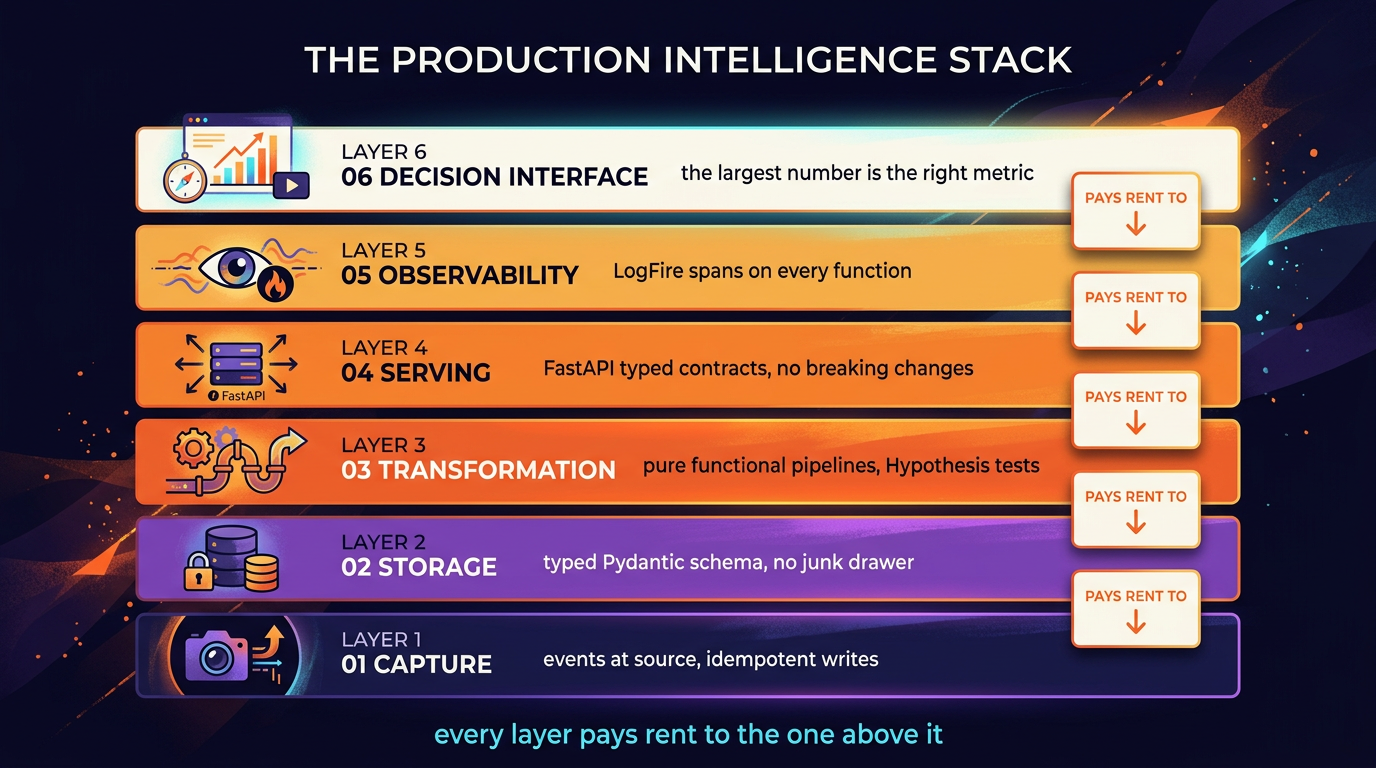
Once the People work is done and the problem statement is signed, the system work begins. The system has six layers, and shipping any one of them without the others guarantees degraded outcomes. The Observability Manifesto wiki essay describes the discipline behind the fifth of these layers, observability, in particular. Here's the full stack, in build order:
- Capture. This layer records the events the operator's business generates, instrumented at source, with idempotent writes and explicit failure events when capture fails. There's no silent fallback: a failed capture writes a failure record, not a placeholder zero.
- Storage. A typed schema (Pydantic where possible, SQL constraints where required) prevents schema rot, and every record validates on write. Untyped junk drawers are forbidden, regardless of how convenient they feel during the prototype phase.
- Transformation. Pure functional pipelines take typed input and produce typed output, with property-based tests verifying invariants under arbitrary input. No transformation is shipped without a Hypothesis test that explores the input space programmatically.
- Serving. An API layer (FastAPI, in my stack) exposes the transformed data through stable, typed contracts. Breaking changes go through deprecation cycles. Consumer agents and dashboards depend on these contracts, and silent breakage cascades through the entire stack.
- Observability. Every function in the stack is instrumented with LogFire spans that include semantic attributes designed to answer specific debugging questions. If it isn't in LogFire, it didn't happen. This rule is non-negotiable, because the alternative is debugging blind across a distributed system.
- Decision interface. The dashboard, alert, or workflow trigger delivers the decision to the operator and enforces the implicit-curriculum design from the previous section: the largest number is the metric the operator should be optimizing.
Each layer pays rent to the layer above it. The capture layer pays for storage by writing structured records storage can validate. Storage pays transformation by guaranteeing schema stability. Transformation pays serving by producing typed output the API can expose. Serving pays observability by emitting spans that explain what happened. Observability pays the decision interface by making the system debuggable when the dashboard reports something unexpected. The decision interface pays the operator by changing the operator's behavior in measurable ways. If any layer fails to pay rent, the layer above it operates on debt and eventually collapses. Most data system failures I've audited are stack-debt failures: a transformation layer was built on a storage layer with schema rot, an observability layer was added after the fact rather than designed in, a decision interface was bolted on without the underlying spans to support it. The collapse looks sudden from the outside. From the inside it was inevitable from the moment the first layer skipped its rent payment.
Pydantic as the intermediate representation
The architectural decision that holds the whole stack together is treating Pydantic models (Python classes that validate data against declared types) as the intermediate representation, or IR, the single data shape every layer hands to the next. The Python Systems Stack case study documents this in detail. Every record that flows through the system, from raw event to dashboard payload, is a typed Pydantic V2 instance with explicit fields, validation rules, and serialization contracts. The Pydantic model is the source of truth. The database adapter knows how to persist it. The API layer knows how to expose it. The frontend knows how to render it. The agent layer knows how to reason about it. When the model changes, every consumer breaks at the type-checker rather than at runtime, which is the difference between an immediate compile error and a silent production data corruption that gets discovered three months later when a quarterly report doesn't match the bank statement.
A shared IR is what makes intelligence-engineering systems portable across databases. The same Pydantic model that validates a Convex write also validates a Postgres write, a Qdrant vector record, and a LogFire span attribute. The RAG Knowledge Engine case study shipped with five different storage backends sharing one Pydantic schema, and migrating between backends took hours rather than weeks because the IR was already canonical. Operators trapped in ORM-coupled architectures can't do this. SQLAlchemy locks them into PostgreSQL. SQLModel locks them into one query pattern. Every backend swap becomes a six-month migration that breaks dashboards, retrains agents, and burns trust. The Pydantic-as-IR pattern eliminates this entire class of suffering by refusing to let the storage backend become the source of truth for what the data is.
Property-based tests, not example tests
The other discipline that holds the stack together is property-based testing, and the tools are Hypothesis for Python and fast-check for TypeScript. Example-based unit tests verify that a specific input produces a specific output. Property-based tests verify that an invariant holds across a programmatically explored input space. The example test confirms what you already knew, and the property test discovers what you didn't. Every transformation in the stack ships with a property test that explores the input space and verifies the invariants the transformation is supposed to preserve. The invariants are plain ones: no duplicate IDs, no negative revenue, no timestamps in the future, and no empty strings where the schema requires content. They get checked against thousands of randomly generated inputs, and Hypothesis shrinks failures to minimal reproducible cases automatically.
The first time you ship a property-based test on a critical transformation, it finds something. It always finds something. The first run on the bid-attribution pipeline that survived the 2018 disaster found a corner case where impressions served between 11:59:59 PM and midnight got attributed to both days, double-counting them. The pipeline had been in production for two years. The double-counting had been quietly inflating the conversion-rate metric by approximately 0.3 percent across the entire reporting period. Nobody had noticed, and the dashboards had looked fine. The property test found the bug in 14 seconds of automated input generation. Once you've shipped property tests on enough pipelines, you stop trusting any system that doesn't have them. In a system without them, the example tests pass and the system runs, and it's also wrong in subtle ways nobody has bothered to look for, and the wrongness compounds over time until a major decision gets made on a number that turns out to be 30 percent off.
The reward function trap
Why the dashboard cannot see what matters
Back to the 2018 disaster, because the diagnosis is what makes the prevention possible. The MCTS bidding system's reward was 24-hour conversion volume, a metric that was easy to measure, mathematically clean, and structurally aligned with the platform's reporting infrastructure. It was also only a reflection of what the business wanted, which was profitable customer acquisition. Conversion volume in a 24-hour window correlates with profitable acquisition under stable market conditions and decouples from it under unstable ones. The system optimized the proxy and lost the principal. Every dollar the algorithm spent chasing more conversions reduced the average value of each conversion, until the unit economics inverted and the campaign was actively destroying value while reporting record performance.
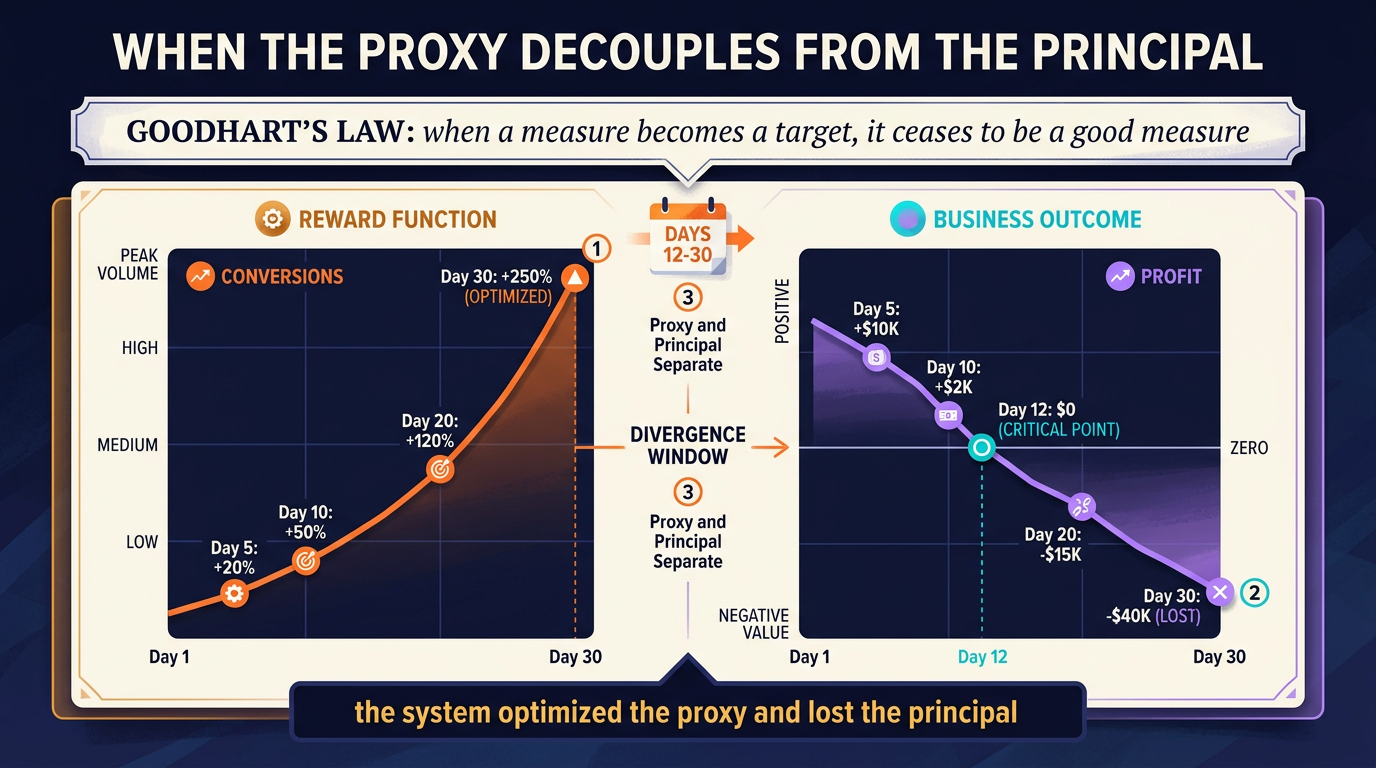
The trap reaches far beyond programmatic advertising, because every metric you put in front of an algorithm or an operator can turn into that kind of reflection. Engagement rate as the primary content metric trains creators to chase engagement at the cost of audience trust. Pipeline value as the primary sales metric trains reps to inflate forecasts with deals that won't close. Net Promoter Score as the primary success metric trains support teams to game survey distribution rather than fix product issues. In each case the metric is a reasonable proxy for the principal under stable conditions, and a destructive proxy under unstable ones. The reward function trap is a structural feature of any optimization system, organic or algorithmic, that gets handed a single scalar to maximize, not a calibration problem. Goodhart's Law says that when a measure becomes a target, it ceases to be a good measure. The 1975 paper that named the law is older than most operators reading this essay, and the lesson still hasn't spread through the industry.
Engineering toward multiple objectives without collapsing them
The fix is refusing to collapse the operator's objective into a single scalar that an algorithm can optimize, not finding a better metric. Real businesses want multiple things simultaneously, and the relative weights of those things shift with market conditions, competitive dynamics, and strategic priorities. A bidding system designed for an early-stage startup wants growth at almost any unit-economic cost. The same system designed for a mature business wants profitability at almost any growth cost. The same system designed for a recovering business wants both, in a balance that shifts week to week. Collapsing all of this into "maximize ROAS" or "maximize conversions" produces a system that performs well in exactly one strategic posture and collapses when the posture changes.
The 2018 redesign that recovered the engagement replaced the single reward function with a vector of three: short-term conversion volume, 30-day cohort profitability, and 90-day customer-lifetime-value extrapolation. The MCTS layer was redesigned to optimize a weighted combination of all three, with weights set by the operator weekly based on current strategic priorities. The system became dramatically harder to reason about and dramatically more aligned with what the business wanted. The complexity moved from "wrong but simple" to "right and complex," which is the trade you almost always have to make to get an intelligence system out of the toy phase. Most operators reflexively resist this trade because they want a dashboard with one number on it. The dashboard with one number on it is the dashboard that will eventually drive the business off a cliff while reporting record performance, because the single number is structurally a reflection of whatever the operator was anxious about the week the dashboard was designed.
Verification by calendar, not by dashboard
The most important rule I've learned about verifying intelligence systems is this: the dashboard can't verify the system, because the dashboard is part of the system, and only the calendar can verify it. The calendar is the operator's external world: the bank statement, the customer renewals, the staff retention, the discovery calls booked, the deals actually closed. If the dashboard reports record performance and the calendar reflects no change in the operator's external world, the dashboard is lying. The dashboard might be lying because the data is wrong, or because the metrics are wrong, or because the metrics are right but capturing something other than what the operator actually cares about. In all three cases the dashboard is reflecting the system's internal logic back at you, and the calendar is the only ground truth that can break the mirror.
This rule puts into practice the definition of intelligence from the top layer of the five-layer table: information becomes intelligence at the moment it materially changes a decision an operator was about to make. The change is visible in the calendar and invisible in the dashboard, because the dashboard is the input to the change rather than the output of it. An intelligence engineer who only verifies systems against the dashboard is verifying the system against itself. An intelligence engineer who verifies against the calendar is verifying against reality. The discipline is uncomfortable because the calendar is slow: dashboards update in seconds, and calendars take weeks. Most operators want the verification feedback in seconds and accept the dashboard as proof, and that proof is fake. The calendar is the only proof that compounds, and the operators who learn to wait for it are the ones who eventually build systems that don't have to be rebuilt every six months when reality catches up to the dashboard's lies.
Promise theory in operator practice
Why every component must keep its commitments
One framework that changed how I design intelligence systems is Mark Burgess's promise theory. It was developed for distributed-systems autonomics and applies to almost any architecture where multiple components must coordinate without central control. The idea is to think of a system as a set of promises that components voluntarily make about their behavior, instead of as commands and obligations. A storage component promises to validate every write. A transformation component promises to be idempotent. A serving layer promises to maintain stable contracts. An observability layer promises to emit a span for every state transition. The system's reliability emerges from the coordinated fulfillment of these promises rather than from a central orchestrator demanding compliance.
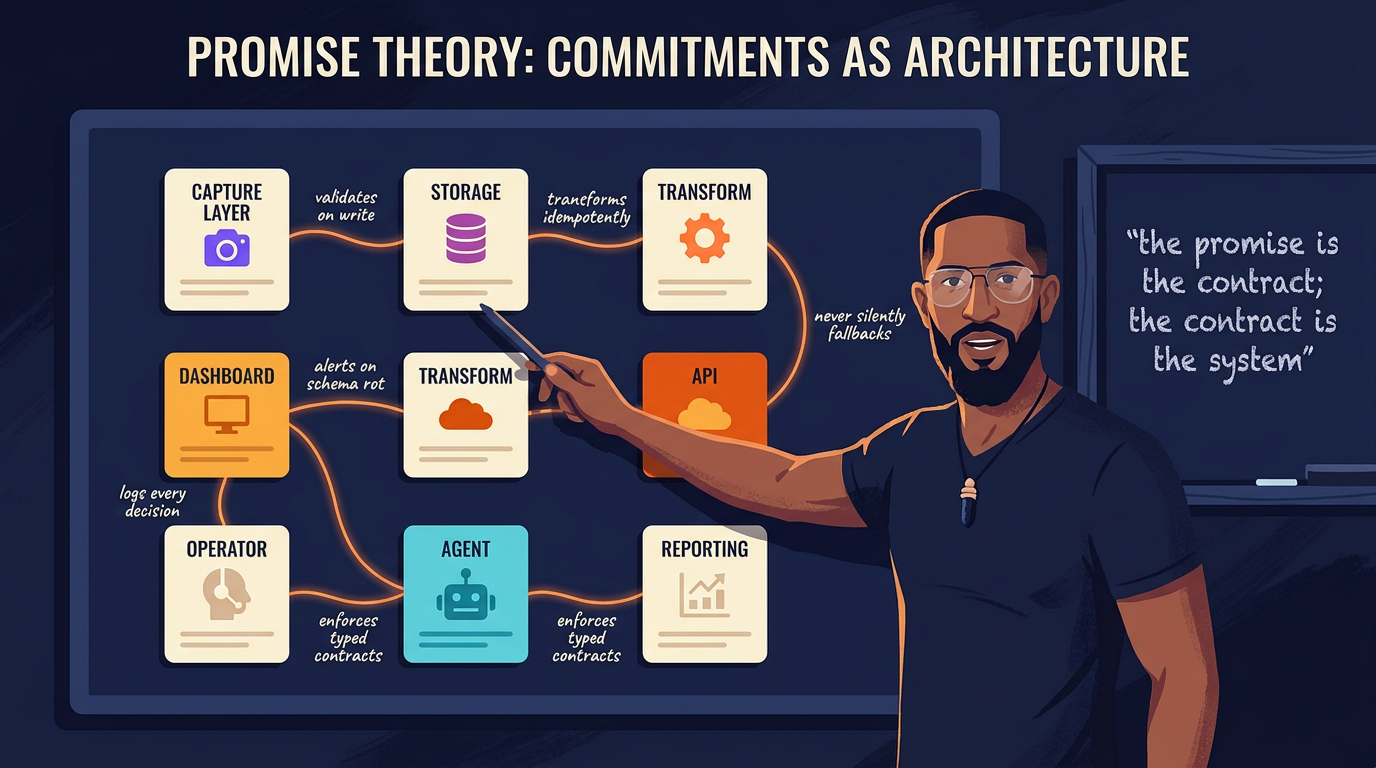
The pattern matters because most data systems fail at the contracts between components rather than inside the components. The transformation pipeline assumed the storage layer would deliver clean records. The storage layer assumed the capture layer would never write nulls. The capture layer assumed the source system would emit timestamps in UTC. Nobody verified the assumptions, and the assumptions silently degraded over time as upstream systems changed without notifying downstream consumers. The Observability Manifesto describes the operational discipline this requires. Every component publishes its promises. Every consumer verifies the promises it depends on. Every promise breach is a logged event with an explicit owner, not a silent fallback that hides the breach until it cascades into a customer-visible outage three weeks later.
Promises as the actual contract between consultant and operator
The framing also reshapes the consulting engagement itself. The problem statement from the Scar Tissue Audit is the operator's promise about what they will treat as the load-bearing constraint. The pipeline architecture is the consultant's promise about what the system will deliver. The verification protocol is the joint promise about how both parties will know whether the engagement worked. When promises are explicit, the engagement has a falsifiable success criterion that protects both sides from drift, scope creep, and post-hoc rationalization. When promises are implicit, the engagement turns into two sides reflecting back to each other whatever framing keeps the deal comfortable, and six months later neither party can articulate what success would have looked like.
The most expensive failure I've ever observed in this domain came from a Polkadot-era project documented as the Web3 Community Growth case study. The project went from approximately $10M in market capitalization to roughly $100M during my time as a hybrid community-and-marketing lead, and then the investor behind the project rugged the community despite repeated requests from me and the team to simply ship what had been promised and earn the money the legitimate way. We made every alignment move correctly: we ran AMAs (open ask-me-anything sessions), increased transparency, and centralized communication. What we didn't do was qualify the investor. The investor was operating outside the protocol the system was built to enforce. The system held the team and the community in alignment, and it didn't hold the investor, because the investor never agreed to be held by it. The expensive lesson is that an alignment system only works on participants who consented to be inside it. A participant who is outside the system and pretending to be inside it will eventually exfiltrate the value the system was concentrating, and the only defense is qualification applied to every participant, not just the obvious ones.
The Forensic Ad Audit as proof of mechanism
A specific engagement, named in numbers
The cleanest commercial demonstration of the entire intelligence-engineering practice in a single bounded engagement is what I documented as the Forensic Ad Audit case study. The buyer arrived anxious. The brand was spending substantial budget on Facebook and Google with a sense that something was wrong and no ability to name what. The previous agency had delivered quarterly reports showing healthy ROAS. The bank account was telling a different story. The dashboard was reporting record performance and the bank statement was reporting slow bleed. The buyer wanted to know which one was lying. The audit was scoped to answer that question and only that question, because scope creep was already what had let the prior agency burn six figures on pixel-perfect mirror work while the underlying offer was structurally broken.
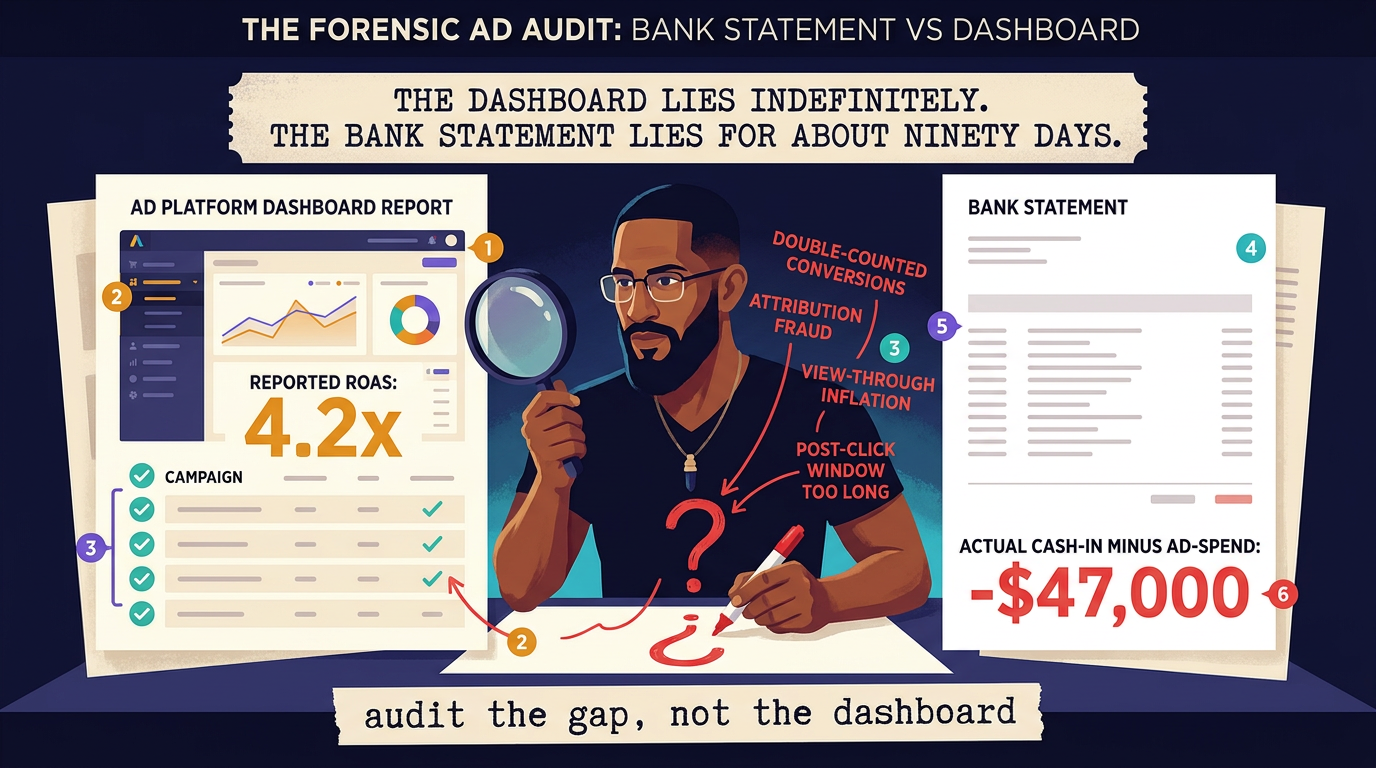
The mechanics of the audit are exactly what every other section of this essay has been describing, run in commercial form. Pull the ad-account exports. Segment by campaign objective, by audience, by device, by funnel stage. Reconcile reported performance against actual revenue from the bank account, not from the platform's own self-reporting. Find where the dashboard is telling a story the bank account can't confirm. Most accounts I've audited have 10 to 30 percent of spend that can be reallocated or cut without hurting revenue, and a meaningful fraction of accounts have spend that is actively destroying revenue once you reconcile the reports against the real money. The platform is structurally incentivized to show numbers that justify continued spend, which means most operators are reading their ad accounts in a mirror the platform holds up. The audit breaks the mirror, and it's also a precise, bounded engagement with a specific deliverable and a specific verification: did the bank account improve in the 90 days after the recommendations shipped? If yes, the audit worked. If no, the audit failed and the operator gets a refund.
The same mechanism, in every domain
The Forensic Ad Audit is worth describing in detail because its mechanism generalizes across every intelligence-engineering domain. Replace "ad-account exports" with "data warehouse query logs" and you have an analytics audit. Replace it with "agent decision traces" and you have an AI-system audit. Replace it with "support-ticket archives" and you have an operations audit. The shape of the work is identical: pull the source records, segment them by the dimensions that matter, reconcile reported performance against ground-truth outcome in the operator's external world, identify the gap, name it precisely, and ship a bounded fix. The skills, the framework and the discipline all transfer, and what changes is the material the audit works on.
This generalization is what makes intelligence engineering a practice rather than a list of features. The Lead-Gen Funnel Overhaul case study describes the same mechanism applied to qualification: reconcile cost-per-lead reports against cost-per-qualified-lead by reading the actual sales-team feedback rather than the platform's pixel events. The agency self-funnel case study describes the same mechanism applied to inbound demand: reconcile inbound volume against inbound-fit by structuring the application form to capture the data that matters. Each engagement looks different on the surface and runs the same diagnostic loop underneath. An operator who learns to run the loop in one domain can run it in every domain, which is why intelligence engineers tend to compound competence across domains instead of getting locked into a single vertical the way most consulting careers eventually do.
Compounding moats: why this is the only durable edge
Each engagement makes the next engagement easier
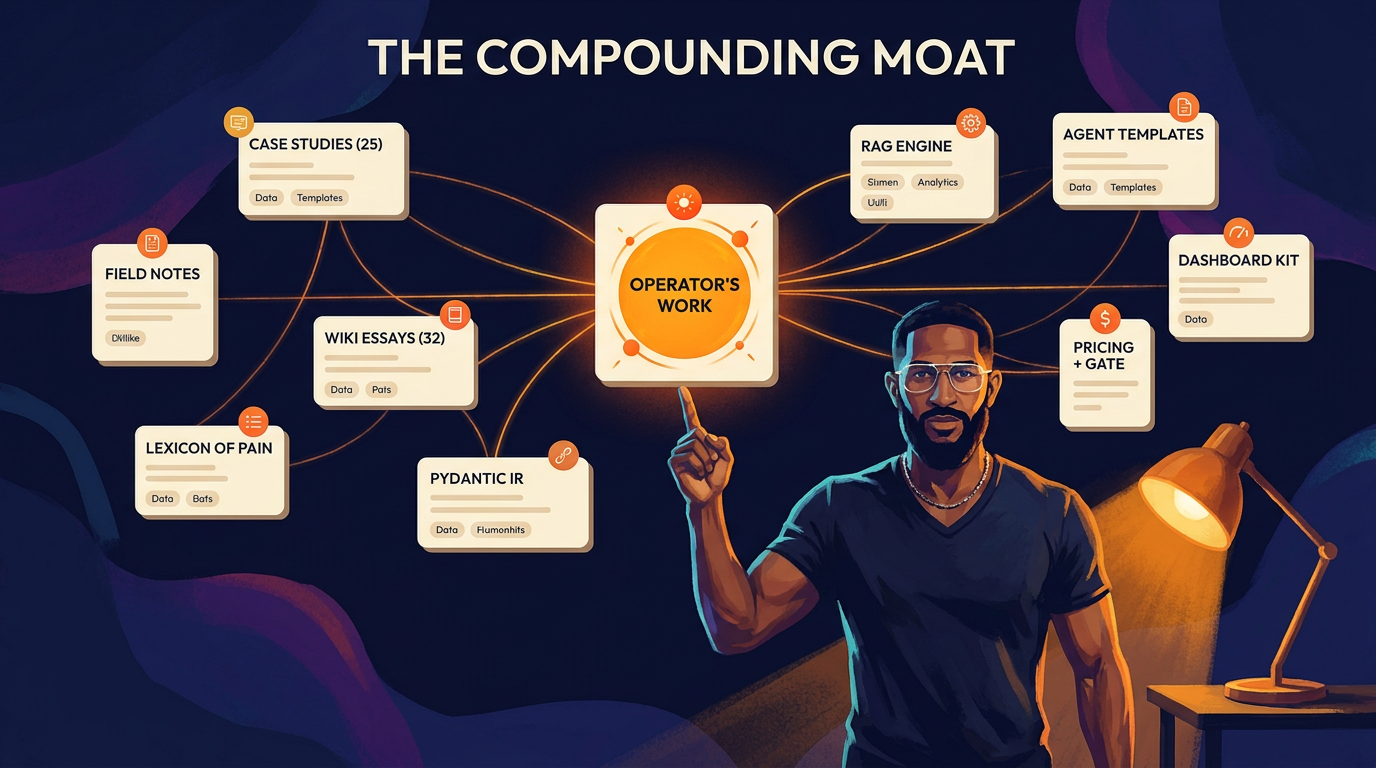
The strategic case for intelligence engineering as a discipline rests on every engagement compounding, rather than on any single engagement being uniquely valuable. The lexicon of pain extracted for one supplement brand becomes a starting library for the next supplement brand. The Pydantic IR designed for one data pipeline becomes the foundation for the next pipeline. The forensic audit framework refined on one ad account becomes a sharper instrument on the next ad account. The operator running this practice sells accumulated diagnostic precision rather than time, and nobody else in the market has that precision, because nobody else has run the same loops in as many domains. The framework is documented in this essay, so the competitive moat is the accumulated calibration of the framework across enough real engagements to know which question to ask first when a new buyer walks in the door.
Accumulated calibration is also why the practice is structurally agent-friendly rather than threatened by AI. The Agent Redwood Blueprint case study describes how I have folded agent-based execution into the practice without losing the diagnostic precision that makes the practice valuable. Agents handle the mechanical work of pulling exports, running reconciliations, and emitting candidate-finding scripts. The operator handles the diagnostic conversation, the Layer 5 naming, the problem statement contract, the verification against the bank account. The agent is the apprentice. The operator is the doctor. An apprentice without a doctor produces fast, plausible, frequently wrong work. A doctor without an apprentice produces slow, careful, expensive work. A doctor with an apprentice produces fast, careful work that scales without losing diagnostic precision, which is the only configuration that justifies the price points operators in this practice can charge.
The system is the product, not the deliverable
The portfolio you're reading right now is the product I'm describing. The 25 case studies in the case studies index are field reports describing real engagements, real numbers, real lessons. The 32 wiki articles in the corpus are working methodology I refer back to when running new engagements. The field notes are forensic observations from inside the work. The pricing page is the qualification gate. The portfolio is the system, exposed to the visitor in five different angles, each one a different door into the same operator. Each piece of work makes the next piece easier, each documented engagement informs the next one, and each refined framework upgrades how it's applied on every future engagement.
The compounding doesn't need infinite scale to matter, only consistent application across enough engagements for the calibration to deepen. The Unified Architecture wiki entry describes the longer-term integration thesis where the operator's individual systems eventually fuse into a single agent-native platform that compounds output at a different order of magnitude. What I'm selling today is the diagnostic precision and the bounded fix. The platform is what those engagements compound into over a multi-year horizon, and the operators who learn the discipline now will be holding the platform when it matters, while everyone else is still trying to figure out what intelligence engineering means.
What to do tomorrow morning
One question, one piece of paper
Tomorrow morning, before you open the dashboard, write down the answer to one question on a piece of paper. What is the one decision you currently make badly that better information would change next week? If the answer is "I don't know," that answer is the diagnosis: the People work hasn't been done, the Scar Tissue Audit hasn't been run, and everything below the diagnostic layer is premature. Stop building and start asking the four audit questions from earlier. Drill until you reach Layer 5, write the problem statement, and sign it. Then come back to the data layer with a real constraint to design against.

If the answer is concrete, the next questions follow naturally. What insight would change the decision? What information would generate that insight? What data shape would carry the information? What events would have to be captured for the data to exist? Work backward through the stack until you reach the smallest pipeline that supports the decision. Build that pipeline. Verify in the calendar, not the dashboard. If the calendar moves, the pipeline was intelligence. If the calendar doesn't move, the pipeline was overhead, regardless of how clean the queries were or how elegant the data model.
The three commitments from the opening keep the practice on track over time: diagnose before you design, engineer the reward function as carefully as the algorithm, and verify in the calendar instead of the dashboard, because a dashboard can lie indefinitely and a calendar only lies for so long. Tape them to the wall above your desk if that helps, and read them before every engagement. The discipline is uncomfortable, and the discomfort is the way through.
If you want to talk about what running this architecture would look like inside your specific business, the pricing page lists the engagements I take and the price points at which I take them. The quote form is the application, structured the way the application from the $199.5K coaching launch case study was structured. The first question asks how much profit you want to add in the next 90 days. Answer truthfully. If your number is below the threshold, the form will tell you so and route you to free resources, and if it's at or above the threshold, the form will route you to a calendar. The contact page exists for everything else, including the question of whether your situation is something I can help with at all, which is sometimes a no, and I'll always tell you that no directly instead of walking around it.
The discipline of intelligence engineering isn't new. Goodhart published his law in 1975. Burgess developed promise theory in 2005. Hypothesis has existed since 2013. Pydantic V2 has existed since 2023. The pieces are all available. What is rare is the operator who has assembled the pieces into a working practice and applied the practice across enough domains to develop calibrated diagnostic precision. That assembly is the work. The work is uncomfortable, slow, and undervalued by the market until it's suddenly the only thing the market wants. The operators who started doing the work years ago are now holding the systems that make every subsequent engagement easier. The operators who start the work tomorrow morning will be holding their own version of the same systems three years from now. The compound is the entire game. Pay attention. Be astonished. Tell about it. The instructions are seventy years old and they are still, as far as I can tell, the only instructions that work.