
1. The answer that was true and useless
A business owner sits down with six months of recorded customer calls and a tool he paid for that promises to read them. The demo was strong. Questions went in, answers came out with citations under every claim, and the machine seemed to have read more in an afternoon than his whole team reads in a year. His calls are real too: customers who bought, customers who left, and customers who asked for something nobody ever wrote down. Somewhere in all that recorded conversation, he figures, is the reason his renewals have been slipping, and for the first time he owns something that claims it can find it. So he types the question he bought the tool to ask:
Why are people cancelling?
The tool takes a moment and answers. Customers mention price, support, and features.
Every word of that is true. He could pull ten calls at random and check it by hand, and it would hold. It's also useless. A word cloud taped to a breakroom wall would've said the same thing, and a word cloud doesn't send an invoice. He reads the answer twice, rephrases the question, and gets the same three words in a different order. There's nothing on that screen he didn't already know in January.
At a short meeting afterwards, somebody says the prompts need work and somebody else says maybe next quarter. On the drive home he settles into one of two conclusions, because those are the only two anyone in the meeting had on offer.
Two verdicts, both wrong
The first verdict says these systems can't do real analysis: they're impressive autocomplete, fine for drafting emails and useless the moment a question has money in it. He'd read that verdict online before he ever bought anything, and now he has a receipt-shaped reason to join it.
The second verdict is quieter and worse: the tool is fine, and his data is the problem. He has six months of calls with apparently nothing in them, plus years of tickets, contracts, notes, and proposals, and the machine that supposedly read them all came back with a shrug. Maybe the archive he's been paying to store is worth what it's been earning, which is nothing.
Either verdict ends the story. The first cancels the tool and closes the subject for a year or two. The second is sadder: the archive stays dark, and every future pitch that mentions his data gets filed with the psychics. A third road skips the verdict and upgrades something instead: a newer model, a longer prompt, or a different vendor with a better demo. That road arrives at the same meeting a quarter later, because the thing that got upgraded wasn't the thing that failed.
I've sat through some version of this story more than once in the past two years. The company, the material, and the question change each time, and the answer barely does. Both verdicts are wrong, and both are expensive. The first walks away from a capability that's real, and the second writes off an asset he already paid to accumulate.
The scene is blended, the failure is constant
I've spent the better part of two years building retrieval systems for real clients: the machinery that moves a question through a body of accumulated language and brings something back. One of those clients is Michael Williams, who sells and services Topcon positioning equipment out of Alaska. His material is vendor brochures, product photographs, and a video library, and the system is built for the moment a customer calls with a problem and somebody needs the right answer while that customer is still on the line. The owner in the scene above is blended from more than one company I've watched run this exact experiment; the answer he got back is the answer they got back. This work is what my weeks are made of, and the failure in this chapter is the one I keep getting called in after.
What the tool was actually reading
When he asked his question, the tool didn't reread six months of calls.
Instead, it went looking for the handful of passages that sat closest to his question, pulled them, and handed them to the model to read. Pulling the nearest passages is the standard move in systems of this kind, and for plenty of questions it's the right move. Ask what your refund window is, and the answer sits whole inside one paragraph of one document, so the system finds that paragraph and reads it out. The demo that sold him the tool was almost certainly built from questions shaped like that, because those are the questions these systems answer beautifully.
His question has a different shape. The answer to why are people cancelling lives across hundreds of calls at once: in which complaints repeat, in what order things happened, in who eventually left and what they'd said in the months before they did. A cancellation call, read on its own, mostly says price, support, and features, because that's what people say in the ten minutes they're cancelling. So the tool made a correct reading of a sliver, and every sliver faithfully contains the same three words. The pattern he asked about ran between the recordings, and nothing between the recordings was written down anywhere the tool could reach.

The system wasn't broken, and his data wasn't empty. The question asked for something that wasn't sitting inside any single piece of it.
The first verdict, "these systems can't do real analysis," assumed the tool read everything and found nothing, when it read almost nothing, correctly. The second, "my data is worthless," assumed the answer measured what six months of calls contain, when it measured what a handful of excerpts contain. Both verdicts graded the wrong test.
Which kind of archive do you own
Whatever one of these systems tells you, it's telling you about the pile it was pointed at, as seen through whatever slice of it the system reached when you asked. His three-word answer was a faithful reading of a few passages, chosen by how closely they matched his wording. It said very little about his customers and nothing about the archive it never touched. Nobody in the meeting knew what the machine had been sampling from, which is why the meeting produced verdicts about the wrong things.
He now holds a question he didn't walk in with. His business has years of language in storage: calls, tickets, contracts, proposals, and the emails around every deal that closed and every deal that didn't. Some archives like that can answer questions that matter to the people who own them. Some can't, because they hold nothing beyond their vocabulary, and no tool will ever pull out of them something that was never there. From the outside, and from his chair in that short meeting, the two kinds look identical.
The experiment he ran can't tell them apart, because a disappointing answer reads the same in both cases. Telling them apart takes a different kind of test, and nobody handed him one with the invoice. Until he has it, every verdict is premature: the harsh one about these systems, the sad one about his data, and whichever one the next vendor's demo is built to install. He walked in asking whether the machine works, and he walks out with a better question: which kind of archive does he own, and how would anyone find out?
2. The field nobody fills in
Pull up the record for a customer who cancelled last quarter. Any CRM will do, including a spreadsheet doing a CRM's job. The record holds a company name, a plan, a start date, an end date, and a dropdown labelled cancellation reason, set to Price. Underneath, maybe, a notes field: "unhappy with support, evaluating competitors." Somebody typed that between meetings, and by the standard most systems apply, the record is complete, because every field is filled in.
Beside it sits the forty-minute call where that customer said why he left; like the last chapter's scene, this one is blended from real ones. On the call he named the two people who'd championed the product internally and mentioned that both had moved on. He described the week an integration broke and how long it stayed broken. He kept using the word "again." He named a competitor, and the month their salesperson first got a meeting. All of it was said out loud, recorded, and even transcribed, and none of it entered any field.

Everything downstream reads the fields. The report that rolls cancellations up by reason reads the dropdown. The dashboard the board sees reads the report. The workflow that flags at-risk accounts reads the same dropdown. So a business that owns a forty-minute account of why it lost a customer, in the customer's voice, operates on one word picked from a menu.
The form didn't lie. Price did come up on the call. The form did what forms do: it held the part somebody had time to write down.
What you own and what you've made explicit are different sizes
Scale that one record up and you have the standing condition of a business that's been running for years. There's a pile: calls, tickets, contracts, proposals, the email threads around every deal that closed and every deal that didn't. And there's what the systems can see of it, which is the filled-in fields, the file names, and the raw words. The pile holds who mattered, what was promised, what changed and in what order, and which of this year's problems is last year's problem wearing a new name. Almost none of that has ever been written anywhere a system could read it. What you own is larger than what you've made explicit, and the gap between the two is the whole problem.
Storage is what hides the gap, because storage feels like ownership. The recordings exist, the tickets are all there, and it's all in the CRM. But owning a recording and owning what's inside it, in a form anything downstream can read, are two different assets that happen to sit at the same address. The cancelled customer's real reason exists somewhere in the building, and it's invisible to every report, every workflow, and every machine the business points at its material.
The tool from the last chapter was one of those machines. When it read its handful of passages and reported price, support, and features, it was reading the one layer where anything had been made explicit: the words themselves. Nobody had ever written down who's who, what happened first, or what connects to what anywhere the tool could reach. The disappointing answer was a census of the fields somebody filled in.
The worth of a pile is two numbers multiplied
I made the general version of this argument in Space Crystals, a field note about reading structure you can't see directly, and one claim from it does all the work this chapter needs. The worth of accumulated material has two inputs, and they multiply.
The first is how much you have. Call it mass: words, calls, tickets, contracts, years of them. Most businesses know this number roughly, and it's the number everybody quotes, because it only ever goes up.
The second is the share of what's in the pile that has been made explicit: written down somewhere a system can read it. It's the number nobody quotes, because nobody's ever asked for it.
Because the two numbers multiply, a large pile with a second number near zero comes out to nearly nothing, which is the arithmetic underneath the last chapter's disappointing answer. A modest pile where most of what matters has been made explicit can answer questions a pile many times its size cannot.

Four questions that measure the second number
"Made explicit" cashes out into four questions, and you can answer every one of them about your systems today, with no technical vocabulary and nobody's permission. Take the CRM from the top of this chapter and ask:
- Who is named, and what are they to each other? A support ticket mentions a person. Does anything connect that mention to the account she belongs to, the contract she signed, the colleague who replaced her when she left? Or is her name just letters that happen to appear in more than one place?
- When was each fact true, and when did it stop being true? Prices changed, plans were renamed, policies were rewritten. Does anything record which version was in force on the day a promise was made? Or does the newest version quietly stand in for all of history?
- Where did each claim come from? A report says churn is driven by price. Can anyone walk backward from that sentence to the calls it was built from? Or did the claim float free of its sources the moment it was typed?
- Which distant pieces are secretly about the same thing? A complaint from March, a clause in one contract, a feature request from last year. Nothing about where they're stored says they're related. Is that connection recorded anywhere, or does it live only in the head of whoever happens to have read all three?
Answering no to all four is the normal state of a business that never had a reason to think about this, and it carries one specific consequence: any question whose answer lives in the connections rather than in the words comes back as mush, and a better model reads the same mush with better grammar. To be fair to the pile, plenty of questions never need any of this. If the answer sits whole inside one document, the raw words are enough, and they always were.
The same question, asked twice
Go back to the six months of calls and the question that returned three useless words. Run it again, against the same recordings, with the four questions answered. Names are connected, so the system knows two calls a month apart involve the same account. Dates are in order, so sequence exists. Outcomes are attached, so it knows which accounts actually left and which only grumbled. Claims trace to their sources, so an assertion about churn can be checked against the calls it was built from.
Ask why are people cancelling now, and the answer has something to grip: which complaints cluster on the accounts that left, what those accounts were asking about in the quarter before they went, and which competitor's name started appearing, when, and in whose mouth. The calls never changed. What was written down about them did.

This effect has been measured in public, by people with no stake in this argument. The team behind one technique, which builds layers of summaries over the source passages, measured it two ways. With the reading model held fixed and structure the only difference, the structured path came out ahead in every setup they tried, by around two points of accuracy on whole-document questions (Sarthi and colleagues, 2024). Paired with one of the strongest models available, the same technique set the best published result on that question class, twenty points past what stood before. The pair tells you where each gain came from: structure moved the answer on its own, at a fixed model, and the headline number took a model upgrade too. A separate research group found that on questions about an entire body of material, added structure changed how complete and how varied the answers were, judged side by side against plain retrieval. Two labs, using different kinds of structure, found the same direction.
Why "we ingested everything" was an empty pitch
One pitch in particular fails against the two numbers. Somewhere in your inbox, past or future, a vendor is saying we ingested all your documents, with a large count attached.
Ingestion moves mass. It carries the pile from wherever it sat into wherever the tool can reach it, and that's real work with real value, since nothing can be made explicit about material that's out of reach. But ingestion by itself doesn't touch the second number: nobody got connected to anybody, no date got put in order, and no claim got tied to a source. A pile twice the size with nothing made explicit is a longer null result, and a document count is a statement about weight, from a salesman who happens to sell scales.
One question exposes the pitch, and it's the same question that grades your pile: what can it answer now that it couldn't answer before? Only the second number answers that.

The two numbers sharpen the question the last chapter left open. The owner drove home asking which kind of archive he owns, the kind that can answer or the kind that can only echo. He can now see what the two kinds are made of: the same material, at different values of the second number. And he can see why the upgrades he kept being offered kept failing, because a better model still reads an unconnected pile. The lever is the material rather than the model. He still can't measure his pile from his desk, or put a number, even a rough one, on which kind he's holding. That takes a test, and he already owns the tools it needs.
3. Measure the split, not the signal
If you've ever split an audience in half and shown each half a different version of the same ad, you already own the instrument this chapter hands you. The two halves share the week, the market, the budget, and the news cycle, so most of what they share cancels out, and any difference that comes back points hard at the one thing that differed. That cancellation is what makes an A/B test worth real money: nobody has to have an opinion about the ad, because the split is the opinion.
That instrument usually gets pointed at landing pages, subject lines, offers, and prices, and it has almost certainly never been pointed at your archive. The question from the end of the last chapter, which kind you own, the kind that answers or the kind that echoes, feels like it needs an expert, an audit, or a leap of faith. It needs a split.
One question, two paths, read the gap
The cleanest way I know to run it is a twin test. Same model, same instructions, same material, two paths, and the gap between the two answers is the finding. One path is your tool exactly as it stands today, which after the last two chapters means the plain reading: nearest passages, no connections. The other path is the same question asked over the same material with one layer of structure added. Ask both paths the same small battery of questions, some lookups and some real ones, and read the gaps.
The reason this beats any dashboard, score, or expert opinion is the same reason the ad split works. Both runs share the same model, the same wording, and the same material. Nearly everything they share cancels, and what's left points at the thing you were trying to measure: whether structure in your material changes what comes back. I made the long version of this argument, and named where the instrument comes from, in Space Crystals; the short version is that a difference between two readings is trustworthy in a way no single reading ever is.
The test runs this week on tools you already pay for, and it requires buying nothing, least of all anything of mine.
The test, step by step
Pick the questions first. Choose two lookups, questions whose answer sits whole inside one document: the refund window, a spec value, a date in a contract. Then choose one or two real questions, the kind this book has been circling, whose answer lives across many documents at once, such as why you keep losing renewals in one segment, or what changed before your busiest quarter. Use a question you care about; the test spends the same effort either way.
Run path one today. Ask your current tool all of the questions, exactly as it stands, and save every answer verbatim. That run is your plain twin, and it costs ten minutes.

Build path two. There are two ways to build it, and both are real; the second is the one nothing can take away from you.
The provider probe. The service your tool uses to turn text into searchable form lets you declare what a piece of text is when it's processed: a question being asked, or a statement of fact being made. Providers put that declaration in different places. Some take it as a setting on the request; at least one current major model takes it as a short instruction placed at the front of the text itself. Your provider's documentation for that service (it's usually called embeddings) says which, and that lookup is the whole prerequisite. Take one passage that matters, from a call or a contract, and have it processed both ways, asking and asserting. Then compare what each version pulls back from your archive. The size of that disagreement reads one layer of structure: how differently your material and the model, between them, treat asking and asserting. If someone technical runs your tooling, this is a one-paragraph request to them.
The hand-built arm. Take your real question and gather the twenty or so documents that bear on it. By hand, in a spreadsheet if you like, write out the four facts from the last chapter for those twenty: who is named and what they are to each other, when each fact was true and when it stopped, where each claim came from, and which of the twenty are secretly about the same thing. Hand that sheet to your tool alongside the documents, and ask the real question again. That's roughly an hour of handwork on a twenty-document sample, and it produces a genuine second path: same material, one layer of structure, built by the person who understands the business best, which is you. Nothing about this arm can expire, because it depends on no provider, no setting, and no documentation page.
Then read the gaps, question by question. Put the answers side by side, lookups first.
How to read what comes back
The reading key is short, and it covers every outcome.
- On the lookups, the two paths converge, and that's correct. A question whose answer sits whole in one paragraph doesn't need structure, so matching answers on lookups confirm that the test ran properly and that the plain path is doing its job.
- On the real questions, read both answers and judge which one is better on the question you care about. You're the qualified judge: the accounts, the history, and the shape of a useful answer are all yours. If the hand-built arm's answer names connections, sequences, and outcomes the plain answer never surfaced, and they check out against what you know, you own the kind of archive that answers, and it always was that kind; nothing you paid for so far could show it.
- Gap width tells you where to look, not what it's worth. A wide gap means structure changed something worth inspecting, and a second path can also differ by being wrong: connections that sound plausible and aren't, detail that expanded without informing. So treat the gap as a flag: read the flagged answers, both of them, and decide as the person the answers are for.
- No gap anywhere usually means one of two things, and you can tell them apart. Either the structure isn't doing work yet, or the material is thin for that question. The hand-built arm is the tiebreaker, because it adds structure to one small area under your direct control. A gap that appears there tells you the material was fine and the structure was what was missing. A gap that stays shut, on a question you care about, with the four facts written out by hand, is your archive telling you it may be the echo kind for that question. Either result is worth the morning, because either result replaces a guess. Before concluding anything, run one mechanical check: if path two's answer never touches the facts you handed it, the structure never reached the model, that run says nothing about your archive, and you rerun it.
The result is a map, drawn by your judgment at whatever resolution you had patience for, showing question class by question class where structure pays on your material and where it's decoration. Nobody sold you that map; you measured it.
Nobody says "better than standard" without running it, including me
The same instrument also points outward, at anyone selling you structure, and that use outlasts the first one.
There's a rule I run my shop on, and I'm putting it in print where clients can hold me to it: nobody in my shop gets to say our retrieval is better than standard without a measured twin comparison. That includes me. I build the kind of structured systems this book describes, which makes me the sort of person whose claims should have to survive this test. Every sales pitch in this field, mine included, reduces to "my path two beats your path one." That's fine, because it's a measurable sentence, and you now own the measurement.
Pointed at a vendor, the instrument becomes one demand, phrased the way you'd phrase any split: show me the comparison on my kind of questions, with the same model, the same corpus, two paths, and the gap. A vendor with a working system can produce that, and a demo that can't survive its own twin was only a demo. Owning the instrument ends the argument, because whether the sophisticated thing is worth its price becomes a number instead of a debate.
What the answer buys you
The owner's question from chapter one now has a procedure instead of a shrug. Which kind of archive do you own? Run the split and find out, this week, on tools you already pay for, without buying anything. Keep your result, because the advice for a reader whose gap tore open in structure's favour on the first real question differs from the advice for a reader whose gap never opened at all.
The test can't tell you what to do about the result. A gap you judged in structure's favour says structure would earn on your material, and says nothing about what that structure is: what the work consists of, who does it, which parts of it you were already paying for under other names, and where the money goes when an invoice says "data." A flat gap says the work hasn't started, or, if it held even through the hand-built arm, that your archive may be the echo kind for that question. Neither branch tells you what acting on it would take. Those are bigger questions than the one you just closed, and they add up to the biggest one: what would it take, on your pile, at your scale, and does it stay worth it as the material grows and the models keep moving? That question stays open until you know what the work itself consists of.

4. What you actually do to a corpus
Picture a company folder of equipment manuals, old proposals, call transcripts, and a deck from a strategy offsite two years back. It grows every quarter. Nobody has opened most of it since the day it was saved, and everybody assumes it'll be worth something eventually.
I own the extreme case. My digital library holds more than a thousand textbooks, and I'll never read them. Reading them was never the plan. I collected them because I want what's in them, and at that scale reading is the worst extraction method available. What I want is a librarian: someone who knows everything about every book, how each book connects to the others, and how the whole shelf connects to what the internet is saying this week. I don't want a search that finds me a book about neural networks; I want a librarian I can ask real questions.
The distance between that folder and that librarian is work, and the work comes as a list of twenty-nine operations in six families. None of them is exotic; each is practiced somewhere in this field or specified in the systems I run. The difference between a pile and a territory is how many of them ran against your material.
Four questions before any operation runs
When I say knowledge engineering, I mean a director's job: deciding what the asset is, grading what it's worth, and choosing which operations turn accumulated material into something agents can navigate. Directing starts with four questions, asked before any tool gets picked up.
- What exists? Count the formats, the media types, and the volume, because you can't scope work on an uncounted pile.
- At what quality? Entry-level retail-grade material or space-grade, industrial-scale stuff? Effort follows the grade.
- From where? Who made each source, why was it assembled, and how did it get here? An answer inherits its source's credibility.
- At what depth? Surface level, or the Marianas Trench? Depth gets declared before work starts, so the budget doesn't get discovered halfway through.
Instruments are a separate thing from the job. Part-of-speech tagging (labelling each word's grammatical role), named-entity recognition (spotting the people, places, and products), bag-of-words (counting which words appear), and stylometry (measuring a writer's style) are passes a director deploys where the four questions call for them. A vendor who sells you one of those passes as the discipline has confused a tool with the directorship.
The six families
The twenty-nine operations group into six families, and the families are there so you can find an operation when you need it. The operations are the content. Each table lists the operation and what it does for you.
Grade the asset before you work it
Family A exists because you can't price work on an ungraded asset, and most piles have never been graded.
| Operation | What it does for you |
|---|---|
| 1. Corpus census | Counts what you actually own: formats, modalities, volume. Budgets start here. |
| 2. Quality grading | Sorts retail-grade material from industrial-grade, so effort goes where the asset can carry it. |
| 3. Provenance audit | Records where each source came from, who made it, and why. Answers inherit their sources' credibility. |
| 4. Depth declaration | States up front whether this corpus gets a surface pass or a deep one. |
| 5. Admission boundaries | Decides what a given use may touch. Searchable is not admitted, and excluded is not deleted. |
Take it apart without losing the addresses
Family B exists because a document becomes usable in parts, and parts that forget where they came from stop being trustworthy.
| Operation | What it does for you |
|---|---|
| 6. Structural decomposition | Preserves the author's own chapter-and-section skeleton as one axis through the material. |
| 7. Chunking | Splits a book-scale source into 50 to 150 semantically whole pieces a system can retrieve. |
| 8. Media-asset decomposition | Pulls figures, formulas, and images out as first-class assets, each described and tied back to its page. |
| 9. Hierarchy manufacture | Builds summaries over clusters of chunks, then summaries over those, so a question gets answered at its own altitude (Sarthi et al.). |
| 10. Dual-hierarchy build | Keeps the author's structure and the emergent semantic one as two separate axes, cross-referenced, with neither forced into the other's frame. |
Operation 8 has a primitive live instance in GPS ContentFactory, the first platform I designed: figures leave client documents as separate described assets, each tied back to its page.
The clustering inside operation 9's cited construction is soft: a chunk can belong to several clusters at once, with a probability for each. Stack those layers and a chunk can carry more than one parent, so the published construction produces something closer to a directed graph, a network where one piece can sit under several parents, than to a strict tree. Honoring that multi-parent membership in the data is part of doing the operation right.

Make it say what it only implied
Family C is the center of gravity. Most of what your material knows is implicit: names without relationships, facts without dates, claims without sources. Enrichment makes the implicit explicit.
| Operation | What it does for you |
|---|---|
| 11. Entity and relationship extraction | Turns mentions into typed people, products, and claims, with edges between them. |
| 12. NLP instrument passes | Runs part-of-speech, named-entity, and stylometric passes to surface who's named, which terms recur, and whose voice a passage carries. |
| 13. Descriptions, tags, and keywords | Gives every chunk and asset a label a search can catch and a person can read. |
| 14. The enrichment loop | Generates questions from a source, researches them externally, folds the findings back in as commentary. |
| 15. Cross-domain bridge hunting | Hunts the horizontal links between distant regions, the highest-value structures a corpus grows. |
| 16. Temporal stamping | Records when each fact was true and when it was learned, so a correction never rewrites history. |
| 17. Evidence-class labeling | Marks every consequential value observed, derived, inferred, sampled, or unknown. |
One book through the loop
Here's operation 14, run on one textbook from the thousand. The standard decompositions run first: the book's chapter skeleton is preserved, chunks are cut, and figures are pulled out and described. Then the loop starts. Generate roughly twenty questions from the book: claims worth checking, topics it treats as settled, places it points past its own covers. Hand those questions to research agents, who answer them externally, out on the live internet, with no loyalty to the book. Then cross-reference. Where the field moved after printing, the commentary records the move. Where the book still holds, the commentary records that too, and what was an assumption becomes a checked claim. Fold the commentary back in, attached to the passages it grounds.
No new book entered the library. Before the loop, this book could answer questions about its own contents. After it, the book can answer questions about where its contents stand: what held up, what got superseded, what the argument outside its covers looks like. Knowledge, to me, is also about enrichment. I collected a thousand books, and the collecting created almost none of the value. The work run against them created it.
Balance what collection skewed
Family D exists because a corpus left to accumulate leans toward whatever was easy to collect, and the lean shows up in the answers. A data scientist rebalances a skewed training set before trusting a model built on it. Your knowledge deserves the same treatment.
| Operation | What it does for you |
|---|---|
| 18. Knowledge balancing | Detects when one cluster of material dominates the corpus and rebalances it, the way a data scientist debiases a dataset. |
| 19. Diversity-aware curation | Harvests for relevance and spread together, so a specialist corpus covers a topic's whole shape instead of restating its dense center. |
| 20. Negative-example banking | Keeps rejected drafts, failures, and one-star material as labeled instances of wrong. |
| 21. Gap and void mapping | Maps what the corpus circles but never fills. Every void is a candidate for the next thing worth making. |
Keep everything, and let it compound
Family E exists because a corpus should compound rather than accumulate, and compounding is a storage discipline before it's anything clever.
| Operation | What it does for you |
|---|---|
| 22. Provenance-carrying storage | Stores source, assertion, and interpretation as separate layers, with summarization never the first irreversible step. |
| 23. Deposit discipline | Ingests everything the system produces back into the corpus, entities and provenance attached, so today's output is next week's input. |
| 24. Usage-lineage capture | Records clicks, reuse, and retrieval against the material: data about how your data gets used. |
| 25. Correction propagation | Fixes the shared source once and recompiles everything downstream, so nobody patches ten generated copies by hand. |
Serve it, then prove it
Family F exists because the point of the other five families is a question answered well, and "answered well" gets proven rather than assumed.
| Operation | What it does for you |
|---|---|
| 26. Retrieval design | Engineers how a question crosses into the material: layered summaries over sources, modes per task, the path an answer travels. |
| 27. Field-strength accounting | Reads mass times enrichment before reading any null result. A null at low field strength says nothing about your material. |
| 28. The split | Evaluates by twin test: same question, two paths, read the gap. |
| 29. Playtest verification | Grades the corpus by what it can now answer that it couldn't before. Volume is never the trophy. |
What separates a pile from a territory
A pile and a territory can hold identical documents. The difference is a count: how many of these operations ran, at what depth, against which parts. Zero ran against the folder this chapter opened on, which is why it answers nothing. All twenty-nine rarely need to run; the four grading questions decide which ones, at what depth, for a given asset and a given job.
The list also works as an audit sheet for a vendor's quote or for your pile. A proposal that says "we'll ingest your documents and build a chat interface" names the moving and the screen, and stays silent on everything between them, and the space between is where a pile becomes a territory. The cost of the work, and where data-project money lands across these operations, deserves the same audit against the last quote you signed.
5. The seven steps your money goes through
A data-project quote has a familiar shape: discovery, data onboarding, integration setup, platform license, dashboard build, training, support retainer. Each line carries a number, the numbers sum to something a board can approve, and the whole page reads like the work is fully accounted for. Pull one you've signed and look for a different kind of line: the one where your material gets made more valuable than it arrived. On every quote I've read or written, that line is missing. The quote prices moving the material, storing it, and putting a screen in front of it. The step that changes what the material is worth doesn't appear.
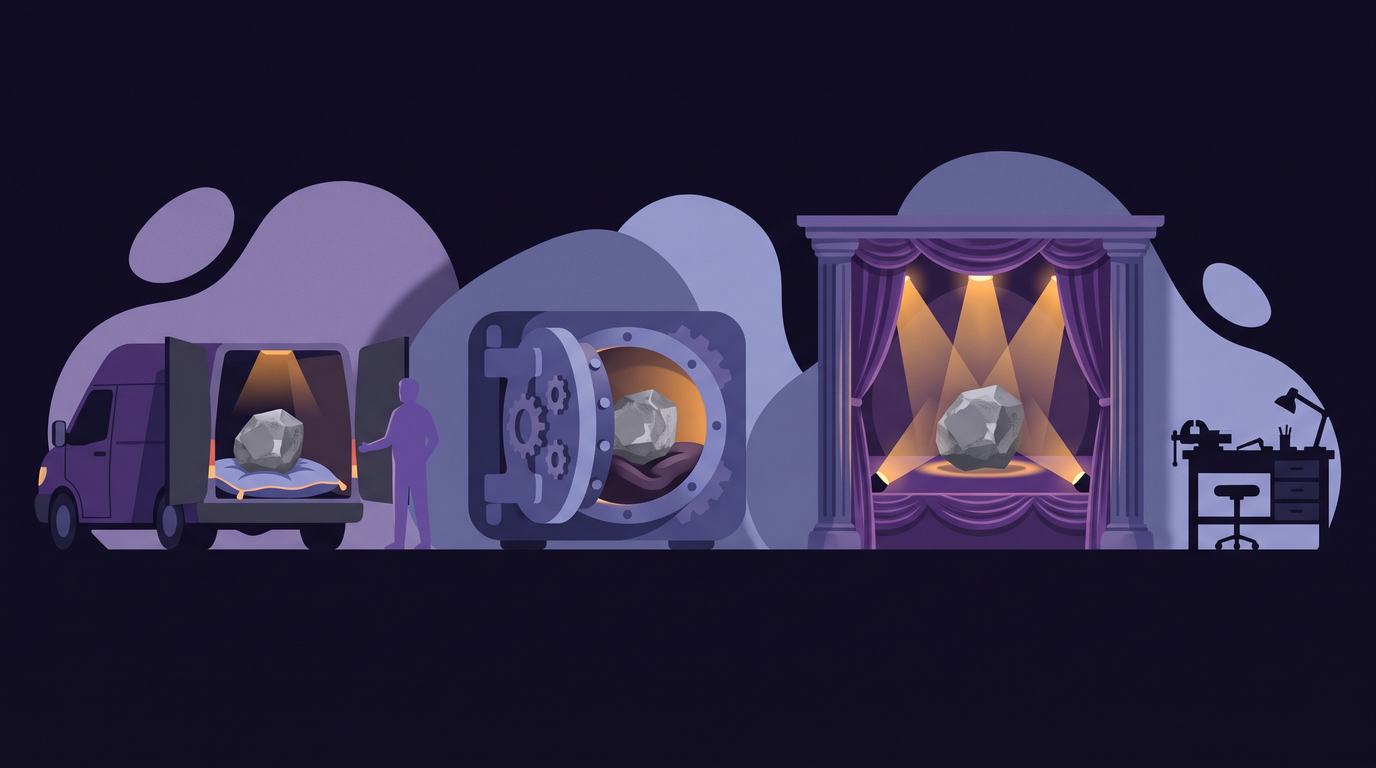
Every data project runs the same seven steps, whatever the proposal calls them. Vendors slice them differently and rename them to suit the fashion, but underneath, the work is this sequence.
The seven steps, in plain words
- How it comes in. Ingestion covers the pipes, the formats, and the rules for arrival. On a quote it shows up as "data onboarding" or "integration setup," billed by connector and by volume. Ingestion is the moving truck: necessary, priced by weight, and your boxes arrive as taped as they left.
- Cleaning it up. Cleaning is the data engineer's core job, and it carries the less obvious half of governance: bag it, tag it, and record where every piece came from and when it was true. Quotes rarely name this step; it hides inside onboarding, and when it gets skipped you find out at step six, the day two systems disagree about a customer's name.
- Looking at it. Exploration is where the whole field of analytics lives. All data is data about data; we're just world models on world models. Your sales records are a model of your buyers, your support tickets are a model of your product's weak edges, and a model of your business is sitting in the pile whether anybody looks. Exploration is a far larger field than the single workshop it usually gets.
- Making it more valuable than you received it. Enrichment is the center of gravity of the twenty-nine operations from the last chapter, and it's the step this chapter is about.
- Reshaping it for a job. Modeling and feature work recut source material into the forms a specific job needs. On a quote this sometimes surfaces as "custom development," priced as engineering hours rather than as work on the material, which is half true and half the problem.
- Building the thing people use. Productization builds the app, the dashboard, the chatbot, or the site. It's the one layer a user ever touches, so it's the one layer everyone feels qualified to judge.
- Watching what happens after launch. Profiling tracks usage, ratings, and outcomes, Amazon-ratings style, so what the released thing did in the world gets recorded rather than assumed. It's almost never bought, so most projects end without anyone learning whether they worked.
Every data invoice you've ever paid lands on one of these seven steps, though rarely under these names. The translation runs like this: "discovery" splits between steps two and three and mostly bills as meetings. "Data onboarding" is step one under a nicer name. "Platform license" is rent on the building where step six will happen. "Dashboard build" is step six itself. "Training" and "support" are the product again, extended in time. Run a signed quote through that translation, mark where each dollar landed, and a pattern shows up.
Where the money actually lands
Budgets pile into step one and step six, on the quotes I've read and the quotes I've written. The reason is structural rather than sinister: those are the steps that demo. Step one demos beautifully; a progress bar eating a folder of PDFs is the most persuasive thing you can show a budget meeting, and it proves the folder existed. Step six demos even better, because there's a chatbot in it. A demo needs something visibly arriving or something visibly answering, and steps one and six are the only two that photograph well.
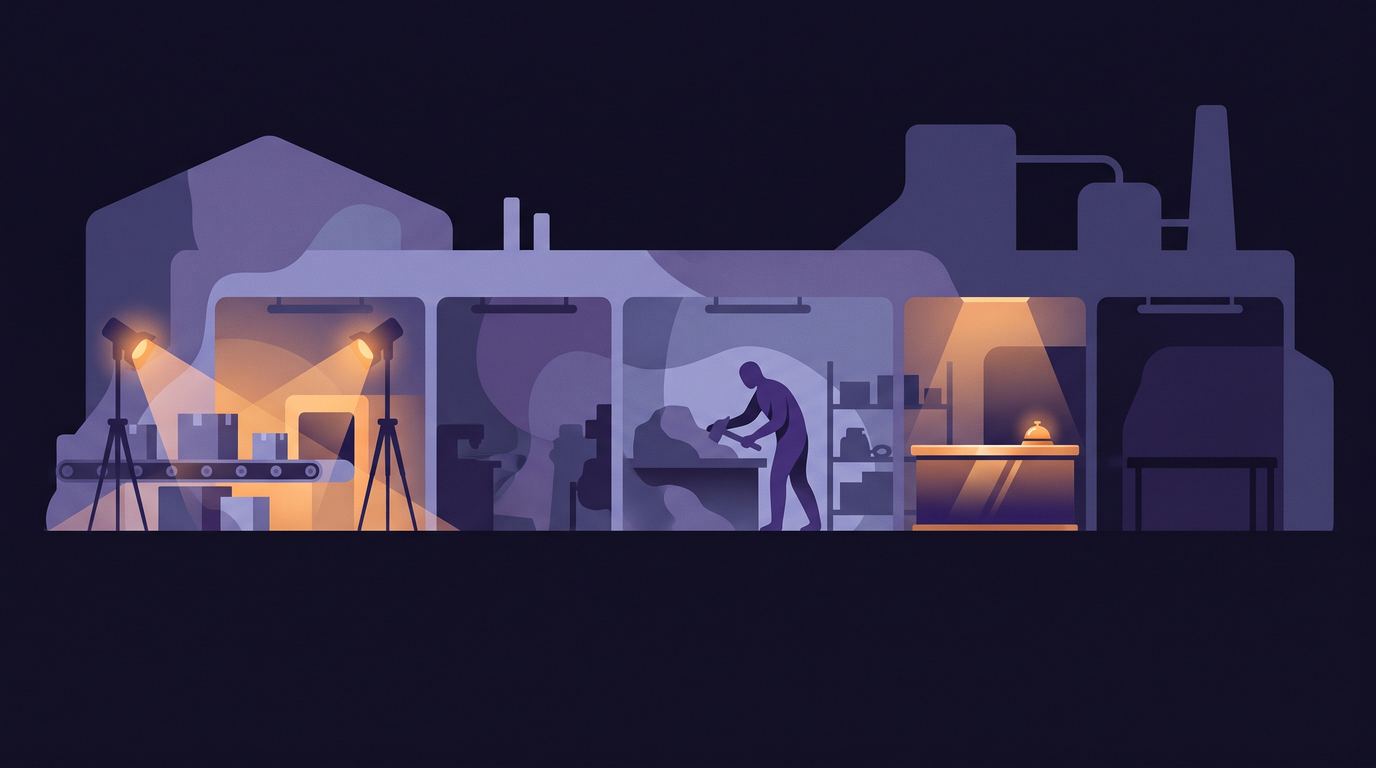
A second mechanism holds the pattern in place, and it has nothing to do with anyone's bad faith. My read is that what demos gets approved, what gets approved gets delivered, and what got delivered last time becomes the template for the next quote. The two visible steps compound their budget share with every project cycle, and the invisible steps never get the chance to prove they deserved one.
I'll concede at full volume that both steps are real work. Ingestion done wrong poisons every step after it, and the product is the only layer a user ever touches. Nothing here says skip them. The failure is in the proportions, because between the truck and the chatbot sit the steps that decide whether the chatbot has anything worth saying, and they're the steps the quote skips.
The step with no line item
Step four is where the value gets created, and it almost never has a line item. Making material more valuable than you received it is a strange purchase to put on a quote: it has no progress bar, no launch date, and nothing to screenshot. Its output is a property of the material, with no separate deliverable to point at. Ask a vendor to point at the enrichment during a demo and the demo can't show it; the place it shows is in the quality of answers months later, and no demo covers months later. So it gets bought, when it gets bought at all, under lines that are about something else, a slice of "onboarding" here, a corner of a dashboard build there, and nobody, including the vendor, can say afterward how much of the project's money touched the material itself.
Chapter 4 listed what this step contains: enrichment, mostly, with the balancing and curation work beside it. Of the twenty-nine operations, the densest cluster sits here, in the step without a name on your quote. The operations that turn a pile into a territory are the ones concentrated in the step nobody prices.
My second standing claim is that unless somebody has spent deliberate effort raising the value of their data, they're unlikely to stay competitive against someone who raises data value natively. Both companies own piles, and one of them keeps making its pile worth more. The gap between them compounds quietly, and no quarterly report has a row for it.
One engagement on the map
GPS Alaska sells and services Topcon construction equipment out of Anchorage. The intake for that engagement was vendor brochures, product photographs, and a video library, collecting digital dust on a shared drive, and the job was blunt: when a customer calls with a machine down, somebody needs a searchable answer faster than a shared drive delivers one.
On the seven steps, that material came in at step one. The work built for that phone call happened at step four: images and spec figures pulled out and described, sections cut so a question can land on one of them, labels a search can catch. On the quote shape from the top of this chapter, that work carries no standard name. The phone call is where its presence or absence shows.

The same placement works on any trade. Swap the brochures for your contracts, your call recordings, your project archives: the intake changes, and the map doesn't.
The map, read forward
The seven steps are a map, and locating your spend on it takes an afternoon with old invoices. If your projects match the quotes I've seen, the marks land heavy on one and six, light on two and three, with step four bare. The hole is the finding. Where the next dollar should go follows from it, and the rent test from intelligence engineering prices the refill: a dollar anywhere on this map pays rent as a specific decision changed, or it stays in your pocket.
The question Chapter 3 left open, what it would take, gains its budget frame here. It would take spend on the steps between the truck and the chatbot, priced as work on the material instead of absorbed into lines about something else. Whether that spend pays depends on what the material can carry, and that depends on something this map can't show: what the material is, how much of it there is, how it hangs together, and how broad or narrow your questions run. A body of material turns out to have a shape you can measure, and the shape decides what step four should even attempt.
6. The shape a corpus has
A table of contents is a map of a book, drawn by its author. Chapters hold sections, sections hold subsections, and every passage has one address in that outline. It works so well that most people never notice what it is: one hierarchy, chosen by one person, out of the several that the same material contains. Your company's version is the folder tree and the CRM's category list, one person's axis, inherited by everyone after them. Your corpus has a shape the way that book does, and the outline you gave it is one axis through that shape.
Questions arrive at an altitude
Ask a system about a whole quarter and it hands back five paragraphs that contain the word "quarter." The answer is true and useless, and by now you can name the mechanism: retrieval by resemblance finds the right neighborhood at the wrong altitude, meaning the wrong level of generality. A question about a quarter is a question about a summary that doesn't exist yet, distributed across dozens of documents, living in no single passage. A pile organized at one altitude, the altitude of the raw chunk, can only ever answer from that altitude, whatever height the question arrived at. The tell, once you know to look for it, shows up all over your systems: answers that are true at the wrong grain, detail where you asked for direction, a passage where you asked for a pattern.

Material becomes answerable at altitude when somebody manufactures the missing levels. In plain words, the construction clusters the passages that belong together, writes a summary over each cluster, then clusters and summarizes the summaries, until the whole corpus rolls up to a handful of top-level statements. A question about a quarter now lands on a summary built for that height, and the summary is checked against the passages underneath it rather than floating free. The technique is Sarthi and colleagues' published construction, and paired with one strong model it bought about twenty points of absolute accuracy on one reading-comprehension benchmark. Twenty points on a benchmark is a lab result, and the mechanism is the part that transfers: answers at the question's own altitude, grounded in the layer below.
A corpus has two hierarchies, and its author drew one
The outline is the first hierarchy. The second one emerges from the content and belongs to nobody. Passages from chapter two and chapter eleven that discuss the same idea sit far apart in the outline and close together in meaning, and if you group material by what it says rather than where its author filed it, a different organization surfaces: neighborhoods of meaning that cut straight across the chapters. The thousand-book library from Chapter 4 makes it concrete. One estimation method shows up in a statistics text, a control-theory text, and a finance text, filed under three names on three shelves, and an expert reading all three recognizes one idea wearing three costumes. No outline holds that connection, because every outline was drawn inside one book. The second hierarchy is made of those connections.
Both hierarchies are real, and forcing them into one frame loses information. The author's structure records intent: this is how the argument was built. The emergent structure records content: this is what the material keeps being about. A question about how a specific machine gets torn down wants the first axis, because the author wrote a procedure in order. A question about everything the corpus knows on one theme wants the second, because no author filed a theme in one place. The working discipline is to build both separately and cross-reference them, so each question can travel down the axis built for it. Collapsing them into one tree, which is what most filing systems do, deletes whichever organization lost.
What a measurement has to survive
Shape, measured, is a number somebody will eventually put in front of you: how many separate regions your corpus has, how its neighborhoods connect, where it circles a topic without filling it. Before trusting any such number, apply one standard. A shape worth trusting is one that does not fall apart when the input is slightly wrong.
The instrument family that measures shape from a cloud of points carries this as a proven property rather than a hope: perturb the input by a bounded amount, and the measured shape changes by no more than that amount. There's no multiplier and no fine print about lucky inputs. The guarantee covers this one instrument family, and it buys the one thing you want from any measurement somebody sells you: a reason to believe the number wouldn't have come out different on a slightly different Tuesday. Most of the tools that produce corpus pictures, the cluster plots and the galaxy maps, reshuffle when you rerun them. Ask which kind you're being shown.

What I measured on my own shelf
Everything above is what I sell, so I checked it against my platform. Its chunk records declare four hierarchy fields in their schema: a level, parent links, child links, and a leaf marker. The data catalog attributed those fields to a pass that supposedly ran, and a project board carried the capability as done. On July 16, 2026, I ran a read-only count against every row of the live deployment, with no sampling, before this chapter could cite it.
Zero of the 2,037 chunks in my platform's live deployment carry any of the four hierarchy fields. The distinct set of level values across the whole deployment is a single null. The trace is short: the ingestion code writes a seven-key payload that never includes the fields, and the receiving mutation doesn't declare two of them at all, so even a correct pass would have nowhere to put its tree. The only hierarchy code in the system is a reader, built to walk a tree, pointed at a database where nothing writes one. Its tests pass on synthetic nodes it builds in memory.
The same pass checked the deployment's volume counters, and they carried no drift at all, so the platform was accurate about volume and blind to structure. No telemetry on the platform would have surfaced the missing tree; only a count of the fields did.
The zero is real, and stopping at the zero would lie by omission, because two more numbers sit beside it and both cut against a clean story, one in the corpus's favor and one against it. A field called hierarchyPath is populated on 2,024 of those 2,037 chunks, and it's real: it holds each chunk's heading trail, derived from the document's outline at ingestion. That trail is a breadcrumb, and a breadcrumb isn't a tree. There are no summaries above the leaves, no linkage, nothing for a question to descend through, and the field was never faked into more than it is. It records which section a chunk came from, it does that job well, and any surface calling it hierarchical retrieval is reporting a section title.
Only 64 of the 241 assets in the same deployment were ever chunked at all. The other 177 were uploaded and never processed, so the usable corpus is 64 assets, whatever the total on the shelf says.
Put together, the three numbers say that the summary tree doesn't exist and can't currently be written, the breadcrumb exists and is flat, and most of the shelf was never processed in the first place. Until levels exist on that corpus and the twin test from Chapter 3 has run against it, no sentence of mine gets to claim my retrieval answers at altitude. The construction is cited to its published benchmark above, and my corpus appears in this book as a measured distance from it.

Wrong twice about one attribution
My strategy corpus carried a technical term credited to a well-known researcher. The credit arrived in generated material, and it was adopted the way it arrived, unchecked.
In a later review pass I flagged that attribution as a fabrication. The term read like a confident label pinned onto a famous name, the kind generated text produces, and I asserted the idea lived only in secondhand accounts and never in the researcher's own writing. A warning went into my reference canon instructing every future draft to withhold the credit.
That correction was also wrong. I had ruled on the claim without reading the primary sources, which is the same step the first pass skipped. When I finally read them, the term turned out to be his. He uses it in his own published essay and in recorded talks, he lays out the idea it names directly and more than once, and the original attribution had been substantially correct. I introduced the defect by correcting without checking.
The warning came out of the canon. The record now carries the claim at its measured altitude: the term correctly attributed, the component mathematics established and older than his use of it, and the synthesis he built on top marked as what it is, a live research program argued in essays and talks, not yet a proven result.
What shape doesn't say
What step four should attempt depends on what the material is: the axes it has beyond the one its author drew, the altitudes its questions arrive at, and whether its measured shape survives a slightly wrong input. You can now ask all of that about your pile.
The shape says what you own and where a question can land, and nothing about what any of it has done. A company can have a document that quietly earns its keep every week and a folder nothing has touched in a year, and the shape of the corpus can't tell them apart. What your material earns when it gets used is its own measurement, and the worth question Chapter 3 left open runs straight through it.
7. Which of your assets earned their keep
Your team still uses something you made two years ago: a proposal that keeps getting cannibalized for new ones, a template that shaped every deck since, or one paragraph that survives in every statement of work because nobody has written a better one. It gets used every week, it has paid for itself many times over, and you can't say which thing it is, because the use never got written down anywhere.
Chapter 6 measured what you own, and the same pile raises a different question: what has any of it done?
Worth is decided at the moment of use
What a piece of your material is worth gets decided by what happened when it was used, and almost nobody records that. A document that answered a real question last Tuesday is worth something you can point at, while a document that has sat untouched for a year is worth an opinion. Most companies grade their material, when they grade it at all, by the second method: somebody's judgment, applied by hand, usually at the moment the thing was made and never again. The grade goes stale the day after it's assigned, and it was never evidence to begin with. The case study everyone agreed was the best one at the launch meeting may not have been opened by a salesperson since, and the hand-assigned grade has no way to notice.

The principle that replaces hand-grading is short: worth is derived from events, never assigned by hand. Something happened involving this asset, the happening got recorded, and the record is the grade. You don't need a tier system or a scoring rubric to act on that. You need the events written down.
A second audit, cheaper than the first
Chapter 4 handed you an audit of operations, which takes an afternoon with your pile. The audit of worth is cheaper, because it's a sort rather than a study. Take your content, your templates, your research documents, and split them into two stacks: proof attached, or opinions attached. A template that six newer documents visibly descend from goes in the first stack. A research report somebody once called great goes in the second. Version histories, sent folders, and copied-forward paragraphs are crude event trails, and even a crude pass sorts most of a pile.
The finding usually mirrors the invoice map from Chapter 5: a small working set with proof attached, and a large majority with nothing attached either way. Nothing attached means unmeasured, and unmeasured material can't defend its storage, its maintenance, or the next dollar spent making more like it.
The audit also hands you a governance rule you can enforce now, without buying anything: nothing new gets commissioned without naming the event that would prove it worked. A case study names the deal it should help close. A template names the reuse it expects. If nobody can name the proving event at commission time, that's the finding, and it arrives before the money is spent rather than after.
What recording use looks like, in primitive form
My platform runs a primitive version of this today, on the creative library GPS ContentFactory manages. Four pieces are live. Every time an asset gets attached to a piece of work or detached from it, an append-only ledger writes the event in the same transaction as the use it records, so the record can't drift from the thing it describes. Usage counts are computed by re-reading that ledger each time; there's no stored number for somebody to edit. The library sorts reuse-first by default, so material with events attached surfaces above material with none. Each event also records who bound the asset, a person or an agent, which starts to matter once a team is part human and part agent, because anyone can see that a creative already ran before running it again. And comments left on work are kept and rolled up into patterns, so a note that keeps recurring against one style becomes visible as a pattern rather than staying scattered.
As of this writing, the library holds roughly 1,800 creatives; about 106 have ever been bound to a shipped piece, and 8 have been reused across more than one. Read the shape of those numbers rather than the numbers, because the shape is your situation too: a large pile, a thin working set, and a very small set of proven repeaters. Recording use made that shape visible, and visibility is what changes decisions.

Nothing in it is clever: an append-only record, a computed count, a default sort, and a rolled-up comment thread. The discipline is that the events get written down at all, at the moment they happen, in a place that can't quietly disagree with reality later.
Credit that travels backward
A recorded use can do more than grade the thing used. When something you shipped earns a real result, a signed client, a renewal, a sale, the credit belongs to more than the piece that shipped. It belongs to the draft the winner was cut from, the template that shaped it, the research that fed it, the source document that made one claim checkable. Picture the result arriving at the finished piece and then flowing backward, down the chain of everything that produced it, re-pricing each link as it passes. The winning article makes its sources more valuable. The sources make the research run that found them more valuable. Value enters at the end of the chain and soaks back through the whole of it.
Run that for a year and you'd hold answers almost nobody can give today: which research paid, which sources keep feeding winners, and which template earns its slot and which one gets copied out of habit. Every business that produces work from its material has these questions, and I can't answer them about my businesses today.
On my platform the wiring exists before the signal does. The chain is recorded: a generated piece keeps a record of which references grounded it, and the link runs in both directions, so you can ask what fed this piece, and what this piece fed. The flow doesn't exist yet. No measured result travels backward down that chain today, on my platform or anywhere I've seen. The backward flow is the designed next step, written into the same data contract that derives worth from events: results against finished work re-valuing everything upstream, source rankings, template win rates, research that proves itself in the performance of the things it fed. The ledger and the lineage got built first because they're what the flow would run on.

Your version of the prerequisite is smaller than mine and available now: keep the chain. When a deliverable ships, record which sources and templates fed it, even if that's one column in a tracker. A chain nobody recorded can never be re-priced, whatever tooling arrives later, and the businesses that will be able to answer "which research paid" in a few years are the ones writing the chain down now.
What the dashboard can't tell you
The dashboard cannot verify the system, because the dashboard is part of the system. Usage counts, reuse ranks, and recurring comment patterns are the machine reporting on itself, and a machine tuned to its own reports drifts toward flattering them. The verification lives outside, in events the system can't award itself: the bank statement, the renewals, the calls booked. Use the inside numbers to steer the work and the outside events to verify it; kept separate, both jobs stay useful.
The boundary also closes this act's question about where the money goes and what the work consists of. The work is twenty-nine operations in six families, run across seven steps whose budgets cluster away from the value, applied to a corpus whose shape decides what the work should attempt, and graded afterward by recorded events and verified by events from outside. You can audit a vendor's quote against the operations, your invoices against the steps, and your pile against its proof.
One question is left standing, bigger than the four chapters that raised it. Everything in this act treated your material as something people work on: graded by a director, enriched by hand or by agents, sorted by events a human can read. The reason for all of it is that a machine is going to read this material and answer from it, and a machine doesn't read the way your best analyst reads. What does your knowledge have to become, and what form does it have to take, for a machine to hold it?
8. Fancy forms
Somewhere in your company, today, somebody filled in a field with a guess because the form wouldn't submit empty. The dropdown demanded an industry, or a lead source, or a reason, and the person at the keyboard didn't know, and the true answer, nobody knows, wasn't on the menu. So they picked something plausible and moved on with their day. Every operator has watched this happen, and most of us have done it this week.
Watch what that guess does next, because it has a career ahead of it. It's in the system now, spelled correctly, formatted properly, sitting in a field with an official name. Reports will roll it up. Filters will match it. Automations will route by it. Eighteen months from now an analysis will lean on it with full confidence, because nothing about a stored value says a stranger invented me to make a form submit. The cancelled customer's record in chapter two, the dropdown that said Price while the real reason ran forty minutes, was this same object seen from the outside.

The answer is a form
The last act ended on a question: what does your knowledge have to become for a machine to hold it? There's a whole industry of vocabulary waiting to answer that expensively. My answer, after years of building these systems, is the least impressive sentence in this book. It's basically just fancy forms. It's a CRM. If you can CRM-ify your material, you've got the thing.
I'm aware of how that sounds. The field runs on words that photograph well in a pitch deck, and I'm telling you the load-bearing move is the object your team already complains about filling in. The reason the form is the answer is a strong one: the form is the one shape of writing that a person and a machine can both read without translation, a shared language between the two. Your team sees labelled boxes and fills them from what they know. A machine sees exactly which fact sits in which position, every time, for every record. Decades of businesses pushing spreadsheets, databases, and CRMs to their limits produced a shape both sides are fluent in, which is why the systems that answer questions well are the ones whose material got form-shaped first. (The engineering name for this discipline is Pydantic as an intermediate representation: one schema, written once, that every other layer is generated from. It's the only jargon the idea needs, and you never have to say it.)
Everything the last act described, the operations, the enrichment, the grading, lands in this shape. If you hand-wrote the four facts for the twin test's second path, you were form-shaping twenty documents, and if the answers improved, they improved because the machine could finally read what you had instead of guessing at it. So the question stops being abstract and becomes an audit. Your business already runs on forms, so the only question is whether they're good ones. And this half of the work is priceable in a way the vocabulary never was: you can see it, assign it, and check it, one field at a time, with no specialist standing between you and your record.
Four questions to ask any field you already have
A good form follows four rules, and each one is a question you can put to a field you already own. Open your CRM to any record and hold these against it, one at a time.
Does the field's name mean one thing? "Status" is the classic offender: it means shipping status in one team's mouth, payment status in another's, and relationship health in a third's, and the field happily stores all three. A machine reading that field learns nothing reliable from it, and neither, if you watch closely, do your people. A name that means one thing is the difference between a fact and a rumour with a label, and the fix costs a rename and one agreed sentence of definition.

Does it record where the value came from? The customer's own words, a rep's summary after the call, a bulk import from a bought list, an educated guess: those are four different grades of fact wearing the same font. A field that carries its origin can be trusted in proportion to that origin, and a field that doesn't gets trusted uniformly, so the guess gets trusted like the quote. One added box, where this came from, with a handful of plain values, upgrades every field it sits beside.
Does it record when the value was true? Chapter two asked this of your whole archive; here it lands on a single box. Is the price on the account the current price, or the price when they signed? Is the owner on the account the owner now, or whoever it was when someone last touched the record? A value without a date quietly claims to be eternal, and almost nothing in a business is. An as of beside the fields that change is the cheapest correction in this chapter.
Does it stay empty rather than filled with a plausible guess? The systems you've been sold get this fourth rule wrong by design.
The empty field is the expensive discipline
Software fills blanks because blanks look broken. A demo with empty fields reads as unfinished; a demo where every box glows with content reads as intelligence. So products autocomplete, infer, default, and backfill, and salespeople present the resulting fullness as capability. The dropdown that wouldn't submit empty at the top of this chapter wasn't an accident. Somebody designed it to refuse the true answer, because required fields produce complete-looking data, and complete-looking data sells.
An empty field tells you what you don't know, and a plausible guess erases the question. The blank field is an open item somebody can chase, price, or decide to live without. The guessed field is a closed item that's wrong, and it closes the question so quietly that nobody ever reopens it: the record looks done, the report rolls up, and the not-knowing has been laundered into knowledge. When chapter one's tool reported a census of the fields somebody filled in, some of those fields were guesses like this one. Nothing downstream can tell the difference, because only the moment of entry knows, so the moment of entry is the only place the record can tell the truth.
So the mark of a knowledge asset built by adults is visible unknowns. A record that says industry: unknown, nobody has asked outperforms a record that says industry: consulting on a guess, in every use that matters, because the first one can be fixed and the second one can only be believed. Audit one thing this week if you audit nothing else: walk ten records and ask which fields are lying politely. Your team knows which ones, because they filled them in.
A form for a person
The hardest thing a business ever tries to hold in a form is a person: the customer, the buyer, the audience member the whole operation exists to serve. People are also where guessed-full records do their worst damage, because a wrong industry misroutes an email while a wrong belief about a customer misroutes a strategy. I hold my person-records to a written standard, a standing template rather than software I can point to running, and its three rules are the four questions grown up to person scale.

Every value carries its evidence, its source, and its date. Prefers email traces to the moment she said so, or it doesn't render at all. An empty field shows as empty, and the record never gets dressed in plausible texture. What a record says about who someone is never grants anyone permission to act; decision maker in a notes field authorizes nothing, because descriptions of people and permissions to act on them live in different places and systems that blur that line end up charging cards on the strength of an adjective. And depth stays a choice rather than a mandate: a sketch with visible blanks beats a portrait of guesses, and you deepen a record only when evidence arrives.
None of that requires new software. It requires deciding that a form is a place where facts live, and that a fact has an origin, a date, and the right to be absent.
The half you can read
Route yourself by the number you took out of chapter three. If your gap on the real questions was wide and in structure's favour, this chapter is where that money is: the four questions are what produced the structure your gap detected. If your gap was flat, you've been reading the diagnosis of why, one required-but-guessed field at a time.
The form is the half of the answer a person can read, and that's by design: it's the layer where your team corrects the record, your judgment applies, and an unknown stays visibly unknown. But when a machine reads your material, the form isn't what it reads. Underneath the systems in this book sits a second written-down version of everything you own, one that nobody on your team reads, because it was never written for people.
9. The layer you never read
Your phone finishes your sentences. You type "running a bit" and it offers late; you type a colleague's name and it offers the next three words of the sentence you usually send her. It's roughly right, often enough to be useful, and when it's wrong it's wrong in a particular way: plausible, fluent, and confidently beside the point. Nobody taught it your meaning. It has read enough to know what words tend to sit near other words, and it plays the tendencies.
Hold on to roughly right, because it describes something much bigger than autocomplete. Every system this book has discussed runs, underneath, on machinery with that temperament. The machinery is useful, and anyone selling it to you should be able to name its weaknesses out loud.
The layer under the forms
When your material enters one of these systems, every passage gets written down a second time. The first version is the one you know: words, fields, records, the layer the last chapter taught you to govern. The second version is a long list of coordinates, a position in a kind of space where passages that mean similar things sit near each other. Engineers call these vectors; you can call them coordinates and lose nothing. When a question comes in, the system drops it into the same space and collects what sits nearby. Nearness is the mechanism behind every "it found the relevant passage" moment you've ever been shown, and it's why the machine's guesses have autocomplete's temperament: nearby-in-meaning is a resemblance judgment, and resemblance is roughly right by nature.

Three facts keep this layer in its place.
The forms are for you; the coordinates are for the machines. The layer you read, correct, and audit is deliberately human-shaped, and it stays the record. The coordinate layer exists so machine work is fast and cheap: finding candidates, grouping likenesses, narrowing a large archive to a shortlist. Nobody on your team reads it, and nothing about that is a defect. It was never written for people, and the layer that was is where your reading and your governing belong.
The coordinate layer is never a second version of the truth. If the coordinates and the forms disagree, the forms win, the way the signed contract wins over somebody's memory of it. A system in which the coordinate layer has quietly become the authority has inverted its architecture.
Everything the coordinates do well was learned from the discipline of the forms. The coordinate layer works to the degree the material feeding it was form-shaped first, with a consistent shape, comparable positions, and one fact in one place, which is why the forms came first. Put structure in and you get useful resemblance out; put mush in and you get a fluent reflection of your phrasing back, which is the disappointing answer from chapter one.
You don't operate this layer, you interrogate it
The layer comes with one mercy: you'll never be asked to tune it, and you should decline any invitation to have opinions about it. Which machinery converts text to coordinates, at what settings, is a supplier's decision, made and remade on the supplier's schedule. What you need, and what almost nobody selling these systems expects you to have, is enough understanding of the layer's known weaknesses to interrogate whoever runs it on your behalf.
That understanding comes as five questions, and all five are questions for a supplier. You point them at somebody else, in a sales meeting or a review, and read the quality of what comes back. They're a different instrument from any check you run on your system by yourself, and the two should never blur.
Five questions for a supplier
What did yours throw away? A position in resemblance-space is useful precisely because it discards information: exact wording, order, tone, the difference between a number and the number. Discarding is how a large archive becomes searchable at all. So the question is whether your supplier knows what was lost and can say it. A good answer names casualties: "exact figures don't survive, which is why we route price questions through the record instead." A bad answer is "we capture everything," and chapter two showed why that pitch is empty.
How does your supplier's system handle a question with a hard rule in it? Resemblance doesn't do rules. A contract clause that applies only above a threshold, a compliance condition with an exact date, a question whose answer depends on two facts holding at once: coordinate arithmetic doesn't preserve constraints or multi-step logic, and a system leaning on resemblance alone will hand back something near the rule instead of the rule. A good answer describes machinery beside the coordinates doing the rule-work, and can say where the hand-off happens. A bad answer tells you the model is very good now.

What happens to us when you upgrade? The coordinates aren't portable. They're positions in one specific piece of machinery's space, and when that machinery changes generation, every passage in your archive gets rewritten in the new space, at somebody's cost, on somebody's schedule. Ask who pays, what breaks in the meantime, and how you'd even know the swap happened. Upgrades will happen either way; you're asking whether your supplier has an answer that doesn't include the word "seamless."
Who watches the drift? Between the big upgrades, the geometry moves in smaller ways: versions shift, neighbours change, a question that pulled the right passages in March pulls slightly different ones in June, and nothing announces it. Drift is the quietest failure mode in the whole stack, because every individual answer still looks fine. The question has a one-word subject: who. A good answer names a person, a check, or an alarm. A bad answer is a pause, and the pause is data.
Which parts of yours are you claiming for? The results a vendor shows you never came from coordinates alone. They came from a whole assembly: how the material was cut into pieces, how it was structured before conversion, how candidates get ranked, what the reading model does with them. The coordinates are one part, and often the least differentiated part, since suppliers frequently rent the same conversion machinery from the same few providers. So when a demo impresses you, ask which parts of the assembly the vendor built and is claiming credit for, and which parts came off the shelf. This question keeps anyone, vendor or reader, from believing the coordinates are the system. They're one layer of it, and a supplier who can't split the credit precisely is telling you something about how precisely the assembly is understood.
Throwing information away is the job
A chapter that lists five weaknesses owes you its author's position on them, and I'll label mine as my reading rather than established fact.
The deepest criticism of this layer is the first question: it throws information away. And discarding is what it's for. Everything this book has asked you to do so far has been narrowing: six months of calls to one answer, twenty documents to four facts, an archive to the shortlist a question needs. The coordinate layer earns its place for the same reason it draws its sharpest criticism. In my reading, the criticism and the value are the same fact seen twice, and you're entitled to weigh that as a stance rather than a theorem.
Carry the division of labour out of this chapter, because it works as a filter. The forms are for you, and they stay readable, governable, and blank where nobody knows. The coordinates are for the machines, and they're fast, resemblance-shaped, treating a question differently from the assertion that answers it, and never the record. A vendor who can say which layer is doing which job, weakness by weakness, is running an assembly he understands. A vendor who can't is guessing, with your archive and your invoice. You now have five ways to find out which one is in the room.
10. The two layers, and the name
Take one customer your business knows well and look at how he exists in your systems. He's in there twice. The first version you can open and read: a record with his name on it, a plan, a history, fields that carry origins and dates if the last two chapters' work has been done, blanks where nobody knows. The second version nobody in your building will ever open: a set of coordinates, a position among everything else you own, near the accounts that resemble him, written in the layer from the last chapter.

Neither one is the customer. He's at his desk right now, unaware of either. Both are samples of him, and each keeps what its reader needs and discards the rest. The form keeps the facts a person can check and act on, and loses his voice. The coordinates keep the resemblances a machine can search, and lose his exactness. They're two deliberate losses, aimed at two different readers.
And both samples work for you daily, in different jobs. When his renewal comes due, the form routes it: dates, terms, the person responsible. When somebody asks a question he's part of the answer to, what themes run through accounts like his, the coordinates find him: he surfaces because of what he resembles, out of an archive too large for anyone to hold in mind. Whatever your business has put through one of these systems now exists this way, written down twice, once for each kind of reader it has, each version doing work the other can't.
One discipline built both layers
This act opened on a question: how does any of this become usable by a machine? You're now holding the whole answer, and its two halves turn out to be one job. Shape the material like a form, so people can read, correct, and govern it. Let the machine write its second copy in coordinates, so it can search resemblance at speed. Keep the division of labour clean, so each layer does only the job it's for and the forms stay the record.
And that division doubles as a filter, which is where it starts paying for itself in meetings. A claim about one of these systems, arriving in a pitch, a demo, or a renewal call, is a claim about one of the two layers, whether or not the person making it says so. Sort the claim before you weigh it. Contradictory records, guessed fields, missing dates, and nobody sure which version is current are form diseases, fixed by form work you can see and assign. Missed resemblances and questions pulling the wrong passages from a well-kept archive are coordinate territory, the supplier conversation you're now equipped for. The filter earns its keep on the incoherent pitch: a vendor promising that smarter coordinates will fix your contradictory records is prescribing a coordinate remedy for a form disease, and an upgrade at the wrong layer doesn't touch the disease. Ask which layer a claim lives at, and pitches start sorting themselves before anyone reaches the pricing slide.
A single set of decisions, made upstream of both, decides whether either layer works: what gets made explicit, under names that mean one thing, with origins and dates attached, with blanks left visible instead of guessed over, and connected where things are about each other. Those decisions are the same ones the middle of this book priced as operations and steps, and they land in both layers at once. The four facts you wrote out for the twin test, and the four questions you put to your fields, improve both the layer you can read and the one you can't, because the coordinate layer works to the degree the material feeding it was form-shaped first: structure in, resemblance out. Make the decisions well and you get a form a colleague can trust, and downstream of it, coordinates a machine can use. Skip them and you get the archive from chapter one, twice.

A name for the discipline
That discipline has a name I can now hand you in one sentence, because nine chapters have already done the arguing: vector engineering is the work of engineering what a machine samples from when it answers, both written layers of it, the forms your people read and the coordinates they never will, a synthesis whose parts are older than any name and which several fields are assembling independently right now. I won't sell you the name, because a name you were sold is a name you'd rightly distrust.
A name is for pointing. Until now you could hold everything this book has shown you and still have nothing to type into a search box, nothing to put in a job description, nothing to say to a vendor except a paragraph. Now you can ask who does your vector engineering and watch what happens to the meeting. You can put the term in front of your CTO with this book attached and let her argue with it. I write the discipline down in public as I run it, from the decision work it feeds to the shapes the data itself takes, and a name being used in the open, with its working shown, is the only credential a name needs.
Hold the name that lightly, though, because the name is the least of what you're carrying. A reader who forgets the term next week and runs the twin test on Monday got everything this book has to give, and a reader who remembers the term and runs nothing got a word. The discipline travels fine without its label; the label without the discipline is how categories get invented at you, and you've been on the receiving end of that before.
The rung after the CRM
Business infrastructure climbs in rungs, and you'll recognize the ones you've climbed. The database made records reliable. The spreadsheet put calculation in every operator's hands. The CRM turned relationships into forms, which is the rung this whole book has been standing on. The automation platform wired the forms together, so an event in one system moves the others. Each rung was optional right up until it wasn't, and each one assumed you'd climbed the rungs below it.
I'll write the next rung as what it is, a bet: a platform where the forms, the coordinates, and the recorded events run as one fabric, so you can rehearse a decision against your material before spending real money on it. I call that a wargaming platform. I know of nothing you can buy today that is one, from me or from anyone, and operators who bet on which category arrives next lose that bet regularly. The ladder's value doesn't hang on the bet landing on schedule. It points at a direction: the later rungs on that list assumed the discipline of the earlier ones, the CRM assumed reliable records, the automation platform assumed forms worth wiring together, and the forms, the questions, and the layers of this act are the assumed discipline of whatever comes next. Climb what's climbable now.

Done well, it still fails
Knowledge becomes usable by a machine when it's engineered into two layers by one discipline: forms for your people, coordinates for the machines, one set of upstream decisions deciding the worth of both, and now one name for the whole of it. The act before this one priced the work, and this one named it.
The name uncovers the hardest question in this book, one that has sat under it since the first scene. The people who built the systems you've already paid for knew most of what this act covers. The vendors who will pitch you next quarter know it too. And the systems still fail, reliably, recognizably, in ways that repeat from company to company almost word for word. Structure gets built, money gets spent, the layers get engineered by competent people, and answers still come back wrong in the same patterned ways. Why does it go wrong so reliably, even done well? The patterns have names, and each one can be recognized.
11. The owner who left eighteen months ago
An account owner left the company eighteen months ago. The system doesn't know. His name still sits on the account record, so the routing rules still send escalations to him, two reports still count the account under his book, and three downstream automations still act on his ownership: renewal reminders that go out over his signature, a quarterly check-in that books against his calendar, a territory rollup that files his accounts under a manager he no longer has. Nobody decided any of this. Somebody left a record unedited, and the record kept governing.
The record kept governing
Look at what the record was standing in for. "This person owns this relationship" was a living fact. It was true because of somebody, since a particular date, at some level of confidence, until something changed, and something changed. The record that stored it carries none of that. A name written into a system has no pulse to check, no expiry condition, no one responsible for its continued truth. The freeze happened for a good reason, because software acts on things, and to act on a fact the system needed the fact held still. But held still is the only way the system can hold anything, and so the dead assignment kept collecting live consequences.
Every system you own forces living facts into fixed objects before it can say anything about them.
A mistake with a name older than software
Sociologists gave this move a name a century before databases existed: reification, making a thing out of a living relation between people. The org chart is treated as the organization. The role is treated as the person. Once the thing exists, the thing governs, and the living relation underneath it stops being consulted at all.
Data tooling didn't invent that mistake. It built the workaround, and the workaround institutionalizes the mistake. In mechanical terms, the moment you want to say anything ABOUT a fact, who believes it, since when, at what confidence, superseded by what, most systems require the fact itself to be frozen into an object first, so there is something to point at. The living parts, the believer and the dates and the confidence, either get frozen along with it or get dropped. Multiply that requirement across everything a business knows and the system ends up managing a warehouse of frozen statements, each one a small owner-who-left waiting to happen, and the maintenance of the warehouse crowds out the meaning it was built to hold.

I have a personal history with this problem, and it belongs here in the words I use for it. Reification is the devil that haunts me at night and the boogeyman under my bed. For years it held my hands behind my back: I could see it was the biggest thing standing between these systems and what could truly happen, and I wasn't technical enough, didn't understand the industry well enough, to see a way past what looked like an inevitable demonic force. The standard tooling for connected facts is on the right track and massively, massively under-tooled. That assessment hasn't changed. What changed is that the way out stopped looking like better freezing.
Where your own tools do it
Run the owner test across your stack and the instances surface fast: a "primary contact" who hasn't answered an email since 2024, an approved-supplier list nobody has re-approved, a customer segment assigned at import time and still governing campaigns years later, a deal still marked strategic from a January planning cycle, and an org chart that describes the company as it stood at the last reorg. Each one was a living relationship somebody froze into an object so a system could act on it, and each object has outlived the relationship it froze. The cost is that the objects govern: they route, they filter, they trigger, they report, and they do it with the full authority of data.
The people who maintain the standard formats for connected records have been working on this for years, and the newest revision that lets a statement be addressed directly was still in candidate stage this spring. The tooling underneath has moved less, and the stores built to hold facts about facts natively remain niche, nowhere near production defaults. The practical escape the field has converged on freezes less instead of freezing better.
The escape is to stop making things
Hold the base records simple, and compute the living context over them instead of freezing it into more objects, a practice with a worked-out form on a knowledge corpus. Who actually owns this account is answerable two ways. The frozen way writes a name once and trusts the future to edit it. The computed way derives it, continuously, from what the record of activity already shows: who touched the account this quarter, who the escalations reached, whose replies closed the loops. The frozen name is an object that waits for somebody to remember it exists, while the computed answer is an annotation that moves when the world moves, because it's recomputed from the world's trail. When the person leaves under the computed model, nothing needs editing: the trail moves, and the answer moves with it.
This book has been running the computed side the whole way through. Chapter 6 measured shape as something computed over a corpus, not a label stored on it. Chapter 7 derived worth from recorded events and sketched credit flowing backward over a chain, with the explicit rule that there's no stored grade for anyone to edit. Every one of those is the same move: the stable records stay simple and frozen, and the living qualities, ownership, worth, attention, confidence, ride over them as computed values that stay current on their own.
The move pays a second way, and it settles a debt from earlier in this chapter. A system that computes its context keeps no warehouse: no second population of frozen statements to maintain, no facts-about-facts waiting for their own owners to leave, no bureaucracy whose upkeep crowds out the meaning. The stored layer shrinks to what was still, and the maintenance shrinks with it. Nobody budgets for tending a warehouse that never got built.

And it pays a third way, which is the oldest one. Computing context over a relation means the relation never becomes a thing at all. The century-old mistake simply stops being committed: there's no moment at which who owns, who believes, or who trusts gets frozen into an object that can outlive the owning, the believing, or the trusting. The living relation stays a relation, consulted live, all the way down to the instant a system acts on it, and that's the sociologists' complaint answered in their own terms rather than patched in ours.
The problem that haunted me and the way out of it turned out to be one object seen from two sides.
What the escape doesn't fix
The escape softens the problem and doesn't remove it, and any sentence that tells you otherwise, mine included, should fail your audit. Some freeze always happens: a record is a freeze, and a system with nothing frozen is a system with nothing recorded. The newest retrieval methods change the problem rather than retiring it. What the escape buys is the choice of what gets frozen. Freeze what holds still: a document, a dated event, an identity. Compute what was never still: who owns, what matters, what's trusted, what's current. The owner who left eighteen months ago was a moving fact frozen as a still one, and every system you own has made that trade somewhere.
The bench version
My current laboratory for this is FreelanceBuddy, the job-application workspace I work in every day. Its records follow the split above. The frozen layer is plain: jobs, applications, clients, and dated events, with every activity kept in a first-class timeline. The living layer rides on the event trail; nothing writes it into the records. The product's standing rule for any number on a surface is that the number derives from real events and opens to them. There is no stored score anywhere for a future to forget about.
One rule from its memory layer carries this chapter's argument better than any diagram. Every finished strategy bundle builds an entry for a long-term memory store in a fixed format; the entry is always built and attached for inspection, and it's sent only when the memory's endpoint is configured and reachable. The standing rule in that module is that nothing ever sends it a test record, because whatever this memory is told resolves into permanent linked records, and a fabricated example client, once resolved, can't be cleanly removed. The discipline exists because the freeze is real. A memory that turns statements into things has to be told the truth, because it will keep whatever you make of it.
The diagnosis you can run
One question now sorts any tool you'll ever be shown: is this piece of context an annotation computed over the material, or a new object materialized into it? Ask it of the ownership model, the health score, the segment, the priority flag. Computed context has a trail you can follow down to events. Materialized context has an edit history and a last-modified date, which is to say it has an owner who might have left eighteen months ago.
The question from Chapter 3 about what it would take gains one more clause here: it would take choosing systems that compute their context rather than accrete it, because everything this book has priced, the enrichment, the shape, the worth, rides on which side of that line your tools sit. And the owner record is one answer to why these systems go wrong so reliably. It isn't the only one.

12. Seven ways a knowledge system lies to you
A backtest, a trading strategy replayed against past prices, made money on paper, and it's the most seductive object in quantitative finance. Every order fills instantly, and every crossing, the cost of making a trade at all, is free. The person running the strategy never panics, never sleeps, never doubles down out of spite. The curve climbs, the numbers compound, and none of it happened. Anyone who has run one knows the specific feeling of watching paper money accumulate and believing, for an afternoon, that the work is done.
Your knowledge system produces the same object. It answers, the answers look right, the demo lands, and the confidence you feel is as well-founded as the backtest's curve, and for the same structural reasons. Knowledge systems fail in seven named ways, each with a symptom you can look for and a question you can ask. The seven are symptoms in your system, and checking them is an audit you run yourself, on the thing you own or rent. The five questions from Chapter 9 are a different instrument, pointed at a supplier. Keep them separate, because the supplier can pass his five while your system fails these seven.
Each failure comes in the same three parts: the failure in one line, the symptom you can observe without any technical help, and the question that exposes it.
Answers built on information the system could not have had at the time
The system's account of the past quietly includes the future. A summary of March reads suspiciously prescient about April, or a customer-health narrative "saw the churn coming" because it was written from data that included the churn. The symptom shows when you ask what the system believed as of a specific date and it answers with everything it knows now, backfilled into then. Ask whether this system can tell you what it knew on a given date, separately from what it learned afterward. A system that can't distinguish those two rewrites history, continuously, in its own favor.
A pile made only of what was easy to collect
The corpus is whatever had an export button. The loud channel dominates because it was loggable, the quiet channel that closes deals is absent because it happened on phone calls, and the rejected drafts, the lost deals, the one-star feedback, the informative failures, got thrown away at the door. The symptom is a system that agrees with your most active system about everything and has never once told you about something that lived anywhere else. Ask what's missing by decision and what's missing by convenience. The first list should exist in writing, and the second is where the answers you needed were living.
A system tuned until it flatters the questions it was built from
It aces every question anyone thought to prepare it for. Tuning happened against a test set, the test set was written by the people doing the tuning, and the system converged on the shape of their expectations. The symptom is that demo questions come back polished and the first real question from an outsider comes back strange. Ask when this system last answered well on a question nobody prepared it for, and who checked. If every question it has ever been graded on came from inside the building, the grades are the building admiring itself.

A plan that pretends the crossing is free
Every answer costs something, and the plan carries none of the costs. Retrieval takes time, the amount a model can read per question has a budget, re-processing a corpus when a model changes has a price, and a system designed as if all of that were free behaves like the paper backtest at the top of this chapter.
I run a trading program, and this failure is the first one its paperwork defends against. The first live tranche of my grid program, which places buy and sell orders at fixed price steps, is $1,000, pre-registered in a spec that freezes its predictions before capital moves, and that spec bans every grid parameter, spacing, level count, fill size, from being chosen ahead of measurement. The reason is written into the document: speculated grid parameters are how backtested grids donate live capital to pools. On paper a grid strategy completes every cycle for free. On the live market, every round trip pays pool fees, slippage against the quoted price, and priority fees, and a spacing chosen from a backtest that ignored those costs turns a profitable-looking loop into a machine that leaks capital one small fill at a time. So the paper phase measures the market's real cost distributions first, and the parameters are derived from the measurements, and the tranche's stated product is the measurement ledger, with profit expected near zero after costs. Measuring first is what respecting the crossing costs. Back in your world, the symptom is a plan with no line for what one answer costs, all-in. Ask what a single question costs this system to answer, and where that's written down.
A setup that assumes the world stopped moving
The system was calibrated once, and the world it was calibrated against kept going. Vocabulary drifts, your customers change what words mean, and the models underneath get replaced by their vendors on a schedule you don't control. One major provider's newest embedding model, the machinery that turns text into coordinates, dropped a configuration parameter its previous model supported, moving the behavior into a different mechanism; the vendor's own documentation carries the change, and anyone who wired the parameter and upgraded had it silently become inert. Nothing crashed. The system just started doing something different from what its setup said it was doing. The symptom is that nobody can name the date of the last recalibration, and upgrades arrive as good news by default. Ask who watches for drift, what would trigger a re-check, and when the last one ran.
A pattern that worked on a hundred documents and breaks on a hundred thousand
The pilot was real, and the pilot was small. At a hundred documents, everything is findable and the demo sings. At a hundred thousand, the space gets crowded: near-duplicates blur together, a handful of central documents start surfacing as the answer to everything, and the retrieval pattern that felt precise at pilot scale returns confident mush. Scale changes what a system is, and behavior measured on the small version stops predicting the large one. The symptom is quality that degraded as the corpus grew, reported by users and invisible in the metrics. Ask for the largest corpus this exact configuration has been proven on, and what changed when it got there.

One average customer standing in for a population that has none
The persona at the center of the deck is the average of a mixture, and the average of a mixture is a person who doesn't exist. Your customers are several different populations: different reasons to buy, different vocabularies, different objections. Average them and you get a profile at the exact center of the distribution, where no real customer sits, and every campaign tuned to that profile is aimed at the one spot guaranteed to be empty. This failure survives every workshop because the average feels representative, and a mixture's average is precisely what isn't representative. The symptom is one persona document, much nodding, and campaign results that never match the confidence of the deck. Ask how many actual customers sit near this average, counted, and what real clusters the averaging destroyed.
Route yourself by your number here. If the twin test from Chapter 3 came back flat on real questions, start with failures three and five: a system tuned to flatter its own questions and a setup the world moved away from are the two that produce that flatness. The other five are prevention.
The same seven, in a different building
You've seen all seven of these before, in the backtest at the top of this chapter. Answers using information from the future is how a backtest cheats time. The pile of what was easy to collect is testing only on the assets that survived. Flattering the questions it was built from is tuning a strategy against its own history until the history approves. The free crossing is trading with no costs. The world that stopped moving is a calibration the market left behind. The pattern that breaks at scale is the small strategy that becomes the market. The average customer who doesn't exist is the single bell curve fitted over a market that has none. The seven ways a knowledge system lies to you are the seven ways a backtest lies to a trader, one for one, case by case. Trading built this checklist, decades of other people's blown-up capital refined it, and it transferred whole to knowledge systems because both objects fail the same way: a simulation of reality, graded by itself, spending your confidence before reality gets a vote.
What to require instead
The audit converts into four standing requirements, and they're the positive form of everything above. Evidence never silently promotes: a value marked as inferred stays marked as inferred until something real upgrades it, and a system that lets guesses harden into facts by repetition fails requirement one. A repeated model answer does not become an observed fact: saying it twice isn't evidence, at any volume. Agreement among participants running the same model is not independent corroboration: three copies of one judge is one judge. And distributions rather than means: any system that hands you one number, one path, or one persona as "the result" is hiding the spread where the truth lives. Take these four to any system you audit with the seven above, and you have both halves: what goes wrong, and what to demand in writing.

One shape under all seven, held as a hypothesis
I hold one more idea as a suspicion rather than a result, and I want the difference visible. Working through these failures across trading, media, and now knowledge systems, I keep seeing the same shape under all of them. Each one freezes something that was moving, too early and on the wrong basis, and then trades on the frozen copy as if it were the moving thing. The backtest freezes time. The easy pile freezes the collection. The tuned system freezes its own reflection. The owner who left eighteen months ago is the same shape, frozen into a routing rule. It's a working hypothesis: I haven't tested it, and nothing in this chapter's audit depends on it being true. If it's true, the seven checks above are one check applied seven ways: find what was frozen, and ask who is still trading on it.
Either way, the audit answers this act's question as far as an audit can: these systems go wrong reliably in seven named ways, each observable, each questionable, all seven old enough to have wrecked fortunes in another industry before touching yours, and possibly with one shape under all of them. What the audit can't tell you is what a system that passes is worth to you, or what to do on Monday morning with a pile, a budget, and a checklist.
That question, what you get and what you do, is the last one standing.
13. What gets cheap once the shape is right
Two things happen once your material is shaped the way this book has been describing. The operations that sound expensive, the strategic ones, the ones that feel like they need a research department, turn out to be cheap. And working out what is worth pursuing and working out what is connected to what stop being two jobs.
Start from something you already own. Chapter 7 sketched credit travelling backward down a lineage chain: a result lands against a finished piece, and the value flows back through the draft it was cut from, the template that shaped it, the research that fed it, re-pricing each link as it passes. That picture was doing more work than it appeared to. Deciding what is worth pursuing next, the thing every operator does by instinct and every strategy meeting does by argument, is the same operation run in the same direction: value flowing backward from outcomes through the things that produce them. You have already seen the expensive-sounding computation. It looked like bookkeeping.
Three dynamics, and the question each one asks
A corpus with shape supports three families of computation, and each answers a question your business already asks in words.
The first asks what is worth pursuing. Which client, which piece of research, or which product line deserves the next unit of effort, given everything that has paid off before? This dynamic is the backward credit flow from the start of this chapter, run as a standing computation rather than a quarterly argument.
The second asks where attention and resources actually flow. Which parts of your material get visited, cited, and spent against, and which sit dark; where effort pools and where it drains. Chapter 7's usage ledger was this dynamic's raw feed, recorded but not yet computed over.

The third asks what actualizes when the system acts. Of everything your material could support saying or making, which one thing gets produced when a question arrives, and what determined the selection. Every answer your system returns is one outcome chosen from many it could have returned, and the choosing has structure worth engineering.
Nothing in value, flow, and selection requires a physics degree to want, and every operator I've worked with wants all three. All three ride on borrowed mathematics, and you should know how much weight each borrowing can carry.
One hub, and what hangs on it
The mathematics of deciding-what-to-do-next has one central body of work: dynamic programming, the Bellman line of results, the same machinery behind every route planner that finds you the fast way home. Dynamic programming is the hub, and it's standard, uncontested mathematics. Around it, three attachments, each by a specific published result. The motion of ideal fluids attaches through a 1966 theorem showing that such flow is least-effort motion of the same structural family as an optimal-control problem. The central equation of quantum mechanics attaches through a specific change of variables that turns the control equation into the quantum one under particular cost assumptions, plus an independently developed bridge problem linking the two fields. And attention and narrative attach through the control-as-inference literature, which shows that optimal control and probabilistic inference are one operation under specific modeling choices.
One person saw the whole of it at once, and he has a name: Ben Goertzel, who reads all of these as projections of one underlying structure and hangs an attention-allocation research program on the reading. Credit for the whole belongs to him. The pairwise mathematics predates him and everyone else involved, and the unified version is exactly what he presents it as: a research program, argued in his own essays and talks, awaiting the work that would make it a theorem. None of this is my discovery. What this book takes from it is the tighter, defensible form: one hub, three labeled attachments, and a stance about what they add up to.
The table lays the joints side by side, with what's proven and what's stance in separate columns.
| Leg | What is proven, and citable | What is not proven, and carried as stance |
|---|---|---|
| Fluid | Arnold's 1966 theorem: ideal incompressible fluid motion is geodesic (least-action) motion on the volume-preserving diffeomorphism group. Established. | Viscosity breaks the clean picture; the full dissipative system is not purely geodesic. "The fluid equations are the control equations" is an overclaim; only the inviscid core carries the action-minimization structure. |
| Quantum | The Hopf-Cole transform linearizes the control equation into a heat equation, imaginary-time-equivalent to the quantum one, for quadratic-cost problems. The Schrödinger bridge problem (Leonard, Pavon, Chen) is an established entropy-minimizing control formalism. Both hold in specific parameterizations. | Quantum mechanics generally "is" optimal control: not established. The physical structure of quantum theory exceeds what control theory carries. |
| Decision | Hamilton-Jacobi-Bellman: the hub itself. Standard dynamic-programming mathematics, uncontested. | Nothing. This leg is the anchor, and it needs no hedge. |
| Attention and narrative | Control-as-inference (Kappen, Todorov, Toussaint, Levine, and the active-inference program): optimal control and Bayesian inference are the same variational operation under specific modeling choices. Real, citable. | The grand version, that every self-organizing system minimizes variational free energy, is broader than any proven theorem and rides as conceptual stance. |
| The full unification | Goertzel's primary sources exist and state the chain directly, in his voice, under his own name for the program. The attribution is verified. | No peer-reviewed paper on the unified program is locatable. Goertzel himself grades it a plausible synthesis awaiting validation. Carried as an attributed, unproven programme, never as theorem. |
Why the expensive operations get cheap
The part you can act on rests only on the proven column. One of the established results in that table carries a direct consequence for cost: under the right change of variables, computing what is worth pursuing becomes the same kind of computation as letting a signal spread through connected records. Planning, the expensive-sounding operation, transforms into diffusion, the cheap one, the family of computation that ranks web pages by their links and finds communities in networks, machinery that data infrastructure has run inexpensively at scale for decades.
Read that against the shape this book has been building. A corpus with recorded events, kept lineage, and context computed over relations is the structure that kind of computation runs on. Working out what is worth pursuing and working out what is connected to what are the same operation in different coordinates, and the second one has always been cheap. The strategic computation costs what the connectivity computation costs.
Chapter 7's discipline still binds here, so the claim stays scoped: the ledgers and lineage chains described there are the substrate this would run on, and the wiring being live is a statement about substrate. The computations themselves are standard, published, and inexpensive once such a substrate exists. I'm asserting the price of the operation on the right shape, and I'm not asserting that my systems run the full loop today; Chapter 7 told you which parts do.
The three dynamics land at three prices, all low, for the same reason. Value flows backward through recorded lineage the way the credit sketch already showed. Attention flow reads off the usage trail the way Chapter 7's ledger already records. And selection, the third dynamic, is the one you shape rather than compute: everything from Chapter 4's operations through Chapter 11's computed context determines which answers are even available for a question to collapse onto. Expensive strategy work becomes cheap arithmetic on structure you were building anyway, for other reasons, chapter by chapter. That is the return on the shape.
Where every borrowing in this book actually stands
Each borrowed idea in this book was marked where it occurred, and gathering them in one place lets you weigh the whole account.
What is measured is mine and is on the record: the hierarchy counts from Chapter 6, taken from a live deployment; the usage counts from Chapter 7, verified in source; the tranche spec from Chapter 12, pre-registered with its capital named; the twin test, which is yours to run and owes nothing to my word. What is transfer is borrowed and labeled: the retrieval constructions are cited to their authors, the reification diagnosis to a century of sociology, the control mathematics to the results in the table above, proven exactly at the joints named there and unproven as a whole, and the sight of it all as one thing to Goertzel. Hold every one of those exactly that firmly and no firmer.
The components aren't new, and I haven't claimed otherwise anywhere in this book. Chunking, embedding, clustering, provenance, event capture: every instrument in the toolbox exists in the literature or in commercial practice, most of them for years. The ground being staked is the assembly: the claim that these components, run together as one discipline on one corpus under the direction this book has described, produce something none of them produces alone, and that the discipline deserves practicing as a discipline. That is a synthesis claim, several communities are converging toward pieces of it independently, and the assembly is where this work stands or falls.
What remains is a question about your business rather than the machinery. Cheap operations on well-shaped material are worth what the decisions they change are worth, and only your business can say whether any of your decisions are in that set. That question has been open since Chapter 3, and it has two answers.
14. Who should do nothing
There's a kind of business this book has been quietly unfair to, and it deserves the chapter where the book stops. Picture a firm small enough that everyone knows every client by name. Work arrives by referral. Every engagement is bespoke, and the questions that matter are questions about this client, this contract, this deliverable: what did we promise, what did they sign, what does the brief actually say. When somebody needs an answer, they open the file and read it, because the answer sits whole inside one document, and the person who needs it knows which document. The archive is small enough to hold in a few heads, the heads are in the building, and nothing anybody needs to know is spread across a hundred files nobody has read.

Now move that firm one notch and watch the ground shift. The firm keeps its size and its referrals, but the partners keep asking why certain engagements go sideways in the second month, and the answer to that one sits across the files rather than in any one of them: the early emails of the engagements that soured, the scope changes nobody connected, the client type that keeps recurring. One question of that shape, asked seriously, is the boundary line. The firm in the first paragraph doesn't have one. Plenty of firms don't.
If the first portrait is your business, the last thirteen chapters have been describing somebody else's problem. This chapter is addressed to you, and its advice is to do nothing and keep your money. Check where you stand against the whole argument first, because the question this book has carried since chapter three has two answers, and only one of them involves anyone getting paid.
The whole argument, in five layers
Everything this book has argued stacks into five layers.
At the bottom sits the material itself, the layer the opening act walked: the pile your business has accumulated, written down twice, forms for your people and coordinates for the machines, worth what its mass and its made-explicit share multiply to, readable by a machine only to the degree somebody made it explicit. Above it sits the work, the layer the second act priced: the operations and steps that turn a pile into a territory something can navigate, the part invoices call "data" without ever itemizing the step that creates the value, the part you can now audit line by line. Above that sits what the work unlocks, the layer just behind you: once the shape is right, the questions that sound expensive, what's worth pursuing, what's connected to what, stop being separate jobs and get cheap together, which is why the work's price and the work's payoff live at different layers and why quotes that name only the first look the way they look. Above that sits the map: the reading of where structure pays on your material and where it's decoration, which you drew in week one with two answers and a gap if you ran the test, and which the failures act taught you to re-check when a system starts grading its own homework. And at the top sits the only layer a business buys: the decision, made by a person, on a Tuesday, verified by events no dashboard can award itself.
Each layer stands on the one below it, and money spent at a layer whose floor is missing buys what chapter one bought.
That's the stack, bottom to top, and it brings due the question from chapter three's close: what would it take, and does it stay worth it? Both halves have been priced along the way, so what remains is the two answers.

The case for acting, made once
The argument for doing the work needs nothing attached to it.
The work compounds. A pile that gets its facts made explicit this year answers better next year, and the answers it gives get folded back in, and the territory thickens, and the questions that follow start from higher ground. None of that can be bought in an afternoon, because an accumulation can only be reproduced by redoing the accumulating: a competitor who starts later doesn't catch up by spending more, only by starting, later, at the beginning. So the distance between a business that engineers its material and one that doesn't is a function of when each started rather than how hard either pushes. That's the whole case. There's no window closing on it, no date after which it stops being true, and anyone who attaches one is selling something the argument doesn't need.
A rehearsed decision costs less than a cold one
Acting buys one more thing, and almost nobody prices it. In the world, a decision collapses once, irreversibly, at full cost: you make the call, reality grades it, and you pay whatever it turns out to cost. Material engineered the way this book describes starts to support rehearsal: asking what would have happened, running the question against what you own before spending real money on the answer, taking rehearsal loss where it's cheap instead of real loss where it isn't. Name one decision you currently take at full price, blind, with no rehearsal of any kind. Everyone has several. That's what the territory is for, and it's the reason the work's value keeps arriving after the invoice is paid.
If your real questions live inside single documents, stop
The other answer gets said plainly, because thirteen chapters of credit are worth spending on one sentence no vendor would write.
If your real questions live inside single documents, none of this is for you. Paying for structure you won't use is the same waste as any other, and a beautifully engineered territory answering questions nobody asks is the most decorated version of that waste available. The test is the shape of the questions that matter to you, whatever your size, revenue, or industry, and chapter three gave you the check for that shape: if the answers you need sit whole inside documents someone can name, the plain path serves you, and it serves you at the plain price.
What the do-nothing verdict asks of you is smaller still: keep the plain path, keep the money, and keep one standing trigger in place of a subscription. Question shape changes. Firms merge, teams grow, a second office opens, and one day a question that matters runs across files instead of inside one. That day, the twin test is still free, still runs on tools you already pay for, and still answers in an afternoon. Re-check when the shape changes, and not before, and no one selling structure gets a meeting until your number asks for one.

I've watched doing nothing be the right answer inside my client work. Parts of Michael's archive in Alaska are this shape: a customer asks which machine fits a job, and the answer sits whole inside one brochure, and the plain path reads it out. Buying structure for that class of question would've been buying decoration, and the discipline of saying so out loud, before money moves, is the part of this trade I'd defend before any of its machinery. Some businesses are that shape all the way through. If yours is one, stopping here is a win, and this book says so without a wink: you checked, you don't need it, keep your money. That outcome makes this book worth what you paid for it, which was an afternoon.
Your number decides, not your instinct
Route the ending by the measurement you've been carrying since chapter three, because it answers this chapter better than any feeling about your sophistication can. If your gap was flat, and stayed flat after you added structure to one small area by hand, this chapter was addressed to you, and the previous section was the finding. If your gap tore open in structure's favour on a question you care about, the compounding argument is about your business specifically, and the work, its price, and its limits are all on the table behind you.
So the question from chapter three closes in both directions. What would it take? The middle of this book priced it: named operations, named steps, work you can see, assign, and audit. Does it stay worth it? If your questions cross documents, yes, and more each year, because the two layers age differently and the money follows the aging. The coordinate layer gets rewritten every time the machinery changes generation; you learned to ask who pays for that in the supplier chapter, and the answer keeps being somebody. The explicit layer, the names that mean one thing, the origins, the dates, the visible blanks, survives every one of those rewrites, because it lives in your material rather than in anyone's machinery. The part of the spend this book taught you to make is the part that keeps its value while the industry churns around it. And if your questions don't cross documents, then no, it doesn't stay worth it, it never becomes worth it, and the person who tells you so before an invoice exists is the one worth remembering. Either answer is a decision made with your number, about your material, which is more than most of what you've been sold ever offered you. Stopping with a checked reason is a win, and moving with a priced reason is the other win, the quieter of the two: no conversion moment, no signature, just a business that starts making its material explicit this year instead of some later one.
What's left is Monday.
15. Monday
This book has been about the material your business already owns, the calls, tickets, contracts, and documents piling up in your systems, and whether they can answer questions that matter. It ends the way I end my client work: with the short list of things you do, starting Monday morning, buying nothing.
Chapter two showed a cancelled customer's record: five fields filled in, a dropdown set to Price, and a forty-minute call that never entered any field. Everything since has been about that gap: what lives in it, what it costs, how to measure yours, who should pay to close it, and who should leave it alone. The record is still sitting there, and so is yours.

Before you open anything, write one question on paper
Use paper rather than a tool, because the tools are what you shouldn't consult yet. Write the one question about your own business that you believe your material could answer, and that nobody has ever been able to get you an answer to. It's the question you've stopped asking because asking stopped working, and it'll have money in it, or sleep: why the good clients leave in year two, what the engagements that go sideways had in common before they went, or which promises this company keeps making that it can't keep. Yours will be more specific than any of those, because it's yours.
If no question comes, that's a finding, and it's the cheapest one in this book: the work is premature for you, which means early rather than wrong. A business with no burning question about its material has no reason to engineer that material, whatever anyone selling structure says. Fold the corner of this page and come back the year the question shows up.
If a question came before you finished reading the instruction, you're carrying the only prerequisite this work has. I open my engagements the same way: one question, on paper, before any machinery gets discussed. It's the only part of my process this book has asked you to copy.
Then run the test, this week, on tools you already pay for
Here's the instrument from chapter three, restated whole in five lines.
- Put two lookup questions beside the question on your paper: things whose answer sits in one document, as a control.
- Ask your current tool all of them, exactly as it stands today, and save every answer verbatim.
- Gather the twenty or so documents behind your real question and write out, by hand, who's named and what they are to each other, when each fact was true, where each claim came from, and which documents are secretly about the same thing.
- Hand that sheet to the tool alongside the documents, and ask everything again.
- Read the pairs side by side. Converging lookups mean the test ran clean. On the real question, the gap tells you where to look, and your judgment of which answer is better tells you what the gap is worth.
The test was the entry ticket in chapter three and it's the exit here, because it's the one object in this book that belonged to you from the start, runnable without me, against anyone. If you ran it back in week one, you already know which branch of the last chapter you're standing on, and running it again now just confirms a decision you made with a number instead of a feeling. And if both arms come back thin on a question you care about, ask what the field strength was when you asked before concluding your material is empty; a null reading at low strength says almost nothing about the pile.
For the next supplier, one demand
The questions you ask a supplier live in chapter nine, and they stay there as five questions on one card, because a list that keeps growing is a list nobody carries. This chapter adds a demand, the one thing missing from that card: show me the comparison that proves your retrieval beats the plain version on my kind of questions. Same model, same corpus, two paths, and the gap. Make it early, before anyone's invested enough to resent it, and make it in writing, so the answer has to be one too.

The demand is this book's test pointed at somebody else's system, and you already know how to read the result, arm by arm and gap by gap. A supplier who produces it is showing you engineering, and a supplier who can't produce it but has slides about it has also answered. And the rule I put in print at chapter three binds in both directions, so you know exactly what I'd owe you across a table: nobody gets to say better than standard, to you or for you, without that comparison. Me included.
Most readers should now leave
I'll close the way I close my sales pages, which is by sending most readers away on purpose. You can help anyone; you can't help everyone, and the same is true of this work. If your real questions live inside single documents, this was never for you, and the chapter that said so meant it. If no question landed on your paper, later is a true answer, and nobody's counting the days. When I write a page for my services, I want most people who read it to conclude it isn't for them and close the tab, because the few whose question and material fit are the only engagements that end well on both sides of the invoice. A book works the same way. If you're leaving here with a checked reason to do nothing, you got full value, and we part square.
And if your paper has a question on it and your number said move, that's the other good exit, and it's quieter than it sounds. The first work is small and unglamorous: one system, four questions put to its fields, blanks allowed to be blanks, a chain written down when a deliverable ships. It counts from the first record you fix, it compounds from the first year you're early, and none of it requires hiring me.
The form, one last time
The cancelled customer's record hasn't changed. The dropdown still says Price. The call still says why, forty minutes of why, sitting outside every field. What's changed is the person standing in front of the record: you can now see both layers of it, price what the gap between them costs, measure your version of it with a test you own, and say what the work of closing it consists of, who should do it, and whether it's worth doing at all on your material.
One thing in this book was never optional, and it's the sentence to keep: whatever a machine tells you, it's telling you about the pile it was pointed at. That was true in the first scene, it's true of the next demo you'll watch, and it's true on Monday morning, when the pile it gets pointed at is yours. What that pile holds, and whether anything's ever been made explicit inside it, stopped being a fact about the world somewhere around chapter three. It's a decision now, and it was always yours to make.
The one offer in this book, marked as such: this is work I do for clients. If your number said yes and you'd rather not do it alone, the door, and the qualification standing in front of it, are here.