
A year paid up front still has to be delivered
A customer who pays for a year of software gives the seller cash before the seller has finished the work. That cash can fund the company. The customer still needs the installation, the support and the result they bought, and a refund promise creates another obligation the seller has to fund. Those obligations determine whether the offer works.
Alex Becker describes two ways of making that offer in his bootstrapping-SaaS video. His team can bill the year up front, install the product, help the customer use it and back the result with a money-back guarantee. Or the team can demonstrate the result before charging. In his telling, both arrangements helped sell Hyros around a business problem the customer could recognize in their own advertising.
The two arrangements finance the work differently. The annual customer finances delivery and relies on the seller to honor the promise. The seller finances the free demonstration and relies on a useful result to earn a paying customer. Both require a product that works for the particular buyer. A confident pitch can't supply that condition.

I call the broader approach I'm building the Value Optimization Framework. Study a substantial business, find an expensive problem inside it, and sell a fix with responsibility for delivery attached. My target is a business doing about $100 million a year, with a problem valuable enough to justify a five- or six-figure engagement. The proposed product combines software with the team operating it. Customer payments fund useful, reusable improvements, and the lessons from that work become education other operators can use.
That's a design for a business. Becker's account is useful precedent for some of its mechanics. It doesn't establish that my proposed organization already operates across sectors, or that every business using those mechanics will get his results. His video is also a founder selling his own products. I can learn from the reasoning without treating his revenue claims as audited results.
The promise determines what the invoice means
The distinction between the two payment arrangements matters to a buyer as much as to a founder. A refund can return the purchase price. It can't return the customer's implementation effort, restore an opportunity they missed, or undo a bad decision made from unreliable data. A seller choosing annual billing has to explain what the customer will receive and what happens if delivery fails.
The free route needs the same precision. A demonstration can establish that a connection works or that a particular workflow produces a usable result. It can't establish a year of reliability from one successful run. The paid agreement still needs boundaries.
My interest is in offers where the software and the operating work make each other more useful. The team learns what the customer needs by doing the work. The software makes repeated work less expensive. The customer gets someone accountable for the result of the combined service, instead of receiving access and having to assemble the rest themselves.
The annual invoice becomes sensible only after those responsibilities are understood. Starting with delivery also gives a founder a way to learn whether the problem deserves a software company at all.
Sell the service before you automate it
Becker's starting point is a service company that owns a tool. The team runs the tool for the customer, handles the awkward setup and learns which parts of the work repeat. The result can initially involve existing software and manual work. A founder can then spend the money from paying customers on automating a service people have already shown they'll buy.
That order changes what gets validated. A working app demonstrates that someone can build an app. A customer who pays for a service demonstrates willingness to pay for that service. A customer who keeps paying after using it provides evidence of continuing value. Each observation answers a different question, and a founder needs to resist treating the first as a substitute for the other two.
The software requirement can also change during delivery. A customer may need an exception handled, a source connected or a report explained before the output becomes useful. Doing the work personally exposes those dependencies. A self-serve sign-up form can leave the founder with a cancellation and very little understanding of why the customer left.

A sales conversation can change the specification
One-to-one selling gives the founder a chance to investigate the problem before committing to the work. The useful questions concern what breaks, how the customer handles it today, who depends on the output and what would count as an improvement. A proposal can then name a fix the customer understands well enough to evaluate.
That's also a qualification process. A buyer who can't provide the necessary data or authorize changes may have a genuine problem and still be a poor fit for the engagement. The commitment needs to be explicit: the future the customer wants has to be connected to changes they're willing and able to make. A seller who ignores that dependency is accepting work under conditions that may prevent success.
The practical comparison is between several things a founder could sell. Teaching a skill gives the customer information they must apply. Selling a tool gives them machinery they must use. Operating a tool for them includes delivery work. Taking responsibility for a specified outcome adds a promise about what that work will accomplish. Those models require different prices, support and evidence. Moving between them is a business-design decision, with no automatic ranking from inferior to superior.


Becker's account favors a high-value problem sold personally, with substantial cash collected up front. That choice makes it possible to work closely with fewer customers. It also means every sale adds delivery obligations. A small team can have a manageable number of sales calls and still sell more implementation work than it can perform.
Reuse begins with understanding the work
The first engagement should teach the team what can become common software and what depends on this customer's circumstances. A data connection may be reusable. The rules that determine which records may be shared may differ by customer. A reconciliation procedure may be common while the approval process remains local.
A founder who turns every exception into a product feature can end up maintaining a collection of custom promises inside one application. The alternative is to define the standard service, identify the exceptions worth supporting and explain which work requires a separate agreement. Customers can then buy the same core result without every engagement becoming a new business.
Becker describes eventually improving the app and onboarding until customers need less personal help. My proposed model keeps an operating team where the work warrants it. That choice has to survive a cost calculation, starting with what an annual payment actually leaves available to spend.
Annual billing changes the cash calculation
Becker gives a simple acquisition example in the video: a sales call costs $500 in advertising and 30% of calls convert. Those are inputs from his account, not a benchmark for another founder's funnel. Taken literally, they imply about $1,667 in advertising per customer, before paying a salesperson or delivering anything.
His spoken estimate is about $1,500. The exact division is $500 divided by 0.30. That difference matters when the example is used to justify spending money, so I'm using the calculation rather than repeating the rounded estimate as exact.
A customer paying $350 a month would need to make almost five monthly payments to cover that advertising cost alone. A customer paying $3,500 up front supplies the cash immediately and leaves about $1,833 after the modeled advertising cost. Installation, support, payment fees, refunds and the company's other expenses still have to come out of what remains.
The annual package therefore improves cash recovery in this example. Calling it profitable on day one would require costs the example doesn't provide.

Collection, revenue and profit answer different questions
The source's monthly and annual prices also aren't the same price with different billing dates. Twelve payments of $350 total $4,200. The $3,500 package collects less over the full year, assuming the monthly customer keeps paying throughout. The seller trades that difference for earlier cash and a different commitment. A real proposal should make that trade visible.
The main quantities can be separated without pretending the example describes a complete business:
| Quantity | What it tells the founder | What it leaves unanswered |
|---|---|---|
| Cash collected | What customers have paid into the business | How much is still needed to fulfill or refund |
| Annual recurring revenue | An annualized view of recurring business | Cash available today, renewal certainty or profit |
| Margin after delivery costs | What remains after the defined cost of serving customers | Other costs outside that definition |
| Cash available for development | What can be spent after obligations are funded | Whether the proposed development will earn a return |
Becker also uses ten $5,000 sales to illustrate collecting $50,000. That multiplication works. It doesn't establish $50,000 of free cash every month, or make ten annual customers equivalent to ten monthly retainers. Each annual contract creates work that extends beyond the month in which the founder closes it.
A team planning to use those collections for development has to schedule the service already sold. The founder needs to know which customers are still onboarding, what ongoing support costs, which commitments require specialist work and what money could have to go back. New sales don't remove old obligations.
Refunds need funding before the next sale
The dangerous version of customer-funded growth spends the annual payment on a new build and relies on the next customer to fund support or refunds for the previous one. That can produce increasing cash collections while making the business less able to keep its promises.
A workable plan allocates money to the work before treating the remainder as development capital. It also allows for customers who take longer to onboard, need more help or qualify for the refund. The right amount depends on the actual agreement and observed delivery costs. Becker's call-cost example provides no basis for choosing a universal reserve percentage.
The same care applies to renewals. Annual billing gives a founder a later renewal decision; it doesn't abolish that decision. A customer who paid in full can stop using the product long before the contract ends. A company can have cash in the bank and a poor renewal outlook at the same time.
The free-result route reverses the initial financing burden. The seller pays for diagnosis and demonstration before receiving the subscription. It suits a bounded proof that's inexpensive enough to provide and strong enough to influence a buying decision. It becomes a different proposition if every free prospect requires substantial custom engineering.
A founder should therefore choose between the payment routes after examining the work required before value is visible. Cheap proof may make payment-after-proof sensible. Substantial installation may support an annual commitment when the buyer can inspect the delivery plan and refund terms. Neither choice repairs an offer whose delivery costs exceed what the customer will pay.
The arithmetic explains why Becker favors annual collection. The guarantee explains why a customer might accept it. That guarantee needs a more careful definition than a promise to make the product work.
Guarantee the part you can stand behind
Hands-on delivery gives the seller control over installation and configuration. It lets the team inspect whether the customer is using the product as intended and correct a problem before it becomes a cancellation. Those are reasons to include service in the offer. They don't give the seller control over every cause of the customer's commercial result.
Becker's argument connects personal delivery to a guarantee: the team does the work, so it can stand behind the work. The original version of this framework extended that into control over every failure mode. That's too broad. A team can install tracking correctly while an advertising campaign loses money. A workflow can process the right records while the customer changes the process those records support.
I've had to make that distinction in my own work. I can guarantee what I do, my output and the process I follow. I can't guarantee that any product will sell because another product in the same category sold before. That limit belongs inside the offer, before the customer pays.

A useful proof makes a smaller claim
I once offered a gym owner an ad-account audit without charging up front. He'd described bad experiences with previous agencies. The audit found an incorrectly installed pixel, inappropriate campaign choices and link problems. Those findings gave him something specific to examine before buying more work.
An audit like that gives the buyer a finding they can inspect. A later revenue increase would need its own evidence.
A seller can use the same discipline when designing payment-after-proof. Define the result the free work will demonstrate. Show the buyer how to inspect it. Explain which part of the paid service remains untested. A free demonstration of one integration shouldn't quietly become evidence that every integration or business outcome is assured.
The annual guarantee needs its own definition. Both parties should be able to read the agreement and describe the same event that makes the promise satisfied or triggers a remedy. A result stated as "better performance" leaves too much room for disagreement.
The agreement needs to settle a short set of questions before the promise can be evaluated:
- What specific output or business result is covered, and how will the parties measure it?
- What baseline and observation period apply?
- What access, data and operational changes must the customer provide?
- What happens when a dependency fails or the customer changes the conditions?
- What remedy applies, and how can the buyer obtain it?
Those questions help distinguish an implementation commitment from a performance guarantee. The seller may choose to accept financial risk on a result influenced by outside factors. Accepting that risk is a commercial choice. It doesn't mean the outside factors have become controllable.
Previous success doesn't remove the need to test
I also worked on a garden-art business that made pieces from silverware. The products attracted attention, and the photography was good. The advertising tests didn't produce a viable result. I'd had successes in metal art, but that experience didn't make this account succeed.
I suspected the website might have contributed, and I had other theories about the audience. I didn't establish a definitive cause. Calling the failure a website problem would turn a possibility into a diagnosis I didn't earn. Calling it proof that the category couldn't work would overreach in another direction.
The useful lesson was to fund testing as testing and explain what the customer was buying from it. The work can identify responses, expose weak assumptions and inform the next decision. A test can be performed competently and still show that the proposed offer isn't commercially promising.
A refund-backed engagement has to allow for that distinction. The buyer needs to understand whether they're paying for an investigation, a specified working system or a measured commercial improvement. The seller needs to price and fund the risk they've agreed to carry.
This is also where qualification protects both sides. A buyer who expects a fixed commercial return without supplying the required inputs is asking for a promise the seller may be unable to honor. A seller who responds by widening the guarantee to win the sale has made the eventual disagreement more likely.
The framework's ambition is to take more responsibility for delivery. The credible way to do so is to name the responsibility precisely, including where it ends. Then the search for a valuable problem can begin without a guarantee doing the work of evidence.
Find the expensive problem before you price the fix
Becker's enterprise version begins with a business making about $100 million a year. Find a problem losing that company about a million a year, or an opportunity capable of adding that much value, and offer a specific software fix. My framework uses the same target scale because an improvement can be valuable enough to fund serious delivery work.
Those figures describe a search strategy. They aren't a finding about every large business. A company can be substantial and have no suitable problem for this team, no budget for an outside fix, or an internal solution that's already adequate. Revenue alone doesn't establish need.
The first move is therefore to study how the business makes money and how work reaches the people making decisions. The useful detail is local: a handoff that regularly needs reconciliation, a decision made without available data, or a manual process whose cost the owner can explain. The seller has to establish the problem independently of the software they'd like to build.

Follow one problem through the business
Consider an illustrative order handoff. Sales records an agreed order, operations turns it into work, and finance decides what can be invoiced. Suppose staff have to reconcile conflicting records before those steps can proceed. The handoff is a candidate for investigation. Its value still needs to be measured.
The first questions concern the records and the people. Which source is authoritative? What's the disagreement? How often does it occur? Who resolves it, and what other work waits while they do? The team then needs to learn whether the cause is missing information, incompatible rules or an approval nobody has authority to give.
Each cause suggests different work. A connection can move data. It can't decide whose definition of a completed order the business should adopt. Automating a disputed rule may reproduce the dispute more efficiently. The relevant fix could include software, a changed responsibility or both.
The future has to be equally specific. An operator can find the order's current state, see what remains unresolved and identify who can act. The transition to that future requires agreement about records and authority. I define the problem and the desired future before choosing the changes required to get there. It stops the tool from becoming the explanation for everything.
The value estimate needs an owner
A million-dollar problem is worth pursuing only after the buyer and seller can explain what the number measures. Lost revenue, avoidable expense, released staff capacity and reduced risk have different meanings. Revenue recovered doesn't all become profit. Staff hours released don't all become cash savings. A modeled risk reduction has uncertainty that a completed sale doesn't.
The buyer needs to own the assumptions used to value the fix. The seller needs to explain which part of that value the proposed work can influence. Pricing against the problem then becomes a reasoned commercial conversation, instead of attaching a large fee to the customer's large revenue number.
The original framework targets multiple-five-figure to low-six-figure engagements. That's an intended range for substantial work, with delivery scope and risk to justify it. It isn't a current quote, a standard market price or evidence that a particular company will pay it. Procurement, security, internal capacity and competing priorities remain part of the sale.
My work on tokenomics and incentive design is one reason I pay attention to how these arrangements behave. In my Solana work, different projects needed different vesting and incentive structures because their users, products and engineering constraints differed. My work included mapping those interests and explaining how the designs could behave under changing conditions.
That experience supports studying who benefits from a mechanism and what behavior it rewards. It doesn't establish that token economics and a logistics business have the same commercial dynamics. The transferable practice is to examine the incentives, including the incentives created by my own fee and guarantee.
A seller paid before delivery has to remain accountable afterward. A buyer asking for a guaranteed improvement has to supply the agreed inputs. A domain expert advising the engagement needs authority to reject a proposed fix that misunderstands the work. The agreement should make those responsibilities compatible before software is built.
Finding a valuable problem is only the beginning. The next question is whether operating the fix remains part of the product, and whether the company can afford to keep doing it.
Keep the service when it earns its cost
Becker describes an early service business becoming more automated as its software improves. My proposed model keeps software and the operating team together where that combination is what the customer needs. The service can remain part of the product after the initial setup.
A system that needs someone to review exceptions, maintain connections and explain results has continuing operating work. Selling access alone would leave the customer to organize that work. Selling the bundle makes the provider responsible for it under a defined agreement. The buyer can then evaluate the cost of receiving the result, including the human work required to keep it useful.
That doesn't make permanent service right for every product. A stable self-serve tool may serve its customers well without an operating team on each account. Keeping unnecessary manual work would increase costs without improving the result. The bundle earns its place when the work it includes is valuable to the customer and the provider can deliver it economically.
Agent assistance needs a measured delivery cost
My proposed framework assumes agentic systems will make the service half much cheaper to deliver. That's a hypothesis to test in the actual workflow. The price of generating an answer or running an automation covers only part of a service. Someone must establish the inputs, check the output, handle exceptions and take responsibility when the system is wrong.
I've had unfinished agentic projects, and I've had to think beyond prompts about integrations, tools and testing. That experience doesn't support treating an agent's plausible output as completed delivery. It supports keeping the operating responsibility visible.
A team examining an agent-assisted service should follow the whole job. Compare the work required to receive an input, produce an acceptable result and recover from a failure. Count review and rework as delivery costs. Keep access to customer data within the agreed permissions. A workflow that reduces generation effort while increasing expert correction may be a poor candidate for automation.
The useful outcome is a lower cost of an accepted result at the required quality. A lower cost per attempt is insufficient. Until the company has observed the complete work, it shouldn't promise software-like margins for an expert service.
Customer payments can fund reusable improvements
The proposed financing sequence starts with a paid engagement that the team can fulfill. Its delivery exposes repeated work. The team can use money remaining after obligations to improve the software or operating procedure, and the improvement can reduce the cost of a later engagement when the later work genuinely matches.
That's how the small-product funding idea fits the framework. Becker describes cash from smaller software businesses supporting Hyros. He also describes the portfolio as messy and says he'd prefer fewer customers receiving more personal attention to large numbers on cheap plans. His lesson includes that operational cost, rather than simply recommending more products.
Reuse has to be demonstrated. A team can compare the next installation with the previous one and identify which parts required less work. It can also discover that the supposed reusable product needs another custom rebuild. The second finding is valuable because it changes what the company should sell and how it should price it.
A portfolio across many sectors adds another test. Shared infrastructure may help with data handling, billing or quality review. It doesn't give the team the domain knowledge to interpret a clinical workflow, legal decision or logistics exception. The people responsible for that work still need to understand the sector's rules.
The framework therefore starts to earn expansion through repeatable delivery within a bounded problem. New sectors remain an investment decision, with their own learning and support costs. Cash from a successful engagement can fund that investment, but the first customer's annual payment still has to cover the first customer's year.
Retained customers support the equity you keep
Customer-funded growth gives a founder another way to finance the company besides selling ownership to outside investors. The retained ownership may become valuable if the company becomes valuable. It may also remain ownership of a business that consumes the founder's time and produces little cash. Keeping the equity is a choice about financing and control, with an outcome still to earn.
Becker separates two goals in his video. A small software business can provide income. A larger business can reinvest earnings to improve the product, keep customers and pursue greater enterprise value. He argues that taking less cash out can make sense when reinvestment creates more value in the ownership stake.
His account includes a claim that Hyros reached $40 million in annual recurring revenue and a valuation above $200 million. Those are his stated figures. They provide context for his reasoning, without establishing a valuation rule for another business or a cash amount he realized from a transaction.

Reinvestment has to buy an improvement
A founder deciding what to reinvest needs to name what the spending is intended to change. Better onboarding might help customers use the product. Maintenance might protect reliability. An improved workflow might reduce delivery effort. Additional capacity might let the team fulfill work it already knows how to sell.
Each investment can be evaluated against that purpose. Reinvesting everything isn't automatically better than taking a distribution. A company can spend more on product and still fail to solve the reason customers leave. It can also expand its sales operation before the delivery team can support the new customers.
The service bundle makes the renewal question concrete. The customer should be able to identify what continues to justify the recurring payment. The provider should know whether the customer still uses the result, what unresolved problems remain and whether serving the account produces a sustainable margin. A friendly call is useful context, but it can't establish those facts on its own.
Annual billing can delay the financial appearance of dissatisfaction. The company needs to investigate non-use and delivery problems while the customer is still under contract, instead of waiting for a renewal invoice to reveal the problem.
Referrals and valuation remain conditional
Becker emphasizes retention and customers recommending the product. That's a reason to invest in a useful customer experience. His examples of customers each referring another describe a possible growth mechanism, not a forecast. Referral behavior needs observation, and a referred prospect still has to qualify and receive good delivery.
Enterprise value is also more complicated than multiplying recurring revenue by a number heard in a founder video. A buyer or investor may examine the durability of revenue, customer concentration, costs and the dependence on particular people. A permanent service bundle has to explain its service economics rather than assume the valuation of a different software business.
My preference in the framework is to fund useful work from customers and retain ownership where that financing is sufficient. That preference doesn't make outside capital universally wrong. It identifies a discipline: choose commitments the organization can deliver, use the remaining cash deliberately and examine whether each investment improves the business customers actually renew.
The same discipline applies when the company starts publishing and recruiting other professionals. Those activities need a purpose and an operating cost, too.
Publish what the operating work can support
The framework extends beyond a single founder selling a single tool. I want domain professionals working through shared operating systems, with the lessons from engagements becoming useful public education. A specialist contributes knowledge of the work. The organization contributes delivery capacity, software and a way to turn what was learned into material other people can inspect.
That combination has to be organized. A professional joining the business needs to know who can approve a promise, who reviews the work, who owns customer communication and how disagreements are resolved. Adding expertise to a sales page doesn't establish that the expert has authority inside delivery.
The same applies to entering another sector. An organization can reuse a technical procedure while still needing different expertise, permissions and customer relationships. A successful logistics engagement doesn't establish competence to make a clinical judgment. Expansion has to preserve the responsibility that made the first offer credible.
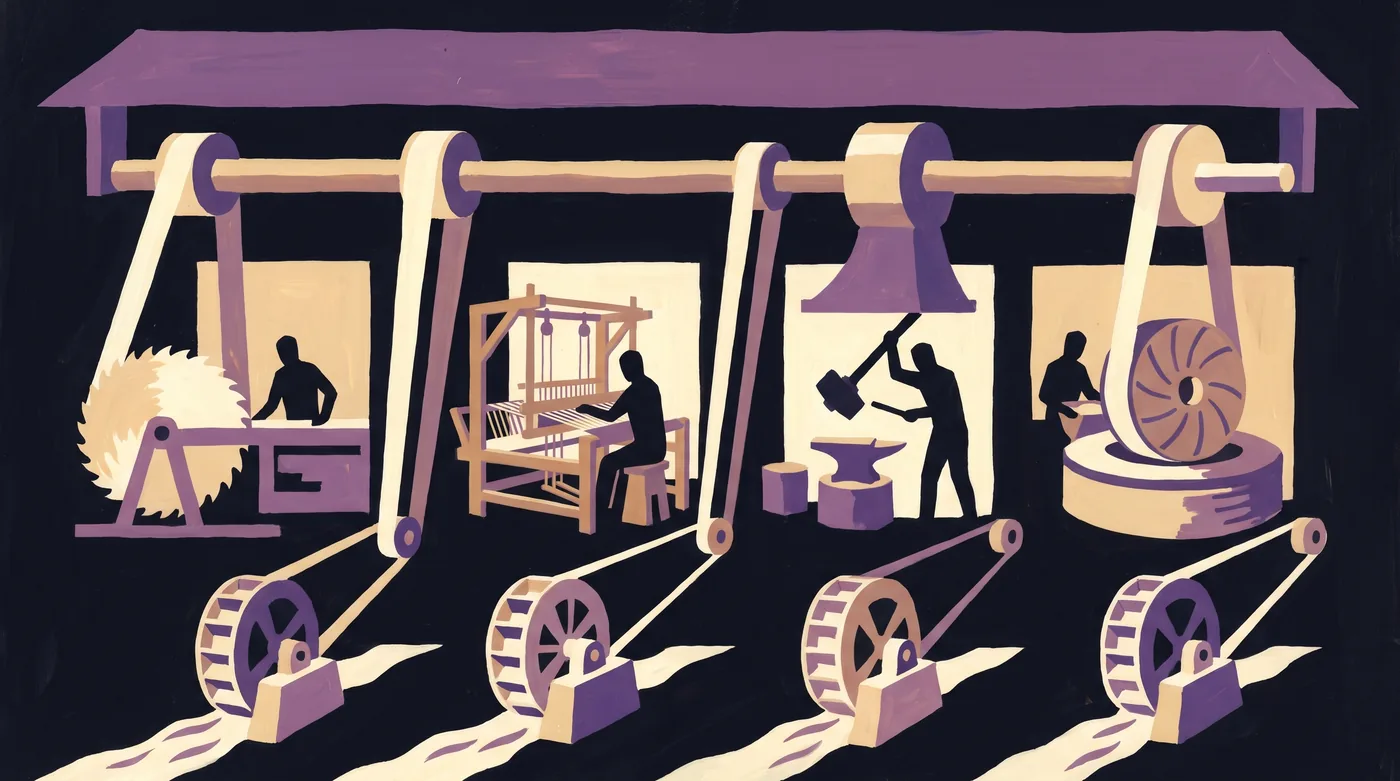
The free release should contain usable work
The original publishing design sets aside substantial bodies of learning for open releases, potentially on a quarterly or annual rhythm. Playbooks, tooling patterns and lessons from engagements would become public educational material. The proposed treatment includes developed visual and interactive explanations, where those forms help a reader understand or use the work.
The release has a different job from the paid service. It should help someone who will never become a customer. A reader should be able to understand a method, inspect an example or apply a bounded procedure without paying for the next explanation. The paid bundle would provide the operating organization, adaptation and responsibility for an agreed engagement.
Publishing also costs work. Someone has to distinguish a customer-specific discovery from a reusable method, check the claims, prepare the material and maintain whatever is released. A useful free resource can demonstrate capability, but calling it free distribution would hide the production and support costs.
Customer permission matters before any of that work becomes public. An engagement may expose confidential information, a business weakness or material that belongs to the customer. A team can teach a general method without publishing those details. A result needs permission and evidence before becoming a case study, especially when the outcome depended on several contributors.
The standard for a public lesson should match the standard for the sale. A proposed mechanism remains a proposal. A measured result keeps its conditions and limits. A failed experiment can be useful when it explains what was tested and what remains unresolved, without attaching a diagnosis that the work didn't establish.
Paid access needs its own reason to exist
The original plan includes a community ladder, with Skool, private groups, VIP programs and coaching as possible forms. That list describes a distribution design. It doesn't establish which programs are operating or create a current invitation to buy one.
Each proposed level needs a distinct useful job. A community might let practitioners compare implementation problems. Coaching might support someone doing the work themselves. A managed engagement might serve a customer who wants the provider to operate the system. The difference is the work and responsibility supplied, not merely access to a smaller room.
The people attracted by public education will also differ from the people buying enterprise fixes. A student can value the explanation without having a budget or authority to commission a deployment. A specialist can contribute expertise without being a sales prospect. A business operator can use the public work to assess the provider before discussing a private problem. The organization needs to serve those relationships without treating every reader as a lead ready for a contract.
Becker's video acknowledges content as a distribution method while warning that it's demanding for a first-time founder already trying to build a company. That warning survives my choice to make publishing part of this model. The content operation needs resources and evidence of its own value. A founder who can't yet deliver the core service may be adding another demanding business before the first one works.

The proposed advantage is cumulative learning: useful engagements improve the methods, professionals contribute to those methods, and the public work helps suitable people find the organization. Whether those effects reinforce one another has to be observed. The long-term intent is to operate internationally on standard terms, with agreements that still fit each engagement and the rules that apply to it. The model can begin with one good explanation from one real engagement. Global reach remains a later ambition.
Start with one engagement you can evaluate
A founder considering this framework can begin by preparing one proposed engagement. Name the business problem, identify the person who can authorize the work and describe what will be observably different after delivery. Then decide what must change on each side for that result to be possible.
The agreement should make the delivery obligation inspectable before it asks the buyer for an annual commitment. A buyer should be able to distinguish the initial installation from continuing operation and see how both are funded. A seller should be able to describe what happens when the promised result doesn't occur without relying on a future sale to pay the remedy.
The decision can be worked through in order, with each answer changing whether the next step is justified:
- Establish the problem using the customer's actual work and records. A large revenue number alone doesn't qualify the opportunity.
- Agree on the result and how both parties will inspect it. Separate a working output from a commercial effect that depends on other causes.
- Identify required access, decisions and customer changes. Resolve a missing authority before making it a delivery dependency.
- Work out the cost of the initial proof, the continuing service and the agreed remedy. Compare annual billing with payment after bounded proof.
- Choose what can be reused without making the current customer's delivery depend on an unfinished future product.
That process can end in a sale, a smaller investigation or a decision to stop. All are legitimate outcomes. An uncertain opportunity may need paid diagnosis before anyone can define a larger promise. A well-understood problem may suit a focused implementation with no reason to add a recurring subscription. The framework should help the parties choose, rather than force every customer into the same invoice.
A buyer can ask for the delivery plan
An operator evaluating an offer can ask the provider to explain who will do the work after the invoice is paid. The provider's explanation should cover the parts the software performs, the parts people review, the customer's responsibilities and the procedure for exceptions. A demonstration can show some of that work, while the agreement explains what continues afterward.
The buyer can also ask what the guarantee leaves at risk. A refund may cover the service fee while leaving internal staff time and other costs with the customer. A performance guarantee may depend on conditions that need to remain true. Those limits should be understandable in the same language as the promised benefit.
The provider's previous results can inform the conversation, but they can't establish the outcome of this engagement. I'd rather show the proposed work and explain how it will be evaluated than ask someone to buy on the strength of an unrelated success.
My target for the managed framework remains substantial businesses with expensive, specific problems. A smaller business may get its value from the open education or a narrower piece of work. A company without a defined problem, necessary access or willingness to change the relevant process is a poor fit for a guaranteed implementation, whatever its size.
The annual payment still comes with a year of obligations. A business has earned the use of that cash when it can explain how it will deliver the customer's year, fund the promise if it fails and improve the work without spending money already owed to fulfillment. I want the software, the service and the ownership retained by the founder to follow from that agreement.