
The medium is never empty.

I. The crystal that should not exist
Somewhere in this galaxy, a star 20 times the mass of our sun ran out of fuel, and its core gave way. Collapse at that scale is a fall before it's an explosion: a ball of iron the size of a planet drops inward in under a second, the outer layers blow away as a supernova, and what stays behind is a sphere about 20 kilometers across that outweighs the sun. It spins several times a second. In the rare cases this note cares about, it also carries a magnetic field between 10^14 and 10^15 gauss. Astronomers call these rare cases magnetars.

How strong a magnetar's field is
Numbers with 14 zeros mean nothing on their own, so here is the ladder. The magnet on your fridge runs about 100 gauss. A hospital MRI, strong enough to fling a wrench across the room, is about 15,000. The strongest sustained field ever built in a laboratory sits near 1 million. A magnetar starts 8 orders of magnitude above that. At that strength, magnetism stops being a property an object has and becomes the main thing its neighborhood is made of.
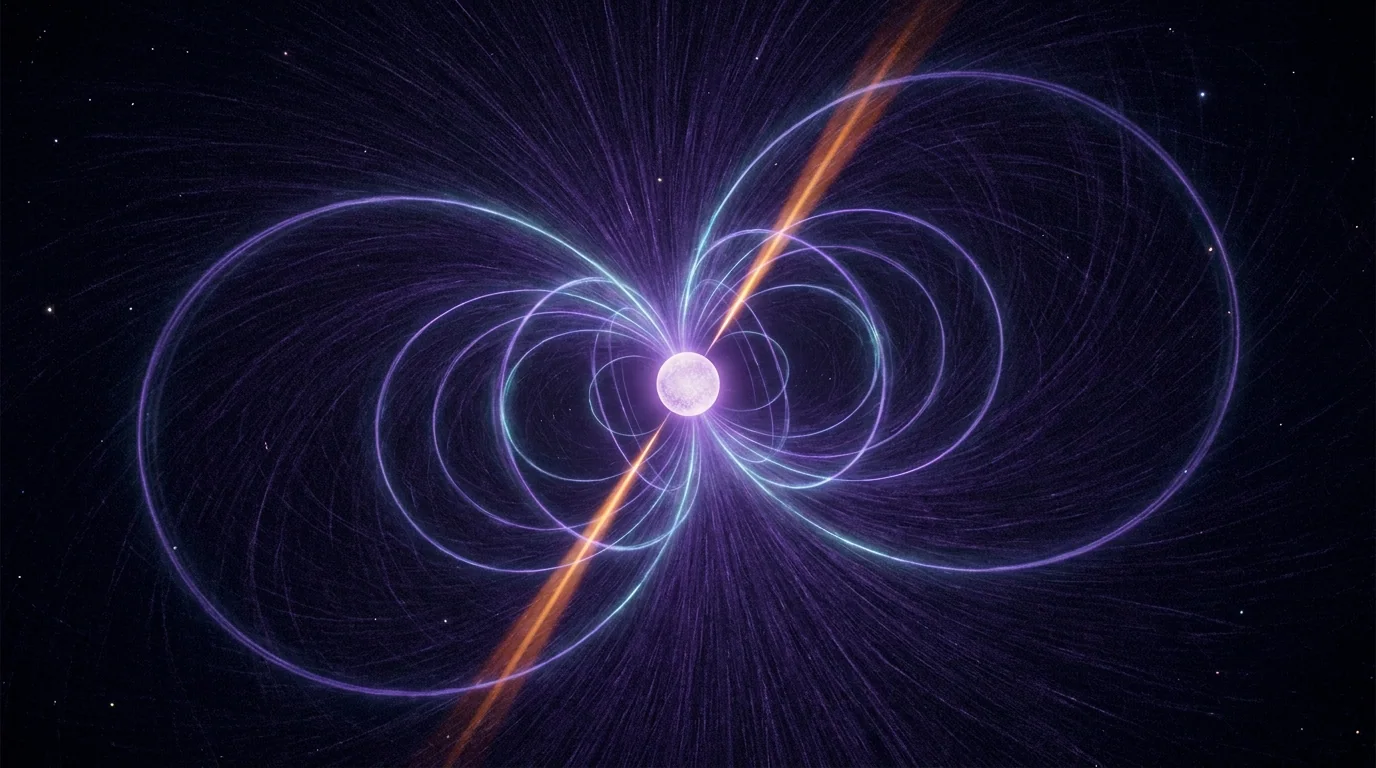
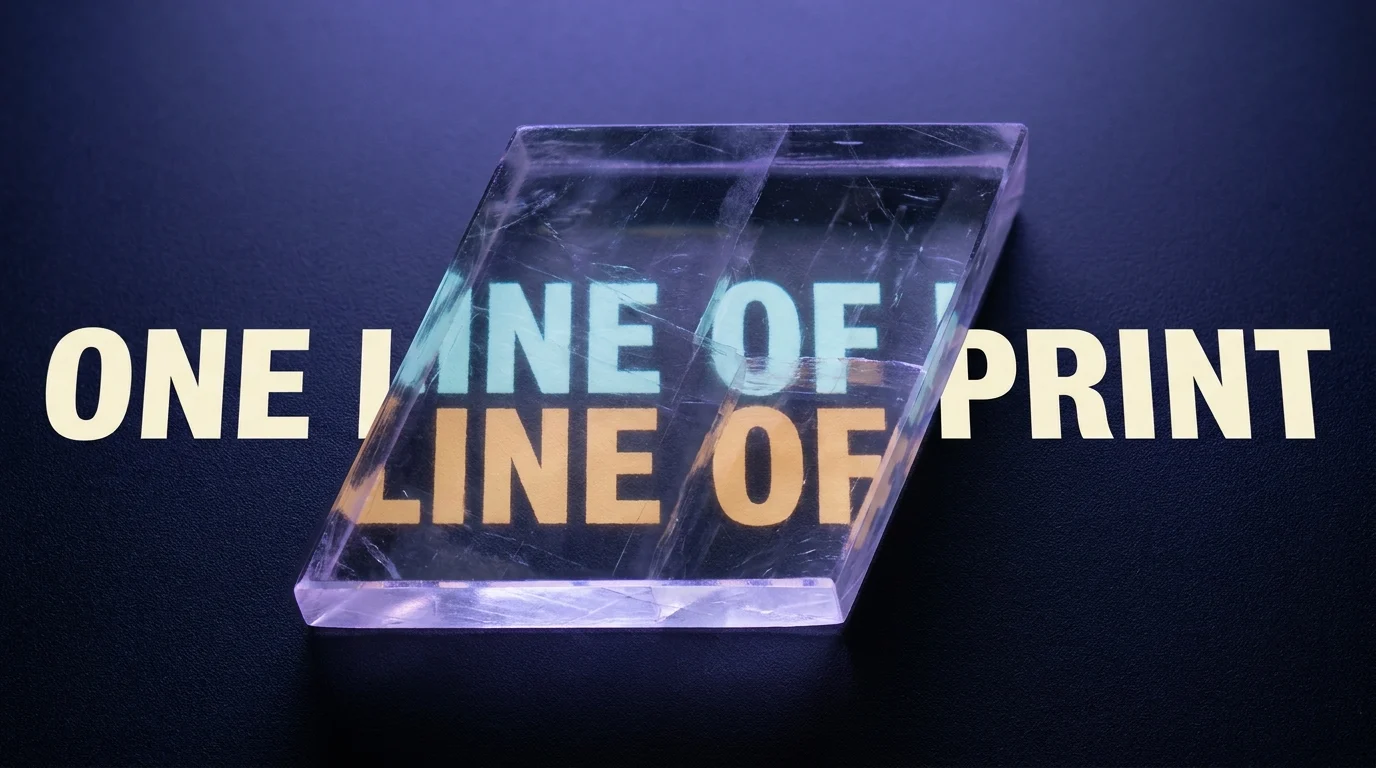
Since 1936 there has been a line drawn through physics at 4.41 × 10^13 gauss. Werner Heisenberg and Hans Euler, working out what Dirac's new picture of the vacuum implied, showed that past this field strength empty space should stop being optically boring. Light crossing it splits by polarization: waves oriented one way travel slightly differently from waves oriented the other way, through what is supposed to be nothing. Tabletop optics has a name for that behavior. It's what calcite does, the crystal that doubles the image of anything you view through it.

Except here there is no crystal. There is nothing at all, and the nothing has a preferred direction.

Why this note calls it space crystals
Physicists call the effect vacuum birefringence, and that's the only time the term will appear in this note. I've been calling it space crystals, which says the same thing in plainer words: crystal optics, happening in empty space, around the corpse of a star. And it's stopped being purely a line on paper. In the last few years, X-ray telescopes watching magnetars have measured light arriving organized in just the way the 80-year-old prediction demands. The physicists' own careful words for that are strong evidence rather than proof.
An event violent enough to belong to fiction leaves behind an artifact. Around it, a medium every instinct says is empty turns out to have had structure all along, and nobody could see that structure, because seeing it takes a field strength nothing on Earth can produce.

II. I keep borrowing instruments
I haven't been able to stop thinking about space crystals for days, and the days have felt long. The idea arrived sideways: I was deep in a stretch of work on retrieval systems, the machinery that moves a question through a body of knowledge and brings something back, and a conversation about magnetars cut straight across it. By the second day I understood why it wouldn't leave: the physics was describing my job.

The instruments this note inherits
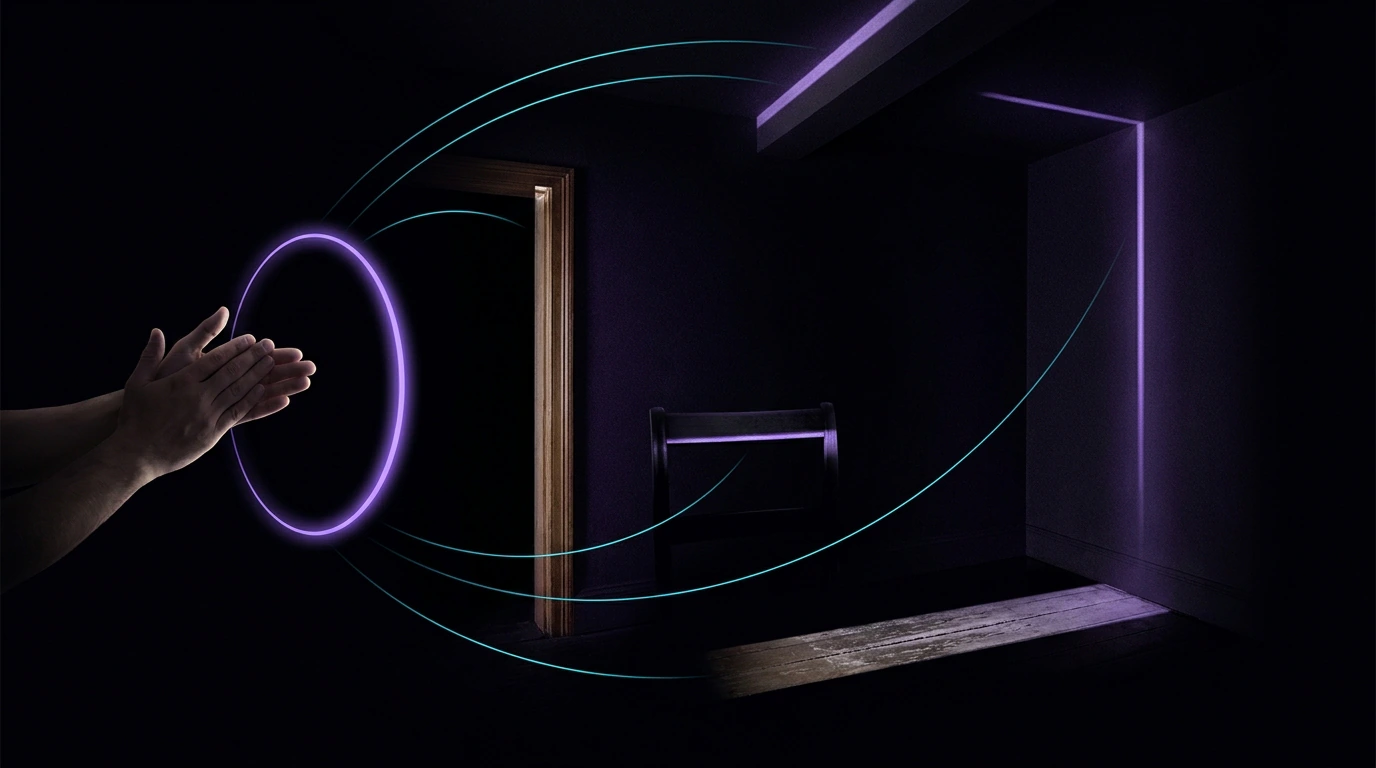
This isn't the first time I've taken an instrument from nature because business wouldn't hand me one sharp enough. On WikiDesignCo I wrote a long piece about echolocation: a bat screaming into the dark and rebuilding the world from what comes back. That article is this note's direct ancestor; everything I've written since about sensing a market descends from the bat. When I later wrote about mapping relevance, the piece opened with a clap in a dark room. The clap was the bat's scream wearing street clothes.
What both earlier pieces walked past
Echolocation was about the probe: you learn by sending signal out into the dark. The mapping work was about the returns: what you draw once the signal comes home. Space crystals is about the part both of those pieces walked straight past. Every probe crosses something before it returns. The bat's scream crosses air. A sonar ping crosses ocean. A question crosses a corpus, an offer crosses a market, and the standing assumption under all of it, so standard nobody says it out loud, is that the crossing is free and the medium in between is nothing.

The magnetar is a 20-kilometer counterexample.
| Phenomenon | What it teaches | Where it lives |
|---|---|---|
| A bat in the dark | Send a signal out and rebuild a room you cannot see from what comes back | Sensing a market before it will tell you anything directly |
| A clap in a dark room | The returns draw the shape of the territory, assembled out of fragments | Mapping which parts of a body of knowledge a question can actually reach |
| Light crossing a magnetised vacuum | The medium a signal crosses has structure of its own, and hands two speeds to one signal | Reading retrieval as optics, with the embedding space as a medium rather than a void |
There's a rule I hold these notes to: a lesson has to come from somewhere, and the piece has to show you where. This one comes from a dead star, and from the specific days I spent unable to put it down, because I build systems whose entire job is to move meaning through media everyone treats as empty, and a piece of measured physics had just told me that the most famous empty medium in existence isn't.
III. What the physics actually says
The vacuum of quantum theory was never the vacuum of common sense. In the picture physicists have worked from since Dirac, empty space is busy at every point: pairs of particles flicker into existence and cancel back out, everywhere, constantly, each pair gone too fast to catch. The flicker is machinery, and it sits behind some of the most precisely tested numbers in science: the same theory predicts the electron's magnetic moment to roughly one part in a trillion, and the prediction holds. Nothing, examined closely enough, is a crowd.

Ordinarily the crowd cancels itself perfectly. Light passes through as if through nothing, because on average there is nothing there to feel. A strong magnetic field breaks the tie. Threaded through by enough field, the flickering acquires a preferred axis, and light stops meeting one medium and starts meeting two: a wave shaking along the field's direction travels through slightly different vacuum than a wave shaking across it. One nothing now has two refractive indices. The formal name for field-induced splitting of this kind is the Cotton-Mouton effect, which laboratories usually demonstrate in liquids. The household version is still calcite.

Polarization, without the physics degree
If polarization feels abstract, you've already used it. A light wave shakes as it travels, and the direction of the shake is its polarization. Glare off a wet road shakes mostly side to side, which is why polarized sunglasses, built to block that one direction, kill the glare while letting the rest of the scene through. Every pair of polarized lenses is a cheap instrument for telling light apart by its mode. The magnetized vacuum runs the same distinction with higher stakes: the direction of the shake, measured against the direction of the field, decides which of the two media a given wave experiences. The same beam crosses the same nothing two different ways.

The reason nobody notices any of this while walking around is size. At the field strength of a good laboratory magnet, a few tesla, the predicted difference between the two indices is a couple of parts in 10^23. A light wave crossing a full kilometer of that vacuum would slip out of step by a distance on the order of a hundred-thousandth of the width of a proton. Past the 1936 line, the arithmetic changes scale: at magnetar field strengths the difference climbs to a few percent, which is the territory of everyday transparent materials. It's the same medium and the same mechanism, 20 orders of magnitude apart in visibility.

How strong each claim is
Because I'm going to build on this, I want the strength of each claim on the table, and I had every one of them checked against the current literature before writing this section. The 1936 prediction is standard theory. The laboratory search has run for a quarter century, and bounds are all it has produced. In 2016, optical polarimetry of an isolated neutron star found polarization consistent with the effect. In 2024 and 2025, X-ray polarimetry of magnetars found much stronger signatures, with the energy-dependent behavior the models call for, and the field's careful phrase for that evidence is strong, with at least one published analysis arguing it is still short of compelling on its own. Where physicists say consistent with, this note says consistent with.
| When | What was done | How strong the claim is |
|---|---|---|
| 1936 | Heisenberg and Euler work out from quantum theory that past a certain field strength empty space should split light by its polarization | A prediction. Standard theory ever since, and untested at the time. |
| A quarter century, ending in bounds | PVLAS bounces a polarized laser tens of thousands of times between mirrors inside the strongest magnets available, hunting a difference of a couple of parts in 10^23 | Null, with bounds. Ever more precise statements of how large the effect cannot be, and no detection. |
| 2016 | Optical polarimetry of an isolated neutron star measures around 16 percent linear polarization | Consistent with the effect. The phrase the field uses, and the phrase this note uses. |
| 2024 and 2025 | X-ray polarimetry of magnetars measures much stronger signatures, carrying the energy dependent behavior the models call for | Strong evidence. At least one published analysis argues it is still short of compelling on its own. |
Three facts carry forward from the physics.
- The structure is always present. The capacity for structure is present everywhere in the medium before any field arrives; the field's contribution is visibility.
- Visibility has a threshold. Below the threshold an instrument that refuses to invent signal reads null.
- The reading itself is differential. The measurement compares two modes of the same signal through the same medium, and the split is the finding.
Those three facts are what I carry indoors.

IV. The vacuum in your retrieval stack
When machines read, text becomes coordinates. Every sentence in a corpus is converted to a point in a space with thousands of dimensions, arranged so that things close in meaning sit close in the space. That coordinate space is the substrate under every AI system that retrieves knowledge: the chatbot answering over your documents, the agent researching across your files, the search box that finds meaning instead of keywords. All of them work by dropping a question into that space and collecting what sits nearby. And nearly all of them treat the space the way physics treated the vacuum before 1936: as a neutral emptiness where distance means the same thing in every direction, for every traveler.

What a trained embedding space holds
A trained embedding space was produced by a model that read more text than any civilization has, and every region of the space is saturated with what that reading taught: which distinctions the model learned to care about, which ones it collapsed together, which directions carry dense meaning and which are nearly dead. Distance in one neighborhood doesn't mean what distance means in another. The priors are this medium's version of the flickering pairs: invisible, present at every point, and felt by every signal that crosses.
Take the word cancel. It lives in a dense, anxious region of the space, packed tight with refunds and disappointments and switching costs, because the model met it a billion times in exactly those moods. Your product's internal codename lives nearly alone, in thin air, because the model met it never. Drop a customer email into the first region and its five nearest neighbors are practically synonyms; drop a technical spec into the second and its five nearest neighbors can be strangers wearing similar words. The two retrievals have the same distance on paper and wildly different meaning in practice. That's what it costs to assume the medium is uniform.

The current generation of embedding models accepts a declaration of intent alongside the content: embed this text as a question, or as a document, or for classification, or for clustering. Same sentence, different declared mode, different vector, different neighbors. Two modes of one signal traveling the same medium differently is polarization, about as literally as an analogy is ever allowed to get. Nobody had to build this into the physics of the space on purpose; it ships in the APIs today. Almost nobody treats it as a measurement opportunity instead of a configuration chore.

Retrieval engineering is medium engineering
Seeing the space as a medium changes the job description. The standard move, grab the handful of nearest neighbors to the question and hand them to the model, quietly assumes the void: it works when the answer physically sits in one nearby chunk, the way a refund policy does. And everything you do to a corpus beyond dumping it in, the enriching, the connecting, the layering of summaries over sources, is engineering of the medium itself: every pass changes what a crossing signal encounters. Retrieval engineering is medium engineering. I've spent the better part of two years on exactly this work, which is why a magnetar interrupted it so easily.

There's one more layer down, because the ground is still moving. Multimodal used to describe storage: relational tables here, documents there, vectors in a third place. Then it described data: text, images, audio held by one system. The newest embedding models will place a photograph and a paragraph into the same space, and with that the word reaches the bottom of the stack: one medium through which every kind of meaning travels. The medium got unified before most of its users noticed it had properties.
| Layer | What multimodal meant there | What a question gains |
|---|---|---|
| Storage | Several kinds of store standing side by side: relational tables here, documents there, vectors in a third place | One system to ask instead of three, with the meaning still split across them |
| Data | Several kinds of content held by one system: text, images, audio | One place to look, while each kind still travels in a lane of its own |
| Embedding | A photograph and a paragraph placed in the same space by the same model | One medium every kind of meaning crosses, which means a question can cross it too |
Where the tools you know stop
Swap github for deepwiki in any public repository's URL and a generated wiki appears, with a question box sitting on top of it. Andrej Karpathy has been public about a version he runs over his own notes: raw sources nobody edits, and a markdown wiki above them that a model keeps current as the sources pile up. For someone learning code they didn't write, or keeping a personal Obsidian vault they navigate by hand, that's a good tool aimed correctly.
Step up a level and you reach what I find in most stacks I get called into. Crawl the documentation, cut it into chunks, embed the chunks, store them, hand an agent the nearest few when it asks. Open-source knowledge bases in exactly that shape are everywhere and they earn their keep. Their ceiling is the shape of the index. A bag of chunks has no altitude, so every passage sits the same distance from meaning, and asking becomes a proximity lookup. That's the void assumption from the top of this section, shipped as a default.

Plenty of what gets built on that ceiling is decoration: a graph visualization that looks like a galaxy and answers no question anyone asked; an agent operating system with gorgeous easing curves that makes nothing faster, nothing cheaper, and nothing less likely to break; ten browser tabs posting on a schedule, beautiful in a screenshot and miserable to run on a Tuesday. Ask three things of it: faster, cheaper, safer. Looking clever isn't on the list.
There's a room past that ceiling with furniture in it, most of it assembled the hard way on client work. In it sits retrieval that runs vertically as well as sideways, so a question about six months of calls gets answered at the altitude it was asked, from summaries built over clustered sources and checked against the passages underneath. There's also a working vocabulary of entities and relations that grows as the corpus teaches it distinctions nobody wrote down on day one, citations that fire only when the thing cited exists on the page, and time and confidence carried as data. Almost nobody knows that room is there, and I have sympathy, because I didn't know crystal optics could happen in empty space until a few days ago.

Physics learned this lesson the hard way, and I recognize the shape of that story from my own work.
V. The sky beat the lab
In a laboratory in Italy, an experiment called PVLAS spent roughly 25 years trying to catch the vacuum in the act. The design was heroic: a polarized laser bounced tens of thousands of times between exquisite mirrors inside the strongest magnets available, accumulating path length, watching for the faintest ellipticity to creep into the beam. They were hunting an index difference of a couple of parts in 10^23, and the outcome, in the collaboration's own summing up, was a set of bounds: ever more precise statements of how large the effect could not be. A quarter century of refinement, and the needle never moved, for the reason section III named. At a few tesla, the structure of the medium sits 20 orders of magnitude below household visibility. The instrument reported the bound it measured. The field was weak.

The sky was broadcasting the whole time
The entire time, the signal was pouring out of the sky for free. Magnetars hold fields 10 to 100 times past the 1936 line as a resting condition, no funding round, no mirrors, no vacuum chamber, because the star is the vacuum chamber. Light leaving the neighborhood of such a star crosses structured vacuum on its way out, and the medium organizes the light as it goes. All anyone had to do was point an instrument that could read polarization in X-rays, which is far harder than it sounds; the first satellite capable of it reached orbit only in the last few years.

The measurements came in layers. In 2016, optical astronomers looking at a lone neutron star found its faint light about 16 percent polarized, consistent with the effect and hard to explain without it. Then the X-ray polarimeter turned to magnetars, and the numbers stopped being subtle. One of them arrives at Earth with its X-rays polarized around 65 percent on average, peaking near 80 at points in the star's rotation. The polarization also changes with the energy of the light, in just the way models of a structured vacuum call for; in a sibling magnetar the polarization direction swings a clean 90 degrees between energy bands, which is the kind of fingerprint that leaves rival explanations doing awkward gymnastics. Stated at its true strength, the field's verdict is strong evidence, with the dissent section III already noted.

What the telescopes actually measured
The telescopes read alignment: light arriving with its polarization organized, carrying the memory of the medium it climbed out through, frozen at the altitude where the medium's grip finally lets go. The vacuum signs everything that crosses it, and the signature is read as a split: how one mode of the signal fared against the other, through the same medium, from the same source.

The structure was there in 1936, and it was there through every null year in Italy. What 2016 and 2024 changed is the seeing, and the seeing changed because the instruments pointed somewhere new. The laboratory strategy synthesizes extreme conditions and has spent a quarter century producing bounds. The sky strategy finds conditions that are already extreme and produced strong evidence within a few years of owning the right instrument. Both are legitimate science. One of them is also a lesson in where to look.
| What was compared | The laboratory | The sky |
|---|---|---|
| What it cost | A quarter century of funded work, exquisite mirrors, the strongest magnets available, and a vacuum chamber | Nothing. The star was already running, and the star is the vacuum chamber |
| Field strength | A few tesla, which puts the effect 20 orders of magnitude under household visibility | 10 to 100 times past the 1936 line, held as a resting condition |
| How long until a reading | Roughly 25 years | A few years from owning an instrument that reads polarization in X-rays |
| What came back | Bounds: ever more precise statements of how large the effect could not be | Strong evidence, with at least one published analysis in dissent |
VI. Field strength for a corpus
Come back to your own stack with the physics in hand. The corpus is the medium. Questions are the light. So what plays the role of field strength? Two factors do, and they multiply. Mass is the first: how much the corpus actually holds, in words, transcripts, tickets, calls, contracts. Enrichment is the second: how much of the corpus's structure has been made explicit. That covers who is named in each passage and what they are to each other, when each fact was true and when it stopped being true, where each claim came from, which distant sections are secretly about the same thing, and what sits above the raw text as summary and below it as source.
| Layer | What it makes explicit | What it buys the question |
|---|---|---|
| Entities | Who and what is named in each passage, and which mentions are the same thing | Two calls about one account stop being two unrelated blocks of text |
| Time | When each fact was true, and when it stopped being true | Sequence exists, so a question can ask what came before what |
| Provenance | Where each claim came from and who said it | An answer can carry its trail back to the passage that earned it |
| Confidence | How strongly each extracted fact is held | A weak reading gets reported as weak instead of stated flat |
| Cross-links | Which distant passages are secretly about the same thing | Answers that live between regions become reachable at all |
Which questions need field strength
Some questions never need any of that. A lookup question, what is our refund window, behaves like light in a weak field: the answer sits whole inside one nearby chunk, and the void assumption serves fine. Other questions are threshold signals. What themes run through six months of customer calls? What connects a complaint in the support queue to a clause in the contracts? What's conspicuously absent from our proposals that competitors keep winning on? These fail against a thin corpus for a structural reason: their answers live in relationships between distant regions, and at low field strength those relationships never become visible to the pass that fetches context. The answer sits in the medium itself, spread across connections no single chunk contains.

Watch the difference field strength makes on one question. Take six months of recorded customer calls and ask what is driving the cancellations. At low field strength, raw transcripts behind nearest-neighbor search, the answer comes back as word frequency wearing a suit: customers mention price, support, and features. That's true, useless, and indistinguishable from what a word cloud knew. Now raise the field. Name every person, plan, and competitor across the transcripts so the system knows two calls mention the same thing. Stamp when each complaint happened, so sequence exists. Link each call to the account's fate, so outcomes exist. Ask again, and the question finally has structure to grip: which complaints cluster on the accounts that actually left, what those accounts asked about in the quarter before leaving, which competitor name started appearing first.

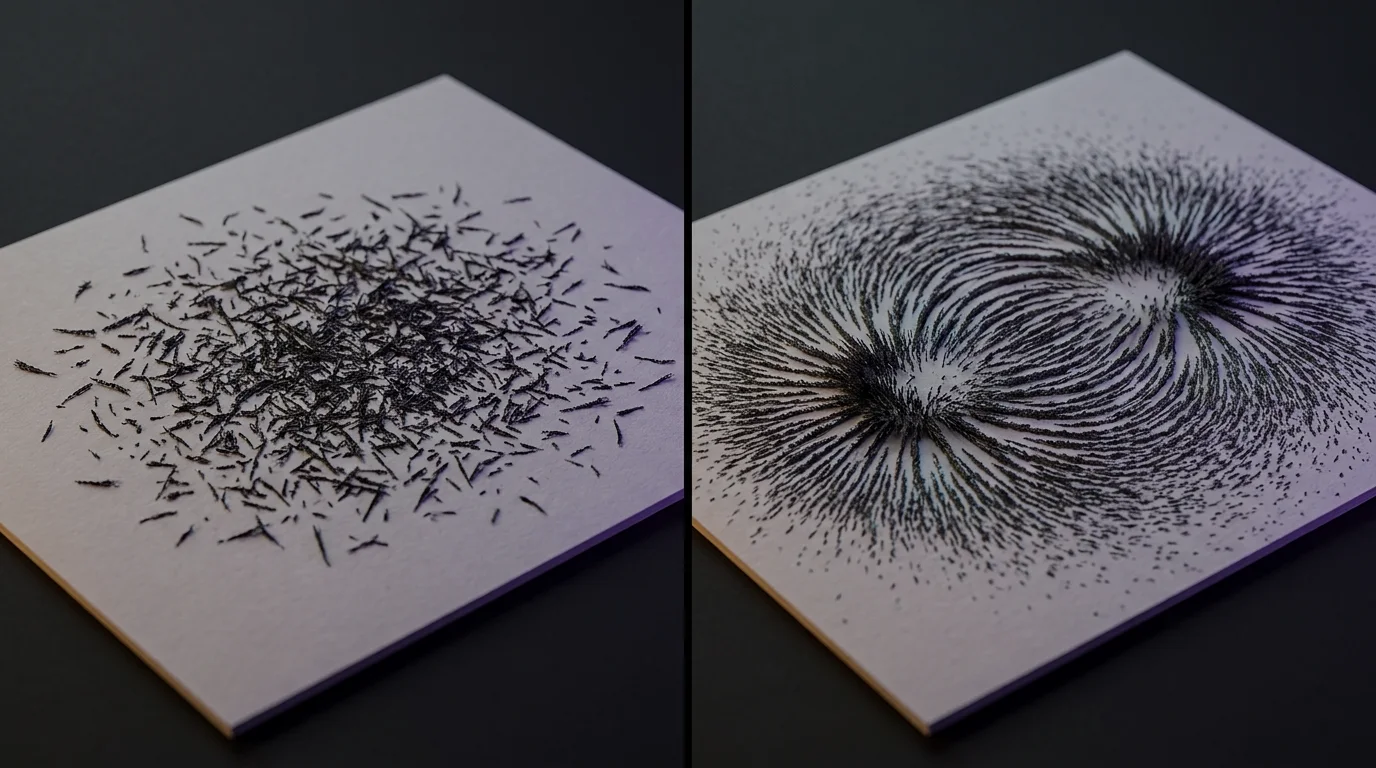
I've watched teams run this experiment once, get mush back, and file the conclusion that these systems can't do real analysis, or worse, that their own data has nothing in it. That's a PVLAS conclusion: a null read at low field strength, and it says almost nothing about the medium. The structure of a business's accumulated language, like the structure of the vacuum, was there the whole time. It costs field strength to see.

Volume is not the trophy
The trap on the other side is counting. A million chunks ingested makes a satisfying number and means nothing by itself, because mass matters only as the thing enrichment multiplies. A corpus twice the size at zero enrichment is a longer null result. Volume is field strength at best. The trophy is what the corpus can answer that it couldn't answer before.

So before concluding that your accumulated years of calls, tickets, documents, and deals have nothing to say about why customers leave or what your best clients have in common, ask one question first: what was the field strength when you asked?
VII. Measure the split, not the signal

Physics read the structured vacuum differentially, every time: two modes of one signal, one medium, and the split between them is the entire finding. That instrument transfers whole, and you can run it on a corpus with tools that already ship.

The twin test
The cleanest version I know is a twin test. Same model. Same instructions. Same corpus. Two retrieval paths: one flat, nearest neighbors and nothing else, and one through the enriched, layered medium. Ask both twins the same battery of questions, lookups and threshold questions together, and read the splits. On lookups the twins converge, and they should; for a question whose answer sits in one chunk, the medium may as well be void, and convergence is the correct reading. On threshold questions the split opens, and it opens widest exactly where the medium's structure is doing load-bearing work. The result is a map: question class by question class, where structure pays and where it is decoration. Arguments about whether the sophisticated retrieval is worth its cost stop being arguments. The split is a number.

The twin test is one polarimeter among many, because the APIs hand you mode pairs for free. Embed the same passage as a query and as a document, and the two vectors' disagreement tells you how differently the medium treats asking from asserting. Pose the same question in your customer's vocabulary and in your own, and the split between what comes back measures how far apart those two dialects sit in your corpus. Ask with a time window and without one. Each pair is one signal, two modes, one medium, and each split is a reading of structure you can't see directly.

How to read a split
Reading the splits takes about a paragraph of training. A large split on threshold questions says the structure is present and earning. A small split everywhere says the enrichment isn't doing work yet, or the corpus is genuinely thin; you tell those apart by raising field strength on one subdomain and asking again. A zero split on lookups is health. And every answer that reaches you carries a signature of the medium it crossed, the way the magnetar's light carries the vacuum it climbed through; two answers to one question differ by exactly the media that produced them.
| The reading | What it says about the medium | What to do next |
|---|---|---|
| A large split on threshold questions | The structure is there and it is carrying the answer | Keep paying for the layer that produced it, and note which question classes it pays in |
| A small split everywhere | Either the enrichment is not doing work yet, or the corpus is genuinely thin | Raise field strength on one subdomain and run the same battery again |
| A zero split on lookups | The answer sits in one chunk, so the medium had nothing to add to it | Read it as health, and stop buying structure for that class of question |
The reason this beats another dashboard of retrieval metrics is the same reason physicists trust birefringence measurements at one part in 10^23: a differential reading cancels everything the two arms share. Model quality, prompt wording and the day's luck are identical on both paths, so they all subtract out. What remains is the medium, isolated. That's the whole trick, and it came from a dead star.

VIII. Point the instrument where the field already burns
Business has its own laboratory strategy, and it looks like focus groups, surveys, brainstorm sessions, and quarterly research decks. Those are synthesized conditions, built with real care and measured with instruments that work, and people perform inside them. Ask a customer what they want in a conference room and you get conference-room answers: polite, considered, weak-field. The structure of what they actually fear and want is present in them the entire time, and the synthesized field is nowhere near strong enough to make it visible. A survey is PVLAS with worse mirrors.

Where your market already burns
The sky strategy asks a different question: where are conditions already extreme? Where do people write while believing nobody is watching? They write in one-star reviews of your competitors, in threads that open with some version of is it just me, or, in the support ticket typed in genuine anger, and in the message a founder sends at two in the morning because the invoice didn't clear. I've built diagnosis on these channels for years, keeping files of the exact phrases people use in them, because in those places the field is at full strength and the structure is legible: what actually got them burned, what they're actually afraid of, what they'd actually pay to never feel again. Nobody polishes a one-star review.
The files are the instrument. When someone in one of those channels writes that their last agency ghosted them, or that marketing is a scam, or that they are terrified of paying for another tool nobody on the team will open, that phrasing is light that crossed a strong field. It arrives organized. I lift the exact words, because a sentence forged at full field strength does diagnostic work that no paraphrase survives, and when the same forged sentence shows up across unrelated writers, that repetition is structure: the market's own polarization, readable by anyone willing to collect it.
| Channel | What it answers that a survey cannot | Why the field runs high there |
|---|---|---|
| A one-star review of a competitor | What went wrong badly enough that someone wrote it down with nobody asking | It is written to warn a stranger, so there is no reason to soften it |
| A thread that opens with is it just me, or | Whether a private suspicion is one person's bad week or the market's shape | The writer believes they are alone, so the sentence carries no positioning |
| A support ticket typed in genuine anger | The exact point where the product stopped being worth the effort | Anger removes the editing pass, and the phrasing arrives at full strength |
| A note sent at two in the morning about an invoice that did not clear | What the writer is actually afraid of losing | It is written past the hour when anyone performs for an audience |
The mapping goes one level deeper, and this is where the magnetar stopped being a metaphor for me and became a mirror. What an extreme event does to a person's structure, or a market's, is make it measurable. The structure predates the event. A market crisis shows you which suppliers, which customers, which beliefs were load-bearing, in a way no stable quarter ever reveals. An extreme season in a life shows what a person's operating system actually does under load, as opposed to what it says it does. Extremity is the field strength at which that structure starts organizing the light that passes through.

Why generic writing reads like nothing
Extremity also explains why generic content reads like nothing. It was produced at zero field. Nothing extreme ever crossed it, so it carries no signature, and readers feel the missing signature before they can name it. The rule I named in section II, that a lesson has to come from somewhere, is this same physics applied to prose: writing that crossed a real field arrives polarized, and writing that crossed nothing arrives exactly as it left, which is to say empty.

So audit where your instruments point. If everything you know about your market came from synthesized conditions, you own a beautiful laboratory and a future of increasingly precise bounds. Somewhere, your market is already burning at full field strength, in channels that cost nothing to read. Point there.
IX. The instrument, assembled
Space crystals, the way I now use the words, is an instrument with three moves.
| What came back | The question to ask | What you do next |
|---|---|---|
| A null result | Is the medium empty, or is my field weak? | Raise field strength on one subdomain and ask again before concluding anything about the medium |
| Signal where everyone had agreed there was nothing | What field strength revealed it? | Add whatever produced those conditions to your instrument collection |
| A medium you cannot see directly | What does one signal do when you send it two ways? | Send it both ways and read the split, which cancels everything the two paths share |
The three moves
When a reading comes back null, ask whether the medium is empty or your field is weak, and refuse to confuse those two verdicts. They feel identical from the operator's chair and they couldn't be further apart; one says stop, the other says strengthen.
When signal shows up where everyone had agreed there was nothing, ask what field strength revealed it. 25 years of laboratory bounds meant one thing: the interesting conditions were somewhere else. Whatever revealed the structure is now part of your instrument collection.
And when you want to map a medium you can't see, send one signal through it two ways and read the split. The split cancels everything the two paths share and leaves only the medium, which makes it the measurement least contaminated by the things you can't control.

One seam, stated plainly
There's one seam in this note, and the note stands or falls on stating it plainly. The physics is measured: predicted in 1936, bounded in the laboratory for a quarter century, strongly evidenced in the sky in the last few years, with the caveats given at their true weight in section III. The transfer is mine: an instrument for thinking, carried out of the physics into corpora and markets and writing, the same way the bat's sonar was carried into sensing demand. A borrowed instrument earns its keep the way echolocation earned it: by changing what you do next. Hold it exactly that firmly, and no firmer.

Somewhere in this galaxy, the corpse of that star is still spinning, several times a second, organizing every photon that leaves its neighborhood. It will keep doing so whether or not anyone points an instrument at it, the way the structure in your corpus and your market keeps organizing what crosses it whether or not you ever read the split. The medium is never empty. There is a crystal in the nothing, and it was there the whole time.

I still haven't managed to stop thinking about it. Now it's your problem too.