
1. A map that answers back
Stand in a dark room and clap once.
The sound leaves your hands, hits the walls and furniture, and comes back in pieces. The close wall answers first and the far wall answers later. A curtain softens the return, and an open doorway sends almost nothing back.
You still can't see the room, but it's no longer blank.
Clap again while turning your head, take one careful step, and listen. The second return changes what you think the first one meant: a shape that sounded like a wall may have a doorway in it, and a quiet patch may be soft furniture. You build a usable map by making contact again and again.
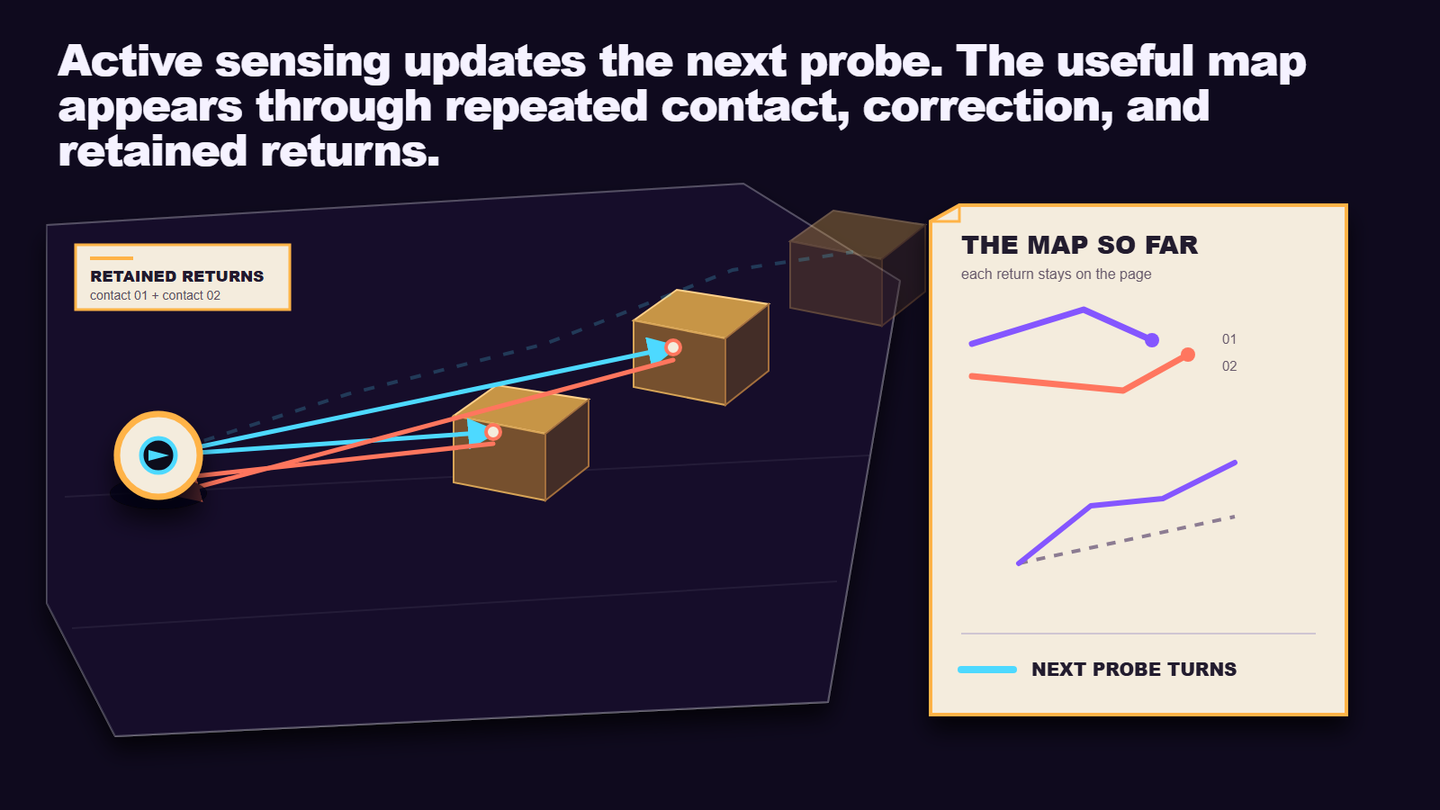
Bats do the same thing with far more precision. Echolocation is a form of active sensing: the animal produces a signal, receives what comes back, and adjusts its next signal to the task and the surroundings. An adaptive echolocation study shows bats changing the structure of their calls in a difficult auditory scene. The return doesn't hand the bat a finished map. It gives the bat evidence for its next movement and its next call.
Hyperrelevance Cartography applies that loop to markets, audiences, and decisions.
An operator sends a probe into a market: a customer interview, a search query, a proposal, a small ad, a pricing page, a field note, a joke, a demo, or a direct question. Something comes back. People click, ignore it, reply, object, buy, share, hesitate, or use words the operator didn't expect.
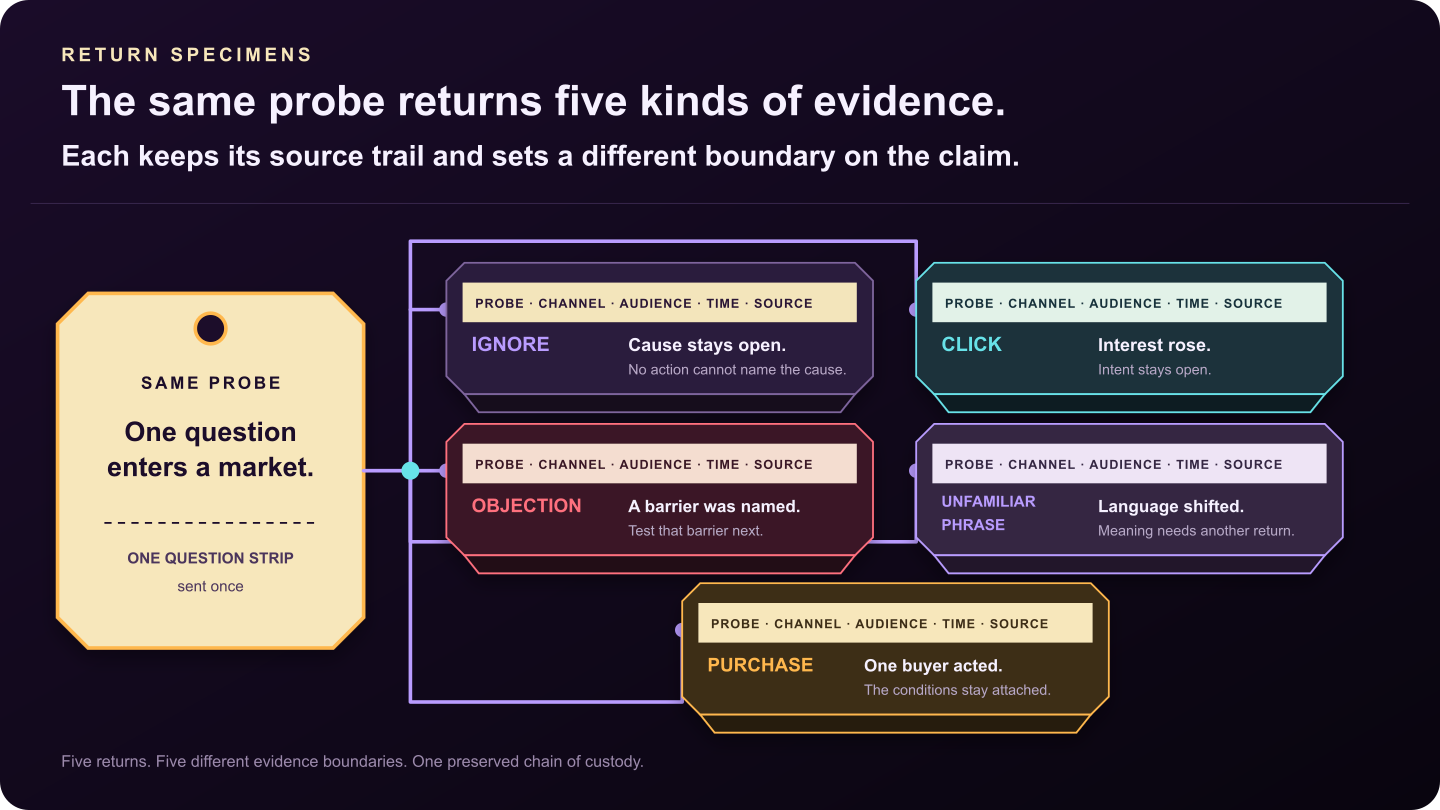
The operator records that return, updates a provisional map, adjusts how much confidence the map deserves, and picks the next probe.
Every useful probe starts from a decision. The decision tells the operator what to listen for, which instrument can hear it, and which result would change the next move. Evidence rules out some paths and real constraints rule out others. The operator then chooses one bounded action, watches what comes back, and changes the map.
possibilities → question → instrument → narrowing → commitment → return → update
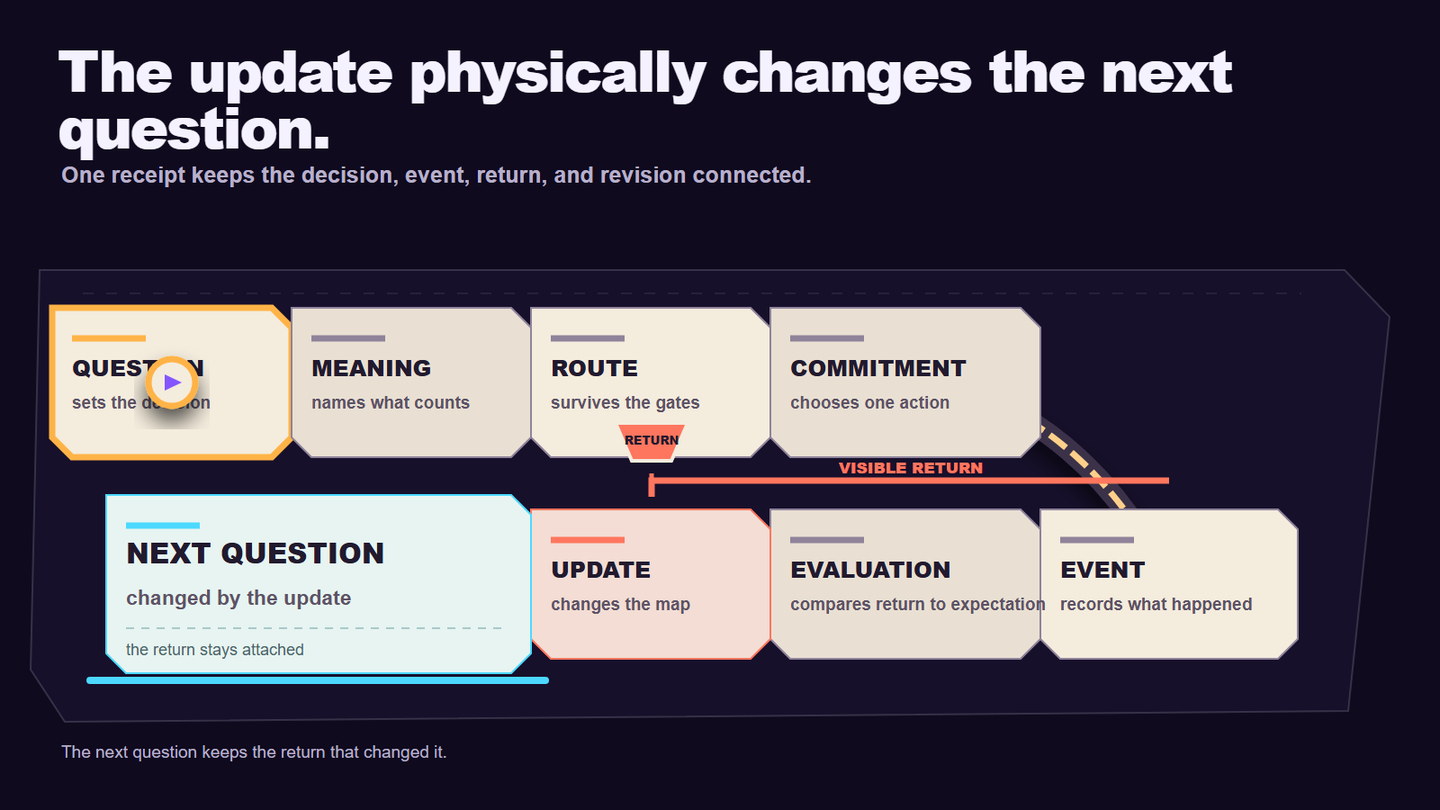
Imagine a team marketing to contractors, deciding which proof belongs on a new landing page. The options on the table are lower price, speed, machine accuracy, less rework, local support, and easier onboarding. The question is specific: which proof will get an Alaska excavation contractor who already owns compatible equipment to book a demonstration this month? The team uses interviews, search behavior, past calls, the budget, and the evidence it already has as its instruments. Claims with no proof drop out, and so do claims aimed at the wrong buyer. Two routes survive. The team commits to a downtime calculator, writes down the response it expects, and publishes the calculator to a bounded audience.
The return might be booked demos, confused questions, silence, or requests for a different kind of proof. None of those responses finishes the map, and each one changes the next test. That cycle is the practical core of intelligence engineering: sensing becomes useful when an observation changes an action and the result of that action changes the model.
The arrows in that chain matter more than the nouns. Research tends to turn into a warehouse, where people collect interviews, reports, screenshots, analytics, and transcripts until the pile feels like knowledge. A pile isn't a map until it changes a decision, and a map doesn't stay current unless later returns can correct it.
Cartography is the right word for this work, because a useful map leaves most of the territory out. A road map ignores tree species, a weather map ignores property lines, and a subway map bends geography so the transfers are easy to read. Each view keeps the differences that matter for one kind of movement.
A market map works the same way. It might show current vocabulary, buyers, objections, channels, competitors, price pressure, trust signals, or the path from attention to purchase, and a different decision needs a different view. The map stays useful as long as it admits what it can't see.
Human returns are not echoes
The echo comparison breaks down in one place. A wall doesn't care that a bat measured it, but a person may change what they do because a company asked them a question. An interview subject may protect a colleague, try to impress the interviewer, forget a detail, or say whatever sounds polite. An ad can create the interest it's trying to measure, and repeated contact can build familiarity or irritation.
A market probe lands inside a social system, and the people in that system interpret the probe before they answer it.
Interpretation makes the return richer and messier, and it makes the record matter more. Each response should carry the question, channel, audience, timing, source, and conditions that produced it, and the map entry should carry a confidence level along with the reason for it.
One proposal ignored by one buyer is weak evidence. Twenty proposals opened and ignored by similar buyers may point to a problem worth testing. A direct objection from a qualified buyer carries different weight from a guess made inside the team. A sale proves that one buyer acted, not that the same message will move everybody else.
A careful cartographer resists promoting every return into a law. The Mirror Ocean goes further into the hard part: a response comes from another person interpreting the probe, not from a passive surface reflecting it.
A trustworthy map stays unfinished
An unfinished map sounds like a weakness, but in practice it's where the reliability comes from.
Once a map is declared finished, people start defending it, and new evidence turns into an annoyance because the answer is already on record. A provisional map expects revision. It keeps the old state, records what changed, and shows which return caused the update.
That history lets another operator inspect the reasoning, and it lets the system learn from being wrong.
Suppose a company believes small contractors care most about price, and interviews support the idea. A pricing test then shows buyers choosing a more expensive package when it includes faster field support and clearer onboarding. The map shouldn't erase the interviews. It should keep both observations, narrow the original claim, and ask a better question next: under which conditions does service certainty outweigh price?
The new probe is better because the old map failed in a specific way. Keeping the old prediction beside the new outcome stops the team from rewriting its expectations after the result comes in. Separating prediction, execution, and observation is the working discipline behind the Observability Manifesto.
Hyperrelevance grows out of that correction loop. The system gets more useful without pretending the uncertainty has gone away.
2. The job of a hyperrelevance cartographer
The title sounds grand, but the work is ordinary enough that anyone can inspect it.
A hyperrelevance cartographer keeps a changing situation legible for a decision maker.
The cartographer finds current evidence, separates observations from interpretations, connects related objects, tracks when claims were true, records confidence, and turns the result into a view somebody can use. After the decision, the cartographer records what happened and updates the map.
That's a different job from general research, which might explain a whole industry. Hyperrelevance work explains the part of the industry that matters for a choice someone is making now: which Upwork job deserves a proposal, which audience deserves a new offer, which client objection deserves a field note, which creative deserves production, or which agent workflow deserves more authority. In every case, the decision sets the lens.
Start with the decision
“Learn everything about construction marketing” has no stop condition. “Decide whether Alaska excavation contractors will respond to a machine-control downtime calculator” has edges. The question is the first instrument, because it turns an unlimited research topic into a decision with an actor, a changed state, and a time boundary. People-Product-Process supplies the buyer-side discipline that makes a question like that worth answering.
The sharper question tells the team which equipment owners matter, which job conditions matter, which downtime costs need proof, which vocabulary signals familiarity, which existing tools compete for attention, and what response would change the decision.
The first research pass maps the domain: who participates, what objects move through the system, what events change its state, which terms carry precise meanings, and which sources own which kinds of truth.
The next pass maps mechanisms: how a buyer moves from problem to search to comparison to purchase, which constraints block that movement, and which signals reveal urgency, budget, trust, or fit.
The third pass tests the map against current evidence. Do the latest job posts, conversations, search results, product releases, and customer actions still support it? Where has the vocabulary changed, and which claims have expired?
Then the team produces a practice artifact, such as a proposal, a piece of content, a tool, a demo, or a campaign. The artifact forces the map to make a prediction, and the market returns evidence. That makes the artifact a test as well as an output.
Five records make the loop inspectable
Every meaningful probe should leave five records:
- The question. What uncertainty was the operator trying to reduce?
- The return. What happened, and what source produced the observation?
- The interpretation. What might the return mean?
- The confidence change. Which belief became stronger, weaker, or more specific?
- The next probe. What test now has the highest value?
The records keep research from turning into theater. A hundred sources can look impressive and leave the decision untouched, while one clean return that eliminates a bad path is worth more. Between them, the five records keep what the team believed before acting, what it did, what came back, how it judged the result, and what it carries into the next run.
They also stop memory from turning into folklore. A team may remember that “customers hated the old offer” when nobody can find the calls, the segment, the date, the offer version, or the exact objections. Later operators then inherit a conclusion stripped of the conditions that made it reasonable, and hyperrelevance depends on those conditions.
Cartographer, engineer, and operator
Three roles overlap in this work. The cartographer builds and updates the map. The engineer builds the instruments and workflows that make mapping repeatable. The operator uses the map to act, judges the return, and holds authority over consequential choices.
One person can wear all three hats, but the distinction still helps.
An automated pipeline that tags named entities can pick out people, companies, products, locations, and relationships, and a retrieval system can bring related evidence into a decision. Both are engineering. Deciding that a cluster represents a new buyer concern takes a cartographer's judgment, and choosing whether to change the offer takes the operator's authority.
Mixing up the roles produces predictable failures. An engineer may build a beautiful graph and assume the visible cluster means something to the business. A cartographer may spot an important relationship and underestimate the work of keeping it current. An operator may act on a dashboard without knowing which assumptions shaped the view.
The loop holds up when the instruments show the choices they made and people can inspect those choices.
Relevance has a clock
Hyperrelevance adds time to ordinary relevance.
A source can be accurate and stale. A tactic can be effective in one platform regime and harmful after a policy change. A buyer objection can dominate one season and disappear after a competitor changes pricing. A voice model can preserve phrases a person stopped using years ago.
Every important claim therefore needs a time boundary.
When was the observation recorded, and when did it become valid? Has later evidence contradicted it? Does the decision need today's state, a historical trend, or both?
The map should be able to say, “This was true then,” without saying, “This is true now.”
That sounds simple, yet many systems either overwrite old facts or keep every fact forever with no visible expiration. Both habits damage reasoning: overwriting destroys the history, and facts that never expire turn old states into current noise.
A map with time built in keeps the sequence. Shape of Data: Provenance explains why a fact needs both a source trail and a clock before another decision can safely reuse it.
3. Why good experts still go stale
Expertise stores compressed experience.
A senior operator has seen patterns repeat, watched tools fail, learned which questions expose weak thinking, and built instinct around consequences. That compression is valuable because nobody can re-derive an entire field before every decision, and the same compression can hide drift.
A paper road atlas can be beautifully made and show every town and highway that existed when it was printed. The atlas becomes dangerous when a bridge closes, a bypass opens, and the driver keeps trusting the old page because it once worked.
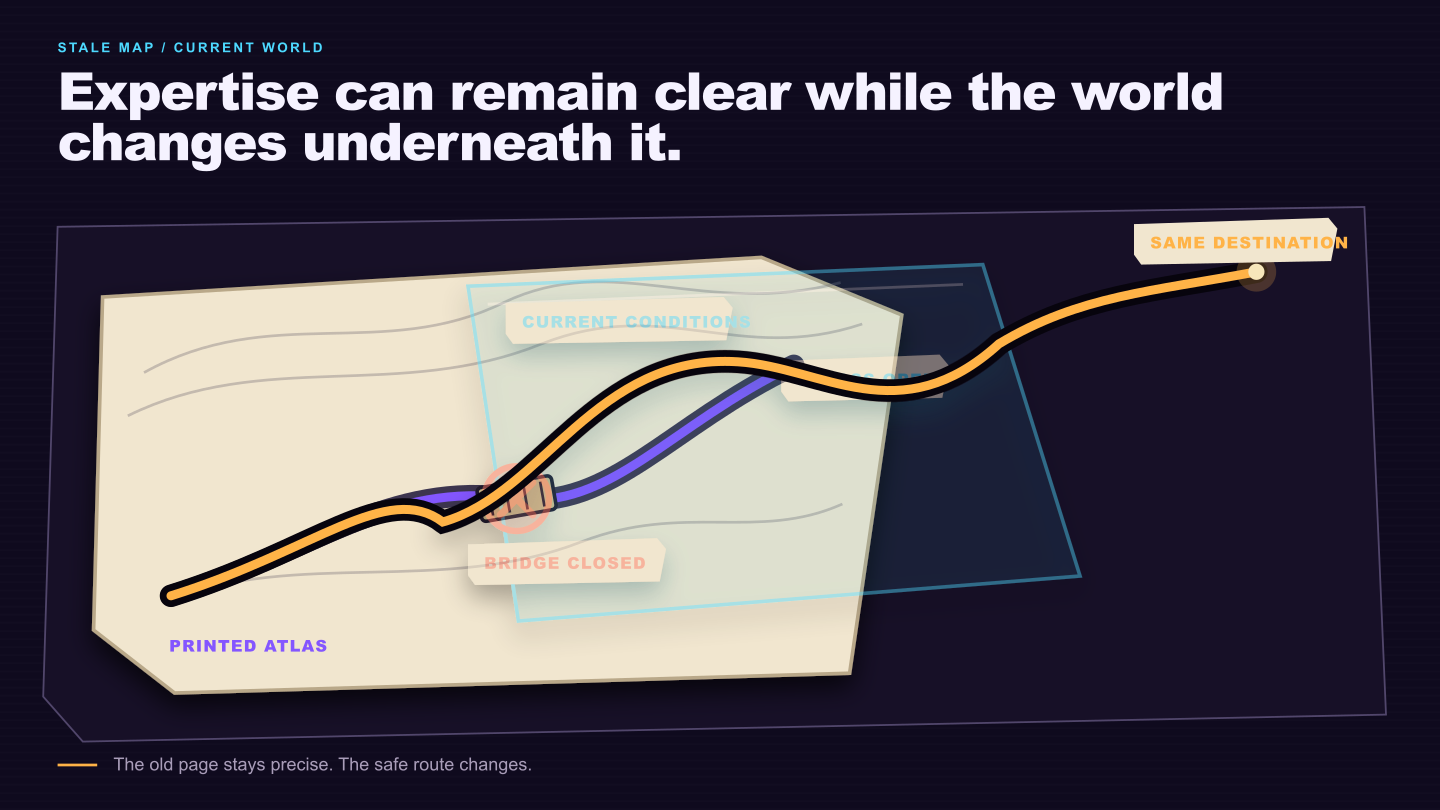
Markets rebuild their roads all the time. Platforms change their ranking systems, buyers learn new vocabulary, and AI tools lower the cost of common outputs. Regulations move, competitors copy successful offers, and audiences develop banner blindness to formats that worked last year. A tactic can decay while the expert's confidence stays high.
Experience and recency solve different problems
Experience helps you interpret a return, and recency tells you what the current state is.
A junior researcher may retrieve the latest release notes and still miss the mechanism that makes the change important. A senior expert may understand the mechanism and miss that the release happened. The strongest system combines current retrieval with experienced judgment. Market Research goes deeper on sensing a changing market without discarding the experience needed to interpret it.
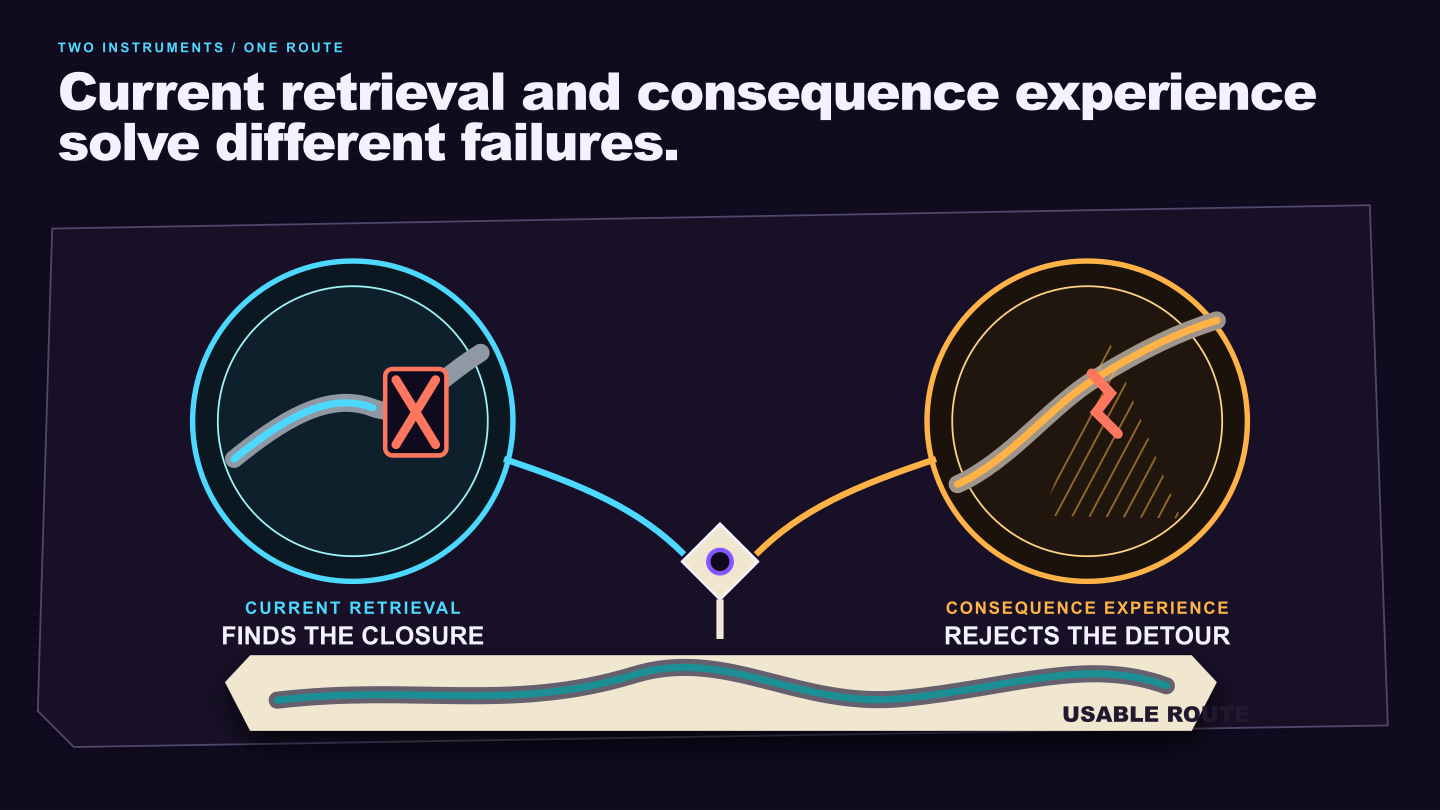
That split changes the familiar junior-versus-senior argument.
A junior backed by a good research platform can gather sources, map vocabulary, compare claims, and run bounded tests at a speed that once took a large team. The junior still needs evaluation, calibration, and a feel for consequences, because the platform doesn't manufacture scar tissue.
A senior expert gets a different advantage from the same system: current evidence can challenge stored assumptions before those assumptions get expensive. The system works as an external memory and as friction against confident recall.
The competition that matters is unaided judgment against judgment connected to current, inspectable evidence, not junior against senior.
Scar tissue changes the route
Some drift is harder than a new software release.
A person can lose a business, a relationship, a home, a body that once moved without pain, or a belief that once made the world feel safe. The old map may stay perfectly clear in memory while the road it describes is gone.
People describe recovery as a return, and that description can send a person looking for a place that no longer exists.
A body may heal from a serious injury through scar tissue. Muscles learn a different load and nerves take a different route. A movement that used to happen without thought becomes a sequence: find the ground, shift the weight, protect the weak point, take the step, check the result.
Andy learned that sequence after spinal surgery, when he had to learn to walk again. Stairs became a full-body problem. Later a backpack held two books, then more weight. Flat ground came before hills, and familiar ground came before varied terrain. Each new radius tested whether the movement held under a little more load.
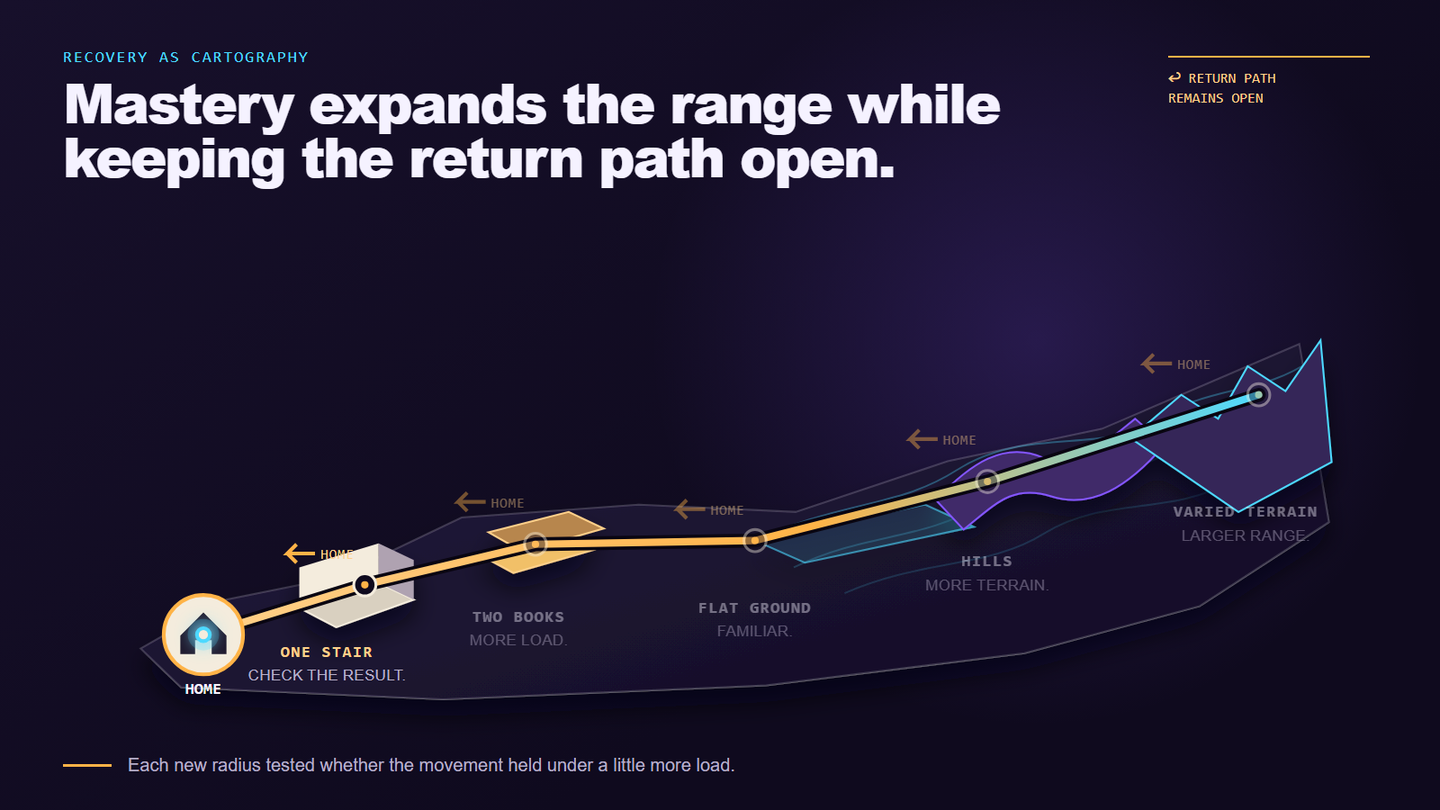
Recovery is cartography at human scale. The first map records damage without turning the damage into an identity. The second records which movement works now, and the third records how far that movement can travel before it breaks. Each return updates the route.
Awareness, skill, and mastery are names for the same progression.
Awareness finds the changed condition. Where does the pain start? Which assumption belongs to the old body, old business, or old market? What can still carry weight?
Skill builds a movement that works inside a controlled range: one stair, one offer, one audience, one test market. The range stays small enough that a bad assumption shows up before it gets expensive.
Mastery expands the range while keeping the return path open, adding more weight, more terrain, a larger market, or a second culture. Mastery doesn't erase the injury. It knows how to move with the body that exists today.
Markets develop scar tissue too. A buyer who paid three agencies and received three polished failures reads a new promise through those losses. A community that watched outside capital arrive, extract value, and leave will treat the next outsider's language as evidence. A technical audience that spent a year correcting confident AI answers will look for receipts before it accepts fluency.
Demographic labels can't hold this history. "Small-business owner," "crypto user," and "construction company" describe broad containers. A scar-tissue map asks what happened, what changed afterward, which words now trigger caution, which proof lowers risk, and which behaviors show that trust is returning.
That history is what turns a customer model into more than a persona card.
Problem, Story, and Transformation provide a useful sequence. A problem is the observable condition. A story is the belief built from repeated contact with that condition. A transformation is a new movement that becomes possible when the person gains enough evidence, skill, and courage to act.
The story layer explains why two people with the same problem choose different routes. One failed campaign may teach a buyer to demand stronger proof. Another may teach the buyer that every agency lies, and a third may teach the buyer to avoid marketing altogether.
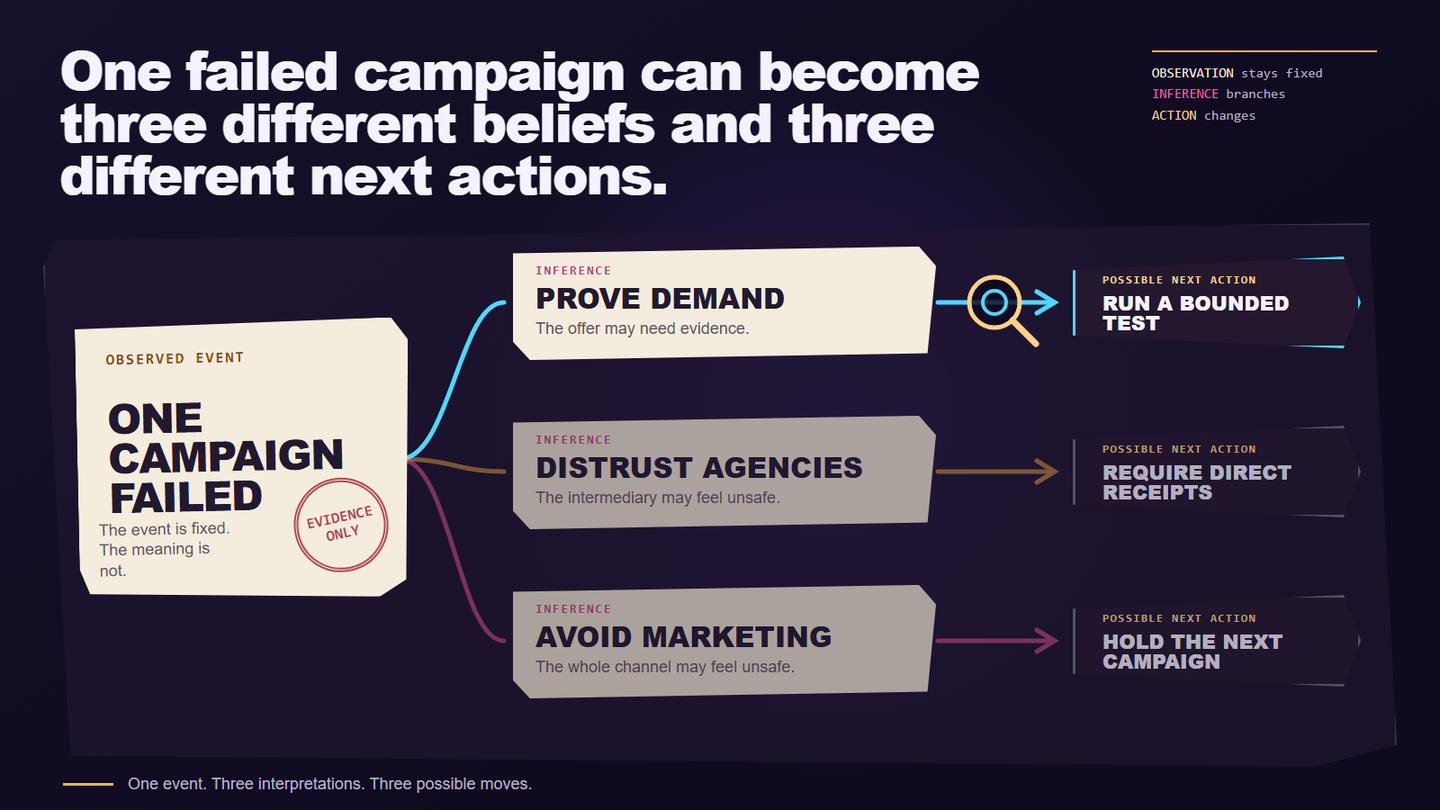
Hyperrelevance Cartography keeps those differences. It links language to experience, experience to belief, belief to behavior, and behavior to a possible next step, and it marks which links came from a source and which remain inferences.
Geographic expansion follows the same rule. A market an operator knows from years of unfiltered contact can serve as a close practice radius. A neighboring market adds load. A national market adds more cultures, channels, and failure modes, and international expansion adds translation, law, history, and local trust networks.
Skipping a radius hides the source of failure. If a message fails across five countries at once, the team may see one low conversion rate and invent one broad explanation. A smaller test can reveal that the offer works, the proof feels foreign, and one phrase carries a local meaning the team never learned.
A cartographer earns each expansion through returns. Every market sends back language, objections, actions, and outcomes, and those returns update the world model before the next radius opens.
The goal is movement that works under present conditions and keeps learning as those conditions change, not a perfect return to an earlier state.
Vocabulary reveals belonging and drift
Every field develops words that carry compressed meaning.
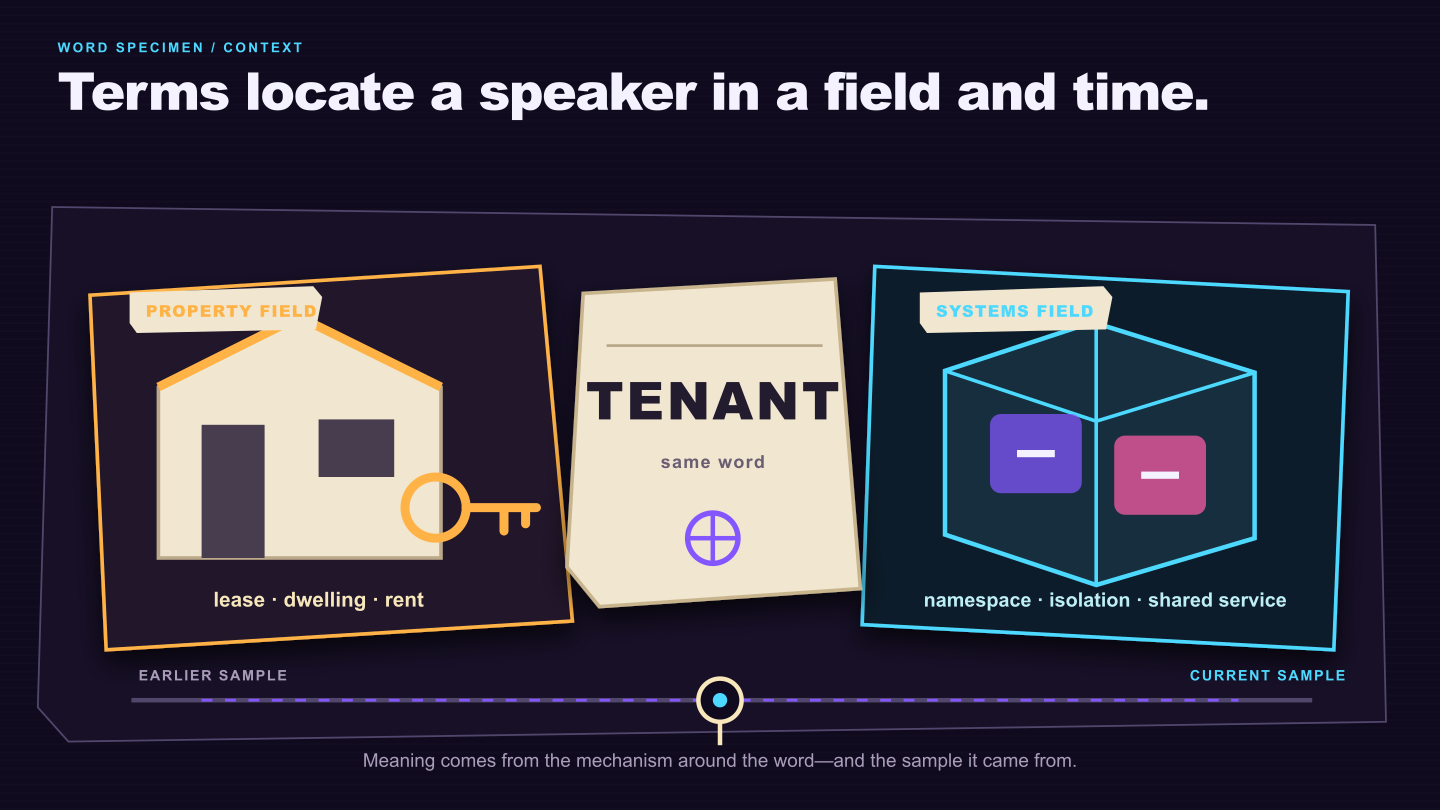
An excavator operator, quantitative trader, creative director, and multi-tenant systems engineer may use the same ordinary word in different ways. “Grade,” “spread,” “scene,” and “tenant” each point to specific mechanisms inside their fields.
Generic vocabulary tells the audience that the speaker sees the category from far away. Correct vocabulary can signal that the speaker is close to the work, and current vocabulary can signal that the speaker is still doing it.
A cartographer maps terms alongside entities and facts. Which groups use the term? What does it distinguish? When did it appear, and which older phrase did it replace? Which words look similar but should never be collapsed?
Sprinkling jargon over weak thinking makes the work worse. Vocabulary matters when it carries distinctions the model must preserve.
A voice fingerprint adds another layer. Phrase frequency, sentence shape, parts of speech, preferred examples, rhythm, topics, and repeated transitions can describe how a person communicates. The fingerprint becomes useful when it helps preserve authorship across a large production system.
A fingerprint also ages. A living voice changes after new work, new audiences, and new scar tissue, so the system needs drift audits rather than a frozen imitation.
Constraints make best practices local
Advice often goes stale because the constraint moved.
“Post every day” may work for a creator with a large production team and fail for a specialist whose trust depends on primary-source depth. “Respond within an hour” may improve one sales process and destroy another team's focus. “Use the winning template” may raise short-term conversion while teaching an audience to ignore the brand.
The expert answer depends on capacity, risk, audience, channel, timing, and the cost of error.
Hyperrelevance records those constraints as part of the claim. The system asks where a practice works, for whom, under what load, with which failure modes, and how the operator will know when the practice has decayed.
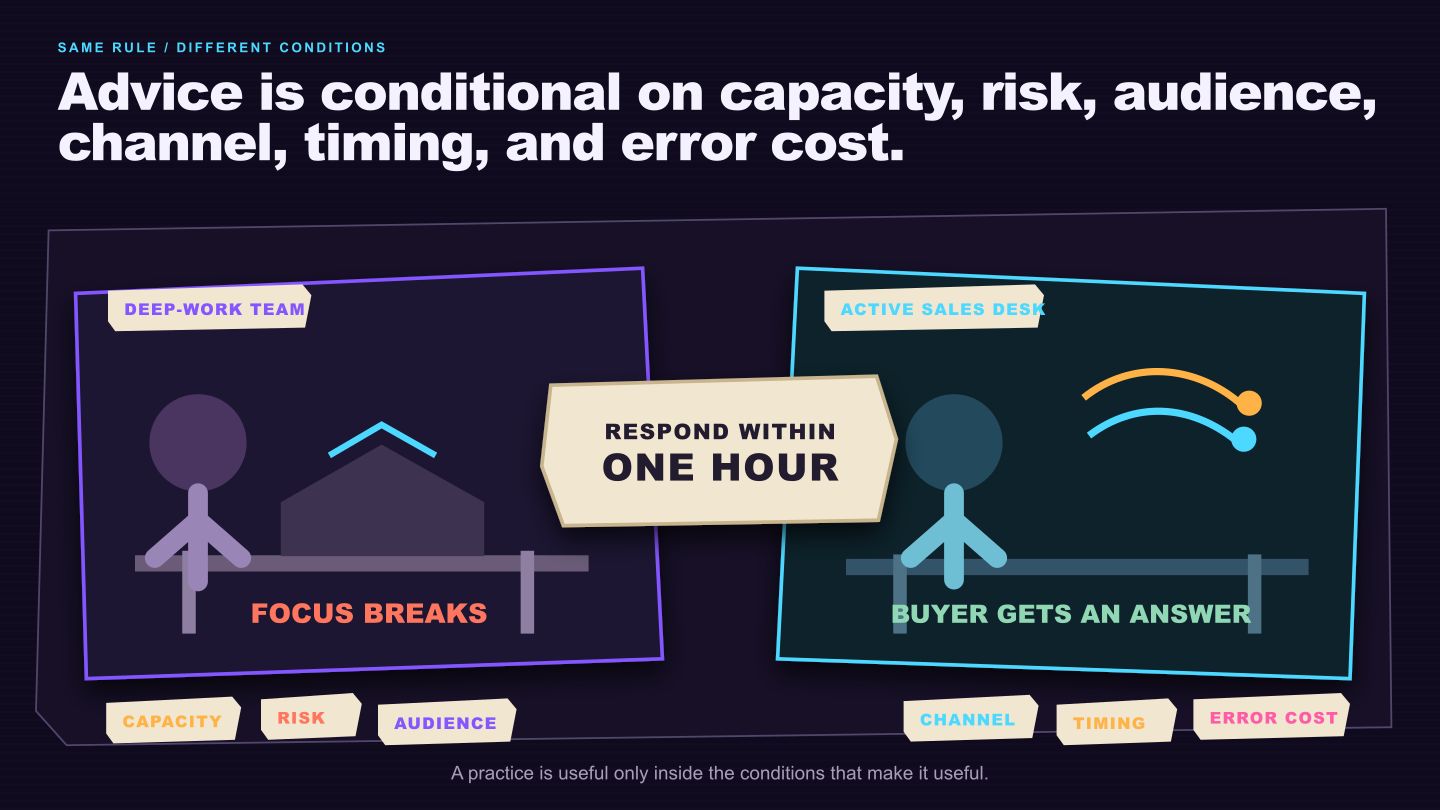
The result is a set of conditional routes, not a library of commandments.
Conditional routes put demands on the data underneath them. One current decision needs one clear view, and the system beneath that view has to keep enough structure to support many other views.
4. The shape appears when a question is asked
Dump a thousand puzzle pieces onto a table.
If the question is “Which pieces form the sky?” color matters. If the question is “Which pieces touch the border?” straight edges matter. If the question is “Which pieces connect these two faces?” location and pattern matter together.
The pieces haven't changed. The question decides which differences are useful.
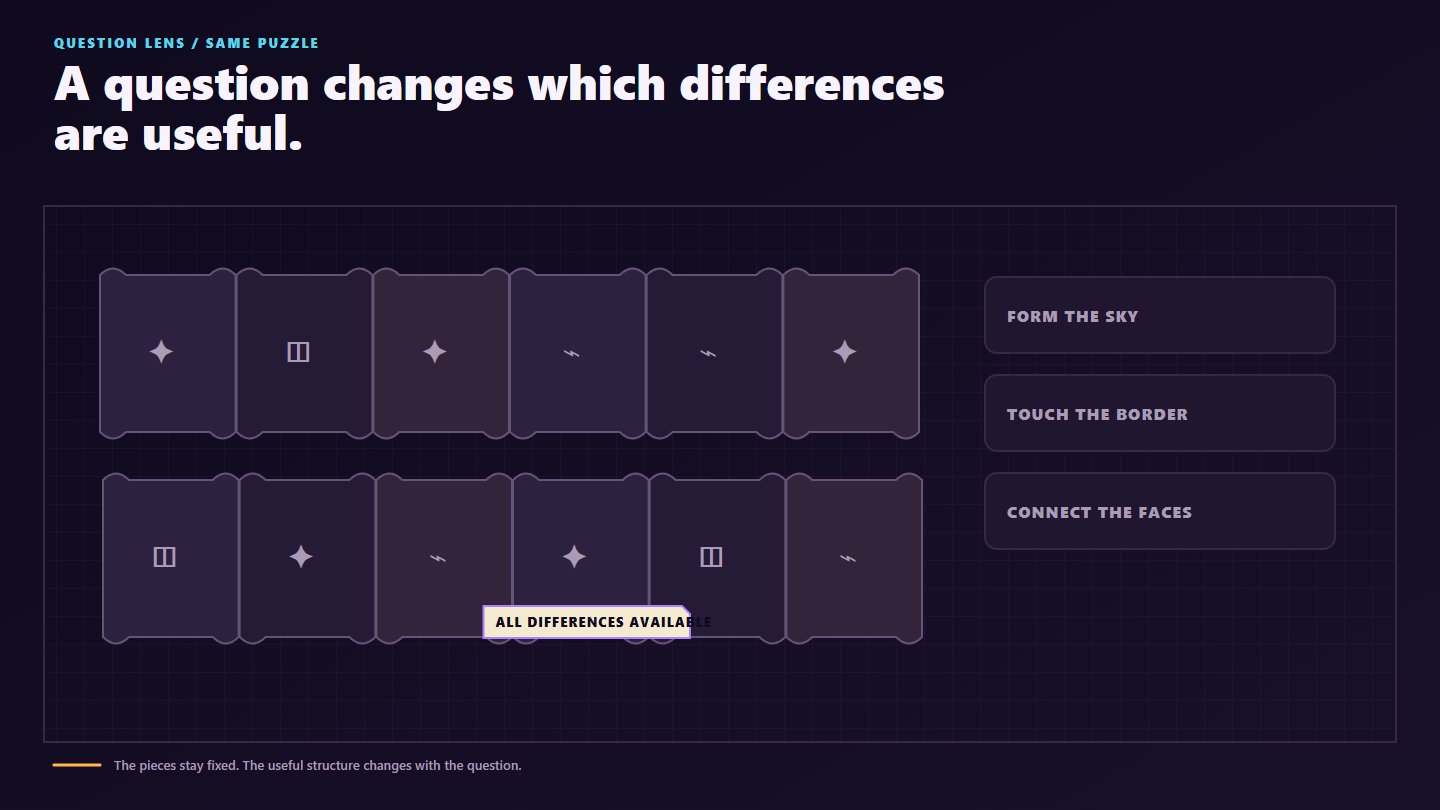
Data systems work the same way. A corpus can be viewed by topic, recency, confidence, source, audience, entity, voice, or business outcome, and each lens brings some relations forward and pushes others back.
A visible map is a constructed view, not the underlying thing.
Remembering that protects a team from its most persuasive graphics. A glowing cluster in three dimensions feels discovered, yet it still depends on what was collected, how the items were represented, which distance rule and projection were chosen, and what threshold separated one group from another. The instrument shapes the picture.
Data can have measurable shape
Topology studies properties, such as connections and holes, that survive certain changes in shape. Topological data analysis applies those ideas to data.
One method, persistent homology, watches features appear and disappear while a chosen scale changes. Imagine drawing a small circle around every point in a field and then slowly expanding the circles. Nearby points connect first and larger groups merge later. Some holes appear briefly and vanish, while others survive across a wider range of scales.
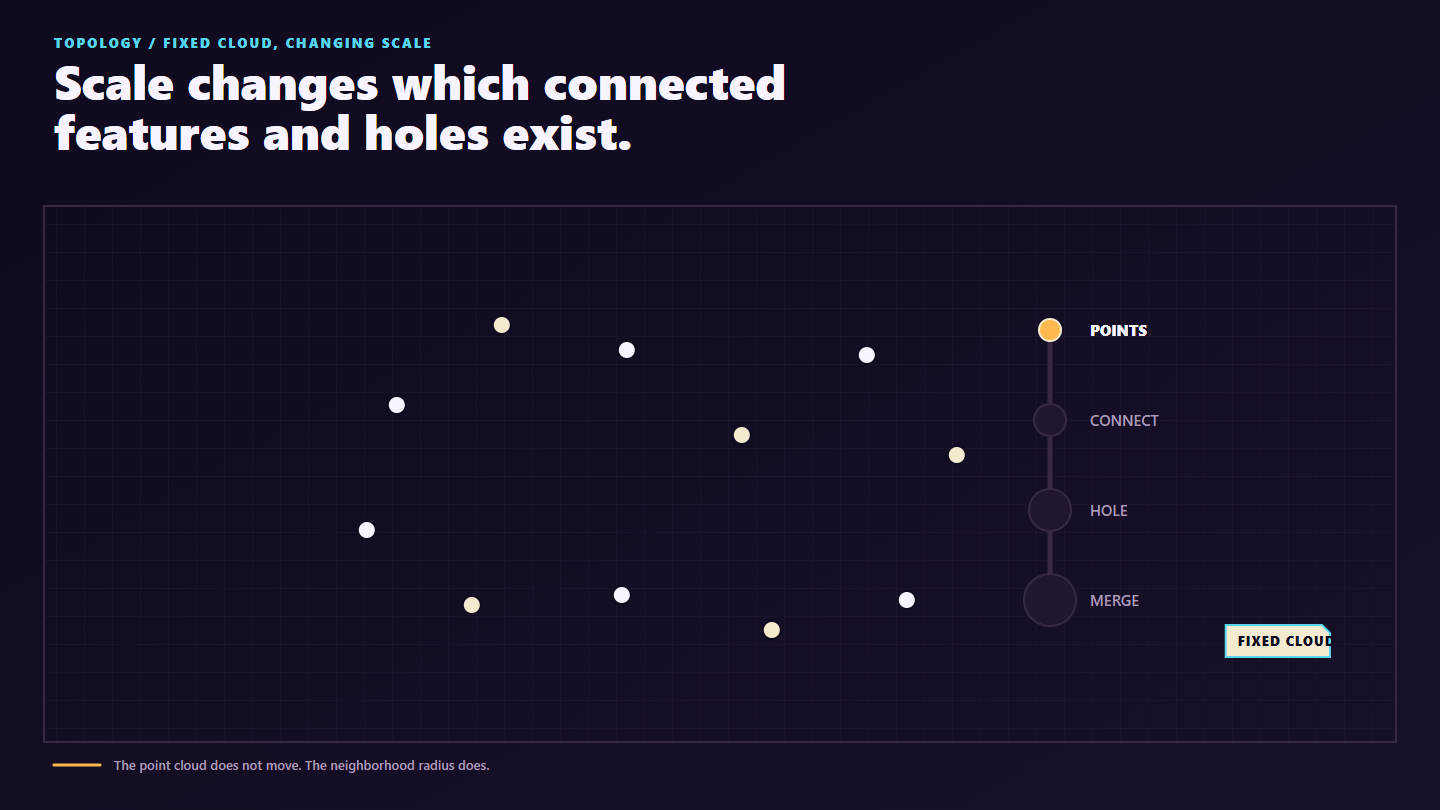
The result can be recorded as a barcode. A longer bar means the feature survived more of the chosen scale sweep.
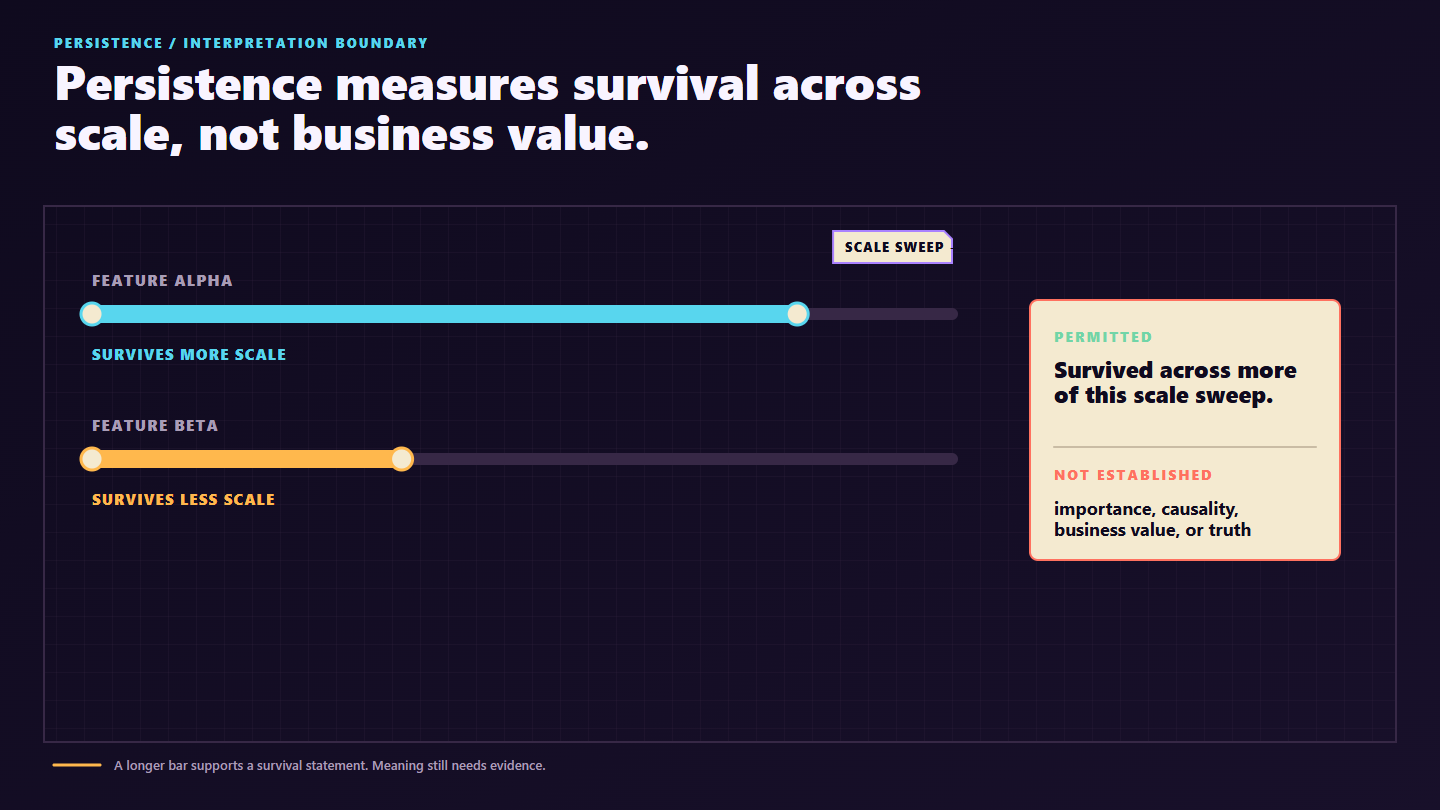
A long bar doesn't mean the feature is important, causal, valuable, or universally true.
The method gives a stable summary under stated mathematical assumptions, but the business interpretation still depends on the representation, the metric, the sample, and the question. A persistent loop might indicate a meaningful cycle, a sampling artifact, or a structure the embedding model created.
The mathematics detects a pattern, and a person or a tested rule decides what the pattern means.
A lens can turn a field into a graph
Mapper is another method from topological data analysis. It starts with a lens, which is a function that assigns a value or position to each data item. The method divides the lens range into overlapping areas, groups similar items inside each area, and connects groups that share items.
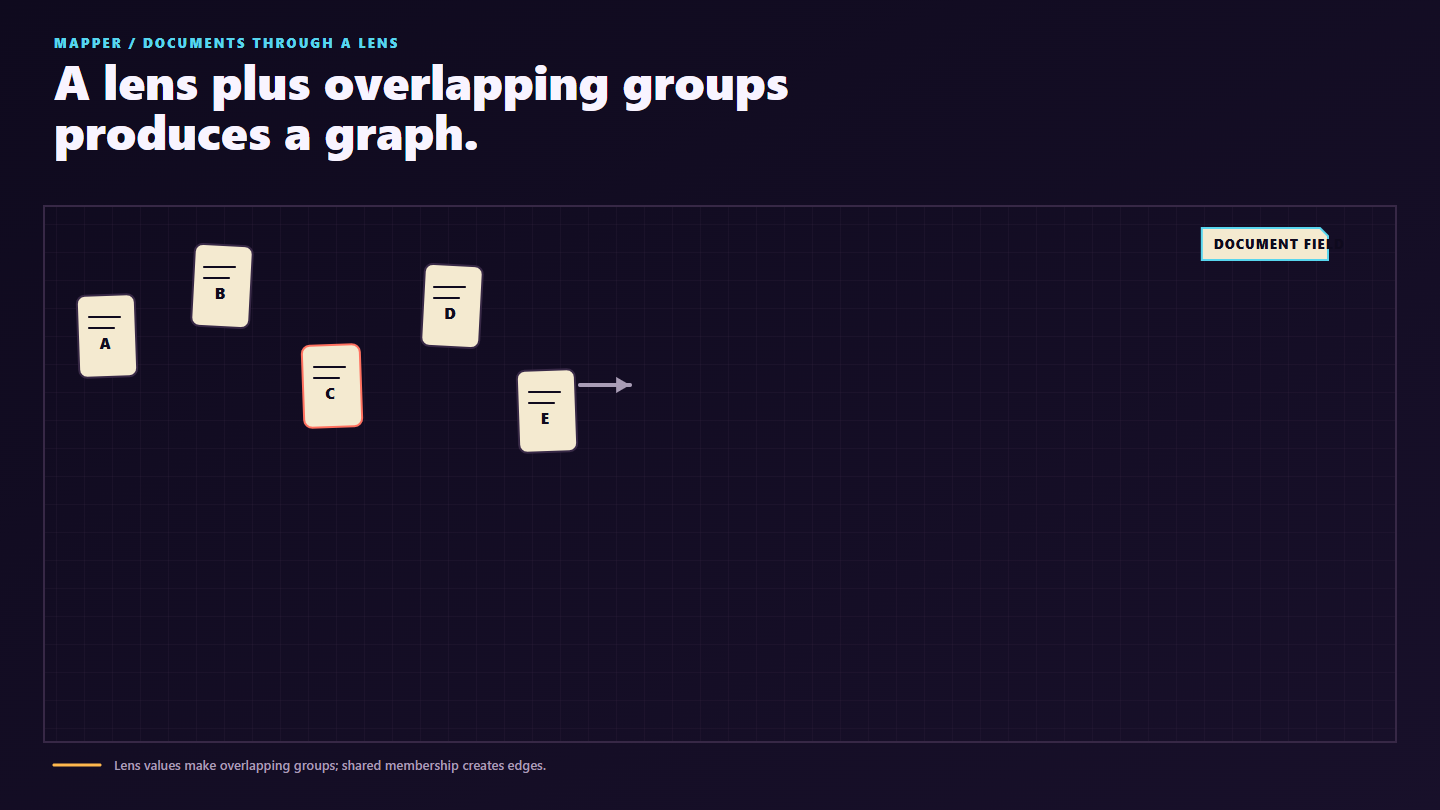
The result is a graph. In plain language, Mapper asks: when we look at these items through this particular question, which neighborhoods appear, and where do they overlap?
A recency lens may reveal old and new vocabulary connected by transition documents. A confidence lens may separate well-supported claims from speculative clusters. A demand lens may reveal several buyer groups that share one problem but differ in budget or urgency.
Change the lens and the graph changes. Change the cover, clustering rule, distance metric, or sample and the graph may change again.
That flexibility is useful because no neutral master view exists, and it turns dangerous when the choices disappear behind the interface.
A cartographer should be able to say why a lens exists and which decision it serves.
Direction carries meaning
Many relations run in one direction only.
“A cites B” differs from “B cites A.” “A happened before B” differs from “B happened before A.” “A supports B” differs from “B supports A.” Flatten those arrows and the map can keep proximity while destroying the mechanism.
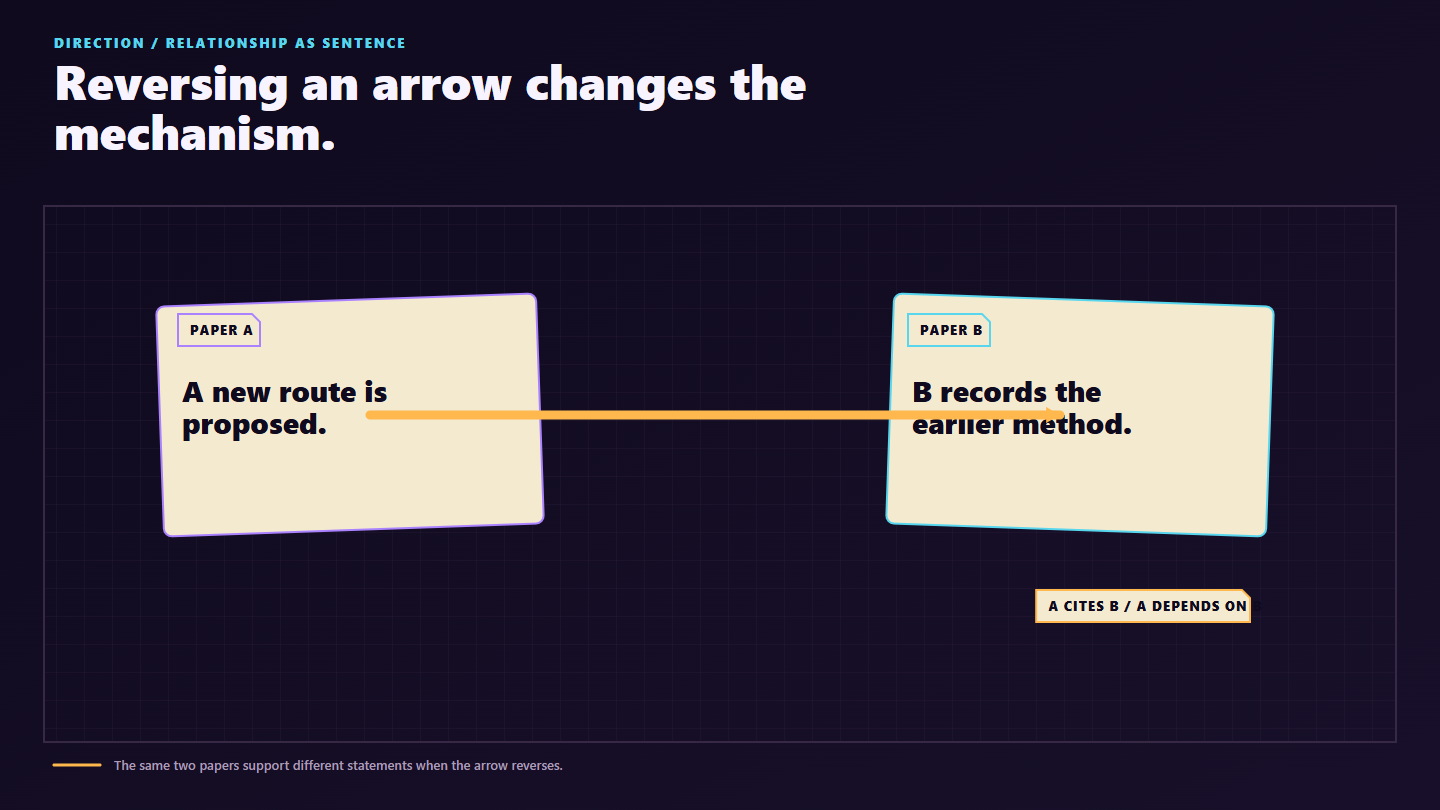
Topological methods built for directed graphs can detect structure that ordinary point-cloud methods miss, but their output still needs interpretation. A directed cycle may be a feedback loop, circular reasoning, repeated citation, or an ingestion defect.
The system should preserve the arrow first and argue about its meaning second.
How a possibility field becomes a decision
Several explanations and routes can be reasonable at the same time before a team acts.
A prospect may be ignoring a proposal because it arrived late, the offer felt generic, the proof was weak, the budget changed, another freelancer won trust sooner, or the buyer hasn't opened Upwork again. Uncertainty here means the team has several candidates with different evidence behind them, not that the team knows nothing.
The decision question creates the first boundary. “Why did this proposal fail?” is too loose because failure hasn't been observed. “Should we change the opening for the next five recent posts aimed at technical buyers?” names the actor, the change, the sample, and the next observable event. Evidence outside that decision can wait.
The instruments set the next boundary. The first keeps the work aligned from its purpose down to the action and the event that ends it. The second starts from the buyer's problem, the future the buyer wants to live in, and the change needed to cross that gap. Used together, they stop the team from choosing an elegant answer to the wrong problem. Public versions of both live in People-Product-Process and the Shape of Data: Shapes.
Evidence and constraints then narrow the field. A route dies when the source contradicts it, the budget can't support it, the operator lacks permission, the claim has no proof, or the action can't produce a readable return. Several routes may survive, and convergence reduces the uncertainty without pretending to erase it.
Committing changes the world the team works in. The team selects one bounded action, records what it expects, and crosses a state boundary. The routes it didn't choose stay in the decision record, because a later return may make one of them useful. A reply, a view, a sale, an objection, a silence window, or a failed render becomes the return. The team compares that event with the prediction, changes its confidence, and reopens the decision when the conditions no longer hold.
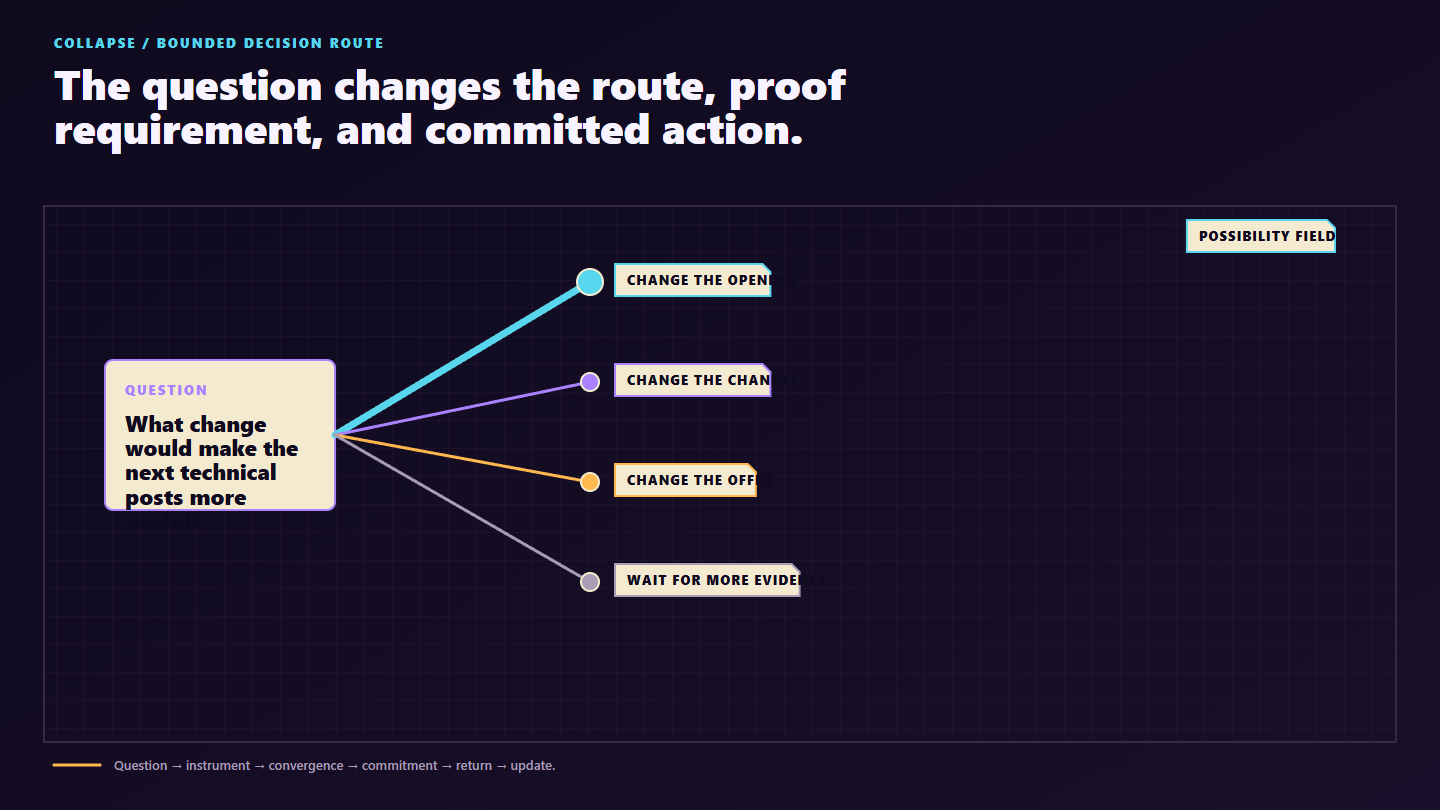
Quantum measurement offers a vivid comparison for the instant when a range of possible states yields one observed result, and the comparison has a strict boundary. Customer decisions don't obey quantum mechanics, observation doesn't make a market claim uniquely true, and similar mathematical language doesn't turn psychology into physics. What transfers is the discipline: keep the possibilities that existed before the choice, name the instrument, commit an observable act, and let the return revise the map.
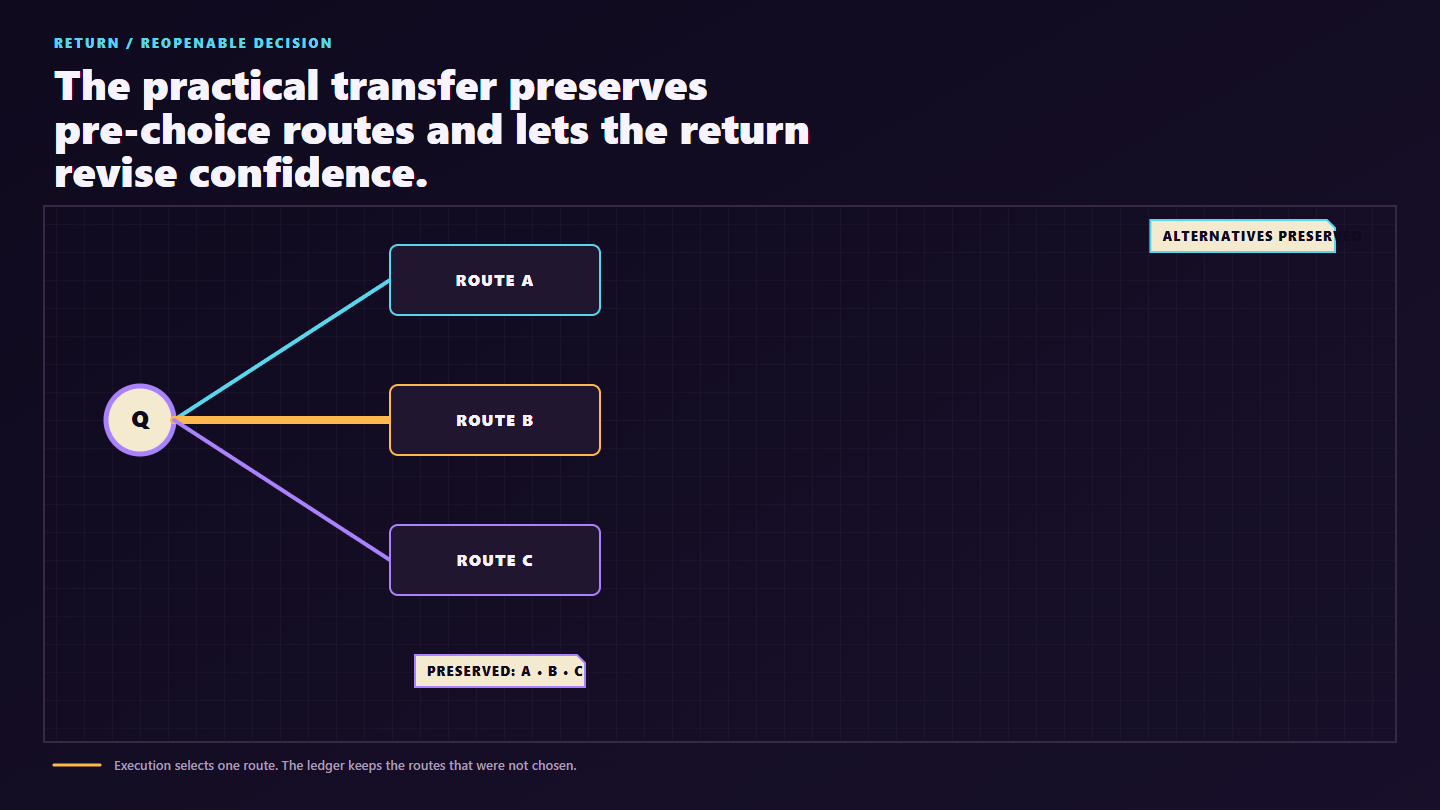
Objects Are a Position follows this idea into a deeper question: what appears to be a stable object may be a view produced by a particular instrument, scale, and purpose.
The system underneath the view now needs a way to keep objects, relations, time, confidence, provenance, and many possible maps, and that's the metagraph's job.
5. A metagraph is the map beneath the maps
A city contains many maps.
The street map connects intersections, the property map records ownership, the water map follows pipes and pressure, and the transit map shows routes and transfers. The weather map moves across all of them. A delivery driver, a city planner, a plumber, a landlord, and a tourist can stand on the same corner and need different views, and the city is larger than any one of their maps.
A metagraph gives a data system a way to preserve the shared objects, relations, and views beneath those maps. It can hold documents, people, companies, products, events, facts, claims, questions, workflows, artifacts, decisions, and the relations among them. It can also hold graphs as objects, connect one graph to another, and keep the provenance and time that tell an operator how a relation came to exist. The Research-Layer Metagraph Compiler shows how that structure can support a public research and compilation pipeline.
Implementations vary, and the idea that matters stays stable: the underlying model keeps enough structure to produce many decision-shaped views without rebuilding reality for every question.
Nodes and edges are the beginning
A basic knowledge graph represents things as nodes and relations as edges.
Andy is a person, SuperHarness is a system, and a Field Note is an artifact. “Andy authored Field Note” is one relation, and “Field Note explains Hyperrelevance Cartography” is another.
Even that simple structure beats a folder of documents. A search for SuperHarness retrieves files containing the word, while a graph can also follow the authors, projects, decisions, artifacts, dependencies, and evidence related to it.
The simple picture breaks down when the system needs to reason over real work.
Was the relation observed or inferred? Which source supports it? When was it valid? Did a later event expire it? How confident is the extraction? Does the relation belong to one customer, one project, or the public corpus? Is the object a claim, an event, a policy, or a generated guess?
None of those distinctions can live safely inside one unlabeled line.
A metagraph adds typed objects and relations around the graph. A claim can point to supporting episodes. A workflow can point to the artifacts it consumed and produced. A decision can point to the evidence available at the time. A later correction can invalidate a fact for current use while preserving the historical record.
The model becomes a record of how knowledge moved, not a pile of confident sentences.
That extra structure matters after a decision. A graph can show that an opportunity connects to a proposal. A hyperedge can bind the opportunity, buyer, proposal version, evidence package, and submission event into one encounter. A metagraph can make that encounter addressable, then attach its confidence, timing, source, evaluation, and later buyer response. The relationship becomes something the system can inspect and revise.
The rejected routes stay available too. If three proposal angles survived research and one was sent, the other two don't vanish, and a later objection can strengthen one of them. A contradiction doesn't overwrite the original claim. It becomes a visible conflict with its own source and time, and a maintenance pass can then lower confidence, mark the relation stale, or reopen the decision. The graph stores the territory; the correction loop is what keeps the territory useful.
Facts need clocks
Suppose the system stores “Product A costs $99.”
The statement may be well sourced and still fail tomorrow. A price belongs to a time, market, currency, plan, and source. Later evidence should create a new state and close the old one rather than overwrite history or leave both prices active forever.
Temporal knowledge systems attach validity to facts and episodes. The operator can ask what the system believed on a date, what is current now, and which event changed the state.
Clocks matter far beyond prices. A person changes roles, a company changes names, a tool removes a feature, and a customer objection becomes less common. A voice changes, a job post goes cold, a policy expires, and a relationship moves from proposal to interview to verbal yes to silence.
The map should represent those state changes directly.
Probability and confidence add another clock-like dimension. “This objection causes churn” may begin as a hypothesis, strengthen after several verified cases, narrow to one segment, then weaken after the product changes. The claim's history is part of the knowledge.
Provenance explains the route, not the truth
Provenance answers where something came from and what happened to it.
A generated brief may derive from a transcript, three research reports, a database query, and an evaluator's correction. A provenance trail can record those inputs, transformations, authors, tools, and timestamps, so another operator can reconstruct the route.
The trail doesn't prove the output is true. Git Kept Every Copy follows the same principle through source history: keeping the route makes a correction inspectable even when it can't make the earlier state correct.
A false source can have perfect lineage. A flawed transformation can be documented precisely. A citation can exist and still fail to support the sentence beside it. Provenance makes inspection possible, but evaluation still has to test the claim.
Keeping provenance and truth apart stops the graph from dressing up as an authority. The system can say, “Here is the source and path,” and then let a human or a tested rule decide whether the evidence is sufficient.
Namespaces keep worlds from bleeding together
One engine may support several projects or customers, so the shared model needs addresses.
A namespace can scope documents, entities, facts, workflows, voice models, and outputs to a tenant or project. Public research may be available to many namespaces. Customer files may stay inside one. A reusable evaluation rule may apply everywhere. A tenant-specific conclusion may never cross the boundary.
The namespace does more than filter a screen. Retrieval, generation, evaluation, export, retention, and deletion all need to respect it.
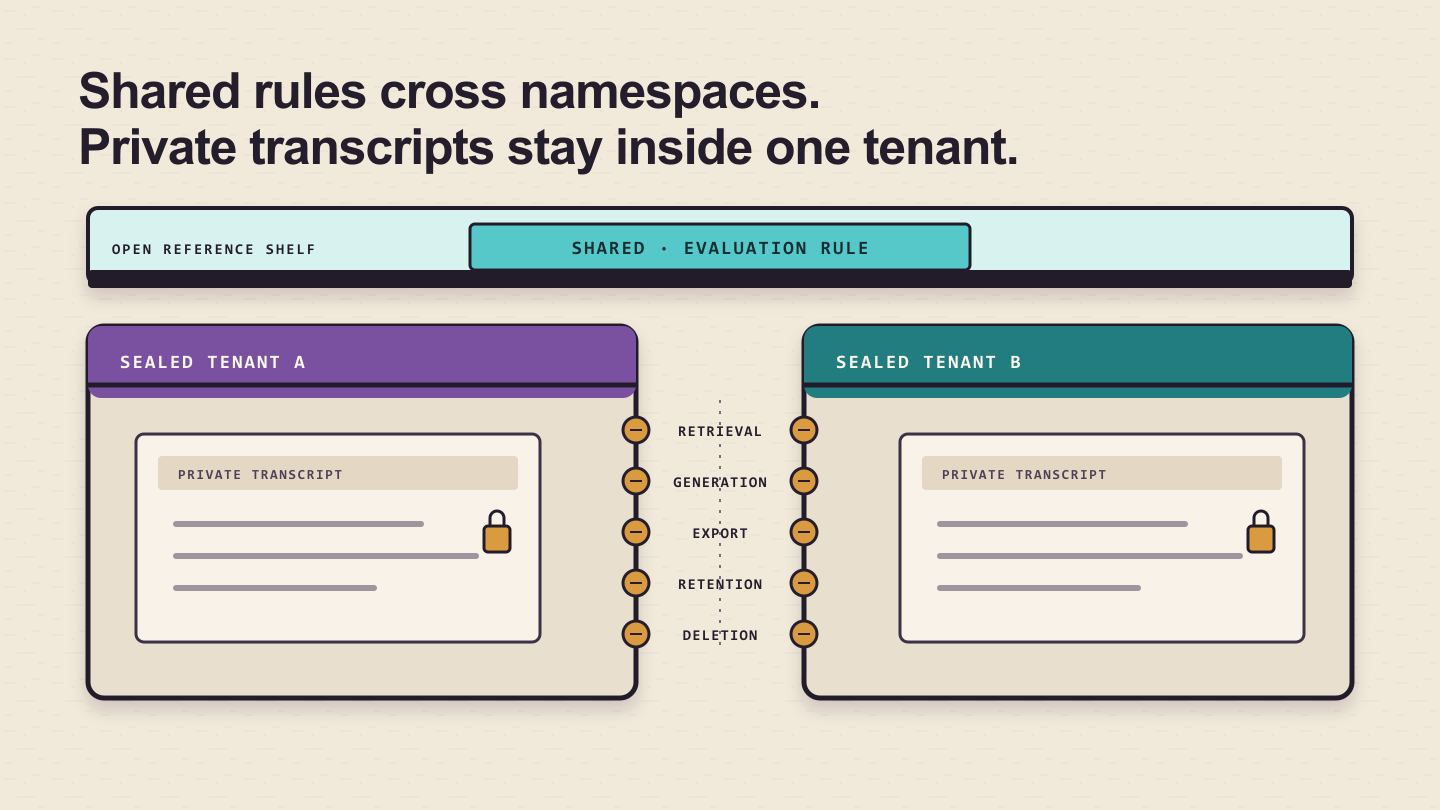
Namespaces are how one metagraph can support a portfolio without turning every customer into training material for every other customer.
A map view is a query with a purpose
Once the underlying relations are preserved, the system can construct views for different decisions.
A sales view may show open opportunities, last contact, confidence, expected next event, and deal rot. A content view may show audience questions, source coverage, existing assets, distribution results, and drift. An operator view may show workflows, dispatches, receipts, evidence, and reopen actions. A voice view may show recurring phrases, syntax patterns, topics, and changes over time.
Each view is deliberately smaller than the metagraph.
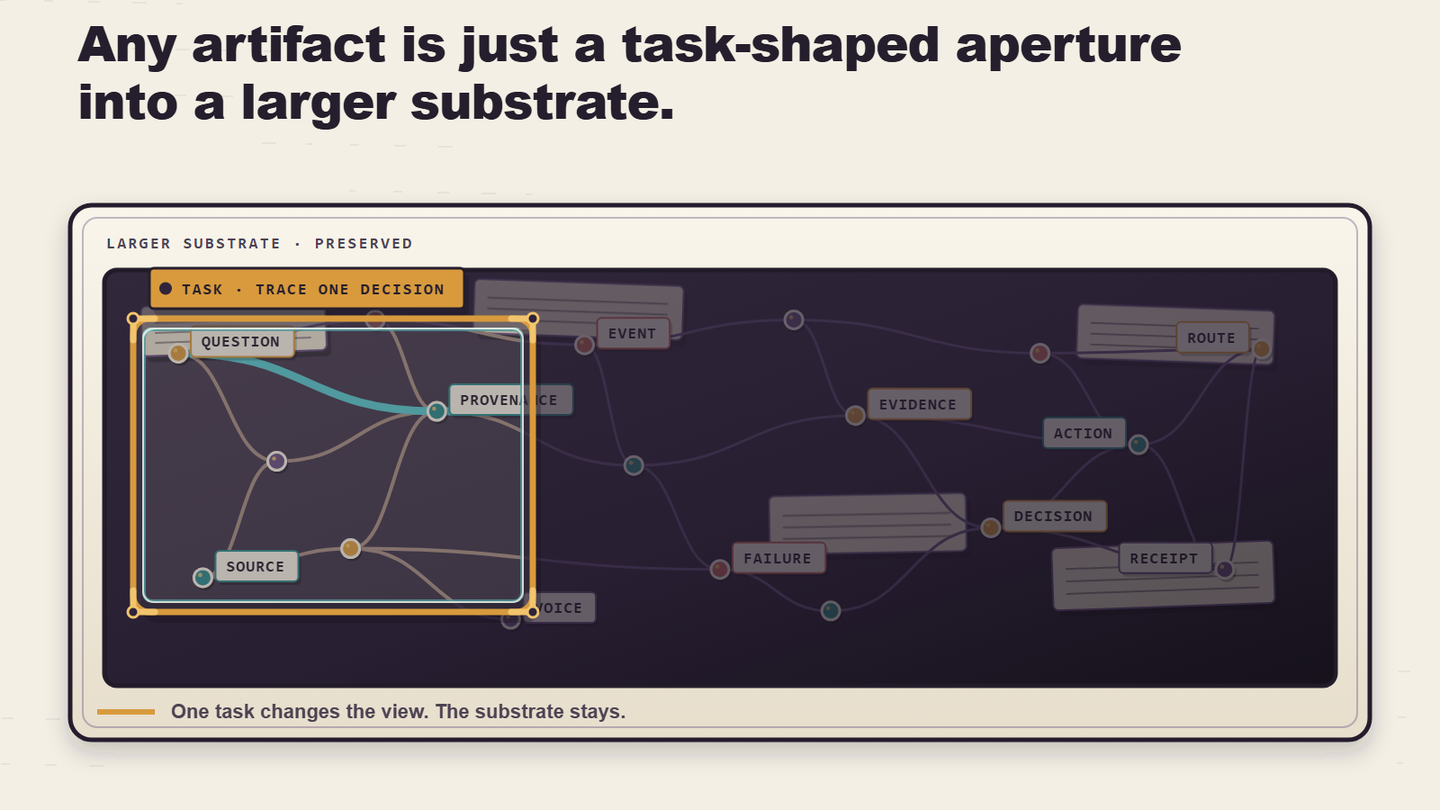
The operator should see the few objects and relations needed to understand, decide, and act. The system beneath the surface keeps the larger context available for inspection. Shape of Data: Ceiling explains the consequence: a view can't answer a question when its underlying representation discarded the required distinction.
The metagraph therefore works as the address system for many useful maps, not as one giant visualization.
Temporal memory and source structure are different instruments
Two graphs can contain some of the same names and still answer different questions.
Graphiti is a temporal memory system. It receives episodes, extracts entities and relations, keeps source links, and allows facts to gain or lose validity as the world changes. A useful query asks what the system currently remembers about an entity, which episode supplied a relation, or which later event superseded an earlier fact. RAG Systems goes deeper on retrieving a bounded contextual world instead of treating memory as a keyword pile.
Graphify maps the structure of a codebase. Its nodes can represent files, components, types, functions, routes, and symbols. Its edges can show imports, calls, ownership, or another structural relation extracted from source. A useful query asks where a dispatch receipt is defined, which components consume an evidence handle, or how an operator shell connects to a workroom.
Graphiti follows meaning through time, and Graphify follows software through a snapshot of a repository.
The difference matters because the two fail in different ways. A temporal memory can remember a stale or badly extracted fact, and a code graph can accurately describe source that never runs. A live database connection can return a healthy status while the human workflow above it stays unusable, and a glowing graph can make every one of those conditions look complete.
Hyperrelevance Cartography keeps the instrument's identity attached to every return. A Graphiti result is a memory return, a Graphify path is a source-structure return, a browser recording is a human-journey return, and a Git commit is a source-history return. None of them quietly gets promoted into another.
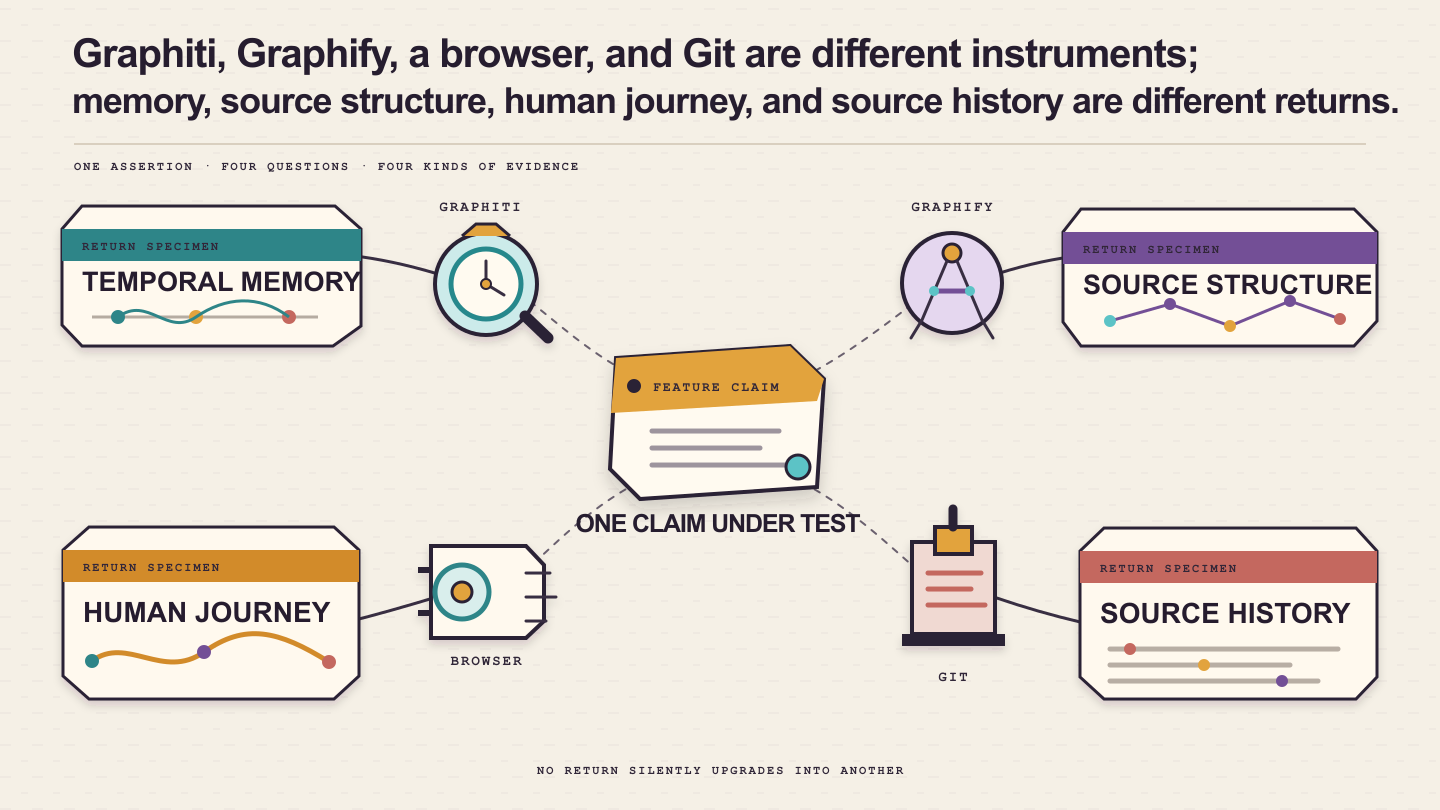
Keeping them separate lets the instruments correct one another.
If memory says a feature is live, a source query can locate the implementation and a browser test can verify the journey. If source contains a component with no route, the graph can reveal the disconnected edge. If a browser shows a result with no receipt, the operator can see that the experience lacks a durable return path.
The metagraph can link all three without flattening them. A feature node can point to an intended requirement, an implemented source path, a runtime observation, and a human acceptance result. The operator can see which evidence supports each status.
Five labels keep the map truthful
Complex systems need plain status words.
A result is observed when a current instrument returned it: a page rendered, a service answered, or a file contained an exact value.
A mechanism is implemented when current source contains a coherent version of it, even if it still lacks a reachable route, a valid configuration, real data, or browser proof.
A mechanism is specified when a canonical design defines it and its intended behavior. A specification gives a team a shared target without creating the target.
Evidence is historical when it describes an earlier state, an expired fact, an old name, or code on a lineage the current product doesn't contain.
A conclusion is inferred when several pieces of evidence support it and no direct observation has proved it yet.
The labels prevent a common collapse. A diagram begins as a specification, a component makes the idea implemented in source, and a health response makes one boundary observed. A screenshot then gets used as proof that the whole system works.
Each step may be real, yet the conclusion can still outrun the evidence.
A truthful map lets different states appear together. AgentOS, the human-facing application over the agent execution system, can be implemented in source, observed as a rendered surface, degraded at a host boundary, and unproven as a complete dispatch-and-reopen journey, all at the same time. Meme Shaman, a product that compiles jokes for specific communities, can have public visual assets and a developed product model while its loop of ingest, decomposition, reconstruction, approval, and outcome is still only specified.
The label belongs to the claim, not the product name. One feature can move from specified to implemented to observed while another feature beside it remains a concept. A product-level badge hides that grain.
The same labels make a useful rule for public writing. Readers can see what exists, what the evidence showed, what follows from the evidence, and what remains a proposal. That boundary makes the vision more credible, because a future state no longer has to dress like a present fact.
6. Voice is a measurable trail
Listen to somebody you know walk down a hallway.
You may recognize the person before you see a face. Stride length, pace, weight, pauses, and the sound of a turn make a pattern. No single feature carries the identity, but together they form a trail you've learned to recognize.
Written voice works the same way. A person's voice includes vocabulary, sentence length, grammar, rhythm, favorite examples, repeated transitions, level of directness, humor, subjects, and the way all of those change with context. A voice fingerprint measures parts of that pattern so a production system can preserve authorship across more work than one person can draft alone. The Voice Fingerprint Deliverable shows the public form of that work across vocabulary, syntax, rhythm, register, and drift.
The fingerprint should describe the voice without flattening it.
Vocabulary is one layer
Word counts reveal recurring nouns, verbs, phrases, and avoided terms. Named-entity recognition reveals the people, companies, products, places, and projects that populate a person's world. Parts-of-speech analysis can show whether the writer favors concrete nouns, active verbs, qualifiers, questions, or abstract nominalizations.
Those measures help, but a bag of words can't carry voice.
Two people can use the same vocabulary with different sentence pressure. One builds a long setup and lands a short verdict while another stacks short clauses. One uses examples to teach and another uses them to challenge. One names pain from inside the scar tissue and another describes it from outside.
The system needs patterns across levels.
Syntax, rhythm, and register carry intent
Sentence structure shows how the writer moves attention, and paragraph length shows where the writer breathes. Transitions show how one thought earns the next, and formatting shows what the writer expects scanners to notice.
Register changes with the job.
An Upwork cover letter is flat text read beside dozens of competitors. A Field Note can use headings, links, figures, and longer argument. A technical handoff needs precise identifiers. A voice memo can wander while discovering the point. Treating all four as one style produces a polished average that belongs to nobody.
The fingerprint therefore includes the situation: who is speaking, to whom, for what purpose, on which surface, and under which constraints.
Drift is part of the identity
A person changes after doing more work.
New projects introduce vocabulary. Repeated failures sharpen explanations. Overused phrases become irritating. A public style guide may ban a construction that appears throughout older samples. The current voice is a path, not a centroid over everything the person ever wrote.
Analysis over time keeps the system from reviving old habits and calling them authentic.
A drift audit compares recent work with earlier periods. Which phrases increased? Which sentence structures disappeared? Which subjects became more concrete? Which metaphors survived because they still teach? Which patterns now read like the generic AI dialect the writer learned to reject?
The voice model updates and keeps the history.
Voice fingerprinting needs consent and proof
Voice machinery is powerful enough to create ethical problems.
A voice belongs to a person and can be used to imply authorship. The system should know whose material it is analyzing, which uses are allowed, who approves publication, and how generated work is labeled inside the production process.
Evaluation should compare output against current, authorized samples. It should also ask whether the piece carries the person's judgment. A perfect imitation of surface rhythm can still put words in somebody's mouth.
The goal is supported authorship: help a person express more of what they mean with consistent craft and inspectable review.
Execution comes next, once the world model and the voice model exist. Research has to become a working artifact, survive review, leave evidence, and stay reopenable after the chat window closes.
7. The data model is the first map
A crowded workshop can hide a bad design for a long time.
At first every bench has a tool, every tool has a label, and the operator can point to any object and say what it does. Then the work grows. One tool needs a second handle, another needs a private drawer, and a third needs a special power cable. Soon every bench carries its own rules, storage, and behavior. The workshop still looks organized from the doorway, while inside, every new job needs somebody who remembers which object is allowed to touch which other object.
Software can grow the same way.
A game engine built around a tree of rich behavior objects feels friendly when a scene is small. A character node can hold movement, animation, collision, health, inventory, and events, and the object is easy to find. The design gets expensive when thousands of objects need the same narrow operation. The engine may have to visit thousands of separate objects, cross boundaries, repeat checks, and move data between systems before it can answer a simple question such as, “Which moving units are poisoned?”
The lesson that transfers beyond game engines is that the shape of the data controls the shape of the work. Unified Architecture carries that question into the boundaries between shared data, components, and the surfaces that consume them.
The god object feels helpful until the world gets large
A god object is one thing that knows too much and does too much.
Imagine a customer record containing contact details, purchase history, ad behavior, consent, writing style, risk score, project state, billing rules, campaign membership, and every method that acts on those fields. The record feels complete, but it's hard to reuse safely. A reporting system needs two fields and receives the whole object. A personalization system wants current language preferences and accidentally inherits billing assumptions. A deletion request touches one record whose private rules reach into ten other services. Over time the record becomes the unofficial operating system.
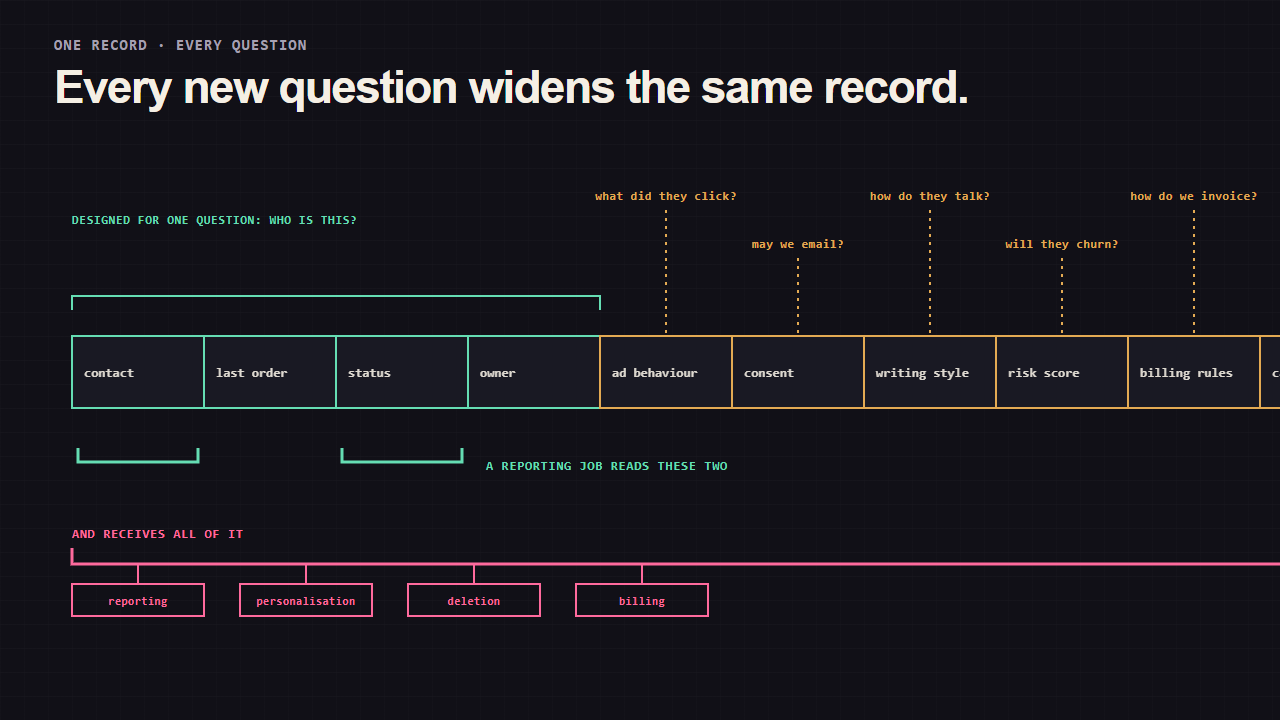
The failure is common because the local convenience shows up before the global cost. The first developer saves time by attaching one more responsibility to a thing that already exists. The twentieth responsibility arrives months later, after other systems depend on the first nineteen. Nobody planned a god object; the organization kept choosing the nearest shelf.
The same problem shows up outside code. “Small-business owner” becomes a persona containing industry, budget, urgency, tool preference, approval behavior, vocabulary, technical skill, and risk tolerance. “Good opportunity” becomes one score that quietly mixes fit, value, freshness, client reliability, competition, and proof requirements. “High-performing content” becomes a label that blends attention, traffic, conversion, revenue, and strategic usefulness.
Each label compresses several different questions into one object, and the object looks clear because its internal disagreements have dropped out of view.
Hyperrelevance Cartography pulls those dimensions apart, preserves their relations, then creates a smaller view for the decision at hand.
Components make composition visible
The entity-component-system, a pattern from game engines, offers a useful alternative.
In ordinary language, an entity identifies one thing. Components hold pieces of data about it. Systems select the entities carrying the components needed for one operation, then read or change that data. The separation keeps identity, data, and behavior from becoming one inseparable bundle. Unity's ECS documentation describes that mechanism directly.
A game unit may have position, velocity, health, and faction components. A movement system needs position and velocity, a damage system needs health, and a targeting system may need position and faction. The unit doesn't need a private copy of every behavior, because each system asks for the smallest useful combination.
Applied to a business, this stays an analogy unless the software actually stores and queries data this way, but it's still a precise analogy.
An opportunity can have source, freshness, budget, fit evidence, client history, stage, last event, expected next event, proposal assets, and uncertainty components. A deal-rot view needs stage, last meaningful event, promised timing, and current date. An asset-selection system needs opportunity type, proof threshold, time budget, and available evidence. A market-regime view needs many opportunity scores over time, not the full private record for each client.
The opportunity stays one address, and different systems work through different slices of it.
Splitting the record this way reduces accidental coupling, and it makes absence visible. If an opportunity lacks a hiring-history component, the scoring system can mark that evidence unknown instead of quietly inventing a neutral value. If consent is missing, the voice system can refuse to use private transcripts. If the last meaningful event is absent, deal rot becomes uncomputable rather than falsely green. Unknown becomes a piece of data like any other.
Data-oriented design starts from the repeated question
Data-oriented design asks what work happens repeatedly, then arranges the needed data so that work stays simple and efficient. Unity's data-oriented design guide makes an important point: choosing an entity-component-system doesn't automatically create good performance. The design has to match the real access pattern.
The warning applies to hyperrelevance work too. A beautiful graph can still store the wrong objects, and a flexible schema can still make common questions slow and ambiguous. A hundred specialist agents can spend most of their time translating incompatible payloads, and a typed system can encode a bad assumption perfectly.
Start with the repeated decision.
Which opportunity deserves action now? Which proof belongs in this proposal? Which fact is still valid? Which audience segment changed? Which asset contributed to an interview? Which client needs a human reply? Which workflow can proceed without approval?
Then ask what data those decisions require, where the data comes from, how long it remains useful, and which system is allowed to change it.
That's cartography before software: the terrain is the work, and the data model is the first map of that terrain.
A typed intermediate representation gives the fleet one language
A compiler doesn't ask every later stage to understand the original source in its raw form.
The compiler parses the source into an intermediate representation, often shortened to IR. The IR gives later stages a shared structure, so an optimizer, validator, code generator, debugger, and visualizer can work from the same defined objects without each one rebuilding the meaning from loose text.
Agent systems need the same middle language.
Take a saved job post. The raw post is evidence and should stay preserved, and the system also needs a typed opportunity model. That model might name the source, buyer, stated objective, inferred problem, budget evidence, fit evidence, risk, stage, next expected event, allowable assets, and unresolved questions. The exact fields are private implementation, and the public principle is simple: each field has a meaning, a type, an authority, and a rule for absence.
The typed model becomes a contract between surfaces.
The scraper can produce it, the database can store it, and the CRM can display it. A scoring system can read bounded fields, a proposal workflow can request an asset plan, and an evaluator can inspect evidence. An event stream can record changes, a client report can summarize approved outcomes, and a deletion process can find related private material.
Without the shared representation, every boundary becomes a translation project.
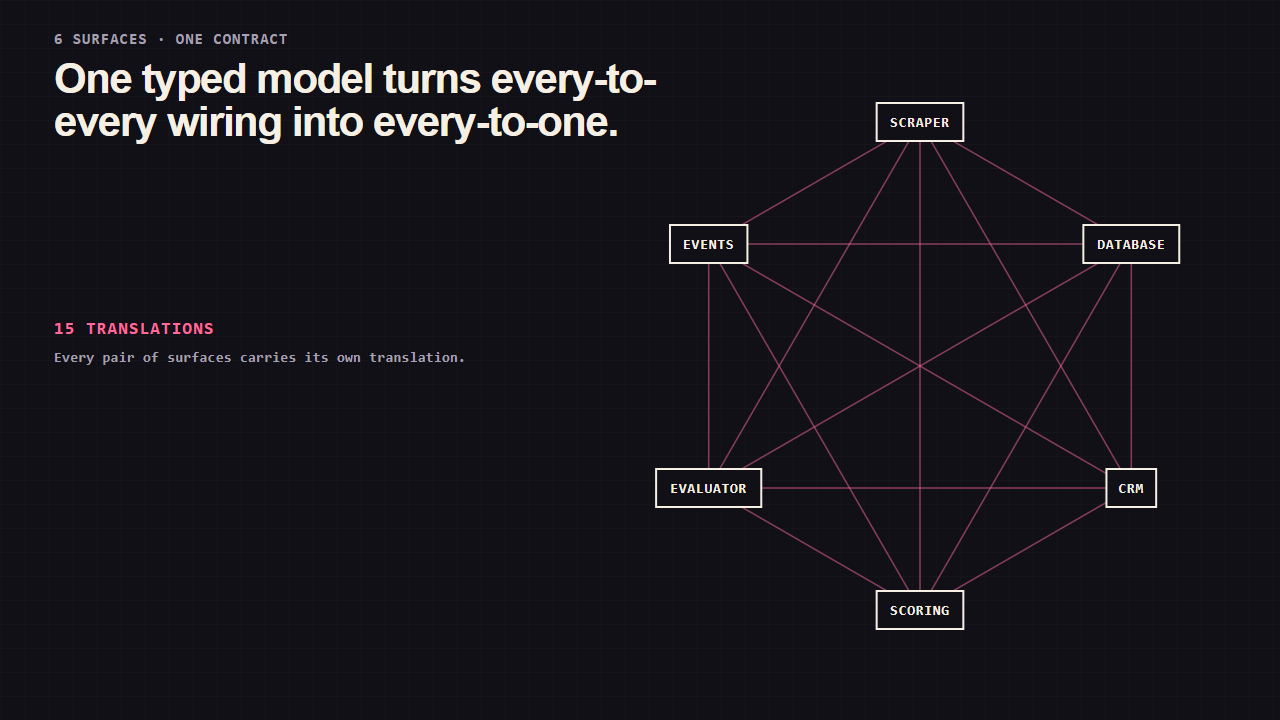
One agent calls the buyer's desired result an outcome. Another calls it a goal, and a third hides it inside analysis text. The interface expects objective, and the evaluator searches for success_condition. Nothing is necessarily wrong in isolation, yet the system still loses meaning through small mismatches.
A typed IR makes those mismatches harder to introduce and easier to detect. It doesn't make errors structurally impossible: a field can be wrong, a type can be too broad, and a validator can pass a false claim. What the contract creates is an inspectable place where meaning can be corrected once for every consumer.
The boundary tax can consume the whole advantage
Performance arguments about game engines often focus on the cost of crossing boundaries.
One runtime owns gameplay objects and another owns rendering or physics, so data crosses a foreign-function interface. Each crossing may require marshaling, copying, conversion, synchronization, or a lookup that breaks the processor's easy path through nearby data. A single crossing can be cheap, but millions of poorly shaped crossings become the work.
Agent systems pay a semantic version of the same tax.
An opportunity starts as a job-post document. A research agent rewrites it into a memo. A proposal agent extracts a new summary. A visual agent receives a prompt describing the summary. An evaluator sees the output with no direct source link. The operator then explains the missing context in another transcript.
Each stage may use a capable model, yet the pipeline still spends its advantage on translation and reconstruction.
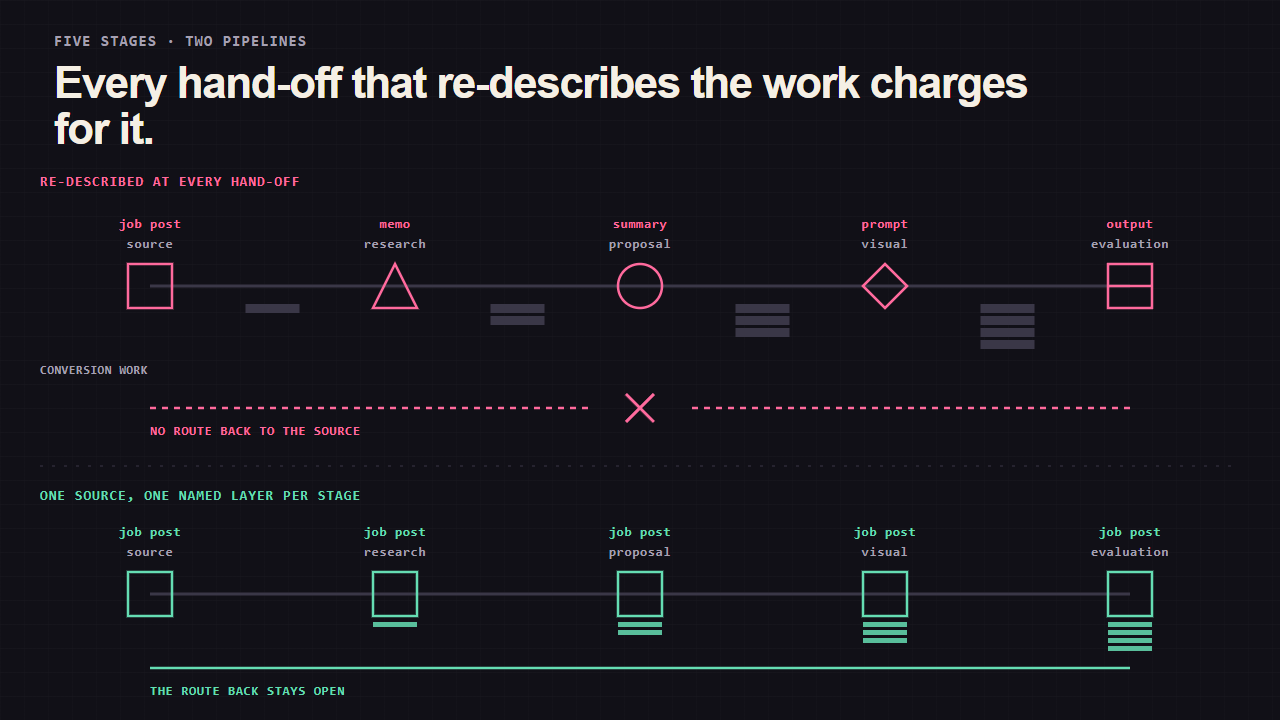
The remedy is controlled derivation. Preserve the raw source, produce one typed representation, and let each activity add a named layer with provenance. Give the next stage the smallest sufficient view plus a route back to the evidence, and record every consequential change as an event.
Now the boundaries carry contracts instead of folklore.
Model Context Protocol, or MCP, can help tools expose defined operations and resources to models, but it doesn't supply the domain model by itself. Connecting a database, browser, or file service solves access. The harness, the layer that runs the agents, still has to decide which specialist receives which tool, which typed input is valid, what authority the operation carries, what evidence returns, and what event ends the work.
Connecting a tool is plumbing, the IR carries the shared meaning, and the harness carries the authority.
Pools often reveal a lifecycle problem
Object pooling is another useful game-engine clue.
A system creates a group of objects ahead of time, turns them on when needed, and turns them off instead of repeatedly creating and destroying them. Pooling can be a sensible optimization. It can also reveal that object birth and death are expensive because each object carries more lifecycle machinery than the operation needs.
Knowledge work develops human versions of pools.
Teams copy last month's campaign, rename last quarter's dashboard, duplicate a proposal document, or keep a collection of half-configured automation templates. The pool saves setup time. It also carries hidden state. A forgotten recipient list, stale claim, old price, wrong client name, or expired permission survives because the copied object contains more history than the new operation requested.
Component-level reuse is safer.
Reuse the verified case-study entity, the current pricing rule, the approved voice sample, the animation component, the citation, or the evaluation contract. Assemble a new opportunity package from authorized parts. Keep lineage so the system can learn which parts travel well and which should be retired.
The aim is to make reuse observable, not to reach purity.
Architecture and tooling mature at different speeds
A system can have a strong internal architecture and a weak operator experience.
That split explains both the promise and the present weakness of SuperHarness, the execution and coordination system behind this work. Its execution layer can model dispatches, profiles, receipts, evidence, and re-entry while AgentOS, the application a person uses over it, remains incomplete as a human journey. Source can contain the right objects while the screen fails to help a person launch, inspect, decide, and reopen.
A game engine can face the same split. A data-oriented core may support large simulations while its editor, visual debugging, asset workflow, or learning curve remains less mature than a friendlier alternative. The architectural bet and the tooling gap can both be real.
The right response is to sequence the work truthfully.
Build one vertical slice that crosses the real boundary. Show one opportunity entering as evidence, becoming a typed model, receiving specialist work, returning a native receipt, appearing in an operator surface, accepting a human decision, and reopening later. Fix the parts of the toolchain that block that slice, and expand only after the shared path works, since architecture earns its value through use.
Defaults are governance
Most system behavior comes from the easiest path.
If the easiest path is a free-form prompt, important fields become optional. If the easiest path is copying an old document, stale context propagates. If every agent can use every tool, authority becomes vague. If evidence is an optional attachment, successful-looking outputs arrive without proof. If the interface rewards launching work and hides reopening, the organization produces activity without durable learning.
Good architecture changes the default.
An opportunity can't reach proposal generation without an evidence-bearing source. A consequential claim can't become verified because it has a citation-shaped string. A specialist receives a bounded profile. A workflow can't mark itself complete without its named event. A human decision changes durable state. A later operator can reopen the artifact and receipt.
The guardrails still need escape hatches, because real work has exceptions. An authorized person should be able to override a rule, record why, and make the exception visible to evaluation.
Enforcing an architecture changes what the ordinary path permits. Architecture theater describes a preferred future while every active workflow keeps running through the old shortcut.
The data model is therefore a statement about which distinctions the organization refuses to lose, as much as a storage decision.
Marketing has flattened one of those distinctions for decades: the difference between a population and an average person.
8. Model populations, not average personas
Meet Average Alex.
Alex is 38.4 years old, owns 1.7 children, checks three social platforms, earns the midpoint income, prefers educational content, worries about price, values quality, and wants convenience. Alex appears in a slide deck beside a stock photograph and a paragraph about pain points.
Alex may describe no person who has ever lived.
Every individual average can be correct while their combination lands in a thin part of the real population. A group can contain younger people with larger families and older people living alone. Combining the average age and average household size creates a neat character who resembles few members of either group. Add average income, average urgency, average technical skill, and average proof threshold, and the persona becomes a statistical costume.
The problem is conditional, not universal. Some averages describe a useful center. Others collapse several clusters into a point where little real behavior occurs. The map has to inspect the shape before trusting the center.
A person is a distribution of conditions
A human being isn't a bundle of fixed marketing traits.
The same person can be price-sensitive on Monday and speed-sensitive on Friday. A failed purchase changes the proof they need next time. A referral changes trust before the landing page loads. A deadline changes which feature matters. A child, manager, spouse, regulator, or teammate can enter the decision. Language changes across a technical forum, a family chat, a procurement call, and a search box.
The scar-tissue example showed why history changes the route, and a population model extends that idea.
The system can store observations and conditions instead of a permanent type such as “skeptical buyer.” This buyer abandoned a similar migration after a broken promise. This buyer has internal engineering help. This buyer needs a board-ready explanation. This buyer used a phrase associated with a recent platform change. This buyer viewed the proof page twice and never opened pricing.
Some fields are directly observed, some come from the operator's recollection, some are reasonable inferences, and some are simulations used to explore a decision. Each field's evidence class has to stay visible.
The richer model gives the system a way to stop pretending that one static card contains the person, and it gives no permission to claim the system knows a person better than they know themselves. The Mirror Ocean explores the deeper problem of modeling another person's model without confusing the simulation for the person.
The persona card is a god object
Traditional personas mix identity, context, desire, behavior, language, and prediction into one narrative object.
Mixing them makes the card easy to present and the model hard to test.
If the campaign fails, which part was wrong? Was urgency overestimated? Was the vocabulary stale? Did the source audience differ from the interview group? Did a price objection actually hide an authority problem? Did the landing page attract one subgroup while the survey described another? The persona offers a story, not a set of separable claims.
An entity-component view creates inspectable parts.
The entity can represent a person, organization, account, session, or simulated specimen. Components can represent observed constraints, current objective, channel context, vocabulary, proof threshold, prior events, timing, authority, confidence, and consent, and systems can query the slice one decision needs.
A headline test may need problem language, awareness level, channel context, and proof threshold. A pricing experiment may need budget evidence, urgency, decision authority, and prior objections. An email sequence may need consent, relationship stage, recent events, and response history. None needs the complete fictional biography of Average Alex.
Breaking the persona apart also protects people from careless essentialism. Demography can matter when the evidence and the decision justify it, but it shouldn't quietly become destiny. The model can favor behavior and context while keeping protected or sensitive traits behind stricter authority.
The city is made of distributions
City-building games make this idea visible.
A city doesn't behave like one average resident. Neighborhoods contain mixtures of household types, travel patterns, jobs, land values, services, preferences, and constraints. A road change affects commuters differently from nearby shop owners, and a new school changes a district differently from a warehouse zone. What the city visibly does emerges from many local states interacting with shared systems.
Hyperrelevance Cartography can use the city as a laboratory.
In that laboratory, streets are channels, buildings are organizations or households, and residents are evidence-bound specimens. Utilities are platform dependencies, zoning is a policy constraint, congestion is competition for attention, and weather and construction are regime changes. A campaign changes one part of the environment, and the system watches how different groups respond.
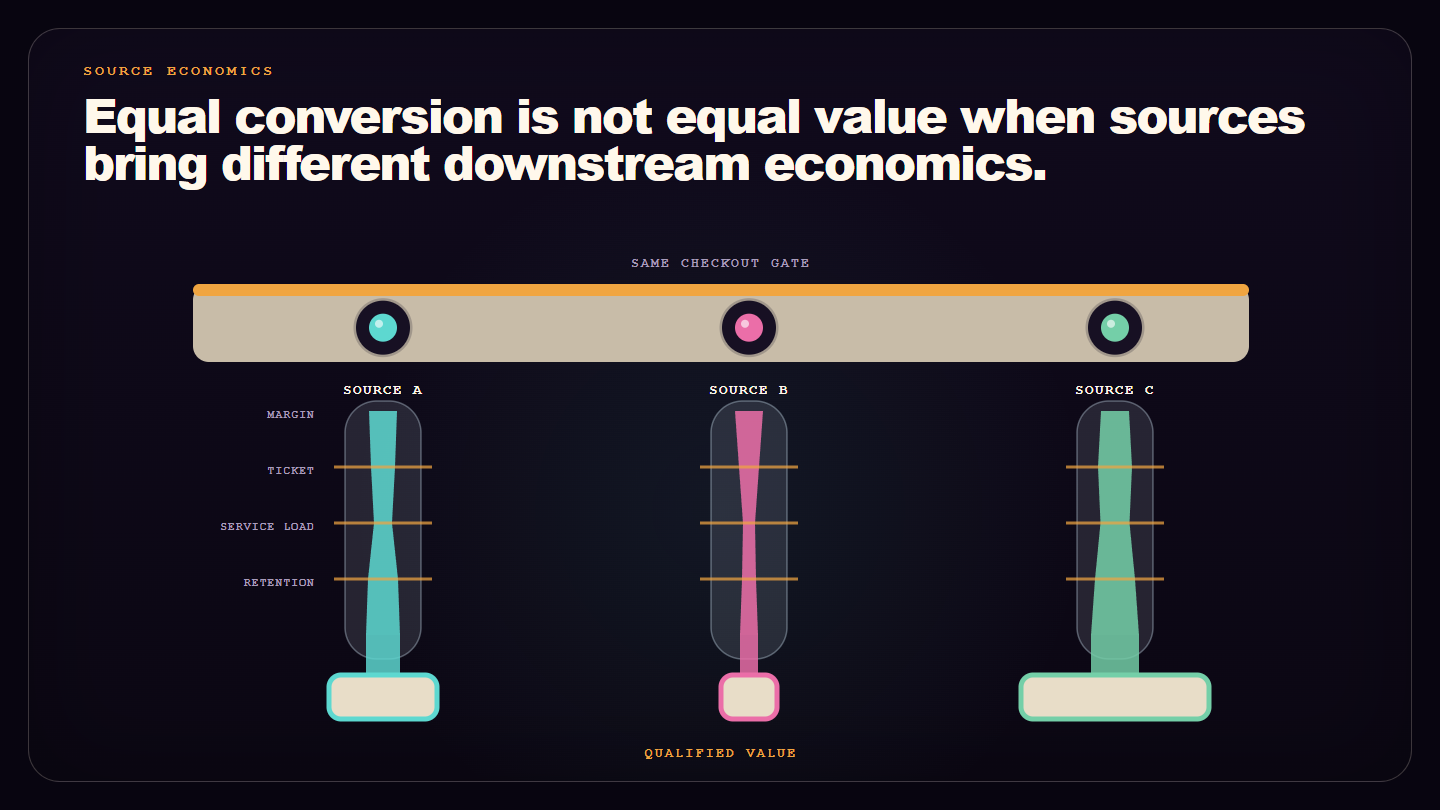
The city picture blocks one dangerous shortcut. A citywide average can improve while one neighborhood collapses. A funnel-wide conversion rate can improve while a high-value segment leaves. A campaign can create more leads while lowering the supply of customers who fit the service.
The map needs local views and aggregate views together.
A world forge assembles conditions, not fake people
A Population Foundry sounds like a place that manufactures synthetic humans, and that framing invites the wrong behavior.
The useful product is a world forge, which assembles declared conditions for a bounded experiment.
An operator chooses a market question, and the system retrieves current evidence. It identifies measured distributions, missing dimensions, dependencies, and source limits, then produces experiment specimens whose fields are labeled observed, operator-supplied, inferred, or simulated. The system doesn't claim that Specimen 184 is a real customer. It claims that this combination of conditions is one test position inside a stated model.
That distinction protects the research.
A specimen can reveal that a proposed message only works when urgency is high and approval is local. Another can reveal that a landing page assumes technical vocabulary absent from a low-awareness group. A cluster can show that a single “enterprise buyer” label hides procurement, technical, executive, and operator roles with different evidence needs.
The experiment creates questions for the market to answer instead of replacing the market.
Controlled bias makes the test legible
Every model has bias.
Data collection overrepresents people who were reachable. Interviews overrepresent people willing to speak. Customer records overrepresent people who bought. Social content overrepresents people who posted. Operator judgment carries experience and scar tissue. Generated specimens inherit the source corpus, model, prompt, and sampling method.
Pretending to remove all bias hides it.
Controlled bias declares the lens. The operator can say, “Weight recent lost deals more heavily,” “Hold budget constant while varying proof threshold,” or “Construct a stress population with low trust and high urgency.” The model then shows what was changed and what remained fixed.
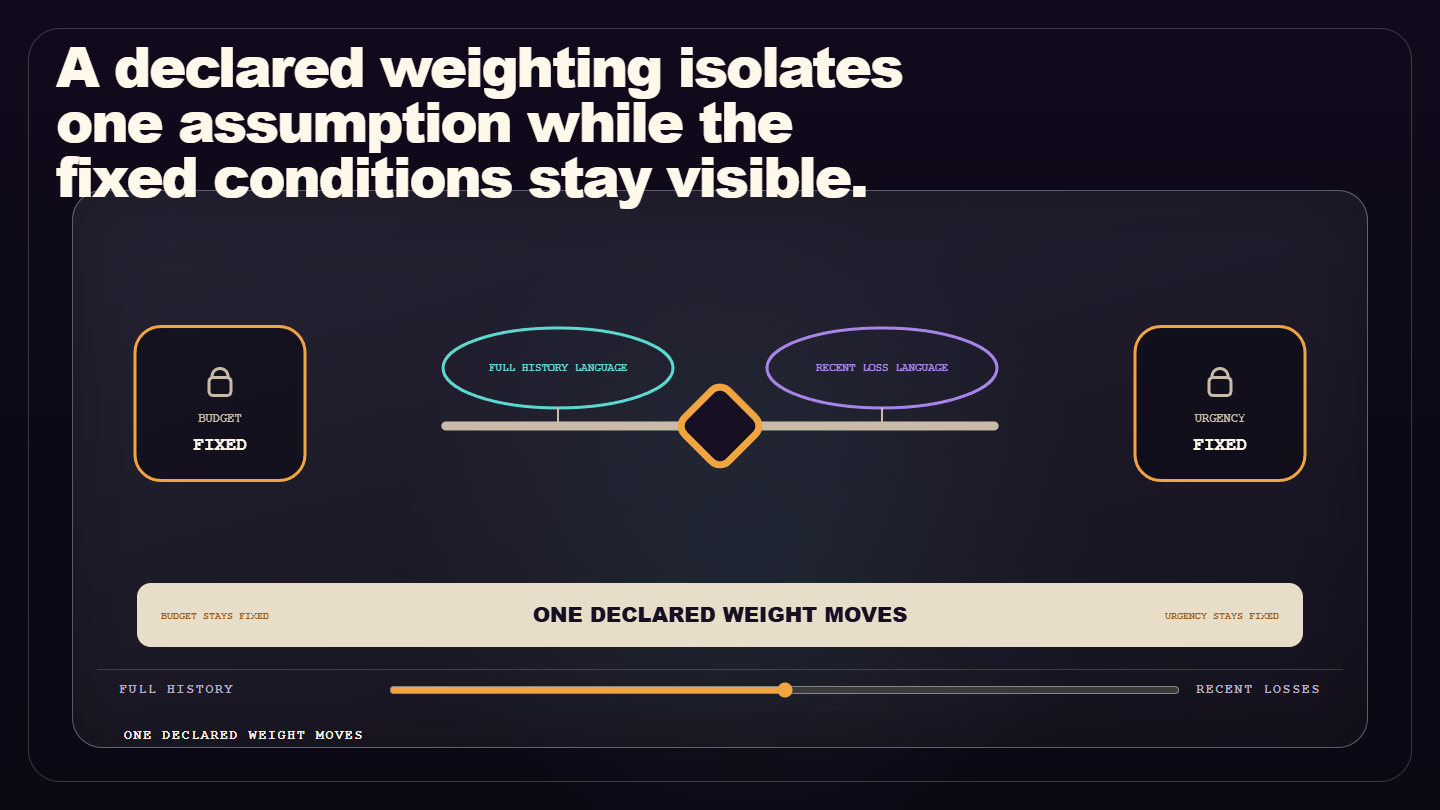
Declaring the weighting turns bias into an experimental control.
It also prevents a panel of agents from impersonating independent human evidence. Five agents using the same foundation model, source pack, and prompt family may produce five fluent opinions. Their agreement can reveal stability inside that setup, but it doesn't count as five independent market observations, so the system should show their common ancestry.
The Wardley Swarm is a council of bounded lenses
A Wardley Swarm can examine one decision from several operational positions.
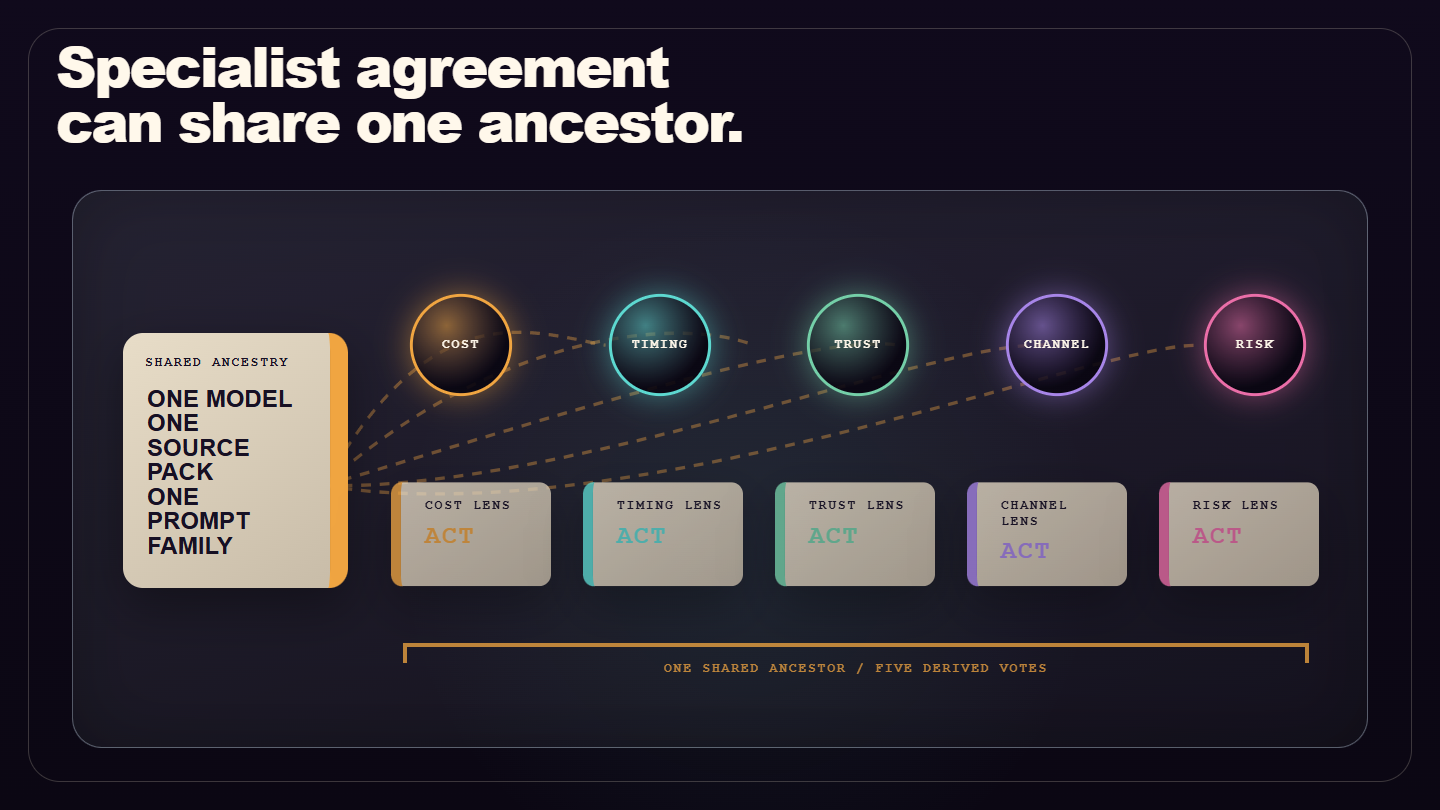
One specialist asks what a buyer is trying to accomplish. Another asks what evidence would reduce perceived risk. Another tests language against current community vocabulary. Another examines delivery constraints. Another challenges whether the proposed intervention can create the measured outcome. An evaluator looks for shared blind spots and unsupported certainty.
Each specialist receives the same typed population model through a different query.
The value comes from structured disagreement. A specialist can say which components drove its conclusion. The operator can see that a message performs well for one cluster and poorly for another. The system can compare the baseline population with one controlled intervention.
The fully populated, drift-monitored, agent-audited version is a specified future, not a shipped product claim.
The useful slice today is smaller: one decision, one source corpus, a few explicit components, two or three distinguishable specimens, one intervention, one evaluator, and one real market return. The team records the miss and updates the population.
That slice proves the loop without building a synthetic metropolis first.
Conversion optimization begins with the objective
Conversion-rate optimization is often introduced through interface changes: button colors, form length, headlines, and page layout. Those are interventions, not the objective.
The objective may be a completed purchase, qualified reply, product activation, retained account, larger agreement, or lower support burden. Changing the objective changes which population matters and which behavior counts as progress.
An email capture campaign and a purchase campaign can use the same traffic and need different models. A campaign seeking immediate sales may favor high intent and strong proof. A campaign seeking future education may accept lower current urgency and value permission to continue the relationship. A churn-reduction program starts after purchase and needs service events, expectation gaps, and product use rather than acquisition language alone.
The objective works as a reward function only in a bounded sense. It tells the system what outcome to optimize without making every path to that outcome acceptable, and consent, brand promises, margin, service capacity, and long-term trust remain constraints.
One typed population can feed several surfaces
Ad targeting, landing-page adaptation, email sequencing, sales preparation, and service reporting often build separate customer models.
One system calls a person a custom audience member, and others call the same person a visitor, a lead, an opportunity contact, or a customer. The person crosses those boundaries and loses their history at each one.
A shared typed population object can preserve continuity while exposing only the allowed view.
The advertising surface can use channel eligibility and consent. The landing page can use declared context and current source. The email workflow can use relationship stage and recent events. The sales surface can use organization, objective, proof needs, and authority. The service surface can use promises, deliverables, outcomes, and risks.
That takes one address system, scoped components, namespaces, and purpose-bound access, rather than one giant public customer profile.
The result is a funnel that behaves like one learning system.
A message changes attention. A visit changes observed context. A reply changes the opportunity. A close changes the service relationship. A service outcome changes the proof available for the next market. Each return updates the model that produced the earlier action.
The Counterfactual Observatory compares declared worlds
A counterfactual asks what might happen under another condition.
Marketing answers that question badly when it compares this month's campaign with last month's campaign and ignores everything else that changed. Season, price, inventory, channel mix, platform policy, competitive activity, and audience composition may all differ.
The Counterfactual Observatory begins with a comparison contract.
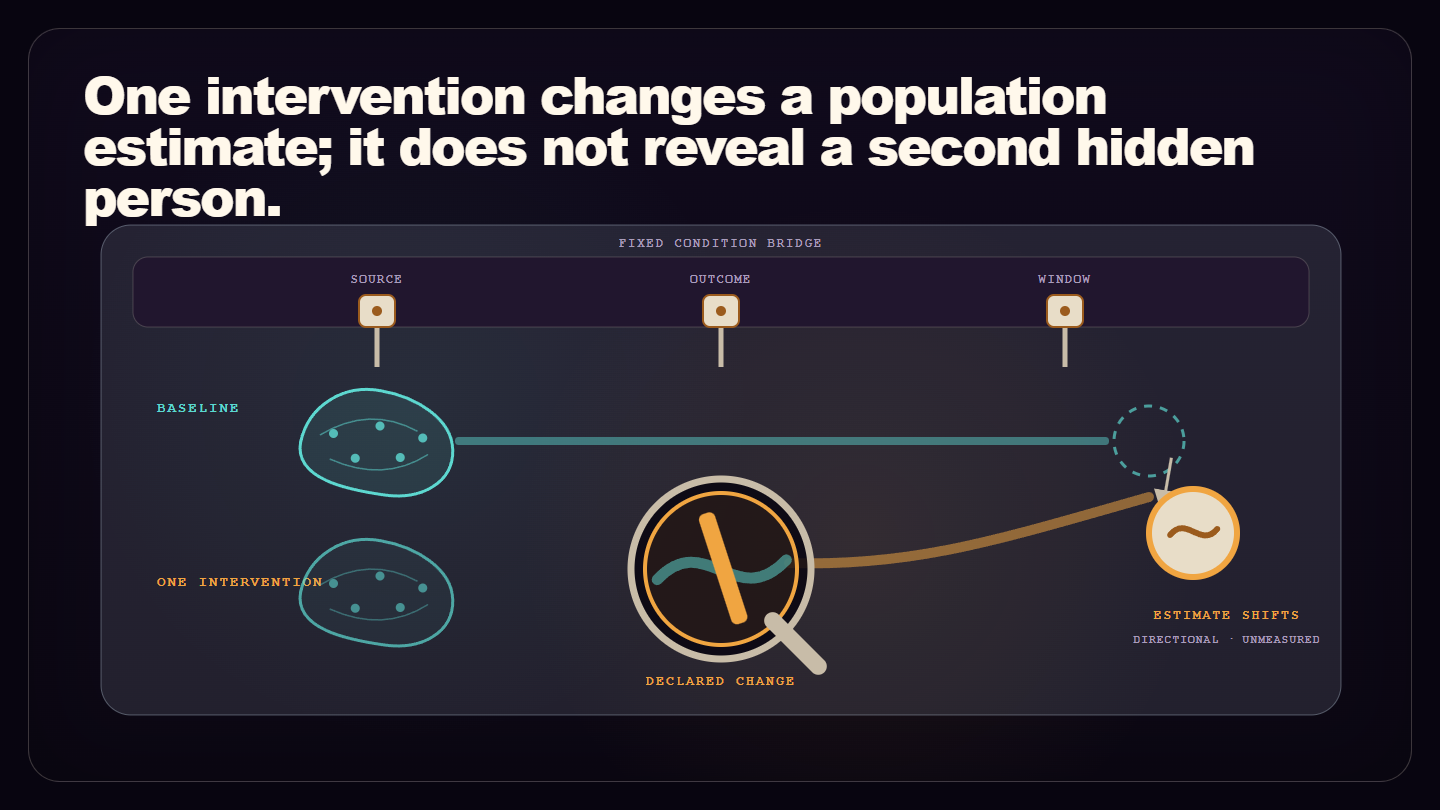
The contract names the baseline population, the intervention, the fields held constant, the fields allowed to vary, the outcome and observation window, the evidence class, and the rule that ends the test.
Simulation can then explore the decision before any capital is committed, and a controlled real experiment can follow. When the observed return disagrees with the simulation, the disagreement is valuable because it shows where the world model failed.
The comparison should resist decorative precision. A synthetic population saying Version B wins by 12.7 percent doesn't create a forecast with that accuracy. The safe result may be directional: Version B depends less on technical vocabulary, creates less risk for low-authority buyers, or performs poorly when urgency is low.
The operator chooses how much real exposure that evidence earns.
Population drift changes the meaning of a win
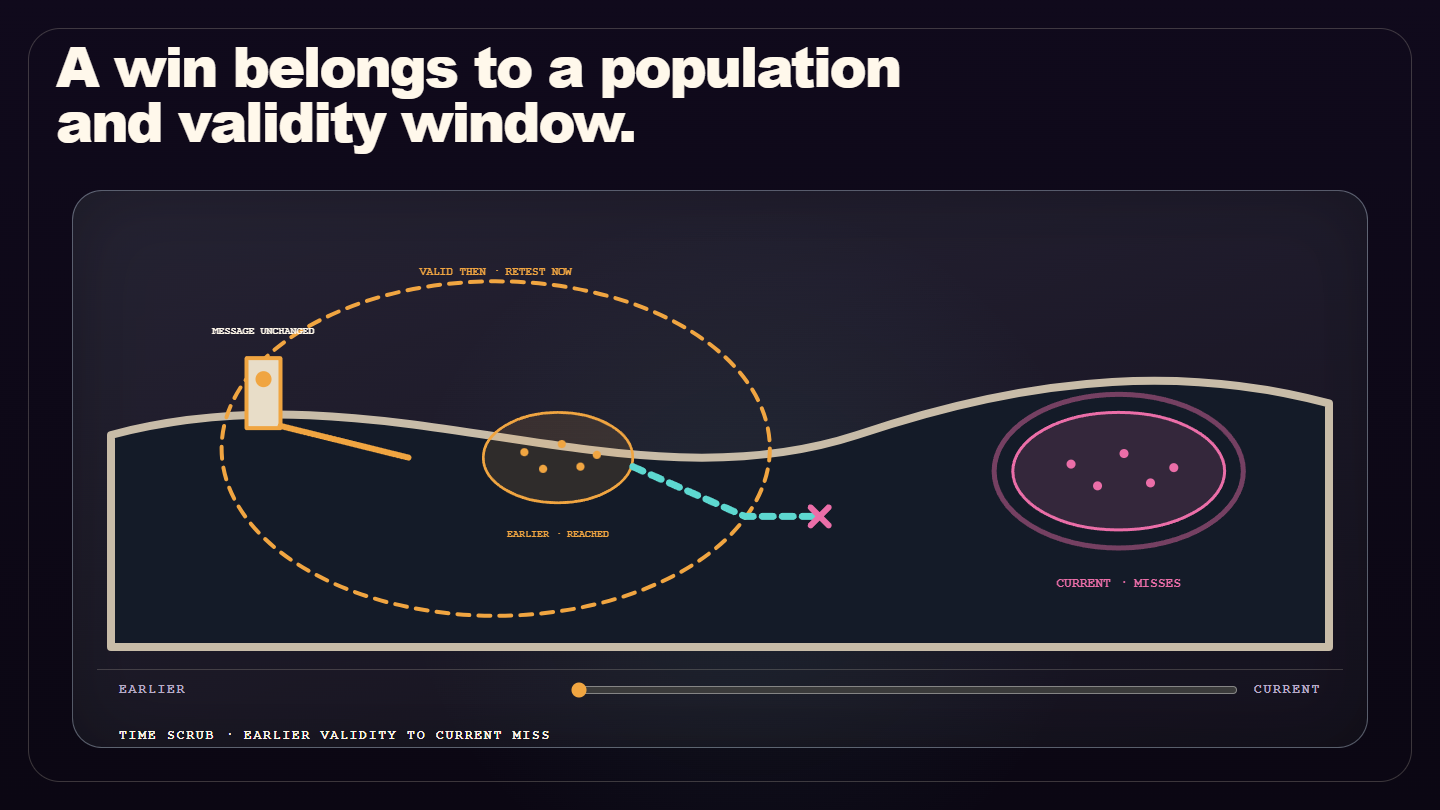
A winning message can become stale while its words remain unchanged.
The audience may move to another channel. A tool update may retire the pain the message names. A scandal may change the proof threshold. Competitors may copy the language until it sounds generic. The people arriving through a paid campaign may differ from the people arriving through referral. The model that explains last quarter's conversion may no longer describe this month's traffic.
Drift detection watches distributions, not only totals.
Did the share of high-urgency opportunities change? Did budget evidence shift? Did a vocabulary cluster appear? Did the time from first view to reply lengthen? Did one source produce more volume and less fit? Did objections move from price to trust?
The system should update a component when the evidence changes and preserve the old validity window. The map then shows that the earlier campaign worked for an earlier population under earlier conditions.
The practice room is deliberately small
Choose one live market question.
Build a source corpus recent enough for that question and define a small set of components. Keep observation, recollection, inference, and simulation separate. Construct a baseline population and one declared intervention, ask several bounded specialists to examine the same typed model, make their common ancestry visible, and let an independent evaluator challenge the result.
Then place a small real bet.
The return may be a click, reply, interview, objection, sale, cancellation, or silence. Record the event and the observation window, compare them with the model, update the components that failed, and keep the full run so the next test starts from accumulated evidence.
This practice turns population modeling into active sensing.
The city can stay incomplete as long as it has one street where a change produces a measurable return and a trustworthy record of what the system believed before it acted.
That return then has to travel through the engine that turns a model into work.
9. From world model to working engine
Follow one signal.
A new Upwork post appears. The buyer wants help with a marketing system, but the post mixes symptoms, tools, and outcomes. The opportunity looks relevant, and the clock has started.
A person could open a chatbot, paste the post, ask for a proposal, and get fluent text back that may even sound competent. That path hides most of the work.
Does the job fit the operator's real experience? Which parts of the post reveal the buyer's deeper problem? Which past assets prove the right capability? Which current facts need research? Which claims can the operator make? What would a strong sample show? Who checks the result? Where does the decision live tomorrow?
A working engine turns those questions into a flow anyone can observe. Its stages are one decision traveling through seven changes, not a row of tools sitting side by side. The post opens a possibility field, and a specific application decision bounds it. Retrieval and analysis supply the instruments, and evidence and policy narrow the candidates. Human approval commits one package, buyer behavior returns a new event, and evaluation and memory update the next decision.
Capture the signal with its conditions
The job post enters the system as a source, not as a blob of prompt text. The original record preserves the possibility field before the team commits to an interpretation.
The record keeps the platform, URL, client, timestamp, budget, stated requirements, questions, attachments, and raw language. Extraction identifies entities, tools, industries, outcomes, and constraints. The original text stays available because extraction can miss or distort.
The system can now connect the opportunity to related objects. Past proposals, portfolio assets, client work, market research, voice samples, and current product knowledge become candidates for retrieval.
Nothing has been generated yet, and the first piece of value already exists: the opportunity is now inspectable.
Retrieve a world, not a keyword pile
Keyword search may find every file containing “Shopify.” The operator needs a smaller and smarter view.
Which Shopify work involved revenue ownership? Which assets show catalog, retention, advertising, or analytics judgment? Which source reflects the operator's current voice? Which facts are recent enough for the market? Which client material is allowed to enter this opportunity's namespace?
The metagraph supports retrieval through relations and time. A project connects to its artifacts, decisions, outcomes, and people. A fact connects to its source and validity. A voice sample connects to a register and date.
Retrieval then produces a bounded context package, small enough for the next worker to use and rich enough to keep the mechanism intact.
Most retrieval anybody has actually touched comes in two shapes, and both of them work.
One is a wiki a model writes and keeps current. Andrej Karpathy published a version of it: raw sources at the bottom that the model reads and never edits, a folder of markdown above them that the model does maintain, and a config file describing how the whole thing is organized. For one person managing their own sources, that's a good instrument, and it's the right shape for the job it's doing.
The other is what an engineer builds when a team needs answers out of a documentation set. Crawl the pages, split them into chunks, embed the chunks, keep the vectors, return the nearest ones to each question. Archon is the open-source version people reach for, and it answers real questions every day.
We ran that second pattern here through 2025. It held until the questions changed.
A flat index returns neighbors. Three ordinary questions get nothing back from it:
- Ask what a corpus keeps circling back to and there's no passage to return, because a theme isn't written down in any one chunk.
- Ask what changed between March and August and there's no clock to read.
- Ask what the corpus never covers and nothing comes back at all, since absence doesn't have a document.
Another level sits above the flat index. Group the chunks into neighborhoods, write a summary of each neighborhood, summarize those summaries, and leave the whole tree standing. Retrieval then runs vertically and horizontally in one query: down to the exact sentence, out across the region it belongs to. Attach when each fact was true, where it came from, and how much anyone trusts it, and the words those sources keep reaching for start extending into a taxonomy the corpus earned on its own.
What gets demoed instead is a graph visualization rotating on a dark background, a control panel with ten animated tiles, an automation rig posting to nine places at once. Ask which of them made an answer faster, cheaper, or less likely to be wrong. A picture of a graph isn't a graph anybody can query.
The common instruments are fine, and they're aimed correctly at the people holding them. What's missing is any sense that a deeper set exists, which is the encouraging part. Physics has the same surprise on record: empty space turned out to carry structure nobody could see until an instrument got strong enough to show it. The rungs above a flat index are laid out properly in the five shapes data actually takes.
Analyze before choosing a product
The engine decomposes the buyer's post.
One layer names the stated request, and another identifies the business problem beneath it. A third maps the future state the buyer wants to observe, and a fourth names the constraints and the evidence required to cross the gap.
People-Product-Process earns its place at this step: diagnose the problem separately from the operator's favorite solution, describe the future through visible artifacts and events, and design the transformation between them.
The analysis may conclude that a proposal is warranted, or it may reject the opportunity, because a strong engine improves selection as well as production.
Rejection matters because production capacity is scarce. Every weak application consumes time that could deepen a better one. The system should explain the reason: poor fit, weak budget, unclear authority, impossible promise, missing proof, expired post, or a market where the operator lacks current context.
Dispatch the right specialist
SuperHarness then routes bounded work to specialist agents. The Agent Systems entry explains why role, authority, tools, and a stop event have to travel with the work.
A harness gives an agent a role, tools, permissions, context, a quality bar, a stop condition, and an evidence contract. That structure keeps one generic model from improvising every part of the company from the same chat window.
Hermes is the agent runtime that executes the work in the current system. Its named profiles carry different standing capabilities: a research profile can query sources and produce a grounded package, a software-engineer profile can inspect and change code, and a creative-production profile can build a bounded visual artifact. An evaluation profile can grade work without sharing the producer's incentives.
Every brief carries the same nine operational rungs: mission, objective, strategy, tactic, operation, action, decision, data, and event, all held inside the purpose they serve. The detail changes from one job to the next, and the coverage stays complete so the receiving agent doesn't fill the gaps with generic assumptions from its training data.
A research job should know which sources own which claims, which queries must run in sequence, which assertion to re-execute, and where to save the result. A visual job should know the adjacent prose, the idea the reader needs to grasp, the visual class, the reduced-motion behavior, the delivered size, and the acceptance proof. An evaluator should know the kill criteria and the correction loop.
The harness makes those contracts repeatable.
Compile the artifact
The engine now turns analysis into a product.
For an Upwork opportunity, the product may include a cover letter, work sample, video scaffold, research note, and follow-up plan. For a Field Note, the product includes a thesis, long-form article, citations, motion program, still images, interactions, accessibility, and rendered proof.
Compilation is a useful word because one source can produce several surfaces.
A transcript can become a world model. The world model can support an article, proposal, infographic, sales conversation, onboarding flow, or agent skill. Each output selects a register, audience, format, and level of detail. The underlying evidence and provenance stay shared.
Call it the one-source-many-surfaces rule. Refining the shared source or component improves every consumer, and creating a second disconnected copy creates drift. The Content Compiler follows that path from a shared source model to several purpose-shaped artifacts.
The engine should compile from canonical data and components wherever possible. A Field Note's index card and detail page should share one entry. Every media slot showing the same concept should use the same registry and source. Every agent profile should inherit one creative standard rather than keeping a private rewrite.
Evaluate the result independently
Generation creates a candidate, and evaluation decides whether that candidate deserves the next state.
The evaluator checks claim fidelity, voice, value density, accessibility, visual comprehension, delivered-size readability, motion behavior, interaction value, source support, and the exact acceptance contract for the product.
The evaluator also re-executes one load-bearing claim or boundary. Re-execution catches a dangerous failure: a report can cite many sources while its central conclusion rests on one false sentence.
When the evaluator finds a defect, the finding returns to the producer with a correction order. The old verdict stays visible while the producer corrects the artifact and records the change, and then the evaluator checks again. Evals and Observability develops the distinction between generating a plausible candidate and earning the state change that accepts it.
The closed loop matters more than a numerical score, because it teaches the system which defects recur and which gates catch them.
Record the receipt and reopen path
A finished artifact leaves a durable trail.
The receipt names the source inputs, profile, model, tools, working directory, branch, session, proof, result, produced files, and residual risk. Git records source changes. The task ledger records purpose, state, decisions, evidence, and handoff. Graphiti preserves reusable learning with temporal validity. The artifact itself contains provenance and correction notes where readers need them.
The reopen path answers a simple question: can another operator return tomorrow and see what happened without relying on the original chat?
Source code alone can't answer that, and neither can a screenshot or a task marked complete. The next operator needs the current state, the evidence, the decisions, the failures, and the next action.
SuperHarness and AgentOS are different layers
SuperHarness holds execution and coordination contracts: the profile, bounded job, authority, receipt, evidence, and durable return. AgentOS gives a person a usable surface over those contracts.
The human standard is higher than the existence of source objects or healthy endpoints. A usable AgentOS surface must let a person inspect the profile, understand what will run, launch a bounded job, watch real state, inspect native evidence, approve or reject, and reopen the same work later. Empty routes, attractive dashboards, and backend endpoints don't complete that journey. State Machine Everything explains why an approval or reopen action matters only when it changes durable state.
The mechanism described here is the operating design, and capability still to come is labeled as still to come. A product counts as ready only when the complete human journey works.
Labeling states that carefully is part of hyperrelevance. The map should distinguish the source state, the intended state, and the human-verified state instead of blending them into one optimistic sentence.
One signal should keep its lineage across every surface
Follow one sentence from capture to publication.
An operator says something during a call. The transcript preserves the words, speaker, time, and recording source. An extraction activity identifies an entity, a claim, and a possible relation. A temporal graph stores that relation with its source and validity. A voice analysis records rhythm and vocabulary without replacing the transcript. A retrieval step selects the sentence for a specific question. A specialist uses it inside an article. A visual turns the adjacent idea into a scene. A reviewer changes the scene after finding that its first version looked good and explained the wrong thing.
The published paragraph and the final scene end up far from the original recording, and their lineage should stay close to it.
W3C PROV offers a useful public vocabulary: entities are things, activities transform things, and agents are responsible for activities. Derivation, generation, attribution, revision, and collection relations describe how one artifact became another.
Those relations record the route without certifying the destination.
A source can be wrong. An extraction can miss context. A faithful transformation can preserve a false premise, and a reviewer can approve a beautiful error. Provenance makes those failures inspectable, but it can't make them impossible.
One-source-many-surfaces is therefore a discipline of controlled derivation. A verified transcript can support a voice fingerprint, a Field Note, a short video, a case study, and a sales asset. Each surface adapts the source for its job and keeps a route back through the activities that changed it.
That route protects the golden goose too. A public surface can show the mechanism, the evidence class, and a bounded receipt without exposing private customer records, profile instructions, scoring weights, extraction recipes, or the complete graph. A reader can understand why the system works while the implementation advantage remains inside the engine.
10. The human stays in the loop by holding authority
“Human in the loop” can mean almost anything.
Sometimes a person clicks Approve after the system has already committed the action. Sometimes the person edits text but can't change the workflow that created the defect. Sometimes the interface shows a summary while hiding the source, policy, model, and evidence. The person is present and powerless.
Real authority has observable actions.
The operator can inspect what will run, change consequential inputs, approve, reject, correct, stop, reopen, and change the policy that shaped later runs. The system records who made the decision and which evidence was available.
A handoff needs more than a transcript
Imagine an air-traffic controller ending a shift.
The next controller needs current positions, destinations, weather, clearances, conflicts, decisions, and expected events. A recording of the previous controller's conversations may contain all of that somewhere, but it's still a terrible thing to operate from.
Agent work needs the same compression.
The next operator should see the purpose, current state, evidence, decision, blockers, and next action. The transcript stays available for forensic detail, and the operating state shouldn't depend on rereading it.
That's why the system uses several authorities instead of one giant memory.
Git answers, “What changed in the machine, and which history contains it?”
The task ledger answers, “Why are we doing this, what state is it in, which decisions were made, and who owns the next action?”
Graphiti answers, “Which reusable learning should later agents retrieve, and when was it valid?”
Native receipts answer, “What actually ran, with which profile, tools, context, and result?”
No one store should pretend to own all four questions.
Approval should change the state
An approval control is real when it gates a consequential transition. State Machine Everything develops the same rule as an operating system: the actor, object, allowed transition, and resulting state all remain visible.
Before approval, the action hasn't happened. After rejection, the system records the reason and doesn't quietly retry. After correction, the next candidate reflects the change. On reopen, the operator can see the decision and its effect.
The same applies to policy.
If every proposal overstates certainty in the same way, editing each proposal is expensive theater. The operator needs a way to change the instruction, rubric, source rule, or workflow that generates that class of defect, so one correction improves later work wherever the shared mechanism applies. That's how human judgment compounds.
Inspection needs the right altitude
The operator shouldn't have to read every token, tool call, and database row for every job, because that would make automation slower than doing the work by hand.
The surface should lead with ordinary meaning:
- what the system understood,
- what it plans to do,
- which evidence supports the plan,
- which uncertainty remains,
- what decision the person owns,
- what will happen after the decision.
Exact paths, identifiers, commands, prompts, and raw receipts remain available below that layer. The person can move down when risk or confusion requires it.
That's progressive disclosure applied to authority: simplicity at the top should make deeper inspection easier, not remove it.
Reopening is part of completion
Work is incomplete when it can be understood only inside the session that created it.
A browser journey should survive refresh. A task should survive a new manager. A receipt should point back to the native run. An artifact should identify its sources and correction history. A decision should remain visible after the interface closes.
Reopening protects the operator from losing context, and it protects the system from false completion. A demo that works once under the builder's hands may collapse when another person tries to resume it.
Authority and evidence let the engine allocate its scarcest resource with more care, and that resource is attention.
11. Attention, capital, and build power
Look at the top edge of a real-time strategy game.
Two or three numbers change while the player works: income flows in, construction spends it, and storage fills and drains. One resource can overflow while another hits zero. The army on the map may look like the game, but the resource bar quietly decides which actions are possible.
A digital profit factory needs a resource bar too.
Capital pays for access, labor, software, inventory, time, and risk. Attention supplies qualified human moments in which a message can be noticed, understood, remembered, and acted upon. Build power turns both resources into deployed work: research, creative, campaigns, conversations, delivery, measurement, and correction.
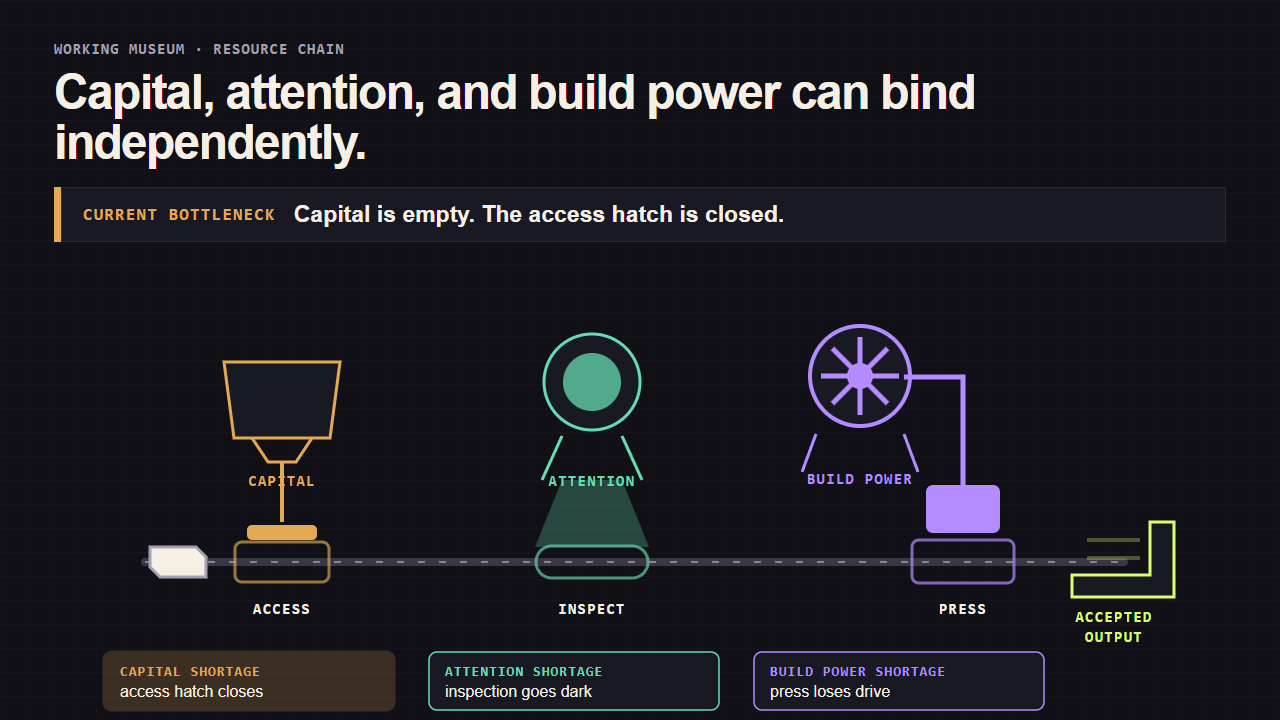
The third resource is easy to miss. A business can have money and audience demand while lacking the capacity to ship useful work. Another can have a talented team and no reliable attention source. Another can have attention and production capacity while cash timing forces every system into survival mode.
The binding constraint moves around, so the operating system needs to show which one binds now. The Standard Model of Effective Media provides the public depth for separating attention inventory, movement, and value.
Manage rates, not piles
Beyond All Reason describes an economy built from metal, energy, and build power. These resources have different roles, and too little of one can slow production. Its official economy guide teaches the player to watch income and use together rather than admiring the stored total.
That rate-based view transfers well.
A business doesn't own “traffic.” People arrive through channels at a rate, and the rate changes by hour, season, platform, offer, reputation, and competition. Capital arrives and leaves through invoices, payroll, advertising, subscriptions, taxes, and reinvestment. Production capacity changes as people, agents, approvals, and dependencies become available.
Storage helps with shocks. Cash reserves cover a delayed invoice, a content library feeds a quiet week, a waiting list preserves demand, and templates cut setup time. None of them fixes a structural mismatch in rates.
If work enters faster than the system can evaluate and produce it, the backlog grows. If production spends cash faster than outcomes replenish it, reserves shrink. If advertising rents attention faster than the offer can absorb qualified leads, acquisition becomes waste. If a team produces assets faster than distribution can place them, inventory decays unseen.
The useful question is, “What is our current inflow, outflow, stored buffer, and conversion capacity for each resource?”
Human attention stays scarce
The internet holds an enormous amount of media inventory, and a person's next useful moment is still scarce.
A platform can generate billions of impressions while one buyer has only a small number of moments in which your problem is relevant, your message appears, and enough attention remains to understand it. Frequency can increase exposure while reducing tolerance. A channel can scale impressions while degrading the share of qualified people. A broad audience can be abundant and economically useless.
Attention also decays.
A job post is fresh when the buyer is actively forming a shortlist. A reply has high value when a conversation is moving. A proposal view can create a short follow-up window. A trend offers cultural attention before every competitor copies it. A support issue becomes expensive when silence changes trust.
The system should track qualified attention as perishable inventory, not as an infinite river.
Deposits are places where intent already exists
Metal in Beyond All Reason comes largely from particular places on the map, and controlling those places matters. The marketing equivalent is a location where relevant intent already concentrates.
A high-intent search query can be a deposit. A trusted referral relationship can be a deposit. A job feed filtered to a narrow capability can be a deposit. A customer segment facing a new regulation can be a temporary deposit. An email list with earned trust can be a deposit.
An extractor is the mechanism that repeatedly harvests that intent.
A ranking article can extract search demand. A referral loop can extract trust. A strong Upwork profile and proposal system can extract opportunity flow. A useful public Field Note can extract recognition from people who already need the thinking it demonstrates.
Every extractor has upkeep.
Search content requires current facts and working pages. Referrals require delivery and relationships. A job-market filter requires fresh ingestion and calibration, and an email list requires permission, relevance, and restraint. “Organic” means the channel doesn't charge for each click, not that the channel is free.
Neglected extractors go dark before their owners notice. Rankings decay, trust weakens, sources change, and the stored playbook keeps reporting an earlier world.
Paid media rents distribution
Paid advertising rents access to moments a platform can place, but it doesn't create human attention from nothing.
Capital buys a chance to enter the competition for attention. Creative earns or loses the moment. Targeting changes which people encounter the bid. The offer and experience determine whether that moment becomes a useful next event.
It's tempting to map the game's energy onto advertising, and the mapping is false. A paid campaign consumes capital and production capacity to acquire distribution. It may capture high-intent demand or introduce a new problem, and its efficiency depends on audience, auction, message, landing experience, measurement, and time.
Owned and earned channels have different cost shapes. They often require larger setup work and smaller marginal spend. Paid channels can produce faster learning and controllable volume while exposing the operation to auction costs and platform rules.
A mature factory uses both deliberately.
More spend meets a curve
Scaling a successful channel rarely produces a straight line.
The first budget reaches the strongest audience pockets. More budget expands frequency, bids into weaker inventory, enters adjacent groups, and strains creative freshness. Results can continue improving while each additional dollar creates less incremental value.
Beyond All Reason has an overdrive mechanic in which extra energy can increase extraction with diminishing returns. The exact formula belongs to the game, and the business lesson is only the shape of the curve.
Measure the real curve.
For each spend band, observe incremental reach, qualified attention, conversion, margin, service load, and downstream value. Separate average return from marginal return. A channel can look profitable overall while the newest spending block destroys value.
The answer may be more spend, or it may be new creative, a new segment, a better offer, stronger proof, or a new deposit. The resource bar should reveal the constraint instead of treating budget as the only lever.
Nanostalling is system-wide slowdown
A strategy-game economy that spends faster than it earns can slow production across the whole base. Beyond All Reason players recognize the stall because many build queues weaken together.
A business nanostalls when a shared resource deficit slows every function.
Cash timing can delay contractors, media, software, and experiments. Approval debt can pause writing, design, campaigns, and reporting. Missing data can force every agent to reconstruct context. A founder's attention can become the hidden power grid, leaving dozens of workflows waiting for one person to review routine choices.
The failure is frightening because nothing has to stop completely. Everything takes longer: response quality drops, reports arrive late, follow-ups slip, and creative gets reused past its useful life. The organization experiences many local problems and misses the shared deficit.
A resource view links the symptoms.
If the common shortage is capital, cut or sequence spending and restore cash inflow. If it is attention, strengthen distribution or find a richer deposit. If it is build power, reduce work in progress, improve the production path, add capacity, or automate a proven step. If it is authority, move defined decisions away from the founder while preserving escalation.
The fix follows the binding constraint.
Build power converts resources into units
Build power controls production throughput in Beyond All Reason. More income can't become more units when the construction system can't spend it.
The marketing equivalent includes research capacity, writing, design, media generation, engineering, evaluation, approvals, deployment, and client communication.
An agent harness can raise build power by routing narrow work to several specialists, running research while implementation proceeds, preserving context, and performing routine checks. It can also create queue theater, where dozens of agents produce documents no operator can inspect, integrate, or deploy.
Useful build power ends in an accepted unit.
A proposal submitted with correct evidence is a unit. A campaign launched with measurement is a unit. A client report that changes a decision is a unit. A reusable component registered on the real site is a unit. A research memo waiting in a forgotten directory is stored work, not fielded capacity.
Throughput has to include evaluation and acceptance, or the factory ends up counting parts instead of finished units.
Reclaim turns wreckage into learning inventory
Builders in Beyond All Reason can reclaim resources from wrecks and parts of the environment. The official reclaim guide makes the mechanic explicit.
Digital operations leave wreckage everywhere.
A failed campaign contains audience data, comments, losing messages, production assets, and timing evidence. A proposal that received no reply contains a target, loadout, claims, and response window. A dead product contains user language, support questions, technical components, and a record of false assumptions. A long meeting contains decisions, explanations, objections, and vocabulary beyond the summary.
Reclaim is a deliberate activity.
The system inspects the wreck, identifies reusable entities, separates evidence from interpretation, preserves lineage, and assigns each recovered part a current status. An old case study may retain its mechanism and lose its market numbers. A failed headline may reveal negative space. A rejected proposal may become a low-fit training specimen. A motion graphic may serve another explanation after its labels and evidence change.
Reclaiming differs from copying, because copying carries hidden state. Reclaim extracts named value with provenance and a fresh validity decision.
Maturity is a change in machinery
Strategy games lock advanced machinery behind an earlier economy. The exact costs and multipliers belong to each game's balance rules, and the structural idea transfers: a later system needs foundations that an early system doesn't have yet.
A solo operator can begin with manual capture, a clear rubric, a few proposal assets, and disciplined outcome logging, and that's a valid first tier. Building a multi-agent production fleet before the opportunity model and review loop work creates idle machinery.
The next tier may add typed ingestion, reusable asset pipelines, lineage, evaluation, and a client event stream. A later tier may add population simulation, adaptive policies, multi-tenant operations, and supervised autonomy.
Each tier should open only after an observable constraint appears and the earlier loop produces reliable evidence.
Maturity is a change in which machinery the operation can use safely, not a badge on the roadmap.
Six layers organize the profit factory
The long list of modern marketing work becomes easier to reason about when sorted into six layers.
The resource layer holds attention, capital, time, data rights, and production capacity, and analytics, attribution, and observability show how those resources move and how uncertain the picture is.
The extraction layer covers search, referral, community, job feeds, partnerships, retention, and other channels where demand or trust already concentrates.
The generation layer covers paid distribution and the other mechanisms that spend resources to create new exposure, learning, or demand.
The production layer is the research, copywriting, design, media, engineering, asset rotation, and testing that turn resources into deployable artifacts.
The command and control layer holds the CRM, workflows, routing, permissions, automation, state, and operator surfaces that coordinate the fielded system.
The doctrine layer holds the documentation, training, knowledge, evaluation standards, and decision policies that let people and agents act consistently under pressure.
The layers depend on one another. Strong doctrine with no production stays a manual, and production without command creates chaos. Extraction without upkeep decays, generation without attribution hides waste, and resources without build power sit unused.
The map should let an operator move between layers while preserving one event chain.
The apparatus around models creates the edge
A quantitative firm doesn't compound because one clever model lives forever.
The advantage comes from an apparatus that finds data, develops models, tests them, sizes risk, executes, monitors drift, records outcomes, and retires failed ideas. Models are inventory inside a production and governance system.
Hyperrelevance works the same way.
One audience insight can help, and the compounding advantage comes from the apparatus that keeps the insight current, turns it into several artifacts, measures returns, detects drift, and preserves corrections. In the same way, one powerful agent can draft, and the edge comes from the harness, typed model, evidence path, evaluation, operator authority, and memory that make many runs improve one another.
That's why AndyDataGuy matters as the first extractor.
The public site can prove one base economy: authenticated thinking becomes useful Field Notes, the notes attract qualified attention, conversations create returns, client work produces evidence, and the evidence deepens later thinking. The site is a public instrument connected to the engine, not a separate thing.
Build that extractor before pretending to operate thousands of agencies.
A cadence keeps the resource bar honest
The exact cadence belongs in the operator's settings, and the activities stay the same.
Review resource flow often enough to see a stall before the whole system slows. Inspect extractors for upkeep and drift, and compare marginal return as a channel scales. Run reclaim across dead campaigns, unused research, and rejected opportunities. Check whether build power matches current inflow, and ask whether the next maturity tier solves an observed constraint or only looks impressive.
Before a large bet, run a skirmish.
Use the population model to rehearse the decision and check the evidence class. Then make one small real deployment, observe the return, keep the result, and increase exposure only when the feedback earns it.
This economy isn't a financial market. Attention isn't money, people aren't deposits, and content isn't a military unit. The game gives the operator a visible language for rates, constraints, salvage, and throughput, but the real measurements still have to come from the real operation.
12. Attention has inventory, flow, and waste
The resource view answered how much qualified attention, capital, and production capacity can move through the factory. A different instrument asks what each measured event means, what caused it, and which value claim the evidence can support.
Picture a market square at noon. The square has room for a hundred stalls, but only twenty sit along the path most people walk. A baker can rent one of those twenty, place bread at eye level, and count everybody who passes. The count matters because it tells the baker how many chances the stall had to be noticed.
The count doesn't tell the baker who smelled the bread, stopped, asked a question, bought a loaf, came back tomorrow, or told a friend.
Marketing systems often compress that entire sequence into one word: attention. That shortcut makes dashboards tidy and decisions sloppy. An impression, a view, a visit, a conversion, and profitable demand are different events. Each event answers a different question. Hyperrelevance Cartography keeps them separate long enough to learn from them.
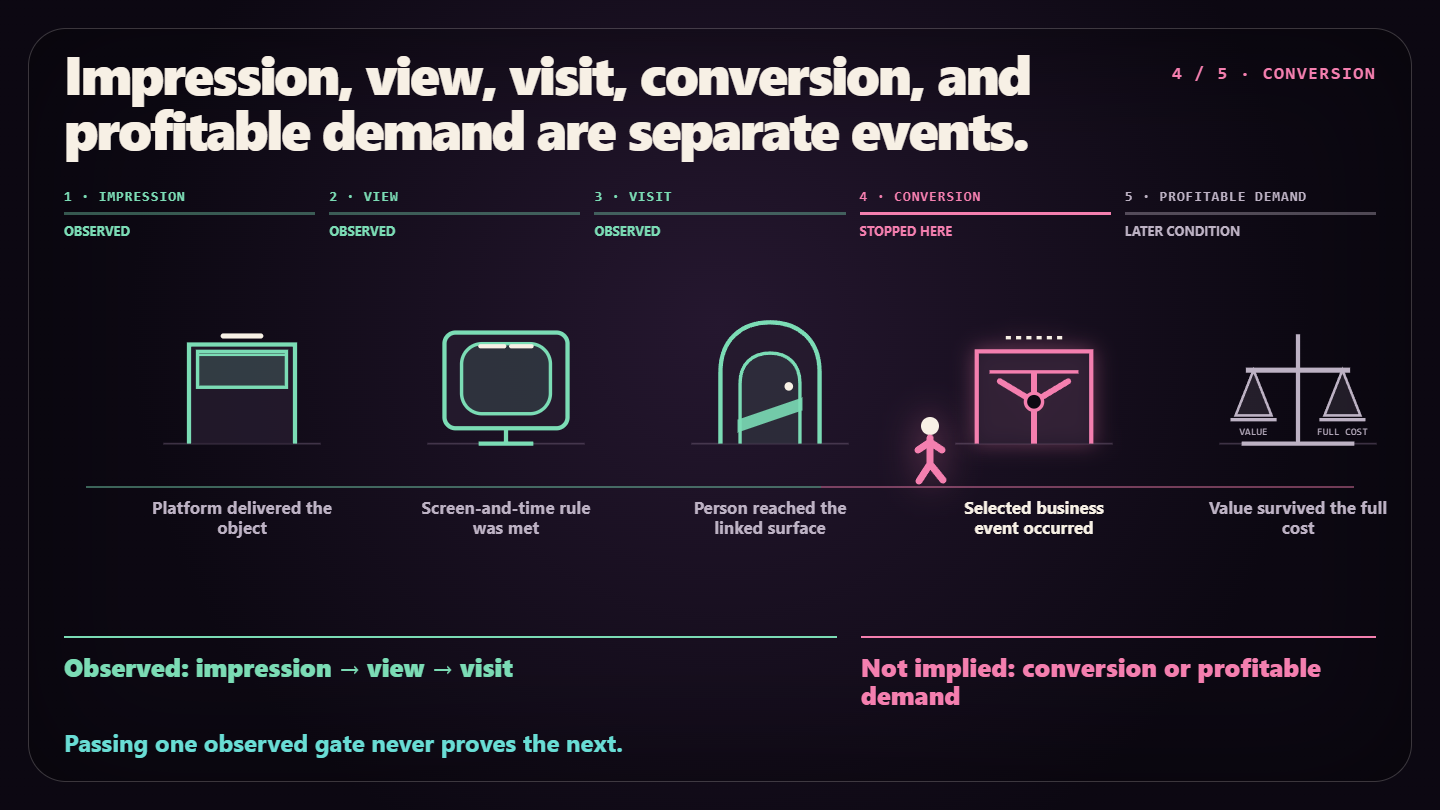
An impression is the widest observation. A platform began delivering or downloading an object according to that platform's rule. A viewability measure asks whether enough of the object occupied the screen for enough time to qualify under a stated standard. A click records an interaction. A session records an arrival on another surface. A conversion records an event selected in advance, such as a booked call, a completed purchase, or a submitted application.
Those observations get stronger as they move closer to the business, but none carries every kind of value.
An impression can have direct commercial value under a cost-per-thousand-impressions contract. The advertiser pays for a measured unit of delivery and the publisher books revenue from the same unit, which makes the impression economically real before anybody proves that the campaign changed a buyer's behavior.
The causal question remains open. Did the impression produce the sale? Would the buyer have purchased anyway? Did a different channel do the persuasive work? Attribution systems connect events into a story. Controlled lift tests compare exposed and unexposed groups to estimate what the media caused. Unit economics decide whether the resulting activity created enough margin to justify the work.
The distinctions matter because every layer can look healthy while the layer below it rots.
A campaign can generate millions of cheap impressions in places where the right buyer never looks. A page can collect visits from people who leave before they understand the offer. A form can produce leads that no salesperson can close. A sales team can close accounts whose service cost destroys the margin. Each surface reports a success because each surface measures a local event.
The cartographer follows the whole route. Attribution goes deeper on preserving the event chain without granting one local metric ownership of the outcome.
A measured moment is still a scarce moment
Herbert Simon described the basic problem in 1971: abundant information consumes the attention of its recipients. Information has become easier to produce and distribute since then, and a person's day hasn't gained extra hours.
Scarcity makes attention a constrained input, and the measurement system sees only traces of it. A served ad may never enter view, and a viewable object may never enter memory. A click can be accidental. A long read can matter without producing an immediate conversion. The event records what the instrument observed, not everything the person experienced.
The engine therefore asks measurement questions beside allocation questions.
Which uncertainty is expensive enough to research? Which audience has a live problem? Which vocabulary signals that the problem is understood? Which format makes the proof easiest to inspect? Which channel can return a useful signal? Which response would change the next decision?
The answers shape the asset and the measurement plan. A field note built to demonstrate technical judgment shouldn't be graded like a discount ad. A joke built to spread inside a niche shouldn't be graded only by direct clicks. A proposal shouldn't be celebrated for being opened if the prospect didn't reply. Each object has a job, a market, and an observable event that shows whether it moved.
Flow is the chain between events
The market square becomes useful when the baker can trace movement. How many people passed? How many turned their heads? How many approached? Which question did they ask? What did buyers choose? What came back unsold? Which customers returned after tasting the first loaf?
Digital systems record pieces of that flow. The hard work is preserving definitions while joining the pieces.
Served impressions, downloaded impressions, measurable impressions, and viewable impressions are different populations. Clicks and sessions differ when pages fail to load, browsers block tracking, or people click twice. Platform conversions depend on an attribution window and a model. A booked call becomes revenue only after the call occurs, the buyer qualifies, the offer fits, and the account survives delivery.
Every join adds uncertainty, which is fine as long as the uncertainty stays visible.
The engine keeps the raw event, the platform definition, the timestamp, the source, and the confidence attached. It can then build a view for the decision at hand. A distribution operator may care about viewable reach and frequency. A salesperson may care about qualified conversations. A finance operator may care about contribution margin after delivery cost. The same underlying trail supports all three without pretending they are the same number.
The metagraph earns its keep here. The impression can stay one event while the creative, audience, channel, visit, conversion, account, and outcome become related objects instead of columns flattened into one report. Time and provenance stay attached, and later evidence can correct the interpretation without erasing the original observation.
One impression can hold three different kinds of value
An impression looks simple because it is often shown as one integer.
The integer can support several claims, and each claim needs its own name.
Commercial value describes what somebody will pay for the event under a contract or market rule. A publisher can bill for delivered or viewable impressions. A sponsor can buy access to a defined audience. The impression has commercial value before anybody clicks because a buyer agreed to purchase that exposure.
Causal value describes what the event changed. Did seeing the message increase recall, search, visits, purchase, trust, or another later behavior? Establishing that value requires an experiment, a credible comparison, or a model with visible assumptions. Billing records alone can't supply it.
Attention value describes the scarce human focus the event actually received. A served ad may never enter view. A viewable ad may pass through the screen without entering memory. A six-minute explanation may command deep attention from fifty qualified people and create more value than a million silent passes.
The three values can travel together, and they can also split.
A large campaign can have strong commercial value for the publisher, weak attention value for the audience, and uncertain causal value for the advertiser. A private technical memo can have no media billing value, high attention value among ten decision makers, and large causal value if it changes a procurement decision.
A cartographer keeps those claims apart by recording what was purchased, what was delivered, what was available to see, what people did next, and which evidence supports a causal connection.
That separation changes allocation.
A media team can compare the price of access to an audience. A creative team can compare whether different objects hold attention. A sales team can compare which interactions produce qualified movement. A finance team can compare value created with the full cost of production and delivery.
The same impression count can enter all four views, and its meaning changes with the question.
The same separation is why attention shouldn't be called a currency. A currency needs a unit stable enough to exchange and account for. Ten seconds from a bored commuter, ten seconds from a surgeon choosing equipment, and ten seconds from a child watching a joke share a duration. They don't share context, consequence, memory, or replacement cost.
Attention is closer to perishable capacity. It arrives inside a person, in a situation, with a current goal. A hyperrelevance engine creates value by matching that capacity with a useful object and a credible next step. It measures the return without pretending every second has one exchange rate.
Traffic, conversion, and revenue are connected events
Marketing reports often place four words in a funnel: impression, traffic, conversion, revenue.
The funnel suggests a clean descent. Real paths branch, stop, repeat, cross devices, and reappear weeks later.
A person can see a post, search the company name later, read an article, ask a colleague, join a call from a forwarded link, and purchase under a different email. Another person can click immediately, trigger a platform conversion event, and never become a customer. A third can read ten times, purchase once, and influence five colleagues.
A metagraph can preserve that mess without claiming to resolve every identity.
Events can link when evidence supports the link. Probable relations can remain probable. Unknown routes can stay unknown. Aggregates can describe population movement while individual records retain consent and access boundaries.
Linking events that way gives the operator a stronger question than “Which channel got credit?” The operator can ask which surfaces introduced language, which surfaces supplied proof, which interactions reduced risk, which events predicted qualified movement, and where the next step disappeared.
The answer can support a budget decision without inventing a perfect customer journey.
Waste teaches when the system records it
Most marketing waste disappears into a monthly total: the campaign spent money, the content team shipped, and the dashboard moved a little. Everybody starts the next month with the same priors.
Cartography turns a miss into a map update.
A joke that earns views outside the target niche may reveal a distribution mismatch. A technical article that holds expert readers but loses beginners may reveal a vocabulary threshold. A proposal that gets opened and ignored may reveal an offer problem, a proof problem, or a timing problem. A strong click rate followed by weak sales may point toward message-to-offer mismatch rather than creative weakness.
The system records the candidate explanations and tests them against later evidence, instead of appointing the first plausible story as the truth.
That discipline changes the economics of failure. The asset can miss its immediate target and still improve the engine, provided the signal is clean enough to change a future choice. Repeated failure without a model update is pure waste. A documented miss that narrows uncertainty becomes research capital.
The market comparison starts to earn its place at this point. Markets exist because buyers and sellers arrive with different information, different timing, and different willingness to trade, and a good intermediary reduces some of that friction. A content engine faces a similar problem, and the similarities need sharp borders.
13. Market making for meaning
A farmer drives into town with twenty crates of tomatoes. A restaurant needs tomatoes on Thursday. Families want a few on Saturday. The farmer wants a buyer now because ripe produce carries inventory risk. The buyers want confidence that supply will exist when they need it.
An intermediary can stand between them, buying from the farmer, holding inventory, selling smaller quantities later, and accepting the risk that prices move or tomatoes spoil. The gap between the buying price and the selling price pays the intermediary for capital, service, and risk.
Financial market making formalizes that function. A market maker regularly stands ready to buy and sell for its own account, and in many venues it maintains two-sided trading interest under specific quoting rules. The firm commits capital, holds inventory, manages adverse selection, and accepts the chance that the market moves against its position. Algorithmic Trading Pipelines gives the nearest public implementation depth before any of that language gets transferred to attention.
That mechanism produces useful ideas for a content business, and terrible ones when the vocabulary gets copied without the mechanism.
A content calendar isn't an order book, a subscriber isn't a counterparty, and a click doesn't clear a claim. Attention lacks the clean units, transfer rules, inventory ownership, and settlement systems of a financial asset. Calling every act of distribution “market making” turns a precise concept into costume jewelry.
The analogy earns its place through a smaller transfer.
A specialist content engine reads demand signals from a market and commits scarce research and production capacity. It creates an offer in a form the audience can inspect and distributes that offer where the response can be measured. It accepts the risk that the work lands badly, attracts the wrong audience, or reveals that the assumed demand was weak. Then it updates the map.
The shared mechanism is uncertainty reduction.
The spread is the distance between two world models
The bid and ask in a financial market expose a gap between buying and selling terms. A service market has a different gap.
The buyer knows the lived problem, internal constraints, budget pressure, and political risk. The specialist knows methods, patterns, tools, failure modes, and the cost of different paths. Each side begins with an incomplete model of the other.
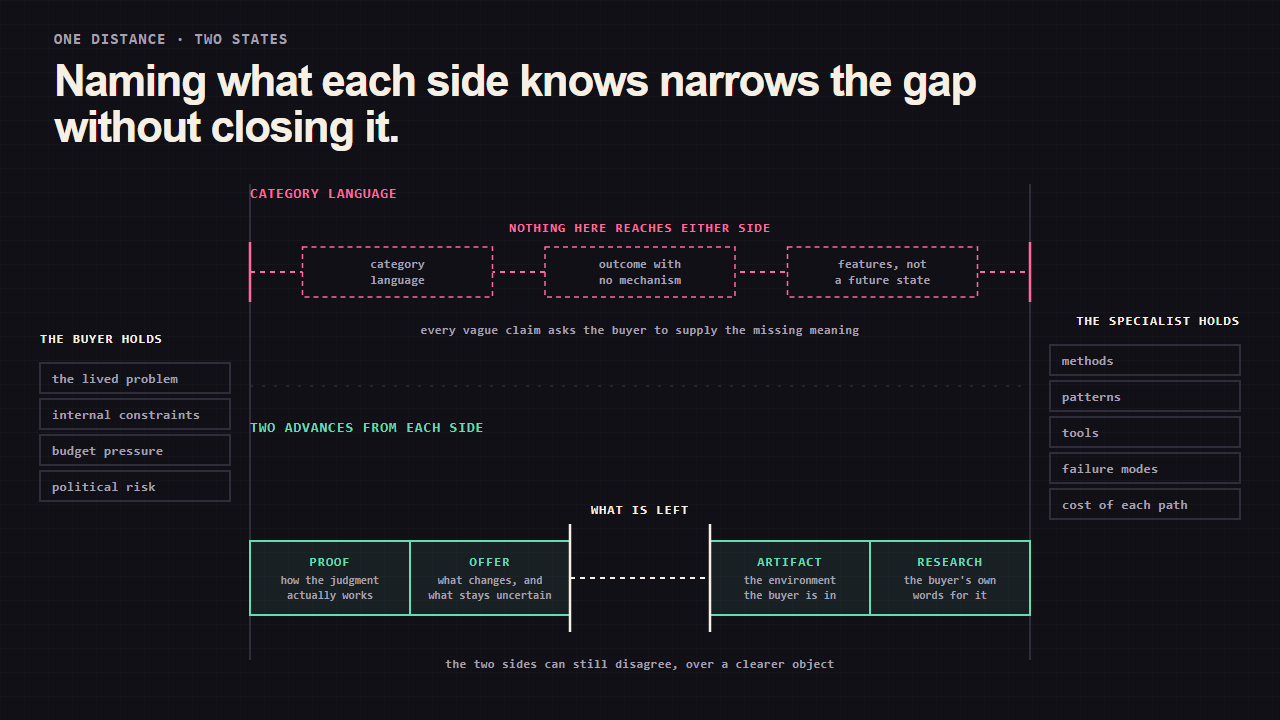
Generic marketing widens that gap. It uses category language where the buyer uses situation language. It promises outcomes without showing the mechanism. It describes features while the buyer worries about a future state. Every vague claim asks the buyer to supply missing meaning.
Hyperrelevant work narrows the gap by making the models legible.
The research names the buyer's actual vocabulary. The artifact shows an understanding of the current environment. The proof demonstrates how judgment works. The offer states what changes, what evidence will exist, what remains uncertain, and what the buyer must provide. The two sides may still disagree on price or fit, but they disagree over a clearer object.
That's the attention-side version of better price discovery. Nobody finds a universal price for attention; the system finds a more credible match between a live problem, a qualified audience, an artifact, and an offer.
Liquidity means a qualified next step exists
Liquidity in a financial market describes the ability to trade without excessive cost or price disruption. A small-business service market has a looser but useful parallel: capable buyers and capable providers often fail to meet at the right time with enough shared context to act.
The provider may be invisible outside a referral network. The buyer may post a vague request because the buyer can't name the technical solution. Platforms may flood the request with generic proposals, which raises the buyer's screening cost. Good providers then avoid the platform because the signal is noisy. The market thins from both sides.
Hyperrelevance Cartography improves the meeting surface. It identifies the language of the problem, the surrounding constraints, the evidence a serious buyer looks for, and the channels where that buyer already searches. It produces assets that let the buyer inspect judgment before scheduling a call.
A better meeting surface can increase qualified flow, but it can't guarantee demand. The system still faces timing, budget, trust, competition, and delivery capacity, and the analogy should make those constraints easier to see instead of hiding them under financial language.
Inventory risk becomes production risk
The financial market maker risks capital and inventory. The content operator risks research time, production capacity, reputation, and audience trust.
An overbuilt asset can arrive after the market moved. A rushed asset can make the operator look careless. A technically correct piece can fail because it uses vocabulary the audience doesn't share. A viral joke can attract people who will never buy. A high-volume campaign can exhaust a channel before the offer is ready.
The engine manages that risk through position sizing in the ordinary sense: match the production bet to the confidence and value of the opportunity.
A weak signal may deserve a short probe. A recurring pain with strong evidence may deserve a field note, interactive tool, or case study. A client-critical decision may deserve primary-source research, independent evaluation, and a reopenable evidence trail. The system spends depth where error costs more.
The map also has to stay private enough to compound. Customers hire the operator for researched outputs and better decisions. The engine keeps reusable workflows, public sources, evaluation methods, and permitted non-identifying learning, while customer data, confidential strategy, and tenant-specific memory stay inside their boundaries.
The customer gets the loaf. The kitchen keeps the ovens, the recipes it owns, the food-safety system, and the experience gained from thousands of service hours. That boundary turns one successful project into better future production without forcing the operator to hand over every part of the machinery.
14. FreelanceBuddy is the first playable world
The theory becomes useful when it survives a Tuesday morning.
A freelancer opens Upwork and finds fifty recent posts competing for attention. Some are vague, some are underpriced, and some describe a valuable problem badly. Some look exciting and sit outside the freelancer's current proof, and one may become a long relationship. The platform clock is already moving.
The ordinary workflow asks the freelancer to remember everything at once: fit, freshness, client history, past examples, offer, price, voice, questions, proof, follow-up, and the energy available today. The freelancer opens tabs, saves a few posts, drafts a few letters, and promises to return to the rest.
FreelanceBuddy turns that scramble into a world with objects, events, tools, and learning.
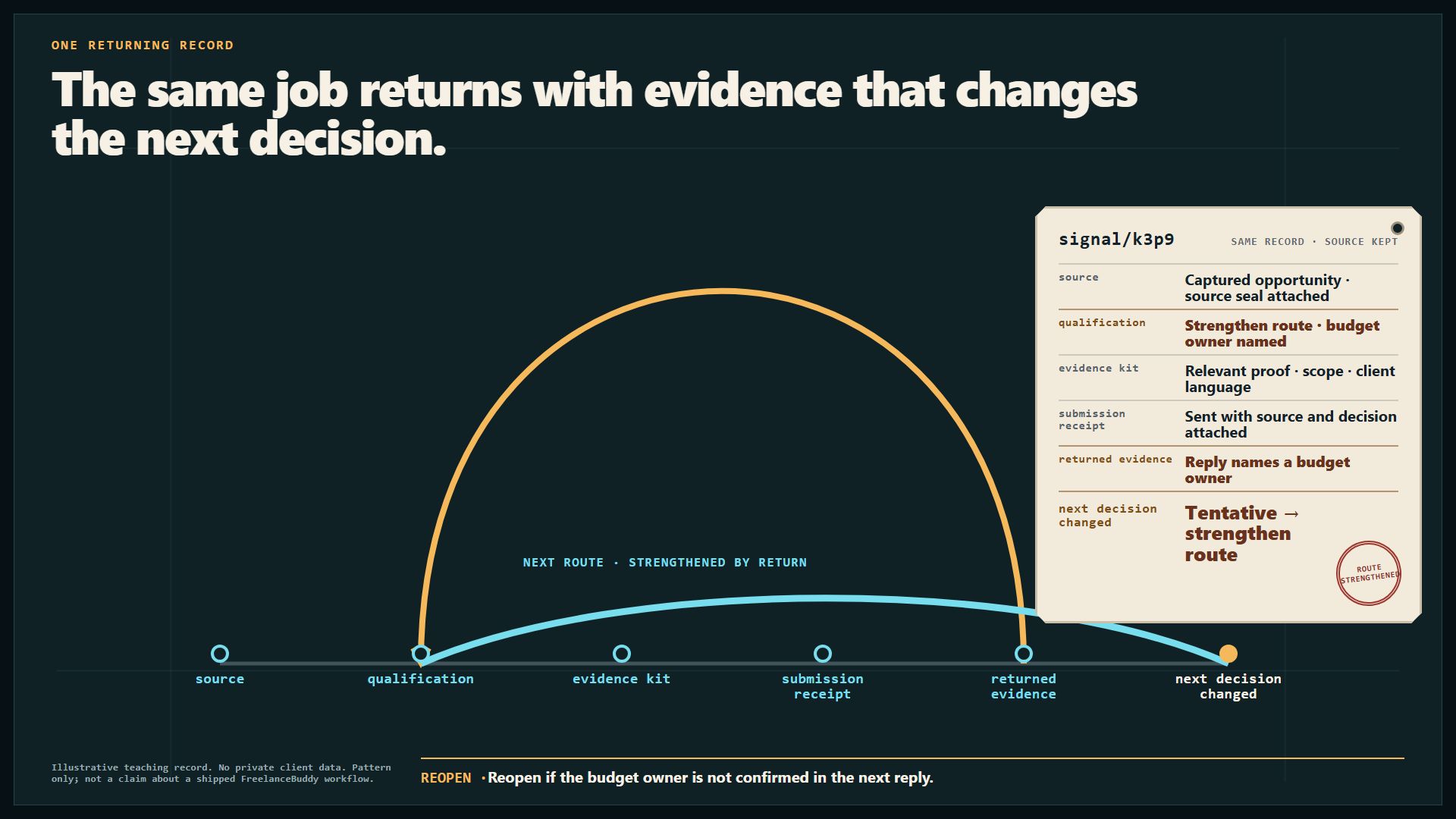
FreelanceBuddy is the first playable world for Hyperrelevance Cartography because the probe-and-return loop is immediate. A job post enters, the operator classifies it, and a proposal package leaves. The buyer views, ignores, replies, interviews, offers, hires, or closes the post, and each return can change selection, production, timing, and the model of the market.
The product is partly real and partly future. Its useful present centers on structured opportunities, evidence, scores, stages, events, proposal work, and assets, and the acceptance target is the complete operator journey from intake to reopening. Mature close-time modeling, automatic client reports, complete lineage learning, supervised autonomy, and the later Swarm Layer, a company-wide system for many people and agents, stay future layers until the human can use and reopen them.
Drawing that boundary makes FreelanceBuddy a stronger example, because a reader can see the playable room and the doors that haven't opened yet.
One opportunity runs the whole loop
Take one recent post for a technical content system.
The possibility field starts wider than the job title. The post may be an immediate application, a negative specimen, an aspirational build target, a vocabulary source, or a signal about a changing market. The first question is concrete: should Andy spend proposal capacity on this opportunity before its useful window closes?
The instruments inspect the source and the buyer-side transformation. Freshness, budget evidence, hiring history, fit, proof, competition, authority, stated outcome, and unresolved questions stay separate. The system also asks what problem exists beneath the requested deliverable, what future the buyer wants to observe, and what change would bridge the two. The Product Growth Loop Audit is a public example of tracing a business problem through states and evidence instead of jumping from symptom to output.
The narrowing stage removes routes that can't survive reality. A stale post leaves the active queue. A claim with no proof leaves the proposal. A long strategic brief dies when the deadline and opportunity value can't pay for it. A visual stays only when it makes a difficult part of the buyer's problem easier to inspect. Several viable packages may remain.
The commitment is the package Andy approves and sends. The decision record keeps the other survivors, the score inputs, the selected loadout, the expected next event, and any buyer-stated timing. Submission changes the opportunity state and starts the stage clock. State Machine Everything provides the deeper model for that kind of durable transition.
The return is an event rather than a mood. Unseen, viewed, replied, interviewing, verbal yes, offer, hired, closed, withdrawn, and cold all carry different information. Silence stays ambiguous until a named window makes it actionable. A buyer's stated date overrides a generic clock because it is better evidence for this relationship.
The update changes the next action and the market model. A view shows that the package crossed one screening boundary. A reply adds the buyer's language and timing. A loss can weaken the target, offer, proof, or asset choice, but the system records unknown when the event can't distinguish among them. Reopening is normal when a new event invalidates the earlier decision.
That loop is Hyperrelevance Cartography in a form that can run before any grander system exists: one source becomes one bounded decision, one committed act, one preserved return, and a better starting position for the next post.
Current, next, and later belong on the same map
The fastest way to make FreelanceBuddy useless would be to hide the difference between what exists and what the vision describes.
The current product already covers valuable ground. Job posts can become structured leads and applications can become deals. A corpus can build up independently of submitted proposals, and opportunities can carry scores, stages, events, and working assets. The operator can inspect individual records instead of treating the job feed as a disappearing stream.
That foundation changes the immediate human job. Andy can collect thirty recent posts, separate candidates from specimens, inspect why the rubric ranked them, and see the recent distribution before spending proposal Connects or production time. A saved post has a durable address. A rejected post can retain its research value. An application can later connect to the assets and decisions that produced it.
The next usable slice is narrower than the full vision and more valuable than another broad dashboard. One opportunity needs to travel through the complete loop from intake to reopen. The operator should see the source, score, evidence, stage clock, strategy transcript, selected loadout, generated candidates, independent review, human decision, submission event, buyer return, and next action on one coherent surface. Workflow Design gives the broader pattern for keeping that chain inspectable.
Several pieces may already exist in source or in adjacent workflows, and the acceptance condition is the joined human journey. If Andy has to leave the interface, remember which terminal session did the work, search for the output file, and manually reconstruct why the score changed, the product hasn't completed the loop yet.
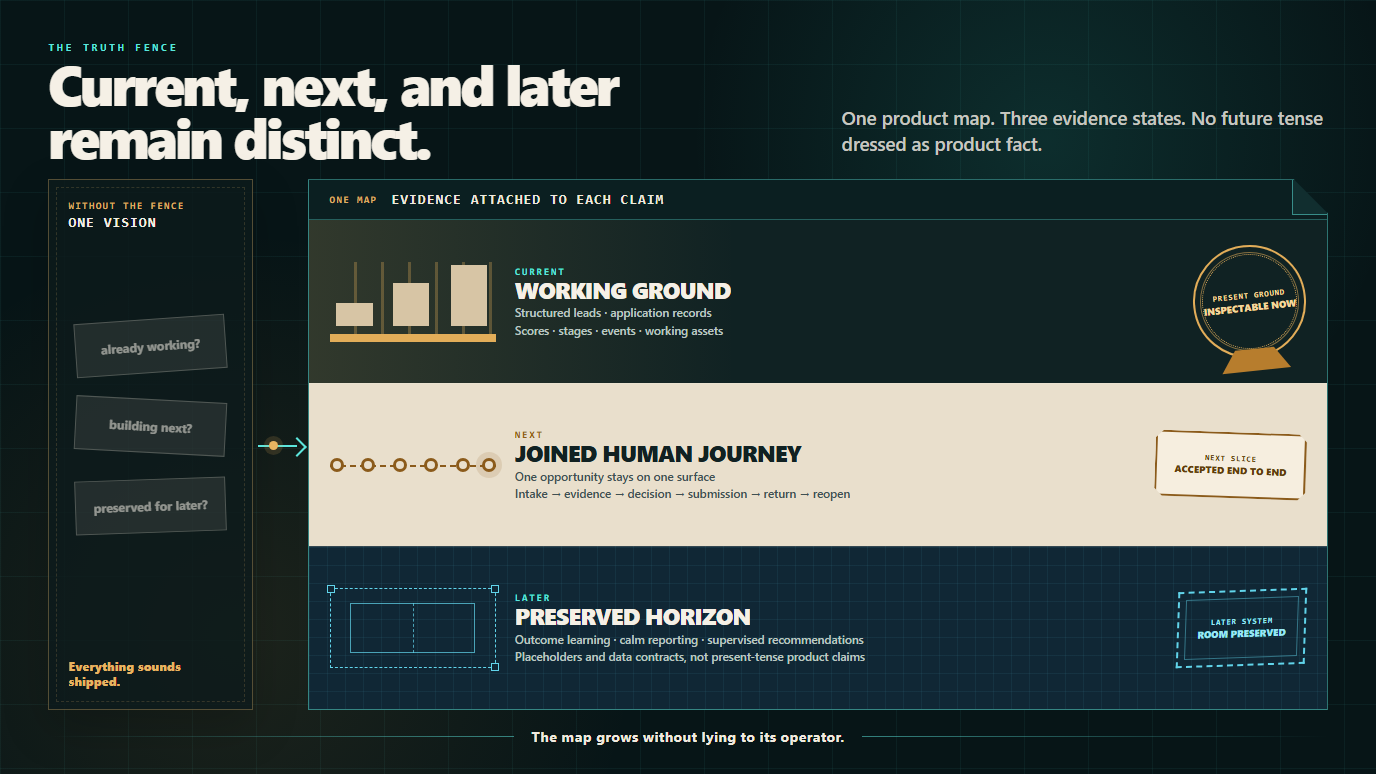
The later system is larger. It estimates close and loss distributions over time once enough real outcomes exist, and it learns which assets go with which outcomes without confusing correlation for cause. It compiles calm client reports from event streams, recommends policies after repeated supervised correction, supports service after a win, and eventually supplies proven components to the Swarm Layer.
Those later capabilities deserve visible placeholders and data contracts now, not present-tense product claims.
The interface can show the boundary directly. A working control appears as available. A source-backed mechanism without browser acceptance appears as implemented and unproven. A designed future appears as specified. A recommendation derived from partial evidence appears as inferred. The status label should sit beside the object or action, not in a distant roadmap.
Showing the boundary makes a product that can grow without lying to its operator. Andy sees the room he can use today, the doorway the team is building next, and the landscape the architecture preserves for later.
The job feed is a landscape, not an inbox
An inbox invites reaction, and a landscape invites scouting.
The job feed contains separate encounters with different requirements, rewards, uncertainty, and timing. Elden Ring offers a useful picture because it gives the player a large authored world, many routes, character attributes, different weapons, sorcery, spirits, and choice about how to develop a build. The official early-game guide says plainly that players can build their character as they choose.
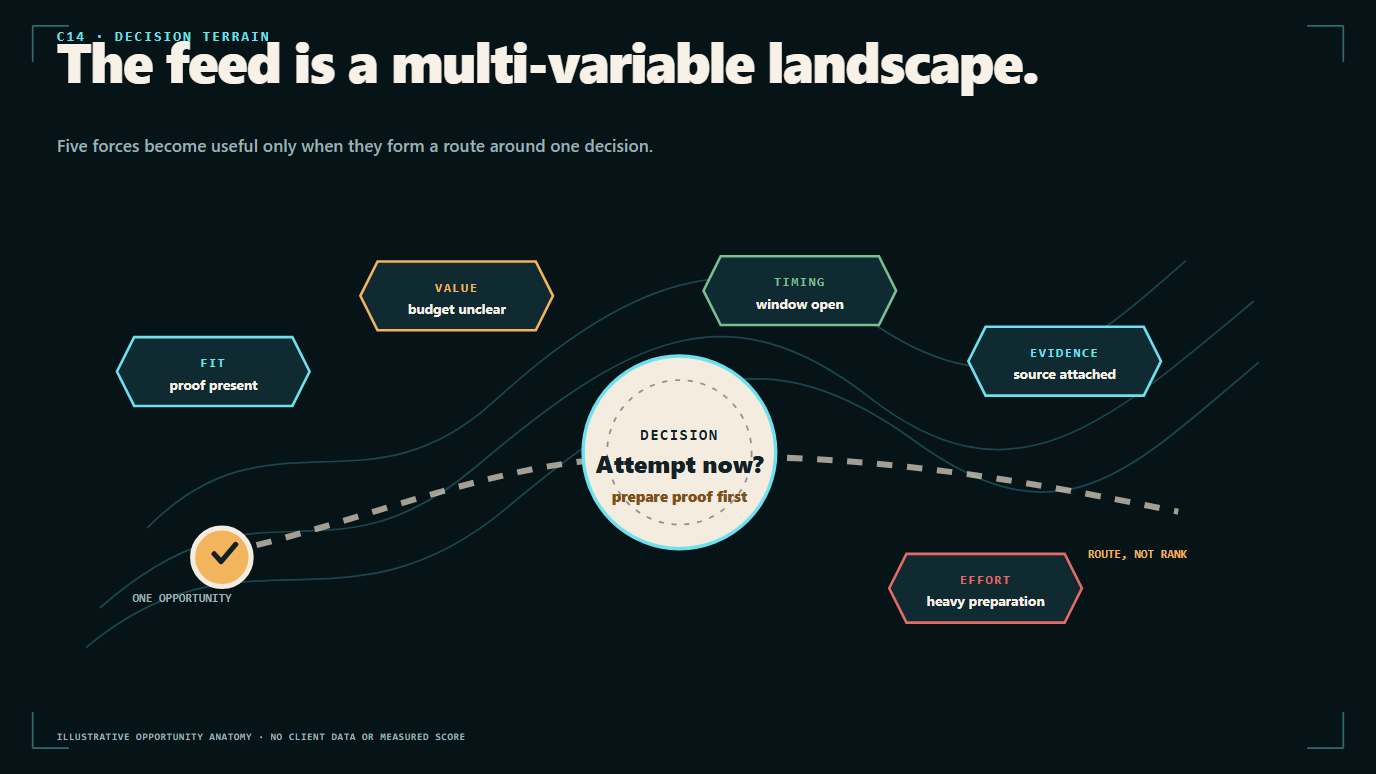
The analogy stops at the opportunity.
Clients are people, and the analogy never casts them as bosses or enemies. The job post is the encounter: a fixed request at a moment in time with a set of visible and hidden requirements. Preparation changes the freelancer's readiness, and enthusiasm doesn't change the buyer's budget, deadline, proof threshold, or authority.
That frame helps the operator make three decisions.
Is this an encounter worth attempting now? What preparation and proof does it require? What can the system learn even if no proposal is sent?
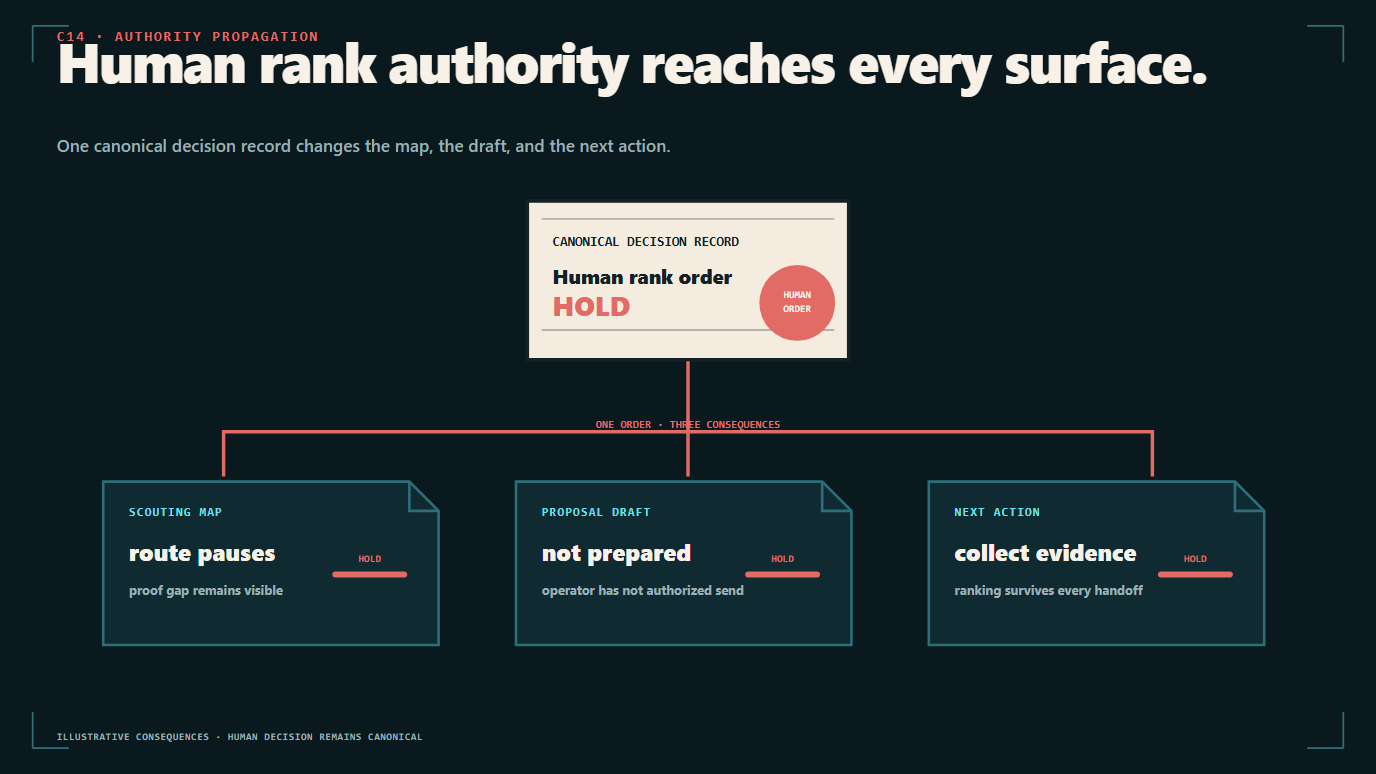
The third question builds the bestiary, a catalog of the kinds of posts the operator has met.
Every saved post earns an archive purpose
A saved opportunity has value before an application exists.
One post can be an immediate candidate. Another can be a warning specimen showing impossible scope, poor budget, copied language, or missing authority. Another can be aspirational: a job the operator can't prove yet but wants to understand and build toward. Another can scout an adjacent market, and another can supply vocabulary or reveal a tool change.
FreelanceBuddy can give each saved post an archive purpose.
A candidate is a post where the system expects a real apply-or-reject decision.
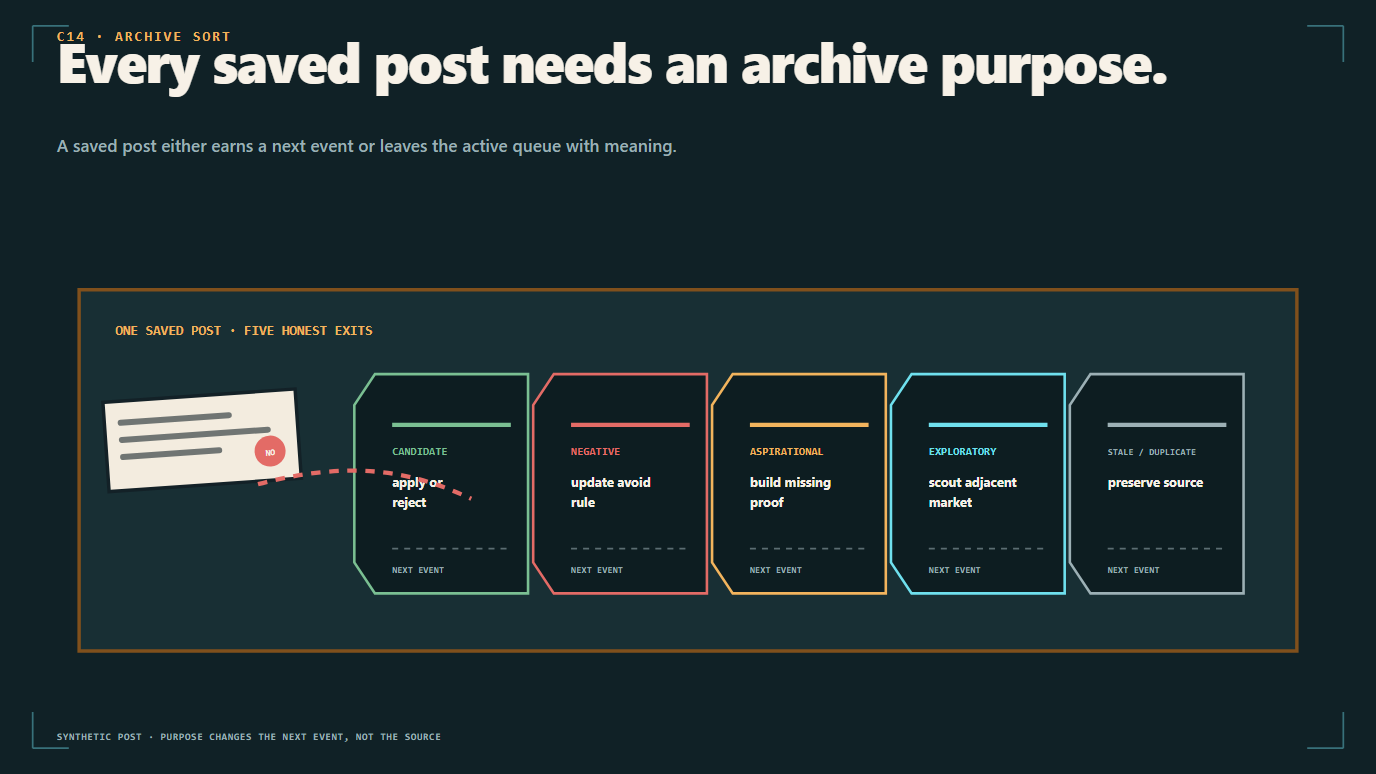
A negative specimen teaches what poor fit or poor quality looks like.
An aspirational specimen defines a capability, proof, or price tier worth developing.
An exploratory specimen broadens the market model without receiving production resources now.
A duplicate or stale specimen stays on record as evidence after it leaves the active queue.
The labels protect the operator from a familiar guilt loop. Saving a post creates no obligation to apply, and the record can pay for itself by improving the map.
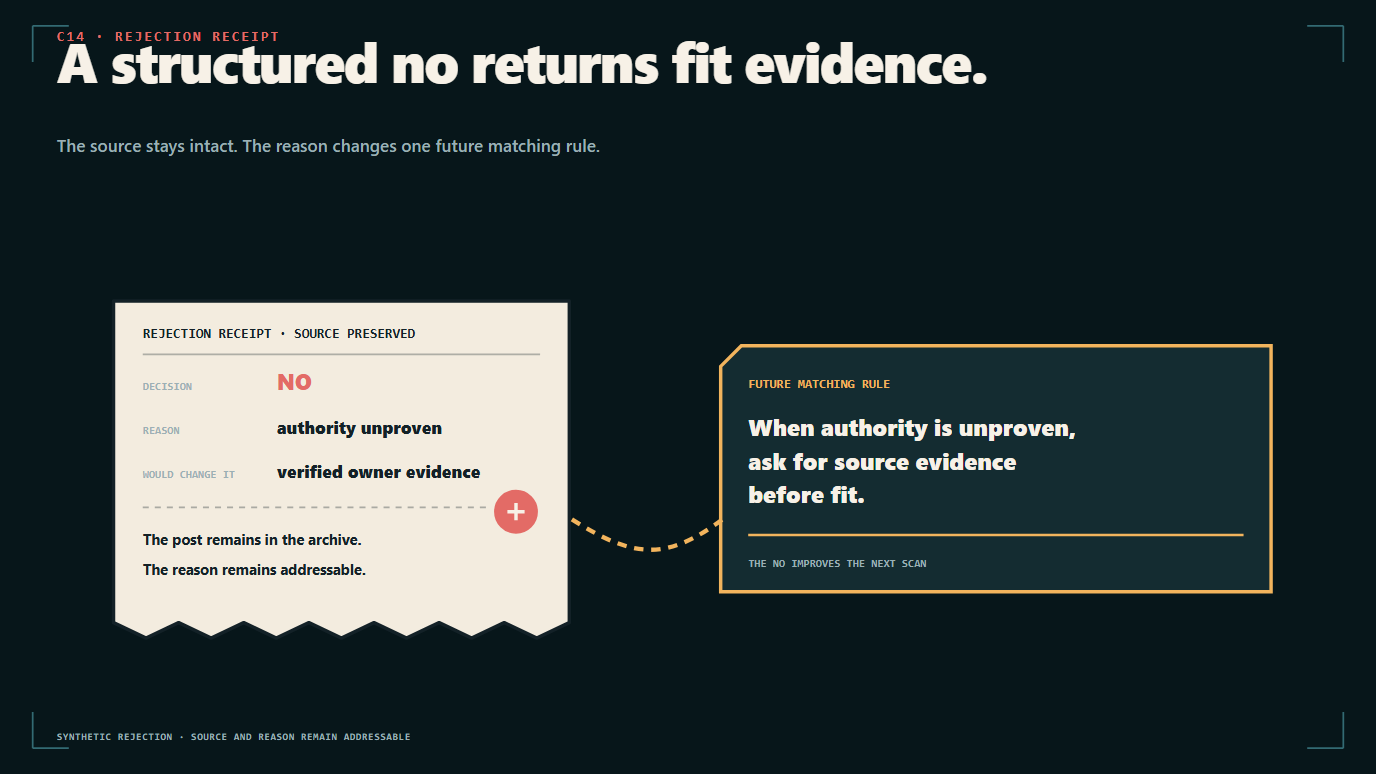
The corpus becomes hand-selected market research. Selection itself is biased, so the system should preserve how each post entered: manually saved, scraped from a filter, imported from an alert, or attached to an actual proposal. The rolling market view can then separate what the platform offers from what the operator chose to collect.
Seventy-two fields are useful only when grouped by decisions
The operator envisions roughly seventy-two data points for each opportunity. A wide schema can capture a great deal, but it can also create a form nobody trusts.
Fields should be grouped around decisions.
The source and time group answers where the post came from, when it appeared, and whether it's still actionable.
The buyer evidence group covers verified payment, hiring history, spend, reviews, location, prior job patterns, and signs of real authority where the platform exposes them.
The opportunity economics group holds budget, rate, expected duration, workload, payment type, and uncertainty.
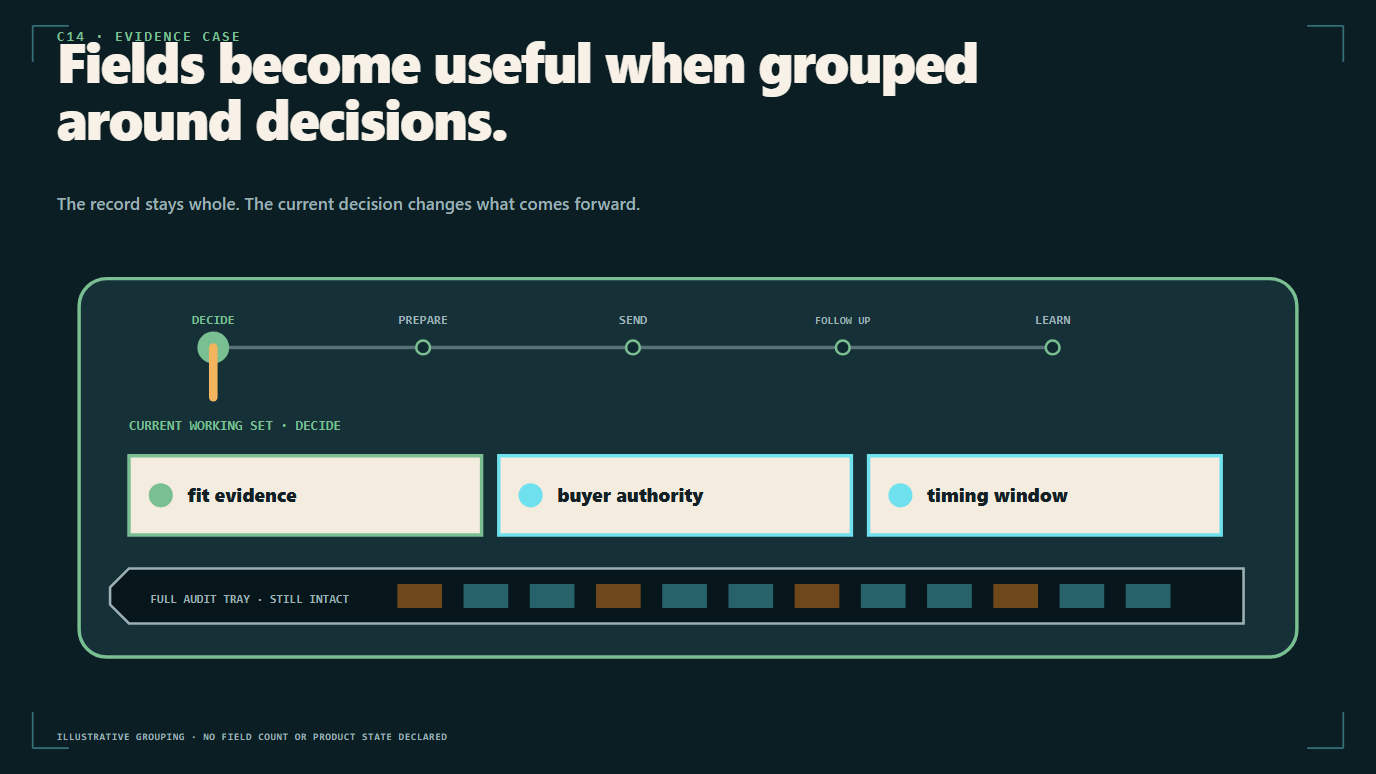
The fit group covers domain, problem, deliverable, tools, role, constraints, and the evidence the operator can stand behind.
The competition and friction group tracks proposal count, interview activity where visible, required questions, attachments, timing, and platform cost.
The strategy group holds the buyer's stated request, deeper problem, desired future, transformation, risks, angle, and proposed next step.
The state group records saved, reviewed, rejected, preparing, submitted, viewed, replied, interviewing, verbal yes, won, lost, withdrawn, closed, or cold, plus the events that justify the state.
The learning group keeps selected assets, lineage, operator feedback, client response, outcome, and later calibration.
The exact field count matters less than coverage and meaning. Each field needs a type, source, freshness rule, and unknown state. A missing hiring history can't silently become zero. An inferred budget can't look observed. A score can't hide which evidence moved it.
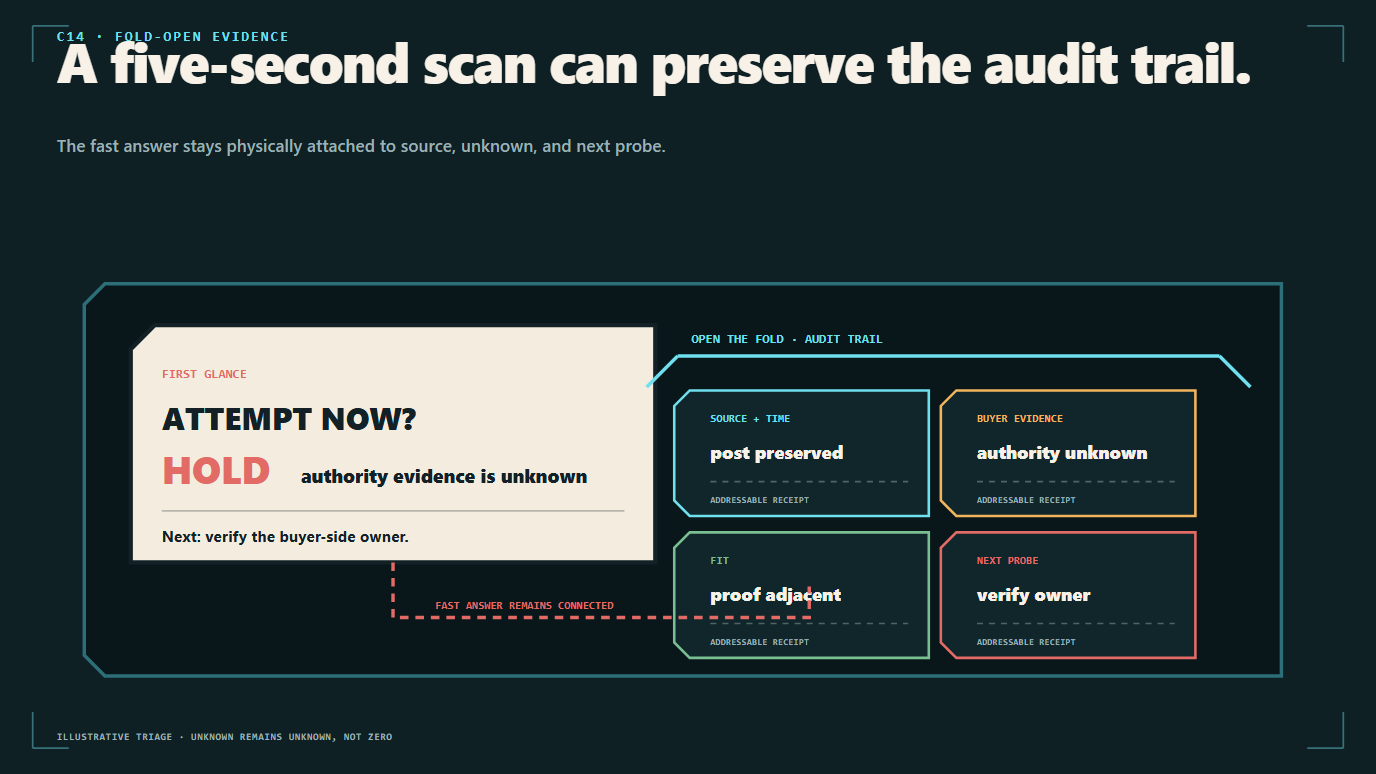
The profile page should reveal the groups progressively: the operator first sees enough to decide, and deeper evidence stays one step away.
One score and one market regime answer different questions
An opportunity score estimates the fitness of one post under one rubric.
A rolling market signal estimates the recent character of the corpus.
Those instruments should never collapse into one number.
A strong opportunity can appear during a weak week. A weak opportunity can appear during a rich market. If the operator loses a proposal, the per-opportunity record asks whether the target, package, timing, or conversation failed. The market view asks whether quality, budgets, competition, or hiring behavior changed across many posts.
Recent observations can carry more weight because the feed changes, and the weighting rule has to stay visible and adjustable. A thirty-day view may suit broad market temperature, while a seven-day view may catch a sudden platform shift and get noisy. A human can compare both.
The interface should show distribution before verdict.
How many recent posts entered each quality band? Which dimensions moved? Did budgets fall while fit improved? Did competition rise only in one niche? Are posts older because ingestion slowed? Are the changes large enough to distinguish from ordinary variation?
The system can call the current condition rich, thin, noisy, or uncertain after showing the evidence. It shouldn't paint one dramatic color and ask the operator to obey.
Deal rot depends on stage and expected next event
Time means different things at different stages.
A saved job post can decay quickly because other freelancers are applying and the buyer may begin interviews. A submitted proposal can sit unseen for days without proving failure. A viewed proposal creates a different clock. A buyer reply creates a conversation clock. An interview, verbal yes, or offer creates another. A client who states, “We decide next month,” has changed the expected event.
FreelanceBuddy should calculate rot from stage, last meaningful event, and any explicit promised timing.
The color carries meaning too.
Red means an actionable relationship is slipping and the operator may be missing a sensible step. Blue means the opportunity is frozen: the process is cold or waiting, and warming it may be possible without implying operator failure. Neutral means no action is due under the current expectation. Amber means the next step is approaching or evidence is insufficient.
One rule, such as dark red after five days, makes little sense across every stage. A fresh job post may deserve urgency, while a submitted proposal that hasn't been viewed may reasonably wait longer. A direct reply or interview request may deserve action within hours, and a verbal yes with no paperwork may turn risky after a few business days. Any client-stated timeline should override the general clock until evidence changes.
The operator needs controls for these thresholds.
Global defaults can establish sensible ranges. Stage-level settings can change them. Opportunity-level expected dates can override both. The interface should explain which rule produced the current state and let the human change it without editing code.
After thirty days without a meaningful event, most opportunities are cold regardless of stage. The visual treatment can distinguish recoverable frozen relationships from missed active responsibilities. The event history remains more important than the color.
Configuration is part of the operator surface
A threshold hidden in code is somebody else's opinion pretending to be a law.
Deal-rot timing, recent-market windows, score weights, application ceilings, asset budgets, follow-up rules, and autonomy gates all contain judgment. The product can ship strong defaults while exposing the judgments that materially change work.
The settings experience should use the same ordinary language as the opportunity view.
“A fresh saved post becomes urgent after this many days.” “A submitted proposal becomes cold after this window if the buyer hasn't viewed it.” “A reply expects a human response within this time.” “A client-stated next date pauses the general clock until that date.” “Recent market quality weights the latest posts this strongly.”
Each setting needs a scope. A system default applies everywhere. A stage rule applies to one class of opportunity. A niche or channel rule applies to a bounded market. An opportunity override records a specific promise or exception. The closest valid rule wins, and the interface shows which rule it used.
Changes should be versioned. If Andy tightens the viewed-proposal clock from fourteen days to seven, later analysis needs to know which opportunities were managed under which policy. Otherwise the system may attribute an outcome change to a new proposal asset when the real intervention was faster follow-up.
Safe controls also need previews. Before saving a threshold, show how many current opportunities would change state. Before changing a score weight, show how the recent ranking would reorder. Before raising an application ceiling, show current production and client-delivery load. The operator can see the blast radius while the choice remains reversible.
That's the difference between a useful interface and a configurable database. The operator doesn't edit fields; they change a policy, see its consequence, and keep the history needed to learn whether it helped.
Volume is a practice build, not a spam license
The operator wants a high-intensity application sprint to break old habits and build momentum.
A sprint like that can be a valid practice build, but it needs boundaries.
The planning scenario may be five applications a day, thirty days, or a hundred submissions in a concentrated run. No trustworthy public benchmark turns that volume into a promised number of clients. FreelanceBuddy should use its own denominators: posts reviewed, candidates selected, proposals submitted, proposals viewed, replies, interviews, offers, hires, revenue, retained value, time, and application cost.
The system can compare three builds.
A volume build sends more qualified packages with a strict time budget. It creates many market returns and protects learning velocity.
A precision build invests deeply in fewer high-value opportunities. It spends more research and production capacity per attempt.
A hybrid build uses cheap, consistent packages for clear matches and reserves strategic briefs or videos for opportunities whose value and evidence justify them.
None of them earns a permanent “best” label, because the market and the operator's capacity decide the mix.
The harness prevents a volume build from degrading into spam. It requires a real fit decision, buyer-specific evidence, current claims, appropriate assets, and a human-controlled send action. It can cap work in progress, flag duplicate language, and stop when quality or energy drops.
Intensity becomes an experiment with a safety floor.
A sprint needs a recovery contract
Elden Ring's New Game Plus provides a modest image: another journey can begin while at least some progress carries forward. The official patch notes confirm the mode without supporting every dramatic percentage attached to it online.
The useful transfer is banked progress.
A concentrated application sprint should leave durable assets: calibrated scoring, stronger negative specimens, better proposal modules, clearer client archetypes, response evidence, improved thresholds, and a record of operator energy. If the sprint ends and those gains disappear inside chat logs, the system has produced exhaustion without compounding.
The sprint contract can name a start date, application ceiling, daily quality floor, rest window, stop signals, and banking routine.
Stop signals might include repeated low-fit submissions, missed client work, falling review quality, sleep loss, rising correction time, or a backlog the operator can no longer inspect. The system should make those conditions visible before motivation turns them into a dare.
Recovery is part of the build.
The operator can choose an intense cadence because they know their own patterns. The product should help them retain the upside and reduce the predictable damage. It should never convert a personal reset strategy into a universal productivity doctrine.
Proposal assets form a conditional loadout
Not every opportunity deserves every asset.
The available loadout may include a cover letter, answers to qualifying questions, a one-page visual, a strategic technical or creative brief, selected case studies, a guarantee limited to controllable outcomes, a landing page, and a Tella video walkthrough.
The system chooses a package against evidence.
A clear, urgent, smaller request may need a sharp cover letter, direct answers, one proof asset, and a simple next step. A complicated opportunity with several stakeholders may justify deeper research, a strategic brief, and a video. A design-sensitive buyer may benefit from a one-pager whose visual language reflects observable brand cues. A skeptical technical buyer may need architecture, risks, and verification instead of polished marketing language.
The asset planner should explain each choice.
Required assets satisfy the platform or buyer request. Recommended assets address a known decision barrier. Optional assets may add value if production capacity permits. Omitted assets carry a reason: redundant, weak evidence, excessive effort, wrong register, or likely to burden the buyer.
The operator can change the loadout.
Planning assets this way turns a proposal from a template into a compiled package. The world model supplies current evidence, the voice model supplies the right register, and the opportunity model supplies the constraints. The production system assembles only the parts that earn their place.
Qualifying questions are adversarial tests
Many Upwork posts include questions designed to filter generic applicants.
Some ask for a specific example. Some hide a required instruction. Some test whether the freelancer understands the domain. Some ask for pricing before the scope is clear. Some contain a phrase that must appear in the response.
The system should treat each question as an independent claim contract.
What is the buyer actually testing? Which evidence supports the answer? What can't be promised? Does the requested format conflict with the stronger strategy? Is the question a simple compliance check or a sign of a deeper concern?
The answer should be direct and shouldn't reuse the cover letter as filler. If a question asks for experience with a tool, the response should name the work and the result or say plainly where the experience stops. If the question asks for an estimate, the response should name the assumptions that control it.
Qualifying questions are a good place for an evaluator to be hostile, because a fluent wrong answer can disqualify the package faster than an imperfect opening line.
The one-pager wins a five-second inspection
A proposal often competes in a crowded, low-attention surface.
A one-page visual can give the buyer a fast proof of preparation. It may show the buyer's current situation, desired future, proposed route, risks, relevant proof, and next step. The visual should use cues from the opportunity or public brand without pretending private knowledge.
The five-second test is literal.
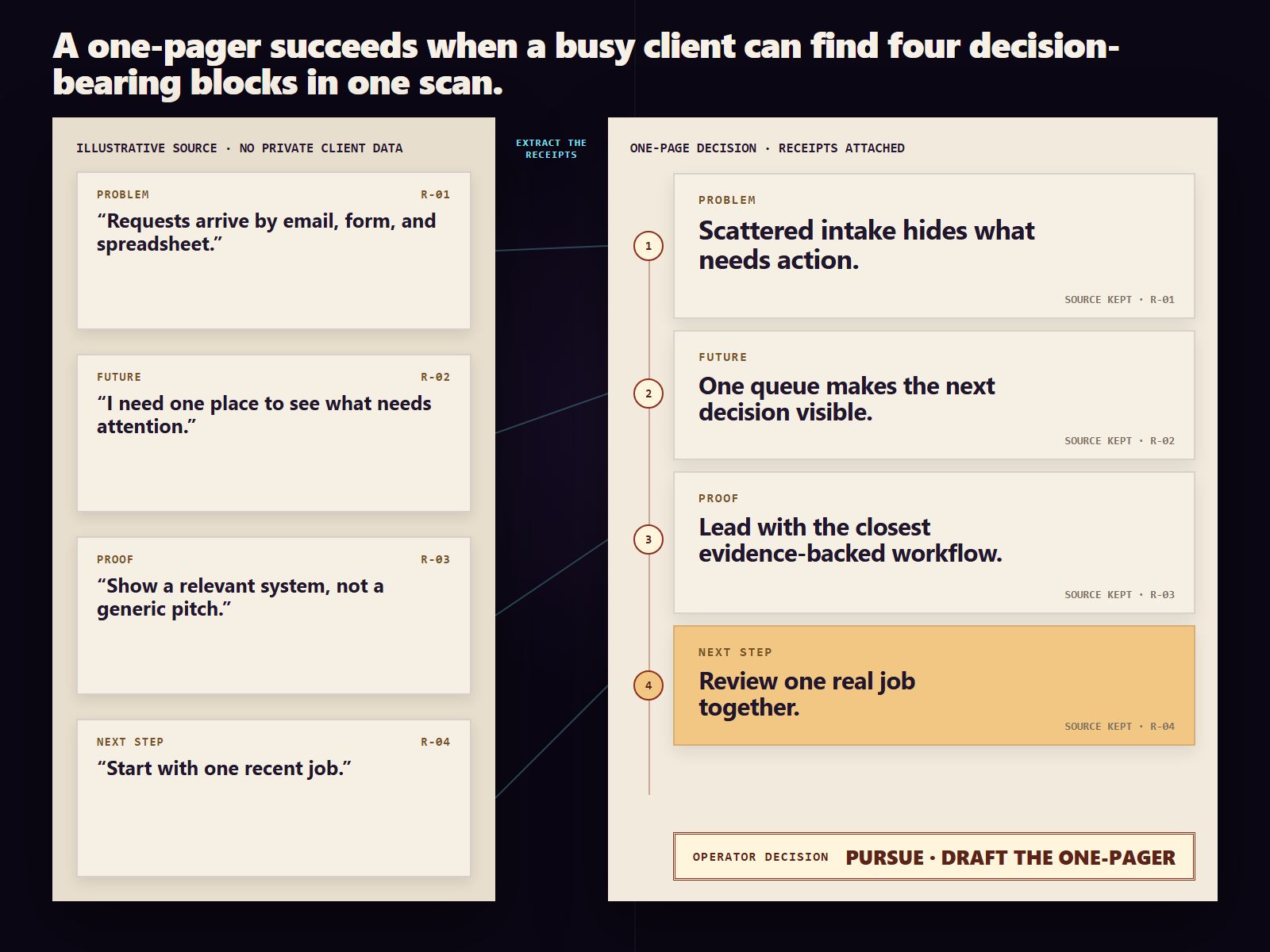
Can the buyer identify that the page concerns their problem? Can they see what changes? Can they find the next step? Does the visual survive thumbnail size and mobile? Does it look like a useful artifact rather than a decorative pitch?
Nano Banana can generate the bitmap foundation through the existing image pipeline. The system still needs a human or evaluator to check text accuracy, visual hierarchy, rights, brand coherence, and whether the image explains anything. Generated polish isn't proof of thought.
The one-pager belongs in the loadout when it reduces buyer effort. It stays out when the opportunity requires a plain technical answer or when the visual would delay a time-sensitive application.
The strategic brief shows the route
The strategic brief is the heavy asset.
It diagnoses the buyer's problem separately from the freelancer's preferred solution, describes the observable future, and maps the transformation between them. It names assumptions, risks, early tests, likely systems, and a safe next step, and relevant figures or motion make difficult relationships concrete.
The brief shouldn't do unpaid implementation dressed up as generosity.
It can show judgment, architecture, sequencing, and evidence without giving away a complete proprietary method or doing the whole contract before agreement. The buyer needs enough to trust the route. The freelancer needs a protected boundary around the engine that makes the route unusually good.
The guarantee follows the same rule. Guarantee response time, process, named deliverables, inspection, correction, and other controllable events. Never guarantee revenue, rankings, viral reach, or another outcome controlled by a market and the client.
The best brief casts the freelancer as a guide. The client stands at point A and wants point B, and the route feels safe, understandable, and valuable enough to repeat at a larger scale.
The video turns prepared assets into human contact
A Tella video can compress trust.
The operator doesn't begin from a blank recording. The opportunity profile, cover letter, one-pager, and strategic brief have already organized the thinking. The system supplies a short walkthrough scaffold: what the buyer asked, what the operator noticed, what the proposed route changes, which evidence matters, and what should happen next.
The operator records the human layer.
That recording adds voice, judgment, emphasis, humor, and live correction, and the buyer can see that a person understands the work. The system should never clone that presence and pretend the operator recorded something they didn't.
The video may become the largest remaining manual step for many opportunities as FreelanceBuddy matures. That's a reasonable target, because the human moment carries high trust while the preparation around it can be compiled.
The target is a repeatable five-to-fifteen-minute recording, not a promise that every opportunity deserves one.
Asset lineage turns proposals into experiments
Suppose one animation appears in three briefs, one article appears in ten proposals, and one one-pager is revised four times. Two proposal packages get interviews and eight get silence.
Without lineage, the operator remembers a vibe.
With lineage, every asset has an identity, source, version, parent, use event, comment, correction, and outcome link. The system can ask whether opportunities receiving a particular article had a higher interview rate after accounting for their fit and tier. It can see that one animation gets reused because it explains well or because the template defaults to it.
Correlation remains correlation.
An article may appear in stronger opportunities because the operator selects it for stronger opportunities. A one-pager may correlate with interviews because high-value applications receive more work. The system can record the pattern and design a controlled comparison rather than awarding the asset a magic score.
Lineage also supports reclaim. A lost proposal can contain a strong diagram. The diagram can enter the asset library with the client-specific labels removed, its provenance preserved, and a new review before reuse.
Every application becomes a production run with traceable parts.
The transcript is a supervision surface
In the early runs, the operator opens an opportunity profile and records a rich transcript.
They explain fit, angle, risks, offer, price, proof, asset choices, concerns, and what they think the buyer actually needs. The system asks questions and suggests answers. The operator accepts, corrects, or replaces them. The transcript carries judgment that the structured fields didn't yet capture.
Over time, repeated corrections can become typed policy.
The system learns that this opportunity class usually needs a one-pager and not a long brief. It learns that a certain claim requires a named case study. It learns the operator rejects a style of guarantee. It learns which missing evidence should stop production. It learns when price belongs in the first message.
The transcript then becomes shorter.
The maturity curve should be defined by observable operator work, not a fictional number of repetitions.
At the dictate stage, the operator supplies most of the strategy.
At co-edit, the system proposes a structured plan and the operator makes substantial changes.
At revise, the system prepares a strong package and the operator corrects bounded details.
At approve, the system prepares the package and the operator mainly inspects evidence, policy, and fit.
At recommend, the system identifies opportunities and loadouts the operator may have missed, while the human keeps authority over sending, pricing, exceptions, and the relationship.
Moving up a stage takes evidence, and less editing time isn't enough on its own. Quality, claim accuracy, outcome calibration, and reopenability all have to hold.
Assistance changes labor, not authority
Elden Ring lets a player use spirits as assistance. The image is useful when kept small: an assistant can carry capabilities developed through the player's build.
FreelanceBuddy can carry retrieval, scoring, question analysis, asset assembly, checks, reminders, and report preparation. The operator keeps the route key.
The human chooses business boundaries, sends proposals, changes prices, handles sensitive claims, speaks to clients, approves publication, and decides when the system should stop. Some decisions may later be delegated under policy, and the authority has to stay visible and reversible.
That arrangement is supervised autonomy.
The product becomes better than the operator at a bounded task when it produces more reliable results under an accepted evaluation, not when it sounds confident or saves a few minutes. It can outperform first-draft writing while remaining unable to own the relationship.
The system should show what it knows, what it inferred, what rule it used, and where the human can correct the rule.
Close time is a distribution, not a date
A buyer doesn't close on the day a dashboard predicts.
The opportunity moves through uncertain time. Some proposals stay unseen, and some are viewed and revisited. Some receive a reply after a long internal delay. Some buyers hire somebody else, some close the post, and some go cold without a clear ending.
Time-to-event analysis gives the right statistical frame.
Define one starting event, such as proposal submission. Record the time of a win, loss, withdrawal, or last observation. An opportunity still open at the last observation is right-censored: its final time remains unknown rather than being counted as a loss. The scikit-survival research paper describes censored time-to-event modeling and evaluation.
A survival curve can estimate the chance that an event hasn't occurred by a time. Its complement can express an estimated chance by that time. A hazard is the current conditional event rate among opportunities still open; it isn't itself a close probability. On screen, those distinctions become a range and an event history, never a promised close date.
Sales adds competing outcomes. A win and a loss can prevent one another as the first closure event, so they should be modeled separately rather than treating every loss as an opportunity that might still win later.
The interface should translate this into ordinary language.
“Most similar opportunities that eventually received a reply did so inside this range.” “This opportunity remains open but the expected response window has widened.” “A client-stated delay moves the next expected event.” “Silence after a view is different evidence from silence before a view.”
Never show one false-precision close date.
New events change the estimate
Every meaningful return can update the distribution.
A proposal view proves the buyer reached the asset. A quick thoughtful reply changes engagement evidence. An interview creates a new stage and clock. A request for a later follow-up changes the expected event. A verbal yes changes the outcome set and introduces paperwork risk. A long silence, an active competing hire, or a closed post changes it again.
The update should explain itself.
The operator can see the previous range, the new event, the updated range, and the rule or model involved. If the model lacks enough history, it should use broad bands and say so. Opportunity-specific stated timing should outweigh a generic platform average until contradictory evidence arrives.
The time model also helps allocate production effort.
A fresh low-confidence opportunity receives a cheap initial package. A promising conversation may earn a deeper follow-up asset. A high-value opportunity with clear authority and strong engagement may justify direct lookahead across several proposal strategies. Most opportunities should use simpler policies so the operator's scarce attention remains available for consequential exceptions.
Four decision methods prevent universal overthinking
Warren Powell's sequential-decision framework offers four broad method classes that transfer cleanly.
Policy function approximation uses a direct rule. If a submitted proposal hasn't been viewed after a stage-specific window, schedule a bounded follow-up check.
Cost function approximation scores an action using selected costs and benefits. The system may decide whether a one-pager earns its production time for this opportunity tier.
Value function approximation considers expected future value. A relationship with expansion potential may justify greater effort now.
Direct lookahead approximation compares possible future action paths through an approximate planning model. It belongs to rare, expensive, consequential decisions rather than every routine application.
The taxonomy protects the system from using its most expensive intelligence everywhere. In the interface, routine choices can show a simple policy and reason; only rare, high-consequence opportunities open the deeper planning workspace.
Five daily applications shouldn't trigger five miniature consulting engagements. Cheap recurring decisions use tested policies. High-stakes exceptions receive deeper reasoning and human attention.
The CRM continues after the proposal
Winning the job is one event in a longer relationship.
The opportunity becomes a client. The client enters onboarding. The system records promises, access, deliverables, meetings, decisions, assets, risks, and next events. The first “wow” moment becomes an observable milestone: the client receives something that changes confidence or capability. A first review checks whether delivery matches the agreement. A longer contract begins only after the work earns it.
Client maturity should never mean time served.
It can mean clear authority, stable communication, validated value, repeatable delivery, trusted data, and an agreed path to a longer relationship. Each transition needs evidence.
FreelanceBuddy's strongest current implementation is closer to opportunity and application management, and the complete post-win relationship model remains a larger build. That future stays on the map because the front of the funnel shouldn't create a pile of clients the service system can't support.
The resource bar applies here too: closing deals faster than onboarding capacity allows creates a nanostall.
Daily reports emerge from events
A daily client update feels expensive when a person must reconstruct the day from memory.
An event-sourced system has already recorded work: task changes, agent runs, decisions, comments, files, tests, meetings, blockers, approvals, and results. A reporting activity can group those events into shorter intervals, then compile a day-level view.
The client report should separate five things.
The activity part says what happened.
The evidence part shows what supports the statement.
The outcome part says what changed for the client.
The risk or decision part says what needs attention.
The next event part says what the client should expect and when.
A complete event log proves the events were recorded without proving the work created value, so the report needs both the trace and the interpretation.
The specified future can compile hourly or four-hour summaries into a daily surface. The cadence should match volume and client preference. A quiet project doesn't need manufactured updates, and a fast multi-agent sprint may benefit from frequent internal chapters and one calm external report.
Every summary keeps a route to its source events, so the client sees the useful surface and the operator can inspect the trace underneath.
FreelanceBuddy is the legacy dungeon
The product needs a boundary.
FreelanceBuddy serves one operator managing freelance opportunities and client work. That scope is a legacy dungeon: authored, bounded, difficult enough to prove the systems, and small enough to finish.
The Swarm Layer is the later open world. It may combine customer relationship management, sales, project operations, workflows, knowledge, agents, reporting, and multi-person coordination across a company.
Building the Swarm Layer first would hide whether the core loop works.
FreelanceBuddy can prove opportunity ingestion, scoring, asset planning, supervised generation, human decision, submission events, outcome learning, client handoff, and reopenability. The proven components can generalize later, and the failed assumptions can be corrected before many teams inherit them.
That order is product sequencing and research design at once.
One operator supplies dense feedback. The product can observe where cognitive load remains, which suggestions get changed, what evidence is missing, and whether the interface supports a high-volume real workflow. The operator's personal system becomes a laboratory for the enterprise one.
The public claim stays bounded. FreelanceBuddy isn't yet a better version of every CRM; it's the place where the operating model earns that ambition.
The practice room banks every run
The high-volume sprint becomes deliberate practice when every attempt creates an inspectable return.
The next twenty to fifty posts are the first live training block
The immediate practice room already has a concrete size.
Andy is about to collect twenty to fifty recent Upwork posts that look interesting. Interesting is only the intake filter. The system's first job is to sort that hand-selected bundle into several clearly labeled groups before proposal production begins.
Every post receives an archive purpose and a score before send. The score exposes its evidence groups rather than hiding behind one rank. The operator can see why a post looks strong, which fields are unknown, how old it is, whether the buyer has a credible hiring history, which proof exists, and what the package would cost to produce. A fascinating post can remain exploratory. A weak post can remain a negative specimen. A high-value post outside the current proof can enter the aspirational set. A strong, fresh match becomes a candidate.
The bundle also sets up the first market snapshot. The interface can show the distribution of quality, budgets, fit, competition, and age across these selected records while clearly labeling the selection bias. Twenty hand-picked posts don't describe all of Upwork. They describe the part of the market Andy noticed under his current search and taste, and that's still useful, because later blocks can show whether the part of the market he notices changes.
Candidates then pass through a score-before-send gate. Andy reviews the opportunity, corrects evidence, chooses a loadout, and records the strategy transcript. The system timestamps the decision. Once submitted, the post leaves the research-only corpus and enters the outcome ledger with a defined starting event.
Deal rot follows the stage policy from that point. Fresh unsent candidates carry an urgency clock because the market is moving. Submitted and unseen proposals carry a wider window. A view starts another expectation. A reply, interview, stated delay, verbal yes, and offer each create their own next event. The interface shows the active rule and allows an opportunity-specific override when the buyer supplies a real date.
Every return updates the world model. A view tells the system the package crossed the first screening boundary. A reply adds language, objections, timing, and intent. An interview adds richer fit and authority evidence. Silence remains ambiguous but changes the time distribution. A loss, closure, or withdrawal becomes a labeled outcome. The absence of a clean ending stays unresolved rather than being rewritten as failure.
The sprint needs stop and recovery signals before the first proposal leaves. Falling below the fit floor, repeating generic language, growing correction time, missing current-client work, shrinking sleep, or accumulating an unreviewed queue can pause new production. The system should show the reason without turning a safety limit into a scolding badge.
At the end of the block, Andy reviews what the system banked: score corrections, stage timing, selected and rejected assets, proposal effort, views, replies, interviews, outcomes, market distribution, and operator energy. The next twenty to fifty posts then begin from a sharper model. That review is the first real proof that collection, action, and recovery belong to one learning loop.
Before sending, score the opportunity and record the loadout. After sending, capture views, replies, interviews, offers, hires, losses, closures, and time. Review failures for target fit, weak evidence, poor timing, wrong asset choice, vague offer, excessive effort, or unknown cause. Preserve unknown rather than inventing a lesson.
Review asset lineage on a cadence. Which articles, visuals, case studies, and brief patterns appear in interviews? Which never get used? Which create buyer questions? Design comparisons where confounding is obvious.
Calibrate the close model against actual outcomes. Did the predicted bands contain the events? Did the model overestimate viewed proposals? Did one stage clock create false alarms? Adjust the operator controls.
Run reclaim. Extract useful language, components, research, and negative specimens from lost opportunities. Remove private client context. Reverify claims before reuse.
Review the sprint itself. How much operator time did each application require? Where did cognitive load remain? Which automation reduced thought and which merely moved it? Did volume weaken current client delivery? Did the recovery plan work?
Then bank the run.
The archive holds stronger rubrics, reusable assets, clearer policies, calibrated timing, market observations, and recovery notes. The next sprint begins from that state rather than from motivation alone.
That's the Elden Ring image worth keeping: the next journey carries a developed build, but the player still has to read the terrain.
The first vertical slice is small enough to use now
The complete vision contains many systems. The first playable slice can be strict.
Ingest one recent job post into the canonical opportunity record. Show the source and freshness. Score it with visible evidence. Let the operator accept or change the classification. Generate a bounded asset plan. Ask for a short strategy transcript. Compile one cover letter and one conditional proof asset. Run an independent check. Let the human approve or reject. Record the submission event manually if platform automation is unavailable. Reopen the opportunity later and record the buyer return.
Then compare the run with the prior one.
The slice can be accepted through one concrete operator story.
Andy opens a newly ingested post. The source text and capture time are present. The page explains that the post is six hours old, the client has hired before, the budget signal is incomplete, and the work matches two proven case studies. The overall score is visible, but every contributing group can be inspected. Andy changes one fit judgment and records why.
The system proposes a hybrid loadout: a concise cover letter, direct answers to two qualifying questions, one existing case study, and a new one-page route map. It rejects a long strategic brief because the opportunity value and deadline don't justify the production cost. Andy records a ninety-second transcript correcting the angle and removing one claim that feels too strong.
A specialist compiles the package. A separate evaluator catches that the one-pager implies a result the case study doesn't prove, and the defect returns to the producer. The corrected package shows the changed claim and keeps the rejection history. Andy can inspect the source, candidate, correction, and final asset without searching a filesystem.
Andy approves the application. If platform submission remains manual, the interface gives the exact package and records Andy's confirmation after sending. The stage becomes submitted. The expected-view clock begins under the current policy. The next day, Andy reopens the same opportunity and sees that the buyer viewed the proposal. The event changes the stage, clock, and suggested next action.
Three days later, the buyer replies. FreelanceBuddy surfaces the opportunity with the source, package, event history, buyer question, and a proposed response. Andy answers, and the system records the change he made. If an interview follows, the interview record inherits the opportunity context instead of starting as a new chat.
That one story crosses the important boundaries: data, scoring, strategy, production, evaluation, authority, event state, time, and re-entry. It doesn't require automatic platform control, a mature probability model, or the Swarm Layer.
The vertical slice should fail acceptance if any one of those boundaries is decorative. A score without evidence fails. A generated asset with no correction path fails. An approval that doesn't change state fails. A submission with no event fails. A buyer return that can't reopen the production context fails. A working terminal command with no human surface fails.
The test is severe because the scope is small. Passing it creates a product Andy can use during the application sprint, and every later capability then has a real path into the product.
That slice is enough to reveal real friction. It tests the typed model, operator controls, proposal loadout, voice, evidence, evaluation, event stream, and reopen path without requiring the whole Swarm Layer.
It also makes SuperHarness useful in a human way. The harness stops being a collection of profiles and dashboards and starts helping one person turn a live opportunity into an inspected action and learn from the result.
The product has become playable when the operator can perform that loop repeatedly from the interface without returning to a terminal to reconstruct state.
FreelanceBuddy is therefore the nearest place where the map can answer back every day, which makes it more than a CRM example inside Hyperrelevance Cartography.
A saved post changes the market model. A scored opportunity changes allocation. A proposal changes the buyer's field. A response changes the stage and timing. A win changes the service system. A loss changes the bestiary. A client outcome changes the proof available to the next opportunity.
The map stays alive because the work keeps touching the world.
15. Four businesses, four views of one machine
A shared engine becomes easier to understand when you stop staring at the engine.
Look at the workbenches instead. One bench holds market data, risk limits, positions, and execution records. Another holds jokes, formats, cultural references, and distribution feedback. A third holds client worlds, editorial systems, production queues, and attribution. The fourth holds public field notes that expose the reasoning without exposing every private mechanism.
The benches look different because the jobs differ, and the shared shape sits underneath them. The Alpha Is a Compiler develops why the reusable transformation system can matter more than any single output it produces:
- Build a current model of the environment.
- Find a costly uncertainty.
- Produce an artifact or action that tests the model.
- Observe the result.
- Preserve the evidence and update the model.
The same loop can support many businesses because the loop is abstract and the world models are specific. The danger begins when the abstraction eats the specificity. A joke engine that speaks like a trading desk will fail, and a trading system that treats risk like engagement will fail more expensively. Shared infrastructure has to carry a common discipline while each business keeps its own objects, vocabulary, constraints, and proof.
Tesseract Markets and Grid Trade Pro: the literal market
Tesseract Markets supplies the financial reference in this portfolio. Its public materials describe a fund and front office supported by a research and execution platform, and Grid Trade Pro sits inside the confidential research boundary.
The boundary matters. A strong public explanation can cover the ordinary mechanics of market making, risk, execution, and research without publishing the parameters, signal stack, portfolio logic, or proprietary edge that give the system its commercial value.
The hyperrelevance loop here begins with a market state rather than an audience state. Prices, liquidity, volatility, positions, and events change over time. A model that was useful in one regime can become dangerous in another. The system needs current data, temporal context, explicit uncertainty, and a way to test whether a signal still survives.
Echolocation is a practical metaphor here. The engine sends a probe into the current environment, and the return pattern changes with the regime, so a response that once meant open space may now mean a wall. The operator keeps measuring because a memorized map can't price a moving market.
Trading is also the cleanest example of why a metagraph carries more than facts. The system needs relations, probabilities, time, provenance, and state transitions. “Asset A correlates with Asset B” is incomplete without a period, a regime, a method, and a confidence level. “This order executed” differs from “this strategy should execute.” Observations, decisions, and policies have to stay distinct objects.
The public lesson is broad: a decision engine becomes safer when its evidence, assumptions, actions, and outcomes can be inspected separately. The private edge remains private.
Meme Shaman: a compiler for cultural fit
Meme Shaman faces a market where the units are messier. Humor depends on shared context, timing, format, identity, and the audience's willingness to pass the object along. The same image can feel sharp inside one community and painfully generic inside another.
Those conditions make a meme a small hyperrelevance test.
The system researches the target world, maps its vocabulary and recurring tensions, identifies formats the community already understands, then compiles those materials into a joke. The joke enters a distribution surface. People ignore it, react, share, remix, or carry it somewhere else. Each response updates the model.
The compiler framing is useful because humor has constraints. A setup introduces a model. A turn changes the model. Timing controls when the audience sees the mismatch. The image, caption, reference, and platform format have to resolve together. Throwing a trending template at a generic brand message satisfies the file format and misses the joke.
Human taste remains the gate. A language model can retrieve patterns, generate candidates, and explain why a structure might work, but it can't guarantee that a community will grant the speaker permission to make the joke. The evaluator has to ask whether the reference is current, whether the speaker belongs, whether the target is fair, whether the joke carries the intended meaning, and whether it's funny before any strategic explanation arrives.
The useful secret is the map that accumulates: which subcultures share which references, how meanings drift, what formats invite participation, which boundaries matter, and what the last hundred releases taught the system. No single meme-making prompt stands in for that map. The output is public, and the map compounds in private.
Constellation Media: one conductor, many specialist shops
Constellation Media supplies the multiplication model.
Imagine a group of specialist agencies. One understands industrial equipment. Another understands local service businesses. Another produces technical education. Another builds humor for a narrow consumer niche. Each agency needs research, retrieval, production, review, distribution, attribution, and memory. Building those systems from scratch inside every agency wastes time and creates different quality failures in every shop.
Constellation shares the expensive primitives.
The conductor can route a job through research, world-model retrieval, voice analysis, content production, creative production, evaluation, and delivery. Shared observability shows where work waits or fails. Shared evidence rules make claims traceable. Shared quality gates prevent one agency from quietly lowering the bar under deadline pressure.
What the client sees stays specialist. A construction client shouldn't receive a generic “Constellation output.” The client receives work that reflects the construction world, buyer, region, product, vocabulary, and business objective, and the underlying engine disappears into the competence of the result.
Sharing the engine while keeping the surface specialist is how multi-tenancy becomes a business advantage rather than a software feature. A correction to the shared citation system improves every agency. A better visual-legibility gate protects every publication, and a new privacy control strengthens every tenant. A mistake discovered in one workflow can become a warning before the same class of mistake reaches another customer.
The propagation has limits. Customer material can't leak across tenants. A pattern learned in Alaska construction doesn't automatically transfer to a financial audience. A shared model may improve a prior, but local evidence still decides. The conductor makes reuse possible and provenance makes reuse governable.
AndyDataGuy: the public field laboratory
AndyDataGuy is where the machinery becomes legible.
The Field Notes expose scar tissue, mechanisms, decisions, and working artifacts. A reader can see how a claim was derived, where a tool failed, what correction changed the system, and what remained uncertain. The property turns internal learning into public proof without publishing private customer data or every implementation detail.
This Field Note came out of the same method. Its source was a conversation. The production team mapped its concepts against operating documents, project dossiers, current memory, source code, and external research. Separate reviewers attacked the scientific metaphors, system architecture, business model, and visual program, and a hostile evaluator will inspect whether each claim and visual survives contact with the rendered page.
The public object has several jobs.
It teaches the concept to somebody who has never seen the rest of this work. It gives a prospective client a way to inspect judgment before buying, and it gives future agents a source they can retrieve and challenge. It creates a durable timestamp for the model as it existed today. It also invites return signals: disagreement, confusion, resonance, qualified inquiries, and later evidence.
The Field Note therefore functions as both artifact and sensor.
Being a sensor doesn't make every post a sales page. The strongest signal may come from a reader who never buys and still exposes a weak claim, and the engine improves when it values correction alongside conversion.
The shared loop, seen four ways
The four businesses reveal different scarce resources:
- Tesseract manages capital, risk, and execution opportunity.
- Meme Shaman manages cultural attention, timing, and permission.
- Constellation manages production capacity, tenant boundaries, and reusable process.
- AndyDataGuy manages public trust, legibility, and the conversion of lived work into durable knowledge.
Their outputs differ because their markets differ, and their shared advantage comes from disciplined observation, explicit state, reusable workflows, evaluation, and memory.
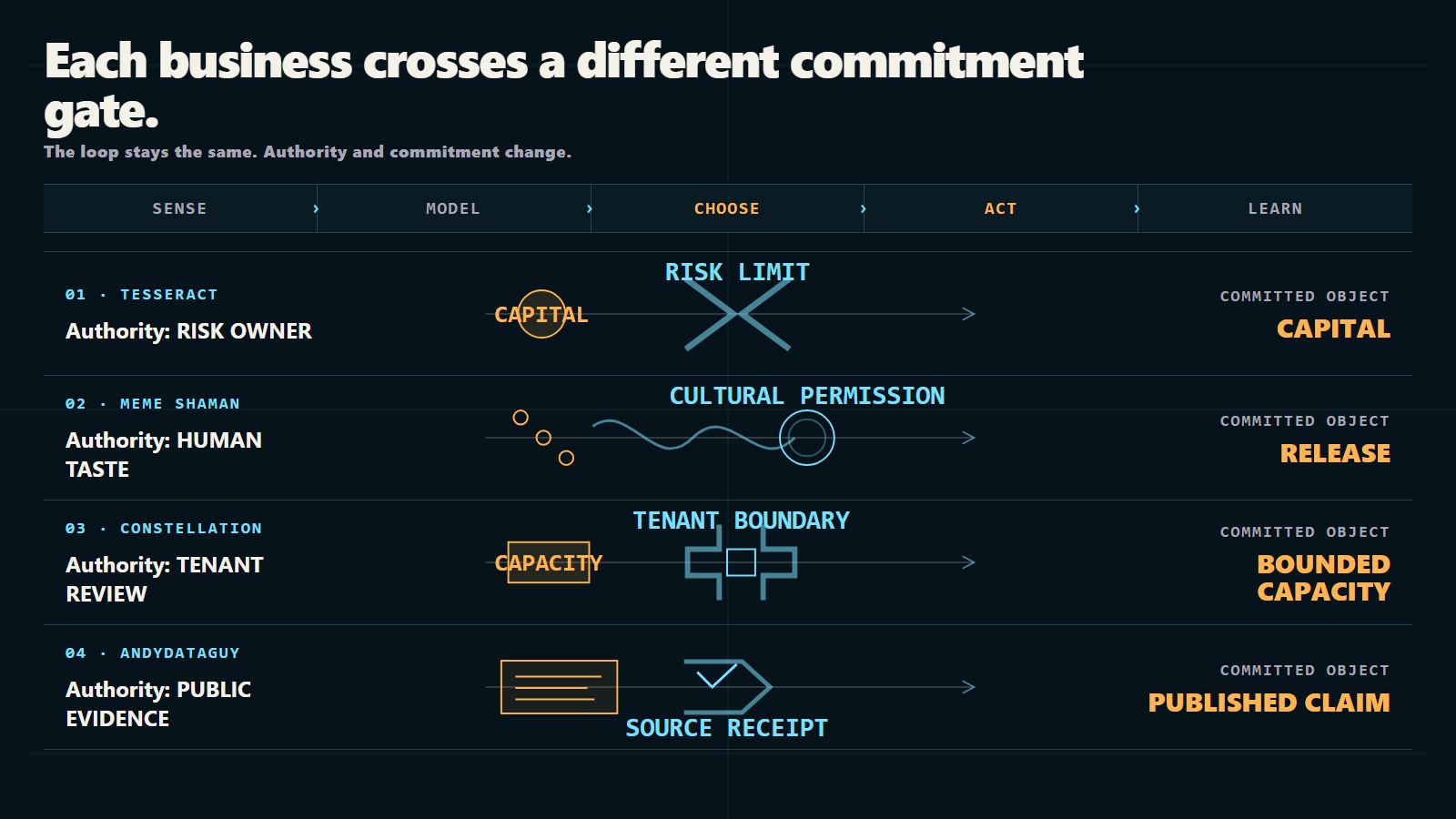
The architecture becomes valuable when a better primitive crosses the portfolio without dragging private data behind it. That's the promise of one engine, and the promise depends on a boundary that keeps it from becoming a leak.
16. One engine can serve many shops
A commercial kitchen can serve several restaurants.
The kitchen shares ovens, refrigeration, cleaning rules, safety checks, receiving docks, and maintenance. Each restaurant keeps its menu, ingredients, pricing, customers, service style, and reputation. A better sanitation process should spread to every restaurant. A secret sauce shouldn't appear on the neighbor's plate.
Multi-tenancy works the same way. A tenant is a customer or operating unit that uses shared parts of a system while expecting its data, configuration, usage, and outputs to remain within defined boundaries. The architecture may pool some components and dedicate others. Sharing is a design choice, not a moral virtue. RAG Systems shows why retrieval boundaries have to preserve the world a result came from instead of relying on a screen-level filter.
The business case is strong. Shared infrastructure reduces repeated build cost. Shared operations make failures easier to observe. Shared quality systems let one correction protect many surfaces. Shared capacity can keep expensive resources busy instead of leaving one copy idle inside every agency.
The risk is equally strong. A weak boundary can expose one client's data to another, let a noisy customer consume common capacity, apply the wrong configuration, or preserve supposedly deleted material in embeddings, logs, caches, generated assets, and backups.
A tenant boundary has to survive retrieval, generation, evaluation, export, and deletion. A user-interface filter isn't isolation.
Namespaces give every world an address
The metagraph needs a way to say which world an object belongs to.
A namespace provides that address. Customer documents, entities, facts, voice models, workflows, policies, and outputs can carry a tenant or project scope. Retrieval begins inside the relevant scope. Cross-tenant sources require an explicit rule, provenance, and a reason the transfer is allowed.
Scoping prevents a common failure, where the engine remembers something useful and forgets who owned it.
Public sources can often be reused broadly. Customer-provided materials may be restricted to one tenant. A workflow template may belong to the operator while its filled instance belongs to the customer. Aggregated learning may be allowed only after de-identification and contractual permission. Some knowledge should never cross the boundary at all.
The architecture records those categories instead of asking an agent to guess.
Shared learning needs a receipt
“The system learns from every customer” sounds attractive until the customer asks what learning means.
The answer has to name the object and the boundary.
The engine can learn that a citation checker misses a certain URL shape. It can learn that a mobile visual becomes unreadable below a delivered type size. It can learn that one workflow creates queues or that one class of source needs a second verification pass. Those are system-level improvements that don't require exposing customer content.
The engine might also observe that a phrase, offer, or channel worked for one tenant. Reusing that pattern elsewhere needs more care. The evidence arose in a particular market, time, audience, and context. Transfer requires a mechanism, not enthusiasm. The receiving tenant still needs local testing.
Every propagated improvement should therefore answer four questions:
- What changed?
- Which evidence caused the change?
- Which tenant material, if any, contributed?
- Where is the change allowed to apply?
That receipt lets the portfolio compound without turning “learning” into a euphemism for memorization.
Multi-tenancy compounds the engine without blending the tenants
Constellation Media can support many specialist agencies because the shared layer solves repeated infrastructure problems.
Every agency needs intake, source handling, research, profile routing, artifact production, review, distribution, measurement, and a reopen path. Building those mechanisms once creates leverage. Improving a shared citation check, mobile rendering rule, or dispatch receipt can improve every agency that uses the engine.
Each agency still needs its own world.
A construction dealer in Alaska, a quantitative trading product, a humor compiler, and a personal intelligence brand shouldn't share one unmarked memory pool. They use different evidence, vocabulary, risk limits, channels, customers, and definitions of success.
A tenant namespace gives each world an address. Access policy defines who may read and write it. Provenance records where shared improvements came from. Transfer rules decide which learning can cross a boundary. Microsoft's multitenant architecture guidance describes the same basic choice between shared components, isolation, and dedicated deployment.
Three classes of material help sort what can cross.
Shared mechanics include platform code, generic renderers, evidence schemas, accessibility rules, and quality checks. These can usually improve for everyone.
Tenant patterns include observed audience behavior, local vocabulary, channel fit, and offer performance. These may transfer as hypotheses after de-identification and local testing.
Tenant secrets include private customer data, contracts, source recordings, internal decisions, credentials, and protected strategy. These stay inside their authority boundary.
The classes keep scale from becoming extraction.
They also clarify the business model. A customer buys useful output, a controlled experience, and the rights promised in the agreement. The engine owner keeps the general machinery and the improvements it has a right to retain. If a customer funds a dedicated invention, the contract can assign that invention clearly instead of relying on vague language about learning.
This model can serve dozens of agencies without making them identical. Shared infrastructure lowers the cost of disciplined work. Tenant world models preserve the local differences that make the work relevant.
Some restaurants need their own kitchen
Pooling isn't always the right answer.
A regulated customer may require dedicated storage and compute. A hostile data boundary may forbid shared retrieval infrastructure, and an unusually heavy workload may harm every other tenant. A contract may require physical or logical segregation beyond the shared default. A dedicated deployment can then reuse the same source, workflows, and quality rules while isolating the runtime resources.
The product can therefore support tiers of isolation. The principle stays stable: share what improves the system and isolate what creates unacceptable risk.
Tiered isolation is how the golden goose survives.
Customers receive the artifacts, outcomes, evidence, and rights named in the contract. The operator keeps its shared engine, orchestration, general methods, public research, and permitted improvements. The system explains enough to earn trust and support inspection without handing every internal map to every buyer.
The arrangement works only when the output keeps proving its value. Nobody needs to hold a knife to the operator's throat and demand the recipe if the meal is good, the kitchen is safe, and the next service is better than the last.
17. Practice cartography before claiming mastery
You don't need a metagraph, an agent fleet, or a three-dimensional interface to practice the method.
Start with one market and one decision. The practice is complete only after a real return changes the model. Research, vocabulary, voice, and simulation are instruments inside that cycle, not separate accomplishments.
Pick a question whose answer can change something this week. “What do local excavation contractors care about?” is too wide. “Which proof would make an Albuquerque excavation contractor book a machine-control demo?” gives the work a buyer, place, action, and stop condition.
Then run five small practices that prepare one bounded commitment.
Build a world model
Write down the people, objects, events, constraints, and relations that matter.
Who buys? Who uses? Who influences? What equipment, software, money, documents, and risks move through the system? Which event begins the buying process? Which event ends it? What can block the path?
Keep observations separate from guesses. “Three contractors mentioned rework” is an observation when the calls exist. “Rework is the main buying trigger” is an interpretation. Give the interpretation a confidence level and a next test.
The first model can fit on one page, and its job is to expose what you don't know.
Learn the vocabulary
Collect the words people use while doing the work.
Record exact phrases from job posts, calls, forums, manuals, reviews, proposals, and support conversations. Define each term in ordinary language. Note who uses it, what it distinguishes, and which nearby terms should remain separate.
Then test yourself. Can you explain the buyer's problem without borrowing vague category language? Can you recognize when two people use the same word for different mechanisms? Can you ask a question that sounds like it belongs inside the work?
Vocabulary is evidence of proximity when the distinctions are correct.
Fingerprint a voice
Choose a person with enough source material and permission to study it.
Map favorite words, sentence lengths, recurring structures, parts of speech, transitions, examples, subjects, humor, and the situations that change the voice. Compare a polished article with a voice memo and a tense support reply. The differences may be part of the fingerprint.
Generate a short passage, then compare it against real samples. Mark imitation tells, missing habits, false polish, and phrases the person has outgrown. The goal is a living model that supports authorship, not a museum copy of old text.
Audit drift
Take one belief the market treated as obvious six months ago.
Search for current evidence. Check product releases, platform rules, buyer language, competitor offers, prices, and recent behavior. Record what stayed stable and what moved. Expire the claim when the conditions no longer hold.
Drift audits work best on consequential assumptions. Audit the advice that drives spend, authority, positioning, or irreversible technical choices before polishing facts that change nothing.
Simulate a decision
Build one artifact that forces the model to predict.
Write the proposal. Publish the field note. Show the price. Run the small campaign. Ask the buyer to choose between two proofs. Define the return before release so a disappointing result can't be renamed as success afterward.
Record the miss with the same care as the hit.
Expand geography as a test
The source conversation proposed a useful progression: Albuquerque, then Dallas-Fort Worth, then national, then global.
Distance itself doesn't create rigor. The progression tests whether the operator has absorbed the signal well enough to carry it somewhere new.
A message may work in Albuquerque because the operator understands the local economy, references, and relationships. Moving to Dallas-Fort Worth changes competition, scale, buyer mix, and vocabulary. A national test removes more local context. A global test introduces language, culture, regulation, timing, and market structure.
At each ring, ask which parts of the model survived and why.
A mechanism may transfer while the phrase doesn't. A pain may transfer while the buyer's proof standard changes. A format may travel while the humor fails. The system earns wider claims one ring at a time.
The one-week cartography drill
Keep the first practice bounded to one market, one buyer, and one decision that can change this week. Write the plausible answers before research begins. That first page records the possibilities before the choice, not a prediction you reconstruct after seeing the result.
Turn the decision into a usable question. Name who acts, what changes, and when the answer is needed. Build one world-model page and one vocabulary sheet because those are the smallest instruments this decision needs. Add the buyer's problem, desired future, proof threshold, and constraints. Value Optimization offers a deeper practice for deciding which value-producing move deserves scarce attention next.
Narrow the options with current evidence. Cross out routes that lack proof, violate a real constraint, answer the wrong buyer, or can't produce a readable return. Keep the surviving alternatives visible. Choose one artifact and write down the expected event before release.
Commit the act. Send the proposal, publish the field note, show the price, or run the small campaign. Record the version, audience, timing, and conditions. Then wait for the return you named rather than shopping for a flattering metric.
At the end of the week, compare the event with the prediction. Which belief lost confidence? Which relation appeared? Which word carried more meaning than expected? Which source proved unreliable? Which next probe now has higher value?
Write one correction note and one reopen condition. “Reopen if two qualified buyers describe the risk as onboarding rather than price” is usable, and “Revisit later” isn't. The cycle is complete when the evidence changed the map and the next operator can see why.
18. The map never becomes the territory
Return to the dark room.
One clap gave you a wall. The second suggested a doorway. A step changed the angle. The room became more usable without becoming fully known.
Hyperrelevance works the same way.
The system can build a current model, retrieve the right evidence, preserve relations and time, coordinate specialist agents, produce difficult artifacts, measure response, and carry learning into the next decision. It can help a junior worker see more context and help a senior worker challenge old confidence. It can let one engine support many specialist businesses without rebuilding the same machinery every time.
It can't remove uncertainty.
The data can be incomplete. The representation can distort. The lens can hide a relation. The audience can change while being studied. The operator can misread a return. A beautiful visualization can make a weak model feel inevitable.
The answer is visible correction.
Keep the observation. Keep the source. Keep the time. Keep the interpretation separate. Keep the confidence. Keep the decision. Keep what happened next. Let later evidence narrow, expire, or reverse the claim.
That sequence turns error into a map update instead of an embarrassment to hide.
The public work matters because it lets other people inspect the model. The private machinery matters because it lets the operator repeat the work, protect customer boundaries, and compound what was learned. The human stays responsible because consequential choices still need somebody who can understand the evidence, reject the output, change the policy, and reopen the trail later.
Follow the public evidence trail
This field note combines published research, public technical definitions, current product boundaries, and clearly marked analogies. Those sources carry different authority. A reader should be able to follow the important paths without knowing the name of an internal file or gaining access to a private workspace.
For the surrounding operating system, start with Intelligence Engineering, then follow the Shape of Data: Provenance for clocks and source trails, State Machine Everything for commitment and reopening, and Research-Layer Metagraph Compiler for a concrete research-to-artifact implementation.
The active-sensing spine comes from biology. Chiu, Xian, and Moss observed paired bats changing parts of their sonar calls while navigating a difficult auditory scene. The study supports a narrow mechanism: a sensing system can change a later probe in response to conditions and returns. It doesn't study markets, customer research, or Hyperrelevance Cartography. Moving from adaptive sonar to adaptive research is an analogy grounded in a shared loop.
The shape-of-data section uses two instruments from topological data analysis. Cohen-Steiner, Edelsbrunner, and Harer establish a stability result for persistence diagrams under stated mathematical conditions. Singh, Mémoli, and Carlsson describe Mapper as a construction built from a filter function, overlapping cover, clustering inside preimages, and shared points. Those sources support the mechanics. They don't grant a business meaning to a cluster, hole, or persistent feature. Representation, lens, metric, sample, and interpretation remain choices.
The quantum comparison has a stricter fence. The Stanford Encyclopedia of Philosophy entry on quantum measurement explains why definite outcomes and state reduction belong to a specific physical and philosophical problem. This field note borrows one picture, a question selecting one useful result from several possibilities, and it makes no claim that customer research obeys quantum mechanics.
The system section keeps its product boundary narrow. A complete operator journey has to connect profile inspection, launch, real execution state, native evidence, a human decision, and reopening. Source, an endpoint, or a screenshot can support one part of that chain. None substitutes for the whole journey. The public Observability Manifesto explains why those evidence classes stay separate.
Neo4j's property-graph documentation supports the storage vocabulary of nodes, relations, labels, types, and properties, and its Graph Data Science documentation supports analytical projections. Neither source defines the complete metagraph behind this work. That meaning comes from application contracts that add evidence, time, claims, authority, workflow, and operational purpose.
The provenance section uses W3C PROV because it gives public names to a simple chain: an entity is changed by an activity for which an agent is responsible. Derivation, generation, attribution, revision, alternate forms, and collections make a path inspectable. Provenance still doesn't certify truth. It records how a result arrived.
The attention section starts with Simon's information-scarcity argument, then separates delivery from human attention and causal effect. Google's impression-counting definition shows that a counted delivery event can occur when an ad begins to download. Google Ad Manager's viewability metrics add an area-and-time condition. Google Ads Conversion Lift uses treatment and control groups to estimate incrementality. Each instrument answers a different question.
The market-making section uses a literal financial baseline before transferring any language. The Bank for International Settlements describes market-making inventory, risk, capital, and changes in dealer behavior. Financial market makers may quote two sides, trade for their own account, and manage adverse selection. A content company doesn't become a financial market maker by holding drafts or matching ideas to audiences. The analogy supports inventory discipline, spread diagnosis, timing, and risk. The literal regulated functions stay on the trading side.
The multi-tenant section uses architecture guidance from Microsoft and AWS to ground shared components, tenant isolation, noisy-neighbor risk, and dedicated deployments. The business inference is local: a shared engine can support many specialist agencies if namespaces, access policy, provenance, contracts, and transfer rules keep customer worlds from bleeding together.
The product and portfolio examples are bounded explanations of the mechanism rather than publication of the engine's private recipes, customer material, scoring weights, or protected strategy. Readers can inspect related public proof in the Content Compiler Reference, AI Agent Systems in Production, Voice Fingerprint Deliverable, and Algorithmic Trading Pipelines.
This public trail stays attached because the argument asks readers to trust a living map. The trail shows which lines come from measurement, which come from a source, which are bounded comparisons, and which remain an inference waiting for a better return.
What the next committed act makes possible
The gains begin with better work on one decision. They become credible only when one decision produces a return the system preserves.
A proposal can use the prospect's current language, answer the risk visible in the job post, connect proof to that risk, and arrive while the opportunity is still alive. A Field Note can connect a difficult idea to evidence, animation, and a useful next action. A campaign can learn from its misses because impressions, attention, traffic, conversion, and revenue remain connected without being collapsed.
The next gain is repeatability.
A voice compiler can preserve how a person reasons across articles, proposals, scripts, and interfaces. It can detect when generated work falls toward generic model language, when a phrase belongs to the wrong audience, and when the source voice itself has changed. A creative system can keep the same world across still images, three-dimensional scenes, motion, and interaction while changing the explanation beside each asset.
The third gain is specialization without rebuilding the factory.
Meme Shaman can use a shared ingest, provenance, evaluation, and production system while specializing in humor, timing, lore, and audience permission. Tesseract Markets can use the same operating discipline while keeping trading data, risk logic, and regulated boundaries separate. Constellation Media can give specialist agencies a common engine while every agency keeps its own sources, language, customers, and taste.
AndyDataGuy can publish the visible edge of the system. Each Field Note becomes a proof surface, a research instrument, a source of audience returns, and a new set of linked assets. The public piece teaches the mechanism. The private graph retains deeper recipes, customer material, correction history, and production leverage.
The fourth gain is scale with a human control plane.
An agent fleet can research more sources, test more lenses, and produce more candidate assets than one operator can hold in working memory. AgentOS can give that operator a place to inspect the profile, evidence, cost, state, receipt, and next action. SuperHarness can enforce the dispatch and lineage contracts beneath the interface. Independent evaluation can reject work before volume turns one weak assumption into a thousand weak artifacts.
Scale becomes propagation of reviewed judgment instead of propagation of output alone.
The final gain is a new way to allocate attention.
Most content systems optimize for production. A cartographic system can optimize for uncertainty reduced, qualified movement created, trust earned, and future decisions improved. It can hold production capacity as limited inventory, place difficult assets where they can create a return, and learn how different audiences price proof, novelty, humor, depth, and risk.
The result is an operating system that can see where attention is flowing, where meaning is scarce, where production is being wasted, and where a useful object can narrow the distance between what a community believes and what a business can prove. It doesn't create a literal exchange for human attention.
That operating system is enough to build a family of companies around one engine without turning the engine into a commodity.
It also changes what mastery looks like. Mastery stops being a warehouse of final answers and becomes the ability to choose a useful probe, recognize a meaningful return, update the model, and move one radius farther without losing the path home. The tools increase reach, the graph increases memory, and the receipts increase accountability, while the world keeps the right to disagree.
A cartographer who accepts that disagreement can keep learning. A system that hides it can only grow more confident.
A trustworthy map stays unfinished. It earns trust by recording the corrections that made the next step safer.
The next committed act is concrete: take the next twenty to fifty recent Upwork posts, preserve the source and selection bias, classify each archive purpose, score the candidates with visible evidence, choose one package, record the expected buyer event, and send only after human approval. Reopen the model when the return contradicts the score, the stage clock, the selected proof, or the reason the opportunity survived.
That run will produce more than applications. It will show which parts of the map survive contact with a live market and which parts need to change.
The Alpha Is a Compiler follows the larger consequence: the advantage compounds when each committed run improves the engine that prepares the next one.
Send the next probe. Keep the return.