
I. Quant funds don't sell signals
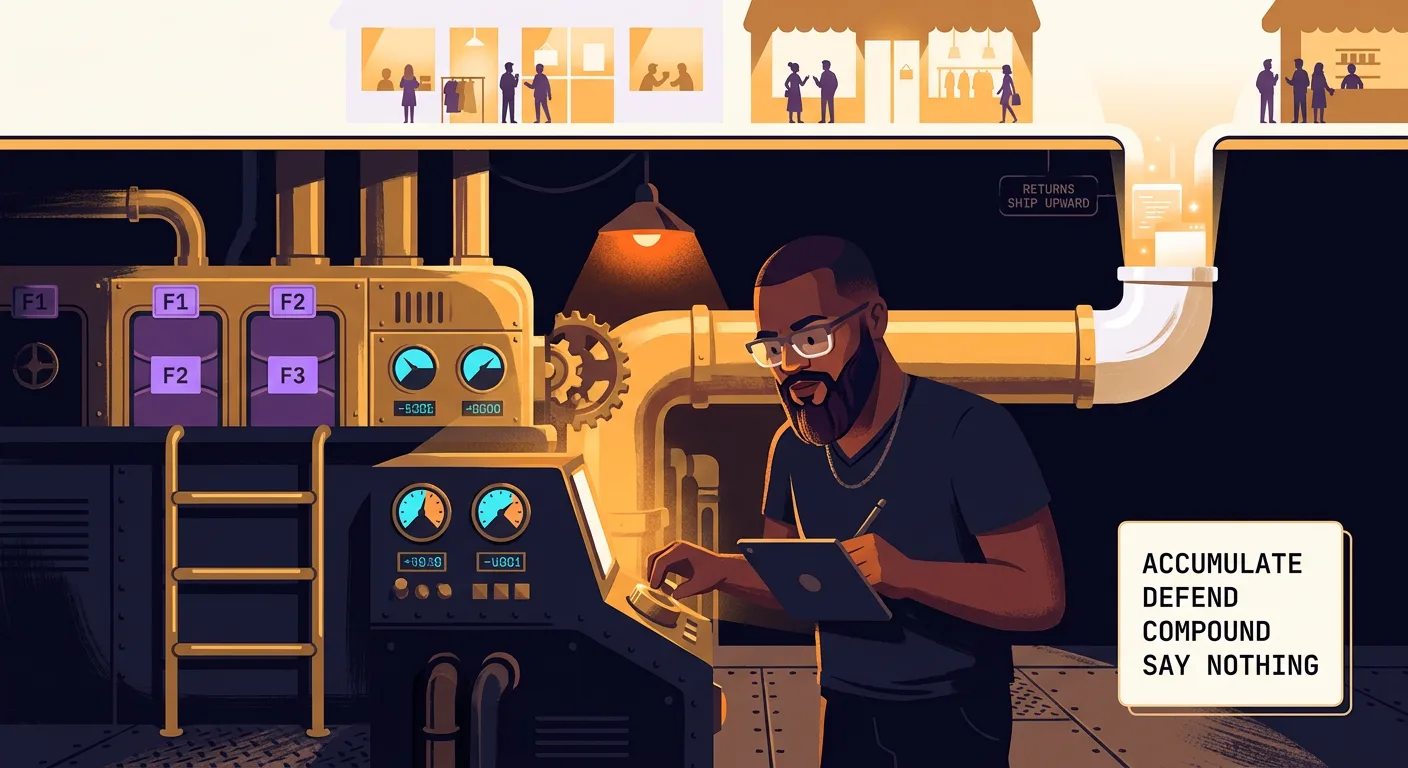
Renaissance Technologies has never sold you a signal. Citadel won't license you its execution stack. The best programmatic trading desks in history have one commercial posture toward their actual edge, and it's the same posture a dragon has toward gold: accumulate, defend, compound, say nothing. They sell *returns*, the downstream artifact, and the machinery that produces the returns stays in the building, because the machinery is the business and everything else is packaging.
Hold that posture in mind, because this memo describes a piece of machinery, and the first thing to understand about it is its commercial position. Nobody buys a content compiler. You can't sell it, demo it, or put it on a pricing page, because the market for "infrastructure that makes AI writing not sound like AI" is a market of people who don't yet believe they have the problem, and by the time they believe it, you don't want their money for the tool. You want their market. The Compiler is not the product. The Compiler is the alpha. The product is a giga-agency: hyper-targeted media for hyper-specific niches, produced at machine cost with human credibility, scaled across every channel simultaneously, limited by exactly one input, which is how much compute you can buy. Parts one and two of this series built the architecture philosophy and the organizational substrate. This part is the engine room, in the detail the first two memos earned the right to skip.
The Compiler is not the product. The Compiler is the alpha.
In a quant fund, alpha decays the moment it leaks, and everyone's models converge on the same public factors. The equivalent dynamic here is that everyone has the same models. Claude, Gemini, GPT: those are the public factors, the beta. Anyone can buy intelligence by the token now, which means intelligence by the token is worth exactly what anyone can pay for it. The edge has to live in what you do to the model output that others can't or won't do, and it has to be the kind of edge that compounds privately: trained on your corpus, calibrated to your voice, fed by your production feedback, getting better every week in ways no competitor can observe from the outside. The operating posture is the quant's: assume everyone else is already smarter and better capitalized, and go find the alpha in the work they aren't willing to do. What we're building is an execution stack for language, with the same relationship to public LLMs that a fund's execution stack has to public market data.
II. The problem, stated with the precision it deserves
Machine-written text has a dialect, and the dialect problem is structural, so let's state it structurally, because the design of the whole machine falls out of the diagnosis.
How the dialect happens
A language model is trained by next-token prediction on the statistical mass of human writing. The training signal rewards plausibility against that mass. What it never receives is the social feedback that shaped every human writer: the glazed eyes that teach brevity, the avoided conversations that teach when to stop, the bored audiences that teach variation. Humans learned to write under consequences. Models learned to write under likelihood. The result is text that converges on the average of all voices, which is no voice, applying patterns that correlate with "quality writing" in the corpus uniformly, regardless of context, forever. The patterns are the em dash as a structural crutch, the "not X, it's Y" construction reaching for profundity, the announced honesty ("let me be honest") that signals its own absence, sentence lengths clustering in a fifteen-to-twenty-five word band with the variance of a military drill, and fake specificity: percentages with no source, precise to a decimal nobody measured. And there's the signature degradation curve: after roughly two thousand tokens of continuous generation, vocabulary narrows, bullets proliferate, rhythm flattens, and the prose audibly runs out of breath.
Humans learned to write under consequences. Models learned to write under likelihood.

The hypothesis from November 2025 was that models would get far more capable while this dialect would sharpen into something humans collectively flinch at. Both halves were confirmed. The intelligence is now extraordinary; the dialect is now a cultural punchline; the word "honestly" has been functionally destroyed in the English language by machine overuse, an actual casualty of war. And the cultural trajectory has a precedent in banner blindness. Internet users learned to not see banner ads rather than critique them, a perceptual adaptation that took a few years and then was permanent and total. The same adaptation is happening to AI dialect, led, as all taste adaptation is, by the youngest cohort with cultural throw-weight. Brands that ship the dialect are about to learn what the brands that said "how do you do, fellow kids" learned, except at content volumes a thousand times higher.
Measure, don't ask
Now the engineering question: what does the industry do about this today? It asks the model to fix it. "Here's my draft, remove the AI smell." Sometimes it runs in a loop, sometimes with a second agent playing editor, sometimes with elaborate prompt scaffolding. Asking the model is using the problem to fix the problem, and it fails for a reason you can state formally: the editing model has the same training distribution as the writing model. Its sense of "better" is drawn from the same statistical mass that produced the dialect in the first place. Ask it to remove clichés and it substitutes adjacent clichés it can't perceive as such, because nothing in next-token prediction renders them visible. It's asking the counterfeiter to authenticate the bills. You don't escape a distribution by sampling from it again, slightly annoyed.

You don't escape a distribution by sampling from it again, slightly annoyed.
The escape is the one every detection discipline eventually finds: measure, don't ask. The dialect is a set of measurable statistical properties of text: surprisal uniformity, sentence-length variance, function-word distributions, syntactic-opener repetition, and embedding-space position. These are features, features feed classifiers, and classifiers built from gradient-boosted trees over engineered features happen to be the exact discipline I spent years min-maxing in algorithmic trading and then in programmatic advertising, where XGBoost over text features extracted portfolio-level insights from ad copy at scale. The Compiler's detection layer is that muscle, repointed. The math judges whether text smells like an LLM, not another LLM.
III. The shape of the machine
In one operational line, the Content Compiler is an agent-powered CI/CD pipeline specialized for programmatic media generation. Code goes through CI before it ships because nobody trusts an unreviewed commit in production; language now goes through the same gate, for the same reason, with the same machinery shapes: triggers, passes, gates, artifacts, logs.
Language now goes through the same gate, for the same reason, with the same machinery shapes: triggers, passes, gates, artifacts, logs.
The request and the response
The architecture is a compiler's. A frontend accepts source in any dialect. A middle-end runs ordered, composable passes over an intermediate representation. A backend renders for targets. The compilation request carries three things: the text itself (any human-facing prose, any length, segmented above ten thousand words by the caller), a register label naming which voice configuration applies (proposal, article, post, internal, each with its own calibration), and content-type metadata for context-sensitive checks. What comes back is two things, always: the processed text, and an audit log recording every operation performed, every defect found, every repair applied with method and before/after similarity score, and every span explicitly marked clean. The audit log is half the product. A compiler that can't show its work is an oracle, and we just spent a whole section on why oracles are the failure mode.
A compiler that can't show its work is an oracle.
What the Compiler is not
Just as important is the boundary, because infrastructure that doesn't know what it isn't becomes a God service, one service that tries to do everything, and part one already held the funeral for those. The Compiler doesn't generate content; drafts arrive from elsewhere. It doesn't store documents; it's a pipeline, not a CMS. It doesn't build the world model it checks against; Graphiti and the embedding space are upstream systems it reads. It doesn't manage publication. And, pointedly, it doesn't do adversarial detection. The Compiler is a linter for our own known generators, in our registers, against our defect catalog. The academic literature on AI-text detection agonizes over paraphrase attacks and unseen-generator generalization, and the agony is real, for forensics. We aren't doing forensics. Nobody is trying to fool this system; the system and the text generator work for the same company. In-domain, on known generators, the detection problem drops from "research frontier" to "tractable engineering," which is the gap the whole design lives in.
| The Compiler does | The Compiler does not |
|---|---|
| Accept text + register + metadata | Generate content from scratch |
| Detect dialect defects via statistical features | Do adversarial AI-text detection |
| Repair spans via escalation ladder | Store or manage documents |
| Produce audit log of every operation | Build the world model (Graphiti/embeddings are upstream) |
| Score voice alignment per register | Manage publication or editorial workflow |
The three pass families
Inside the boundary sit three pass families, ordered by cost and depth. F1, smell elimination, is cheap and deterministic-leaning, and it runs on everything. F2, voice verification, asks whether the surviving text sounds like me, in this register, rather than merely "not-AI." F3, resonance verification, asks whether the text lands against the world model. F3 is the deep gate, defined today as a port and implemented when its upstream dependencies harden. The minimum viable product (MVP) is F1 plus F2.
IV. F1: smell elimination, down to the bolts
F1 operates at span level (sentence or sub-sentence), never requiring document context for detection, and it uses zero LLM calls in its detection layer. Detection is a stacked classifier: for each span, extract a feature vector from five signal sources, feed the combined vector to an XGBoost ensemble, get back a per-class defect probability. The five sources, in cost order:
Detection: the five signal sources
Lexical rules. These run regex and exact match against the banned catalog: em dashes (U+2014 and friends), the banned vocabulary (delve, crucial, leverage-as-verb, utilize, robust, the rest of the rogues' gallery), banned phrases ("it's important to note that," "in today's landscape," every announced-honesty construction), the "not X, it's Y" pattern. They produce binary features, free to compute, and individually so reliable they barely need the classifier.
POS and syntactic features. These cover part-of-speech (POS) distributions, dependency parse depth, clause counts, and the sentence-opener signature: the first three POS tags of each sentence, tracked across runs. Three consecutive sentences opening with the same syntactic shape is the parallel-structure addiction ("You can do X. You can do Y. You can do Z.") rendered as a computable feature.
Surprisal and burstiness. This source measures per-token negative log-probability under a small reference model, aggregated per span. It's the one likelihood-based signal in the stack, and the small model serves as a reference distribution, a measuring instrument, not a judge. Human text is bursty, with low-surprisal function words alternating with high-surprisal content choices, while machine text is eerily smooth, plausible everywhere and surprising nowhere. The variance of surprisal is close to a thermometer for the dialect, and the detection literature (the Binoculars line of work, the RAID benchmark results) consistently shows likelihood-shaped signals carrying the most robust discriminating power, which is why the stack includes one alongside the cheap features rather than relying on either alone.
Function-word and punctuation ratios. These track the comma-to-period ratio, semicolon frequency and function-word distributions. They're stylometry's oldest tools, and they still earn their rent.
Embedding aggregates. Each span is embedded in the 3072-dimensional Gemini space that's standard across the Constellation, my group of companies, and compared against defect-class centroids learned in training. This is the net that catches the semantic patterns rules can't articulate. "Stage 2 leakage" is the text monologuing about its own analytical process instead of addressing the reader's situation; the "drunk conversation" is structurally fluent text performing connection while talking entirely about itself. You can't regex your way to those, but you can learn their neighborhoods in embedding space.
| Class | Detection Method | Threshold |
|---|---|---|
| A: Banned vocabulary | Lexical rules, exact match | Any match, zero tolerance |
| B: Structural patterns | POS rules (0.8) + classifier (0.9) | False profundity, performative announcements |
| C: Statistical patterns | Computed metrics vs calibration corpus | Two standard deviations from empirical distribution |
| D: Semantic patterns | Embedding + surprisal classifier | 0.85 confidence |
| E: Voice and rhythm | Composite scores per register | Per-register thresholds |
The five defect classes
The classifier's output routes to five defect classes, each with its own threshold and repair authority, ordered by confidence. Class A, banned vocabulary, uses deterministic detection: any match is a defect, with zero tolerance in output and a hard gate. Class B, structural patterns (false profundity constructions, performative announcements, false contrast against an unestablished referent), uses rules over POS tags for the clear cases at 0.8 confidence and the classifier for the ambiguous ones at 0.9. Class C, statistical patterns (sentence-length variance, hedge density, transition-word density, unsourced statistics), uses computed metrics whose thresholds are derived from the calibration corpus rather than invented. Take the documents that define passing voice, compute the empirical distribution of each metric, and flag any span landing outside two standard deviations. The corpus is the spec. Class D, semantic patterns, uses the embedding-plus-surprisal classifier at 0.85 confidence, and it's the only class whose repair may require a model call. Class E, voice and rhythm (urgency language, diminishing-effort framing, directness violations measured as the ratio of affirmative to negative-first constructions), uses composite scores against per-register thresholds.
Repair: the escalation ladder
Detection is half of F1. Repair is the other half, and repair is where the research from part two of this series earns its keep, because the naive move (hand the flagged span to an LLM and say "fix it") reopens the exact door we just bolted. Instead, repair climbs an escalation ladder, each rung more expensive and less deterministic than the last, and the Compiler always prefers the cheapest rung that produces acceptable output.
Rung one: deterministic rules. This rung does direct substitution or deletion. The em dash becomes a period, comma, or parenthesis by a clause-structure heuristic. "Furthermore," at sentence start is deleted and the sentence proceeds, unembarrassed. "It's important to note that" vanishes and nothing of value is lost. It makes zero model calls, and it clears all of Class A and most simple Class B.
Rung two: the style edit-tagger. This is the architecture borrowed from grammatical error correction (GECToR is the canonical citation), retrained for style: an encoder that predicts a discrete edit operation per token (KEEP, DELETE, REPLACE-with-x, INSERT, MERGE-with-next) from a finite vocabulary, instead of freely generating a rewrite. Training data gets synthesized by the obvious inversion: take clean human corpus text, inject AI artifacts programmatically, train the model to reconstruct the original. Two properties make this the workhorse rung. It's bounded: a hard cap of 30% of tokens changed per span, so it can't wander off and redecorate. And it's auditable: every change is a named operation in a log, not a diff you have to reverse-engineer. It costs one inference call on a small, fast model, with no LLM, and it carries Class B structure, Class C rhythm and Class E phrasing.
The edit-tagger is bounded: a hard cap of 30% of tokens changed per span, so it can't wander off and redecorate.
Rung three: constrained span-infilling. This is the only rung where an LLM appears, and it arrives in handcuffs. It receives the defective span, one sentence of context on each side, the specific diagnosis, and hard constraints: every anchor token (entities, numbers, proper nouns, technical terms) preserved verbatim, output length budgeted, banned tokens excluded from decoding. It's reserved for Class D semantic repairs and the directness restructurings the tagger can't manage.
The meaning gate
And after any repair, at any rung, comes the meaning gate: embedding similarity between original and repaired span must exceed 0.92, and every anchor token must survive verbatim. Fail either check and the repair is rejected, and the span is flagged for human review instead. The Compiler fixes how things are said and leaves what is said to the author, and the gate is what makes that division a mechanism instead of a slogan.
The Compiler fixes how things are said and leaves what is said to the author.

V. F2: sounding like Andy, not like nobody
Strip every AI tell out of a paragraph and what you've achieved is a competent ghostwriter: generic professional text with no fingerprints, which is its own kind of tell, because the entire commercial thesis runs on the opposite property: a specific human, visible in the text, with a register and a rhythm and a way of swinging at things that an audience learns to recognize and trust. F1 removes the negative, and F2 verifies the positive: does this read as this author, in this register?
F2 scores; it doesn't gate.
Two signals, fused
Voice is a family of registers sharing a core signature. The proposal register (direct, value-dense, "I've written the checks"), the article register (analytical, cross-domain, patient) and the post register (compressed, hook-first) are three different things. A verifier that learned one register would flag the others as impostors. So F2 maintains per-register centroids, and the register label on every compilation request selects which one the text is measured against.
Detection runs at document level, not span level, and stacks two complementary signals. The first is a content-independent author-style embedding, from the authorship-verification literature (the LUAR and Wegmann lines of work): models trained, via contrastive learning with content words masked, to capture how an author writes independent of what they're writing about: rhythm, function-word habits, syntactic preference, punctuation behavior. The input text is embedded and compared by cosine similarity against the register centroid, and a score under the register threshold flags voice misalignment. The second is classical stylometric distance: roughly thirty quantitative features (sentence-length mean and variance, type-token ratio, hapax ratio, punctuation distribution, clause-per-sentence, question frequency, direct-address frequency) computed and compared against the register's reference distribution by Mahalanobis distance. The two signals, one learned and one counted, are fused into a single voice-alignment score with register-specific weights.
The corpus grows by operation
The reference corpus seeding all of this already exists as authenticated text in my voice, tagged by register: my portfolio page, my Upwork profile, my Mirror Ocean article and my People-Product-Process document. And the corpus grows by operation: every output I approve becomes a positive example, and every rejection with voice feedback becomes a negative one, accumulating into periodic retraining. The system converges on my actual judgment, not a frozen snapshot of it.
Two design decisions deserve their reasons stated. First, F2 scores; it doesn't gate. It returns a continuous value with a diagnostic breakdown (which features deviated, in which direction) and the caller decides what to do. A proposal pipeline might hard-gate at a high threshold; an internal-docs pipeline might log and pass. Policy belongs to the consumer; measurement belongs to the Compiler. Second, drift is monitored, not assumed away. Voices evolve. The monitor is a domain classifier between my older authentic writing and my recent authentic writing; when its AUC climbs past 0.7 (meaning a machine can now reliably tell old Andy from new Andy), the system flags recalibration, and I rule on whether the drift is evolution (update the centroids) or contamination (purge the recent additions). The voice model is versioned like any other production model, because that's what it is.
VI. F3: the resonance port, where the echolocation comes home
F1 and F2 answer "is it clean" and "is it him." Neither can answer the question the whole agency monetizes: does it land? Does the text address this audience's situation, in this audience's own recorded vocabulary, at the point in their cycle where they actually sit? Or does it perform address, beautifully, at nobody? F3, resonance verification, asks that question, and in the MVP it's deliberately a port: an interface specified now so F1 and F2 can't accidentally preclude it, implemented when its upstream dependencies harden.
Does it land?
The port's named inputs
The port's named inputs are the world model this whole operation has been building under other headlines. Our Graphiti temporal knowledge graph (twenty thousand entities, fifty-eight thousand typed edges, the 130-plus emotion ontology) provides the concept structure text is checked against for grounding. The 3072-dimensional embedding space is the lingua franca for measuring distance between what the text says and the audience's recorded semantic territory. The Lexicon of Pain, a deliverable of my People-Product-Process framework, is the per-segment vocabulary harvested from where customers are honest because they think no one is watching (Reddit threads, YouTube comments, one-star reviews, support tickets), and F3 checks whether the text echoes that vocabulary or imposes its own, because copy is assembled from the customer's recorded reality, not imagined. And the audience-state model from my echolocation framework records where this segment sits in the cycle of suffering and growth (pain, fear, shame, denial; or truth, responsibility, healing, forgiveness), so the text can be checked for addressing people where they are rather than where the author wishes they were. F3 is the sonar from my echolocation memo, operationalized: ping the world model, measure the return, adjust the signal.
Checking for the presence of good
F3 also inverts the polarity of checking. F1 hunts for the presence of bad patterns, while F3 verifies the presence of good ones too: the five engineering moves I named in my Mirror Ocean article (cosmic zoom-out, small situated human, patchwork people, unfinished sentence, yep-yep-yep) run as positive-pattern checks, because what separates competent-but-inert text from bridge architecture is the presence of moves, not the absence of defects. How to operationalize those five as computable checks is open research, stated as such, which is one reason F3 is a port and not a promise. The other reason is dependency maturity: the graph and the segment profiles exist but aren't yet production-stable for programmatic query. The port waits. Its interface takes the same compilation request plus an audience-segment identifier, returns a resonance score and a diagnostic breakdown, and performs no repairs, because resonance defects are too context-dependent for automated repair and route to human editorial judgment, where they belong.
WikiDesignCo is where this family lives in the business. The wiki is the public proving ground of the deep gate: long-form artifacts, compiled against the full world model, published as demonstrations that this machine produces text humans finish reading. The first Wiki article through the pipeline is, not coincidentally, the MVP acceptance test.
VII. Invariants and economics: the constitution and the budget
Three invariants bind every compilation, and every one of them is a direct repudiation of how the LLM-edits-LLM approach fails.
The three invariants
No silent rewrites. Every modification is recorded: original span, replacement, defect class, repair method, similarity score. If the Compiler can't explain a change, it can't make the change. This invariant is part two's audit-stream discipline applied to prose: the comment thread for text.
Meaning preservation. No repair alters factual content, logical structure, or argumentative direction. The meaning gate enforces it mechanically; spans that can't be repaired within it get flagged, not mangled.
The Compiler changes how, not what.
Monotonic quality. Text exits no worse than it entered. After all repairs, a single re-analysis pass runs the full detection stack over the output; any defect introduced by a repair (fix an em dash, accidentally birth a hedge) is caught and either repaired at a higher rung or reverted. There's one re-analysis and no infinite recursion, and final defect counts go to the log. And the gate sequencing inside the run is deliberate: F1 before F2, because measuring voice on text still full of AI tells conflates dialect with voice; Class A before B before C within F1, because deleting a banned phrase can dissolve a structural defect downstream of it and you'd rather not false-positive on a corpse.
| Invariant | Mechanism | Failure it repudiates |
|---|---|---|
| No silent rewrites | Audit log records every operation with before/after | LLM edits with no trail, changes discovered by diff |
| Meaning preservation | 0.92 similarity gate + anchor-token check | Overreaching rewrites that alter the argument |
| Monotonic quality | Re-analysis pass after all repairs | Fixes that introduce new defects |
The budget
Then comes the budget, because a quality gate that costs more than generation gets bypassed under production pressure within a week, with apologies, and then forever, without them. The ceiling is that compilation must cost no more than 15% of the generation cost of the same text. The architecture is what makes that ceiling comfortable rather than heroic. F1 detection is feature extraction plus a small XGBoost ensemble, with no LLM, and it's effectively free at the margin. Rungs one and two of repair are free and near-free. Rung three is one scoped LLM call per defective span, roughly a hundred tokens of input each; at a pessimistic 10% of spans needing it on a 250-sentence article, that's twenty-five tiny calls. F2 is one embedding pass and one feature pass. The whole thing decomposes to span level by design (no operation ever loads the full document into a context window), which is the compute-unit insight from my original November memo, borrowed from the way Solana meters computation, still paying dividends: treat the context window as a metered resource, decompose until every operation fits comfortably, bundle and parallelize the rest. The latency target for the article profile is under sixty seconds for five thousand words, in a batch context, and it's generous on purpose. The span-level architecture parallelizes to much lower latencies when faster consumers (email, chat) arrive, but optimizing for them isn't MVP scope.
Acceptance, for the first consumer, captures the epistemology of the whole project: the metrics (defect counts, voice scores, cost fractions) are instrumentation. The gate is me reading the compiled article and the audit log and confirming four things: it reads as my voice, no tells survive that I can detect, no repair moved my meaning, and the log is intelligible. The system exists to satisfy a human judgment. The numbers exist so the system can be debugged when it doesn't.
VIII. The database: SpacetimeDB, Convex, and the discipline of wanting the right thing
Now the question that's been deferred through three memos: where does all of this state live? The state in question is the compilation requests and their statuses, the audit logs, the calibration corpora, the register centroids, the feedback examples, and the operator review queue. Two candidates were on the table, plus the field, and the comparison runs through the three stated criteria: don't shoot yourself in the foot, serverless economics, and end-user experience.
SpacetimeDB, the fair hearing
SpacetimeDB goes first, because it deserves a fair hearing before the verdict. What Clockwork Labs built is impressive and specific: a database that is also the application server, where your logic compiles to WASM modules that run inside the database, eliminating the network hop between compute and state entirely. It was built to run BitCraft, an MMO, and that origin is the spec: thousands of concurrent clients mutating shared world-state at tick rates, with sub-millisecond reads, real-time state replication to every connected client. For that workload it may be the best tool ever built. The attraction is real and the speed is real.
And it's the wrong tool here, for reasons that have nothing to do with quality. First, the workload shape: a content pipeline is business CRUD plus workflow plus audit, where jobs move through queues, humans review outputs, and logs accumulate. Nothing in it resembles ten thousand players in a shared tick-simulated world; buying SpacetimeDB for this is buying a Formula 1 car to deliver groceries, and then discovering it has no trunk. Second, the maturity surface: the ecosystem is young, the community is niche, operational tooling and migration patterns are still forming, and there are almost no documented large non-game production deployments. The foot-gun criterion explicitly penalizes being anyone's pioneer on their core data platform. Third, the economics: the model is closer to managed-cluster than to scale-to-zero pay-per-request, and the requirement was explicit on this point. Fourth, the polyglot story: the Compiler's heavy lifting is Python (NLP, XGBoost), and SpacetimeDB's center of gravity is Rust/C# WASM modules; the integration is swimmable but upstream. The fair summary: SpacetimeDB is a magnificent answer to a question this system isn't asking. If WikiDesignCo someday ships a live, multiplayer, real-time visualization of the agency's world model (the Sims-like simulation my echolocation memo gestures at), that's the day to reopen this file, for that subsystem.
Convex, suspiciously shaped like the requirement
Convex, by contrast, is almost suspiciously shaped like the requirement. Reactive queries are the core primitive: the Next.js operator UI subscribes, and when a compilation finishes or a review lands, every connected screen updates, push not poll. That's criterion three solved at the architecture level rather than the duct-tape level. Every mutation is a serializable ACID transaction, with schemas typed end-to-end into the TypeScript frontend: criterion one. Genuinely serverless usage-based pricing approaches zero at idle, which matches the bursty rhythm of agent fleets: criterion two. HTTP actions serve as the doorway for the Python service, which is the topology my site-architecture plan from May already drew: the Compiler as a FastAPI service on Cloud Run holding a Convex HTTP-action client. And the deciding factor that isn't on any vendor's comparison page: the Constellation already runs on Convex. FreelanceBuddy is Convex. The ContentFactory stack is Convex. The schemas, the operational knowledge, the deployment patterns, the muscle memory: they exist. Part two of this series spent three thousand words on why platform consolidation is what makes a mesh real instead of theater; choosing a second database religion for the flagship service would be ignoring our own memo, and people who ignore their own memos end up writing apology memos.
So: Convex, primary, decided. One hedge stays a watch-item rather than a build-item. Convex's sweet spot is the operational slice: live state, queues, and documents into the hundreds of gigabytes. If the audit logs and feedback corpora someday grow into a long-horizon analytical asset (training-data mining across millions of compilations, compliance-grade retention), the standard move is a boring system-of-record alongside (serverless Postgres in the Neon mold, scale-to-zero, full SQL), fed from Convex by event export. That's a future migration with a well-worn path, not a day-one architecture. Day one is one database, the one the rest of the company already speaks.
Day one is one database, the one the rest of the company already speaks.
IX. Closing: the giga-agency, assembled
Pull the camera back and look at what the three memos describe as one machine.
The pyramid, replaced
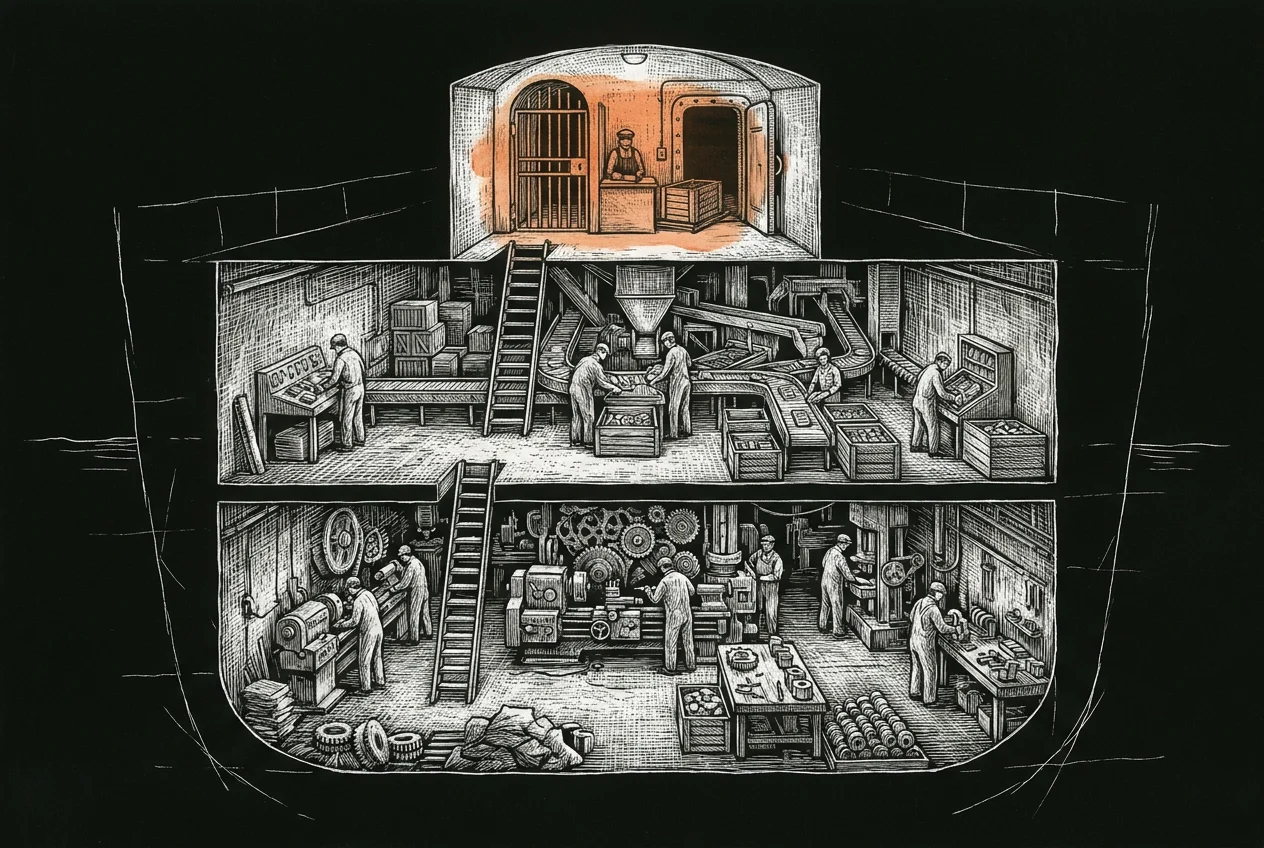
An agency, in the classical sense, the kind I ran for eight years, is a pyramid of expensive humans converting client money into media: strategists, copywriters, designers, media buyers, account managers, each layer adding cost, latency, and variance. The giga-agency replaces the middle of the pyramid with the stack these memos specify: agent harnesses (part two) orchestrating fleets of agents doing strategy decomposition, research, drafting, and production; Higgsfield as the creative studio arm producing images, video, and sound at whatever volume the briefs demand; and the Content Compiler (this memo) as the quality floor under every word that reaches a human being. Above the machine sit a small number of senior humans setting direction. Beside it sit entry-level operators: hired in emerging markets, paid performance bonuses aggressive enough to attract the best talent in their cities, equipped with a platform that multiplies their individual effectiveness by an order of magnitude. The labor arbitrage is paying people well, not paying them less to do the same work: they operate machinery that lets one person do what previously took a department, and the agency pockets the spread between the machinery's cost and the department's.
The edge, named
The competitive structure this produces maps exactly onto the quant-fund analogy from the opening. The fund's edge is never the market data everyone can buy; it's the private execution stack that converts public data into private returns. Here, the models are the market data: public, commoditized, identically available to every competitor. The edge is the conversion layer: a Compiler trained on a proprietary defect catalog accumulated across years of production, calibrated to voices no competitor possesses, fed by a feedback loop of operator judgments no competitor can observe, checking resonance against a world model with twenty thousand entities that took years to build and compounds every week. Hyper-targeting hyper niches becomes economical because the marginal cost of a campaign collapses; hyper-quality becomes maintainable because the quality gate is mechanical rather than heroic; hyperscale across channels becomes possible because the binding constraint stops being headcount and becomes compute spend. Compute, unlike talent, scales with a credit card. That is the shape of the 18-to-36-month chapter: while the agency industry consolidates through M&A, the operations that survive will be the ones whose cost structures already crossed this divide, and the divide is crossed exactly here, in the engine room, one deterministic pass at a time.
One argument, three altitudes
And the three memos turn out to have been one argument, told at three altitudes. Part one: build like a compiler, with the IR in the middle, adapters at the rims, composition over inheritance, pure transformations over shared mutable state. Part two: organize like a mesh, with domains owning their outputs as self-describing products, events as the substrate, governance as code, disciplines enforced by machinery because machinery is the only thing that sustains discipline. Part three is where both abstractions touch revenue: the Compiler is a compiler, the most literal instantiation of part one's thesis, and it is the mesh's governance layer for the one product class that ultimately matters commercially: the words and media that reach human beings and either build trust or burn it. The mesh guarantees the artifacts flowing between agents are trustworthy. The Compiler guarantees the artifacts flowing from the machine to the market are. It's the last gate before the money.
Apply second-level thinking one final time. The first-level read of this whole project is "a tool that removes AI smell from text," and at first level it's nice to have. The second-level read prices in the trajectory: the volume of machine-written language is going vertical, human sensitivity to its dialect is sharpening into reflex, and the entities that thrive in that world are the ones whose output clears a bar the dialect can't (credibly human, specifically voiced, actually resonant) at machine cost. The tools are public. The models are rented. The defect catalog, the voice centroids, the world model, and the feedback flywheel are private, compounding, and very hard to reverse-engineer from the outside, because all anyone outside ever sees is that your content works and theirs reads like a press release from the uncanny valley.
Content is the first compiler, not the last. The same architecture (varied sources into a common representation, ordered passes, gated output, audit trail) compiles other things: a knowledge compiler refining raw corpus into structured intelligence the way a refinery cracks crude, a prediction compiler, a decision compiler, a state compiler. Each one is the same machine pointed at a different raw material, each one another place where public intelligence gets converted into private, compounding advantage. The Content Compiler is where the family ships first because language is where the market judges you first.
Quant funds don't sell signals. Agencies are about to learn why.
Sources worth your time: my corpus synthesis and production scope for the Compiler (the full spec this memo narrates: pass families, defect classes A through E, the repair ladder, the meaning gate, invariants, the 15% ceiling, and the first-consumer acceptance test). The November 2025 genesis transcripts for the LLVM and Solana compute-unit lineage. Omelianchuk et al., "GECToR" (2020), for the edit-tagger architecture. The Binoculars and RAID papers for likelihood-based detection and benchmark reality. The LUAR and Wegmann lines for content-independent authorship embeddings. Dehghani and Dulay per part two. Convex and SpacetimeDB official documentation for the database comparison; Clockwork Labs' BitCraft writeups for what SpacetimeDB is actually for. And parts one and two of this series, which this memo cashes out.
A feed of banner advertising from the late 1990s beside a feed of machine-written text from now. Internet users adapted to banner ads by ceasing to see them at all, a perceptual change that took a few years and then was permanent and total; critique never entered into it. The same adaptation is drawn mid-progress on the AI dialect: uniform rhythm, announced sincerity, the em-dash crutch, fading from a young reader's attention band by band. The third panel holds the brand that said how do you do, fellow kids, the standing record of what audiences do to a voice that imitates them badly. Text in the dialect is going invisible to the cohort with the most cultural throw-weight, at volumes a thousand times higher than banner ads ever ran.
Calibration documents, the writing that defines a passing voice, stack on the left. Their measured distributions, sentence-length variance, hedge density, transition-word density, curve across the center, and detection flags sit at two standard deviations from what the corpus actually does. On the right, crossed out, a hand sets a threshold dial by feel. A dial set by intuition flags ordinary sentences the author writes every day; a threshold derived from the corpus flags only genuine outliers. A number that gates behavior is either derived from real distributions or it is technical debt in the shape of a ceiling. The corpus is the spec.
A long-form wiki article marked up as a quality instrument: resonance checks in the margins and five handwritten stamps naming the moves that separate living writing from competent-but-inert writing: the cosmic zoom-out, the small situated human, patchwork people, the unfinished sentence, the yep-yep-yep of recognition. A final stamp marks this article as the acceptance test for the compiler's first production run. Zero defects is the floor of the system, and the deep gate checks for the presence of moves beyond the absence of smells; the proof happens in public, on artifacts people finish reading.
A Formula 1 car parked at a suburban curb, groceries stacked beside it, nowhere to put them: the fastest machine in the frame and the wrong one for the errand. The second panel draws the errand's actual shape: job queues, human review trays, accumulating audit ledgers, records moving at business speed. The third panel is a filing drawer, closed, labeled with the single condition for reopening it: a live, multiplayer, real-time visualization of the world model, the workload the racing car was built for. A tool choice is a workload decision, and a magnificent answer to a question the system never asked still loses. Writing down the reopening condition keeps the verdict a decision instead of a grudge.