
A universe becomes worth exploring through the lives inside it
Imagine commanding an army so large that individual machines disappear into the movement of the front. A city survives because of a decision you make. In another work, you walk its streets. In a novel, you meet someone whose family paid for that victory. Much later, you discover that the war itself disturbed an arrangement between beings for whom the entire civilization was a minor concern.
That's the feeling I want Depths of the Void to sustain. The same place can hold a military campaign, a neighborhood, a romance, a mystery, an atrocity, and a discovery that changes how we understand all of them. Each perspective should reveal something the others can't. The city deserves to exist before it becomes a battlefield, and the people who live there deserve lives after the campaign ends.
I grew up with real-time strategy games, especially Total Annihilation and Warcraft. I’m drawn to the feeling of directing immense systems, watching extraordinary machines move, and knowing that their capabilities come with consequences. The relationship I imagine between strategy games, lived-in worlds, and books owes something to the way I experienced Warcraft: first the great conflicts and legendary figures, then the chance to inhabit the world around them. Depths would need its own peoples, history, visual language, and reasons to care.
The Xeelee Sequence and The Three-Body Problem are important reference points for the scale I’m reaching toward. Dune interests me as a way of thinking about radically diverged humanity, while Depths would also contain abundant genuinely nonhuman life. Fringe points toward another quality I enjoy: speculative discoveries that remain connected to investigation and severe consequences. I want to combine those kinds of questions with the depth of place and history I associate with Tolkien and Sun Eater, rather than reproduce any one of their settings.
The scale can keep opening outward. A war crosses a planet. A discovery changes an empire. An attempt to save a galaxy harms another universe. Humans may be involved at every stage without being the strongest, oldest, wisest, or most capable beings in any of them. We can acquire leverage that wildly exceeds our understanding. Curiosity gets us through a door. Pride convinces us we understand what's on the other side.

I also want the scale to open inward. Someone has to prepare food, maintain a pressure seal, raise a family, repair a machine, interpret a sacred text, negotiate a debt, or decide whether to trust a stranger. Those activities give enormous events something to change. A galaxy’s survival is abstract until we know some of the lives that survival contains.
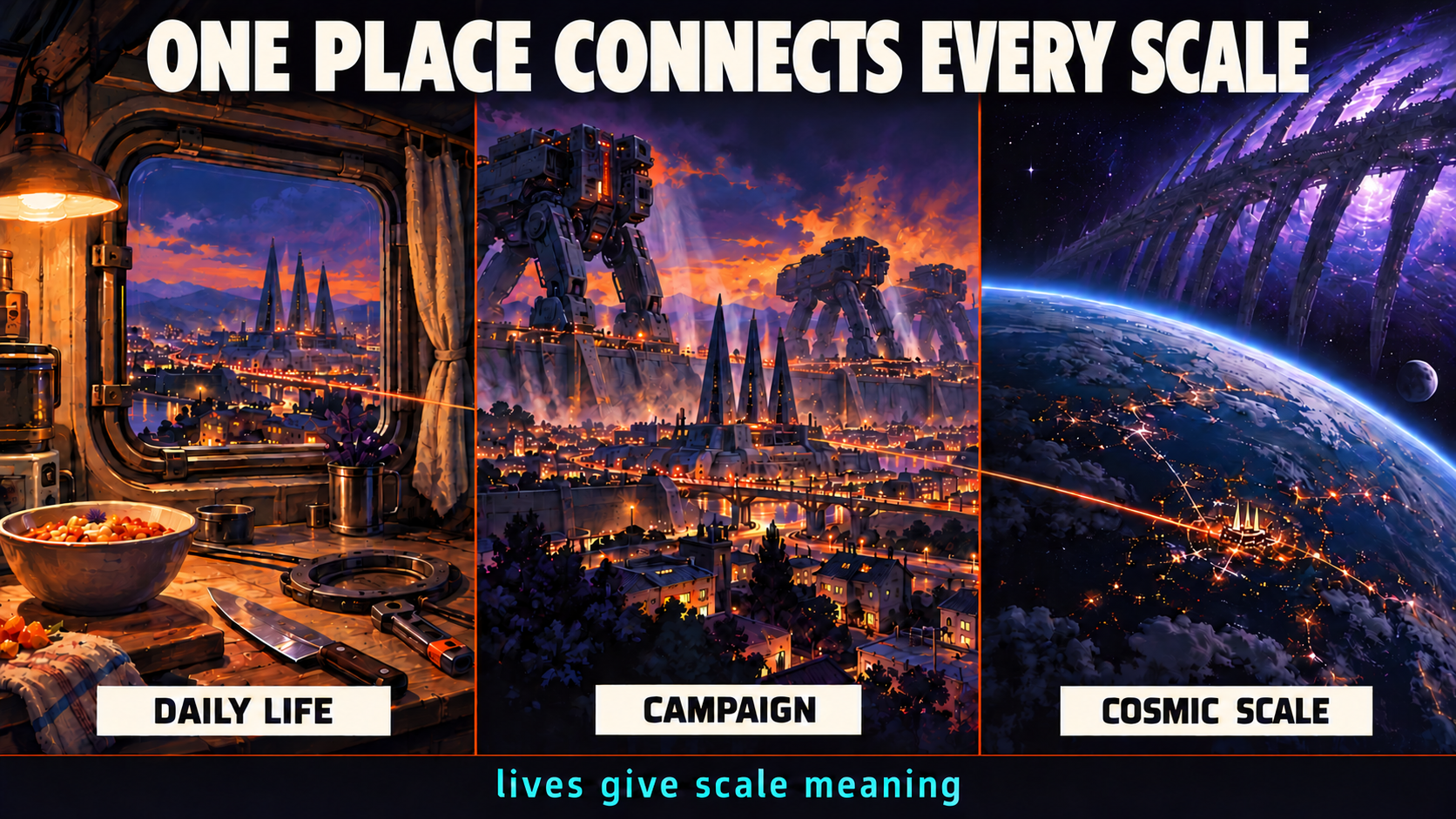
Economics and culture are the foundations I want to build this universe around. Tolkien’s commitment to language gives me a useful comparison for the depth I mean. I want to understand how people sustain themselves and how they understand the lives they're sustaining. Resources and exchange shape their possibilities. Language, religion, kinship, institutions, and historical memory shape what they value, whom they owe, and which possibilities they consider acceptable.
Those foundations keep changing each other. A resource shortage can turn a ritual obligation into a political conflict. A sacred promise can keep a costly route open after its commercial purpose disappears. A society’s account of an old betrayal can determine who owns a deposit or who's allowed to trade. Material abundance can ease a supply problem while leaving questions of belonging, authority, and meaning fiercely contested. I want that interaction to shape ordinary choices as deeply as it shapes wars.
The result could support dozens of distinctive games, hundreds of books, animation, series, webcomics, and forms we haven’t chosen yet. Those are horizons, not a release schedule. I’m interested in audiences first: the person who wants a cozy community, the person who wants military strategy, the person who wants romance, and the person who wants to confront something terrifying. Each should have an experience made for them inside a coherent world.
The horror matters. So does endurance. I want overwhelming smallness, the kind of scale that can make a familiar world suddenly feel fragile. I also want the possibility of learning, adapting, growing stronger, protecting someone, and choosing to remain decent after terrible things have happened. Progress can be real while the next horizon remains immense.
Looikos is the agent-native ecosystem through which I want to develop the capabilities that make this undertaking possible. Simulation engineering is part of that work. Shared representations, persistent history, specialized agents, and reusable production systems matter because they can help a universe remain connected as its creative range grows. Their purpose becomes clear when we know what we want to experience.
I don’t yet have a settled central plot or a working universe-scale simulation. The scenarios in this essay are possibilities for exploration, including the fractured Earth, the subterranean civilization, the lunar facility, the dimensional breach, and the survivors of another universe. They're deliberately open. I want to guide a world deep enough to surprise me, while retaining responsibility for what becomes part of it.
Earth’s destruction should leave places we still recognize
The image I keep returning to is Earth, recognizable and fractured. I want the familiarity to survive long enough for the damage to hurt. A viewer should recognize the home world and then struggle with what has happened to it. I haven’t decided whether the atmosphere survives, what holds the fragments in their arrangement, or which regions remain habitable. Those questions matter because each answer creates a different history.
A shattered world can't serve as a dramatic wallpaper while its inhabitants carry on under ordinary planetary conditions. If I choose that image, I have to account for the catastrophe and for whatever extraordinary intervention allows anything to remain. Some answers might come from grounded extrapolation; others would require an explicitly fictional technology or physical rule. The setting should carry the consequences of that choice.
One possible path begins below the surface. Imagine a technologically advanced subterranean species with an entire civilization shaped by conditions humans rarely encounter. A spiderlike or climbing body could be part of the design direction, but its significance would extend beyond a frightening silhouette. Space, vibration, heat, pressure, mineral access, and the risks of opening a passage could give this civilization different priorities. Its engineering would answer the problems of its own environment.
Humans on the surface might live for a long time without understanding that world. The inhabitants below might have little reason to care about surface politics. Their eventual conflict could begin around a resource both need, or around extraction that one side experiences as an attack on its home. I haven’t chosen the resource. Its function should make the conflict understandable before it becomes an excuse to start a war.
Different factions on each side would have different interests. A human extraction consortium could demand access while a surface city fears the consequences. A subterranean government could seek isolation while its merchants favor exchange and a regional community wants revenge. Neither species needs a single opinion. The conflict becomes richer when the people described as natural enemies already depend on one another in ways their leaders conceal or misunderstand.
The war could fracture Earth. Survival might then force cooperation that neither side originally wanted. A joint lunar facility offers an interesting possible next step: enemies maintaining a shared foothold while each brings expertise the other lacks. Cooperation could be sincere, coercive, uneven, and necessary at the same time. Children born after the catastrophe might understand the partnership differently from the generation that fought.
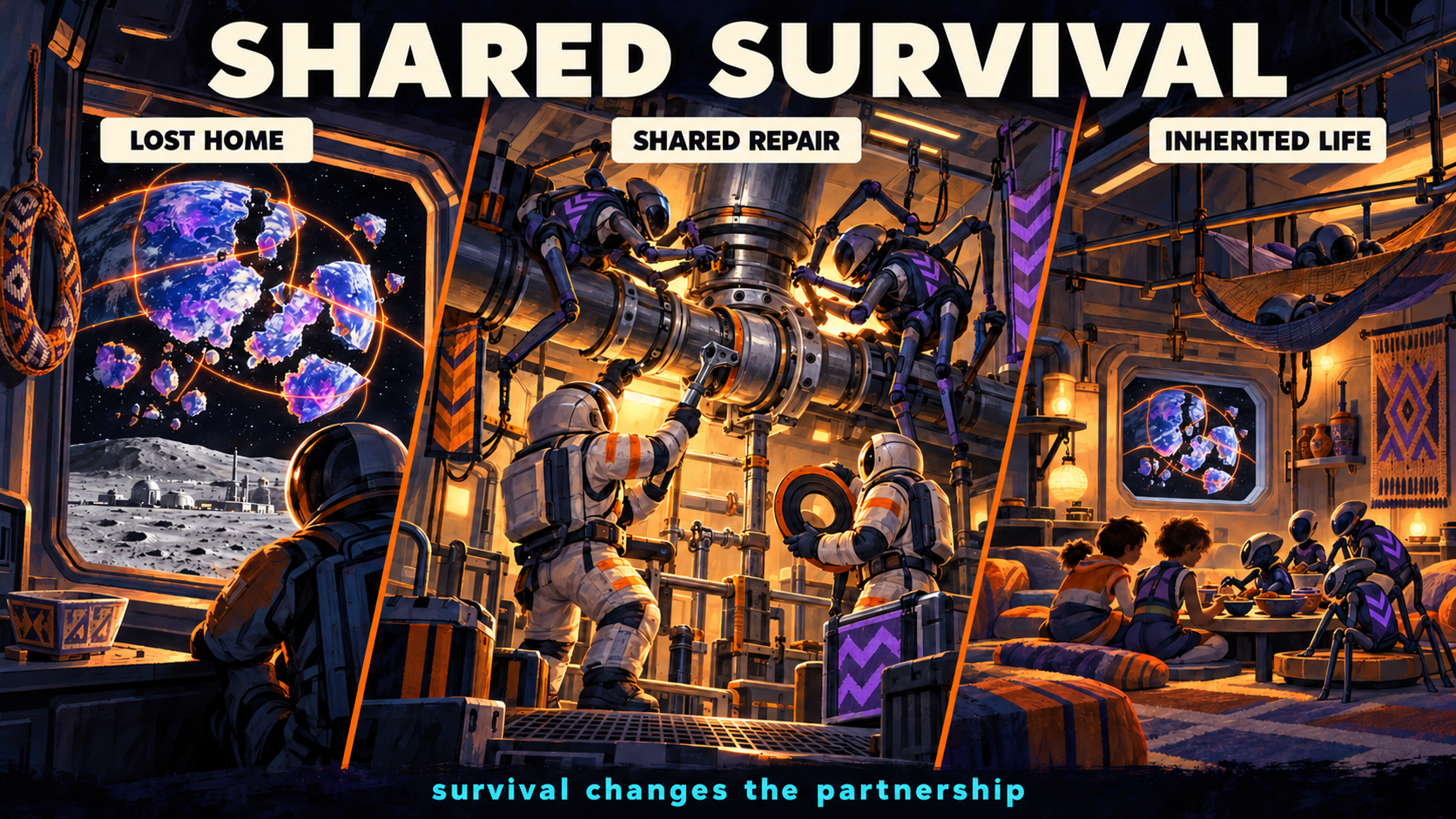
Then the facility, or something connected to that history, could become the site of a dimensional breach. The event that seems like the end of the planetary story would become the opening of a far larger one. Humanity might have crossed a boundary without knowing that someone else depended on its remaining closed.
The timing remains open. There could be enormous intervals between the fracture, expansion across space, the breach, and the later response. Different eras could interpret the same ruins through incompatible histories. A devotional image might preserve a fragment of engineering knowledge. A hated treaty might be the reason a civilization still exists. The audience could discover that the catastrophe it thought it understood was only one event in a longer chain.
I want the broken Earth to carry that weight. It can be a home, a warning, a disputed inheritance, an object of pilgrimage, a source of salvage, a political claim, and an accusation. Its emotional meaning depends on who's looking at it and what their people believe happened there.
Economics and culture shape how a civilization meets its needs
Before I ask what currency a civilization uses, I want to ask what its inhabitants need. What sustains them? What environments can they occupy? How do they reproduce, recover, communicate, and protect what matters to them? Which requirements can be substituted, and which become urgent when a supply fails?
Those questions begin with bodies and environments, but a civilization also inherits ways of interpreting them. People learn what counts as a need, who has a duty to meet it, and what forms of dependence they can accept. A religious community might treat maintaining another settlement’s life support as a sacred obligation. A neighboring institution could treat the same service as a negotiated claim. Their disagreement would concern both material survival and the kind of society each believes it should be.
An economy can exist without familiar money or markets. Allocation can occur through kinship, ritual, coercion, reciprocal obligation, public provision, automated systems, or arrangements we have yet to imagine. The useful question is how scarce possibilities become actual choices. That includes organisms and communities whose behavior would be misleadingly described as human commerce.
Culture helps determine which arrangements people recognize as legitimate. A language might distinguish a gift from a debt through who can ask for repayment. A kinship system could place an obligation on a household that another society assigns to an individual. An institution might preserve a claim in ceremony, written law, living testimony, or a medium suited to a nonhuman intelligence. We would need to understand those distinctions before translating every commitment into one accounting field.
For a subterranean population, safe inhabitable volume could be more important than surface acreage. For a long-lived spacefaring society, a promise may extend beyond the lifespan of everyone currently negotiating with it. A distributed intelligence might care about reliable access to separated habitats. These are exploratory possibilities, not biological claims or finalized species. They give us ways to ask how a different life produces a different account of value.
A shared port becomes much more interesting when its customers require incompatible environments. One community needs a particular atmospheric composition; another requires shielding; another finds the vibration of the freight machinery intolerable. A supposedly neutral design standard can favor the bodies of the people who wrote it. Access becomes an economic and political question expressed through architecture.
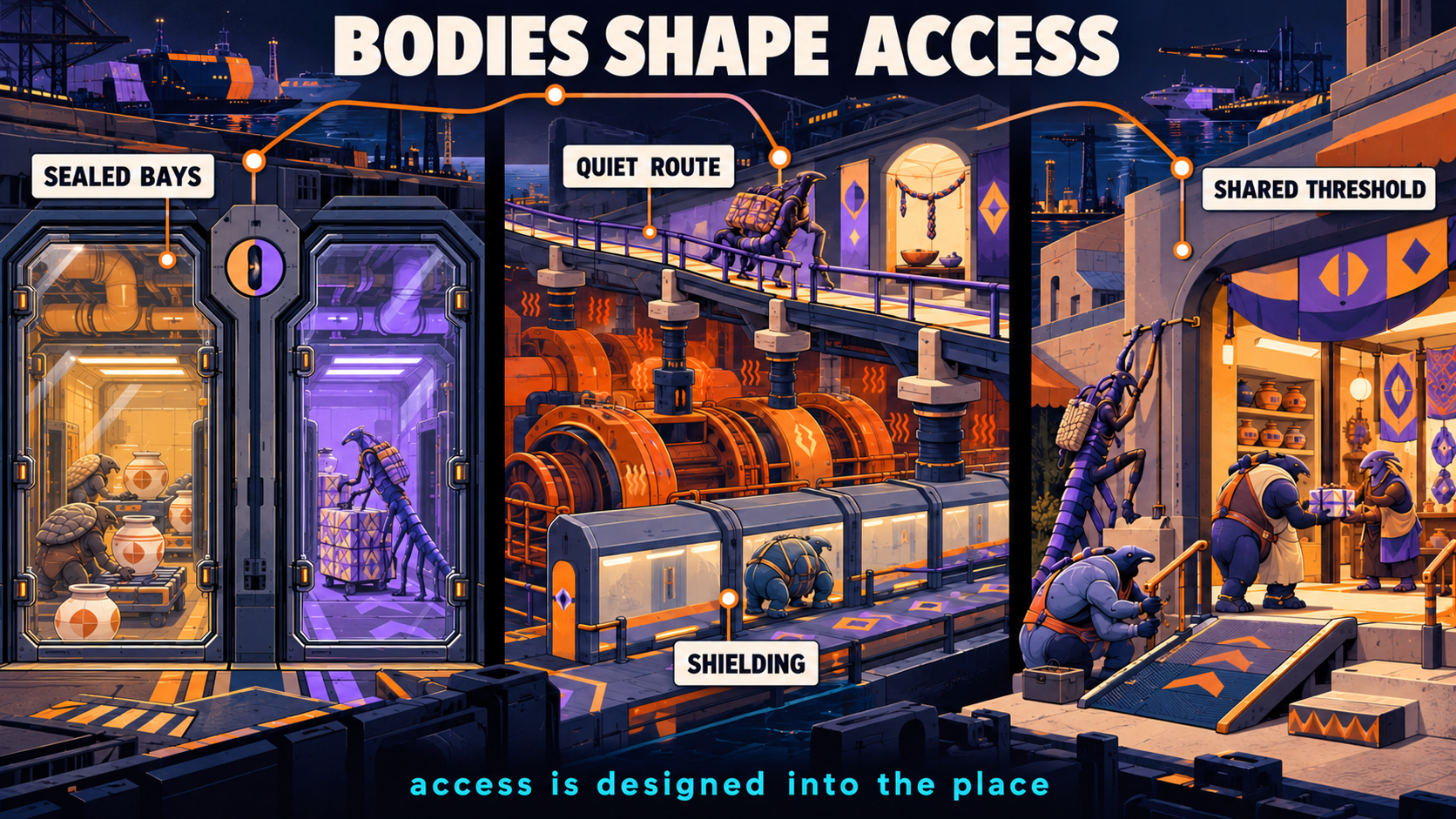
The same port could also contain surfaces one community regards as common passage and another considers sacred. Its maintenance calendar could conflict with a ritual calendar. A shared trade language might make an agreement possible while carrying assumptions about ownership that one party never accepted. Physical accommodation would solve only some of those problems. Institutions, translation, and the memory of earlier agreements would shape who trusts the place enough to use it.
The conflicts needn’t always become wars. A caretaker might quietly alter a shop entrance to accommodate a neighbor. A freight cooperative might discover a cheaper arrangement that makes coexistence possible. A neighborhood festival might depend on ingredients that only arrive because two rival jurisdictions continue honoring a small agreement. That's worldbuilding with room for affection, competence, and everyday ingenuity.
At the other end of the scale, the same relationships can support exploitation. Whoever controls the route may demand labor, information, tribute, or political obedience. An abundance of raw material means little to someone who can't reach it safely or use the infrastructure that makes it useful. A powerful society can describe itself as generous while making every beneficiary dependent on its continued approval.

Post-scarcity therefore needs a scope. A civilization might have abundant food and manufactured goods while still disputing territory, autonomy, status, attention, security, unique artifacts, access to a particular place, or the right to refuse intervention. Two societies may each meet their citizens’ material needs and still have incompatible plans for the same system. Abundance changes the terms of conflict. It doesn’t require universal agreement about what a good life is.
I want to follow those terms through institutions. Who can claim ownership? How is a promise enforced across distance and unequal power? What happens when a debtor lives for ten years and a creditor for ten thousand? Does a collective inherit the obligations of a member that leaves it? If a machine creates an indispensable substance, who controls the machine, its maintenance, and the knowledge required to keep it operating?
Those questions can become plots. A maintenance guild could have more practical influence than a ceremonial ruler. A religious order could protect a transport obligation because abandoning it would strand a population. A military victory could impoverish the victorious state by destroying the skilled community that maintained its infrastructure. A merchant could prevent a war while profiting obscenely from the peace.
Economics also changes what heroism means. Someone may save a town by accepting a dependency their descendants resent. A commander may preserve an army while consuming the reserves a civilian region needs for recovery. An apparently merciful policy may export its costs to a population the protagonists never meet. I want the audience to see enough of those relationships to understand why different people can remember the same decision differently.
Culture gives those memories a durable form. A monument can honor a commander while a family preserves a song about the civilians left without supplies. A school can teach the agreement as liberation while another community marks it as the beginning of dependence. Those accounts can shape later marriages, alliances, rituals, and political claims. The records of what happened and the histories people live by can remain connected without becoming identical.
I don’t yet know what the relevant resources or institutions would look like at universal scale. That uncertainty is part of the attraction. I want the inquiry to reach both material possibility and cultural meaning: what sustains an actor, what it values, whom it recognizes as an obligation, and how its actions change somebody else’s life. Larger numbers alone can't supply that depth. Economics can become strange because bodies and environments are strange. Culture can become strange because perception, ancestry, collective memory, and experience are strange. Their interaction should remain coherent enough to give a particular choice consequences we can understand.
Alien civilizations need histories that don’t revolve around humans
I imagine thousands, perhaps tens of thousands, of species across the wider setting. That's an ambition for range, not a count of completed designs. It only becomes meaningful if some of those beings can carry stories in which humans are peripheral or absent.
I want genuine xeno civilizations alongside human populations that have diverged through long histories and different environments. Those are different sources of strangeness. A seemingly alien community might turn out to be human; another community might be genuinely unrelated and still become easier for a protagonist to understand than their own government. The audience should have room to be wrong in both directions.
A species is also too large a unit to stand in for a character. Shared physiology can create common constraints without giving every individual the same temperament, loyalty, intelligence, or politics. A culture may span species. A species may contain competing cultures. A faction may recruit across both, and its alliances may change as its members’ needs change.
Consider a possible coalition formed to maintain a corridor through a hostile region. Its members might share little beyond their need for passage. The engineers who keep it open, the merchants who finance it, the migrants who depend on it, and the fleets that defend it could disagree about its purpose. A faction built around the corridor can be coherent without becoming a uniform species-state.
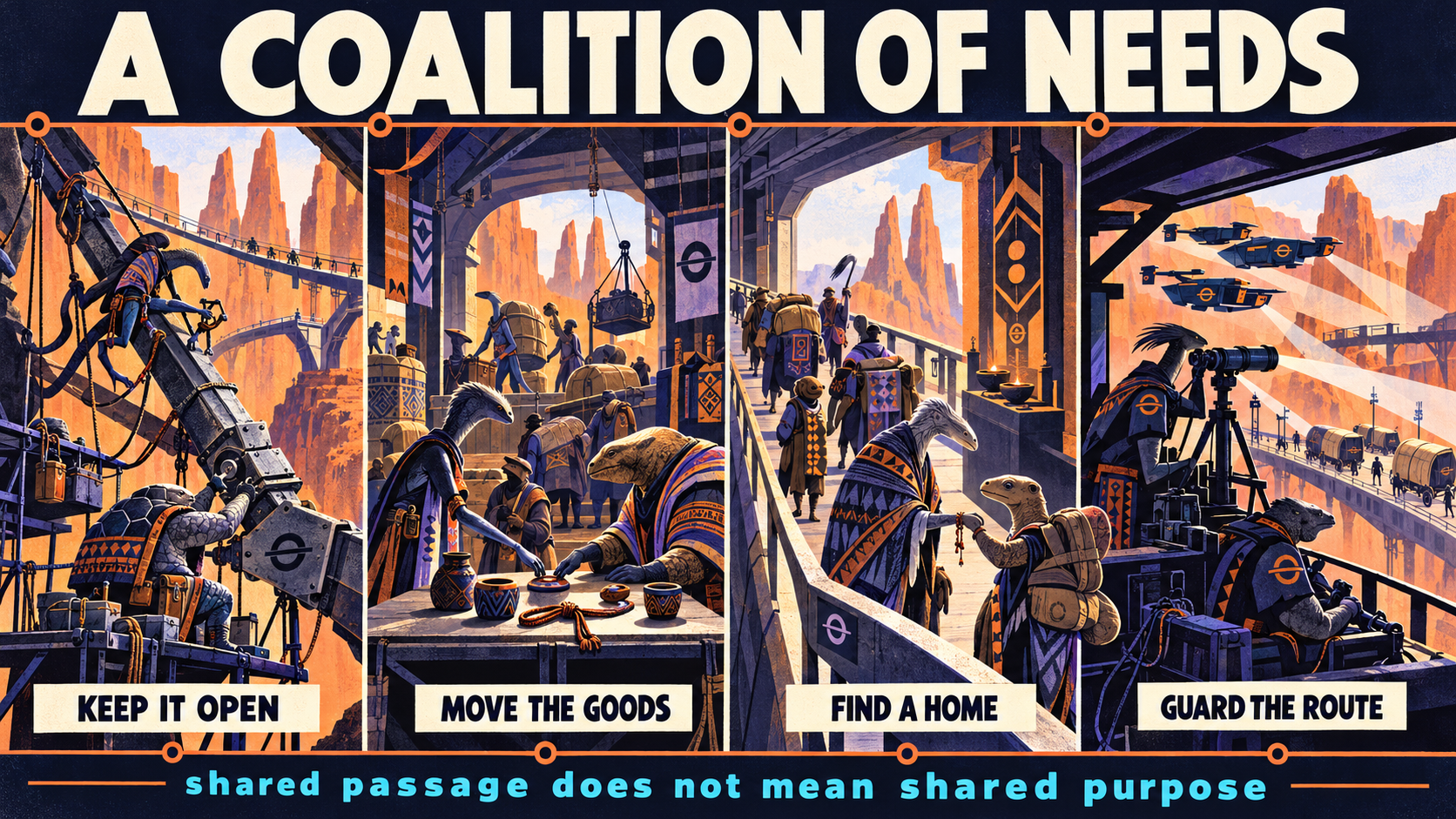
That creates room for several kinds of power. A militarized population may dominate a frontier while depending on a politically weak community for repair. An ancient species may possess techniques that younger civilizations can't reproduce while lacking the numbers or flexibility to govern them. An institution could survive the extinction of its founders. An artificial or inherited system might continue enforcing an agreement whose original parties no longer exist.
I also want human cultures to have more depth than a single imperial aesthetic. My interest spans many religious traditions, ancestries, and cultural backgrounds, then asks what migration, isolation, catastrophe, technology, exchange, and disagreement could make of them over long periods. I’ve described wanting to draw from twenty or thirty major traditions and backgrounds; that's a call for serious breadth of research, not a ranking or a set of boxes that each becomes one faction.
A practice might persist because it remains useful, because it's sacred, because people love it, or because an institution punishes those who abandon it. People from the same background can disagree about all four. Descendants can reinterpret an inherited ceremony after its original conditions have disappeared. A community might preserve a language across the stars while transforming the institutions once expressed through it.
That approach lets faith, family, status, pride, sacrifice, and fear influence choices without reducing a real religion or ancestry to a moral alignment. The seven sins can offer lenses on ambition and self-deception, but they shouldn’t become a species assignment sheet. Pride can animate a heroic refusal and a catastrophic denial. Loyalty can sustain a family and excuse an atrocity. A society’s virtues can become dangerous when their scope narrows.
The extraterrestrial cultures need comparable care. We can ask what a body makes perceptible, what an environment makes expensive, and what a history makes meaningful. We then need room for individuals to disagree within those conditions. A climbing species may have a spatial vocabulary that humans struggle to follow; that tells us little by itself about whether a particular person is generous, authoritarian, playful, devout, or exhausted.
I’d want to develop language, religion, social systems, kinship, and historical memory for nonhuman communities with the same depth of attention. A distributed intelligence could have disagreements about which memories belong to an individual and which belong to the community. A long-lived population could argue over whether an ancestral vow still binds people who remember its making. A climbing society could preserve a pilgrimage through a route humans can't physically follow. These are possibilities to investigate, not species-wide beliefs or settled canon. Each could influence inheritance, exchange, political authority, and the way someone recognizes a home.

Humans remain important because they're one of the ways I want to explore these questions. They don’t receive a guarantee of eventual supremacy. The setting should remain capable of showing us a human triumph from the viewpoint of someone who paid for it, or a human catastrophe that barely changes another civilization’s day. That displacement is part of the scale.
Invented technologies still need consequences the world can enforce
I want the speculative possibilities to grow from serious engagement with science. Isaac Arthur and the community around that kind of long-horizon thinking are valuable research directions for me: ways to ask what energy, time, distance, materials, and engineering constraints allow before reaching for a convenient miracle. A useful idea from an explainer is a beginning for research; the underlying claim and its assumptions still need checking.
The setting needs three distinguishable layers. Established science supplies the starting constraints. Extrapolation explores capabilities that may be consistent with those constraints but remain far beyond demonstrated engineering. Deliberate invention introduces a rule the fictional universe needs. The audience doesn’t need a lecture every time a device appears, but the creators should know which layer they're using.
Black holes are a strong example because I want them to matter as resources, infrastructure, and weapons. Real black holes already give us extraordinary environments. NASA describes the event horizon as a boundary beyond which escape is impossible, and the hot material around an accreting black hole as a source of radiation. The light comes from that surrounding environment; a black hole isn't simply a glowing portal. NASA’s overview of black holes
From that starting point, a fictional civilization might build around access to an extreme environment or an energy-harvesting system. What it can actually build, control, survive, or weaponize would require separate decisions and research. A portable black hole, a stable inter-universe passage, or a mechanism that fractures Earth while preserving recognizable inhabited remnants would demand far stronger assumptions. I won’t disguise those assumptions by putting “quantum” in front of them.
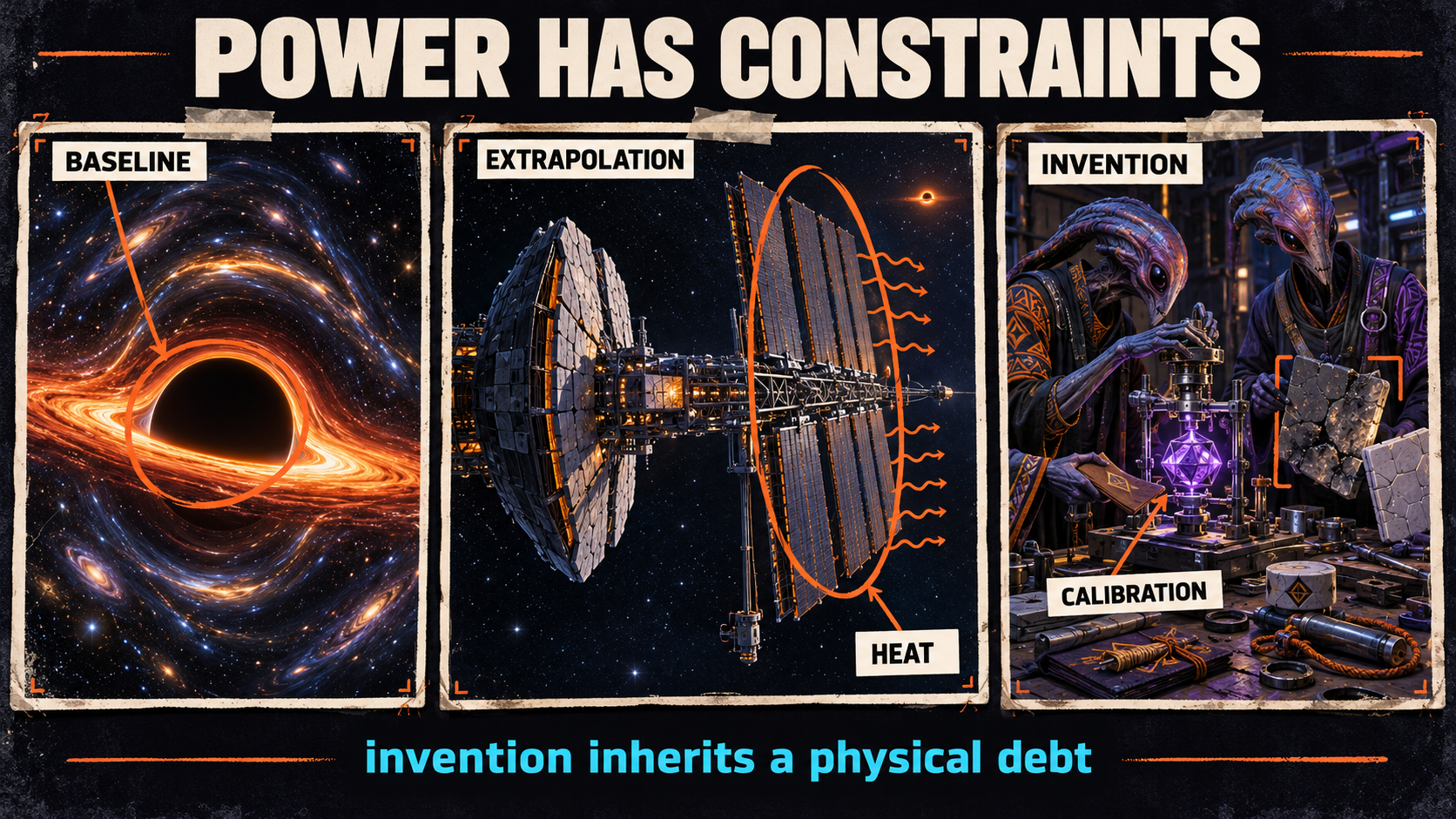
What people call magic in the setting could be technology or physical mastery so advanced that its workings are inaccessible to them. Its effects still need boundaries. Who can use it? What knowledge and equipment are required? What does it consume? What can interrupt it? What accumulates when it's used repeatedly? A capability that's mysterious to a character can remain disciplined in the creator’s record.
That distinction gives ancient technology real dramatic force. Humans might recover a system whose controls they can operate while misunderstanding what those controls affect. They could learn enough to reproduce one output without knowing the wider process that makes it possible. A successful test would then be evidence of a capability, with the rest of its consequences still uncertain.
The temptation becomes intelligible. A besieged population has a machine that may stop the enemy. Waiting for a complete explanation may mean extinction. Using it may create an obligation or release an effect its operators can't perceive. Scientists, commanders, religious authorities, civilians, and neighboring species could reach different conclusions without any of them needing to be foolish.
I don’t want time travel to function as an escape hatch. Dimensional events, different experienced durations, or strange causal relationships would need explicit treatment, and none should allow a character to erase a costly history with a convenient reset. A resurrection, restoration, copy, or alternate world would create new questions about identity and loss rather than automatically canceling them.
A useful rule can generate several kinds of story at once. If an extraordinary operation requires rare calibration knowledge, that supports research, apprenticeship, espionage, coercion, and dependence. If its danger grows with repeated use, a commander must care about more than immediate firepower. If the people who understand it can't survive the environment where it's needed, cooperation becomes a physical necessity.
I want to push science toward its speculative edges while keeping the debt visible. The more extraordinary the capability, the more carefully its consequences need to connect with the rest of the world. That gives the audience something to learn, fear, and reason about.
Saving one galaxy could destroy someone else’s universe
One possibility keeps pulling these ideas together: humanity helps save its galaxy, and the same action destroys another universe. The people who celebrate the victory may truthfully describe what they survived. The people who later arrive to condemn them may truthfully describe what they lost.
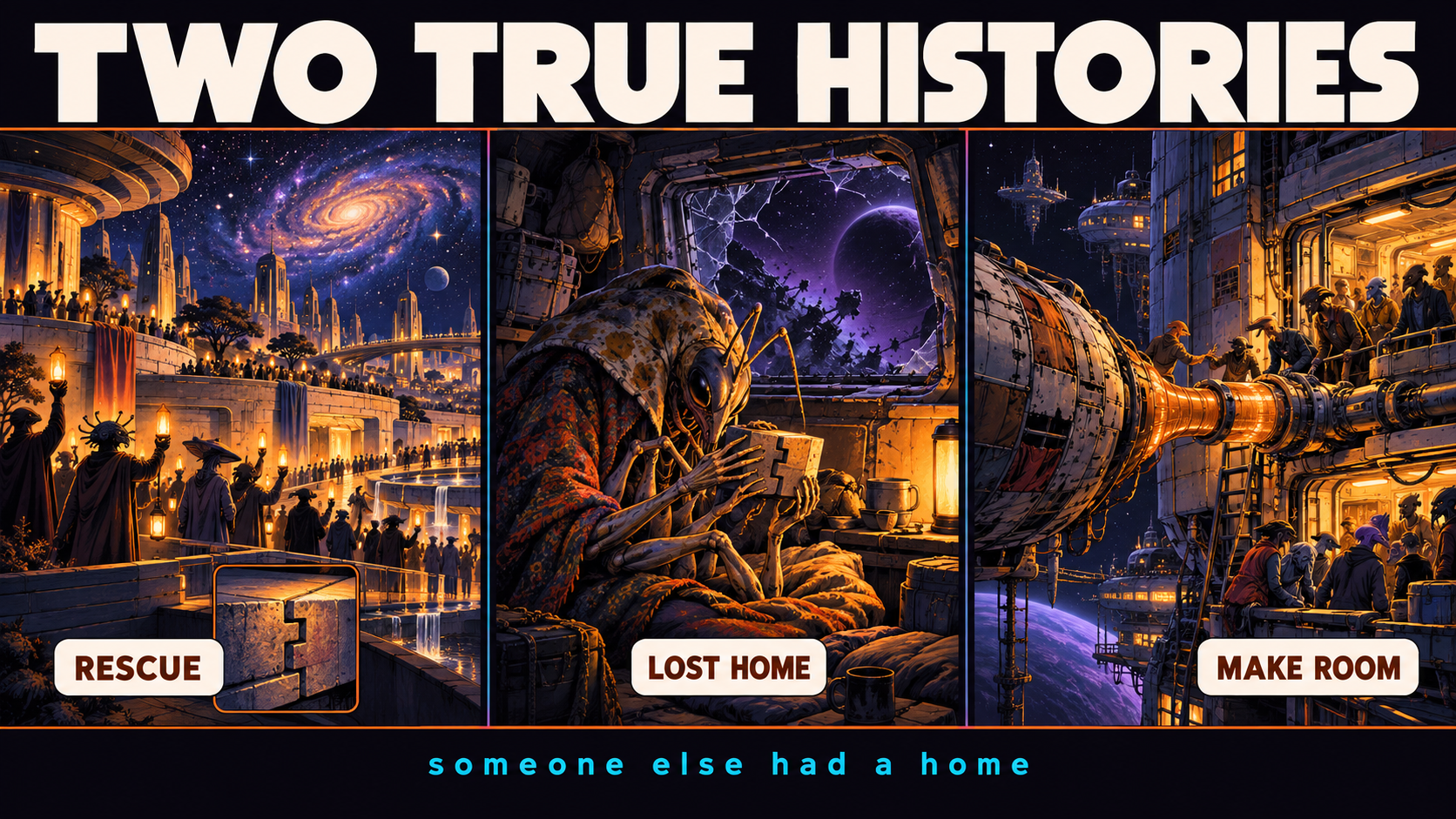
I haven’t fixed that event as canon, chosen its mechanism, or settled when it happens. What interests me is the shape of the consequence. The story refuses to end at the boundary of the protagonists’ knowledge. Their solution reaches someone they didn't account for.
At first, the returning threat might look completely alien. Its bodies, machines, behavior, or relationship to space could make ordinary categories fail. Evidence could gradually suggest that some of these beings are humans from the damaged universe, transformed by a different history and by whatever survival demanded of them. The revelation would change the meaning of earlier encounters without requiring every frightening thing in the setting to secretly be human.
I’d want discovery to happen through evidence and competing accounts. A recognizable structural detail could appear where it shouldn’t. A recovered record could use a familiar concept in a disturbing context. Different witnesses might preserve incompatible pieces of the same event. The reader could begin connecting them before the protagonists can prove what happened.
The survivors shouldn’t become one undifferentiated revenge faction. Some could want justice, some refuge, some restoration, some conquest, and some the destruction of everyone associated with the catastrophe. Others might reject collective punishment while having no safe place left to live. A society can have a legitimate grievance and contain factions willing to commit indefensible acts.
The original galaxy would have its own divisions. People who inherited the benefits of the victory might deny the cost. Others might accept the history while disagreeing about responsibility. Institutions could suppress evidence to preserve legitimacy. Descendants could feel obligations they can't possibly repay. A political movement might exploit the revelation for aims unrelated to the survivors.
The economics becomes severe. Where can displaced populations live? Who recognizes their claims? What happens if their survival systems consume resources that existing societies depend on? Can a damaged environment be restored, and who has the capability to attempt it? A moral revelation becomes a practical crisis when somebody has to make room.
The military story also changes. A fleet may confront an enemy whose methods it must stop while discovering why that enemy exists. A soldier can be right to protect civilians and still belong to a civilization implicated in the larger cause. That's more interesting to me than a late revelation that simply changes which side the audience is supposed to cheer for.
The cosmic layer can complicate responsibility further. Perhaps larger powers anticipated the intervention, benefited from it, or treated both universes as acceptable losses. Humans could have been manipulated without becoming innocent of their own choices. A godlike actor could be constrained by a conflict we have only begun to understand.
I want mysteries at that scale, but “beyond comprehension” can't be a permanent substitute for design. We can give readers partial models that become more useful as they learn. One work might establish what an event did locally; another might reveal its economic purpose; a later one might expose the larger factional struggle. Understanding can grow while the horizon remains far away.
The most important consequence survives every expansion: somebody’s home was real, and it was lost. No diagram of universes should make that less important.
People need something worth protecting when horror reaches them
Berserk matters to my imagination because I’m drawn to a person continuing through horrific suffering without the story making perseverance easy. Warhammer 40,000, Dead Space, and the cosmic horror associated with H. P. Lovecraft point toward other fears I want to explore: overwhelming systems, violated assumptions about life, and the discovery that humanity occupies a far smaller place than it believed. These are influences on intensity and questions, not templates for borrowing their creatures or plots.
I want genuine philosophical horror alongside physical danger. A civilization could discover that its most sacred monument is working infrastructure for something else. A rescue technology could preserve the information it needs while destroying what its users consider a person. An institution might maintain ordinary prosperity through an arrangement that becomes unbearable once its beneficiaries understand it. Each is a possible direction, not an accepted mechanism.
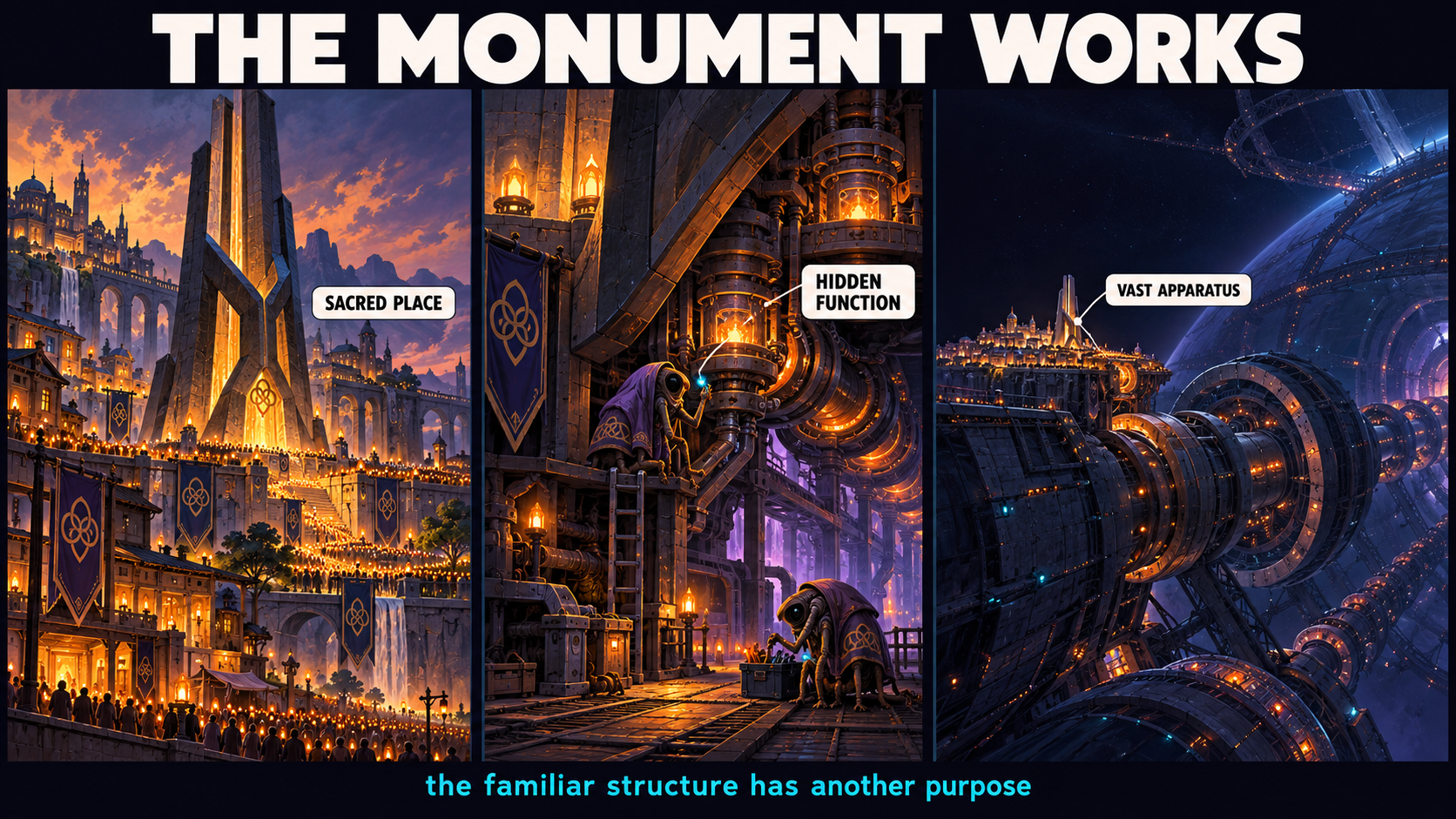
The horror can begin in something mundane. A shipment arrives with quantities that make sense until someone checks where it originated. An old maintenance routine requires a step nobody can explain. A familiar sky changes by an amount that seems negligible until an astronomer recognizes the scale. The world becomes frightening because the details connect.
Megalophobia belongs in that experience. An immense machine should change how a body feels in its presence. A fleet can become small against a structure, a planet small against a process, and a galaxy small against the interests of an older power. The escalation is strongest when each new scale changes the meaning of the old one. A larger object with a larger weapon quickly becomes a counting exercise.
Godlike beings can have factions, resources, dependencies, rivalries, and blind spots. Their indifference may be more frightening than hatred. A universe could be ordinary to them, something they manage or pass through on a timescale that makes human urgency almost invisible. Their attention might be dangerous precisely because they finally notice.
Human endurance doesn't require a guarantee that enough training makes every threat beatable. The growth I associate with Dragon Ball Z can take other forms here: study, discipline, adaptation, collaboration, and the ability to recognize a leverage point that was previously invisible. A person might set off a chain of events that reaches godlike power without personally becoming the most powerful being in existence.
That growth should carry obligations. Knowing more can make a decision harder. Saving one person may require refusing a seductive shortcut. A character may become capable of revenge and choose protection instead. Another may mistake continued survival for moral permission to do anything. Those choices let endurance become a subject rather than a slogan.
Darkness also needs variation. A quiet conversation, a functioning neighborhood, a sincere friendship, humor, food, art, and the relief of finishing a difficult job give the audience reasons to care. A story that destroys every source of meaning can flatten its own horror. I want some things to survive because people worked, sacrificed, or refused to surrender them.

Different works can choose different limits. A mature horror story may go to places a cozy game never depicts. The cozy work can remain sincere and emotionally safe within its promised experience; it doesn't have to punish its audience with an unexpected atrocity to prove that the larger setting is dark. Content expectations and audience trust are part of the creative design.
The universe can contain terrible things without requiring every community to encounter them in the same way. Some people will know the horror directly. Some will inherit distorted accounts. Some will live their entire lives in a place others fought to preserve. Their smaller happiness can be one of the most consequential outcomes the larger story contains.
A city’s history can connect a romance to the war outside it
I don’t want to begin with a list of media formats and fill each slot. I want to ask where an audience is, what experience they come for, and which part of the universe can sustain it. There can be something for many different people without requiring every work to satisfy all of them.
Consider a possible city built around a transfer facility. A strategy game could put the player in charge of defending the approach. An exploration game could let them inhabit the neighborhoods afterward. A romance could follow two people whose communities depend on opposite sides of a new agreement. A mystery could investigate why the official history of the siege omits a particular shipment. A horror story could reveal what that shipment contained.
The works wouldn't need to recount the same plot. They would share facts that become meaningful in different ways: which district survived, which route remained open, who gained authority, what the public believes, and what only a few people know. The audience could enter through any one of them and receive a complete experience.
A cozy game might focus on restoring a garden, running a small workshop, maintaining a habitat, or helping neighbors meet each other’s needs. Those activities are already economic and social. Different bodies and customs can produce gentle problems of accommodation and cooperation. The deeper lore can enrich the setting without becoming mandatory homework or a threat to the game’s tonal promise.
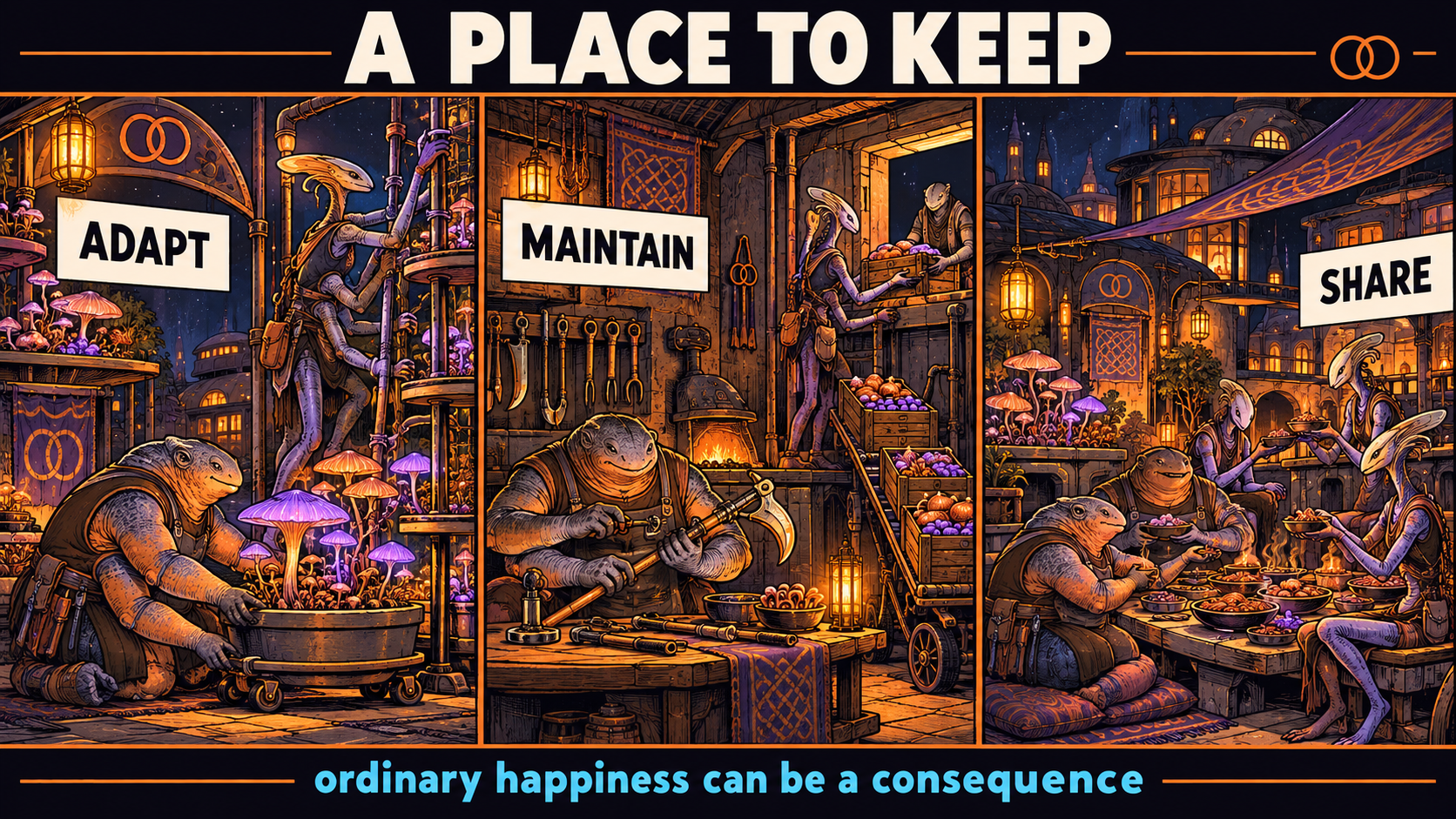
An RTS can explore the opposite scale of decision. Production, logistics, reconnaissance, terrain, and enormous machines can make the player feel the reach of a command structure. The interesting connection comes when the buildings on that map are places other works have taught us to recognize. A route closure then carries more meaning than a temporary reduction in income.
A shooter could follow the people tasked with carrying out one narrow part of that campaign. An MMO-scale aspiration could let people inhabit its aftermath, form relationships, and encounter institutions whose histories extend beyond their current quest. Those forms require different budgets, mechanics, and operating commitments. Their suitability has to be earned through complete smaller works; their presence in the vision isn't a promise that all are in production.
Books and webcomics can reach perspectives that a game’s mechanics may not support. They can spend time inside a person’s uncertainty, follow a family across generations, or let a nonhuman narrator reveal assumptions a human character never noticed. Animation can make scale, movement, or an unfamiliar environment immediately legible. A short film can choose one decisive moment and let the rest remain implied.
The audience connections can be optional and rewarding. A symbol seen in a workshop might later appear on a military artifact. A song could preserve a misunderstood technical instruction. A minor character in one work might be remembered as a founder in another era. Recognition should add meaning; it shouldn’t be the only reason a scene works.
The franchise will also contain communities with conflicting tastes. Some will love the political depth and dislike the horror. Others will care about tactical mastery and barely follow the mythology. Some will become experts in one era that another group rarely encounters. A setting this broad needs clear entry points, tone signals, and respect for those differences.
Cross-media coherence therefore means preserving shared consequences while allowing each work its own form, pace, and emotional contract. The world is the connection. The audience’s immediate experience is the obligation.
Later stories should inherit what earlier stories changed
The city, the fracture, and the possible inter-universe catastrophe establish the creative horizon. To make that horizon durable, each local story needs consequences it can rely on. A family’s journey and a fleet’s movement can share a transport constraint while experiencing it very differently. The following port example is a deliberately small way to test that connection; it isn't the boundary of the universe or a settled first product.
A universe-first approach appeals to me because I want the setting to keep doing work after the first story ends. I want another writer, a game designer, or a future version of me to find possibilities in its structure. A place should have more history than whichever character happens to be looking at it.
Tolkien and Christopher Ruocchio’s Sun Eater are two of my closest creative influences. I’m drawn to the feeling of entering a world whose language, institutions, old conflicts, and competing accounts extend beyond the immediate plot.
Worldbuilding can support a story by making some choices costly. A travel rule determines who can escape, who can trade, and how far an authority can enforce a decision. A communication rule determines how quickly news spreads and which people can act before anyone else knows what happened. A resource constraint determines who depends on whom. Those consequences can remain in place across very different stories.
Consider a declared fictional rule that moving certain materials between star systems requires access to a limited transportation network. I’m inventing this rule for the example. We haven’t accepted it for Depths. The rule would make transportation access politically important even if there were enormous quantities of material elsewhere. A mining settlement could be materially rich and still dependent on whoever controls its departure route.
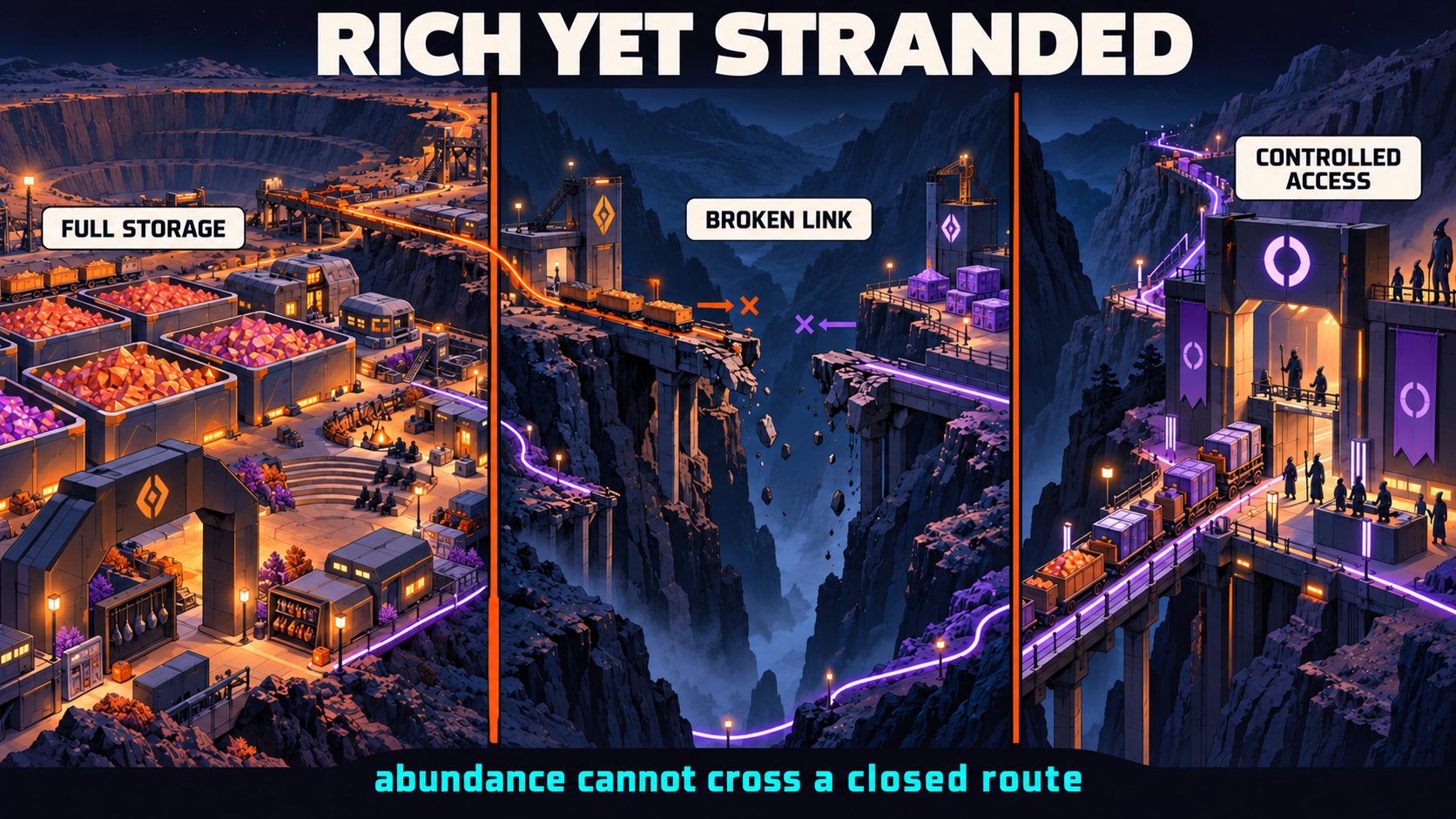
A short story could follow a worker waiting for transport. A strategy game could let a player decide where to build an alternate connection. A political narrative could follow an institution deciding which shipments receive priority. Each work would select a different perspective, but the shared constraint would give those perspectives something in common. A later author wouldn’t need to introduce an entirely new cosmic power every time the existing plot became inconvenient.
That’s the kind of foundation I want. It requires deciding what the rule permits, where it applies, and what would count as an exception. A rule that says transportation is expensive needs more explanation if every character can travel freely whenever a scene needs it. An exception might be worthwhile, but it changes the setting. We should know whether it’s a rare capability with its own costs, a discovery that alters history, or a mistake in the earlier work.
The same approach also tells me where to stop preparing. I don’t need to enumerate every shipment in the universe to explore transportation dependence. I need enough detail for the decisions the first work asks its characters or players to make. The model can leave unrelated places unresolved without pretending they’re empty or already fully designed.
There’s a useful difference between an unknown detail and a contradictory detail. An unknown detail is an invitation to create. A contradiction can undermine something the audience already used to understand the work. The record should distinguish them. Otherwise a creator may treat a missing fact as an instruction to guess, then accidentally override an established consequence.
Universe first also leaves room for stories to correct the universe. A setting document can describe a believable institution in broad terms while giving us no workable reason for an individual to remain in it. A small story makes that weakness harder to avoid. Someone has to want something, make a decision, and live with what follows. We may discover that an institution needs a different incentive, that a resource is too easily substituted, or that a supposedly restrictive travel rule creates no meaningful choice.
A simulation can reveal a different class of weakness. The written rule might sound plausible while the implemented rule makes every settlement converge on the same strategy. Perhaps one transportation option dominates all others under the assumed costs. We can then change the rule deliberately, or accept that consequence and explore it. Calling the world complex doesn’t make its behavior varied.
I’m also interested in dark themes, and the rules matter there. Power becomes more convincing when it has a mechanism. An empire’s reach could depend on supply, communication, local cooperation, and institutions capable of continuing its work. Losing control of a settlement could mean losing the capacity to repair a route or enforce a promise, rather than simply changing a color on a map. People living there would have reasons to care that differ from an emperor’s.
That doesn’t mean converting suffering into a numerical score and letting the model decide which stories are important. Fiction still needs choices about perspective, dignity, responsibility, and what the work asks the audience to experience. A simulation can tell me that a settlement has lost access to a resource under its rules. It can’t tell me which person’s experience deserves a story or how that story should be told.
The first implementation can therefore use a bounded foundation: some declared rules, places shaped by those rules, and enough history to make their current circumstances understandable. We can tell small, complete stories while that foundation develops. Each story then gives the next creator more than a name and a visual reference. It gives them consequences they can work with.
LLVM shows how different tools can share one representation
A creator working on the city’s romance and a designer working on its siege need some of the same underlying facts. They also need very different kinds of freedom. The architectural question begins there: can we preserve the city’s history, bodies, resources, and obligations while allowing each work to make its own artistic choices? LLVM gives me a useful analogy for the shared foundation, with important limits.
LLVM interests me because it supports an ecosystem of work that no single tool could contain. Its projects share infrastructure while solving different problems. A language frontend, an optimization pass, and a target backend require different expertise, yet their work can connect through a representation designed for those connections.
The LLVM project describes its infrastructure as reusable compiler and toolchain components. Its intermediate representation has defined instructions, types, and semantics. A frontend translates supported source-language behavior into that representation. Other components can analyze or transform it, and a backend can produce code for a supported target. The shared representation makes specialization practical because each contributor doesn’t have to recreate every other contributor’s job.
We keep encountering information in different forms, then needing to use it in different systems. Research notes, customer conversations, structured records, creative briefs, and observations have different shapes. Their downstream uses also differ: a decision aid, a content pipeline, an application interface, or a simulation. Directly connecting every input to every output encourages repeated translation work and inconsistent assumptions.
A common intermediate model can reduce that repetition. We could represent a claim with its source, status, relevant time, and relationships. A system producing a review document could read the same accepted claim that another system uses to prepare a queryable interface. Both outputs would retain a connection to the evidence and the decision that made the claim usable.
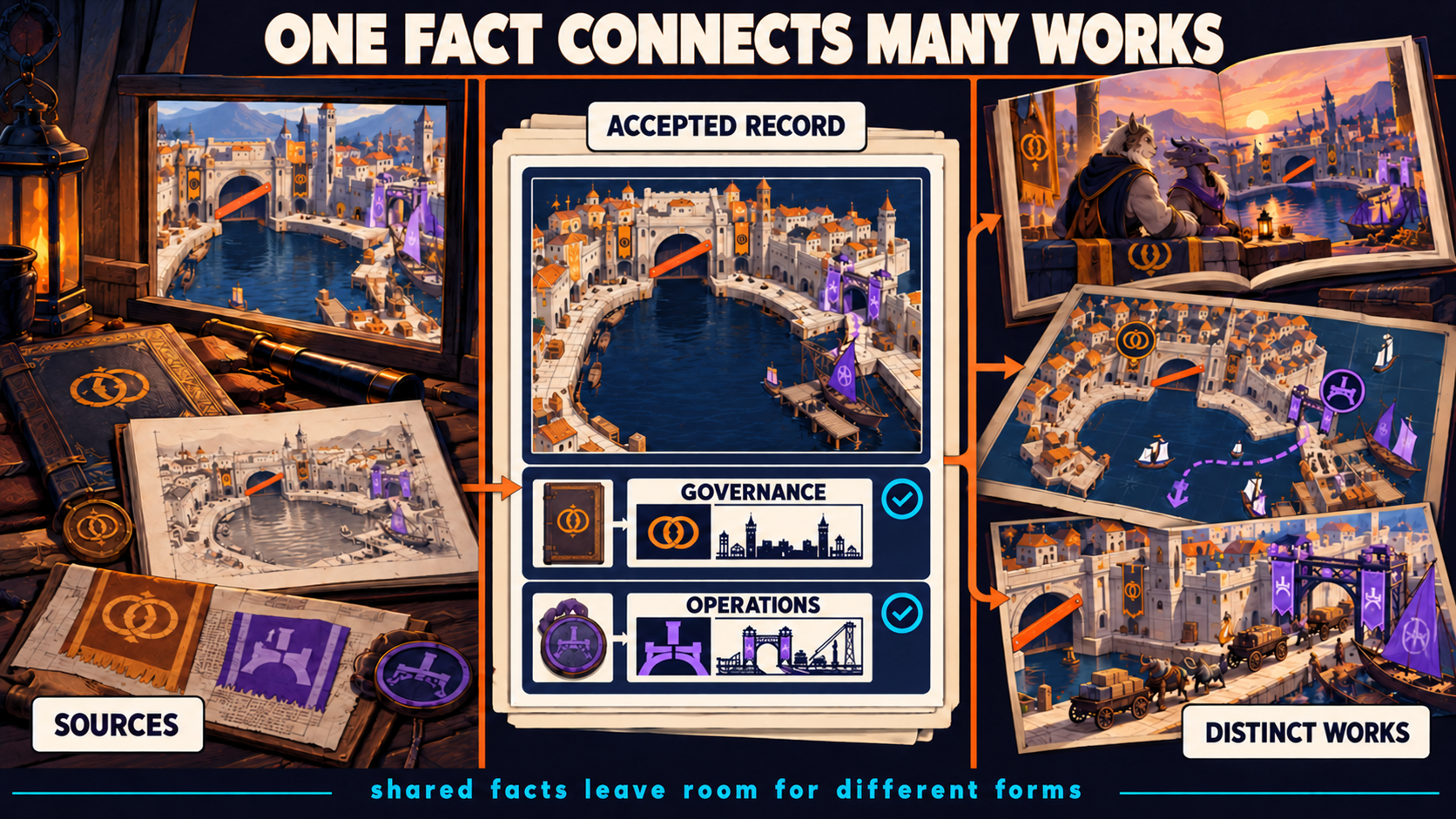
That model would need more than a common file format. A field called “owner” could mean a copyright holder, a project manager, a state that controls territory, or a process responsible for updating a record. Giving each record an owner field doesn’t make those meanings interchangeable. The representation has to preserve the distinctions its consumers rely on, and its adapters have to know which meaning they’re handling.
LLVM has a formal setting for some of those obligations. Source languages and targets still have important differences, but the intermediate representation supplies explicit semantics for the operations it contains. A business model starts with observations that may be incomplete or wrong. A fictional universe starts with rules that an author can change. The shared-representation analogy therefore tells us where to put work; it doesn’t transfer compiler correctness to a claim about customers or civilizations.
This changes what I mean by “simulation compiler.” I’m imagining a system that can help turn a modeled domain into usable operational or creative systems. It would carry sources into typed representations, use those representations in bounded processes, and bring observed outcomes back into the model. Some transformations might eventually be mechanical and tightly checked. Others would remain interpretive, uncertain, or subject to human acceptance.
A settlement record makes the distinction concrete. We might mechanically check that its resource consumption respects a declared accounting rule. We could check that its materialized port belongs to the polity named in the selected snapshot. We couldn’t mechanically establish that the resulting place is emotionally compelling, or that its institutions capture every plausible response to scarcity. Those are different standards of success.
The commercial assets within Looikos give this direction practical entry points. WikiDesignCo concerns making knowledge usable across work. Scatter Model belongs to the broader software and modeling direction. FreelanceBuddy gives the commercial operation a specific place to apply systems around finding and doing client work. Their relevance lies in the possibility of shared capabilities: source handling, explicit requirements, durable records, evaluation, and feedback. I don’t need each brand to solve every domain before a useful part can exist.
A reusable component also needs someone responsible for its contract. A source parser can change how it interprets dates. A model can change which uncertainty states it allows. A downstream consumer may depend on the old behavior. An ecosystem that encourages specialization has to support compatibility, versioning, tests, and disagreement between contributors. Reuse replaces some duplicated work with coordination work.
That trade is worth making when the component serves real repeated needs. It’s less attractive when we invent a universal interface before we understand any of its consumers. We could spend a great deal of time designing a perfect settlement schema and discover that our first story only needs a handful of facts, while our first game needs a constraint the schema never represented.
I’d rather develop the shared foundation through concrete jobs. A model should survive a real transformation: a recorded rule becomes a state update; the state becomes a local scene; the scene becomes something someone can inspect. A defect in that transformation tells us which interface is missing or too ambiguous. We can improve it with a specific consumer in mind.
That’s why LLVM serves as an architectural inspiration rather than a product specification. I want specialized work to accumulate without every new project starting from zero. Depths provides a demanding domain for trying that approach, including the kinds of ambiguity a software compiler ordinarily doesn’t have to resolve on behalf of an author.
A world model has to preserve the agreement that keeps a settlement alive
The consequence I want to preserve is specific. Someone signs an agreement to keep a population alive, and that agreement changes who can enter a facility, what goods arrive, and which authorities people must obey. The story can follow a resident who never sees the agreement. The model still needs to preserve what the agreement changed. Otherwise the scene may look plausible while telling the wrong history.
The agreement’s cultural meaning also needs a place in that history. Was it recognized through a court, a kinship obligation, a religious institution, or several authorities whose accounts differ? Does the community remember the concession as mutual aid or as humiliation? Those interpretations can shape which later proposals people will accept. We can preserve the accepted event alongside its institutional context and the competing accounts people hold, then choose which of those relationships a particular story or simulation needs.
We’ll use a port settlement as the running example. Everything specific about it is illustrative. It has a local material deposit, a processing facility, a transportation connection to another settlement, and residents who rely on imported supplies. A neighboring polity controls an alternate route. That’s enough structure to ask what happens if the port stops working.
For this bounded calculation, we don’t need a name for its emperor or a complete cosmology yet. We need to know which materials the port handles, what the residents depend on, who can repair it, and which alternatives exist. The model’s first job is to preserve those relationships so that an update has consequences we can inspect.
A world model contains several kinds of information that deserve different treatment. A rule states how something works within the model. State describes its current condition. A relationship connects it to something else. An observation reports what someone encountered. An interpretation says what we think that observation means. Treating all five as interchangeable text makes the system easy to populate and difficult to trust.
Our example could declare that processing consumes a local material and produces an export. The current state could say the facility is operational. A relationship could say the port connects to a particular destination. An observation could report that a shipment failed to arrive. An interpretation could propose that the destination is withholding access. The failed shipment doesn’t establish that interpretation by itself. Damage, scheduling, missing cargo, or another cause could produce the same observation.
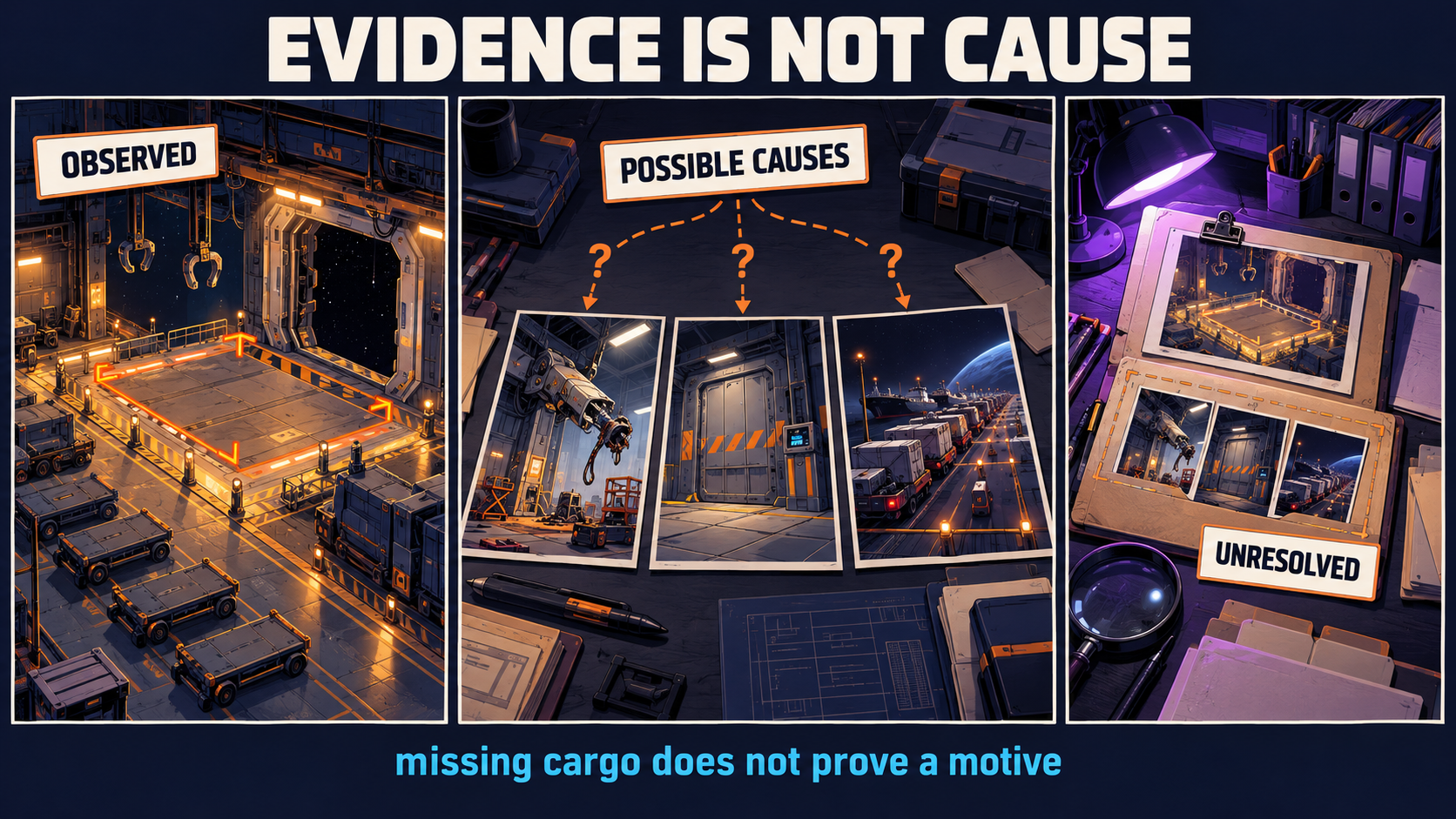
A fictional model lets us decide which of those causes exists. A commercial model has to investigate. That difference remains even if we store both domains in similar typed records. An author’s accepted decision can establish fictional truth; an analyst’s accepted interpretation can still be wrong about the world outside the system.
The Looikos metagraph direction is useful here because it gives claims and relationships their own records. A relationship can carry a source, confidence, and time context. A document can provide the fuller explanation while a thinner record gives systems an addressable reference. The current design notes also show architectural revision: an earlier graph-store direction developed into a Convex-native claims-layer proposal with a later integration seam. I want that evolution visible in the work. A previous document shouldn’t remain current merely because it sounds more complete.
The port’s control relationship needs time for the same reason. “Polity A controls the port” can be true before an event and false afterward. A history view may need both statements. A current-state view needs the one valid at its chosen point in time. A story told by an unreliable official may claim that control never changed. Those accounts can coexist if the system records what each statement represents.
Missing information also needs to remain missing. If we haven’t decided whether an alternate route can carry the settlement’s imports, a simulation shouldn’t silently assume that it can. We could run two declared scenarios, one with sufficient capacity and one without it. Their different consequences tell us whether capacity is a load-bearing assumption worth resolving. Filling the field with a convenient default would conceal that discovery.
The decision determines the resolution we need. A model asking whether the settlement can survive a port closure may need aggregate supply, consumption, substitute routes, and repair capacity. A game about maneuvering vehicles through the port would need local geometry and individual movement. A short story might need to know who gets priority access and why. The records can connect, but they don’t need identical detail.
More detail can make a model worse when it adds unsupported certainty. Giving every resident an exact daily consumption value looks sophisticated. It may contribute nothing if all the important outcomes depend on one fictional transportation rule we haven’t tested. The useful detail is the detail that changes a decision or reveals a consequence.
The model also needs an outcome that can challenge it. Suppose our rules predict that an alternate route keeps the settlement supplied after the port fails. We materialize the place and discover that the route can't physically reach the facility under our declared movement constraints. The economic prediction and the local place disagree. We can revise the transport assumption, revise the geometry, or accept a different consequence. Recording the disagreement tells us where the model failed.
A commercial counterpart is a proposed customer action based on a source record. We might believe a particular requirement is satisfied, then find that the delivered result can’t be used. The correction belongs in the requirement or the transformation that interpreted it. Saving the complaint as another document doesn’t ensure the next job handles that requirement differently.
I’m interested in a world model that supports that entire sequence. A source or accepted rule establishes an input. A representation preserves the relevant meaning. A process makes a bounded decision. An outcome reveals whether the process and representation served the job. The system then has somewhere specific to apply the correction. Our port settlement will let us test that sequence without pretending we’ve already modeled the universe around it.
A vast universe can preserve history without simulating every resident
The audience should feel a universe with depth beyond the current camera. That doesn't require every unseen resident to run continuously as an expensive simulation. It requires the consequential things to remain true when we encounter them again: a lost home stays lost, a treaty has effects, and an approaching fleet can change a market before anyone sees it. Computation should serve those promises.
My No Man’s Sky conversation became difficult to follow when a response stacked galaxies, regions, systems, planets, stations, and enormous totals together. One answer later corrected a total that didn’t match its own multiplication. The useful lesson for this article is to ask what each number counts before treating it as evidence of scale.
A galaxy can contain regions. A region can contain star systems. A system can contain planets and other places a player might visit. Those are nested ways of addressing space. They don’t tell us how many places have been generated, how many have durable changes, or how many are being simulated at this moment. A region used to organize addresses also needn’t correspond to a political territory. An empire could cross several regions, while one region could contain competing authorities.
A large address space is relatively easy to describe. An illustrative 64-bit identifier has about eighteen quintillion possible values. That arithmetic says something about identifiers, not the number of worthwhile places a project has built. The generator may reject some values. Different values may produce outcomes that feel similar. A player may reach only a small part of the space. None of those possibilities tells us how much changing history the system can maintain.
No Man’s Sky provides a primary-source example of continuous procedural world construction. Its programmer Innes McKendrick’s GDC session describes a real-time pipeline from voxel generation to terrain processing, population, and simulation. That supports the idea that a vast explorable environment doesn’t require exhaustively authoring and storing every local scene in advance. It doesn’t establish that every distant inhabitant continuously has a full simulated life.
For Depths, I’d separate addressable places, persistent consequential state, active computation, and currently presented detail. We could have a huge space of possible places while maintaining macro state for a much smaller set of meaningful political and economic relationships. We could present a detailed local settlement while only a bounded area runs expensive movement and behavior. Each count answers a different question.
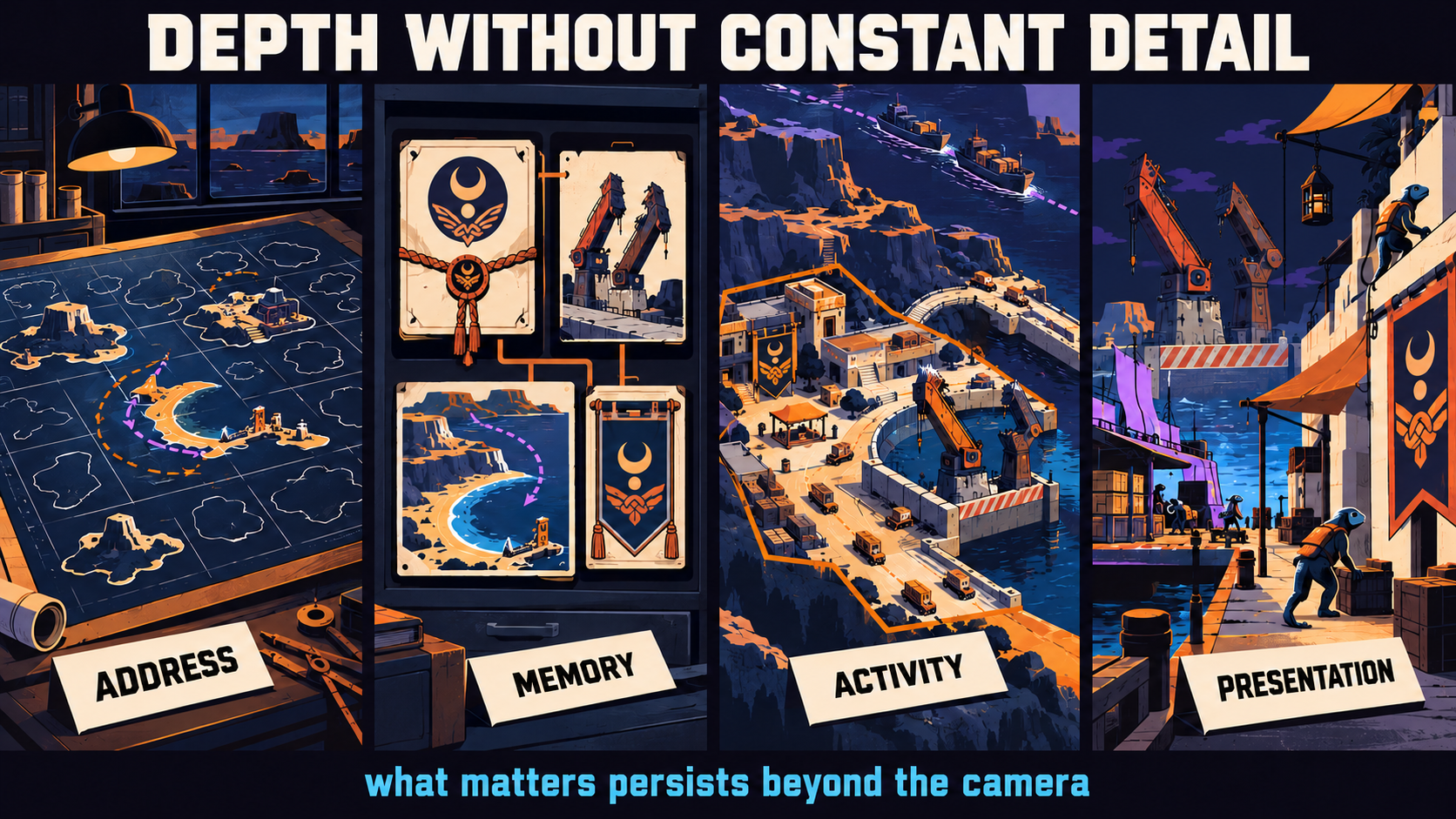
Our port settlement needs a baseline and changes. A baseline might derive its location, environmental conditions, and starting layout from stable inputs. Its changing state would include the port closure, ownership, repairs, and important consequences. Regenerating the baseline can save storage, but it can’t replace the record of those changes. The settlement shouldn’t recover its destroyed port merely because a visitor leaves and returns.
A seed also needs a versioned interpretation. The same seed passed to a changed generator may produce a different layout. A schema change can alter which parameters exist. A new accepted asset can change what the materializer selects. Repeatable generation therefore needs a contract that includes identity, inputs, generator version, and the state being interpreted. A seed is one part of that contract.
I’m setting aside asset generation and movement alignment for this thought experiment. Assume we can produce compatible visual assets and motion from the selected parameters. That lets us focus on what the world must remember and how detail becomes active. It’s an assumption for reasoning, not a claim that the real production pipeline is solved.
The detail budget should follow obligations. A named character who carries an important object may need durable identity and a recorded location. A background resident walking past a warehouse may only need a plausible role and routine for that local visit. A visible crowd doesn’t automatically require a permanent record for every body. Conversely, a character becoming narratively important can create a new persistence obligation.
Distance can help allocate rendering and local behavior, but consequence also matters. A faraway fleet approaching the port could alter supply before the player sees it. A distant decorative pedestrian may have no comparable effect. “Nobody is looking” is therefore an insufficient reason to stop every update. We need to know whether the inactive thing can affect something we’ve promised to keep current.
Factorio demonstrates selective activity in its inserters. Its developers describe inserters sleeping when their transport lines don’t change and waking when an arriving item makes work possible. They also discuss deterministic handling of wake requests. The object retains meaningful state while avoiding repeated work that can't change its result. The transfer to Depths is a design principle we’d have to implement around our own causal relationships.
A macro model might update supplies and political decisions on a coarser logical clock than local movement. A local visit might expand a snapshot into buildings, traffic, and background routines. The transition has to preserve agreed facts: control of the port, whether it functions, which routes are available, and whether an important visitor is present. A prettier representation that violates those facts breaks the model at the point the audience can inspect it.
We can ask how many records persist, how many relationships update, how much local work a visit activates, and how those costs change when players gather in one place. We can measure those questions in a small implementation. An enormous theoretical map supplies no answer to them, and buying more compute won’t fix a missing causal contract.
Components let a being’s capabilities change without changing its species
A multi-species universe creates a practical demand for this flexibility. A visitor’s body, learned skill, equipment, institutional role, and political allegiance can each affect what they can do. A wounded veteran and a newly arrived merchant may share a species while having very different access needs. A design that forces all of those differences into one rigid family tree will make the world less expressive.
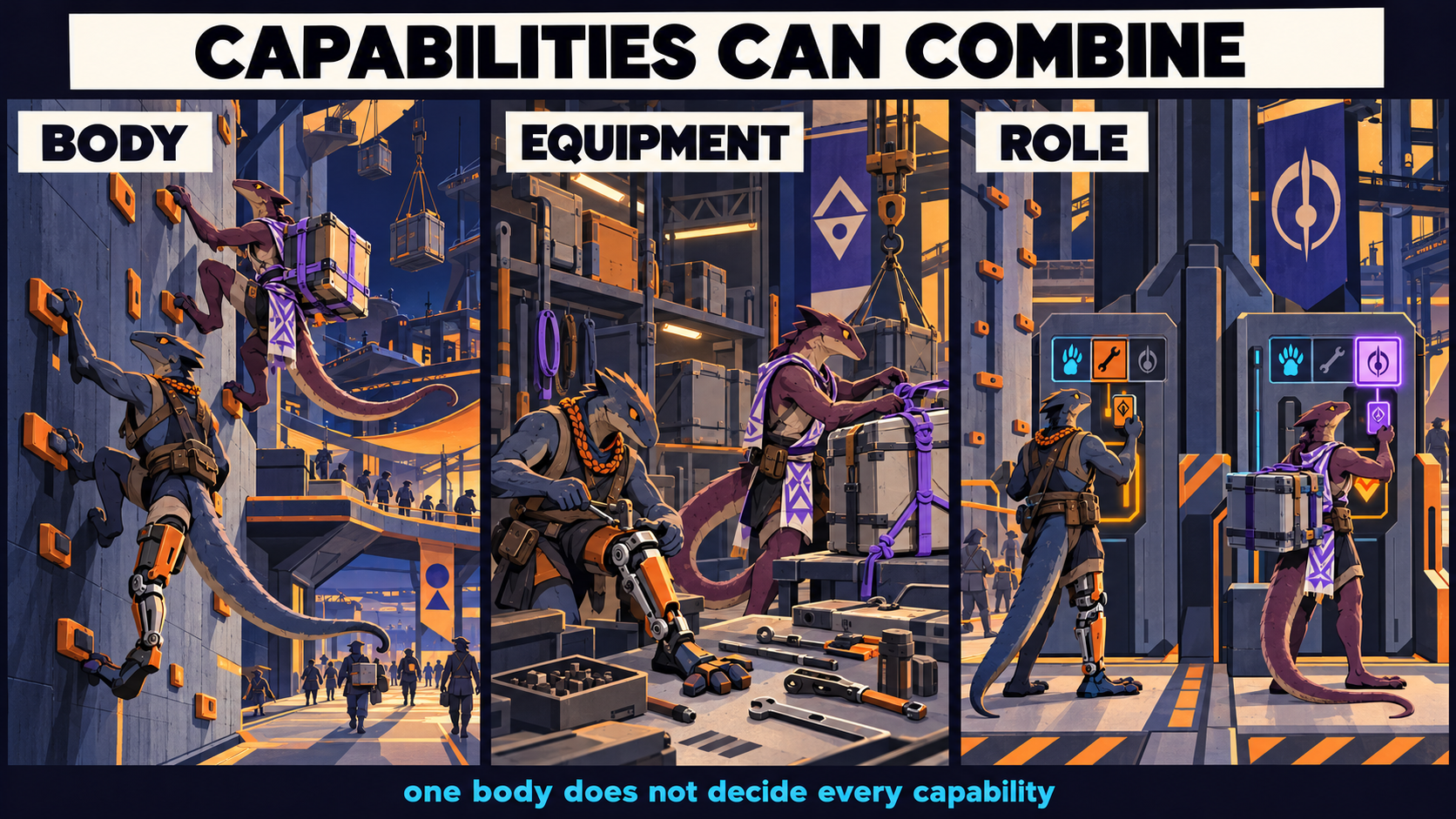
Entity-Component-System architecture keeps giving me a useful way to think about combinations. An entity provides identity. Components provide data associated with it. Systems process entities that have the data relevant to a job. We can vary capabilities without requiring a new subclass for every possible combination.
Our settlement’s entities could include residents, vehicles, facilities, and routes. A movement system might need a position, a mobility capability, and a current destination. A supply system might need an inventory, a consumption rule, and a delivery connection. A polity update might need controlled locations, resource access, and relationships. Those systems ask different questions about the same world.
A warehouse can have inventory and a delivery connection without having mobility. A vehicle can move without consuming the same supplies as a resident. A resident might carry cargo while also having a role in a local routine. The component model gives those capabilities separate expression. We don’t have to decide whether the resident belongs under a “worker,” “traveler,” or “cargo carrier” class before the relevant system can find it.
Required and optional data make this more precise. A route-planning process may require a destination and mobility constraints. It might accept a preferred route as optional guidance. Missing guidance can have a defined fallback. Missing mobility constraints can't quietly mean “move however seems convenient” if the resulting route will determine what buildings the being can enter.
The choice belongs to the consumer. Two consumers can judge the same entity differently. A display system can show a warehouse while a supply calculation waits for a validated capacity record. Rendering the warehouse doesn’t establish that the economic model can use it. We should preserve those independent states instead of assigning a single “complete” label to everything attached to the entity.
That pattern already appears in a concrete piece of my data work. The inspected GPS ContentFactory source separates chunk text, embeddings, and NLP enrichment into linked Pydantic records. A function displaying text can use the chunk. A vector-dependent consumer also needs an embedding compatible with its task. The chunk’s usefulness for display can survive missing enrichment. This is source-level composition we can inspect; it doesn’t demonstrate a deployed game-engine ECS or an in-production scheduling system.
The distinction helps me choose machinery. ECS thinking can improve ordinary records and processing functions. A full runtime adds storage, querying, change management, and scheduling mechanisms that may be useful when many entities repeatedly participate in those operations. We need a workload that justifies the extra machinery. Declaring every application ECS-native won’t make its expensive external API calls or ambiguous requirements cheaper.
Data-oriented design asks a related question about the actual data and transformations. Richard Fabian’s explanation starts from the data being processed and the machine doing that processing. That encourages us to investigate repeated access patterns, representation, and cost. ECS can organize those patterns, but it doesn’t guarantee good choices about them.
Bevy makes the tradeoffs concrete. Its archetype documentation groups entities with the same component set. Its storage documentation distinguishes tables, which favor iteration, from sparse sets, which favor insertion and removal. The appropriate choice depends on whether our work mostly scans existing data or repeatedly changes entities’ component sets. “Components live in contiguous arrays” is too broad to serve as a universal explanation.
We’d also need to decide which changes alter values and which alter membership. Changing a port’s remaining capacity can keep its component set intact. Adding a new capability can change that set. If we represent every temporary condition by repeatedly attaching and removing components, the structural-change workload may matter more than the value updates. We should measure the design we intend to run.
Scheduling has a separate obligation. Bevy uses declared access to avoid running incompatible component accesses together. Its system documentation also says default execution ordering is nondeterministic. Two systems can be safe to execute concurrently while the product still requires one to run after the other. We might require a route closure to apply before calculating which shipments depart. Access safety alone doesn’t establish that order.
Change tracking needs interpretation too. A framework’s changed marker may indicate mutable access rather than a comparison proving the value differs. Bevy’s Changed query documents that distinction. An important political event should therefore have its own meaning and record. A low-level change flag doesn’t tell the history tracker whether a border moved, why it moved, or who authorized the transition.
Durable identity also belongs to our application. Bevy’s Entity documentation warns against relying on its runtime representation as a long-term cross-run identity format. A port referenced by a story, a snapshot, and a later visit needs an enduring world ID that can resolve to whichever runtime entity represents it now. Despawning a local scene should release runtime resources while leaving the port’s history addressable.
This is the part of ECS I want to practice across Depths and Looikos: each process states what it needs, the representation keeps capabilities independently usable, and the application names the lifetime and authority of changes. Performance then becomes a measurable question about the workload. The component diagram helps us ask that question; it doesn’t answer it for us.
Shared trait rules can make alien lineages recognizable
For the audience, a species first appears as a presence: how it enters a room, where it directs attention, what it considers comfortable, and how other people respond. A related lineage can make that presence recognizable across eras and environments. The generation system has to support those relationships while leaving culture and individual character free to develop through history. Thousands of bodies with no distinct lives would miss the point.
My interest in a genome-inspired design starts with family resemblance. I want exploration to reveal beings whose differences feel connected. A player could recognize a related body structure, then notice how movement, scale, sensing, or local adaptation differs. That seems more promising than filling a catalogue with unrelated creatures and hoping quantity creates depth.
I’m borrowing the idea of inherited structure as a design tool. A parameterized creature generator doesn’t become an evolutionary simulation merely because we call its parameters a genome. Actual simulated evolution would require rules for inheritance, variation, reproduction, selection, and change across generations. We can decide how much of that process serves the experience. A related design space is already useful even before we attempt those additional mechanisms.
Our port settlement gives us a bounded example. Imagine a fictional lineage with a shared limb arrangement, a common joint structure, and a recognizable way of balancing its body. Individual or regional variation can change body proportions, load-bearing capacity, sensory emphasis, and movement pace within valid limits. These are proposed design dimensions for our illustrative lineage.
We can give inheritance and environment a specific job in the example. Keep a parent design’s limb arrangement, joint structure, and climbing capability. Allow a bounded inherited variant to differ in metabolism and movement pace. Under invented accounting rules, the parent requires eight energy units per day for baseline maintenance, while the variant requires five and moves cargo more slowly. The ridge environment supplies six usable units per resident per day; the basin supplies ten. Those numbers are fictional inputs, not biological measurements.
The parent passes the basin’s maintenance test and fails the ridge’s. The variant passes both, but its lower cargo pace changes which local routes can meet a delivery requirement. A generation rule could retain viable related variants for the ridge and reject candidates that break the shared body constraints. Sensing can vary within the same lineage too: the rule could require a resident’s sensory channel to detect the route markers its movement system uses. That adds an explicit compatibility check without deriving culture from anatomy.
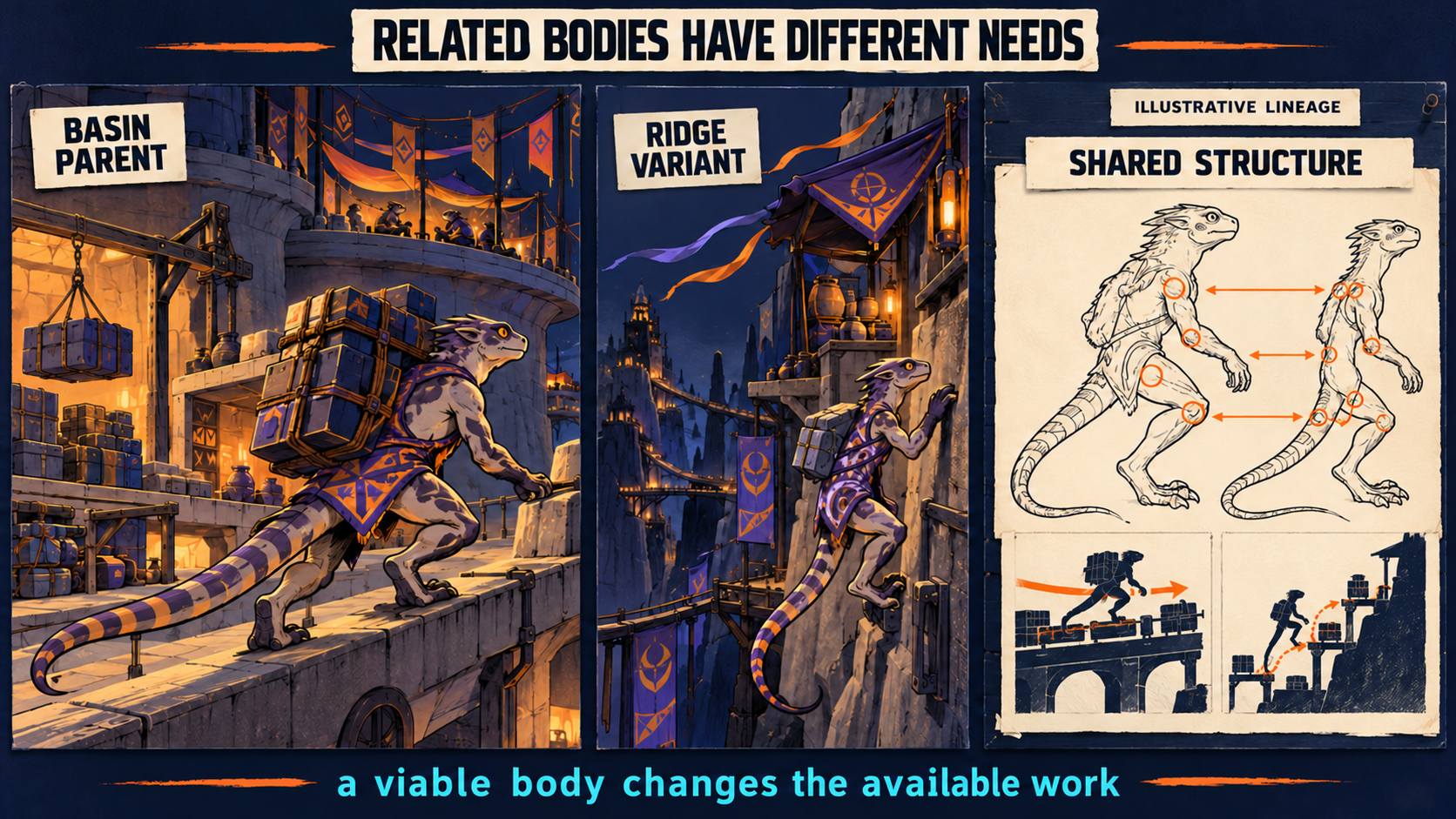
This trace produces a related design whose usefulness changes with environment. A population-level evolutionary model would also need reproduction, inherited variation, and selection over successive generations. We can choose that stronger model later if its changing populations serve a story or game.
Some variation can be continuous. A body proportion can move through a range while retaining the same structural relationships. Other variation needs discrete valid choices. A walking body and a burrowing body may require different topology, contact rules, or space requirements. Limb count can’t drift smoothly through every fractional value. We need a grammar that says which structures exist and which parameter ranges make sense for each one.
The distinction matters for systems as well as appearance. A movement capability might state that a being can climb certain surfaces, carry a bounded load, or traverse a given passage. A body description may explain the visual expression of that capability. The two should agree. A beautiful variation that can't perform the actions its record permits would create a defect at the generator’s output boundary.
A constraint checker could reject a body whose declared cargo load conflicts with its fictional support rules. It could reject an entrance whose clearance excludes all intended residents. It could also flag missing information instead of inventing a valid combination. These checks establish consistency with our declared design, not scientific proof that the organism could evolve or survive in reality.
Core species or lineages would give the audience reference points. Recognizable silhouettes, movement patterns, and recurring sensory or material cues could make a spectrum understandable. A place can still contain individual variety. The anchors give a player a familiar structure for comparing variations.
We’d have to choose the strength of those anchors. If every variation changes every visible trait, the claimed relationship may only exist in a database. If every variation changes only surface color, exploration may feel repetitive despite a large parameter space. A useful test asks whether someone can identify the common structure and describe a meaningful difference without reading the generator’s records.
Relatedness also needs a history if it becomes consequential. Nearby planets could share a lineage because of migration, a common origin, deliberate settlement, or a fictional mechanism we’ve accepted. Geographic proximity alone doesn’t establish ancestry. A map generator could arrange related designs near each other for a visual experiment, but a later story about descent would create stronger claims that need support within the setting.
Culture should remain separately expressible. Two communities with similar bodies can make different choices about public space, ownership, transportation, ritual, or power. A biological requirement can constrain the range of workable buildings without deciding which institution controls them. A capable climber might live in a vertically organized settlement because materials and local history favor it; another community could choose broad ground-level circulation for reasons of access, safety, or shared use.
Technology belongs in that separate history too. A community may possess a capability because it inherited equipment, traded for it, captured it, or developed it. A trait vector that derives “technology level” from body shape would erase those possibilities. I want the model to preserve enough independent dimensions for the universe to surprise us through understandable causes.
The lineage and capability records could still connect. A transport designer needs to know which bodies the vehicle serves. A settlement may adopt a standard because most residents share particular movement requirements. A political history can explain why a minority population lacks access despite a technically possible design. These connections become more useful when the records preserve their different kinds of authority.
I’d start with a small set of related designs and exercise them through the same task. Can each resident reach the facility, use its controls, and transport a required item? Which parameters change the answer? Which differences only change presentation? That experiment would tell us where variation contributes to experience and where it adds production cost without changing anything a visitor can understand.
The genome idea then becomes a way to generate connected possibilities under explicit constraints. We can grow its range as we learn which combinations remain readable and useful. We don’t need to settle a complete tree of life before discovering whether one family of beings makes a settlement more interesting to inhabit.
A climbing species needs a different city from a walking species
Imagine entering a district whose builders never assumed that the floor was the primary surface for movement. Public signs, private rooms, traffic, and meeting places might reveal their history immediately. A human visitor could find an apparently open building inaccessible, while a local resident experiences a human-designed checkpoint as confinement. Movement becomes both a visual identity and a source of social consequences.
The port settlement sits in a sheltered basin in our example. A second settlement occupies an exposed ridge along the alternate transportation route. Both contain related residents from the illustrative lineage. We’ll declare that those residents can climb suitable surfaces, while heavy cargo still needs engineered support. The environments and capabilities are fictional inputs chosen to test the model.
The basin settlement can use broad circulation around its processing facility. Its port gives incoming supplies a clear destination. Warehouses, unloading areas, and resident access can cluster around that function. The place has a reason to concentrate activity even before we write its political history.
The ridge settlement faces a different layout problem. Its usable space is narrow, and the declared environmental conditions make some exposed paths unreliable. Residents can use climbing routes that heavy cargo can't. A route suitable for a person carrying a small object may be unsuitable for a shipment feeding the processing facility. We need at least two access questions: can residents move through the place, and can its material flows do the same?
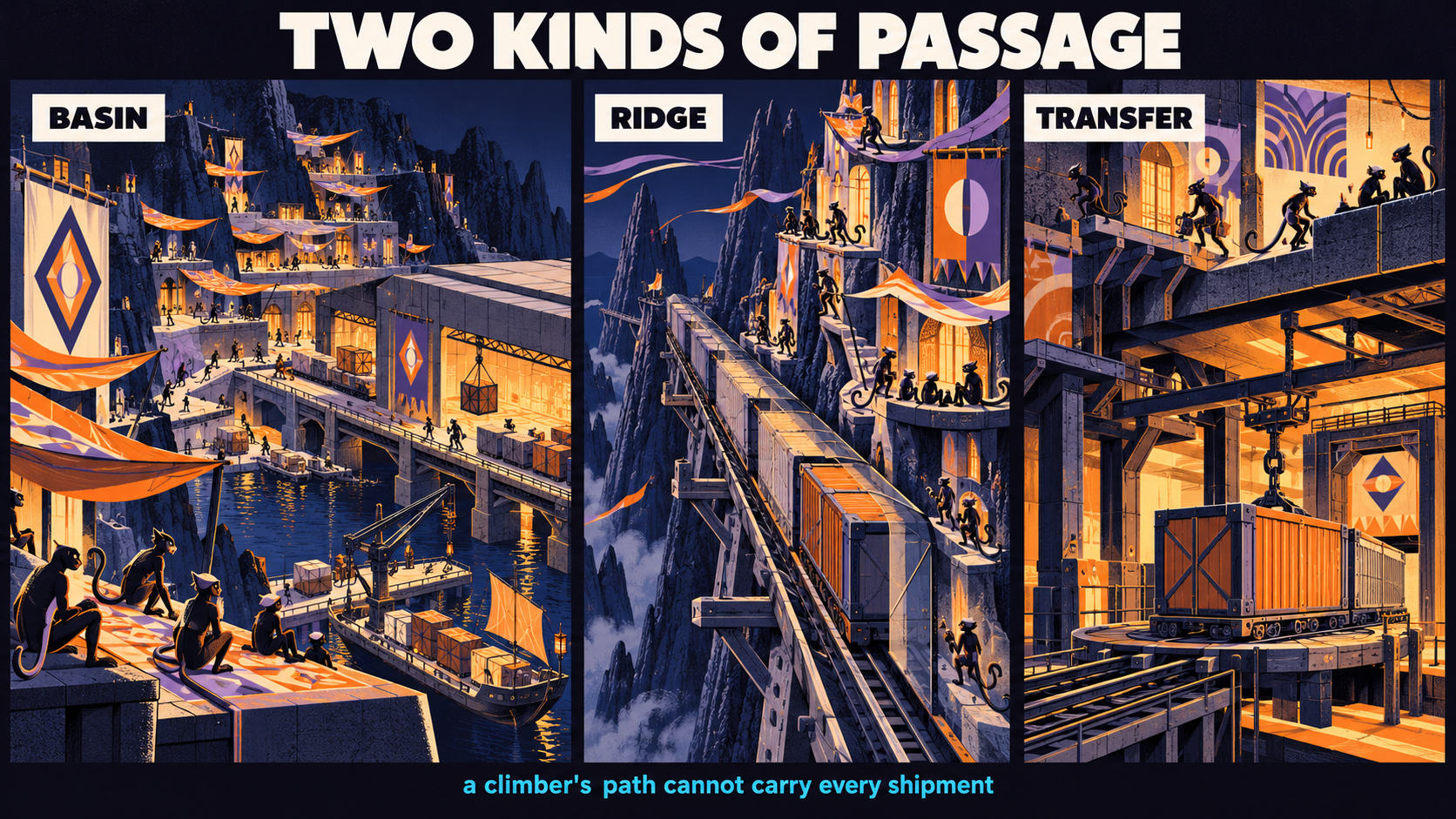
One design could use protected cargo rails and separate climbing surfaces. Another could use enclosed passages large enough for vehicles and residents together. A third could locate storage below the ridge and transfer only processed goods upward. Each changes construction, maintenance, capacity, and daily activity. The environment narrows the choices, while institutions and history help select among them.
That selection should remain visible. A settlement built around a shared enclosed route may show queues, scheduled movement, and maintenance interruptions. Separate routes may make resident movement freer while concentrating cargo control at a few transfer points. A place with lower storage might reveal repeated deliveries and workers moving between levels. The visitor encounters consequences of a design rather than a randomly assembled architectural style.
The bodies also change the details. A climbing route needs reachable surfaces and useful transitions. An entrance must admit the residents and objects intended to pass through it. Controls need a compatible interaction method. Resting places have to match the body’s support needs. These are structural relationships the model can preserve even while the compatible asset and animation pipeline remains assumed for this exercise.
Transportation adds scale. A resident’s ability to climb locally doesn’t solve travel between settlements. A vehicle can serve that trip while requiring a transfer into a different local movement system. The transfer point becomes a place where activity concentrates. It can also become a point of dependence: closing one facility may affect many residents who could otherwise move freely within their own district.
The same population could build different architecture after migration. A new environment changes workable materials and movement costs. Existing customs may persist, adapt, or become contentious. We can represent that tension through a retained architectural preference alongside current constraints. Deriving every building directly from biology would miss the history that makes the place particular.
Believable background life can use those relationships without giving every resident a continuously running economic model. A local scene might select roles such as arriving passenger, cargo worker, maintenance worker, and resident moving between districts. Its routines would draw on the settlement’s function, current conditions, and selected logical time. We can bound the number of visible bodies and the complexity of their activity while retaining a plausible connection to the place.
A port closure should alter that scene. Cargo workers might be occupied with repair or redirected unloading. Passenger activity could shift to the alternate route. A queue could form where transfer capacity is constrained. The exact depiction remains a creative choice, but normal operation shouldn’t continue unchanged if the macro record says the facility is unavailable.
This gives background activity an explanation. It also gives us a test. A reviewer could inspect the scene without seeing its records and identify which facility has a problem, where people are going, and what the settlement does. If the scene only communicates “aliens walking around,” we’ve created motion while leaving the place’s function hidden.
Identity can become more detailed when the experience requires it. A background worker selected for a local scene can be a temporary presentation role. A worker whom a player interacts with repeatedly may need a stable record. A named character participating in a story needs stronger continuity again. We should make that promotion explicit so that an interaction doesn’t accidentally create a promise our storage model can't keep.
Cities: Skylines II supplies a useful contrast in fidelity. Its announced citizen simulation describes lifepaths and activities such as work, education, shopping, and care. My background-life goal doesn’t require reproducing that entire municipal model. We can learn from its separation of roles and activities while choosing a smaller set of persistent obligations for Depths. The precise citizen and visible-instance limits of another game also shouldn’t become our own budgets without testing.
Epic’s Significance Manager documentation offers a framework for adjusting detail and tick frequency according to project-defined relevance. That's an available implementation reference. Our project would still have to decide which facts survive lower detail and which routines need to catch up when they matter again.
The two settlements now differ for an understandable reason. Their residents share capabilities, but their routes, usable space, history, and chosen infrastructure produce different local activity. A visitor can discover those differences through movement and observation. We’ve added depth without assuming that every resident in both places must perform a full simulated life while nobody is there.
The smallest life should still matter inside an enormous army
The military scale I imagine owes a great deal to the feeling of Total Annihilation, Supreme Commander, and Beyond All Reason. I want the machinery to feel extraordinary. I want a commander to see systems interacting across a front and understand that a local decision can become a strategic disaster.
That scale becomes richer when the force has a history. Who built it? Which civilization supplied the materials? What maintenance does it require? Which bodies can operate it? What did the society sacrifice to make so many of these machines possible? A battlefield can reveal a culture’s priorities before anyone explains its ideology.
Ancient technology makes these questions sharper. A faction may possess one irreplaceable system and organize its entire military around keeping it operational. Another may prefer vast numbers of simpler machines because repair knowledge is widely distributed. A third may depend on biological adaptation or on people trained through a punishing process that their society has normalized.
I’m interested in how far someone will go for family, culture, species, faction, or pride. A volunteer and a coerced recruit can undergo the same procedure and give it radically different meaning. A society can honor sacrifice while concealing who had no realistic choice. A legendary defender can be a source of hope and a reminder of what the state does to its own people.
The campaign should make logistics visible enough to matter. Taking a resource site can be useless if the army can't transport what it extracts. Destroying a bridge can protect a retreat while condemning a settlement that relied on it. A rapid victory can leave a force unable to hold what it captured. Those constraints create room for strategy beyond whichever side possesses the largest weapon.
The individual stories can then show what the strategic view omits. A repair crew may improvise with material diverted from civilian use. A resident may keep a workshop open because every closed business weakens the community’s chance of surviving the occupation. A soldier may discover that a supposedly empty zone contains people the command model never counted.
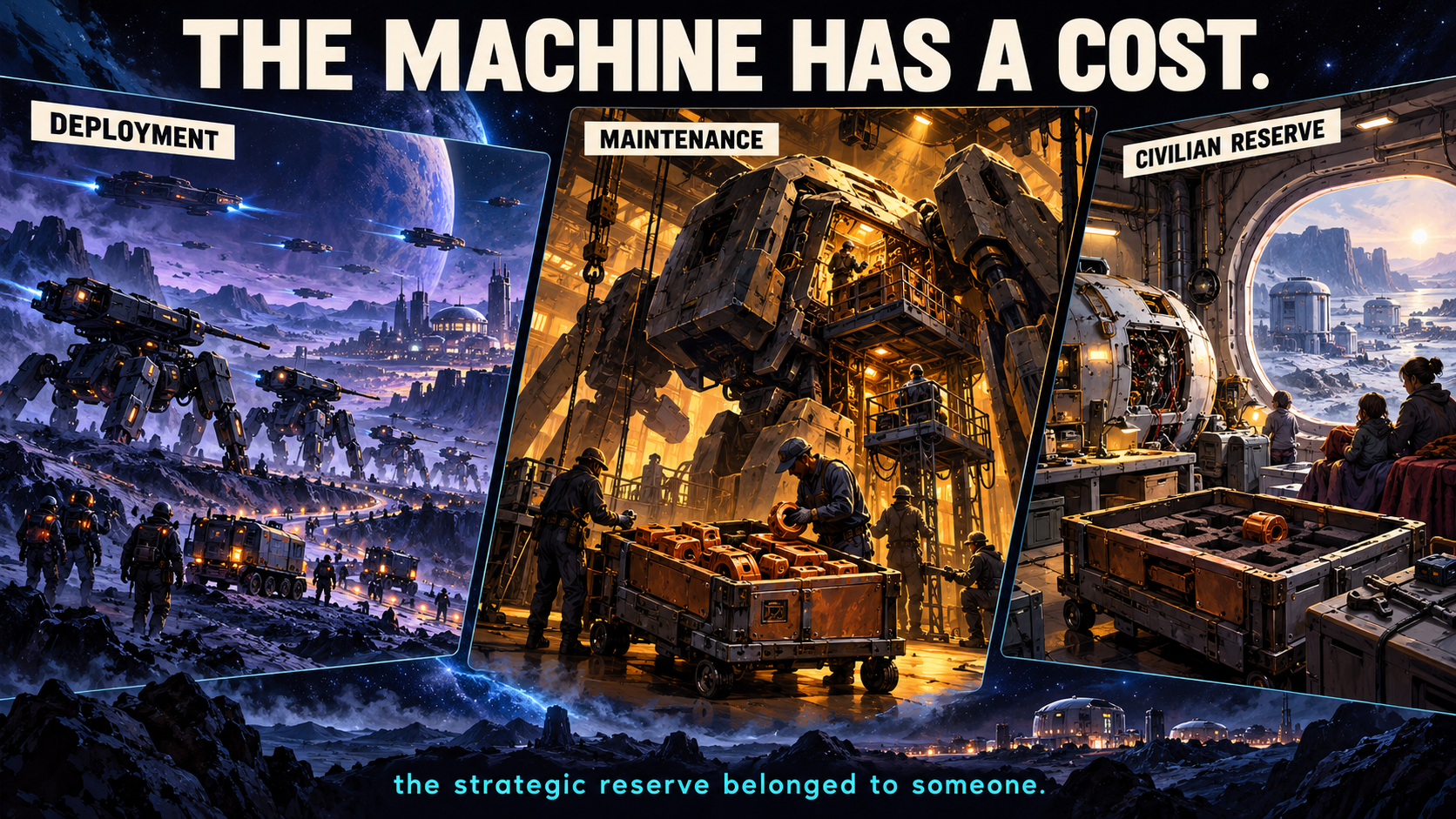
The cosmic perspective adds another layer without replacing those lives. An enormous deployment might be a small move in a conflict between ancient powers. A strategic breakthrough might only be possible because another entity wants the route opened. The commander can make a brilliant decision inside the information available and still misunderstand the larger purpose.
I want the reader to be able to move between these scales and feel each remain true. The machinery is impressive. The strategy matters. The cost belongs to people and other beings with their own lives. The universe can dwarf all of them without erasing their significance.
Civilizations should keep changing when nobody visits them
The military and household stories meet here. A transfer facility changes hands, and that event affects an army’s reach, a shopkeeper’s stock, a family’s plans, and a rival institution’s bargaining position. The people don't all need to be animated while the event occurs. The event does need to remain available to every later work that inherits its consequences.
The civilization layer needs to remember consequential relationships even when its local places are inactive. I’d begin with a small macro model: polities, important locations, resource flows, transportation links, and relationships. The server would own the accepted shared state. A local visit would consume that state and produce a bounded detailed place.
This is a proposed architecture. It hasn’t been demonstrated at universe scale. Keeping its records compact helps storage, but the cost of updating their interactions still needs measurement. A million small records can create a difficult simulation if each one repeatedly interacts with every other record.
The stable baseline would identify places and define their starting parameters. The changing macro records would describe matters such as port availability, controlled locations, supply access, route capacity, and current agreements. Consequential events would record accepted transitions. Snapshots would make a selected state available without reconstructing the entire history for every visit. A materializer would interpret those records at a chosen logical time.
Some consequential relationships would belong to cultural history as well as resource flows. A treaty could depend on an institution’s recognized authority; that authority could weaken after an event people interpret as a broken sacred obligation. The shared record would need to distinguish an accepted event from the accounts different communities give it. We would model the parts a current experience needs and preserve the wider authored context for later creators. Culture doesn't require simulating every belief continuously to remain part of what a place inherits.
Our port failure can now move through the model. The basin polity initially controls the port and depends on its imports. A recorded failure reduces its usable capacity. The next macro update evaluates the resulting supply gap under the declared resource rules. The neighboring ridge polity controls the alternate route and has its own capacity commitments. It can supply an alternative only if that route and its available resources permit it.
A two-tick fixture makes the policy and power change inspectable. Give the example invented supply units and logical ticks. Assume shipments in this calculation arrive within their assigned tick. At the start of tick zero, the basin has twelve units in reserve. Its residents consume ten per tick, while the damaged port delivers four. Its reserve falls to six. The alternate route can carry nine units per tick, with three already committed elsewhere, leaving six available. The supplying origin must also have those six units; route capacity doesn’t create supplies.
For this fixture, give the basin a simple policy: seek an agreement if the next tick would bring its reserve below six, and prefer a feasible agreement to unmet consumption. Give the ridge polity a policy of preserving its existing deliveries while gaining operational control where spare capacity permits. It offers six units of recurring supply in exchange for operating the transfer facility. These invented policies explain this one transition; they make no claim to model realistic government or accepted Depths behavior.
Suppose the agreement takes effect at tick one. The basin receives four units through the damaged port and six through the alternate route, then consumes ten. Its reserve remains six. The ridge polity now operates two relevant transfer points instead of one, increasing its transport reach and the basin’s dependence on it. The basin retains local governance. Those changed capabilities and relationships express power more precisely than a generic strength score.
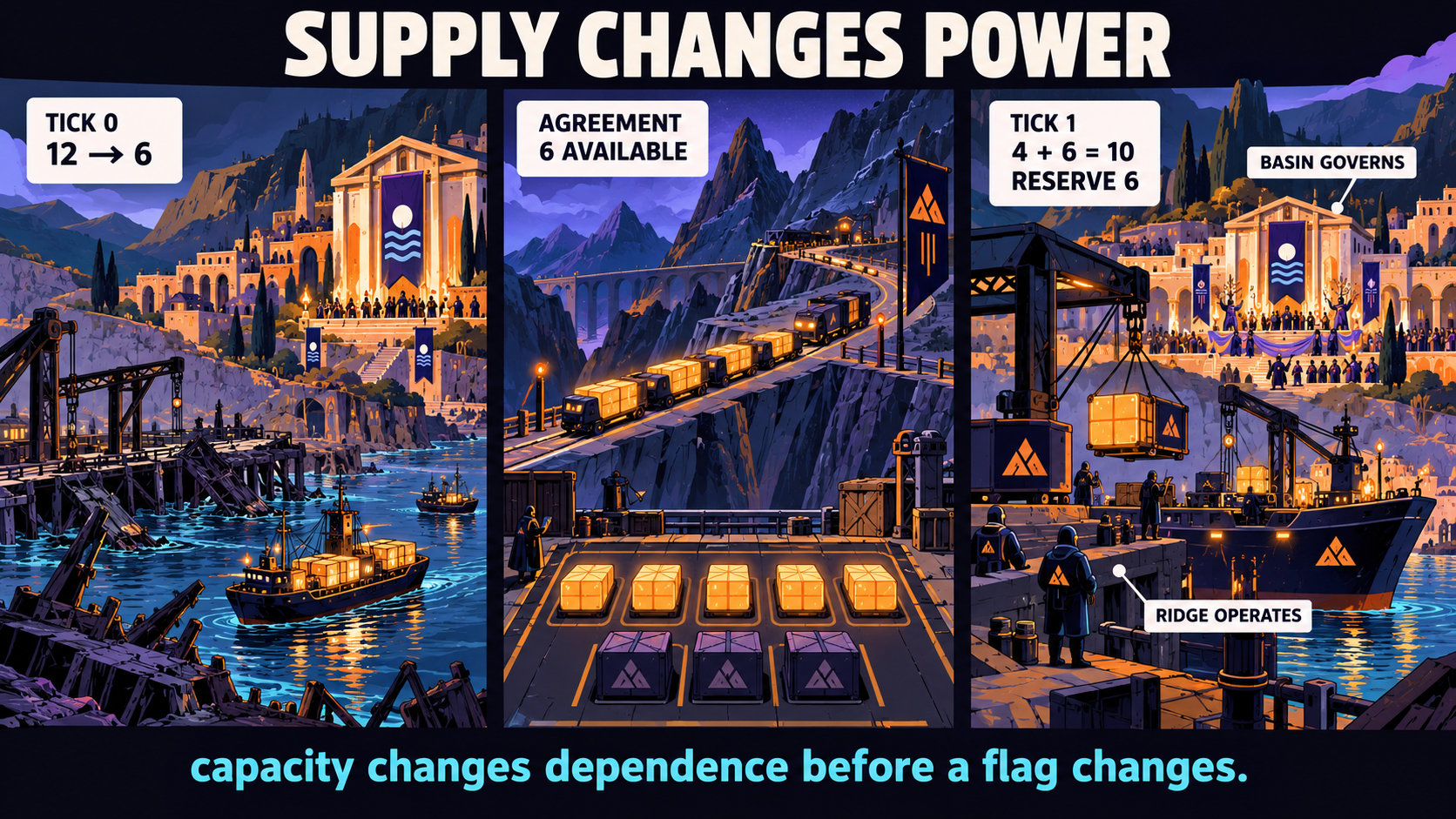
The update reserves the shipment once and accounts for both inventories under the declared travel-time rule. A neighboring demand can’t reuse that allocation. A five-unit alternative would leave a recurring one-unit shortage, so the same policy would need another response. These figures supply a reference calculation for testing a more elaborate model.
The same model could test refusal or an intervention that changes the facility’s control. Each alternative would need its own policy and capacity obligations.
The event record should preserve enough context to recover that change. It would identify the affected locations and polities, the relevant preceding state, the accepted action, its effective time, and the rule or authority under which it applied. An unaccepted proposal belongs elsewhere. A command requesting a change can fail; a history event describing the completed transition must reflect what actually applied.
The snapshot after that transition would show the damaged port, the alternate supply route, and the new operational control. The history tracker could expose the failure and agreement as linked events. A later local visit could present redirected traffic, changed access markings, and a functioning transfer facility consistent with the selected snapshot. We’ve retained a meaningful past without continuously animating the workers who carried out every shipment.
Resource relationships give this history a mechanism. The developer description of Dyson Sphere Program connects interplanetary transportation to resources unavailable in sufficient quantities on one planet. Its staged production makes a distant objective depend on understandable intermediate work. The lesson I’d apply is that territory matters when it changes what can reach whom, at what cost and capacity. Distance on a map can remain visually impressive while having little consequence if all supplies are interchangeable and transport has no constraint.
A polity’s power therefore needs more than one value. A state can have abundant material and poor transport. It can control a route without owning the facilities that supply it. It can claim a territory while lacking the capacity to enforce the claim. Different views could summarize those conditions, but the summary should retain a connection to the relationships beneath it.
An influence field might help estimate reach in places without explicit control records. I’d treat it as a declared approximation. Simple distance decay can be misleading when a route network makes one remote place accessible and a nearby place difficult to reach. The tracker should distinguish an estimate of influence from accepted ownership, and distinguish both from an actor’s claim. A single colored border would conceal those differences.
History also needs an interface. Bay 12 describes Dwarf Fortress worlds with civilizations, centuries of generated history, and changes recorded across games. Its Legends-related development records expose historical events and figures. I’m interested in that inspectable relationship between a generated past and the present. A Depths tracker could let someone select the port, find the event that changed its control, and follow the route whose availability made the agreement possible.
Martin Fowler’s event-sourcing explanation describes preserving historical external inputs and handling changes in processing rules. Akka’s snapshot documentation explains the recovery role of snapshots and the limits introduced by deleting earlier events. Snapshots and events would need version contracts. Replaying recorded transitions assumes that we retained the required inputs and can interpret them under the appropriate rules. A new reducer or generator can change the meaning of an old event. We may need saved projections, migrations, or versioned replay rather than assuming that an event log supplies a cheap, exact reconstruction of any past state.
The cross-region problem appears immediately. Imagine a shared cargo fleet can serve either settlement during a given interval. Region A catches up when a visitor arrives and assigns that fleet to the basin. Region B later catches up from an older snapshot and assigns the same fleet to the ridge. Both local calculations may appear valid in isolation while the shared history spends one capacity twice.
Lamport’s work on logical clocks distinguishes causal ordering from the additional ordering decisions distributed systems require. A last-updated timestamp doesn’t solve that conflict. We’d need a coordinated logical clock for interacting records, ordered boundary events with explicit ownership, or a documented approximation that preserves the resource obligations we care about. Independent lazy catch-up is easier when regions are truly independent. Trade and war make that assumption harder to maintain. Visit order shouldn't decide which version of a past agreement becomes true.
For a first test, I’d favor a small coordinated macro update over an ambitious distributed shortcut. It gives us a reference outcome we can compare with a later partitioned approach. We can then decide which errors an approximation introduces and whether those errors affect the promised experience. There’s no need to select the final distributed design before we understand the coupling.
A local materialization request would name a stable place ID, baseline and schema versions, a selected snapshot and logical time, applicable changes, and accepted references for persistent objects or characters. The output would include a bounded local manifest. The materializer could choose background routines within that contract, but it shouldn’t invent a different owner or restore an unavailable route because its local generation finds that convenient.
Player actions would need the same authority discipline. An interaction might affect a private session, a campaign branch, or the shared macro world. Those are distinct products. A local depiction of a destroyed warehouse doesn’t automatically authorize changing everyone’s future supply. We have to decide which effects the shared world accepts and how competing actions resolve.
That leaves a tractable experiment: one coupled pair of settlements, a port failure, a capacity-constrained response, a recorded agreement, a tracker, and a later visit. We can inspect whether the same event survives every transformation. If it does, we have evidence for that narrow architecture. Larger political histories would require more actors, more rules, and further tests of cost and behavior.
Canon needs an author and a record of accepted changes
The possible revelation about humans from another universe makes this distinction essential. The creator may be exploring several explanations. A published character may believe one of them. A later work may establish a different truth through evidence. A system that treats every sentence as equally authoritative could accidentally settle the mystery, spoil it, or create a contradiction. Canon stewardship is part of protecting the story’s ability to unfold.
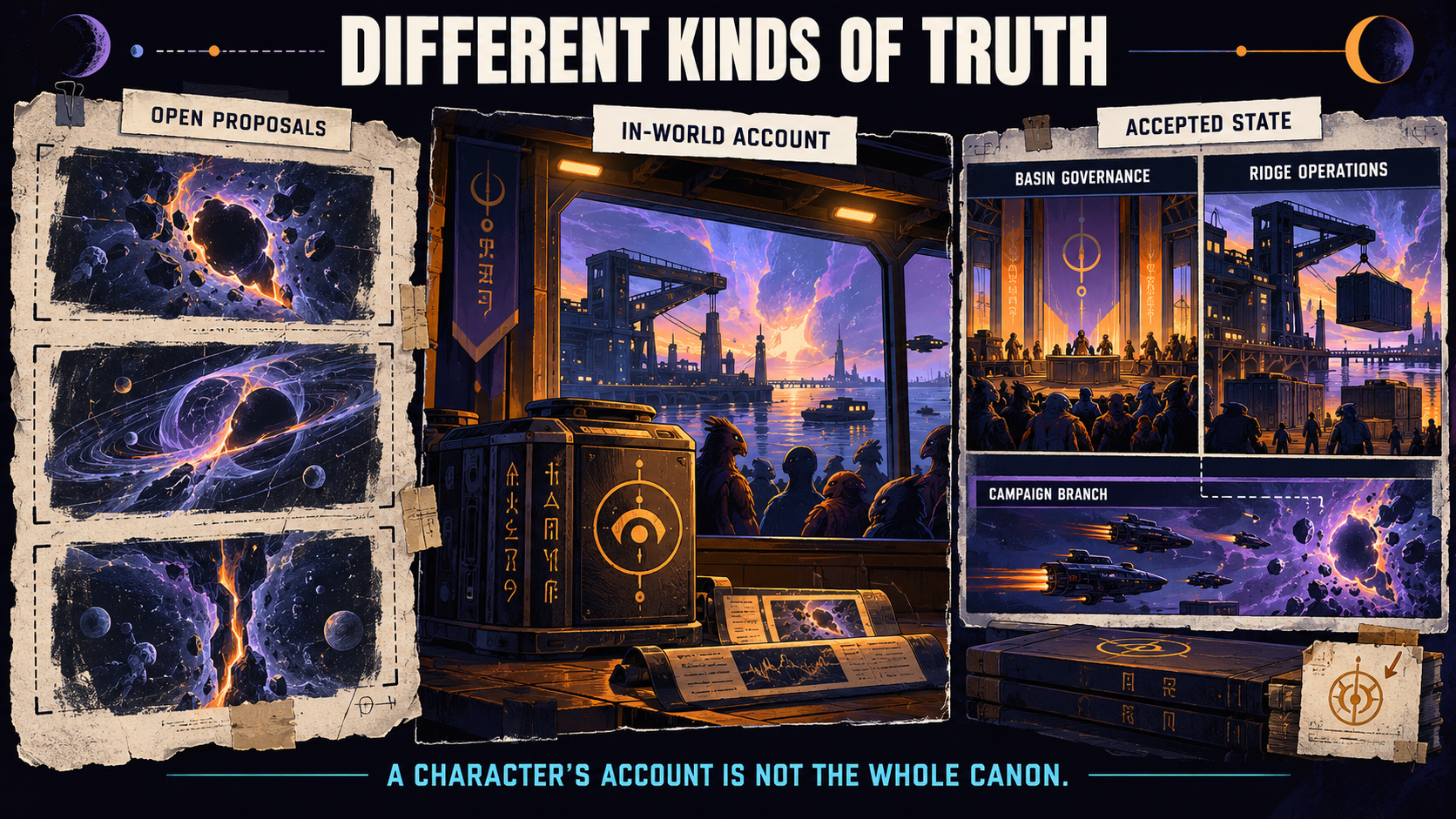
A shared universe needs a creative agreement about authority. More writers and more output make that agreement more important. A central database can help people recover decisions, but it won’t decide which proposal deserves to become part of the setting.
Warhammer 40,000, Dungeons & Dragons, and Star Wars are reference points for the breadth I’m imagining: a setting that can support many works, creators, and ways of participating. I’m not assuming their different continuity practices reduce to one engineering failure we can fix. The question for Depths is which promises we want to make about our own works, then what records and decisions those promises require.
We’ve already encountered several things that could mistakenly receive the same “canon” label. An accepted physical rule describes how our fictional universe works. A dynamic state record describes what happened under its rules. A creative proposal suggests a possible future addition. An in-world account reports what a character or institution believes. A player campaign can explore an alternate sequence. A mystery can remain deliberately unresolved.
The port example shows why the differences matter. The accepted shared state says the ridge polity gained operational control of the transfer facility after an agreement. A basin official might claim the arrangement is temporary. A later story might show that official concealing a more permanent concession. Both accounts can belong in an accepted work without both claims being objectively true within the setting.
A retrieval system that collapses those accounts into “the ridge polity temporarily controls the facility” has made an authorial decision. It may have selected the most recent or most fluent sentence while losing the account’s status. We’d need to preserve the speaker, evidence, relevant time, and distinction between reported belief and accepted world state.
A proposed canon record would name the claim, its source, acceptance status, relevant time or continuity, and authority. It would also identify what superseded it when a decision changed. A creator could retrieve the current rule and inspect why it's current. Historical versions would remain available where published works or alternate branches still depend on them.
A rule change requires impact analysis. Suppose we revise the illustrative transportation rule so that a previously limited route can carry far more cargo. That could weaken the port’s dependence on its neighbor. A game mechanic using the old capacity may need adjustment. A story built around the shortage may remain valid in an earlier period, or it may contain a contradiction we need to address. A codex entry needs to distinguish the change from a mistaken earlier description.
The canon record helps us find those dependencies. It doesn’t choose the best treatment. We could restrict the new capability to a later discovery, preserve an older continuity, correct an error openly, or rewrite an unpublished work. Each choice affects the audience differently. Creating an in-world explanation for every mistake can add confusion, so that option should earn its place as a creative decision.
Mechanical checks can cover explicit obligations. A story using a named location can be checked against the relevant state snapshot. A game manifest can be checked for unavailable routes. A reference can be checked against an accepted source and version. A character’s asserted knowledge can be compared with the information they’re allowed to possess, provided we’ve represented that information boundary.
Other checks remain interpretive. A passage can satisfy every factual constraint and still misrepresent an institution’s character, flatten a culture, or resolve a mystery in a way that undermines the work. An agent can flag a concern and point to the relevant material. The creative lead still has to decide whether the work preserves the setting’s intended meaning.
We also need separate views for audiences and creators. A public codex can explain what a reader is meant to know. A private creator record can preserve later revelations and unresolved alternatives. A character’s view may be narrower again. Sharing one complete knowledge dump with every production task would make accidental disclosure more likely and could erase useful differences in perspective.
Continuity branches deserve explicit names rather than hidden exceptions. A tabletop campaign could use an accepted setting while giving its players a different local history. A game session could preserve its own consequences. Those branches need a relationship to shared canon that participants can understand. Otherwise the technical system may force local choices into universal history, or silently discard outcomes the player expected to matter.
The governance should remain understandable without learning a graph schema. A creator needs to answer: what can I change, what must I preserve, which source applies, and who accepts a consequential addition? A reader needs enough context to know which work or account they’re encountering. If those answers require a long explanation from the database designer every time, the policy hasn’t become usable yet.
My goal is a record that supports creative judgment and makes consequential changes recoverable. That would let new work add depth without treating every old sentence as equally authoritative or every inconsistency as something an algorithm should conceal.
Agents can build more lore than their coordination can support
I want agents to help a world grow beyond the detail I can personally maintain, including communities and histories I'd never have thought to write alone. Their value lies in the connected work they enable: a believable culture, an intelligible conflict, a finished game, a scene with emotional force. The production method should keep returning to that outcome rather than measuring success by the volume of generated lore.
Agent-native infrastructure is part of why I’m willing to explore this scope. Specialized agents can help research, retrieve context, develop alternatives, draft, check explicit constraints, and prepare different kinds of output. I want those capabilities to reduce repeated work so that human attention can concentrate on consequential decisions and the quality of the experience.
The capacity comes with a coordination problem. An agent can produce a plausible answer to a question we haven’t decided. If that answer enters the next task as accepted context, a suggestion can become apparent canon without anyone deliberately choosing it. More agents can repeat the same suggestion and make it look independently supported.
A proposed small content job makes the boundaries visible. Suppose we want a short piece about the port agreement. The brief would identify the audience, the intended form, the accepted event and snapshot, and the perspective the piece can use. It would specify whether the writer may introduce a temporary character, propose a persistent character, or only work with existing accepted people. Those permissions change what the output can safely add.
A context-gathering agent could retrieve the relevant transport rule, the port failure, the agreement, and the two polities’ recorded interests. It would also bring forward unresolved facts that affect the piece. We don’t need the entire universe in the prompt. We need the context that constrains this job and a way to find more when the draft reaches a boundary.
The drafting agent could explore a resident’s perspective within that context. If the brief permits proposals, it could suggest a character with a clear proposal status. It should leave unresolved consequential facts visible for acceptance. A missing detail about a meal may have different implications from a missing detail about whether the neighbor owns the facility permanently. The system needs a way to distinguish those decisions.
A checking agent could trace factual references back to the selected source set. It could flag a passage that restores the broken port, changes the agreement’s date, or gives a character information outside their recorded view. It could also identify uncertainty it can’t resolve. A successful retrieval check says the draft reflects the supplied records; it doesn’t establish that those records are complete or that the story is good.
The creative review then asks a different set of questions. Does the chosen perspective give the reader a reason to care? Does the conflict have a consequence? Does the work use the setting’s rules meaningfully? Does its language sound like a person telling this particular story? A correct draft can fail those tests. We need to judge the experience someone receives, rather than the number of constraints the draft satisfied.
Acceptance would create separate records for the finished work and any consequential facts it introduces. A revision to the story’s wording needn’t become a world-state update. A newly accepted character might need identity and continuity obligations. A change to the underlying agreement would need a canon decision and impact review. Keeping those operations separate reduces the chance that editing prose silently rewrites the setting.
The same principle applies to cross-media production. A codex entry explains. A short film chooses what to show and how to pace it. A game turns rules into actions and feedback. A single source model can support those jobs, but each form requires its own decisions. Automatically converting one text into several formats can multiply a weak experience just as efficiently as a strong one.
Agents also need useful failure states. A task can be blocked by conflicting authority, missing source material, incompatible versions, or an unanswered creative decision. A delivered first attempt should be complete enough to evaluate against its stated scope. Delivery, evaluation, creative acceptance, and any later publication approval are separate events. A fluent draft with unresolved dependencies can be a valuable intermediate result, but someone has to know that it remains intermediate.
My existing infrastructure and writing systems give this direction practical work to build on. They don’t establish that an autonomous creative studio already maintains a universe correctly. The question is which parts we can exercise with a small job, what fails, and how a specific correction changes the next job. An agent pipeline that keeps producing the same defect needs a changed brief, process, or test rather than another vague instruction to do better.
Rights require their own records. We’d need to know which assets and sources a work uses, what permissions apply, how contributors receive credit, and who owns accepted output. A lore graph can reference those records without replacing them. Generative capacity doesn’t remove the obligations involved in distributing or licensing creative work.
A supplier model faces the same questions as a fictional settlement
Economics is also one of the bridges back to Looikos. A fictional port and a real service business both invite questions about dependency, capacity, commitments, and uncertainty. The fiction gives us freedom to invent and explore; the business has to answer to actual people and outcomes. Shared methods are useful only when that difference stays visible.
Culture matters to that comparison too. A business can contain professional norms, inherited habits, ideas about authority, and different understandings of what a promise means. A capacity model may show an option as feasible while the people responsible for it regard the arrangement as unacceptable or can't coordinate under it. We need evidence about those actual conditions before treating them as inputs. The fictional world lets us invent a cultural history; the commercial decision requires us to learn the history of the people involved.
The commercial connection becomes clearer when the model has to support a decision someone can act on. Wardley Swarm is an active build direction within Looikos for that kind of work. Its purpose is to help an operator frame a strategic question, represent the relevant environment, compare interventions, and preserve what the outcomes teach. Existing components can contribute to that build without proving the complete product is customer-ready.
Consider an illustrative service business choosing between two delivery approaches. One approach depends on a specialized provider. Another keeps more work inside the team but uses capacity that could serve other customers. The operator needs to decide which approach can meet a commitment under uncertain demand and provider availability. This is a hypothetical counterpart to the settlement’s transportation problem, not a claim about a particular client.
A dependency view would identify what the customer receives and what that result relies on. The specialized provider may offer an efficient component while becoming a point of dependence. The internal option may preserve control while requiring more maintenance or limiting throughput. A Wardley-oriented view can help the operator examine those relationships and how the components might change. Mapping those components doesn’t determine which delivery approach to use.
A commitment view would ask what each participant has actually undertaken to do. A supplier’s advertised capability differs from a confirmed delivery promise. An internal team’s ability differs from capacity already committed elsewhere. The Promise Theory interest in my stack is useful for keeping voluntary commitments and expectations visible. We should know which required promises exist, which remain assumptions, and what happens if one fails.
An uncertainty view would separate observations from beliefs. We may have evidence of past delivery performance but little evidence under a new workload. We may know that a customer asked for a result while remaining uncertain whether they’ll accept a particular substitute. The model should preserve that uncertainty so the operator can choose a test or a contingency that reduces an important unknown.
A response view would consider other actors. A provider could change its terms after demand rises. A customer could alter priorities after seeing the first result. Competitors and collaborators can react to our action. Game-theoretic reasoning gives us questions about those responses; a characterized agent gives us a possible way to explore them. Neither supplies a validated forecast simply because the response sounds plausible.
The sequential decision view would name a state, an available action, uncertain new information, and a resulting state. That's the role I’m interested in from Warren Powell’s unified decision framework. We can compare policies for acting as information arrives rather than treating strategy as one final choice made before the work begins. A policy might reserve capacity, seek a confirmed commitment, or delay a less consequential action while a critical unknown resolves.
Give the business example invented work units. The first scenario assumes a provider can deliver eight units during the required interval and the team can supply two, meeting a ten-unit requirement. A new observation establishes that the provider has confirmed only six for that interval. The capability claim and the commitment record now support different quantities. The planned delivery is short by two.
Suppose the team also has two uncommitted units earmarked for optional expansion work. An operator policy that protects confirmed customer delivery would move those units into delivery, making four internal plus six provider units. The dependency view exposes the gap; the commitment view prevents treating advertised capacity as reserved capacity; uncertainty remains around whether the provider fulfills its six. Other-actor scenarios can test a further shortfall, and the sequential policy can define the response when that information arrives.
The changed choice is to defer optional expansion and reserve internal capacity, instead of relying on the provider’s advertised figure. A later outcome would test whether ten accepted units arrived within the interval and what the reallocation cost. That outcome could support a better policy, reveal an unreliable assumption, or show that limiting intake would have served customers better. These are scenario quantities, not client operating results.
Those views support the same delivery decision. I don’t want the operator to receive five disconnected framework essays and reconstruct their relationship. The system should show where a dependency relies on an unconfirmed promise, how that uncertainty affects a policy, and which actor’s response could change the outcome. A common representation helps preserve those connections, provided we define the meanings and keep their sources.
The port example has the same structure at that level. It has a required result, dependencies, scarce capacity, other actors, and possible responses. What transfers is the discipline of making those relationships explicit. Its fictional rules don’t transfer into a customer model as evidence. Real participants can behave in ways our invented policy never allowed, and real outcomes need observation.
A swarm could explore alternative interpretations and interventions. Its agreement would tell us about the modeled population and its assumptions. If many agents share the same source gap or model bias, agreement can strengthen the appearance of a conclusion without adding independent evidence. We need calibration against observed outcomes and a baseline that shows whether the additional machinery improved the decision.
The Goertzel and FluQNet ideas I’ve been studying belong in that research category too. They inspire questions about allocating attention, representing uncertainty, and coordinating processes. A mathematical resemblance between domains isn’t proof that one domain’s equations predict another. We’d need explicit assumptions, interpretable quantities, and comparisons against simpler methods before treating a proposed connection as an operating advantage.
The useful commercial result would be an accountable decision record: what the operator chose, what evidence supported it, which assumptions mattered, what happened, and what should change next time. That record can also reveal a reusable capability we need to improve. A source-resolution defect may justify a better evidence contract; a capacity error may justify a different state model; a failed promise may justify a new contingency.
The visual identity can connect the business to the fictional universe
The dark visual direction of Depths connects with the way I think about my companies, their characters, their design systems, and their animation. I want those connections to develop deliberately over time. A motif can appear in plain sight for years before a story changes what the audience understands about it.
That doesn’t require placing a company name inside the fictional universe. The connection could live in a silhouette, a pattern of motion, a recurring arrangement of forms, a sound, a character gesture, or a symbol that works within a brand’s own identity. Each company should still have a clear purpose for the people it serves.
A useful Easter egg has an immediate life and a possible later meaning. Someone encountering a company’s visual language should receive a coherent experience even if they never read a Depths story. Someone following the fiction might eventually recognize a connection and discover that a detail they had seen for years carried a second layer.
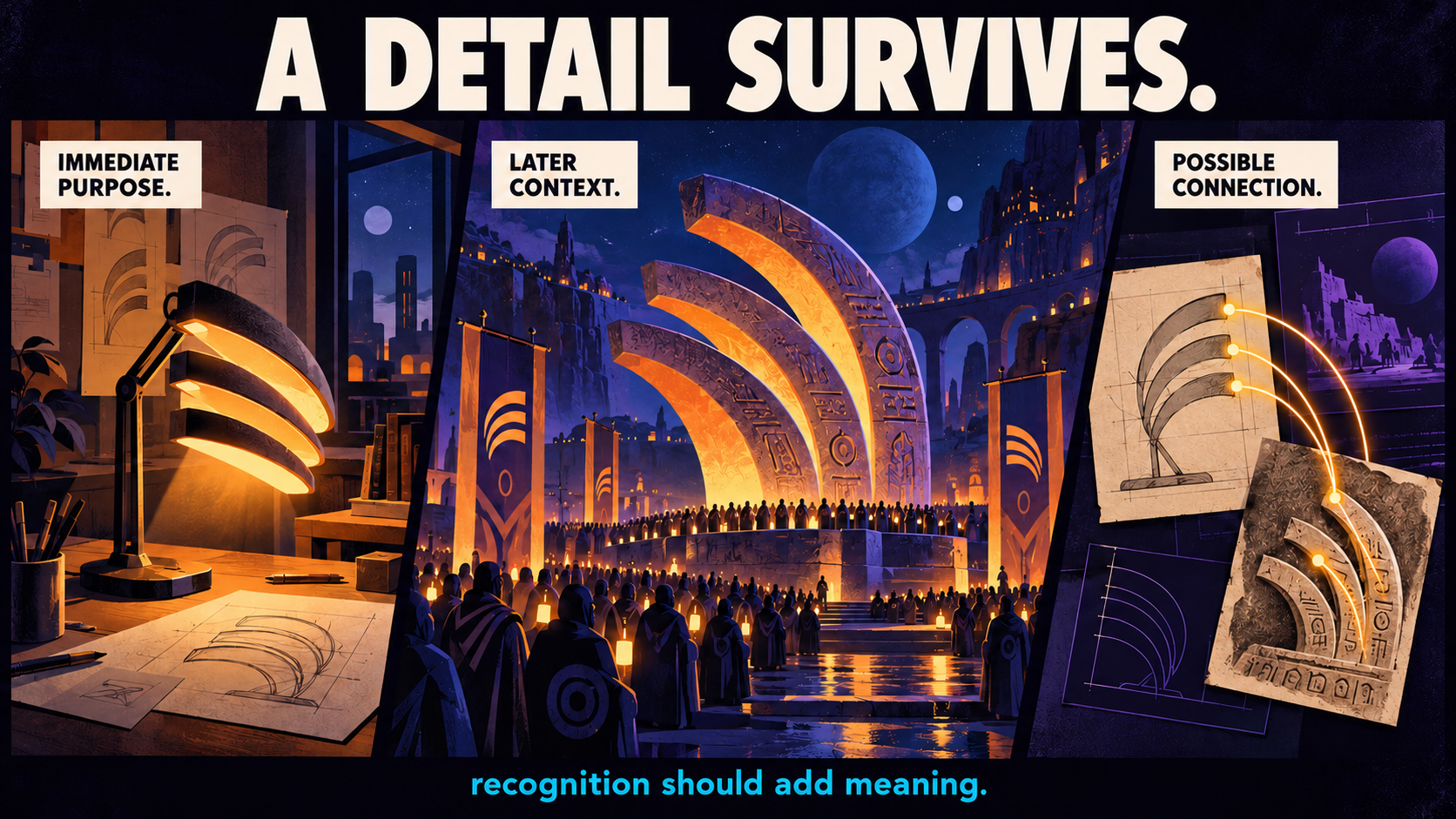
I’m interested in reveals that could take a decade to mature. That horizon calls for restraint. A symbol doesn't become profound because we promise it will matter later, and a later explanation should feel earned rather than attached after the fact. Some motifs can remain atmospheric. Others can become load-bearing clues once a story has a good reason to use them.
There's also a distinction between a genuine planted clue and an interpretation we develop later. Both can be creatively useful. The record should let us know which we're working with so that we don’t make false claims about what was planned. A long-lived universe will inevitably discover connections its creator didn't anticipate at the beginning.
The practical connection to Looikos is therefore creative as well as technical. Reusable design capabilities, characters, motion systems, and asset records can support a recognizable family of work. The brands don't have to collapse into one identity, and the fiction doesn't have to become an advertisement. Their shared language can reward attention while each serves its own audience.
Specific symbols, meanings, and reveals remain open for me to shape. The direction is to let the companies and the franchise contribute to one another over time, with enough continuity that a small detail can survive until the story is ready for it.
A closed port can test continuity before we build a galaxy
The first delivery should let us experience the intention. If we're making a military-scale animation, the shot should communicate scale and a consequential action. If we're making a small story, someone should want something and face a meaningful choice. A technical slice can support those experiences, but a passing test alone doesn't tell us whether the universe has become compelling.
The next step has to produce something we can inspect. An outline of a universe doesn’t tell us whether a port’s state survives a visit. A list of components doesn’t tell us whether their systems interact correctly. We need a small slice that exercises those relationships, and a complete delivery whose strengths and weaknesses we can evaluate before choosing revisions.
I’d begin with the declared transportation rule and the two settlement records. The first result would establish that the model can represent their resources, links, capacity, and control without hiding unresolved assumptions. We should be able to read the records and explain which choices they permit. If that explanation requires an improvised exception, the model needs work before more content enters it.
A state-transition test would apply the port failure and rerouting agreement. A test would inspect the preceding and resulting state, the event record, and the relevant resource accounting. It would also attempt an invalid transition, such as granting capacity the neighboring route doesn’t have. A useful rejection reveals why the action can't apply. Silently correcting the input would make the test appear successful while hiding the model’s actual contract.
A tracker would then expose that transition. We could ask someone to recover why the facility changed control and which relationship made the change possible. That checks a different obligation from the state update. The simulation might be internally correct while its explanation remains unusable. We need both if history is supposed to contribute to exploration.
A local materialization would exercise the same state at higher detail. The output would show the damaged port and active alternate route. A repeat visit at the same selected snapshot should preserve the agreed facts. A later snapshot should change the relevant activity without replacing unrelated identity. We can inspect those transitions using representative states rather than assuming that an attractive initial scene establishes continuity.
The neighboring region test matters next. We’d visit the settlements in different orders, apply a shared-capacity event, and compare their resulting macro history. If visit order changes who used the same fleet in the past, the local catch-up design has failed a consequential invariant. We can then improve coordination or restrict the approximation’s scope before adding more coupled regions.
A player-originated change would test authority. We could distinguish a local session effect from a shared accepted event, then verify what persists after leaving. The experiment would need a declared policy for what the player is allowed to change. It shouldn’t accidentally select the final multiplayer product by treating every interaction as globally authoritative.
Those are proposed learning steps, not an approved implementation schedule. Their order follows dependencies. We need a meaningful state transition before a history view can explain it. We need a materialization contract before repeated local visits can test it. We need coupled records before we can assess whether partitioning preserves their obligations. A calendar promise would add little while those design choices remain open.
No Man’s Sky gives me a useful example of sustained expansion. Hello Games’ 2020 development retrospective describes adding several distinct player-facing systems across that year, including living ships, a controllable mech, cross-platform multiplayer, and derelict freighters. Its official press material describes continuing major updates after the original release. Those records show a large procedural environment acquiring further experiences over time. They don’t establish that such development is easy or that any ambitious project will succeed by adopting the same cadence.
My near-term version of shipping can be internal. A model we can use, a tracker we can interrogate, or a local place we can revisit gives us evidence before public launch. Internal work still needs an acceptance event. “We explored the idea” is weaker than “the updated port remains unavailable across repeat visits under the selected version, and its history explains why.”
Existing persistent state also creates a maintenance obligation. Cities: Skylines II’s Economy 2.0 rollout explained transition effects for existing saves, including changes that would take time to settle. That’s a relevant warning for any evolving model. New rules encounter old records. We need to decide whether to migrate them, preserve a version, or expose a changed interpretation. Adding features can require work on the places people already care about.
The cost test should follow the exercised slice. We can measure persistent records and interactions, macro-update time, local materialization, active behavior, and correction effort. We can test concentrated activity as well as sparse exploration. Those measurements will show whether one expensive subsystem or one interaction pattern dominates. A speculative count of future planets won’t identify that bottleneck.
Each completed slice can leave us with a reusable contract and a clearer next question. The port test might establish continuity while leaving political policy open. The tracker might establish discoverability while revealing that relative power is poorly summarized. A complete small experience might establish that the place is understandable while showing that it gives the player too little to do. Those are useful results because they change what we build next.
A complete small game can show which part of the universe deserves more work
The wider audience vision stays present even when the first release is small. A successful logistics experiment doesn't oblige the entire franchise to become a logistics game. A strong horror scene doesn't require every future audience to accept horror. Each delivery should clarify which experience it serves and how its consequences connect to the wider world.
An audience needs a complete reason to engage with a work before it needs a diagram of the franchise around it. My larger ambition can guide production, but a short story has to reward reading, a clip has to reward watching, and a game has to reward playing. A hint about future lore can add interest after the immediate experience works.
A short story gives us a way to examine a consequence through someone’s decisions. The port agreement could appear as a condition shaping a person’s day rather than the subject of a technical explanation. The work would need a perspective, a meaningful choice, and an outcome. The setting’s unresolved scope should leave possibilities for later work without leaving the present story unfinished.
A serial story creates a different obligation. The reader needs reasons to return while each installment provides its own development. The shared world record can help continuity, but it won’t select a worthwhile progression automatically. Adding another event to the timeline can expand the record without changing what the reader understands about the characters.
A short clip can communicate a movement pattern, a local environment, or a change in a place with less explanation than prose. It has to choose a visible event. A camera moving through a large settlement may demonstrate scale while conveying little about its function. A bounded sequence showing cargo redirected around a closed port could make the constraint readable. Its pacing and presentation would still require creative judgment.
A small game would test agency. Our illustrative transportation model could support a focused loop around moving supplies, maintaining a route, and choosing priorities when capacity is constrained. The player would act, see consequences, and adjust. We could deliberately limit the game to one place and one recurring decision structure while allowing the surrounding history to explain why that work matters.
That’s only an example of how the model could support a game. I haven’t chosen it as Depths’ first product. A lore system can tell the player that a shortage matters. The mechanics have to let the player understand and influence something about that shortage. Otherwise the setting becomes an explanation attached to a loop that doesn’t use it.
I’ve been looking at games such as Vampire Survivors and other focused indie references because a clear recurring loop can support considerable variation. I want to study what people repeatedly do, which decisions change their outcomes, how feedback explains improvement, and what makes another attempt worthwhile. Learning from that structure requires original expression and a loop suited to our own work. It doesn’t give us a reason to copy distinctive characters, art, branding, or a game’s identity.
Factorio’s developers provide a concrete interface lesson. Their train-overview discussion distinguishes too few trains, insufficient loading input, and drop-off congestion. Those conditions need different responses. A useful game makes the important cause discoverable so that the player can choose an informed next action. Our transportation loop would need a similar distinction between supply shortage, unavailable capacity, and a broken route.
Cities: Skylines II provides a consequential-design lesson. Its Economy 2.0 diary says expense-linked government subsidies reduced player agency and consequences, then describes removing that support and revising the economy. The inference for our design is that many variables can coexist with weak tradeoffs. If every choice receives enough automatic compensation to succeed, a complex simulation may offer little reason to learn its structure. That developer explanation is evidence of a documented problem and revision, not proof that the revision completely solved it.
A focused game can expose those issues sooner than a much larger one. We can ask whether a player understands a failure, has viable alternatives, and can improve through decisions the game supports. More buildings or more generated species won’t answer a weak-loop problem. We may need a different action, a clearer cost, or a consequence that changes the next attempt.
The work’s apparent simplicity also tells us little about its total cost. A small game still needs usable controls, feedback, compatible assets, testing, distribution, and support appropriate to what it promises. A short film needs coherent shots and timing. A story needs editing. Agent assistance can change those costs, but the finished experience remains the thing we have to evaluate.
I’d expand after a small work gives us a specific reason. A story may make a particular institution worth exploring further. A game may reveal a mechanic people want to revisit under new conditions. A clip may help an audience recognize a lineage or place. Those signals can guide the next addition to the universe. They don’t require every successful format to become a permanent production obligation.
A misunderstood treaty should lead to a specific correction
Delivery comes before revision. I want a team or agent to scope the intended result, make a plan, choose a strategy, execute it, and deliver a complete first attempt. Then we can score the result against a rubric and compare it with other completed work. That gives a revision evidence to respond to, instead of letting a process repeatedly polish its own feelings about an unfinished output.
A feedback loop becomes useful when feedback changes a particular part of the work. We can collect comments, store them, and make the next agent aware of them while continuing to produce the same defect. After the completed result has been evaluated, an authorized revision can change a particular model, method, or test, followed by evidence about whether that change helped.
Our settlement experiment supplies a concrete case. We could expect a visitor to understand that the basin polity still governs the settlement while the ridge polity operates the transfer facility. We’d then observe how someone interprets the local place and tracker. Everything about this test remains hypothetical; no audience result has been collected for the example.
Suppose a reviewer interprets the ridge polity’s markings as complete annexation. The event record may be correct, but our presentation has collapsed two relationships into one. We’d investigate whether the tracker, the local scene, or the underlying schema failed to preserve the distinction. Adding a sentence explaining the correct answer might help one view while leaving the same defect in the next generated output.
The more durable correction could be to represent governance and operational control separately, then require both views to handle them. The tracker would distinguish the relationships. The materializer would use an appropriate combination of access cues and settlement identity. A checking rule could flag a manifest that applies a single owner label where the selected state contains separate authorities.
We’d then test the revised version on the same understanding task. A reviewer who has already heard the explanation may no longer supply a useful comparison. We could use a fresh reviewer or a different but structurally equivalent case, while preserving the criteria we intended to test. The goal is to learn whether the representation and presentation communicate the distinction, rather than whether someone can repeat our correction.
The result could still disappoint us. Perhaps the relationship distinction is too subtle for the local experience we’re trying to create. Perhaps the tracker requires too much inspection. We could simplify the presentation while keeping detailed records available for creators. We could also decide that this particular political distinction doesn’t serve the first small work. Either decision would be more informative than adding more signs until the reviewer guesses the expected answer.
A technical failure would create a different correction. If repeated visits restore unavailable cargo, we need to investigate authority, snapshot selection, or accounting. If macro history differs with visit order, we need to investigate coupled updates. If local activity ignores the closure, we need to investigate which state the routine selector consumes. “Improve quality” hides those different causes and gives the next process no precise target.
We should preserve rejected explanations as well as accepted fixes when they help prevent repetition. A suspected generator defect may turn out to be an outdated snapshot. A visually confusing border may turn out to be a model that fails to distinguish influence from control. The decision record should explain what the investigation established and why we chose a particular intervention.
Cost belongs in that record. A correction can improve the result while making the process too expensive for its intended use. We’d need to consider research, generation, runtime processing, review, revision, and maintenance. The meaningful unit is a result that meets its acceptance criteria. Raw output count can rise while accepted results become slower or more costly.
The same discipline applies commercially. A process may deliver more proposals while reducing their relevance. A source-handling change may improve completeness while increasing review time. We need a baseline and a decision about which outcome matters. A later observation can then challenge the claimed benefit. Storing more data gives us the material for learning; it doesn’t establish that learning occurred.
I want revenue-producing work within Looikos to support this longer research direction. That creates an economic constraint, not a guarantee that every creative experiment will pay for itself. Client demand for one useful system doesn’t prove demand for a fictional universe. Creative interest doesn’t prove that the shared infrastructure serves customers well. Each needs its own acceptance and economic evidence.
The portfolio can still make the experiments valuable in more than one way. A reliable source-to-model contract developed for client work could help creators recover accepted lore. A continuity defect found in Depths could reveal a versioning weakness that matters elsewhere. We should record the specific transfer and test it in the receiving domain. Similar terminology is insufficient evidence of reuse.
I want this world to surprise the people who continue it
The deepest reason for making this agent-native is that I want the universe to become more detailed than one person could comfortably know. I want to guide it and still experience awe when a connection becomes visible. A species’ needs could shape a trade route; that route could sustain an alliance; the alliance could preserve a technology; that technology could become part of a catastrophe centuries later. The surprise should emerge from relationships that withstand inspection.
That ambition doesn’t remove authorship. I still have to choose what the work is trying to do, which proposals deserve acceptance, and how the audience should encounter them. Agents can multiply the capacity to explore, remember, compare, and produce. They also make it easier to create mountains of plausible material that nobody cares about. The finished work is where those possibilities are tested.
I want Depths to last long enough for my grandchildren, and perhaps their children, to find something worth exploring. A century-scale direction can guide what I preserve without pretending I can schedule the distant future. Someone continuing the work should inherit understandable consequences and room to make new choices.
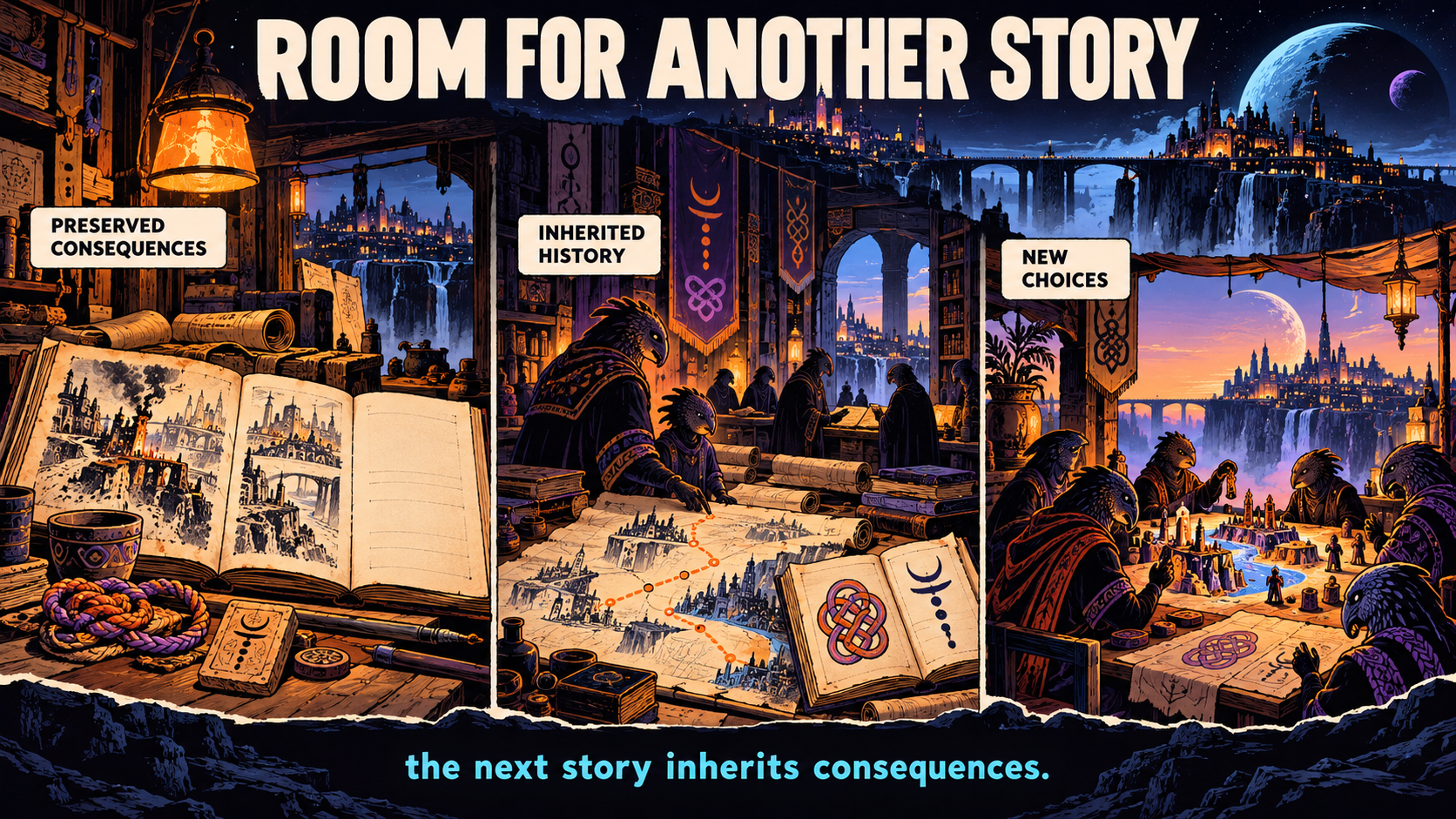
The next complete piece can be small. It might be an image of Earth whose damage is painful to recognize, an animation that makes a human force feel tiny, a story about a family whose survival depends on an agreement, or a game that lets someone build a life inside a strange community. The first attempt should carry a clear intention and arrive as something we can judge.
I want the wider system to make those pieces connect. The army defends a city. The city contains lives. Those lives depend on institutions and economies. The institutions inherit history. The history includes acts whose consequences reach far beyond the people who performed them. Somewhere beyond that, other powers have their own conflicts and their own reasons to notice us.
A person in the city may never know the whole story. A reader can gradually understand more than any one character. I may never know every worthwhile story the universe can hold.
That's the direction: many connected stories, from ordinary lives to armies to the forces manipulating them; genuine horror alongside endurance and growth; and distinct experiences for different audiences within one coherent universe. The engineering earns its place when it helps those stories remain alive, surprising, and consequential.
The setting’s history and rules remain creative decisions
The fractured Earth, subterranean civilization, resource conflict, lunar facility, dimensional breach, galaxy-saving intervention, destroyed universe, and returning survivors are exploratory directions. Their order, timing, mechanisms, factions, and eventual revelations remain creative decisions. The possible scenarios in this article don't establish canon.
The port settlements, polity policies, two-tick quantities, lineage energy units, supplier-capacity case, and proposed architectures are illustrative models. They demonstrate ways to reason about consequences, not implemented products or scientific validation. The first release, specific brand motifs, and reach of player effects remain open.
“Simulation engineering ecosystem” remains the present working description of the Looikos direction; “simulation compiler” describes an intended capability to earn. The breadth of the creative ambition is distinct from the current production state.
The sources distinguish author intent from technical evidence
Author intent includes the owner’s detailed October 14, 2026 feedback on economics and culture, scale, species, horror, endurance, audiences, and connected brand motifs, alongside the three supplied briefs and the complete nine-turn worldbuilding conversation. Its assistant answers were treated as research leads, with important technical claims checked separately. The external links in the article support the particular claims beside them; design consequences remain explicitly reasoned proposals.
Dated owner sources used for context include:
- The Looikos Ecosystem
- Depths of the Void
- ECS Data Architecture
- Wardley Swarm Rebalance Directive
- The Metagraph of Looikos
- The World Model: The Toolbox in Our Work Truck
- The Andy Data Guy Voice
The earlier draft was developed from the owner’s writing packet, including Headline Mastery, skeleton-of-thought, and the Casagrande line-edit kit. This version re-centers the article on the creative universe while retaining its detailed architectural examples. Scientific baseline, speculative extrapolation, and invented setting rules are distinguished in the text.